




Abstract
Objective
The use of virtual reality and augmented reality to improve older adults’ quality of life has rapidly increased in recent years. This systematic mapping review aimed to provide a comprehensive overview of existing research that identifies and classifies current virtual reality and augmented reality applications that enhance the quality of life of older adults to increase the understanding of the impact of these technologies.
Methods
To reach this objective, a systematic mapping review was conducted of the studies published between 2009 and 2020 in major scientific databases, such as IEEE Xplore, Web of Science, Scopus, and PubMed. A total of 57 studies were analyzed and classified into four main quality of life domains: physical, cognitive, psychological, and social well-being.
Results
The findings showed that virtual reality and augmented reality have found their places in many quality of life studies of older adults. Although virtual reality and augmented reality applications are notably growing in the physical and cognitive well-being domains in training and rehabilitation settings, they are still in the early stages of development in psychological and social well-being research as well as healthcare settings. Our findings also revealed that virtual reality games, particularly motion-based exergames, and 3D augmented reality systems are the most common virtual reality and augmented reality types among the reviewed studies. Moreover, balance and attention were the most prevalent physical and cognitive functions when using motion-based and immersive virtual reality exergames and augmented reality systems and games, respectively, while confidence and interaction were the most dominant psychological and social functions.
Conclusion
This mapping review provides a comprehensive overview of potential areas for further research in this field, thereby assisting researchers, technologists, and health practitioners in expanding this field of research.
Introduction
The enhancement of older adults’ quality of life (QoL) has attracted the interest of numerous researchers.1–5 According to the literature, many older adults are dissatisfied with their lives because of the decline in their cognitive, physical, psychological, and social abilities.6,7 Thus, they experience social isolation, loneliness, a loss of self-esteem, and difficulty performing daily life activities, all of which have a negative impact on their QoL. 8 These impairments can be mitigated by leveraging technologies to enhance QoL for older adults by improving or delaying the decline of their physical, cognitive, psychological, and social functions during their daily activities.4,9–12 Numerous technological devices and applications with significant potential are available to assist older adults by improving their QoL and fostering independence.4,13 For example, smartphone applications that provide health information and functions to improve the elderly health, 14 the real-time locating system that can monitor and track their movements, 15 and smart homes. 16 In addition, emerging technologies, such as virtual and augmented reality, as well as the continued advancements in artificial intelligence, sensing systems, and robotics, will continue to develop and gain widespread adoption.17,18
Technologies such as virtual reality (VR) and augmented reality (AR) have the potential to assist older adults in overcoming their challenges and limitations by allowing them to monitor and maintain their health and, ultimately, improve their QoL.12,19,20 Although VR and AR both develop interface systems for displaying digital information, they are essentially distinct technologies that need different computer systems to interact with them.21,22 The participant is immersed in a digital environment when using VR, which is a real-time dynamic environment that stimulates and enriches the senses through various sensory channels, such as sight, hearing, and touch.23,24 There are several ways to access a VR environment, including desktop computer, motion-detection technology such as Kinect, wearable device such as head-mounted display (HMD), or projection-based VR described as cave automatic virtual environment (CAVE). The level of immersion provided by a VR delivered via HMD and CAVE is significantly higher than that provided by a VR delivered via desktop computer.25,26
In comparison, AR blends the real environment with virtual components in real time. It strives to integrate virtual information with the physical environment to improve perception and interaction with the real world. 27 The use of handheld devices such as mobile or AR glasses allows the user to see both the surrounding physical environment and the digital artifacts. AR technology has the potential to benefit older adults by improving their daily activities, such as shopping online, accessing health information, and communicating with their families. 28
Recent research of VR and AR applications for older adults has increased significantly, with positive results across multiple QoL domains.29–33 These technologies can effectively benefit and assist older adults in improving their QoL domains of daily living.34,35 Many studies of older adults have addressed the potential of VR and AR applications to improve the physical and cognitive activities of older adults, enhance their social support, engage them in activities, motivate them in training programs, and generally improve their overall QoL.36–40
The increasingly widespread use of VR and AR technologies to improve the QoL of older adults and the availability of new emerging trends of these applications to researchers and practitioners have created new possibilities for these applications. Thus, it is necessary to classify and clarify the different types of these technologies along with how they relate to different domains among older adults. This systematic mapping review aims to provide a wide overview of the research area by classifying VR and AR applications according to the QoL domains of older adults. It seeks to differentiate between the wide applications of VR and AR for older adults and classify their use in various contexts to provide practitioners with accurate information prior to incorporating these technologies into daily practices.
Literature review
The concept of QoL encompasses multiple domains of well-being, including physical, cognitive, social, psychological, and sensory.3,41 VR and AR create the opportunity to deliver interventions that improve the physical, cognitive, psychological, and social domains of older adults. Existing research has revealed many advantages of VR and AR applications for the multiple domains of older adults. For example, Lee et al., 19 in their critical review, developed an evaluation framework by using contextual analysis and factor extraction to observe how older adults use VR and AR and how these could affect their lives. The authors stated that most studies examined the physical and social well-being of the elderly and concluded a lack of evidence regarding the appropriate technology that could improve their social well-being. Similarly, Silva, Mol 31 conducted a systematic review of the literature on the potential applications of VR and AR for older adults and focused on the most often utilized devices. According to their findings, the primary applications of VR and AR include healthcare, rehabilitation, fall prevention, physical activities, cognitive training, entertainment, and virtual travel. Although several previous systematic reviews have been conducted in this field, these reviews focused on a particular type of technology, such as VR,32,42,43 designed digital games, 29 exergames,12,37,44,45 and video games. 46 Other systematic reviews concentrated on a single domain of QoL in a particular intended purpose setting, such as social effects, 45 physical rehabilitation, 42 physical training,29,44,46 physical function of frail disabled adults, 12 or physical rehabilitation for elderly with stroke. 32 Appendix A summarizes the systematic reviews of VR and AR applications for older adults. Forsman, Nordmyr 47 revealed that it is critical to strike a balance between physical, cognitive, psychological, and social well-being to optimize aging QoL. Most of the previous reviews did not provide an extensive and comprehensive overview of the application of VR and AR in improving the multiple QoL domains of older adults in different intended purpose settings. Owing to the importance of this subject and the lack of investigations in this regard, it is necessary to guide researchers, developers, and practitioners to develop this emerging research area. Thus, there is a lack of research evidence to recognize the current uses and types of VR and AR applications that enhance the different QoL domains of older adults.
VR and AR
Current technological advancements in VR and AR, combined with a significant decrease in the cost of devices and the widespread availability of high-speed internet connections, have increased the use of these systems. VR and AR as multidisciplinary tools provide a secure environment for older adults to practice without exposing them to potentially dangerous situations in the physical world. AR offers them new ways to interact with their physical surroundings, while VR allows them to immerse themselves in virtual worlds. Thus, they can experience different situations and places that they would otherwise be unable to experience due to their impairments. VR comprises a set of computer hardware, from single desktop displays to high-fidelity motion-sensing input devices and wearable technologies. Numerous technological devices and systems with various features are included under the umbrella term “VR,” which can be broken down into two categories according to the level of the participant's immersion: (a) immersive VR, where users are fully integrated into the virtual environment with multiple sensory canals through HMD and VR caves, and (b) semi-immersive or non-immersive VR, where a computer screen displays the environment without isolating the user physically from the real world, such as on videogame consoles. 48 AR can also be created by utilizing and connecting various innovative technologies, such as specific-purpose glasses or any device with a screen and a camera, like a tablet or smartphone. 49 These devices enable users to interact with the AR in real time, thereby enhancing their experience.
Game-based and non-game-based VR applications have gained popularity in numerous studies of older adults. These applications have the potential to provide interactive experiences within a virtual or augmented environment, in which it is possible to manipulate the content, duration, intensity, and feedback to create an adequate exercise prescription. 50 Game-based VR applications for older adults, also commonly known as VR exergames (a combination of physical activity and video games), have been utilized as assistance training in order to enhance participants’ levels of enjoyment. 51 In general, non-game-based VR applications use VR features (e.g., immersion and real-time interaction) to bring real-world training conditions into the VR context (i.e., experience constraints with walking in daily life and stepping over virtual objects).51,52 They can also be combined with treadmills, wearable sensors, and/or motion detection sensors to provide the user with greater feedback. 52 The popularity of AR games has increased, and games that incorporate AR may provide older adults with enjoyable leisure experiences.53,54 When used in a non-game-like context, AR still provides a certain fascination and helps keep participants engaged while using applications that allow 3D viewing with the use of a camera.55,56
Both VR and AR applications sense user inputs and provide haptic, aural, and visual feedback to blend the interactive virtual with the actual environment.57,58 VR applications may consist of a headset with stereo display displays, handheld controllers, motion tracking, haptic feedback, and a processing unit such as a personal computer. While AR devices can range from highly specialized to more general purpose, the most common AR example is the smartphone, which features AR-generating hardware such a camera, speakers, a screen display, a touchscreen, and a haptic motor.
VR and AR and the QoL of older adults
VR and AR applications are increasingly employed to improve and maintain the ability of older adults to perform various tasks in different contexts for training, rehabilitation, and healthcare,19,43,46 such as taking medications, preparing meals, recalling tasks to be completed, and using navigational skills while walking or driving. In addition, the relationship between VR and AR as well as different QoL domains and factors among older adults has been studied through various empirical studies.12,36,59–61 However, a comprehensive guideline for the use of these technologies to improve the QoL of older adults is still lacking, which requires further consideration.
Given that the decline of their cognitive, physical, psychological, and social abilities significantly affects the QoL of older adults, it is necessary to investigate the impact of various technology interventions, such as VR and AR, to facilitate healthy aging and reduce these declines. Despite a growing body of research indicating that VR and AR have the potential to improve and maintain the QoL of older adults, in the literature the terms VR and AR are still frequently used interchangeably to refer to vastly different technologies applied 3D virtual environments, and there is no clear distinction between their different types. 24 Thus, the results are frequently used to describe these technologies without distinguishing between types or are typically focused on general classification with contradictory definitions.
It is therefore necessary to shed light on the potential of various subcategories of VR and AR, and more specifically, on their potential effects on the QoL of elderly adults. This need draws the researcher's attention to other types of these technologies that may be a better alternative for improving QoL domains.
Accordingly, the main aim of this mapping review is to screen the current literature and provide a high-level overview of the current state of research on VR and AR that enhances the QoL of older adults to increase the understanding of the impact of these technologies. While prior systematic reviews focused on a specific domain or context spatially, our review is tightly focused on the relevance of AR and VR and their direct application on the QoL of older adults. It likewise examines research conducted in the areas of rehabilitation, training, and healthcare. The findings may help the researcher by providing necessary information to field researchers conducting primary or secondary field research to improve the QoL of older adults. Furthermore, it may help technology developers and health practitioners decide which type is the most appropriate for more valuable experiences for older adults.
Methodology
A systematic mapping review allows us to obtain a comprehensive insight, classification, and a detailed analysis of topics in a specific domain. 62 Thus, a mapping review was applied in this study to provide a structured understanding of the literature and identify the neglected research fields. The review process was performed based on the four phases suggested by Petersen et al., 63 as illustrated in Figure 1. The first phase established the research questions. The second phase, which includes the identification process, defined the search strategy for articles and the selection process for screening and selecting the most pertinent articles based on the inclusion and exclusion criteria. The collected data were then independently examined using a concept matrix based on the title and abstract. If the title and abstract of a publication could not be classified, then the full text was scanned. The concluding final phase classified and analyzed the findings of the collected articles. The selection process was also conducted according to the Preferred Reporting Items for Systematic Reviews and Meta-Analyses (PRISMA) guidelines, 64 as shown in Figure 2.

The phases of systemic mapping review.

PRISMA flow chart of the study selection process.
Definition of research questions
This systematic mapping study aims to obtain a wide overview of studies on VR and AR applications for the QoL of older adults by systematizing and structuring the literature in the field. Thus, this study seeks to address the research questions outlined in Table 1. Our aim is to contribute to the extant body of knowledge on the applications of VR and AR for the QoL of older adults.
Research questions.
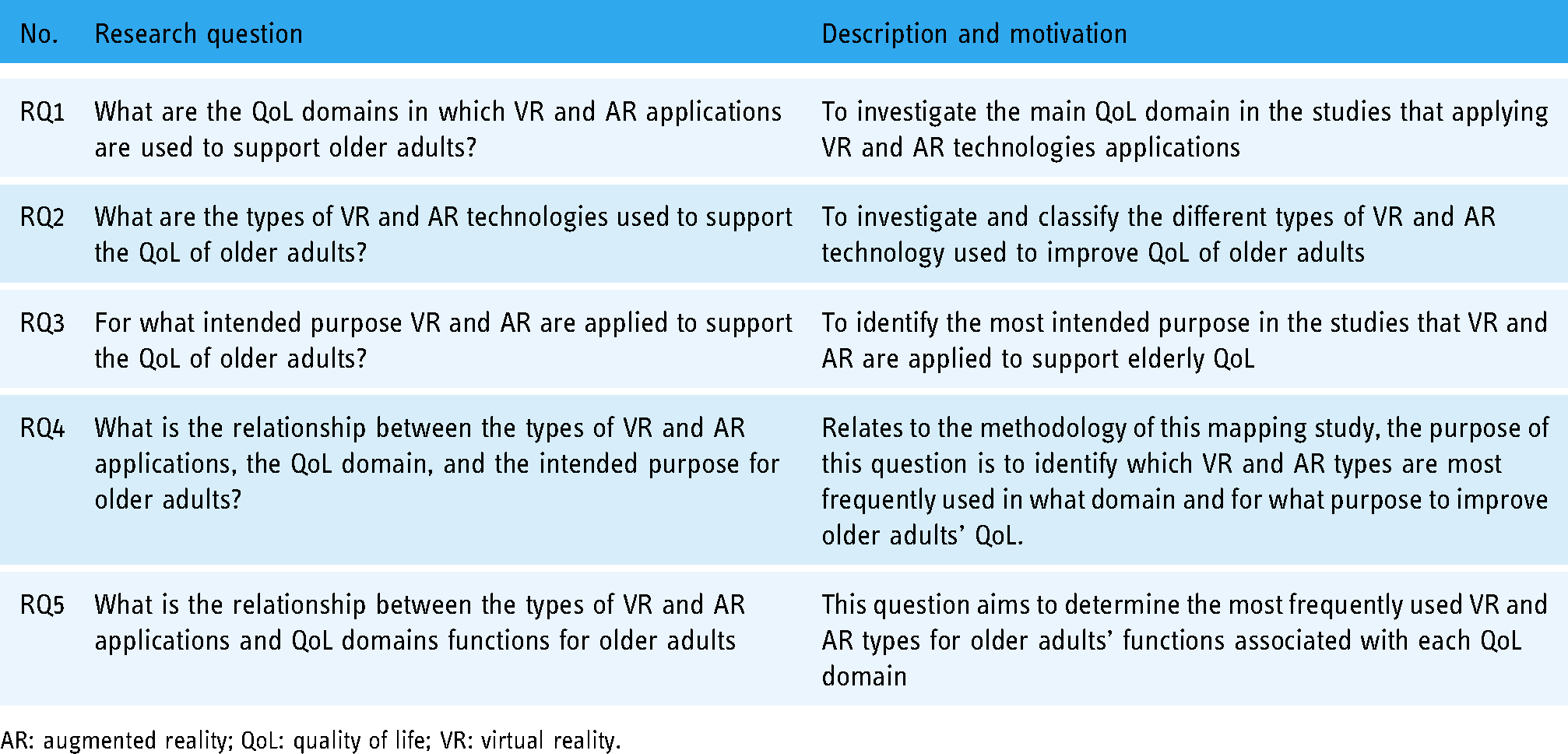
AR: augmented reality; QoL: quality of life; VR: virtual reality.
To answer these questions, Kitchenham et al.’s 65 mapping study and Webster and Watson’s 66 structure approach were followed as appropriate approaches for comprehensive insights.
Search strategy
A systematic search was undertaken across the most relevant databases, including Scopus, IEEE Xplore, Web of Science, EBSCOhost, and PubMed between 2009 and September 20, 2020. This time frame was chosen following the study scope to capture the most recent advances of AR and VR technologies for older adults QoL. The purpose of the current study was to create a classification for the last decade of studies; thus, beginning the search in 2009 increased the likelihood of obtaining AR and VR for older adults QoL articles, and we ceased identifying potential articles in 2020 to initiate the review procedures.
The conference papers were included because most innovative and development research in VR and AR is conducted through conference papers rather than journal articles. The keywords were identified based on the main research questions and grouped in four sets. Their combinations were used to identify relevant articles. The search strategy was formulated as [(Set1) AND (Set2) AND (Set3) NOT (Set4)], as shown in Appendix B. Different search strategies were developed because of the different indexing terms and functions of each database. Appendix C summarizes the search strategies and filters for each database.
Eligibility criteria
The inclusion and exclusion criteria were used to eliminate studies that did not address the research questions. The following articles were included: (a) the intervention used VR or AR technologies; (b) physical, cognitive, psychological, and social well-being were investigated; (c) published between 2009 and September 20, 2020; (d) the participants have a mean age greater than 60 years, were healthy, or the population consisted of mixed patients; (e) article was written in the English language.
The studies were excluded if they (a) were not original research (e.g., books, theoretical papers, or presentations); (b) were reviews, usability, or oriented design studies without evaluation; (c) examined populations that were not clearly identified as older adults; and (d) did not assess any QoL-related domains.
Classification categories for analysis (coding)
The classification and coding process allowed us to collect relevant data for analysis within the research scope. According to the guidelines suggested by Webster and Watson, 66 all relevant articles were categorized by the researchers in a concept matrix, as shown in Appendix D. The first step was to read and classify the abstracts, methods, and results of the relevant articles. The next step was to create a classification system. Figure 3 illustrates the classification results that served as the basis for this systematic review. The results were categorized primarily into three divisions: QoL domains, intended purpose, and VR and AR types.

Virtual reality (VR) and augmented reality (AR) applications framework for older adults’ quality of life (QoL).
Classification of studies
QoL domains
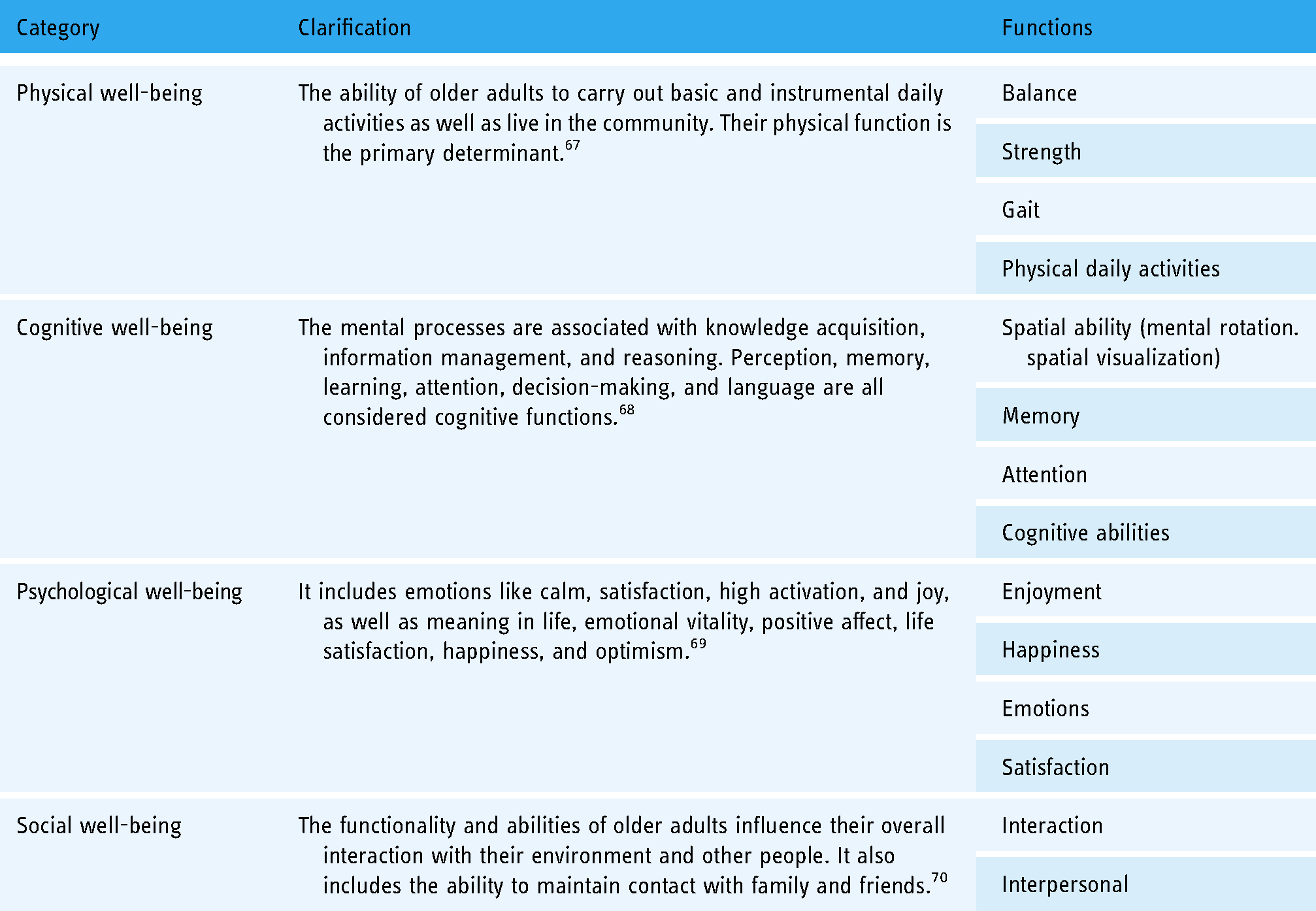
The classification stage of the 57 articles revealed that VR and AR for older adults can be divided into four categories of QoL domains. The categories are summarized in Table 2.
QoL domains and functions.
Intended purpose
These technologies assist older adults in their daily lives for three primary intended purpose categories. The categories are summarized in Table 3.
Intended purpose categories.

AR: augmented reality; VR: virtual reality.
Type of VR and AR technologies
The main goal of this comprehensive classification is to provide an overview of the various types of VR and AR applications that can improve the QoL for older adults.
To provide a wide-ranging classification, it is necessary to divide the selected articles into two main categories: game-based and nongame-based (system). This categorization has been discussed in some of the previous literature, which describes these two types 52 by comparing them74,75 or focuses on one type to determine its effectiveness. 76 Then, the subcategories are identified based on device type and VR immersion level to provide a complete picture of the applications of these technologies for the QoL of older adults.
The four major categories of VR and AR types that emerged from the 57 articles are VR system, VR game, AR system, and AR game. Each category is classified into subtypes as listed in Table 4.
AR and VR types.

AR: augmented reality; CAVE: cave automatic virtual environment; HMD: head-mounted display; QoL: quality of life; VR: virtual reality.
Results
Study selection
The initial search resulted in the identification of 8064 publications and 22 additional studies after backward and forward snowballing techniques were applied to the citations. After duplicate articles were removed using title-based sorting in an Excel spreadsheet, 3643 articles were eligible for screening. In the screening phase, the researchers checked titles and abstracts of articles based on the inclusion and exclusion criteria and excluded irrelevant articles. In this step, all the researchers agreed to exclude 1784 studies. In the full-text reading of the remaining 1859 studies, two stages were implemented. In the first stage, scan the whole content by applying filters for the exclusion criteria using web-based tool ResearchRabbit Beta3 (www.researchrabbit.ai), which excluded 1440 irrelevant papers. This filtering stage left 419 studies for further selection. In the second stage, the three researchers independently selected studies based on their complete paper reading to identify the remaining potential papers. A total of 179 studies were also excluded by the researchers, which resulted in 240 studies.
The additional irrelevant articles were excluded during the coding process by classifying them based on the concept matrix. This step allowed the irrelevant article to be excluded during the coding process by classifying based on a matrix concept and continuous reading of all papers. Following a discussion of the coding system and an agreement on initial discrepancies, re-coding was performed and more papers were excluded. At the end of this stage, 57 relevant articles were included in our systematic mapping study, as shown in Appendix E.
Description of the studies
As illustrated in Figure 4, most of the articles included in this review were papers published in journals (n = 47) and conference proceedings (n = 10). Figure 4 shows a gradual increase in the number of studies retrieved from 2015 to 2020. Furthermore, between 2015 and 2020, the vast majority of published studies were journal articles (66%). This increase can be attributed primarily to the significant growth of using VR and AR applications among older adults. Although there was a significant increase between 2012 and 2014, it occurred mainly in 2013 and was followed by a decrease in 2014.
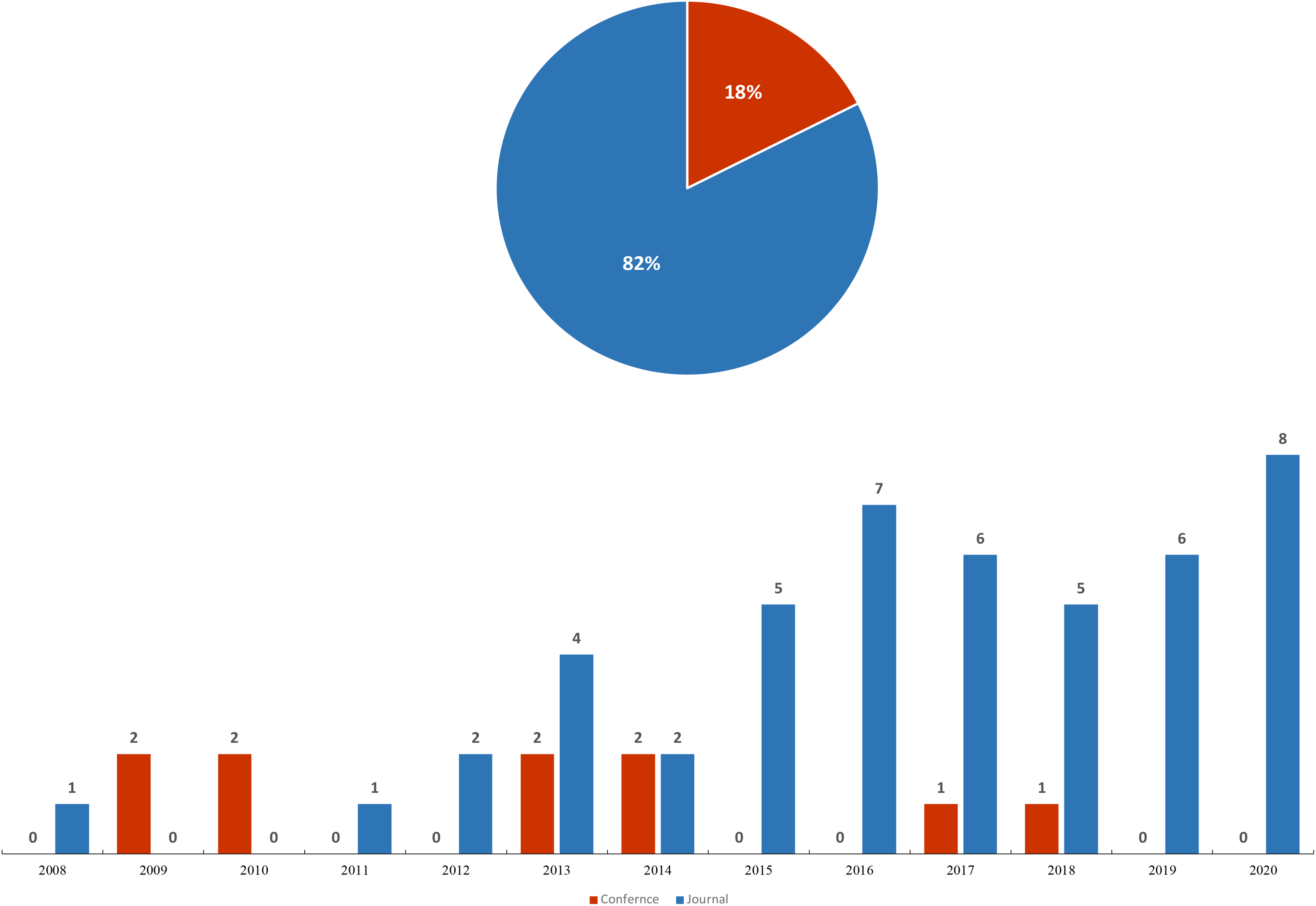
Publication outlets and publication years of the selected articles.
To better understand the direction of studies in VR and AR applications that improve the QoL of older adults, the results were categorized according to each research question and various types of plots and tables were used to map the findings. Thus, this systematic mapping study results are presented following the same order outlined in the research questions.
QoL domains
RQ1: What are the QoL domains in which VR and AR applications are used to support older adults?
The classification of the articles according to the QoL of older adults is illustrated in Figure 5. It showed that the most frequent QoL domains were physical well-being (n = 32) and cognitive well-being (n = 26). The findings also showed that authors in this field were less interested in psychological well-being (n = 12) and social well-being (n = 5). The total adds up to more than 57 studies because some of the studies fell into more than one domain.

The quality of life (QoL) domains.
Types of VR and AR applications
RQ2: What are the types of VR and AR technologies used to support the QoL of older adults?
According to Figure 6, the findings indicated that the most common VR type was VR games (49%). This main type includes three major subtypes, namely, motion-based exergame (35%, n = 20), immersive VR exergames (7%, n = 4), and desktop VR-based games (7%, n = 4). Most these subcategories are based on motion-detection technologies using different types of motion sensors to facilitate the interaction of older adults with the games. The immersive VR was accessed via HMD when playing the exergames, while the desktop games were accessed via notebook computers and mouse for interaction. Only two studies used AR games in a handheld device (mobile) and tabletop; both utilized an interaction technique based on the manipulation of tangible physical objects. However, 28% of the studies used AR systems, such as 3D AR systems (9%), in-car simulator systems (7%), and AR-based physical exercise systems (5%). In terms of VR systems, 7% of the studies used immersive systems, while 5% used non-immersive VR training systems.

Types and subtypes of virtual reality (VR) and augmented reality (AR) applications.
Intended purpose
RQ3: For what intended purpose are VR and AR applied to support the QoL of older adults?
As shown in Figure 7, the 57 studies were mainly classified into three intended purpose settings: 49% applied VR and AR for training purposes, 46% for rehabilitation purposes, and only 5% for healthcare. For training purposes, the studies applied VR and AR to train and maintain different QoL domains, such as cognitive and physical functions in older adults81–100 or psychological and social functions.59,101,102

Virtual reality (VR) and augmented reality (AR) applications intended purpose settings.
For occupational therapy and rehabilitation purpose, VR and AR were used in clinical settings or as a rehabilitation tool.33,103–107 In addition, in some studies, VR and AR were used for patients with varied physical and cognitive declines, 108 diagnosed with diseases such as stroke, 109 Parkinson's, 110 Alzheimer's,111–113 multiple declines and diseases,114,115 or other issues such as fear of falling. 116 For healthcare purposes, the use of AR was for health promotion to meet health goals, such as medication management and health screening.117,118
Mapping VR and AR application types, QoL domains, and intended purposes
RQ4: What is the relationship between the types of VR and AR applications, the QoL domain, and the intended purpose for older adults?
The bubble chart shows the combination of VR and AR types, the QoL domains, and the intended purposes (Figure 8). It shows that VR was the most widely employed in the physical well-being studies, including VR game (n = 17), VR system (n = 11), and AR system (n = 7). For cognitive well-being, VR game (n = 9) was the most applied, followed by VR system (n = 8) and AR system (n = 7). VR game (n = 2) and AR system (n = 2) were the most two types most used for social well-being, while VR game was the type most used for psychological well-being (n = 5).

Virtual reality (VR) and augmented reality (AR) types, older adults quality of life (QoL) domains, and intended purposes.
Most of the studies used VR and AR as training and rehabilitation interventions. For training, the most types applied were VR games (n = 13) and AR system (n = 9). Furthermore, VR system (n = 10) and VR game (n = 10) were widely applied for rehabilitation, and none of the studies used AR games for this purpose. These findings also revealed that few studies applied AR (n = 3) for healthcare, and no studies used VR for this purpose.
Mapping VR and AR types and QoL domain functions
RQ5: What is the relationship between the type of VR and AR applications and QoL domain functions for older adults?
Note that the total number of articles in the bubble charts is greater than that of the bar charts because a single article may contain multiple functions. As depicted in the bubble chart in Figure 9, balance (n = 24) was the common physical function among the reviewed studies, using motion-based exergame (n = 15)33,84,85,87–89,92,93,96,97,104,109,110,119,120 and immersive VR exergame (n = 3).100,108,121 For studies on gait (n = 14)88,89,92,93,96,97,100,104,109,114,115,119–121 and muscular strength (n = 10), most of them utilized VR based game.87,89,93,99,100,103,104,121–123

The combination of virtual reality (VR) and augmented reality (AR) applications type and quality of life (QoL) domain functions for older adults.
Attention was the most frequent function of cognitive well-being among the studies, applied in in-car AR system simulators (n = 4),82,83,124 AR games (n = 2),117,125 desktop VR-based games (n = 2),106,126 and motion-based exergames (n = 2).98,104 Spatial ability (n = 7) studies applied AR and VR types, including handheld AR system (n = 2),94,95 developed AR-based 3D system (n = 2),90,105 immersive and non-immersive system (n = 1), desktop VR-based game (n = 1), and motion-based exergame (n = 1).91,106,126
For everyday activities, VR studies (n = 3) applied different virtual environments to simulate daily life activities, including desktop VR-based game, immersive VR system and non-immersive VR-based system.106,112,127
Furthermore, few studies employed VR and AR for the psychological and social well-being of older adults. Psychological confidence was the most frequent function among the studies (n = 5), applied in desktop VR-based game, 108 immersive VR exergame (Balance Rehabilitation Unit [BRU]), 107 motion-based exergame, 116 and AR-based Otago exercise.81,103 For social well-being, interaction was the most frequent function (n = 4) in studies that applied AR assistive technology,118,128 VR immersive system, 101 and VR exergame 59 with multi-player or users.
Supplementary Appendix F shows that all QoL domains covered in reviewed studies have their functions linked to the VR and AR subtypes and the related intended purpose settings on which VR and AR were applied. Owing to the various types of overlaps, VR and AR application subtypes were demonstrated to be relevant to various functions. As a result, certain articles were classified in more than one category. For example, Ordnung et al. 93 classified under two cognitive and physical domains and various cognitive and physical functions, such as processing speed, executive functions, balance, flexibility, and muscular strength.
Discussion
This review was undertaken to identify a broad range of AR and VR application and assess the various types of these technologies with older adults in relation to QoL. The review findings revealed a positive trend of publications by year, indicating that VR and AR applications are becoming increasingly prominent as a research topic to improve the QoL of older adults. According to the mapping, there is a wide variety of VR and AR applications in the reviewed studies combined with the four main QoL domains and their effectiveness with older adults, indicating an interest in the use of VR and AR in many different contexts, especially in rehabilitation and training for older adults.
The 57 reviewed articles were mainly classified under four main domains in connection to AR and VR technology usage. We included the four main VR and AR types categorized under either non-gaming system application to cover the wide range of these applications and classified them in subcategories to identify the main orientation of these technologies to support older adults and give a clear picture about VR and AR usage.
On a holistic level, the analysis of QoL domains showed a variety of positive effects of AR and VR on physical well-being and cognitive well-being. The findings showed that VR and AR applications can assist older adults with gait training by providing a challenging and motivating environment for practicing balance, thereby reducing the risk of injury from falls. This outcome is consistent with the findings of previous systematic reviews that showed the promising potential of VR and AR in maintaining and enhancing the physical performance of older adults.35,76,129,130 On the cognitive level, the studies that were analyzed for this review have shown that VR can be useful when evaluating and investigating cognitive training and rehabilitation. The review results likewise indicated that combination of physical and cognitive domains is gaining broad adoption field for the application of VR and AR in some studies.24,131 Although the results revealed that the level of satisfaction, enjoyment, and interaction that occurred during VR and AR training was positively evaluated by the older adults, the social and psychological domains have received less attention among the studies than other QoL domains.24,46,129,132 However, they have received more attention in recent research, for example, Appel et al. 133 applied an immersive VR non-game system for older adults with varying levels of cognitive and physical impairments using settings that could be tolerated, and their results showed a positive feedback, with participants feeling more relaxed and adventurous. Furthermore, Cheng et al. 102 and Zheng et al. 59 revealed promising positive effects of the VR system and game on the psychological health of older adults.
For the technology types, in most studies, exergames significantly improved various cognitive functions, as well as the QoL among elderly with a risk of falling. VR games were used in nearly half of the articles, and motion-based or immersive exergames were most commonly implemented to improve physical well-being, such as in studies by Hsieh et al., 85 Sato et al., 87 Katajapuu et al., 33 Duque et al., 108 and Adcock et al. 100 Moreover, for psychological well-being, such as study by Zheng et al., 59 or physical–cognitive well-being, such as studies by Ordnung et al. 93 and Carrasco et al. 98 As many commercial exergames already included components such as full-body motion and gesture-based interactions, VR games were widely used in QoL studies of older adults, which aided older adults in simplifying certain actions, encouraging physical activity, and making repetitive actions easier.35,129
AR has also the potential to enhance older adults QoL domains. The results indicated that the use of this technology may enable them to become more independent and less reliant on their caregivers. For example, AR game was the application used the least when compared to the AR system (28%), which used 3D for either physical well-being134,135 or cognitive well-being.90,105,113 The in-car AR system simulator also appeared to be a promising solution for assisting and maintaining the well-being of older drivers.82,83,86,124 The remaining studies applied AR-based physical exercise using AR-based Otago, an exercise program for physical activities that suggests a specific training method utilizing AR81,103 or other physical exercises performed by a therapist. 122
For the intended purpose, the majority of studies found that VR and AR improved the QoL of older adults by providing them with effective training and rehabilitation mechanisms for physical and cognitive well-being. Age-related deterioration of motor and cognitive functions results in a disproportionate number of older adults who need training and rehabilitation. 136 Thus, these tools were widely adopted to help older adults train, maintain, and improve their physical and cognitive functioning, such as balance, gait, muscular strength, attention and memory. This may also be because it permits the incorporation of motivating and enjoyable activities into the rehabilitation and training process.
On the basis of the mapping, relationships between VR and AR types, functions, and intended use were addressed in terms of the QoL domains.
Physical well-being domain
In the literature, the high level of physical activity has been linked to improved balance, muscle strength, and QoL in older adults. 46 Thus, it is not surprising that most of the studies focused on the physical well-being domain, particularly balance and fall prevention. VR games played a vital role in most studies in this review, such as VR-based exergame. For example, using motion-based exergame consoles such as Nintendo Wii for balance 97 and muscular strength 99 and Microsoft Kinect Xbox for various physical functions.93,96,104,119 These consoles provide a full-body interaction with computer games using motion detection sensors with feedback that engage older adults while performing physical training and rehabilitation contexts.59,100,121 On the other hand, the one-on-one nature of the immersive VR exergame allows for personalized balance training, thus improving the performance and commitment of older adults during treatment. For example, the studies applied the BRU, a customized postural rehabilitation program based on games tailored to the needs and abilities of older participants using HMD with visual feedback, which helps make them active and enthusiastic.108,121 The findings of the present study revealed that VR-based training enhances the physical well-being functions of older adults, such as balance and gait, and has advantages over traditional exercise programs. The use of VR might also help rehabilitation clinicians conduct telerehabilitation on a remote basis so that exercises are carried out at home in a virtual environment and data are then transmitted to the clinician.
Unlike VR, which creates fully virtual environments, AR augments the real environment by providing virtual elements in the physical environment. Among the reviewed studies, several AR systems were applied, such as AR-based physical exercise program using AR-based Otago81,103 or AR-based exercise system 122 to improve balance, muscular strength, gait, and mobility. The AR-based 3D system is also applied to enhance balance and mobility.134,135 These AR systems promote physical activity by using real-time motion recognition with a motion analysis sensor, such as Kinect, to track the whole-body motion and interaction of participants with virtual objects in a 3D environment displayed on a large screen. The interactive experience in these technologies facilitates active engagement and physical training by linking motion-sensing with visual and audio feedback. Thus, devices such as the Nintendo Wii Remote and Microsoft Xbox Kinect sensor are widely used in VR games, VR systems, or AR systems for application in physical training.
The majority of the studies applied VR for physical rehabilitation using either commercially available devices for VR games or developed VR systems. Repeated and systematic trainings are common rehabilitation procedures, and VR applications provide repetitive exercises and gradually increase the task's difficulty while reducing the amount of guidance provided by a clinical therapist Thus, VR applications for physical rehabilitation have a significant potential to improve balance for older adults with various impairments. They enable older adults to improve their independence while practicing repetitive physical functions tailored to their needs and level of ability in a safe and enjoyable environment. Although VR has gained widespread acceptance as a therapeutic tool for older adults in recent years, 25 AR has also shown promise in providing an interactive experience that allows knowledge to be gained in the therapeutic setting. For example, for AR systems based on Kinect sensors,134,135 these systems promote and induce rehabilitation in real-world exercise settings by providing interactive experiences linked to physical reality, thus facilitating knowledge acquisition in daily activities.
Cognitive well-being
VR-based games have been found to be an effective intervention tool to improve several cognitive functions of older adults. Among the reviewed studies, most cognitive training studies used desktop games. For example, applied desktop VR-based games can improve attention, memory, and spatial abilities, while VR console games can improve executive functioning. This effect might be due to the interactivity of VR-based games’ environments, which create playful and motivating experiences during cognitive training. Thus, older adults are kept engaged and challenged throughout the training duration. Moreover, for everyday activities, several VR studies applied different virtual environments to simulate daily life activities. In these studies, the VR simulation may provide a more effective training due to its similarity to actual daily activities that may help transfer the learned skills to everyday life.
For example, the applications applied desktop VR-based game, immersive VR system, and non-immersive VR system were based on a VR stimulation designed to train cognitive functions, such as attention tasks (cooking or making a coffee), working memory tasks (shopping), and executive functions (arranging tasks).
On the other hand, the interfaces of AR systems can directly provide real-time 3D visual support for surrounding information and promote spatial visualization. Thus, most of the studies applied AR to improve this function, such as AR-based 3D systems that present a full 3D hologram, used cubes as markers, or developed handheld AR to train spatial ability, specifically mental rotation. The in-car AR system likewise showed promise for improving the attention of older adults and helping them improve safety and avoid collisions. For example, there are AR systems that provide a full-car driving simulator with high-quality visual and audio systems. These simulator systems allow older drivers to increase their responses by AR cues without affecting other tasks, thus reducing their cognitive load. 83 Although the projection-based VR system is not widely used for cognitive training due to its high cost, it also showed promise for enhancing the sense of presence feature, which is needed to improve spatial ability.
The findings of this review also revealed that the use of VR and AR in rehabilitation settings for cognitive well-being is a rapidly growing field. Multiple studies have demonstrated that VR has a larger potential to improve cognitive functioning for older adults with multiple cognitive impairments. For instance, the applied VR system can be used for mild cognitive impairment and Alzheimer's disease to support the elderly during a daily living activity and improve their cognitive abilities in rehabilitation settings.
Although AR application is not required to wear any equipment and can reduce elderly cognitive load during rehabilitation, only a few studies have applied AR in rehabilitation settings. An AR-based 3D system can be developed to improve mental rotation ability and assist older adults in performing daily living activities. Although AR is a promising application for the healthcare of older adults, only one study developed handheld AR minigames for cognitive-health screening. These AR minigames aim to screen and monitor the cognitive abilities of older adults by providing an informal measurement of their cognitive performance through the game scores.
Furthermore, several of the reviewed studies tended to combine one or more domains to maximize the benefits of the training, such as physical–cognitive training to improve either only physical well-being or both physical and cognitive well-being. In this multimodal approach, VR (specially using VR exergaming) offers an opportunity to combine physical activities and cognitive exercises to promote physical learning through problem-solving, thus enhancing cognitive functions. For example, using an immersive VR system increased balance and reduced cognitive load, and a non-immersive VR treadmill training improved gait, mobility, and cognitive functions. This approach is promising, which could be due to two primary reasons. First, most daily activities require both cognitive and physical functions, which may enhance training transfer effects. Second, the central nervous system controls body movements, and this training method targets the interaction between physical and cognitive domains. 100
Psychological well-being
For older adults, psychological well-being encompasses both emotional and subjective well-being. According to the findings, VR and AR applications have shown increasing promise to reduce depression and increase confidence and positive emotions for elderly populations. Although most of the studies mainly applied VR and AR as intervention tools to improve the cognitive and physical well-being of older adults, they most frequently described VR as an engaging and enjoyable tool. 94 The few studies that applied VR for psychological well-being described it as engaging, motivating, calming, and an enjoyable environment, which may reduce feelings of depression and isolation and improve overall QoL, 133 especially during the VR-based exergame that encourages and motivates them by increasing their competitive spirit to score more points.
Social well-being
Social well-being has been recognized as a powerful domain to enhance the QoL of older adults, yet studies applying VR and AR to support their social well-being are lacking. Thus, there is a need to focus on the social well-being of the elderly due to its effects on their physical and cognitive well-being. 2 For example, AR assistive systems could improve the interaction of older adults by acting as personal assistants to help them in their daily life activities. In these systems, AR plays an important role in human–machine interaction because it allows object recognition and interaction in real time by attaching digital information to the real world. On the other hand, in the reviewed studies, human–human social interaction was combined with cognitive, physical, and psychological functions. These studies applied different types of VR, such as VR video game console, immersive VR exergame, and immersive VR system, providing a method for social interaction to enhance social relationships and encourage interactions with caregivers, family, and friends.
Overall, based on our classification, the potential and difficulties of VR and AR applications to maintain and enhance the QoL of older adults could be discussed from two perspectives. First, from the QoL domains perspective, VR applications can be used to train cognitive and physical functions in healthy older adults or those with various impairments. However, older adults with mobility limitations can benefit from these technologies to improve their psychological and social well-being, allowing them to see one another and engage in activities together. Thus, there is a need for exergames with less intense physical exertion and more appealing, understandable components so that the elderly can enjoy playing them. 59 AR, in particular, may help older people navigate locations directly on their handheld devices or while driving by presenting them with information or visual cues that are embedded in the real environment to guide them. Different AR systems, 3D AR, and in-car simulation systems can be applied for cognitive training or AR physical exercise training. The areas of application of 3D images and holograms are diverse and promising, thus can support new forms of social interaction among older adults. In addition, VR and AR can also be applied to other domains, such as the behavioral domain in combination with other domains or separately to offer older adults real time management and make the consequences of their behaviors more tangible to motivate them to change.137,138
From the intended purpose perspective, this review concluded that VR training and rehabilitation appeared to be a promising supplement, if not an alternative, to traditional physiotherapy techniques. However, older adults are often hesitant to adopt training or rehabilitation without assistance, this may be due to their limited familiarity with technological advances. To address this issue, it is necessary to adapt these technologies to the specific requirements of the older adults to maximize their involvement in the training and rehabilitation processes. Using VR game, VR system and AR system are most popular applications in training, therapy and rehabilitation that can help older adults maintain their physical and cognitive abilities. Although few studies have applied AR to healthcare, the results showed great promise in AR, especially in the areas of medication management and health screening adapted to the needs of older adults. 28 This technology enables older adults to take their medications correctly and encourages them to lead more independent lives without the need for assistance from a caregiver by using AR Assistive systems118,128 or AR game for cognitive health screening. 117 More research into how this technology can be used in healthcare could make it much easier for older people to be independent and take part in daily activities.
Limitation
The number of selected studies is determined by the research questions, the amount of time allotted to search, and the inclusion and exclusion criteria. These parameters limit the number of studies that can be chosen, which can be considered limitations of this review study. This systematic mapping review has several limitations. First, this review focused only on English-language articles and this excluded important articles published in other languages. Second, the studies were selected from five primary databases (Scopus, Web of Science, EBSCOhost, PubMed, and IEEE Xplore) and other databases were excluded. Third, only articles published between 2009 and September 20, 2020 were included, and additional articles published after were not included due to the completion of the results and graphical illustrations. Finally, to obtain all available published articles on VR and AR applications for the QoL of older adults, the current review did not perform a quality assessment of the included studies, but quality assessment is optional in systematic mapping studies.62,139
Using a set of inclusion criteria to select relevant studies can be subjective, with the possibility of missing publications. We reduced subjectivity by selecting relevant publications for evaluation on the basis of independent author ratings.
Future directions
The findings of this study indicated that despite the increasing interest in applying VR and AR to improve the QoL of older adults, these tools are still in their infancy and the low maturity of the field must be improved. Nevertheless, the increasing number of studies in the last few years will most likely lead to more research in this field. For future work, the following recommendations are put forward. First, although our finding showed growing evidence that VR and AR physical training can help older adults to improve functions such as balance and mobility and reduce their risk of falling, there is a need to enhance the positive effects observed in studies using VR. Future research is needed to investigate various physical functions in depth during the training and rehabilitation settings. For example, more research is required to fully comprehend and assess the effects of VR gaming and non-gaming systems on physical well-being by considering factors such as the most appropriate intensity, duration, and frequency for older adults. To improve physical functions, it is also critical to carefully select the type of VR and AR application by considering the function characteristics, participant needs, and implementation method. For instance, immersive VR-based and AR-based systems seem promising to improve physical well-being. Thus, more future research is needed to address the effects of these types on different physical functions.
Second, the findings indicated that VR and AR interventions could improve cognitive functions. Thus, future work is needed to address more cognitive functions in training and rehabilitation settings and investigate the effect of a specific type of VR and AR on a single cognitive function, such as attention, memory, and spatial ability, rather than multiple functions at the same time. Furthermore, the findings showed AR as a promising tool for healthcare. Thus, there is a need for further studies on applying AR cognitive healthcare and telemedicine by conducting more studies on cognitive screening and medication management.
Third, the findings also showed that combining the physical and cognitive (the multimodal approach) in VR and AR training and rehabilitation has the potential to enhance physical, cognitive, and emotional functions. Particularly VR applications seem promising in physical–cognitive training. Thus, future research should explore the effectiveness of this method in clinical settings rather than only research settings.
Fourth, from the findings, most studies used a commercial or one setting for all participants, expect for Appel et al., 133 for psychological well-being. Thus, due to the decline of cognitive and physical abilities in older adults and the potential complexity of tasks, future VR and AR studies could provide the elderly with the ability to select the appropriate application for specific training or rehabilitation to maximize the VR and AR benefits of their training.
Fifth, as the motion-based exergame is the widely used for different domains and purposes, using VR and AR in combination with a motion-tracking Kinect sensor eliminates the need to wear an additional device to monitor objects. Thus, it can overcome the huge burden that may occur when using wearable devices for VR in some settings. Understanding the demands and characteristics of older adults is also critical for future work to avoid their negative feelings that may affect the results. Further studies may also need to compare the impact of VR and AR on improving the QoL of older adults.
Sixth, our findings support the need to further investigate VR and AR as applications that can be valuable interventions to promote and maintain psychological and social well-being among older adults. They have the potential to increase the level of positive emotions, entertainment, and interaction among older adults, even in the studies that primarily focused on the physical and cognitive functions of the participants. However, there is a paucity of information regarding the extent to which successfully incorporating these technologies into training and rehabilitation can boost the social and psychological well-being of a person. Therefore, there is a need for additional future research on social and psychological well-being that considers how these applications could be used to reduce the negative emotions of older adults and provide them with means that encourage them to interact to break their isolation. In addition, it is essential to consider the emotions and feelings of older adults during training and rehabilitation as well as customize VR and AR designs and settings to their tolerance and engagement, which may affect their physical and cognitive abilities. Also, since studies examining the application of VR and AR to influencing older adults’ behaviors are still in their infancy, the intriguing possibilities presented by these technologies merit further investigation.
Finally, the elderly population is growing and the advent of the metaverse era highlight the significance of mixed reality research for the elderly. The rise of mixed reality combines the real and virtual worlds to create new interactive visualizations. These visualizations help unleash new potential for seeing and interacting with diverse computing processes, including advanced smart wearable systems with tactile sensing and feedback capabilities. Therefore, future research should include older adults as active participants throughout the design process to better understand and address their requirements, hence enhancing their experience with these applications.
Conclusion
VR and AR applications positively affect physical, cognitive, psychological, and social well-being for healthy and mixed-patient older adults. The previous reviews described VR and AR applications as they are still in their development phase. However, the finding in this review showed that they have been improved and have found their places in many QoL studies of older adults. Owing to the high number of repetitions and variability in a complex and motivating environment that provides dynamic interaction with visual and auditory feedback, most of the reviewed articles emphasized the benefits of VR and AR for physical and cognitive training and rehabilitation. However, few articles highlighted their importance in improving the social and psychological well-being of elderly adults. To avoid any negative effects that may occur using immersive VR devices, researchers and healthcare providers can choose semi-immersive VR or AR devices, particularly AR, for healthcare to access their medical information, medicine time-reminder, and health screening, thus making these processes more enjoyable and motivating for older adults.
The findings of this review have practical implications for researchers, technology developers, and health practitioners. Integrating these technologies carefully can help to improve training, rehabilitation, healthcare, and telemedicine planning as well as reduce anxiety for therapists and older adults for better QoL.
Supplemental Material
sj-docx-1-dhj-10.1177_20552076221132099 - Supplemental material for Virtual and augmented reality applications to improve older adults’ quality of life: A systematic mapping review and future directions
Supplemental material, sj-docx-1-dhj-10.1177_20552076221132099 for Virtual and augmented reality applications to improve older adults’ quality of life: A systematic mapping review and future directions by Reem Sulaiman Baragash, Hanan Aldowah and Samar Ghazal in Digital Health
Footnotes
Acknowledgments
The authors would like to express their gratitude to the Research Creativity and Management Office (RCMO), and the Centre for Instructional technology and Multimedia at Universiti Sains Malaysia (USM) for supporting this publication.
Authors’ contributions
Reem was lead researcher and also the lead author. Hanan and Samar contributed to the development of the keywording strategy. All authors participated in the literature review and contributed to drafting the final manuscript. All authors read and approved the final manuscript.
Declaration of conflicting interests
The author(s) declared no potential conflicts of interest with respect to the research, authorship, and/or publication of this article.
Ethical approval
This article does not contain any studies with human participants or animals performed by any of the authors.
Funding
The authors disclosed receipt of the following financial support for the research, authorship, and/or publication of this article: The Article Processing Charge (APC) was funded by the Research Creativity and Management Office (RCMO), Universiti Sains Malaysia (USM), and the Centre for Instructional technology and Multimedia, USM.
Guarantor
RB.

Supplemental material
Supplementary material for this article is available online.
Summary of the systematic reviews on VR and AR applications for older adults.

| Studies | Database source | Keywords | Articles and timespan | Focus |
|---|---|---|---|---|
| Larsen 44 | Medline/PubMed, EMBASE, Cochrane Library, and Web of Science | Game, exergames, virtual reality, active video, game-based, digital play, computer-supported collaborative sports, physical training, physical activity, motor activity, leisure activity, physical fitness exercise exertion BMI, vo2max, vo2peak, weight loss, body weight, obesity, sports, kinesiology, physical education, move, prevention, rehabilitation, health promotion, balance, physical function, heart rate, musculoskeletal, energy expenditure, energy metabolism. | 7 out of 1861 | Exergames have the potential to improve the elderly's physical health. |
| de Rooij, van de Port 32 | PubMed, Embase, MEDLINE, and Cochrane Library | Game, gaming, stroke, cerebrovascular accident/disease, brain attack, balance, postural control, mobility, gait, ambulation, walking, lower extremity, endurance. | 21 out of 328 From inception until December 1, 2015. |
Examine whether virtual reality-based balance and gait training are more effective than traditional balance and gait training in stroke patients. |
| Li et al. 45 | PsycINFO, PubMed, CINAHL, and ScienceDirect | Exergame, Wii, kinect, active video game, social terms, and aging terms. | 10 out of 350 | Provide an overview of exergames’ social effects on older adults. |
| Amorim et al. 42 | MEDLINE via PubMed, EMBASE, SciELO, LILACS, and PEDro | Virtual reality exposure therapy, video game, rehabilitation, physical therapy, elderly, postural balance, proprioception, clinical trial. | 10 out of 486, 2010–2016 | Summarize the effects of physical therapy interventions utilizing VRT on elderly balance rehabilitation. |
| Lee et al. 19 | Google Scholar | Older adult, senior, elder, virtual reality, VR, augmented reality, AR, health and wellness, fun, independent living, social, technologies to support healthy aging. | 15 out of 30, 2000 | Develop a context and evaluation framework for using augmented and virtual reality technologies to promote older adults’ well-being. |
| Silva et al. 31 | ACM, IEEE, Science Direct and Google Scholar | Virtual reality, VR, older users, elderly, senior, older people, old person, old adult, virtual reality. | 63 Out of 264 2012–2018 |
Determine the potential applications of virtual and augmented reality for elderly people and the most frequently used devices. |
| Kappen et al. 46 | ACM Digital Library, IEEE Xplore, ScienceDirect, PubMed, EBSCOhost, SpringerLink, Web of Science, and Scopus | Exergames, older adults, aged, elderly, motivations, digital games and older adult fitness, older adult PA, active older adults, fitness games. | 55 out of 530 | Identify a taxonomy of exergames being used as technological interventions addressing the physical activities of older adults. |
| Cacciata et al. 37 | PubMed, CINAHL, Web of Science, PsychInfo and Cochrane | Exergaming, exercise, game, active video, video games, virtual reality, elderly, geriatric, aged, older adults and health-related quality of life | 9 out of 213, 2007 to 2017 | Examine the effect of exergaming on older adults’ quality of life. |
| Zheng et al. 12 | PubMed, EMBASE, CINAHL, Web of Science, and the Cochrane Library | Frail elderly, virtual reality, kinect, nintendo, Wii, X-box, play-station, play station, Dance revolution, avatar, exergame, video-based game،computer-based game, interactive computer game, health game, commercial game, game-based training. | 7 out of 362 until January 15, 2019. | Evaluate whether exergames positively impact physical outcomes in pre-frail and frail older adults and explore user's subjective feelings and compliance. |
| Wang et al. 29 | Web of Science | Older adults, the elderly, game-based learning, digital game, educational game, serious game, interactive game, video game, mobile game, computer game, online game, simulation game, motion game, board game, exergames, older adults, the elderly, game-based learning, digital game, educational game, serious game, interactive game, video game, mobile game, computer game, online game, simulation game. | 67 out of from 2013 to 2018 | Examine and characterize the literature on the mixed impacts of playing digital games on older adults. |
The search sets.

| Search sets | Keywords |
|---|---|
| Set1 | “virtual reality” OR “augmented reality” OR “mixed reality” OR “games” |
| Set2 | “old people” OR “senior” OR “elder” OR “aged” |
| Set3 | “quality of life” OR “well-being” OR “physical” OR “cognitive” OR “social” |
| Set4 | "artificial intelligence” OR “machine learning” OR “internet of things” OR “smart*” OR “children” OR “kid*” OR “young” OR “middle age” |
The search strategies for databases.

| Database | Papers | Search strategy | Notes |
|---|---|---|---|
|
|
2191 | (TITLE-ABS-KEY (“virtual reality” OR “augmented reality” OR “mixed reality” OR “exergame” OR “games”) AND TITLE-ABS-KEY (“old” OR “senior” OR “elder” OR “elderly” OR “aged” OR “old people”) AND TITLE-ABS-KEY (“quality of life” OR “well-being” OR “Healthy life” OR “Physical” OR “Cognitive” OR “Emotion” OR “Social”)) AND PUBYEAR > 2008 AND PUBYEAR < 2020 AND (LIMIT-TO (DOCTYPE, “ar”) OR LIMIT-TO (DOCTYPE, “cp”)) AND (LIMIT-TO (EXACTKEYWORD, “Aged”) OR LIMIT-TO (EXACTKEYWORD, “Virtual Reality”)) AND (LIMIT-TO (LANGUAGE, “English”)) AND (LIMIT-TO (SRCTYPE, “j”) OR LIMIT-TO (SRCTYPE, “p”)) | Search does not support more than 8 Booleans per field |
|
|
2031 | (“All Metadata”:“virtual reality”) OR “All Metadata”:*game) OR “All Metadata”:“augmented reality”) AND “All Metadata”:old*) OR “All Metadata”:elder*) AND “All Metadata”:“quality of life”) OR “All Metadata”:well-being) NOT “All Metadata”:“artificial intelligence”) NOT “All Metadata”:“machine learning”) NOT “All Metadata”:smart*) NOT “All Metadata”:“Internet of things”) | |
|
|
3386 | TS = (“virtual reality” OR “augmented reality” OR “mixed reality” OR “game*”) AND TS = (“old*” OR “senior” OR “elder*” OR “aged”) AND TS = (“quality of life” OR “well-being” OR “Physical” OR “Cognitive” OR “Social”) NOT TS = (“artificial intelligence” OR “machine learning” OR “internet of things” OR “smart*” OR “children” OR “kid*” OR “young” OR “ middle age”) #3 AND #2 AND #1 Not #4 |
|
|
|
111 | Search Alert: “(“virtual reality” OR “augmented reality” OR “mixed reality” OR “games”) AND (“old people” OR “senior” OR “elder*”) AND (“quality of life” OR “well-being”) NOT (“artificial intelligence” OR “machine learning” OR “internet of things” OR “smart*” OR “children” OR “kid*” OR “young” OR “middle age”) Scholarly (Peer Reviewed) Journals; Published Date: 20090101-20200931; Language: English AND Also search within the full text of the articles Narrow by Journal: - ageing international Journal: - age & ageing Journal: - age Journal: - technology & health care Journal: - activities, adaptation & ageing Journal - journal of ageing research Journal: - physical therapy Journal: - journal of rehabilitation research & development Journal: - neurorehabilitation Journal: - journal of neuroengineering & rehabilitation (jner) Journal: - aging & mental health Search modes - Boolean/Phrase |
|
|
|
345 | Search: (“virtual reality” OR “augmented reality” OR “mixed reality” OR game OR exergames) AND (older OR senior OR elderly) AND (“quality of life” OR well-being) Filters: English, from 2009–2020 |
The reviewed studies and information.

| Study | Setting | QoL domains | Functions | Participants | Apparatus | Outcomes | ||
|---|---|---|---|---|---|---|---|---|
| 1 | 140 | Training | Physical (multimodal, physical–cognitive) | Not specific | 22 healthy older adults | Non-immersive VR-based bicycle training | The VR with cognitive exercise (solving simple puzzles and hitting targets based on the answer) can break the negative link between perception of time spent exercising and performance. | |
| 2 | 125 | Training | Cognitive | Memory, attention, and categorization | 12 older adults | Tabletop-based AR (mini-games) | The prototype proved able to provide a pleasant social cognitive training because of its simplicity. | |
| 3 | 124 | Training | Cognitive | Attention reducing cognitive load | 12 older drivers, & 12 younger drivers | In-car AR simulator system—AR-based windshield display | Significant reduction in navigation errors and distraction-related measures compared to a typical in-car navigation display for older drivers. | |
| 4 | 141 | Training | Cognitive | Spatial abilities (Wayfinding) | 32 older adults 5 and 30 younger adults. | Immersive VR system projection-based VR |
Participants exhibited significantly more successes in a VR environment with more wayfinding cues. | |
| 5 | 123 | Rehabilitation | Physical | Muscular strength movements |
5 older adults and 16 younger adults. | Handheld VR mobile games, bowling and penguin toss iPad – iPhone gesture-based games |
The mobile games are an effective means for performing range of physical exercises for older adult and more enjoyable. | |
| 6 | 126 | Training | Cognitive | Attention concentration, processing speed memory |
43 older adults | Desktop VR based game | The use of videogames leads to the improvement of cognitive functioning and quality of life of elderly people. | |
| 7 | 127 | Rehabilitation | Cognitive | Daily living activities | 10 older adults | Non-immersive VR system | VR with learning methods hold promise for improving the performance of everyday actions in both healthy elderly and Alzheimer's disease patients. | |
| 8 | 142 | Rehabilitation | Physical | Not specific | 19 older adults | Motion-based exergame | Physical activity was significantly greater for all game conditions compared with the rest. | |
| 9 | 81 | Training | Physical psychological |
Gait balance falls efficacy (confidence) |
21 older adults | AR-based physical exercise | AR-based Otago exercise is effective for improving balance, gait, and falls efficacy of elderly women. | |
| 10 | 82 | Training | Cognitive | Attention (driving performance) |
24 individuals 18 to 75 years of age |
In-car AR simulator system | The in-car AR system was useful in helping older adults to avoid collision, and more effective for older than younger drivers to encourage safe driving. | |
| 11 | 83 | Training | Cognitive | Attention (driving performance) | 20 older adults | In-car AR simulator system | The in-car AR system cues show promise for improving elderly driver safety by increasing hazard detection. | |
| 12 | 84 | Training | Physical cognitive (multimodal, physical–cognitive) |
Balance cognitive load | 57 older adults | Motion-based exergame | For users who are at risk of falling, the slowing down in reaction time due to cognitive load is much larger than for users who are not at risk of falling. | |
| 13 | 108 | Rehabilitation | Physical | Balance confidence |
60 older adults | Immersive VR exergame HMD (BRU) |
Microsoft-Kinect BRU-training is an effective intervention to improve balance, increase confidence, and prevent falls in the elderly. |
|
| 14 | 85 | Training | Physical | Balance | One male 67 years of age | Motion-based exergame | VR-based training program system is much helpful to the improvement of balance ability, and certainly to the prevention of falling. | |
| 15 | 118 | Healthcare | Social | Interaction | 5 older adults | AR assistive Technology | AR assistive technology makes the usage of a medical drug dispenser (pillbox) easier for elderly people | |
| 16 | 86 | Training | Cognitive | Attention | 64 older adults | In-car AR simulator system |
In-car (AR) system have positive impact for elderly drivers with gap estimation. | |
| 17 | 107 | Rehabilitation | Physical psychological |
Mobility balance confidence |
17 older adults | Desktop VR-based game | PC based VR exergames have the potential to improve mobility and increase confidence, thus, exergames can potentially reduce the risk of falling in older adults. | |
| 18 | 87 | Training | Physical | Balance muscular strength |
24 older adults | Motion-based exergame motion detection sensor |
VR exergame developed in this study was effective in improving muscular strength of lower extremities, not the balance. | |
| 19 | 128 | Healthcare | Social | Interaction | 48 older adults | AR assistive technology | AR assistive technology & tablet have the potential to promote social interaction and QoL. | |
| 20 | 135 | Rehabilitation | Physical | Balance Mobility |
18 older adults | AR-based 3D system | This system can enhance balance and mobility in healthy elderly people. | |
| 21 | 109 | Rehabilitation | Physical psychological social |
Balance gait depression interpersonal relationship |
40 older adults | Motion-based exergame | VR training effectively improved balance, gait abilities, depression, and interpersonal relationships among stroke patients. | |
| 22 | 88 | Training | Physical | Balance gait |
30 older adults | Motion-based exergame | VR game exercise may improve the balance and gait of elderly individuals in communities. | |
| 23 | 89 | Training | Physical | Balance gait muscular strength |
57 older adults | Motion-based exergame motion detection sensor | Kinect-based exergame is effective in improving walking, muscular strength, and balance in elderly people. | |
| 24 | 90 | Training | Cognitive psychological |
Mental rotation ability enjoyment |
28 older adults | AR-based 3D system hologram |
AR-3D training system improved the mental rotation ability. Almost all said that the training was enjoyable. | |
| 25 | 117 | Healthcare | Cognitive | Cognitive health screening | 13 older adults | Handheld AR game | Handheld AR game is a promising tool for cognitive health screening. | |
| 26 | 116 | Rehabilitation | Psychological | Falls efficacy (confidence) | 16 older adults | Immersive VR exergame HMD |
VR therapy is an effective treatment for fear of falling syndrome. | |
| 27 | 110 | Rehabilitation | Physical | Balance | 23 older adults | Motion-based exergame | Home-based VR balance training and conventional home balance training. equally effective in improving balance, walking, and quality of life among community-dwelling patients with PD. | |
| 28 | 91 | Training | Cognitive | Memory spatial abilities |
40 older adults | Desktop VR-based game | Desktop VR game can be an effective way of improving visuospatial, working memory, and episodic memory. | |
| 29 | 115 | Rehabilitation | Physical (multimodal, physical -cognitive) |
Gait, mobility |
302 older adults | Non-immersive VR-based treadmill training | Treadmill training with VR has improve gait and mobility over treadmill training alone. | |
| 30 | 92 | Training | Physical psychological |
Balance gait enjoyment |
20 older adults | Motion-based exergame | The exergames used in this study show promise to improve balance and gait. All participants expressed high levels of enjoyment when playing both exergames. |
|
| 31 | 103 | Rehabilitation | Physical Psychological |
Balance muscular strength confidence |
30 older adults | AR-based physical exercise | AR-based Otago exercise can improve muscle strength, balance, and physical functions in elderly women to prevent falls and stimulate confidence. |
|
| 32 | 114 | Rehabilitation | Physical (multimodal, physical –cognitive) |
Balance gait |
34 older adults | Non-immersive VR-based treadmill training | Treadmill training with VR, can promote both physical and cognitive function that can transfer to daily living activities and promote health. |
|
| 33 | 33 | Rehabilitation | Physical | Balance gait |
30 older adults | Motion-based exergame | Both types of exercise, exergaming, and conventional were beneficial for older adults’ physical functioning. | |
| 34 | 119 | Rehabilitation | Physical | Balance gait |
32 older adults | Motion-based exergame | VR video exergame console with the Xbox Kinect improved knee proprioception in older men. |
|
| 35 | 93 | Training | Physical cognitive (multimodal, physical–cognitive) |
Balance flexibility muscular strength processing speed executive functions |
30 older adults | Motion-based exergame | VR video exergame improves physical and cognitive functions. |
|
| 36 | 111 | Rehabilitation | Cognitive | Spatial abilities | 20 older adults | Non-immersive VR system | VR-based training for patients with AD; has a significant improvement in long-term spatial memory. | |
| 37 | 104 | Rehabilitation | Physical cognitive (multimodal, physical–cognitive) |
Balance gait, muscular strength attention concentration |
46 older adults | Motion-based exergame | There were no significant differences between the two groups; both interventions provided positive effects on Physical, and cognitive functions of the elderly. | |
| 38 | 94 | Training | Cognitive | Spatial abilities (navigation) | 44 older adults & 22 younger people | Developed handheld AR | The potential of AR for older adults, as a possible aid tool to manage everyday tasks, such as navigation and planning. | |
| 39 | 95 | Training | Cognitive | Spatial abilities (navigation) | 18 older adults | Designed handheld AR with glasses | Navigation performance tends to be better with the auditory mode not AR. | |
| 40 | 101 | Training | Psychological social | Happiness emotions interactions |
63 older adults | Immersive VR system HMD |
The VR system reported being less socially isolated, being less likely to show signs of depression, experiencing positive effects more frequently, and feeling better about their overall well-being. | |
| 41 | 96 | Training | Physical | Balance gait |
23 older adults | Motion-based exergame | VR increases the possibilities of physical training and can improve balance and gait thus help reduce the risk of falls. | |
| 42 | 112 | Rehabilitation | Cognitive | Daily living activities | 79-year-old woman | Non-immersive VR system | The non-immersive VR successfully trained people with AD to relearn daily activities. | |
| 43 | 97 | Training | Physical | Balance mobility gait |
20 older adults | Motion-based exergame | VR video exergame console effectively improved balance, mobility, and gait speed of elderly female fallers. | |
| 44 | 105 | Rehabilitation | Cognitive | Spatial abilities spatial mental rotation | 22 older adults | AR-based 3D system | 3D AR system was effective in helping the participants observe and imagine spatial signals and improved their mental rotation skills. | |
| 45 | 113 | Rehabilitation | Cognitive | Daily living activities | 10 older adults | AR-based 3D system using HoloLens |
The 3D AR system had no clear positive effect on the patients’ performance. |
|
| 46 | 106 | Rehabilitation | Cognitive | Memory flexibility attention |
25 older adults | Desktop VR-based game | Desktop VR based game increases visual memory, attention, and cognitive flexibility. |
|
| 47 | 121 | Rehabilitation | Physical | Balance gait muscular strength |
195 older adults | Immersive VR exergame HMD (BRU) |
The potential use of VR as a practical alternative to improve balance training outcomes for reducing falls risk in older adults. | |
| 48 | 134 | Rehabilitation | Physical | Balance mobility |
36 older adults | AR-based 3D system | The 3D-AR system can improve balance in the elderly more effectively. | |
| 49 | 120 | Rehabilitation | Physical | Balance gait |
28 older adults | Motion-based exergame | VR rehabilitation resulted in a greater improvement in the balance and gait of individuals with PD when compared to conventional physical therapy. | |
| 50 | 98 | Training | Physical cognitive (multimodal, physical–cognitive) |
Physical activities cognitive functions Spatial abilities attention |
38 older adults | Motion-based exergame | VR increased in the level of physical activity performed and revealed an improvement in the executive functioning. | |
| 51 | 99 | Training | Physical | Muscular strength | 60 older adults | Motion-based exergame | The muscular benefits for the VR games are unclear. However, the games could have other beneficial effects such as on cardiovascular health or well-being. | |
| 52 | 133 | Rehabilitation | Psychological | Enjoyment emotions |
66 older adults | Immersive VR system HMD |
Immersive VR increased positive emotions and decreased the negative emotions. | |
| 53 | 143 | Rehabilitation | Cognitive physical (multimodal, physical–cognitive) |
Cognitive abilities gait speed and mobility |
68 older adults | Immersive VR exergame HMD |
Positive effect of immersive VR training on cognitive as well as physical function in older adults with MCI. | |
| 54 | 122 | Rehabilitation | Physical | Muscular strength mobility | 27 older adults | AR-based physical exercise | AR-based physical exercise were significantly increased muscle parameters compared to the control group. |
|
| 55 | 102 | Training | Psychological | Happiness, life satisfaction |
60 older adults | Immersive VR system + aromatherapy HMD |
The results are promising for the promotion of psychological health in institutionalized older adults. | |
| 56 | 59 | Training | Psychological | Emotions | 319 older adults | Motion-based exergame | Exergames could lead to increase in positive emotions and a decrease in negative emotions over time. | |
| 57 | 100 | Training | Physical cognitive | Balance gait muscular strength memory attention flexibility |
31 older adults | Motion-based exergame | The findings indicate a positive influence of exergame training on executive functioning. No improvements in physical functions or brain volume were evident in this study. | |
The concept matrix.

|
|
QoL domains | VA type | PA settings | ||||||||
|---|---|---|---|---|---|---|---|---|---|---|---|
|
|
|
|
|
|
|
|
|
|
|
||
| 1 | 140 |
|
|
|
|
||||||
| 2 | 125 |
|
|
|
|
||||||
| 3 | 124 |
|
|
|
|||||||
| 4 | 141 |
|
|
|
|||||||
| 5 | 123 |
|
|
|
|
||||||
| 6 | 126 |
|
|
|
|
||||||
| 7 | 127 |
|
|
|
|
||||||
| 8 | 142 |
|
|
|
|
||||||
| 9 | 81 |
|
|
|
|
||||||
| 10 | 82 |
|
|
|
|||||||
| 11 | 83 |
|
|
|
|||||||
| 12 | 84 |
|
|
|
|
||||||
| 13 | 108 |
|
|
|
|
||||||
| 14 | 85 |
|
|
|
|||||||
| 15 | 118 |
|
|
|
|||||||
| 16 | 86 |
|
|
|
|||||||
| 17 | 107 |
|
|
|
|
|
|||||
| 18 | 87 |
|
|
|
|
||||||
| 19 | 128 |
|
|
|
|||||||
| 20 | 135 |
|
|
|
|||||||
| 21 | 109 |
|
|
|
|
|
|
||||
| 22 | 88 |
|
|
|
|
||||||
| 23 | 89 |
|
|
|
|
||||||
| 24 | 90 |
|
|
|
|
||||||
| 25 | 117 |
|
|
|
|
||||||
| 26 | 116 |
|
|
|
|
||||||
| 27 | 110 |
|
|
|
|||||||
| 28 | 91 |
|
|
|
|
||||||
| 29 | 115 |
|
|
|
|
||||||
| 30 | 92 |
|
|
|
|
|
|||||
| 31 | 103 |
|
|
|
|
||||||
| 32 | 114 |
|
|
|
|
||||||
| 33 | 33 |
|
|
|
|
||||||
| 34 | 119 |
|
|
|
|
||||||
| 35 | 93 |
|
|
|
|
|
|||||
| 36 | 111 |
|
|
|
|||||||
| 37 | 104 |
|
|
|
|
|
|||||
| 38 | 94 |
|
|
|
|||||||
| 39 | 95 |
|
|
|
|||||||
| 40 | 101 |
|
|
|
|
|
|||||
| 41 | 96 |
|
|
|
|
||||||
| 42 | 112 |
|
|
|
|
|
|||||
| 43 | 97 |
|
|
|
|
||||||
| 44 | 105 |
|
|
|
|||||||
| 45 | 113 |
|
|
|
|||||||
| 46 | 106 |
|
|
|
|
||||||
| 47 | 121 |
|
|
|
|||||||
| 48 | 134 |
|
|
|
|||||||
| 49 | 120 |
|
|
|
|||||||
| 50 | 98 |
|
|
|
|
|
|
|
|
|
|
| 51 | 99 |
|
|
|
|
|
|
|
|
|
|
| 52 | 133 |
|
|
|
|
|
|
|
|
|
|
| 53 | 143 |
|
|
|
|
|
|
|
|
|
|
| 54 | 122 |
|
|
|
|
|
|
|
|
|
|
| 55 | 102 |
|
|
|
|
|
|
|
|
|
|
| 56 | 59 |
|
|
|
|
|
|
|
|
|
|
| 57 | 100 |
|
|
|
|
|
|
|
|
|
|
References
Supplementary Material
Please find the following supplemental material available below.
For Open Access articles published under a Creative Commons License, all supplemental material carries the same license as the article it is associated with.
For non-Open Access articles published, all supplemental material carries a non-exclusive license, and permission requests for re-use of supplemental material or any part of supplemental material shall be sent directly to the copyright owner as specified in the copyright notice associated with the article.
