




Abstract
Background
Asthma is a condition in which the airways become inflamed and constricted, causing breathing difficulties, wheezing, coughing, and chest tightness. Social networks can have a substantial effect on asthma management and results. However, no studies of social networks addressing asthma have been undertaken.
Objective
The aim of this research was to identify the significant social network structures, key influencers, top topics, and sentiments of asthma-related Twitter conversations.
Methods
All the tweets collected for this study included the keyword “asthma” or were mentioned in or in replies to tweets that were performed. For this study, a random sample of Twitter data was collected using NodeXL Pro software between December 1, 2022, and January 29, 2023. The data collected includes the user's display name, Twitter handle, tweet text, and the tweet's publishing date and time. After being imported into the Gephi application, the NodeXL data were then shown using the Fruchterman-Reingold layout method. In our study, SNA (Social Network Analysis) metrics were utilized to identify the most popular subject using hashtags, sentiment-related phrases (positive, negative, or neutral), and top influencer by centrality measures (degree, betweenness).
Results
The study collected 48,122 tweets containing the keyword “asthma” or mentioned in replies. News reporters and journalists emerged as top influencers based on centrality measures in Twitter conversations about asthma, followed by government and healthcare institutions. Education, trigger factors (e.g., cat exposure, diet), and associated conditions were highly discussed topics on asthma-related social media posts (e.g., sarscov2, copd). Our study's sentiment analysis revealed that there were 8427 phrases associated neutral comments (18%), 12,582 words reflecting positive viewpoints (26%), and 27,111 words reflecting negative opinions (56%).
Conclusion
This study investigates the relevance of social media influencers, news reporters, health experts, health organizations, and the government in the dissemination and promotion of asthma-related education and awareness during public health information.
Introduction
Asthma is a condition in which the airways become constricted and inflamed, resulting in breathing difficulties, wheezing, coughing, and chest tightness.1,2 Asthma can be triggered by allergies, air pollution, exercise, and respiratory infections, among others. 3 Despite medical advancements, the prevalence of asthma continues to rise, making it a significant public health problem. 4 The World Health Organization (WHO) estimates that the 235 million people who have asthma are responsible for 250,000 annual mortalities.5,6
In the United States, asthma is the most prevalent chronic child condition, affecting almost 6 million children under the age of 18.6,7 Low-income people and people with different skin color are also disproportionately affected by asthma, as seen by an increase in hospitalizations, emergency department visits, and asthma-related mortality. 8 Much emphasis has been paid to the medical and environmental aspects that contribute to asthma, but the social dynamics around the ailment have received less attention. 3 Social factors, such as social support, social networks, and social norms, can have a substantial effect on asthma management and results. 9
Social network analysis (SNA) is a method of research that examines the social structure and dynamics of groups, organizations, and communities. 10 SNA provides a strong lens through which to comprehend the social interactions, linkages, and influences that determine health-related behaviors and outcomes.11,12 Numerous research has utilized SNA to investigate talks around disorders like COVID-19, 13 melanoma, 14 myeloproliferative neoplasms, 15 brain tumor, 16 measles, 17 Zika, 18 and Ebola. 19 However, no comprehensive studies of social networks addressing asthma have been undertaken. Prior research on asthma-related social networks has concentrated on sentiment polarity identification, 20 but they have not studied the most talked about subjects and key influencers driving the discourse. Additionally, the main finding of the prior research suggests the potential for coupling with methods to detect figurative language like sarcasm and irony and adapting it to other languages rather than identifying patterns and key topics and influencers. 20 Given the complexity and multifactorial nature of asthma, SNA might be a valuable approach to understanding the social networks of asthma conversation, gaining insights into how social factors shape the experience of asthma, and informing interventions that utilize social support and influence to improve asthma management and outcomes.
The major purpose of this study is to apply SNA to comprehend how people use Twitter to share their experiences and to identify significant social influencers and asthma-related issues. The following research questions are included:
What are the key social network structures related to asthma discussion on social media? Who are the key social influencers in the asthma discussion on Twitter? What are the most common topics discussed in social media conversations related to asthma? What are the sentiments expressed in social media conversations related to asthma?
Methods
Data collection
This research employed a time-based sampling approach to collect a random sample of publicly available Tweets from December 1, 2022, to January 29, 2023, 20 utilizing NodeXL Pro Software. This sampling method was chosen to ensure a representative selection of tweets over the specified timeframe, allowing us to capture a diverse range of discussions related to the asthma topic on social media. All tweets obtained for this research contained the keyword “asthma” or were mentioned in or replies to tweets containing this keyword. 20 The information obtained comprises the user's display name, Twitter handle, tweet text, and the tweet's posting date and time.
Data cleaning
During the data cleaning process, we identified duplicate edges, which represented repeated sets of nodes (individual users within social media networks) or relationships among social users. To ensure data integrity and eliminate redundancy, we applied deletion and merging techniques to address these duplicate edges. This step was crucial to streamline the dataset and obtain accurate insights from the social network analysis. Afterwards, the pre-processing steps involved in text analysis include tokenization, which breaks texts into discrete words based on punctuation marks and white spaces, stop words elimination to remove common words with no substantial meaning, stemming to connect different word nuances, normalization to address inflections, Part-of-Speech (POS) tagging to identify the function of words in sentences, and parsing to extract phrases and functional dependencies using annotated grammar rules. 21
Data analysis
A SNA of the data was performed using the program NodeXL (Social Media Research Foundation, California, CA, USA). 22 SNA metrics were used to determine the top topic by hashtags, sentiment-related phrase (positive, negative, or neutral), and centrality measures (degree, betweenness). Top hashtags frequently encapsulate the core of a topic succinctly and efficiently, rendering them an appropriate avenue for our research in Social Network Analysis on Twitter. 23 NodeXL was utilized to create network measures, including betweenness centrality and network clusters. 24 The NodeXL data were then represented via the Fruchterman-Reingold layout algorithm by loading the data into the Gephi program. 25 The Fruchterman-Reingold algorithm is a method used in Social Network Analysis to visually arrange nodes in a graph by simulating attractive forces between connected nodes and repulsive forces between all nodes, resulting in nodes that are connected to each other pull closer together, forming clusters of related nodes, while unrelated nodes push away from each other. It helps reveal important features such as clusters, hubs, and bridges in the network, thereby facilitating a deeper analysis of relationships and interactions within the social network.25,26 In SNA, edges represent connections or relationships between nodes (individuals, entities, or elements) within a social network. Each line connecting two nodes signifies some form of interaction, communication, or association. Understanding these edges is crucial to comprehending the structure and dynamics of the social network under investigation, as they reveal patterns of communication, influence, and information flow. 27 The size of the graph's nodes was sorted according to their betweenness centrality score (BCS). Betweenness centrality is a network analysis measure that identifies central nodes or edges and analyzes the global structure of a network. It measures the extent to which a node or an edge works as an intermediary in global information exchanges across a social network. In online social networks, a high betweenness centrality coincides with nominations of closest friends, because it reflects social capital investments into the relationship when distant social circles are bridged. 28 The technique involved drawing lines between each tweet and its associated relationships, such as “retweet” or “reply-to” relationships, as well as establishing connections with “mentions” relationships. A self-loop edge was added to each tweet that was not tied to anything else to ensure their visibility in the network and provide a complete representation. This approach avoids misinterpretation and allows analysis of engagement and influence within the network.29,30 The size of the graph's node clusters/groups indicates the number of users discussing a certain topic and is proportional to their BCS scores, reflecting the user's influence on the flow of information as well as the frequency of mentions from other users. Larger nodes indicate users with higher influence, as they are more frequently mentioned by other users, thus reflecting their prominence in information dissemination and interaction. 14 Nodes with higher BCS are considered influential in shaping communication patterns and information dissemination within the social network. 27 In-degree centrality measures the number of incoming connections (mentions or retweets) a user receives. In contrast, out-degree centrality measures a user's number of outgoing connections (mentions or retweets). These centrality measures provide valuable insights into the attention and influence a user has in the network. 31 We also employed sentiment analysis, to better comprehend how people expressed their views, attitudes, and feelings towards the issue, 32 in our study specifically on the asthma topic. In this study, we employed sentiment analysis to classify tweets into positive, negative, or neutral categories based on their overall tone and attitude towards the asthma topic. Tweets classified as positive conveyed sentiments of hope, thankfulness, awareness, or enthusiasm regarding the asthma topic, while tweets classified as negative indicated emotions such as anger, fury, fear, or regret about the asthma topic. The remaining tweets fell into neutral category. It is important to note that while sentiment analysis was a primary focus of this study, emotions were not subjected to rigorous analysis and were considered separately from sentiment classification.
Results
Social network analysis
The data set used in this study consisted of 48,122 tweets including the term “asthma”. Using data from December 1, 2022, to January 29, 2023, we clustered Twitter users into social networks. 22
The key social network structures related to asthma discussion on Twitter depicted by Gephi in Figure 1 that were identified the five key users with various sized circles and colors based on the betweenness centrality score (BCS), which explains how node sizes are ranked. The lines coming out of each circle show strong ties with other Twitter users, indicating that the users in those circles were more influential. The five Twitter users with the greatest betweenness centrality score were “User A” (blue), “User B” (green), “User C” (red), “User D” (yellow), and “User E” (purple). These are expected to be influential Twitter users who are actively spreading asthma information and engaging with other people in the network.
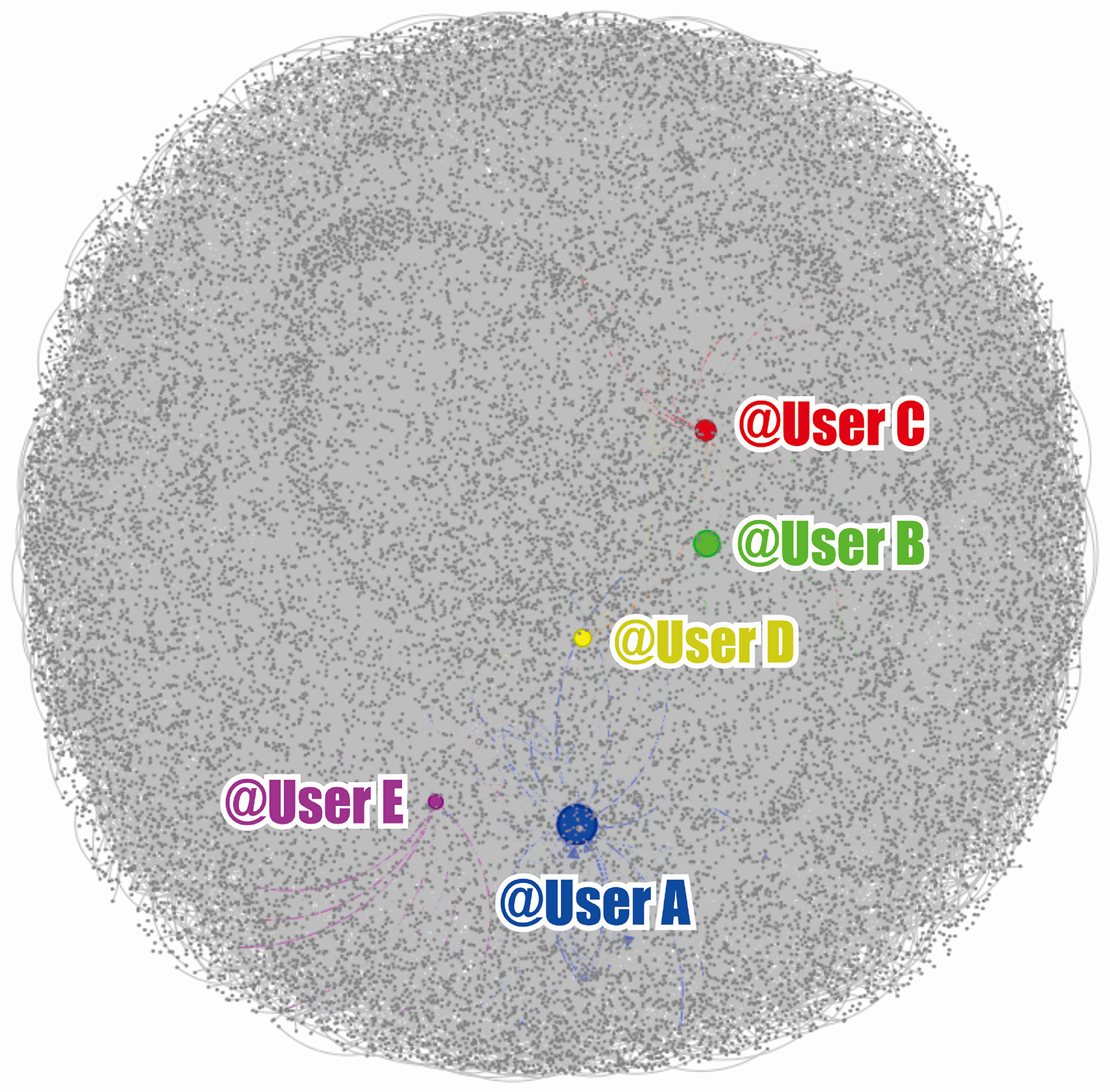
Social network visualization of 48,122 twitter users in the asthma discussion using the Fruchterman-Reingold algorithm, revealing clusters and relationships. Top five users: “User A” (blue), “User B” (green), “User C” (red), “User D” (yellow), and “User E” (purple).

Sentiment analysis of tweets posts. Positive tweets in orange, neutral tweets in green, and negative tweets in yellow.
Top 10 hashtags used
Table 1 indicates the most popular hashtags throughout study period. Overall, the hashtags were utilized to have discussions about asthma, #asthma (n = 801), #health (n = 159), and #meded (n = 136) were the hashtags that were used the most since they are related to a person's health condition, and a lot of medical education media is required so that someone may better comprehend the condition of asthma. In addition, “SarsCov2” and “COPD” also popular. Furthermore, # kitty is discussed on hashtags because it is one of trigger factor for the occurrence of asthma in an individual, particularly when it comes to cat fur.
Top 10 hashtags in tweets.

Top 10 in-degree and out-degree centrality scores
The top user with in-degree and out-degree score of each Twitter user to explain the patterns and trends. The results show user “User D” is highly central in-degree and “User F” highly central out-degree the network.
Sentiment analysis
The sentiment analysis of our study showed in Figure 2, illustrating that there were 12,582 positive phrases (26%), 27,111 phrases reflecting negative sentiments (56%), and 8427 words reflecting neutral comments (18%) about the topic of asthma, according to the frequency of words flagged as positive and negative feelings. The other phrases were classified as “non-categorised” because they were either neutral (i.e., they did not fall into the positive and negative terms categories).
A negative opinion that arises was as follows: “I wish I had a cute laugh like others, but I sound like a donkey with asthma”., “i have asthma don't yell at me please i am sooooo small and have never done anything wrong ever”, and “i hate having asthma, i just wanna be able to breathe without coughing/wheezing”. While for a positive perspective such as “My best friend Lauren is in the hospital with her 14mo son Geoffrey with another asthma-like attack. They’re putting him on a vent. Please pray for healing, for strength, and for Lauren”
Discussion
Using SNA to identify influential users and sentiment patterns, this study offers, to the best of our knowledge, the first thorough analysis of asthma-related Twitter interactions. Based on their betweenness centrality score, the study of social network data has shown the five most important Twitter users in the asthma community. In social network analysis, betweenness centrality indicates the degree to which a Twitter user is located on the shortest path between other network nodes. 33 A user who has an elevated betweenness centrality score is influential in disseminating information throughout the network because they have a higher influence on the flow of information between all other users. 34 The top five Twitter users with the highest betweenness centrality scores were considered influential in spreading asthma-related information and have strong ties with other Twitter users. @User A, who has the highest betweenness centrality score, has been advocating for asthma patients to be offered COVID-19 booster vaccines based on tweets submitted and user profiles that predominantly discussed tweets related to asthma and COVID-19 booster vaccines. @User B, a Member of Parliament for Northeast Cambridgeshire and the Health & Social Care Secretary, has also been vocal about health issues related to asthma. @User C, the founder of Igor's Newsletter, provides health commentary on health issues, including asthma. @User D, a blogger and editor, has also been engaged in sharing information on asthma and other health-related issues. Finally, @User E, an international journalist and author, has been actively sharing her knowledge and experience related to asthma. This aligns with previous studies on asthma that have highlighted the importance of journalists and news media in shaping public health communication and awareness. 35 The public expectation and need for credible health information in during pandemic have put a renewed focus on science and the news media's increasing involvement in health and illness discussions.35,36
The results suggest that “User D” is a key influencer in the network and has a significant impact on the spread of information related to asthma. This user might have a large following on the topic of asthma, which makes their content more likely to be shared or mentioned by others. Similarly, “User F” is a significant content creator in the network, as they mention or retweet other users frequently. This user might have a high level of engagement with the asthma community on Twitter and could be a source of information and resources for those interested in the topic. 37
Top hashtags are used to identify and monitor certain discussions or topics. By examining the frequency of hashtags in social media posts, researchers may determine the most popular or trending topics within a certain group or network. 38 During the study period, the most frequently used hashtags were #asthma (n = 801), and #health (n = 159), as indicated in Table 1. Utilizing these hashtags reveals a significant focus on discussions surrounding asthma and related health conditions. Asthma is one of attention in the health sector because asthma is the most common non-communicable disease in children and one of the most common chronic diseases in adulthood. 39 It is noteworthy to observe the emergence of #SarsCov2 and #COPD among the top hashtags, as these conditions share similar symptoms with asthma and are widely reported on Twitter. 40 Asthma is considered as a potential risk factor for severe COVID-19 due to an abnormal immune response and respiratory function. 41 The inflammatory environment in the bronchioalveolar system of asthma patients may lead to a reduced expression of the SARS-CoV-2 receptor, angiotensin converting enzyme 2 (ACE2), which could protect them from the infection. 42 Some studies have suggested that only patients with allergic asthma are protected from COVID-19, as eosinophil recruitment to the bronchial epithelia reduces ACE2 expression.43,44 However, the available data does not provide sufficient detail regarding asthma etiological classification, and further studies are required to advance this issue. It has also been reported that respiratory viruses can trigger asthma exacerbations, which can increase the severity of the infectious condition. Therefore, it is essential for asthma patients to take precautions to avoid COVID-19 infection. 41
Additionally, the relationship between high average temperature in the environment and higher prevalence and severity of asthma has been extensively established in previous study from Brazil. 45 Some Brazilians taking part in this survey's study center indicate a high prevalence for residents with lower average temperatures. These disparities, together with Brazil's great geographic diversity, highlight the need of studying these variable correlations in this large tropical country. 45 However, our study did not extensively explore the geographical relationship between the countries and the prevalence of asthma.
The popularity of #health, #meded, and #medtwitter can be attributed to the need for medical educational resources better to understand asthma and its impact on overall health. Educational resources are essential in understanding and managing asthma, a condition affected by factors such as patient education and involvement. 46 Social media platforms are commonly used to disseminate information on asthma, but excessive use may lead to negative effects such as internet addiction and sleep deprivation, which can impact control and self-perception of asthma symptoms. 47 Additionally, the discussion of #kitty and #catsoftwitter highlights one of trigger factors in asthma occurrence and management, particularly in relation to cat fur. Cats are known to produce allergens that can trigger asthma symptoms, including through their saliva, dander, and urine. Exposure to these allergens can cause an overreaction of the immune system and worsen asthma symptoms, especially in adults exposed to aeroallergens. 48 Specific IgE components can indicate severe asthma related to cat exposure. 41 The best action for patients with allergic asthma is to avoid contact with cats and maintain aggressive hygiene practices. 49
Sentiment analysis indicates that there is a predominance of negative sentiment towards asthma in twitter users’ conversations and its consistent with the unfavorable perspective towards asthma. These results are consistent with negative sentiment observed in other health issues, such as COVID-19, 50 COVID-19 vaccine, 51 and monkeypox. 52 Negative sentiment towards asthma has significant implications for individuals with the disease, as it can lead to self-stigmatization and contribute to lower quality of life, physical and mental well-being of the patients living. The psychosocial implications of asthma can affect self-management and may result in self-stigma and low self-esteem among individuals with asthma. 53 These factors can have direct or indirect effects on asthma control and may result in diminished self-efficacy, impediments to healthcare access, and strained social interactions. Self-stigmatization of asthma can hinder asthma management and result in negative health effects. Frequent emergency department visits, high self-stigma, and low self-esteem relate to poor asthma management, and low literacy rates are associated with worse asthma stigmatization, according to studies conducted in Malaysia. 54 “Courtesy stigma” from the broader South Asian community can also lead to stigmatization and shame in negatively affecting their ability to regulate themselves. 55 Prior research finding imply that healthcare practitioners, particularly pharmacists, must increase asthma education and awareness initiatives to alter public perceptions. 56
This study was limited by its reliance on publicly accessible Twitter data, which may not truly reflect the ideas and attitudes of the broader community on asthma. The study did not evaluate the effect of geography or cultural background on attitudes about asthma, which may have significant consequences for the development of tailored treatments to combat negative attitudes and stigmatization towards asthma in certain populations. The data collection process did not include specific geo-location or language restrictions use Azure machine, resulting in tweets from users worldwide and written in various languages, but future research will explore incorporating these filtering options for additional insights. Furthermore, the relatively short duration of data collection might encompass only limited range of conversations and trends related to asthma on the platform. Therefore, this study has a limitation that neither the dynamics nor the evolving nature of online discussions about asthma could be analysed due to the limited time frame of data collection. A more extended data collection period could offer a more comprehensive understanding. Exploring the distinct relationship between emotions and sentiments, integral aspects of natural language processing (NLP), is essential for future studies. Detailed emotion analysis techniques could provide a deeper understanding of emotions’ impact on sentiments and contribute to a more nuanced comprehension of online discussions about asthma. Future research should also consider a combined approach, integrating both word-level and tweet-level analyses to ensure a comprehensive evaluation that aligns with the study's goals for Sentiment Analysis. Furthermore, the results of our most popular hashtags in this study simply reflect general discussions about a topic. However, in order to identify a specific topic in future study, it is recommended to use keywords as the searching terms.
Conclusion
This study investigates the relevance of social media influencers, news reporters, health experts, health organizations, and the government in the dissemination, promotion of asthma, and awareness during public health information. These findings have important implications for health communication and public policy for asthma and provide a framework for future study in social media analysis linked to asthma and successful health promotion strategies.
Footnotes
Acknowledgments
This study is supported by University of Szeged and the Institute for Research and Community Service (LPPM) Universitas Jenderal Soedirman, Purwokerto, Indonesia.
Contributorship
Conceptualization: IYK and HP; methodology, formal analysis, software: IYK; data curation and validation: IYK, and HP; writing—original draft preparation: IYK and HP; writing—review and editing: RB ; and funding acquisition: IYK and RB. All authors reviewed and edited the manuscript and approved the final version of the manuscript.
Declaration of conflicting interests
The author(s) declared no potential conflicts of interest with respect to the research, authorship, and/or publication of this article.
Ethical approval
Ethical Approval is not applicable in this research. Twitter allows third-party developers to utilize APIs (Application Programming Interfaces), such as NodeXL Pro, to access and analyze public Twitter data. 57 The study exclusively involved the analysis of publicly available tweets using automated tools, obtaining informed consent or ethical approval was deemed unnecessary. The confidentiality of Twitter users was diligently maintained, and no discernible risks or ethical concerns were identified during the research.
Funding
The author(s) disclosed receipt of the following financial support for the research, authorship, and/or publication of this article: This work was supported by the Szegedi Tudományegyetem, (grant number 6497).
Guarantor
IYK.
