



Abstract
Objective
People with disabilities (PWDs) are at greater risk of COVID-19 infection, complications, and death, and experience more difficulty accessing care. We analyzed Twitter tweets to identify important topics and investigate health policies’ effects on PWDs.
Methods
Twitter's application programming interface was used to access its public COVID-19 stream. English-language tweets from January 2020 to January 2022 containing a combination of keywords related to COVID-19, disability, discrimination, and inequity were collected and refined to exclude duplicates, replies, and retweets. The remaining tweets were analyzed for user demographics, content, and long-term availability.
Results
The collection yielded 94,814 tweets from 43,296 accounts. During the observation period, 1068 (2.5%) accounts were suspended and 1088 (2.5%) accounts were deleted. Account suspension and deletion among verified users tweeting about COVID-19 and disability were 0.13% and 0.3%, respectively. Emotions were similar among active, suspended, and deleted users, with general negative and positive emotions most common followed by sadness, trust, anticipation, and anger. The overall average sentiment for the tweets was negative. Ten of the 12 topics identified (96.8%) related to pandemic effects on PWDs; “politics that rejects and leaves the disabled, elderly, and children behind” (48.3%) and “efforts to support PWDs in the COVID crisis” (31.8%) were most common. The sample of tweets by organizations (43.9%) was higher for this topic than for other COVID-19-related topics the authors have investigated.
Conclusions
The primary discussion addressed how pandemic politics and policies disadvantage PWDs, older adults, and children, and secondarily expressed support for these populations. The increased level of Twitter use by organizations suggests a higher level of organization and advocacy within the disability community than in other groups. Twitter may facilitate recognition of increased harm to or discrimination against specific populations such as people living with disability during national health events.
Keywords
Introduction
The COVID-19 pandemic disrupted health care systems worldwide. Two years after the start of the global pandemic, the World Health Organization reported more than 452 million cases and 6 million deaths from COVID-19 worldwide on March 11, 2022. 1 At that time, the virus accounted for a reported 78.7 million cases and 957,00 deaths in the USA, 3.34 million cases and 37,000 deaths in Canada, and 19.4 million cases and 162,000 deaths in the UK. 1 Forty-three percent of individuals who acquired COVID-19 experienced or are experiencing postacute sequelae of COVID-19 (PASC) or “long COVID.” 2 For patients who were or were not hospitalized due to COVID-19, the estimates were 54% and 34%, respectively. 3 The COVID-19 pandemic left health care systems overwhelmed and unable to care for the rapidly growing number of patients resulting in capacity measures such as cancelling elective surgeries and nonurgent care. When these measures were insufficient, providers and organizations were forced to choose which patients to treat preferentially or to deny care. 4
In emergency situations, crisis standards of care (CSC) may be used to determine how to allocate and ration limited resources 5 by assigning patients CSC scores using acute and chronic severity of illness and life expectancy. Even though scores are supposed to lead to unbiased decisions, CSC priority scores result in fewer scarce resources allocated to Black patients. 6 Evidence is emerging that CSC may disproportionately affect disadvantaged populations because comorbid conditions and expected lifespan are unequally distributed. 7 Health service researchers have proposed alternate ways of distributing resources that seek to avoid discrimination against people with severe health conditions. 8 Section 1557 of the United States Affordable Care Act and Section 504 of the Rehabilitation Act prohibit discrimination based on disability in programs and activities funded by the federal Department of Health and Human Services. 9 During the COVID-19 pandemic, some health care organizations and providers were accused of failure to comply, with disability advocacy organizations in several states filing complaints with the Office of Civil Rights.10–14
Existing CSC recommendations support the development of CSC plans that embody fairness and equitable processes, including transparency, consistency, proportionality, and accountability. Furthermore, they call for community and provider engagement, education, and communication, and the rule of law with regard to authority and environment. 15 However, even when CSC are implemented in accordance with antidiscrimination mandates, access to care, the services of caregivers, and other resources may be limited, leading to decline in health and quality of life, disparities, and health inequities.6,16–19 An analysis of US ventilator allocation guidelines and CSC guidance for ventilator reallocation indicates that inequities may result from the use of such guidelines18,20 when community attitudes do not support ventilator reallocation. 21
Adding to the effects of CSC, having any disability negatively affects the likelihood, severity, and outcome of COVID-19 infection. Heightened vulnerability results not only from disease- and disability-related characteristics such as reduced lung function but also from environmental factors such as living in a congregate setting (e.g. long-term care facility) or lack of access to protective equipment.22–24 Disability often may result in a lower economic status and decreased access to care, medical products, and services (e.g. face masks and home grocery delivery). 25 COVID-19 screening and practices are variable and may not be performed in ways that are effective in some people (e.g. those with spinal cord injuries), 26 and test kits may not be available to people with disabilities (PWDs). 27 In addition, COVID-19 may present differently in PWDs, hampering timely diagnosis.28,29 Reduced activity due to self-isolation or home lockdown may increase pain, make pain management strategies less effective, or increase the likelihood of health problems associated with lack of exercise.30,31
Social media 32 has been shown to be a valid approach to identifying patient perspective around health conditions, pandemics, preventive measures, and treatments.33–35 The microblogging platform Twitter facilitates analysis of public perceptions and patient perspectives. More than 145 million daily active users 36 post, repost, and comment on “tweets”—short notes of up to 280 characters. Twitter commentary has been used as a reflection of public opinion on health conditions such as diabetes 37 and cancer and on legislation (e.g. the Affordable Care Act). 38 Twitter has acted as a tool for analysis of public opinion and sentiment on emerging infectious disease outbreaks such as measles, 39 influenza, 40 Zika, 41 Mpox, 42 and SARS-CoV-2.34,35 We hypothesized that the public discussion on Twitter would provide insight into the experience of PWDs during the COVID pandemic.
Methods
Data collection and processing
On 14 January 2022, we used Twitter's application programming interface (API) to access Twitter's public COVID-19 stream. 43 We collected all English-language tweets for a 2-year span from 1 January 2020 to 14 January 2022. The tweets contained a combination of keywords related to COVID-19, the disability community, and topics of discrimination and inequity such as “Krip the vote,” “Disability Twitter,” and “Eugenics by CDC” (Appendix). We provided descriptive statistics for tweets, including user profiles and tweet content, and determined long-term tweet availability based on Twitter API status codes (“user suspended” or “no user found with this User ID”). We used Python version 3.9.1 software (Python Software Foundation, Wilmington, DE) for all data processing and analyses. 44 Institutional review board approval and informed consent were not required because this study used only publicly available data published voluntarily by Twitter users.
Descriptive analysis
We used the python library M3-Inference, 45 which uses a deep learning model trained on a Twitter data set using profile images, screen names, names, and profile descriptions to predict the Twitter users’ gender, age, and type of account. We used the ethnicolr library 46 in Python to obtain ethnicity information, which uses a model trained off the 2010 US census data to predict the user's ethnicity.
Sentiment and emotion analysis
Prior to performing a sentiment analysis on the tweets, we preprocessed the tweets into plain text, which required the removal of hyperlinks, Twitter handles, “#” symbols, and replies to tweets. We used Python's SentiStrength Library 47 to identify and classify these preprocessed tweets’ sentiment (positive or negative). SentiStrength uses a lexicon-based classifier as well as a rule-based algorithm to measure sentiment on a scale of −4 (most negative) to 4 (most positive). Because deleted or suspended accounts may represent individual accounts that ran afoul of the Twitter rules of engagement, we calculated the average monthly sentiment for all the tweets and compared them based on their account status (active, suspended, or deleted). Before performing an emotion analysis on the tweets, we use the Spacy library 48 to clean the text further. We tokenized and transformed the tokens into their root form through natural language processing techniques such as lemmatizing and removing stop words and nonalphanumeric characters. The removal of stop words eliminates words that provide little semantic meaning, such as “their,” “who,” and “is.” We used the Python library NRCLex 49 to label the primary emotion for each tweet (fear, anger, anticipation, trust, surprise, sadness, disgust, or joy).
Topic modeling
Topic modeling is an effective methodology for organizing large amounts of unstructured social media data (like a library of tweets) into topics. Conventional methods, such as content analysis, rely on human coders to identify topics, but these can be slow and unreliable. In contrast, topic modeling uses machine learning algorithms, such as latent Dirichlet allocation (LDA), to automatically analyze textual data and identify topics. This approach is especially valuable during fast-moving events, such as pandemics, when timely understanding of public sentiment and timely responses from public health agencies are critical. 50
To clean the data by removing tweets unrelated to COVID-19 and disabilities, we used the gensim 51 library in Python and applied an unsupervised machine learning algorithm called LDA 52 to group tweets using a representative set of words into word clusters. We then used the most highly weighted words in each cluster to determine the content of each topic. We removed tweets with topics unrelated to COVID-19 and inequities in the disabled community. With the remaining tweets, we then performed an additional topic modeling and analyzed topics by word clusters to determine the content of each topic. Topic modeling allows the discovery of themes or patterns in a corpus. A pattern describes a set of recurring words that suggest a topic of discussion that reoccurs in multiple tweets.
To optimize the number of topics in our analysis, we trained and evaluated several LDA models with topics ranging from 2 to 50 topics based on their topic coherence score, which summarizes the semantic similarity among high scoring (frequent) words within topics. We ultimately chose a 12-topic LDA model as it produced the highest score. An author without access or insight into the topic modeling labeled the topics using the 20 most frequently used terms, which were ranked by weight. All authors evaluated these topic labels, reached a consensus, and identified example tweets whose content pertained >99% to a specific topic.
Results
Descriptive analysis
Between 1 January 2020 and 14 January 2022, we identified 134,443 English-only tweets related to COVID-19, the disabled community, and topics of discrimination and inequality among the disabled community. After the removal of duplicate tweets, tweets that were replies, and retweets, we retained 94,814 tweets from 43,296 accounts. Of all accounts, 1068 were suspended during our observation period (2.5%) and 1088 (2.5%) were deleted (Table 1) while 41,139 (95%) remained active Twitter accounts. Among verified users tweeting about COVID-19 and disability, suspension (0.13%) or account deletion (0.3%) was significantly less common (p < 0.001).
Characteristics of Twitter users.

Comparison between the groups is done using the Welch t-test.
Significant difference between active and suspended users (P < 0.001).
Significant difference between active and deleted users (P < 0.001).
Significant difference between suspended and deleted users (P < 0.032).
Significant difference between active and suspended users (P < 0.01).
Significant difference between suspended and deleted users (P < 0.010).
Significant difference between active and deleted users (P < 0.02).
Significant difference between suspended and deleted users (P < 0.017).
Table 1 shows the demographics of Twitter users, including age, gender, and ethnicity. The largest group of users included users 40 years or older (52%). Compared to other topics our group had explored regarding COVID-19, this percentage was higher (Plandemic/Scamdemic 45% and Breastfeeding (manuscript in preparation) 33%). 53 Males and non-Hispanic Whites represented the largest groups of all user groups (Table 1). Male users under the age of 40 were overrepresented significantly among accounts that had been suspended or deleted. Asian users were significantly overrepresented in suspended accounts compared to active accounts (15.6% vs. 10.9%, p < 0.001), whereas Hispanic users were significantly underrepresented among suspended accounts (7.4% vs. 8.5%, p < 0.001). The vast majority of suspended and deleted users tweeted from personal accounts, 65.0% and 68.2%, respectively. Suspended users, on average, posted more than active users and had fewer followers than active users.
Of all 94,814 tweets, 90,500 (95.5%) tweets were published by 41,140 (95.0%) active users (2.2 tweets per user), 2585 (2.7%) tweets were published by 1068 (2.5%) subsequently suspended users (2.4 tweets per user), and 1729 (1.8%) of tweets were published by 1088 (2.5%) user accounts subsequently deleted (1.6 tweets per user) (Table 2).
Characteristics of tweets.

Comparison between the groups is done using chi-square test.
Significant difference between active and suspended users (P < 0.001).
Significant difference between active and deleted users (P < 0.001).
Significant difference between suspended and deleted users (P < 0.003).
Significant difference between suspended and deleted users (P < 0.001).
Significant difference between suspended and deleted users (P < 0.002).
Users who were suspended were statistically more likely to have their tweets retweeted (p < 0.001) compared to active users. Twitter Web App was the most used platform by active users (35.5%). Users who were suspended were statistically more likely to be iPhone users (39.1%) compared to active (23.5%) and deleted users (31.2%). Tweets posted by active users were statistically more likely to contain replies, likes, and be quoted by other Twitter users (p < 0.001).
Our analysis explores whether accounts belong to individuals versus organizations. With 43.9%, the percentage of organizational accounts was higher for the disability topic than any other COVID-19-related topic that we reviewed in the past.
Emotion analysis
Emotions were similarly distributed among active, suspended, and deleted users. Generalized negative and positive emotions were most common followed by sadness, trust, anticipation, and anger for all tweet groups (Figure 1). Tweets from suspended accounts were more likely to express fear than tweets from active and deleted accounts.
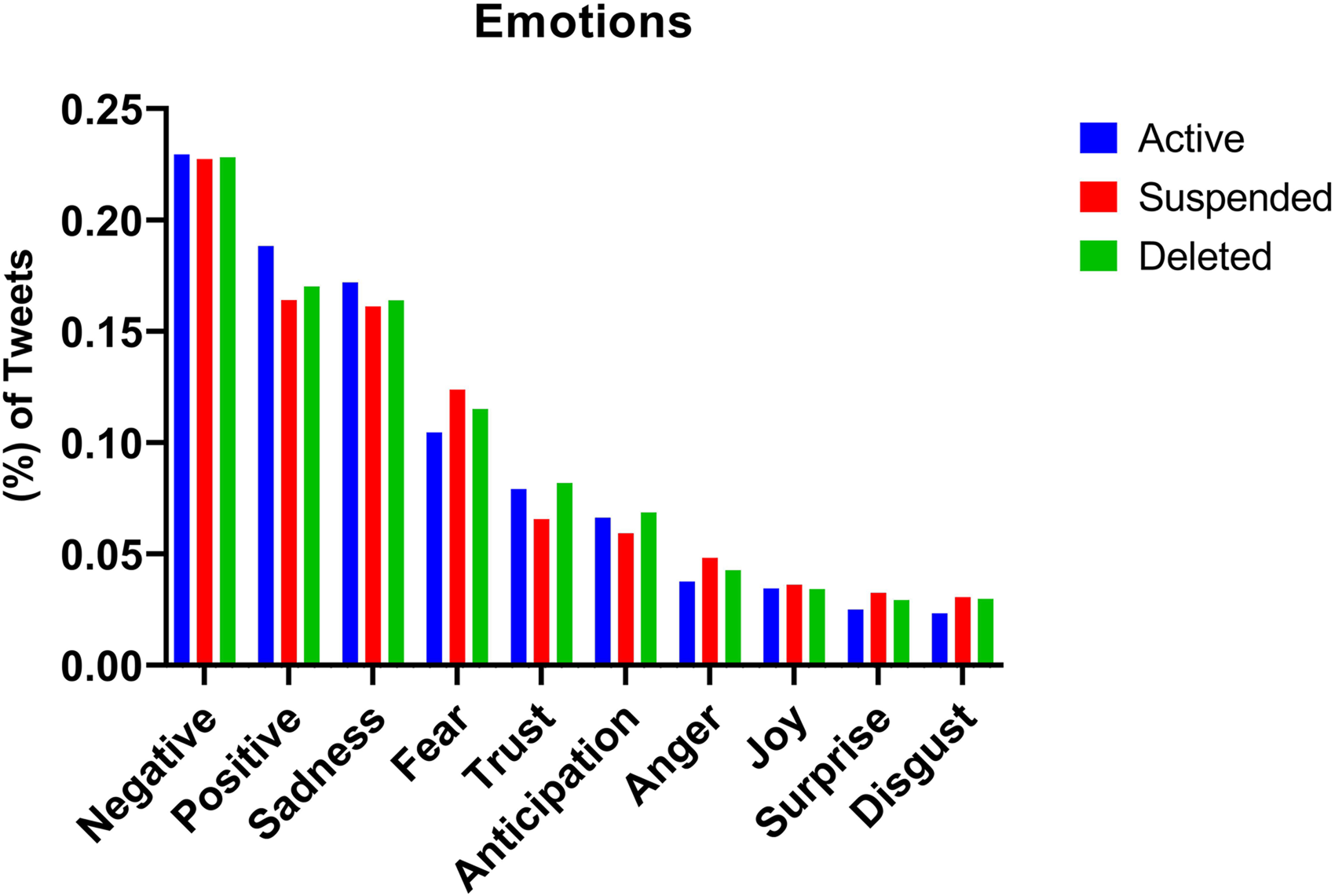
Emotion analysis for active, suspended, and deleted accounts.
Sentiment analysis
The overall average sentiment for the tweets on a scale from −4 (most negative) to 4 (most positive) was negative, as shown in Figure 2. The degree of negative sentiment varied among the groups, with tweets from active users being less negative than those posted by suspended and deleted users. Throughout the study period, suspended tweets contained the most negative sentiment out of all the groups.

Sentiment analysis (scales −4 to 4). Suspended accounts generated tweets that were more negative.
Topic models
The LDA model identified 12 topics expressed in our sample of tweets. The topics were labeled subjectively based on their respective keywords (Table 3). Two topics (representing only 3.2% of all tweets) were not per se related to PWD. One topic (1.4%) discussed the disinformation relating to how the vaccine “can disable” a person and the other (1.8%) focused on the disability resulting from long COVID. The remaining 10 topics (96.8%) were focused on the effects of the pandemic on PWD. Nearly half of the tweets belonged to the topic “Politics that neglect and leave behind PWD, older adults, and children” (48.3%). The next most popular topic was “Efforts to support PWD in the COVID-19 crisis” (31.8%). The third most common topic, “Disabled people need better access to vaccines and other support,” accounted for only 6.3% of tweets. Analysis of sentiment strength, mean retweets, and mean likes (Table 4) indicated that the most negative sentiments (calls for political action to protect PWD from COVID-19 and politics that neglect and leave behind PWD, older adults, and children) did not necessarily receive the largest numbers of retweets and likes.
Table of topic models.

Table of topics with sentiment strength, mean retweets, and mean likes.

Discussion
Our research on early COVID-related Twitter data, which predates even the coining of the term “COVID,” uncovered important themes that had not yet gained widespread public attention. As early as January 2020 (2 months prior to the stock market crash), Twitter users expressed concerns about the pandemic's economic impact.33,34 Moreover, conversations at that time prioritized respiratory protection measures such as wearing masks and practicing social distancing, even before it was established that COVID-19 primarily spreads through respiratory droplets. Harnessing social media data could enable us to leverage the collective knowledge and insights of the masses to identify emerging issues and potential interventions.
PWDs experience worse outcomes following COVID-19 infection than those without disabilities.23,54 Any disability is associated with increased risk for in-hospital mortality. 55 People with intellectual and developmental disabilities (IDDs) are at a higher risk for infectious disease-related emergency room visits, hospitalization, and death in hospitals.56,57 They were admitted to hospital with more severe symptoms (e.g. seizures) than non-IDD individuals, deteriorated more quickly, were younger at death, and experienced more difficulty accessing care teams than those without IDDs.58,59 PWDs had longer hospital stays, more frequent readmissions within 30 days, and a greater likelihood of severe outcomes including death.60–62 As the pandemic progressed and health care systems became strained, some PWDs found it more difficult to receive their usual level of care 63 or needed medical supplies. 64
Our analysis of tweets between 1 January 2020 and 14 January 2022 demonstrated that the most important topic (48.3% of tweets) was a discussion on how politics and policies leave disadvantaged populations like PWD, older adults, and children behind. This immediately linked to a discussion of how to help, aid, and protect these populations (31.8%). This focus on the need for support of PWD reinforces research findings that poorer mental well-being, greater occupational stress, difficulty using digital health tools for support, and having their needs go unacknowledged and unaddressed within the community contribute to COVID-related illness and death. 65
Sadness and fear were among the highest ranked emotions, and overall, the tweets had a negative sentiment throughout. This finding is not surprising given that PWDs were more likely to experience symptoms of psychological stress (e.g. depression, suicide ideation, and anxiety) and report loneliness than people without a disability.66–68 These sources of stress included pandemic-related concerns such as inadequate access to health care, as well as nonpandemic issues such as emotional or physical abuse and inadequate food. 67 The poorer health outcomes experienced within this community, noted previously, have been found to have resulted in part from COVID-19 control measures that failed to adequately address PWD human rights and socioeconomic well-being. 69 Heightened visibility of medical ableism70,71 and the shortcomings of “one size fits all” approaches to public health planning have renewed decades-long calls for rethinking and restructuring of health care for PWD.72,73
In addition, our samples of tweets were more likely to be tweeted by organizations than other topics we have explored in the past. This may reflect a high level of organization and advocacy among the PWD community, as well as a growing movement for disability justice focusing on health care-related institutions and policies. Recent work in this area has advocated for the involvement of PWD in disaster planning to address the needs of PWD better, 74 more accurate data collection about PWD to quantify COVID-19-related disparities better and disparity reduction strategies, 75 engagement with the disability community on the development of informatics-based solutions for health disparity reduction, 76 explicit efforts to identify and eliminate structural ableism within health care including medical rationing, 77 and rethinking of the field of bioethics’ reflexive disregard for PWD. 78
Although fewer accounts were suspended in the analysis of this disability and COVID-19 theme than in a prior study on the hashtags #scamdemic and #plandemic, in which more than 20% of accounts were suspended, still in this work, 2.5% of accounts were suspended and 2.5% deleted after a year, which is a fairly high rate. Further, we found that tweets generally had negative sentiments. These findings suggest that this topic generated passionate discussion or outrage, which is more likely to result in reporting of tweets by other users. Users whose accounts were suspended had the most retweets and the highest negative sentiments throughout the observation period, suggesting inflammatory statements more likely generating interests by other Twitter users. In January 2023, iPhones and Android phones accounted for 55% and 45% of the market, respectively. 79 We noticed a relative increase in suspended users who used iPhones, which may have resulted from greater usability of iPhones for PWDs. 80
Limitations
Our study has a number of limitations. First, we used existing tools to analyze sentiments and emotion of tweets that are not specific to health care topics, which could have skewed our analysis. Second, because we targeted only tweets in English and are unable to determine precise geographic locations for users, we are limited in making conclusions about specific countries or countries where English is the not the predominant language. Third, our keywords selected 10 topics that were indeed focused on PWDs and COVID-19, but 2 topics were not related to this topic and accounted for 3.2% of all tweets.
Conclusions
Twitter, the microblogging social media platform, hosted a robust and in part passionate (as indicated by suspended and closed accounts) discussion on the topic of disability and COVID-19. The predominant discussion focused on how politics and policies leave disadvantaged populations like PWD, the elderly, and children behind followed by the topic focused on helping these populations. Twitter may be a medium that allows public health officials to detect an increase in discrimination of specific populations like people living with disability in the context of a national crisis.
Footnotes
Contributorship
CP, CUL, RJM, and MID conceived the study. MID performed the analysis. CP and CUL led the manuscript writing, with critical inputs from RJM and MID. All authors interpreted the findings, reviewed, contributed to, and approved the final manuscript. The article processing charges for this article are supported by the Clinical Informatics Center at UT Southwestern Medical Center.
Declaration of conflicting interests
The author(s) declared the following potential conflicts of interest with respect to the research, authorship, and/or publication of this article: RJM has received grant funding from the Centers for Disease Control and Prevention and research funding from Verily Life Sciences, the Sergey Brin Family Foundation, and the Texas Health Resources Clinical Scholar program.
Ethical approval
Not applicable, because this article does not contain any studies with human or animal subjects.
Funding
The author(s) received no financial support for the research, authorship, and/or publication of this article.
Guarantor
CP.

Trial registration
Not applicable, because this article does not contain any clinical trials.
Appendix
Keywords contained in Twitter's public tweet stream:
Crip the Vote
CripTheVote
CSC
Disability
DisabilityTwitter
Disabled
Disabled and access
Disabled and equity
EugenicsByCDC
Handicap
Impaired
Incapable and disabled
Incapacitated
Krip the Vote
KripTheVote
Paralyzed
#NoBodyIsDisposable