



Abstract
Objective
In-hospital falls are a significant cause of morbidity and mortality. The Veterans Health Administration (VHA) has designated fall prevention as a major focus area. The objective of this report is to assess the performance of a new sensor-enabled wearable system to prevent patient falls.
Methods
An integrated sensor-enabled wearable SmartSock system was utilized to prevent falls at the acute care wards of a large VA hospital. Individual patients were only provided the SmartSocks when they were determined to be at high risk of falling. All fall count rates, with and without using the SmartSock, were evaluated and compared for individual patients. SmartSock sensor and electronic health record data were combined to assess the system's performance from February 10, 2021, through October 31, 2021.
Results
There were 20.7 falls per 1000 ward days of care (WDOC) for those not using the SmartSocks compared to 9.2 falls per 1000 WDOC for patients using the SmartSocks. This represents a reduction of falls by more than half. These findings are further confirmed with a negative binomial regression model, which showed the use of the SmartSock had a statistically significant effect on the rate of falls (p = 0.03) when length of stay was held constant and demonstrated the odds of fall incident rate of 0.48 (95% CI, 0.24–0.92), that is less than half compared to when patients were not wearing the SmartSock.
Conclusion
The use of a sensor-enabled wearable SmartSock fall prevention system resulted in a clinically meaningful and statistically significant decrease in falls in the acute care setting.
Keywords
Introduction
Falls are the leading cause of accidental injury and death in the United States (US) and the leading reason for nonfatal emergency room visits. 1 Falls disproportionally impact older adults and fall-related deaths in this group increased by 31% from 2007 to 20161,2 It is estimated that by 2030 there will be 100,000 deaths per year that are related to falls. 3 Falls also have a tremendous economic impact, with an estimated cost in the US of $50 billion in 2018, and costs are expected to reach $100 billion by 2030.3,4 Patients in the hospital have an increased risks of fall, such as from confusion related to illness, new polypharmacy, change in environment, and attached medical devices such as catheters or IV's. Hospitals have trialed many strategies to reduce falls from restrains to one-to-one (1:1) staff sitters in the room. Yet falls continue and effective prevention of falls remains challenging.5–8
The association between falls and patients who are hospitalized has been a recognized issue since at least the 1950s.5,9 Falls are among the most common preventable hospital adverse events leading to harm, increased cost, increased length of hospital stay, and discharge to long-term care facilities.8,10,11 It is estimated that up to one million patients fall each year during their hospitalization, resulting in a thousand falls per year for a large hospital, with half of these falls resulting in injury.10,12,13 In-hospital falls are a quality metric used to assess accreditation, reimbursement, and hospital credibility.11,14 The Veterans Health Administration (VHA) is the largest integrated healthcare system in the United States and has a patient population that is at increased risk for falls due to older age and multiple comorbidities.15–18 As part of our continual work to enhance care, the VHA has identified falls as a major focus area.
New technology presents opportunities to reduce the risk of in-hospital falls. Hospitals have implemented a variety of strategies from alarming beds to patient wearables. The VA Palo Alto implemented a wearable SmartSock system that works as a nursing alert to prevent falls. This paper reviews our assessment of the performance of a SmartSock system to prevent falls.
Methods
This quality improvement and assessment project received a Determination of Non-Research from Stanford IRB (Stanford University, Stanford, CA, USA), protocol # 60079, as well as by VHA determination. The SmartSock system was deployed and retrospectively assessed in three of VA Palo Alto Health Care System's acute care wards from February 10, 2021, to October 31, 2021.
Stakeholders
As part of our ongoing efforts to continually enhance care at VHA, multidisciplinary teams, including those from Innovation; Nursing Service; Acute Care; Office of Quality, Safety, and Value; Biomedical Engineering; Office of Information and Technology; Information System Security; Compliance; Privacy; and Executive Leadership, partnered to improve VHA's fall rates. This group assessed the need, identified a wearable SmartSock fall prevention solution, and designed an implementation plan. To optimize clinical integration, adoption, and outcomes, Nursing Service had the responsibility and ownership of incorporating the SmartSock system into their routine clinical process.
Fall risk
The fall risk assessment utilized the existing VHA facility fall assessment protocol. Nursing Service staff continued to independently assess their patient's fall risk every shift, on admission, at transfer, or at any additional time as clinically indicated. Fall risk was assessed using a combination of clinical judgement, as well as the Morse fall assessment scale.19–21 This preexisting standard facility protocol has a patient's high-risk fall status and care plan charted in the clinical notes, discussed daily in clinical rounds, and a red sticker placed on the patient's room door to enhance clinical awareness of a high-risk patient.
Patients
Our acute care wards are dedicated to patients who are acutely ill, require close monitoring, and high levels of care. The SmartSock quality improvement project was utilized for inpatients located in three acute care wards, who were determined to be a high risk for fall by regular standard nursing assessments. All high-fall-risk inpatients were eligible to use the SmartSocks. There was no randomization for this initiative, the system was implemented as an additional augment to care, and routine care was not withheld because of the use of the system. Therefore, the use of the SmartSocks did not change our other facility care protocols, such as encouraging and facilitating safe patient ambulation. VA nursing staff follow VA 38 CFR Part 17 interim final rule, which directs that a progress note describing the clinical encounter and treatment plan is the expectation to document that informed consent was obtained for low risk and broadly accepted standards of medical practice, such as fall prevention safety alerts. Patients were given the option to refuse the fall prevention system. Patients were not candidates for the SmartSock if they could not wear a sock, did not want to wear a sock, or were determined not to be at high risk for fall. Because fall risk may fluctuate during care, the implementation plan included only utilizing the SmartSock system during the time a patient was determined to be a high risk for fall.
Implementation
Acute ward nursing staff were responsible for adjusting care appropriately when patient status changes were identified, including a change in fall risk status, which included adding and removing socks, as well as activating and deactivating the alarm functionality. For example, when a patient was no longer determined to be a high fall risk, the SmartSocks were removed or deactivated. When a high fall-risk patient was supervised ambulating, staff would deactivate the SmartSock alarm to prevent false alarms. SmartSocks were exchanged for new ones, per the established protocol for standard nonskid hospital socks, such as when soiled. Multidisciplinary innovation and technical teams were responsible for the technical installation and integration of the solution, which included configuring the system to the acute care teams requirements. For example, to enhance clinical workflow efficiency, and to ensure that the functionality was available regardless of the room the patient was in, the systems technical components were installed in each of our acute care rooms. Therefore, if a patient's condition changed, there was no need to move patients to specified rooms to utilize the system. When a patient was being directly monitored, the system was configured so that staff had the ability to place the system on a suspend alert function, to prevent unnecessary alarms.
Device
The wearable SmartSock fall prevention system, ‘Patient Is Up’ (PuP ®), is a bed-patient monitor alarm system (bed alarm) by Palarum LLC. Similar to a traditional bed alarm, this SmartSock solution is designed to alert staff when a fall-risk patient attempts to leave their bed or is out of bed. This system has integrated several technologies to improve fall prevention performance and reduce alert fatigue: (1) A principal component of the solution was a wireless electronic-textile SmartSock with multiple nonskid treads on the bottom. When not activated, the sock functioned and felt like a standard nonskid hospital sock. (2) The SmartSock had three small pressure sensors woven into the fabric at the bottom. To prevent false alarms, from pressure applied to the bottom of the feet while the patient is in bed, additional information about physical orientation and speed of movement was provided by an Inertial Measurement Unit consisting of an accelerometer, gyroscope, and magnetometer, which was located above the ankle of one SmartSock (Figure 1). (3) The SmartSock silently communicated via Bluetooth to an ‘In Room Tablet’ (IRT) mounted in the patient's room, and from there via WiFi to an integrated network of small battery-powered antennas mounted on the ceiling of the acute care ward and to a cloud-based server. (4) The cloud-based server utilized an analytics algorithm that processed and stored the SmartSock data real-time and triggered a safety alert when the correct parameters were met; if the patient was in a standing position, if there was pressure on the socks, and if there was movement. (5) Nursing staff in the acute care wards wore an integrated smart badge, roughly the size of an employee ID badge (Figure 2). (6) The three nearest nurses to the patient were immediately informed of an out-of-bed safety event via badge vibration and buzz audio alert. Because the safety alert did not come from the SmartSocks or the patient's room, the patient's specific room number was also displayed on the small screen of the smart badge to empower response efficiency. As with a traditional bed alarm, nursing staff responded to an alert as soon as possible to ensure patient safety. If staff were unable to respond within 30 s, the system was configured to alert the next three closest nurses, and at 90 s an “all call” alert for the entire unit was triggered. This escalation protocol was designed to balance the risk of alert fatigue with the potential that the closest nurses may not always be available to respond. For situational awareness, the alert was also simultaneously displayed on the Unit Coordinator tablet, located at the ward nurse's station. (7) For efficiency and to further reduce fatigue, the alert was configured to automatically disable using a “proximity terminate” feature which was triggered when a staff member, wearing a smart badge, entered the patient's room. (8) Palarum provided the required equipment as well as a dedicated on-site representative to conduct regular, ad-hoc system training, system support, and weekly team falls reviews.

The PuP ® SmartSock is viewed from below (a) and from the side (b). From below, the three integrated pressure sensors are identified as black squares, the raised nonskid treads are tan, and the Inertial Measurement Unit is attached to the SmartSock above the lateral aspect of the ankle (a).
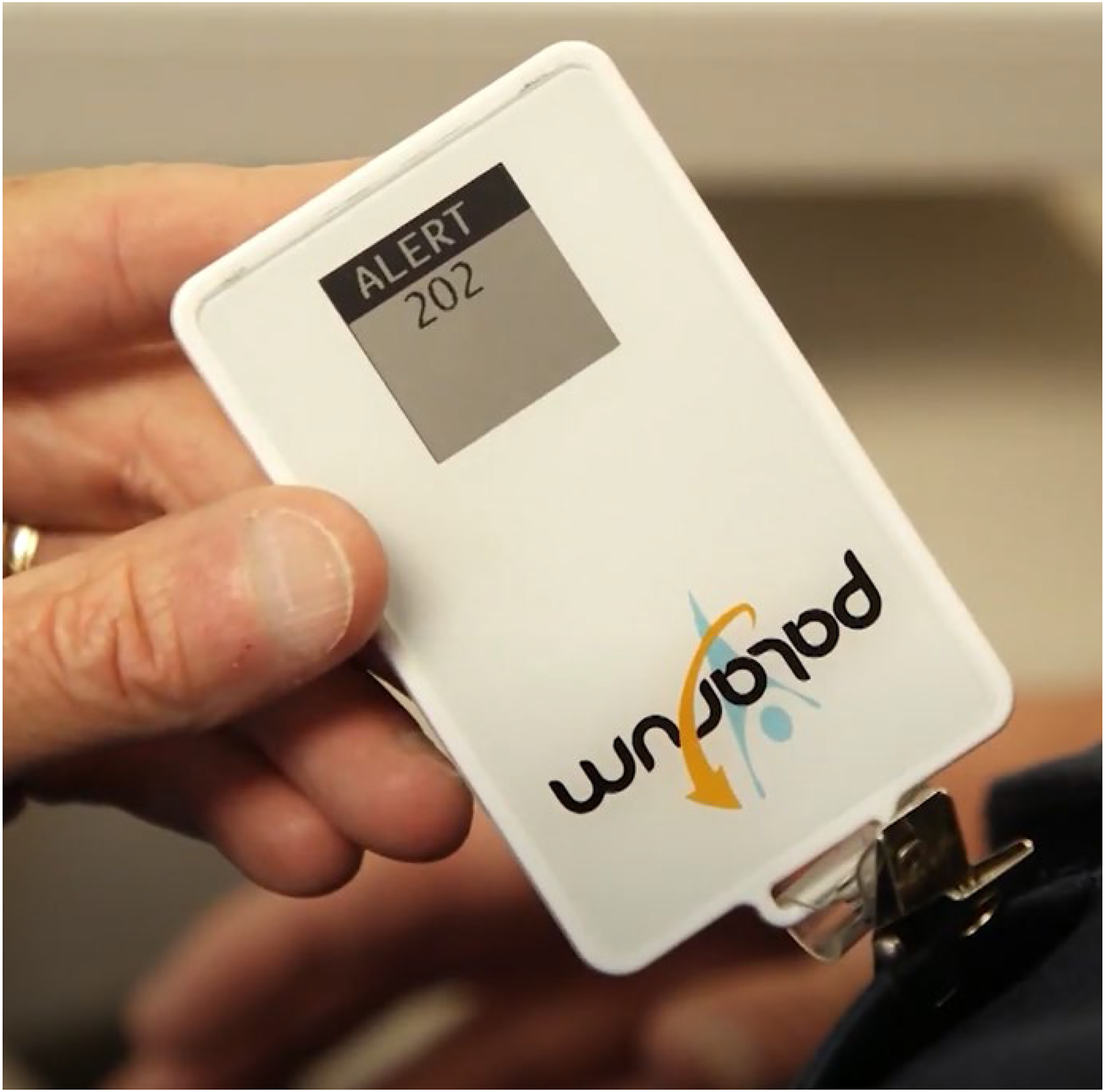
Smart badge with screen display identifying room number location of the alert.
Our assessment compared the same patients time-adjusted fall rate while utilizing the SmartSock system, compared to the time they were not, during their acute care hospitalization. This mitigated interpatient variability of demographics and comorbidities.
Variables
The SmartSock sensor data utilized for this assessment included patient room numbers, alerts, and activity information. VHA operational information included length of stay, demographics, and comorbidities. VHA's EHR database was queried to identify all fall report progress notes and a manual chart review was also performed to confirm accurate fall time documentation. The Charlson Comorbidity Index (CCI) was calculated for each patient (CCI scores of 1–2 are classified as mild, 3–4 are classified as “moderate” and ≥ 5 are classified as “severe”). 22
Statistical analysis
All of the patients who had time with and without the use of the SmartSocks during their acute care admission were included in the assessment. The confirmed data was normalized by the total number of hours patients were wearing vs not wearing the socks and converted to days of use (total hours/24). The final number for each category was presented as ward days of care (WDOC), a commonly used unit of measurement for healthcare quality. This resulted in two time periods for each patient; total hours with and without the use of the SmartSocks. Negative binomial regression was performed according to the meta-analysis methods of Robertson and colleagues which identified it as the best-performing statistical method for evaluating a fall prevention intervention, compared with traditional logistic regression, Poisson, and others. 23
Results
Patient characteristics
We identified a total of 834 patients who utilized the SmartSocks at some time during their acute care hospital stay. The average age of the cohort was 73 years old and were primarily male, which is expected for our older Veteran population. The most common baseline chromobodies of the cohort include the following; 79% had a diagnosis of hypertension, 48% had diabetes mellitus, 45% had chronic obstructive pulmonary disease, and 28% had congestive heart failure. The average CCI score was 4.6 (Table 1).
Patient characteristics.

In-hospital falls
Both the with, and without, SmartSock groups had similar total WDOC, which was 2074 and 2077, respectively. The SmartSock group had 19 total falls compared to 43 total falls in the no SmartSock group. Adjusting for WDOC, the fall rate while utilizing the SmartSock versus not wearing SmartSock was 9.2 versus 20.7, respectively, per 1000 WDOC.
These results are further supported by the negative binomial (NB) regression model which utilizes WDOC and SmartSock (binary) as independent variables. We included WDOC as an independent variable to control for the confounding effect that length of stay may have on fall risk. The dependent (outcome) variable was a fall count for each patient (min. falls = 0/max. falls = 5), in each group. This resulted in model parameters indicating SmartSock use had a statistically significant impact on fall reduction (p = 0.03). Patients wearing the SmartSock had a fall incident rate of 0.48 (95% CI, 0.24–0.92) when WDOC is held constant, which was obtained by taking the exponential value of the SmartSock variable's log odds (−0.73). As demonstrated in the NB regression plot, as WDOC is extrapolated over time, the expected fall count is reduced by approximately half at any point during their hospital stay when wearing the SmartSock (Figure 3). These results are consistent with the fall rate reduction observed in the overall population (Table 2).

Plot of the negative binomial (NB) regression model with fitted lines of the association between the ward hours of care and expected fall count, when wearing the SmartSock (teal) and not wearing the SmartSock (red). The accompanying shaded area represents the confidence intervals for each group.
Patient falls with and without the SmartSocks.

Discussion
For decades, multiple interventions have been utilized to help reduce in-hospital patient falls. Patient monitoring is a broadly accepted approach for fall prevention with numerous different tools, techniques, and strategies leveraged to enhance patient safety such as bedside patient sitters, video monitoring, traditional bed alarms, as well as other newer portable movement sensors. Unfortunately, these interventions have yet to demonstrate consistent value, and despite broad efforts, in-hospital falls decreased by only 5% in the U.S. from 2014 to 2017.14,24
At our institution, the use of a SmartSock bed-patient monitoring alarm system resulted in a large and statistically significant decrease in falls. There are advantages to the SmartSock system when compared to other fall prevention strategies. For example, traditional bed alarm systems, which are commonly used throughout the US, have had little to no effect on fall reduction in multiple studies.6,11,25–27 In addition, traditional bed alarms result in an increased burden on nursing staff who experience alarm fatigue due to false alarms.5,28 An advantage of the SmartSock system is that it is more streamlined, designed to only trigger an alert when several specific parameters are met, and then immediately alerting only the three closest nurses and nurses station. In addition, once a caregiver enters the room, the alert is automatically deactivated, further reducing unnecessary or prolonged alarms. Therefore, the technical configuration is designed for improved specificity while also reducing the cacophony of alarms often encountered in the medical wards.
1:1 bedside patient monitoring is another traditional fall reduction intervention. However, this strategy is not ideal as sitters are expensive, costing over $1 million annually, and require scarce hospital staff to be delegated to one room. Importantly, a recent review outlined that there is little evidence that 1:1 sitters significantly reduce falls. 13 Video Monitoring has been shown to reduce the need for 1:1 sitters, but does require extensive setup and training, has privacy concerns, and prior evaluations have not demonstrated significant change in the rate of falls.13,29
Our observation, that falls were reduced by more than half, is especially compelling because the SmartSocks were only utilized to alert staff when patients were clinically determined to be at the highest risk for fall. Therefore, our results would be expected to be biased for more falls when patients were utilizing the SmartSocks. Furthermore, the intervention and control data were from the same patient, therefore reducing confounding demographic and comorbidity variables of comparing different patients.
Responding to a fallen patient requires unplanned close physical contact between patients and multiple staff members. Therefore, it is particularly meaningful that reducing falls also decreased the amount of potentially dangerous infectious exposure during the COVID-19 pandemic, which can have far-reaching impact in ways that extend beyond an acute fall event.
Our emphasis on broad multidisciplinary collaboration from the inception of the initiative, delegation of roles to teams most experienced in specific areas such as clinical ownership, workflow integration, and process responsibility by the Nursing Service utilizing the solution, likely contributed to system optimization and adoption. This also suggests that our results are likely related to the combination of people, processes, and technology. With any new technology, user education, acceptance, and adoption, as well as hardware or software updates and downtime may impact system performance. Continual use may result in associated degradation from wear-and-tear of the equipment which may also impact performance in the future. This fall prevention system has several different technical components that are necessary for its function, thereby potentially increasing the likelihood of a technical issue and therefore emphasizing the need for comprehensive technical quality assurance. The SmartSock system was implemented as an additional augment to care, and routine care was not withheld because of the use of the system; A nurse's knowledge and other standard care related to a patients fall risk was not altered. As a result, our assessment is limited in that it assessed the SmartSock system during routine clinical care without blinded randomized controlled methodology. A matched, blinded, pre and during implementation trial design may provide additional insight into subsequent studies. Nonetheless, our approach also provides pragmatic and practical insight regarding the capability in a real-world environment. Our strategy, to have patients as their own control, likely over-adjusted for this limitation and may have underestimated the positive effect of the system. In addition, our population is unique, consisting primarily of older male Veterans. This results in gender, age, and comorbidity bias which limits generalizability. For this assessment, we only considered patients who were at a high risk for fall using a combination of clinical judgement and the Morse Fall risk scale. It is not completely understood if a patient's risk of fall has additional variability that we did not consider, beyond a binary yes or no designation for high fall risk. For example, a patient may be directed to stay in bed, for various clinical reasons, at different times during their stay. This may change a patient's fall risk versus times when they are encouraged to be independent. This warrants additional assessment to understand how a patient's risk of fall varies during these situations, which could have an impact on the outcomes of fall prevention interventions, such as the SmartSock.
As part of our ongoing efforts to continually assess and improve care, in the following months after this initial observation period, our Nursing Service expanded eligibility to patients who met the following criteria: (1) high/moderate fall risk based on nursing judgment, (2) post-operative day #0 and reassess daily, (3) patients determined to be impulsive and/or patients unlikely to use call light, and (4) recent history of falls. Additional assessment about how these changes impact performance is planned. Furthermore, our assessment was only performed in the acute care setting and utilizing the system in other settings will require additional considerations, as the use with more ambulatory patients may increase the risk of staff alert fatigue. Therefore, we expect that the processes and procedures will need to be adjusted for different care environments, with specific attention to alert configurations. Further evaluation of the performance in other care locations, as well as understanding variations based on time of day, is warranted. Finally, future assessment of the complex short and long-term financial burden of inpatient falls, in comparison to the cost of the SmartSock fall prevention system, is also of great interest.
Conclusion
The use of a sensor-enabled wearable sock fall prevention system resulted in a clinically meaningful and statistically significant decrease in falls in our acute care setting. The need for health safety enhancements, that can prevent falls while also reducing demands on our thinly stretched staff, is imperative for patient health, provider support, and hospital performance.
Footnotes
Acknowledgements
We are grateful for the partnership and collaboration of our dedicated nursing teams as well as Palarum LLC.
Author contributions
Data curation: ZPV, and PS performed the data curation. Formal analysis: Thomas F. Osborne, Zachary P. Veigulis, David M. Arreola, Ilya Vrublevskiy, Paola Suarez. Investigation: Thomas F. Osborne, Zachary P. Veigulis, David M. Arreola, Ilya Vrublevskiy, Paola Suarez. Methodology: Thomas F. Osborne, Zachary P. Veigulis, Paola Suarez, David M. Arreola. Project administration: Thomas F. Osborne. Software: Thomas F. Osborne, David M. Arreola, Ilya Vrublevskiy, Zachary P. Veigulis. Supervision: Thomas F. Osborne, Angela Gant-Curtis. Validation: Zachary P. Veigulis, Paola Suarez, Evann Schalch, Rachel C. Cabot. Visualization: Zachary P. Veigulis. Writing – original draft: Thomas F. Osborne. Writing – review & editing: Thomas F. Osborne, Zachary P. Veigulis, David M. Arreola, Ilya Vrublevskiy, Paola Suarez, Catherine Curtin, Evann Schalch, Rachel C. Cabot, Angela Gant-Curtis.
Contributorship
TFO and AGC researched literature and conceived the study. All authors were involved in protocol development, gaining ethical approval, patient recruitment, and data analysis. ZPV and PS performed the data curation. TFO wrote the first draft of the manuscript. All authors reviewed and edited the manuscript and approved the final version of the manuscript.
Disclaimer
The contents do not represent the views of VHA or the United States Government.
Declaration of conflicting interests
The author(s) declared no potential conflicts of interest with respect to the research, authorship, and/or publication of this article.
Ethical approval
This quality improvement and assessment project received a Determination of Non-Research from Stanford IRB (Stanford University, Stanford, CA, USA), Protocol # 60079, as well as by VHA determination.
Funding
The author(s) disclosed receipt of the following financial support for the research, authorship, and/or publication of this article: The company Palarum LLC provided the fall prevention equipment for the evaluation free of charge through a Cooperative Research And Development Agreement (CRADA). However, this assessment received no specific grant from any funding agency in the public, commercial, or not-for-profit sectors.
Guarantor
TFO.
