




Abstract
Objective
To reveal the characteristics, development trend and potential opportunities of China–ASEAN collaboration in the medical and health field based on bibliometrics.
Methods
Scopus and International Center for the Study of Research Lab (ICSR Lab) was used to analyze the scale, collaboration network and distribution, impact of cooperative papers, collaboration dominance and evolution of the literature on China–ASEAN medical and health collaboration in the Scopus database from 1992 to 2022.
Results
From 1992 to 2022, 19,764 articles on medical and health collaboration between China and ASEAN were filtered for analysis. The number of China–ASEAN collaborations has shown a clear upward trend over the years, indicating a gradually closer and improved collaboration relationship overall. The institutional collaboration network between China and ASEAN countries was obviously clustered, and the network connectivity was limited. The substantial differences between the median and mean values of citation impact of China–ASEAN medical and health research collaboration reflected that the collaboration was ‘less’ but ‘better’. The dominance share of collaboration between China and the main ASEAN countries was fluctuating upward and has become more and more stable after 2004. Most of the China–ASEAN collaboration focused on their own characteristic research topics. In recent years, collaboration in infectious diseases and public health had expanded significantly, while other research topics had maintained in a complementary development trend.
Conclusion
Collaboration between China and ASEAN in the medical and health field has exhibited a progressively closer relationship, and the trend of complementary research has remained stable. However, there are still areas of concern, including the limited scale of collaboration, narrow scope of participation and weak dominance.
Introduction
Since 2003, collaboration in the medical and health between China and ASEAN countries (including Malaysia, Indonesia, Thailand, the Philippines, Singapore, Brunei, Vietnam, Laos, Myanmar and Cambodia) has demonstrated sustained and positive development, and various exchanges have gradually become institutionalized. ASEAN countries have become important partners in medical and health field of China, particularly in areas such as the prevention and control of infectious diseases, traditional medicine and stomatology. In the context of the COVID-19 pandemic, China and ASEAN countries have continuously strengthened strategic communication, and promoted collaboration in the medical and health field. Collaboration between China and ASEAN countries plays a positive role in maintaining health security and promoting the well-being of people. China and ASEAN countries adhere to the purpose of building a ‘community of shared future’, uphold the principle of win–win collaboration and mutual benefit, and construct a China–ASEAN medical and health collaboration mechanism. By project collaboration, medical assistance, joint defense and joint control, the collaboration between China and countries along the ‘the Belt and Road’ are deepen constantly. This is an important strategic decision of China, and plays an essential role in supporting medical institutions in Southeast Asia to carry out further multilevel, multiform and multiangle academic, technical and talent exchanges.
Bibliometrics has been used in the evaluation of scientific publications, scientific research work, discipline development and institutions for a long time. It is an interdisciplinary field that utilizes mathematical and statistical methods to quantitatively analyze all knowledge carriers.1,2 It is widely used in many research fields, including medicine,3,4 environmental science,5,6 energy, 7 management8,9 and computer science. 10 Scientific research collaboration is an important way to promote the development of science and technology, 11 while the international coauthored papers are an important indicator to measure the development of international scientific research collaboration and the output capacity of scientific research collaboration. 12 Many scholars have analyzed the network structure, collaboration mode, hot spots and changing trends of international scientific research collaboration in many fields through bibliometrics. Scholars in China have carried out a series of bibliometric studies based on quantitative data, focusing on the collaboration between China and other countries in certain fields, such as traditional medicine 13 and COVID-19.14,15 While scholars have explored international research collaboration papers between China and several developed countries from different perspectives, there is a limited focus on medical and health research collaboration between China and ASEAN countries in existing literature.
In the context of the ‘Belt and Road’ strategy, exploring the overall situation of medical and health research collaboration between China and ASEAN countries will help to understand the characteristics of such collaboration and provide support for the implementation of the ‘Belt and Road’ strategy. This research aims to reveal the characteristics, development trend, and potential opportunities of China–ASEAN collaboration in the medical and health field from a perspective of bibliometrics. By analyzing scientific research collaboration in the medical and health field between China and all ASEAN countries over the past 30 years, the study intends to provide decision-making support for further promoting China–ASEAN international collaboration in the medical and health field.
Materials and methods
Data resource
The data resource of this study was Elsevier's Scopus database. The query time of the study was August 2022, and the time range was set from 1992 to 2021.
We defined the scope of the medical and health field in this study using All Science Journal Classification Codes of Scopus, which are shown in Table 1.
ASJC codes used for defining the field of medical and health.

ASJC: All Science Journal Classification.
The obtained basic data were involved in a total of 19,824,552 papers, 1,882,865 institutions and 16,035,263 authors. Furthermore, we only included papers that involved collaboration between both Chinese and ASEAN countries. Finally, 19,764 core collection papers, 4378 core institutions and 38,618 core authors were included in this study.
Methods
The analysis and calculation of the research were based on the visual analysis of the literature by Elsevier's International Center for the Study of Research Lab. The research overview and development trend of China–ASEAN scientific research collaboration in the medical and health field were comprehensively obtained. The analysis framework was shown in Figure 1.
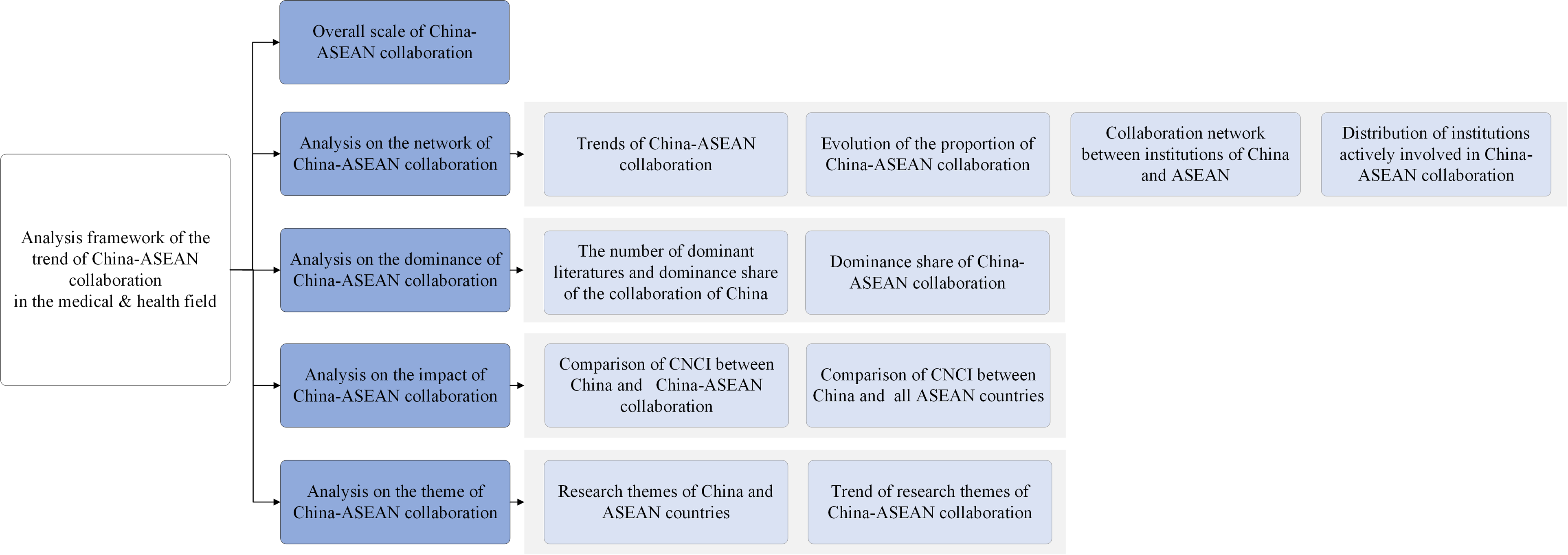
The analysis framework of the trend of medical and health collaboration between China and ASEAN counties.
Definitions
Number of published papers: The number of papers included by Scopus. The higher the number of published papers, the larger scale of scientific research in a certain aspect.
Internationally cooperative paper: Paper published by at least two cooperative countries/regions.
Collaboration rate: The proportion of internationally cooperative papers in the total number of papers published in a certain country in a certain period of time.
Average annual growth rate: It refers to the average annual growth rate over a certain number of years. Compared with the annual growth rate, the average annual growth rate is calculated on a long-term basis, which can better illustrate the trend, potential and expectation of growth.
Dominant literature: In the internationally cooperative literature, the first author and the corresponding author contribute the most and play the dominant role. The dominant literature of a country/region refers to the literature produced by the national researchers participating in international collaboration as the first author or corresponding author. The more the dominant literatures, the stronger the leadership. On this basis, the dominance share can be defined as the ratio of these dominant literatures to all cooperative literatures.
Citation frequency: The number of citations from Scopus.
Citation impact: It was measured by referring to the Category Normalized Citation Impact (CNCI) calculation method in Incites. The calculation formula is:
Results
Overall scale of China–ASEAN collaboration
From the perspective of bibliometric analysis, the trend of the number of published papers can directly reflect the scale and development trend of the research field. The development of bilateral collaboration in the past 30 years were shown by counting the number of collaborations (cooperative papers) between China and ASEAN countries from 1992 to 2021 (Figure 2). According to the collaboration trend over the years, the collaboration between China and ASEAN countries in the field of healthcare has gradually become closer, and the number of collaborations showed a significant upward trend, especially in recent years. The number of collaborations increased from 16 in 1992 to 2312 in 2021, which was the largest in 2020, reaching 3069. Based on the perspective of macro trends, China–ASEAN collaboration will be more frequent in the future. Under the situation of the normalization of COVID-19 epidemic control, collaboration between China and ASEAN countries will gradually return to the normal growth level.

Macro trend of medical and health collaboration between China and ASEAN.
Analysis of the China–ASEAN collaboration network
Understanding the basic situation of the international collaboration between China and ASEAN countries can compare and further analyze the change trend of the number of internationally cooperative papers, which can intuitively show the difference in the development trend between China and ASEAN countries.
The number of collaborations between China and ASEAN countries increased significantly, and the overall development showed a significant upward trend from 1992 to 2021 (shown in Figure 3). Among all ASEAN countries, collaboration between China and Singapore was the closest, with the highest number of collaborations reaching 1515 in 2020. This was 672 times more than the number of collaborations between China and Malaysia, which ranked second in the same year. In addition, collaboration with Thailand was also relatively close, with 4957 cumulative collaboration times in 30 years ranking second. However, China's collaboration with Cambodia, Myanmar, Laos and Brunei Darussalam was less frequent, with a comparatively low upward trend. It was indicated that it was necessary to actively expand and strengthen collaboration between China and these countries.

Trends of China–ASEAN collaboration from 1992 to 2021.
By analyzing the proportion of the number of collaborations between China and ASEAN countries from 1992 to 2021 (Figure 4), it was shown that the number of collaborations between China and Singapore consistently ranks first in the vertical proportion, accounting for approximately 40%, followed by Thailand (20%) and Malaysia (20%). In the horizontal proportion, the proportion of China's collaboration with Singapore and Thailand was decreasing year by year, while the proportion of China's collaboration with Vietnam, Indonesia and Malaysia was slightly expanding. For Cambodia, Myanmar, Laos and Brunei Darussalam, the number of collaborations with China remained relatively low, and there was no significant change in the proportion.

Evolution of the proportion of China–ASEAN collaboration between 1992 and 2021.
According to the participating institutions of international literature coauthored by researchers from China and ASEAN countries, the collaboration network between China and ASEAN institutions was constructed (Figure 5). The nodes in the network represent the institutions participating in collaboration, and the connection between nodes indicates that there is collaboration between the two institutions. The node size reflects the betweenness centrality. The larger the node is, the stronger the betweenness centrality is. The adopted layout algorithm is Kamada Kawai, and the community detection algorithm is Louvain. To make the institutional collaboration network diagram easier to understand, only the connections representing transnational collaboration conducted by institutions from China and ASEAN countries, with a weight exceeding 30, were retained in the network diagram.
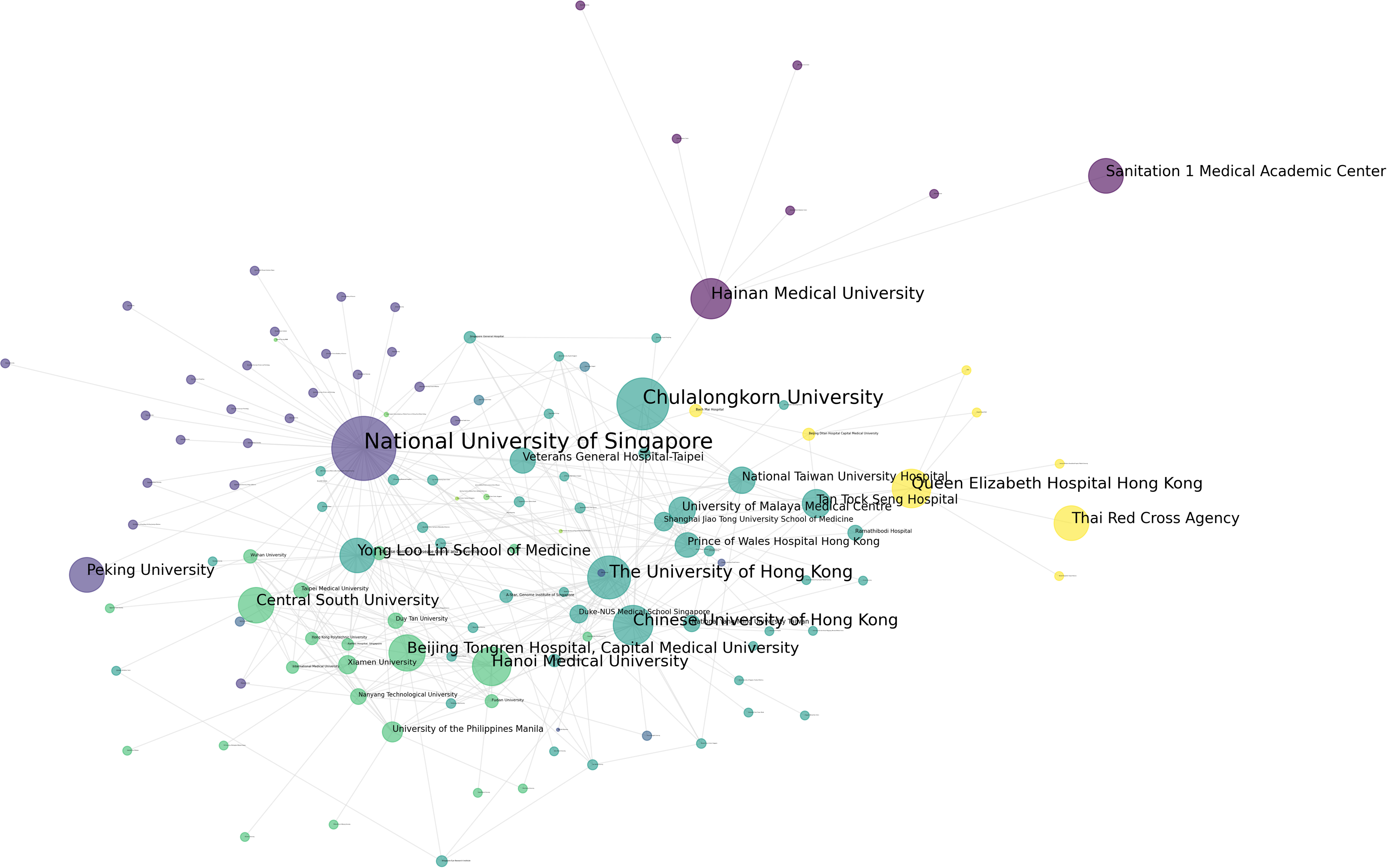
Collaboration network between China and ASEAN institutions.
Five clusters were identified in all the ASEAN institutions collaborating with China's institutions, comprising three big clusters and two small clusters. One big cluster was centered around National University of Singapore and Peking University, while another big cluster was centered around Chulalongkorn University, Yong Loo Lin School of Medicine, the University of Hong Kong, Chinese University of Hong Kong, University Malaya and National Taiwan University Hospital, and the rest one was centered on Central South University, Hanoi Medical University, Beijing Tongren Hospital, Capital Medical University, University of the Philippines Manila and Duy Tan University. The two small clusters were centered around Hainan Medical University and Sanitation 1 Medical Academic Center, and centered on Queen Elizabeth Hospital and Thai Red Cross Agency, respectively. These clusters were closely related, indicating that institutions in these countries or regions share common research areas of interest. The National University of Singapore ranked first in the scale, intensity and density of collaboration in the network, followed by Chulalongkorn University and the University of Hong Kong.
Table 2 shows the locations of top 50 most active chinese institutions in China–ASEAN collaborations in the above collaboration network. The Chinese regions with the closest collaborations with ASEAN include Taiwan (9996 cooperative papers), Hong Kong (6017 cooperative papers) and Beijing (4964 cooperative papers), which had 17, 8 and 9 highly collaborative institutions, respectively. Representative institutions in Taiwan included National Taiwan University Hospital (677 papers), Chang Gung Memorial Hospital (566 papers) and National Yang-Ming University (500 papers). Representative institutions in Hong Kong included The University of Hong Kong (1394 papers), The Chinese University of Hong Kong (1363 papers) and Prince of Wales Hospital (628 papers). Beijing's representative collaborative institution was Peking University (378 papers). It is obvious that, primarily due to regional influences, most collaborative institutions were located in southern China.
Distribution of top 50 most collaborative Chinese institutions with ASEAN.

From another perspective, Table 3 shows the locations of top 10 most active ASEAN institutions in China–ASEAN collaborations in the collaboration network. According to this table, seven institutions are from Singapore, accounting for 81.4% of the total collaboration volume among the top 10 institutions, two are from Thailand (10.5%) and one is from Malaysia (8.1%). The institution with the highest collaboration volume with China is the National University of Singapore, with 3249 collaboration times, followed by the Yang Lu Ling Medical School with 1725 times and Duke-National University of Singapore with 967 times, all of which are from Singapore. It can be seen that Singapore has closer ties with China in the field of medical and health. However, there is still potential for further enhancing collaboration between China and other ASEAN countries.
Top 10 most cooperative ASEAN institutions with China.

Analysis of the dominance of China–ASEAN collaboration
The dominance share of the international cooperative literatures that a country participated in can often reflect a country's leading role in scientific research collaboration.
Figure 6 displayed the number of dominant literatures and dominance share of the collaboration of China in the medical and health field from 1992 to 2021.The volume of collaboration led by China has been on a positive upward trend, with an average growth rate of approximately 17.22% every 10 years. After 2000, the volume of collaborative literature led by China has shown an increasing trend, particularly since 2011. Prior to 2000, China's collaborative leadership rate exhibited a small fluctuating trend, as the number of papers published by China and ASEAN countries was relatively low. After 2000, China's collaborative leadership rate showed an overall upward trend, increasing from 62% in 2000 to 75% in 2020, a growth of 13 percentage points over 20 years. Although China's dominant literatures decreased slightly in 2021, dominance share of the collaboration remained at 75%. Overall, China's leadership in international collaboration in the field of medical and health has greatly improved in the past 30 years.

The number of dominant literatures and dominance share of the collaboration of China.
Figure 7 showed that the dominance share of collaboration between China and the main cooperative ASEAN countries was fluctuating upward. Dominance share of collaboration fluctuated significantly before 2004 because the frequency of collaboration between China and ASEAN countries was low. After 2004, the dominance share of China–ASEAN collaboration was relatively stable. The dominance share of collaboration between China and Singapore held steady at 60%, which was higher than that of other countries, followed by Vietnam, Malaysia and Indonesia (approximately 40%). It can be seen that, at present, the collaboration mode between China and ASEAN countries was relatively balanced and the dominance share of collaboration was relatively low (far lower than the dominance share of collaboration between China and other countries). However, in recent years, there was a trend of gradual improvement of China–ASEAN collaboration.
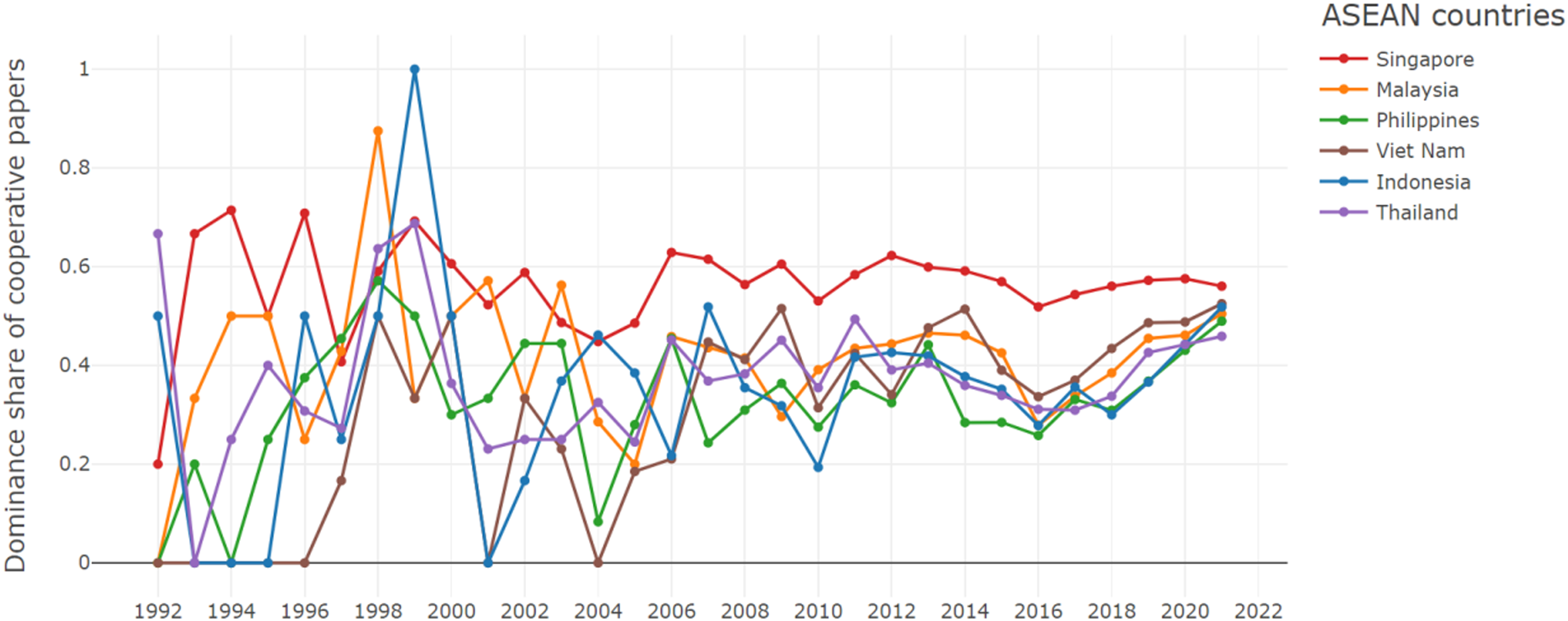
Dominance share of China–ASEAN collaboration.
Analysis of the impact of China ASEAN collaboration
To further compare the impact of cooperative papers between China and ASEAN countries, the annual CNCI median of cooperative papers between China and ASEAN countries between 1994 and 2021 were calculated (shown in Figure 8). The CNCI median is more conducive to reflecting the overall situation of the citation impact of cooperative papers, because the number of cooperative papers between China and some ASEAN countries was small.

Comparison of citation impact of cooperative papers between China and ASEAN countries.
It can be seen from Figure 8 that over the past three decades, the citation impact of cooperative literature published by China and the major cooperative ASEAN countries had fluctuated on the whole. The median CNCI stabilized between 0.63 and 1.02, while the average CNCI stabilized between 2.00 and 2.70. After 2002, the citation impact of the cooperative literature published by China and the major collaborative ASEAN countries fluctuated around the global benchmark. The citation impact of the cooperative literature published by China and Singapore had the highest median CNCI (1.02) and average CNCI (2.70), followed by Vietnam, Malaysia and Indonesia. The citation impact of other collaborative countries was low and unstable.
It can be seen that collaboration between China and ASEAN countries in the medical and health field can expand the impact of China's research papers in this field on the whole. However, this positive effect was only concentrated on collaboration between China and some major ASEAN countries at present. In addition, the large differences between the median and mean values of citation impact also reflect that scientific research collaboration in the medical and health field between China and ASEAN countries was ‘less’ but ‘better’. The scope and overall depth of collaboration need to be improved.
Analysis on the theme of collaboration between China and ASEAN countries
Table 4 presented the main research themes in the field of medical and health for both China and ASEAN countries. As shown in the table, China's main research themes in the medical and health field include oncology, cancer research, pharmacy, biomedical engineering and drug discovery. In ASEAN countries, the prominent research themes in the medical and health field are public health and occupational health, infectious diseases, pharmacy and drug discovery. It is worth noting that infectious diseases did not appear among the top 10 medical and health research themes in China, while some of China's major research themes in the medical and health field, such as oncology and molecular medicine, are not the main research areas of most ASEAN countries. Thus, there is strong complementarity in the research themes between China and most ASEAN countries in the medical and health field. Additionally, China and Singapore shared some of the main research themes, such as oncology and biomedical engineering, but with different focuses (China focuses on the former while Singapore focuses on the latter), indicating strong synergy in research themes between the two countries.
Main research themes of China and ASEAN countries.

By comparing the evolution of collaborative themes between China and ASEAN countries, we can identify the similarities and differences in research themes between China and ASEAN countries to find the future cooperative direction of China in this field.
The evolution trend of the hot themes of the cooperative literature can be deduced by analyzing the research field and publication timeline in the literature index data. The annual evolution trend of the top 10 major research hotspots in the cooperative papers between China and ASEAN countries included oncology, public health and occupational health, infectious disease, biomedical engineering, toxicology, immunology, molecular medicine, pharmacology, drug discovery and cancer research (shown in Figure 9). The collaboration between China and ASEAN countries in the fields of toxicology, infectious disease, public health and occupational health, oncology and pharmacy expanded significantly with a relatively high growth rate in the past 10 years, which are likely to continue to be the main research themes for China–ASEAN medical and health collaboration in the coming years. On the other hand, the collaboration in biomedical engineering, molecular medicine and immunology was relatively stable. Combining this result with the information shown in Table 4, we found that the collaboration between China and ASEAN countries leverages the research expertise of both sides in the medical and health field, with a significant complementary trend.
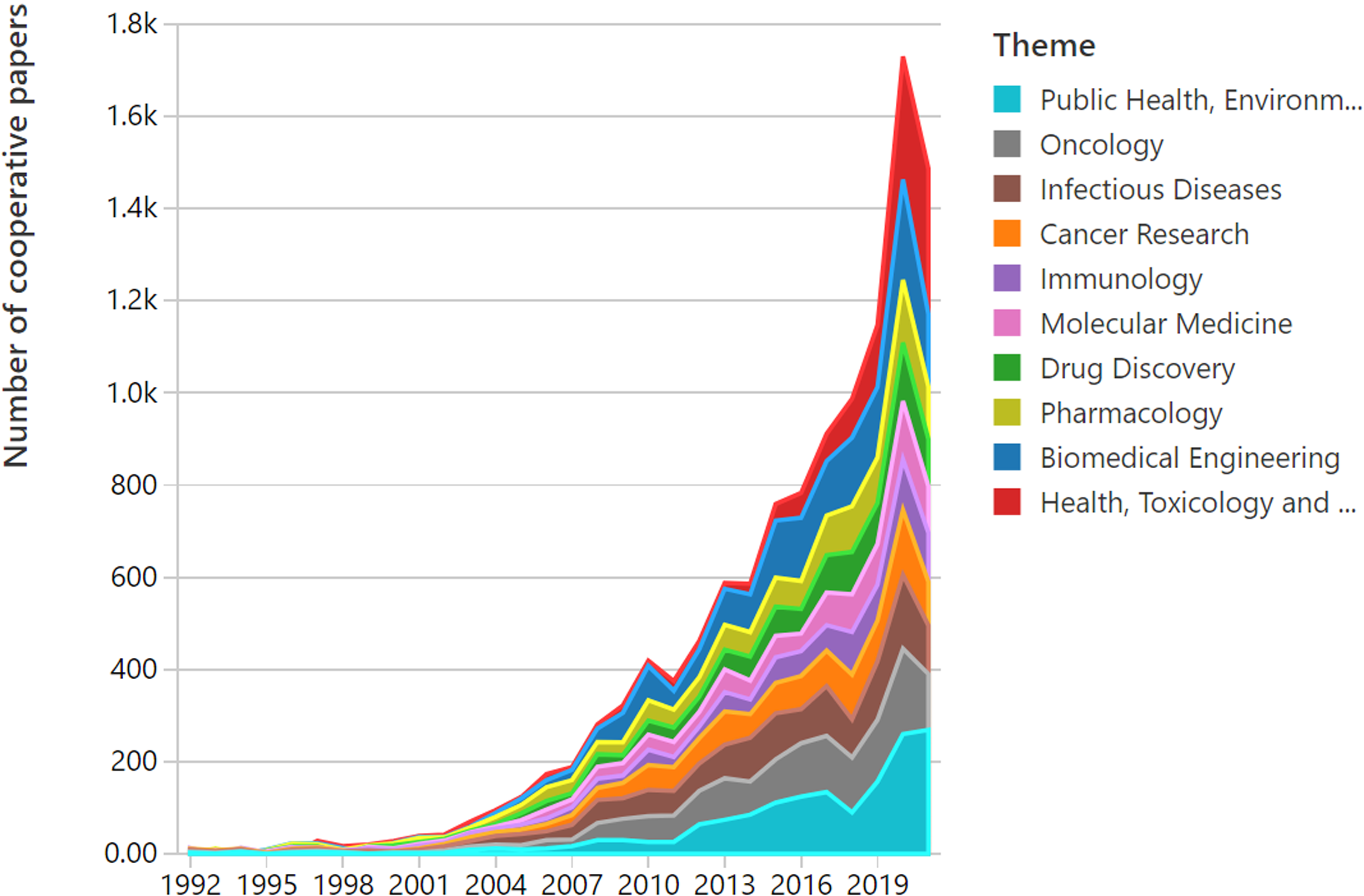
Changes in main research themes of China–ASEAN cooperative papers.
Discussion and conclusions
From a bibliometric perspective, this research explored the scale, collaboration network and distribution, impact of cooperative papers, dominance of collaboration, and evolution of collaborative research themes of China–ASEAN medical and health research collaboration from 1992 to 2021.
In terms of collaboration scale, the collaboration between China and ASEAN countries in the field of medical and health was gradually getting closer, and the number of cooperative papers showed a significant upward trend, especially in recent years. With the enhancement of China's comprehensive strength, China's development in the medical and health area has been recognized internationally, and its collaboration with ASEAN countries has become closer. China has experienced a multiple role transformation from an integrator to a supporter and then to an advocate in participating in global health governance. In the 30 years since the establishment of dialog between China and ASEAN countries, the scale of trade between China and ASEAN countries has expanded 85 times, and China has become the most important collaborative country of many ASEAN countries in the field of healthcare. Although the impact of the COVID-19 epidemic increased volatility between 2020 and 2021, the collaboration between China and ASEAN countries was generally good. The COVID-19 pandemic has strengthened the awareness of the ‘Human Health Community’ among people all over the world. Under the impact of the COVID-19 epidemic, collaboration between China and ASEAN countries in the field of healthcare continued to develop, not only in the output of the cooperative papers but also in China's support for the prevention and control of COVID-19 in ASEAN countries. Since the COVID-19 pandemic, China and ASEAN countries have continuously strengthened collaboration in the field of medical and health to jointly build the ‘China ASEAN Health Shield’, including increasing joint production and technology transfer of vaccines, carrying out collaboration in research and development of key drugs, helping ASEAN countries strengthen their construction of grassroots public health systems and personnel training, and improving their ability to respond to major public health emergencies.
In terms of collaboration network and distribution, the number of collaborations between China and ASEAN countries increased significantly. Among them, collaboration with Singapore was the closest, accounting for approximately 40% of the total medical and health collaboration between China and ASEAN countries. Singapore has a similar cultural background to China and is ahead of China in medical technology and medical resources. Since 1999, Singapore and China have signed a number of memorandums of collaboration plans and collaboration agreements, formulated bilateral medical and health development collaboration programs, encouraged medical and health exchanges and collaboration between the two countries, and mutually recognized the qualifications of some medical schools, laying a solid foundation for medical and health collaboration between the two countries. 16 In recent years, China's collaboration with Vietnam, Indonesia and Malaysia expanded slightly, accounting for 10%, 9% and 19%, respectively, in 2021. Vietnam has a highly overlapping disease spectra with China because it is a neighbor of China and has the similar climate and environment with Guangdong, Guangxi, Yunnan and other places in China. Some medical colleges and universities in Vietnam have maintained long-term collaboration with medical colleges and universities in Guangdong, Guangxi, Yunnan and other places in China and have constantly strengthened medical and health collaboration through student enrollment and exchange of doctors, teachers and students for further study. 17 China has continuously promoted collaboration with Indonesia, Malaysia and other countries in the medical and health field by signing memorandums of collaboration, receiving foreign students, cooperating in running schools, holding relevant international exchange meetings and other ways. 16 For Cambodia, Myanmar, Laos and Brunei, the number of collaborations with China was relatively low, with no significant change in the proportion. In terms of geographical distribution, the institutions in China with close collaboration with ASEAN countries were mainly located in Taiwan, Hong Kong and southern China. The institutions in ASEAN countries that collaborated closely with China were mainly located in Singapore and Thailand. The institutional collaboration network between China and ASEAN was obviously clustered, but the network connectivity was limited. As revealed in a previous study on China–ASEAN collaboration in higher education, collaborations between China and ASEAN often occur within relatively limited regions in southern China, and the scope of collaboration remains limited. Despite the fact that in recent years, more institutions in central and first-tier cities have begun to establish collaborations with ASEAN in the medical and health fields, there is still significant potential for expanding the breadth of collaboration. 18
In terms of dominance, the collaboration mode of China and ASEAN countries was generally balanced, and the dominance share of collaboration was relatively low (approximately 40–60%), which indicated that there is much room for improvement. The reason for the relatively low dominance may be that the medical and health scientific research collaboration between China and ASEAN countries has been developing at a low level for a long time, and the development trend has made a breakthrough in recent years. China can enhance its leading role in China–ASEAN medical and health collaboration on the basis of hardware conditions by accelerating the construction of basic scientific research facilities and increasing the funding of international cooperative scientific research projects. At the same time, China need to strengthen the cultivation of international talent. Through the planned training and enrichment of talent echelon, China will cultivate a group of high-end composite talents with high foreign language level, strong communication ability, excellent professional knowledge and the knowledge of relevant domestic and foreign industries. These talents with international vision, foreign language ability, technical background and international organization management experience will help to enhance the soft power of dominating China–ASEAN medical and health collaboration.
In terms of citation impact, the average annual citation impact of China–ASEAN collaboration papers was generally higher than that of all papers published by China. In the past 30 years, China's collaboration with ASEAN countries in the medical and health field has played a positive role in expanding China's impact in the medical and health field. However, at present, this positive effect is only focused on China's collaboration with some major ASEAN countries (Singapore and Malaysia). In addition, the large differences between the median and mean values of citation impact in the above analysis reflect that the medical and health scientific research collaboration between China and ASEAN countries was ‘less’ but ‘better’, which suggested that the scope and overall depth of collaboration still need to be improved.
In terms of research themes, most collaborations between China and ASEAN countries were focused on their own distinctive research topics. In recent years, collaboration in infectious diseases and public health has expanded significantly. Other research themes have also maintained a good complementary development trend in the past three decades. For a long time, China and ASEAN countries have suffered from all kinds of infectious diseases, faced similar public health problems and formed a joint prevention and control mechanism for infectious diseases and public health. Therefore, collaboration in infectious disease prevention and control, emergency health response, traditional medicine, talent training, global health governance and other fields has been strengthened. This is not only the trend of global health development but also a concrete manifestation of China's deepening of the construction of a human health community with ASEAN countries.
The collaboration between China and ASEAN in the medical and health field was generally on the rise, and the trend of complementarity in research was stable. However, there are still problems such as limited collaboration scale, narrow scope of participation in collaboration, and weak dominance. Based on the characteristics and shortcomings of the above findings, we propose the following suggestions to improve the collaboration between China and ASEAN countries in the field of medical and health: First, deepen international collaboration, accelerate infrastructure construction, explore the integration channels of international collaboration, actively integrate into the global medical and health collaboration network and jointly build a global medical and health governance system. Second, further strengthen medical and health research collaboration between China and ASEAN countries in light of regional differences. Adhering to the Silk Road spirit of ‘peaceful collaboration, openness and inclusiveness, mutual learning, and mutual benefit and win-win’, China will continue to consolidate and strengthen collaboration with major ASEAN countries, actively explore new collaboration patterns with other ASEAN countries (e.g. multi-party collaboration between government, non-government and ASEAN institutions 19 ), widely carry out academic and talent exchanges and further increase the number of research collaboration papers. Third, multidisciplinary research in the existing pattern of key collaboration areas should be actively expanded. At present, collaboration between China and ASEAN countries in the field of medical and health is mostly carried out around their own characteristic research themes. In the future, China should deepen the research on emerging medical and health disciplines, across disciplines and humanities and social sciences, comprehensively carry out multidisciplinary collaboration in all fields, dig deep into the existing research hotspots, actively explore new research fields and increase the depth and breadth of collaboration.
The bibliometric method used in this study is a type of descriptive method, which has inevitable limitations. The output of scientific literature represents the collaboration between research institutions or universities in the forefront of scientific research, which is an essential aspect in revealing China–ASEAN collaboration in the field of healthcare. However, the analysis based on scientific literature cannot completely reflect all aspects of the China–ASEAN collaboration, which may lead to certain biases in data and perspectives. Nevertheless, the results of this study still have value for revealing and understanding the current status of academic collaboration between China and ASEAN in the field of healthcare.
In future work, we will further explore other aspects of the collaboration between China and ASEAN; for example, text mining techniques can be employed to structure and quantitatively analyze relevant policy documents between China and ASEAN, revealing the mutual inclination and coordination of R&D policies. We can utilize data from databases such as the Derwent Patent Database to uncover cases of collaborative technological innovation between enterprises in China and ASEAN. Statistical databases like OECD-Statics and the United Nations International Organization for Migration can be used to analyze population inflow and outflow data between China and ASEAN. Additionally, databases like Scopus can further be utilized to construct address change sequences of researchers, enabling the study of transnational mobility among scientists between China and ASEAN.
Footnotes
Contributorship
XL, SW and ZH conceived the study and were involved in literature research, discussion of research results and suggestions. RZ contributed to the method development, coding and data analysis. RH and SW were involved in manuscript writing, discussion of research results and suggestions. YZ contributed to the data analysis and manuscript writing. YS was involved in the data analysis and manuscript writing.
Declaration of conflicting interests
The author(s) declared no potential conflicts of interest with respect to the research, authorship, and/or publication of this article.
Funding
The author(s) disclosed receipt of the following financial support for the research, authorship, and/or publication of this article: This work was supported by the Foreign Experts Service Department, Ministry of Science and Technology of the People’s Republic of China, Guangxi Higher Education Undergraduate Education Reform Project.
Guarantor
Zhaoquan Huang.
