



Abstract
Background
Since entering the 21st century, there has been an increasing interest in minimally invasive surgery for spinal diseases, which has led to the continued development of minimally invasive spine surgery (MISS), with major breakthroughs in technology and technical skills. However, in recent years, there is little relevant research using bibliometrics to analyze the field of MISS research. The purpose of this study is to sort out the publication situation and topic trends of articles in the field of MISS research from the perspective of bibliometrics.
Methods
The articles and reviews related to MISS from 2000 to 2022 were retrieved and downloaded from the Web of Science Core Collection (WOSCC). Visualization and knowledge mapping were performed using three bibliometric tools, including online bibliometric platform, CiteSpace and VOSviewer software. Curve fitting and correlation analysis were performed using Microsoft Excel software. The global research publication output, contributions of countries, institutions, authors, and journals, average citations per item (ACI), Hirsch index (H-index), research hot keywords, etc., in this field were analyzed.
Results
A total of 2384 papers were retrieved, including 2135 original papers and 249 review papers. In the past 22 years, the number of annual publications of MISS research has shown a steady growth trend. China contributed the most papers, and the United States ranked second, but the United States had the highest total citations, and H-index value. The most prolific institutions were Soochow University, Capital Medical University and Wooridul Spine Hospital. In this field, Professors Lee SH, Ahn Y and Yang HL have made significant achievements. However, there is relatively little international collaboration between institutions or researchers. World Neurosurgery is the most published journal on MISS research. According to the keyword co-occurrence analysis, recent keywords mainly focus on researches on minimally invasive modalities, techniques and prognosis, while on the keyword analysis of the ongoing bursts, percutaneous transforaminal endoscopic discectomy, lumbar diskectomy, spinal stenosis, recompression, diskectomy, endoscopic spine surgery, laminectomy, transforaminal lumbar interbody fusion, etc., will likely continue to be a research hotspot in the near future.
Conclusion
Looking at the temporal trend in the number of publications per year, the number of publications for the MISS study will increase in the near future. China has the highest number of publications, but the US has the highest quality publications. International cooperation needs to be further strengthened. Our findings can provide useful information for the academic community and identify possible research fronts and hotspots in the coming years.
Introduction
Minimally invasive spine surgery (MISS) has received more and more attention due to its advantages of less trauma and high efficiency. It has grown significantly over the past two decades, with major breakthroughs in technology and technical skills. 1 The reason for its rapid development2–5 is that, unlike traditional open spine surgery, MISS has less damage to muscle tissue, facet joints, and vertebral plate. In addition, it reduces the traction on the nerve root and dural sac, maximizes the stability of the surgical segment of the spine, and reduces the occurrence of long-term pain and discomfort due to spinal instability. It is precisely because of its advantages of less trauma, quick postoperative recovery, and spinal stability that MISS has become an important technology for the treatment of spinal degenerative diseases. For routine operations, such as the treatment of cervical or lumbar disc herniation, 6 spinal stenosis, 7 and pedicle screw fixation, 8 many surgeons prefer MISS techniques over mature open surgical techniques in recent years. At the same time, they also published a large number of studies related to MISS. However, the rapid growth in the number of publications makes it increasingly difficult for academics to keep up with the latest research. Although some meta-analyses and systematic reviews can provide scholars with basic information in the field, they only focus on some specific perspectives of MISS research, while some valuable information, such as annual growth trends in published output, current research analysis of hotspots, predictions of future research hotspots, and contributions of authors, institutions, and countries are rarely mentioned.9,10 Studies have indicated that an overview analysis of the knowledge structure and current research hotspots in a field can help researchers better understand and benefit from the field. 11
Bibliometric was defined by bibliometrics pioneers as ‘the application of mathematical and statistical methods to books and other media of communication’ and ‘the quantitative analysis of the bibliographic features of a corpus of literature’. It can quantitatively and qualitatively analyze vast amounts of publications on macroscopic and microscopic levels in a certain field. 12 Nowadays, bibliometric analysis has become an interdisciplinary approach that combines statistical methods and data visualization techniques and is becoming an important research method for evaluating international cooperation, citation analysis, research trends and hotspots in published literature in specific fields. 13 Several free visualization tools, including VoSviewer, 14 CiteSpace, 15 and BibExcel, 16 enable researchers to create knowledge structure maps and track scientific developments. As a result, bibliometric analysis has become an increasingly popular method to obtain the knowledge structure and current research hotspots in a field, and currently widely used in orthopedic diseases and surgical methods, such as spinal stenosis, 17 developmental hip dysplasia, 18 knee osteoarthritis, 19 spinal deformity 20 and atlantoaxial surgery, 21 etc. Since entering the 21st century, MISS has received extensive attention and research, and major breakthroughs have been made in its surgical technology and technical skills. However, to our knowledge, although there had been several bibliometric studies on discectomy and kyphoplasty,22,23 no attempt has been made to analyze the entire field of MISS in recent years. In order to fulfill this knowledge gap, the aim of this study is to visually demonstrate the overall research framework, major contributors, current research hotspots, and possible future research directions in this field.
Methods
Data collection
Although databases such as PubMed and Google Scholar can meet the needs of evaluating global MISS research trends, the data for this study were retrieved and downloaded from the Science Citation Index Expanded (SCI-Expanded) of the Web of Science Core Collection (WoSCC). WoSCC is one of the most comprehensive and authoritative database platforms for obtaining global academic information, and is considered to be the best database for bibliometric analysis.24,25
Retrieval strategies
The search was completed on March 15, 2023, subject to changes as the database is updated daily. The search formula is established with reference to previous research. 11 Search strategies were as follows: Title: ‘minimally invasive spine surgery’ OR ‘endoscopic foraminotomy’ OR ‘Key-hole Foraminotomy’ OR ‘percutaneous disc decompression’ OR ‘percutaneous endoscopic decompression’ OR ‘percutaneous vertebroplasty’ OR ‘percutaneous kyphoplasty’ OR ‘endoscopic discectomy’ OR ‘microendoscopic discectomy’ OR ‘Arthroscopic discectomy’ OR ‘endoscopic spine system’ OR ‘biportal endoscopic spinal surgery’ OR ‘percutaneous coblation nucleoplasty’ OR ‘unilateral biportal endoscopy’ OR ‘Endoscopic fusion’ OR ‘endoscopic spine surgery’ OR ‘percutaneous spinal surgery’ OR ‘percutaneous discectomy’, and Language: ‘English’ and Time Span:‘2000–2022’. A total of 2904 publications were retrieved, excluding 520 invalid records including conference abstracts, book chapters, brief reports, editorial materials, published online, retracted publications, corrections, news item, proceedings paper, reprints, letters, and non-English literary works. Ultimately, 2384 publications included 2135 articles and 249 reviews were included as the final dataset (Figure 1).
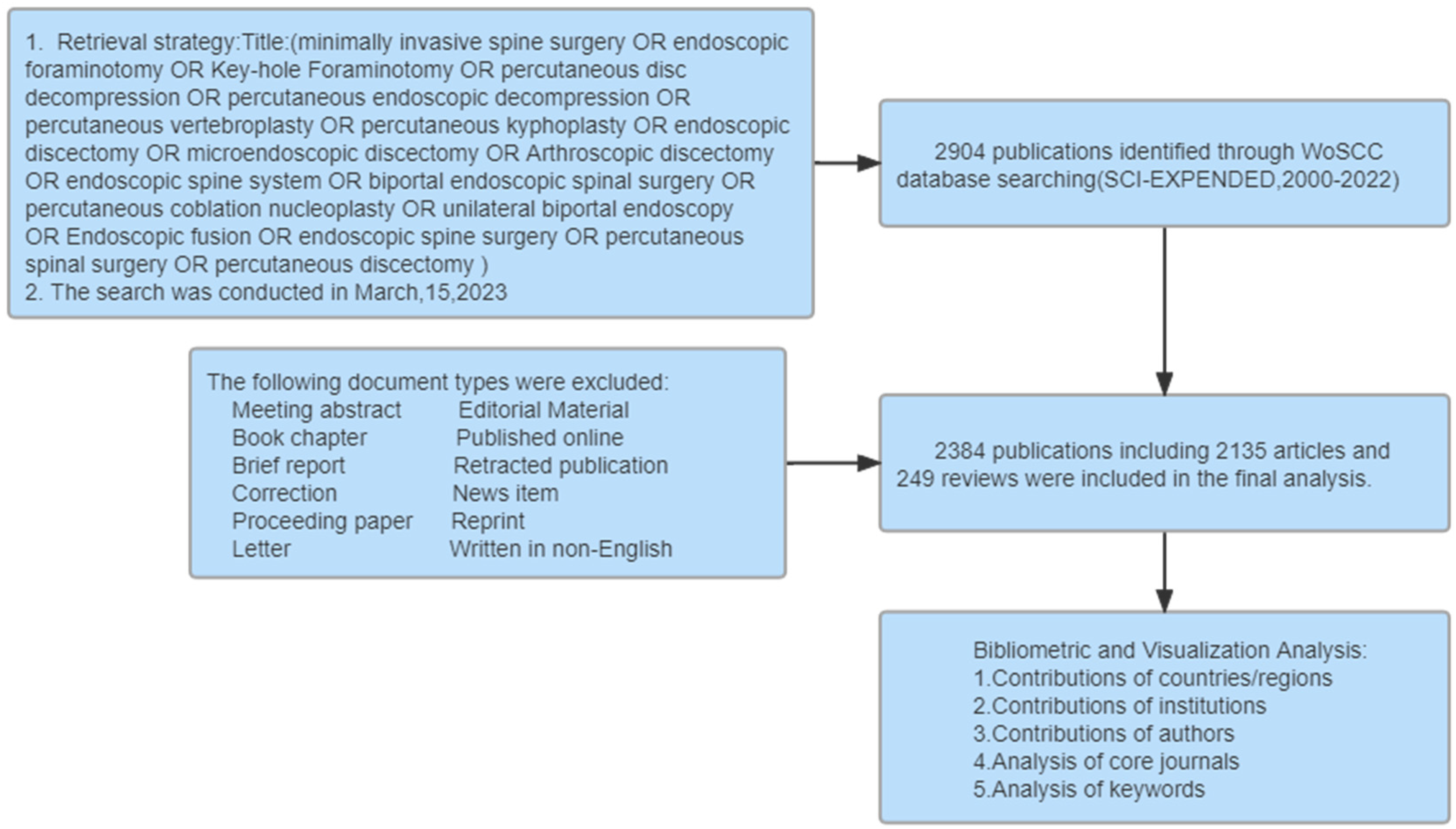
Flowchart for the selection of literature included in the study.
Data extraction and descriptive analysis
The records of all publications, including titles, abstracts, authors, nationalities, institutions, journals, keywords, references, etc., were downloaded and exported in plain text format, and these TXT files were imported into Microsoft Excel 2016 for further data processing and graphing.
In WoSCC, independent analysis of searched publications is carried out using the “Create Citation Report” function, which obtains basic information on publications, including Hirsch index (H-index) for country, institution, journal and author and the average citations per item (ACI). The H-index is an indicator for evaluating the quantity and quality of papers published by a country, institution, journal or author. It is defined as an individual publishing H publications, and each publication is cited at least H times. 26 ACI is another indicator that reflects the average number of citations of a publication in a corresponding year within a certain range, reflecting the value of the publication and its contribution to science. 11
Bibliometric and visualized analysis
Bibliometric and visual analysis was carried out by three bibliometric tools, including VOSviewer (Version 1.6.16, the Netherlands), CiteSpace (Version 5.7 R5, Drexel University, USA) and an online bibliometric platform (https://bibliometric.com/).
VOSviewer is a bibliometrics software developed by Professors Van Eck and Waltman 14 with text mining capabilities to extract important parameters from a large number of scientific publications for constructing and visualizing of co-authorship, co-citation, bibliographic coupling and co-occurrence network. 27 This research mainly uses this software to perform visual network analysis such as institutional co-author analysis, author-bibliographic coupling analysis, journal co-citation analysis, and keyword co-occurrence analysis.
CiteSpace, another bibliometric software developed by Chen, 15 is one of the most popular bibliometric tools for visualizing and analyzing scientific literature, and is often used to determine knowledge structure, distribution, as well as evolution in a given field. In this study, CiteSpace was used to perform a dual-map overlay of scientific journals and identify the latest 10 keywords in top 50 keywords with the strongest citation bursts.
In addition, an online bibliometric platform (https://bibliometric.com/) was also applied to conduct the collaboration analysis of countries.
Results
Literature publishing situation and trends of global research
After the screening of the above literatures, a total of 2384 published literatures were finally screened from 2000 to 2022, including 2135 original literatures and 249 reviews. The specific distribution of MISS research annual publications over the past 22 years is shown in Figure 2A. It can be seen from the figure that the global MISS research papers have shown a steady growth trend in the past 22 years, of which 52.1% (1242 papers) have been published in the past 5 years. In total, 54 countries have contributed to the development of this field of research. A world map of global research productivity is shown in Figure 2B.
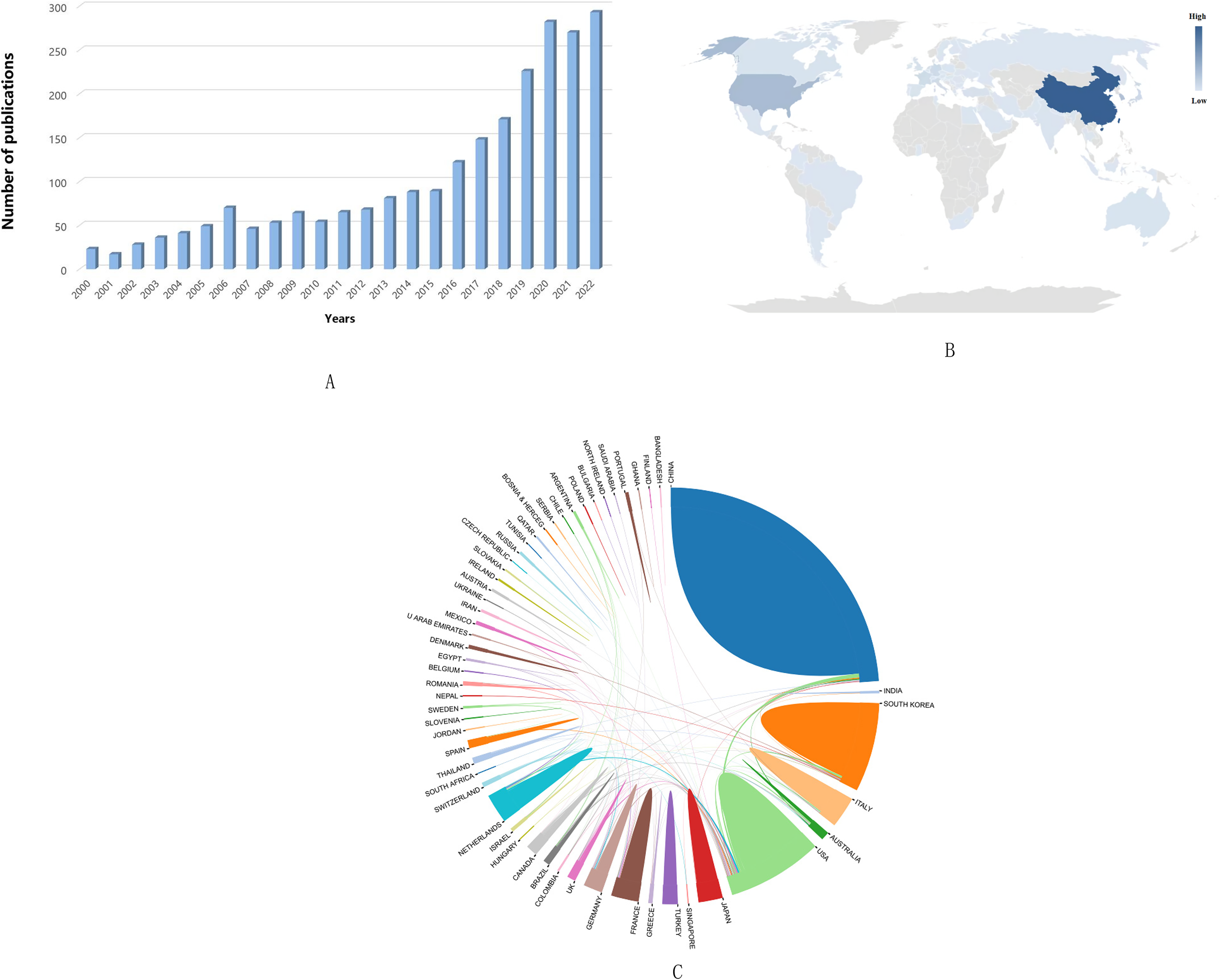
(A) The number of annual publications in MISS research from 2000 to 2022. (B) A world map showing global scientific output of MISS research. (C)The cooperation map of countries involved in MISS research (generated by online bibliometric platform). The color area indicates the number of publications. The larger the area, the more the counts. The lines represent the collaborative relationship between countries, and the thicker line indicates a closer relationship.
Contributions of countries/regions
Table 1 lists the top 10 countries that contributed the most research publications in the field of MISS research. As it is mentioned, China published the largest number of articles (1196/2384, 50.17%), followed by the United States (372/2384, 15.60%), South Korea (297/2384, 12.46%), Japan (100/2384, 4.19%), and Germany (85/2384, 3.57%). Although China published the most articles, it was not China (11,764) that had the highest total citations, but the United States (13,656). The France has the highest average citation frequency (38.61), followed by the Netherlands (37.51), United States (36.71), Germany (35.01), and South Korea (28.93). What's more, H-index in the United States (62) surpasses other countries and ranks first. South Korea (49) came in second, followed by China (41). As shown in Figure 2C, the analysis of international cooperation shows that the United States cooperates the most with the rest of the world.
Top 10 countries contributed to research publications in the field of MISS research.

Notes: Publications from England, Scotland, Northern Ireland, and Wales were assigned to the UK, while those from Hong Kong, Macau, and Taiwan belonged to China.
Contributions of research institutions
In terms of research institutions, it is roughly estimated that more than 2000 institutions are involved in research in the field of MISS. The histogram in Figure 3A details the publication volume, H-index, and ACI of the top 10 scientific research institutions. Seven of them are from China, two from South Korea and one from France. Soochow University China and China's Capital Medical University tied for first place with 62 papers, and South Korea's Wooridul Spine Hospital ranked third with 51 articles. From the perspective of H-index, Wooridul Spine Hospital has the highest H-index at 32, and Changgong Memorial Hospital has an H-index of 19. The highest ACI value was at Wooridul Spine Hospital (58.78), followed by Udice French Research Universities(33.73) and Catholic University (32.97). It is worth noting that despite the high number of articles published by Chinese institutions, the H-index and ACI values are not high. Using VOSviewer software to analyze the co-authorship network between institutions, it is found that the degree of collaboration between institutions is relatively low, as shown in Figure 3B.

(A) Top 10 institutions contributed to research publications in the field of MISS research. (B) The co-authorship map of institutions involved in MISS research (generated by VOS viewer). Each node represents a different institution, and the node size is proportionate to the number of publications. Different nodes were coded with different colors, depending on the average appearing year of the institution. Specific division information can be seen in the color gradient at the bottom right.
Contributions of authors
More than 9000 authors participated in the publication of these 2384 articles. As shown in Figure 4A, in terms of the number of publications, Lee SH from South Korea is the author with the most publications, followed by Ahn Y from South Korea and Yang HL from China. Among them, Lee SH and Ahn Y are from the same research unit. At the same time, they are also the top two authors with the highest H-index and ACI values. In Figure 4B, the author-bibliographic coupling analysis overlay visualization map was generated using VOSviewer software. It can be seen that later researchers in this field seem to be centered on Lee SH and Ahn Y.

(A) Top 10 authors contributed to research publications in the field of MISS. (B) The bibliographic coupling map of authors involved in MISS research (generated by VOS viewer). Each node represents a different author, and the node size is proportionate to the contribution of the research scope. The lines represent the collaborative relationship between authors, and the thicker line indicates a closer relationship.
Analysis of core journals and subject categories
A total of 825 MISS research articles were published in the top 10 journals by publication counts, accounting for 34.61% of all 2384 articles. Table 2 summarizes the basic information of these journals. World Neurosurgery published the most papers (181 papers, 7.59%), followed by Pain Physician (118 papers, 4.95%) and Spine (99 papers, 4.15%). Journal Impact Factor (JIF) is an important factor parameter to evaluate the value of journals and that of included publications. Pain Physician has the largest impact factor at 4.965, followed by Journal of Neurosurgery Spine (3.602) and Spine (3.468). In addition, Spine has the highest ACI value (59.45), and its H-index is also the highest (43). Journal Citation Reports (JCR) divides journals in the same WoS category into four equal parts based on the JIF value, with the top 25% classified as Q1, the top 25–50% as Q2, and so on. According to the JCR 2021 criteria, the top 10 most active journals are 6 in Q2 and 4 in Q3.
Top 10 journals in the field of MISS research ranked by the publication number.

In addition to publication counts, the impact of journals is also determined by how many times they are co-cited in a particular field of research. In this study, the co-citations of journals were analyzed using VOSviewer software. As shown in Figure 5A, journals with at least 100 citations were included in the visual analysis. The top four most cited journals are Spine, European Spine Journal, Journal of Neurosurgery Spine, and Pain Physician. Such results show that these journals have published a large number of high-level studies, which have attracted great attention from researchers in the field. Therefore, it can be expected that more high-quality research will be published in these journals. What's more, the dual-map overlay of journals represents the disciplinary distribution of journals participating in MISS research. As shown in Figure 5B, the citing journals are on the left, the cited journals are on the right, and the citation relationships are indicated by a color path. As can be seen from the figure, there are mainly six citation paths in the dual-map, including three green paths and three pink paths. The path indicated that literature published in Medicine/Medicine/Clinical and Neurology/Exercise/Ophthalmology journals mostly cited papers published in Health/Nursing/Medicine, Sports/Rehabilitation/Sport and Psychology/Education/Social journals.

(A) Journal co-citation analysis by using VOS viewer. Each node represents a different journal, and the node size is proportionate to the number of citations. (B) A dual-map overlay of the journals in MISS research by using CiteSpace. The labels represented different research topics covered by the relevant journals. The left side of the map was citing journals, while the right side was cited journals. Different colors and widths of lines originating from the citing map and ending at the cited map indicated the paths of the citation links. The path widths were scaled proportionally to the frequency of z-score-scale citation.
Keyword analysis of research hotspots
In bibliometrics, keyword co-occurrence analysis is a common method for identifying hot research topics. This study uses VOSviewer software to extract keywords from 2384 papers. As illustrated in overlay visualization map of Figure 6A, the 116 most frequently used keywords in the MISS study were included, and they appeared at least 30 times. Each keyword is represented by a different color based on the average occurrence year of the keyword in the literature. Purple nodes represent the keywords that appear earlier, while red nodes represent more recent keywords. The specific division information can be seen in the color gradient in the lower right corner. It can be seen that the early keywords mainly focus on the research of vertebroplasty and kyphoplasty, while the recent keywords mainly focus on the research on the modalities, technique and prognosis of minimally invasive surgery.
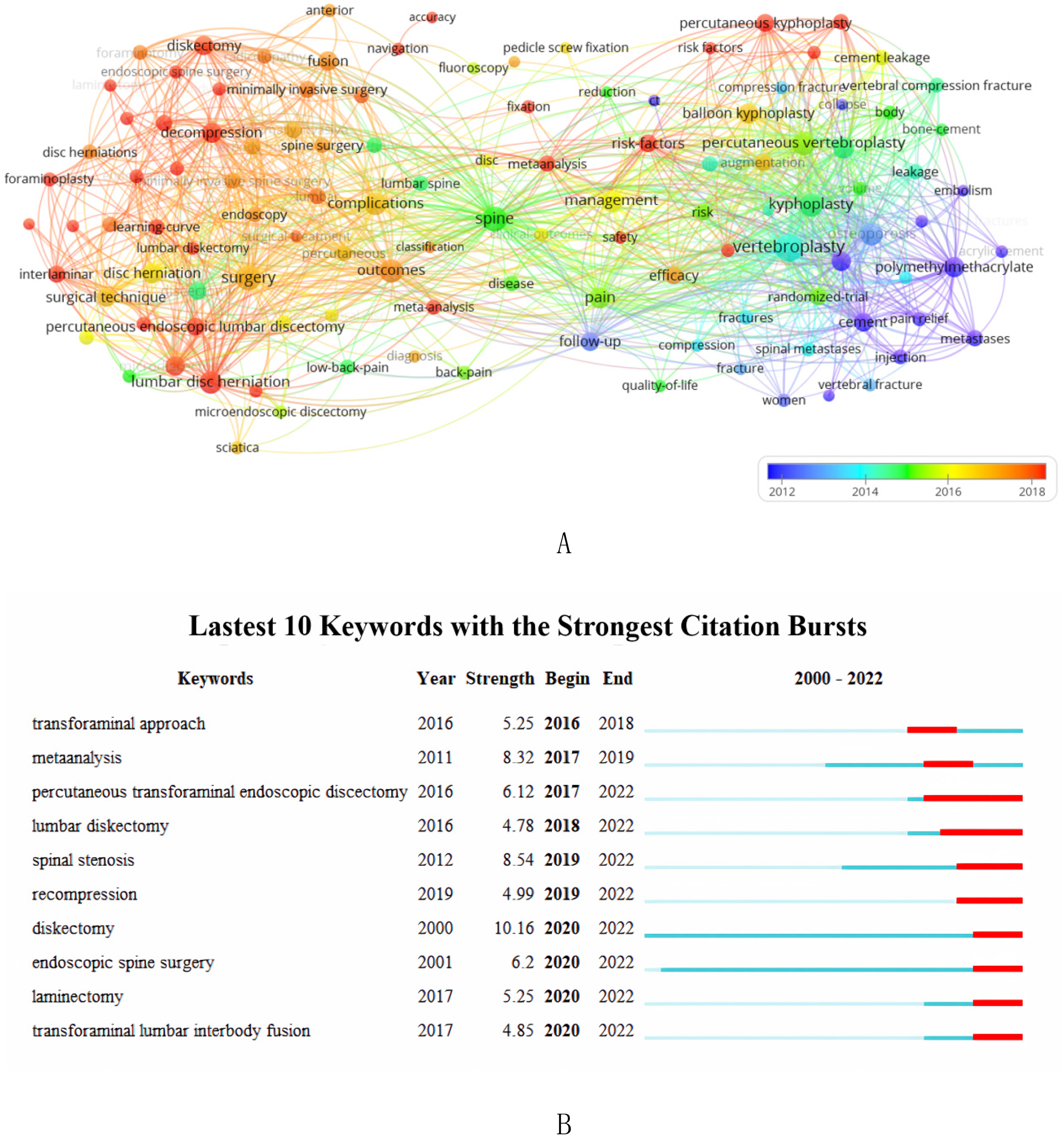
(A) Overlay visualization map of keywords co-occurrence analysis (generated by VOS viewer). Each node represents a different keyword, and the node size is proportionate to the number of publications. Different nodes were coded with different colors, depending on the average appearing year of the country. Specific division information can be seen in the color gradient at the bottom right. (B) Latest 10 keywords in top 50 keywords with the strongest citation bursts from 2000 to 2022 (generated by CiteSpace). Keywords with citation bursts refer to those that have been frequently cited in a period of time, which means that the keywords have received special attention from relevant academic researchers. The green line indicates the time interval, while the red line represents the duration in which a keyword was detected the strongest citation burst.
Keyword with the strong citation bursts analysis was performed using CiteSpace software. The burst keyword by CiteSpace is seen as another important signal reflecting research frontiers and trends. The strongest citation bursts of keyword are usually those terms that are mentioned widely in the article and attract a lot of attention. As shown in Figure 6B, it shows the latest 10 keywords in top 50 keywords with the strongest citation bursts from 2000 to 2022. The following, it should be noted, were the keywords with citation bursts that continue to 2022: “percutaneous transforaminal endoscopic discectomy (2017–2022),” “lumbar diskectomy (2018–2022),” “spinal stenosis (2019–2022),” “recompression (2019–2022),” “diskectomy (2020–2022),” “endoscopic spine surgery (2020–2022),” “laminectomy (2020–2022),” and “transforaminal lumbar interbody fusion (2020–2022).”
Discussion
Based on bibliometrics and visual analysis methods, this paper analyzes the development trend of global MISS research from the aspects of literature output, contributions of countries, institutions, authors, journals, and current research hotspots. As can be seen from the publication output, the number of annual publications of MISS research has shown a rapid upward trend over the past 22 years, which may indicate that people are increasingly interested in the development of this field, and there may be more research on MISS in published in the following years. According to the available knowledge, the rapid development of MISS research is caused by several factors, one of which may be the popularity of the concept of rapid postoperative recovery worldwide. 28 In addition, the rapid development of minimally invasive spinal instruments also provides the necessary conditions. 29
In terms of contributions of countries, China published the most papers, followed by the United States and South Korea, which have made great contributions to MISS research. Although China's literature publication volume far exceeds that of the United States, its H-index and ACI values are much lower than those of the United States. Indicators such as total citations and H-index are the highest in the United States, which confirms the high quality of American papers and their significant influence in the world. While pursuing the number of papers, China should pay more attention to improving the quality of papers. In addition, the cooperation visualization map shows that the cooperation between countries as well as between research institutions is relatively low, mainly concentrated in the United States. Interestingly, although some Asian countries have contributed greatly in the number of papers published, the cooperation between Asian countries and research institutions has not formed a cooperative network, which indicates the lack of academic exchanges between Asian countries and research institutions. Insufficient international cooperation may seriously affect research efficiency and quality. Therefore, as pointed out by some researchers, international cooperation and exchanges should be strengthened, which can not only improve the efficiency and quality of research, but also help to expand the depth and breadth of research and promote the development of scientific research.30,31
As for journal analysis, World Neurosurgery, Pain Physician and Spine published the most articles on MISS research. Among them, Spine is the most cited journal, indicating that that it has published a large number of high-level research, which has attracted great attention from researchers in this field. Therefore, it is foreseeable that future advances in MISS research may be published in these journals. In addition, as can be seen from the dual-map overlay of the journals, all publications mainly focus on target journals in two fields: (1) Neurology, Sports and Ophthalmology; (ii) Medicine, Medicine and Clinical. Whereas, the most-cited publications mainly focused on journals in three areas: (1) Health, Nursing, and Medicine; (ii) Sports, Rehabilitation, and sport; and (iii) Psychology, Education, and Society. It can be speculated that the research of MISS is of great significance to the development of these fields.
From the author's contribution, through the author's bibliographic coupling analysis, the relevant follow-up researchers seem to be centered on Lee SH and Ahn Y, which indicates that Lee SH and Ahn Y have an important influence on the development of this field. Lee SH and Ahn Y are from the same research institute. In 2004, they published an article on percutaneous endoscopic lumbar discectomy for recurrent disc herniation. The study has attracted widespread attention in the field of MISS research and has been cited more than 210 times so far. In addition to this, Lee SH and colleagues went on to publish several clinical studies on percutaneous endoscopic discectomy, including the classification of disc migration and surgical approaches, percutaneous endoscopic discectomy through the interlaminar approach, radiation exposure and surgical failure analysis of percutaneous endoscopic discectomy. These studies have also attracted a lot of attention in the field of MISS research, with each study being cited at least 100 times. These results suggest that percutaneous endoscopic discectomy is a safe and effective procedure for the treatment of disc herniation, even for patients with recurrent disc herniation, but the appropriate surgical approach or different methods should be selected according to the location and degree of the herniation.32–36
According to the average appearing year of keywords in the literature, the relationship characteristics of each keyword can be seen at a glance from the overlay visualization map of Figure 6A. We can see that the early keywords mainly focus on the research of percutaneous vertebroplasty (PVP) and percutaneous kyphoplasty (PKP), while the recent keywords mainly focus on minimally invasive surgical methods, techniques and prognosis studies. PVP was first proposed by French professor Galibert, who used this procedure to treat cervical vertebral hemangioma with great success. 37 Subsequently, PVP quickly became the treatment of choice for osteoporotic vertebral compression fractures and is very popular in Europe and the United States. In 2001, Reiley et al. 38 developed an inflatable balloon that can create a space in the vertebral body, and then inject bone cement to restore the fractured collapsed vertebral body, thereby restoring the height of the vertebral body and enhancing the strength of the vertebral body. This procedure not only relieves the patient’s pain, but also corrects the kyphosis of the spine, so it is called PKP. As a matter of fact, PKP is based on the development of PVP. PVP and PKP provide a very effective new method for the treatment of osteoporotic thoracolumbar compression fractures because of their small trauma and rapid pain relief. 39 Therefore, they have good application prospects in the treatment of thoracolumbar vertebral compression fractures, and then quickly swept the world in just over 30 years. With the popularization of the concept of fast postoperative recovery, spinal surgery has gradually developed to be minimally invasive and has gradually begun to replace part of open surgery. In addition to the above-mentioned percutaneous techniques, tube techniques and endoscopic techniques are also popular. 40 Endoscopic techniques began in 1975 when Hijikata treated lumbar disc herniation by percutaneously decompressing the disc under x-ray. 41 Then in 1999, Yeung developed the Yeung Endoscopic Spine System, which is considered to be the foundation of modern percutaneous spinal endoscopic technology. 42 Subsequently, many investigators have modified endoscopic techniques. The above-mentioned Lee SH group is one of the typical representatives, and the first translaminar approach they reported had an important impact on the development of endoscopic techniques. 30 With the continuous advancement of minimally invasive techniques and equipment, the indications for endoscopic therapy are constantly expanding. Currently, endoscopic techniques have been widely used in cervical, 43 thoracic, 44 lumbar, 45 and interbody fusion. 46
In addition, we also used CiteSpace to analyze the temporal trend of the migration of research hotspots for the 50 most frequently cited keywords from 2000 to 2022. Studies from 2000 to 2012 mainly focused on the etiology, diagnosis, screening, symptoms, treatment, and prognosis of osteoporotic vertebral fractures, indicating that MISS studies in this period mainly focused on osteoporotic vertebral fractures. From 2013 to 2022, research focus turns to minimally invasive surgery for spinal degenerative diseases. The representative keywords are microdiscectomy, lumbar diskectomy, fusion, percutaneous transforaminal endoscopic discectomy, and foraminotomy, reflecting the diversified development of surgical methods. At present, minimally invasive surgery of the spine has been applied to tumors, 47 deformities,48,49 and trauma. 50 In the past years, from 2017 to 2022, the most frequently occurring keywords were percutaneous transforaminal endoscopic discectomy, lumbar diskectomy, spinal stenosis, recompression, diskectomy, endoscopic spine surgery, laminectomy, transforaminal lumbar interbody fusion, these it may continue to be a research hotspot in recent years.
By bibliometric analysis of current global research publications in the field of MISS, neurological surgeons and related scholars can learn about the overall publication status and latest research hotspots of papers in this field in recent years, which has certain implications for clinical work and academic research. In addition, government research funds can selectively provide financial support for current research hotspots and evidence-based practice in clinical work according to current research trends. 51
Limitations
There are several limitations inherent in bibliometrics in this study. First, one of its limitations is the potential for incomplete retrieval of studies due to the search terms being restricted. Nonetheless, we believe that the vast majority of MISS research have been included and the sample size is adequate. Second, the bibliometric data included in this study were all from the WoSCC database, ignoring other large databases. Thus, some relevant literature contained in other databases may inevitably be missed. However, as stated in previous studies, WoSCC is one of the most comprehensive and authoritative database platforms for obtaining global academic information, and is considered to be the best bibliometric analysis database.24,25 The data in the WoSCC literature are sufficient to reflect the current state of MISS research. In addition, different databases have different characteristics, including file output formats and citation calculation methods. Merging multiple databases might not be the best option. Third, another limitation of this study is that due to software limitations, this study only analyzed English-based publications, ignoring several high-quality non-English articles.
Conclusion
We summarize the publications of MISS research from 2000 to 2022, including contributions of countries, institutions, authors, and journals, and analyze the overall knowledge structure, development trends, and research hotspots in this field. It can be speculated that there will be more and more articles on MISS research in the near future. China publishes the largest number of papers in this field, but the quality of the papers is not high. The United States ranks second in the number of articles published, but the quality of the articles is the highest, and has a great impact on the entire world. There is little international collaboration in the field of MISS research. Therefore, cooperation between countries and institutions should be strengthened to improve the efficiency and quality of research. In addition, it is recommended that more attention be paid to the following research topics: percutaneous transforaminal endoscopic discectomy, lumbar diskectomy, spinal stenosis, recompression, diskectomy, endoscopic spine surgery, laminectomy, transforaminal lumbar interbody fusion and so on. In summary, through bibliometric analysis, neurological surgeons and related scholars, especially new entrants, can clearly understand the basic knowledge structure of the field, including the contributions of countries, institutions, authors, and journals, research hotspots and frontiers. We hope these analyses will inspire them and benefit the development of MISS.
Footnotes
Acknowledgements
The authors thank Dr Xuecheng Huang for his theoretical guidance on this study. The funders had no role in study design, data collection or analysis, decision to publish, or preparation of the manuscript.
Contributions
(I) Conception and design: R Weng, DX Lin, YK Song ; (II) Administrative support: QS Wei; (III) Collection and assembly of data: HW Guo, WS Zhang, XM He; (IV) Data collation and plotting: WC Li, HH Lin, MC He; (V) Data analysis and interpretation: MC He, QS Wei; (VI) Manuscript writing: All authors; (VII) Final approval of manuscript: All authors.
Declaration of conflicting interests
The author(s) declared no potential conflicts of interest with respect to the research, authorship, and/or publication of this article.
Funding
The author(s) disclosed receipt of the following financial support for the research, authorship, and/or publication of this article: This study was supported by the Double First-class Discipline Construction Project of Guangzhou University of Chinese Medicine (Grant Number: Z2015002), the Major Project of “Double First-class” and High-level University Discipline Collaborative Innovation Team of Guangzhou University of Chinese Medicine (Grant Number: 2021XK05), the Cultivated Project of “Double First-class” and High-level University Discipline Collaborative Innovation Team of Guangzhou University of Chinese Medicine (Grant Numbers: 2021XK41).
Guarantor
QS Wei.
