




Abstract
Objective
The aim of this study was to describe the benefits of digital health and social services perceived by older adults and to examine factors associated with perceiving these benefits. Several factors related to (a) sociodemographic characteristics, (b) area of residence, (c) physical, cognitive, psychological, and social functioning, and (d) Internet use, were examined.
Methods
The present sample included 8019 respondents aged between 75 and 99 years. The inverse probability weighting method was used to correct for bias. Linear regression analyses were used to examine the associations.
Results
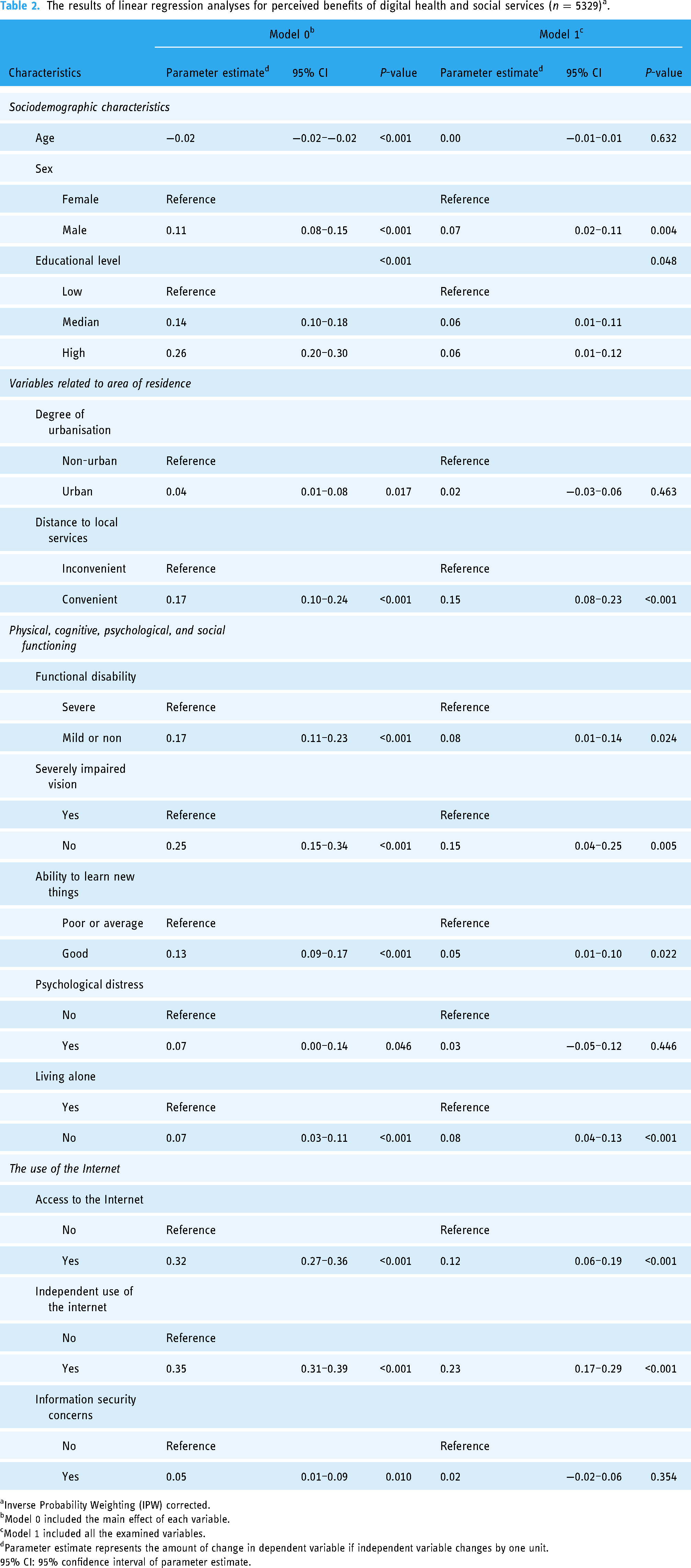
The ease of use of the services regardless of the time and location was perceived as the most beneficial. Convenient distance to local health or social services (parameter estimate = 0.15 [0.08–0.23]), good functional ability (PE = 0.08 [0.01–0.14]), good vision (PE = 0.15 [0.04–0.25]), ability to learn (PE = 0.05 [0.01–0.10]) and living with someone (PE = 0.08 [95% CI 0.04–0.13]) were associated with perceiving more benefits. In addition, access to the Internet (PE = 0.12 [0.06–0.19]) and independent use of the Internet (PE = 0.23 [0.17–0.29]) were associated with perceiving more benefits.
Conclusions
Older adults who are healthier, have a social relationship in their everyday life or have easier access to traditional services seem to perceive more benefits from digital health and social services. Digital services should be developed to correspond with special needs caused by disadvantages in health and the social environment. To facilitate the use of digital health and social services, more efforts should be made to enhance older adults’ perceptions of their benefits.
Keywords
Introduction
Societies worldwide are aging as life expectancy is lengthening. 1 With the aging of the population the number of older adults living with disabilities and long-term illnesses will also increase.2,3 This increases the populations’ health care demands4,5 and reliance on social services. 6 Simultaneously older adults face problems accessing health and social services as provision seems to become increasingly scarce7,8 and deterioration in mobility limits their abilities to leave their homes to receive services. 9
The use of digital services provides older adults with an opportunity to compensate for potential losses in their mobility,9,10 improves access to health and social services and supports in the management of one's own health and wellbeing5,11,12 Moreover, the use of digital health and social services may foster active aging and help older adults to manage their health and remain independent longer, ultimately promoting better wellbeing and quality of life.7,12,13 From the service providers’ perspective the use of digital services has the potential to improve the allocation of scarce resources and the efficiency and cost-effectiveness of the services.7,11,14
The dissemination of technology and digital services is increasing 15 and the coronavirus disease 2019 (COVID-19) pandemic even accelerated the provision and use of digital services as alternatives to in-person visits. 16 However, the increased provision of digital services has the potential to exacerbate digital exclusion especially among the oldest of the older adults, 17 enforcing the already existing inequalities in society and in health and wellbeing.18–20 Although older adults are increasingly using technology, previous literature indicates that they typically have lower access to and usage of digital technologies18,21–23 and are less likely to adopt22,24 and learn 25 current technologies required to access the Internet and digital services compared to younger adults.
Perceptions of the benefits of digital technology, the Internet and digital services are strongly associated with their adoption and use.5,7,15,26,27 Older adults have been shown to have less interest in digital services 28 and perceive fewer benefits12,18,29 compared to younger generations. Sociodemographic factors such as male gender 12 and higher education26,29 have been reported to be associated with perceiving more benefits from the use of the Internet and digital services. In addition, potential associations between health status and perceived benefits of digital services have been identified 18 and declines in physical and cognitive functioning have been reported to be associated with non-use of digital technology and the Internet.12,30,31 People living alone have previously perceived fewer benefits of the use of digital services and the Internet 29 and concerns have been raised regarding the risk of digital exclusion among socially isolated individuals. 18 Moreover, access to technology25,27 and trust in the security of digital services are key in perceiving benefits from these services. 18
However, previous studies mainly concern the factors associated with the use and perceptions of the benefits of the Internet and digital services in general and adults of all ages have been included as participants. Moreover, most previous studies have included only participants who use the Internet and little research has been conducted using a nationally representative sample of older adults. Given the rapid aging of the population and the increased provision of digital services, it is essential to understand how older adults perceive the benefits of digital health and social services, as their perceptions are strongly associated with the use. 18
This study aims to evaluate the benefits perceived by older adults of digital health and social services and to examine which factors are associated with these perceived benefits. Several factors related to (a) sociodemographic characteristics, (b) area of residence, (c) physical, cognitive, psychological, and social functioning, and (d) the use of the Internet, were examined. The findings of this study might offer a better understanding of the perceived benefits of digital health and social services and the associated factors. This information could be beneficial in developing future digital interventions to improve the health and wellbeing and quality of life of older adults as well as to increase service utilisation and reduce disparities.
Finland provides a fruitful context for conducting the study as it is one of the fastest-aging societies in Europe 32 and among leading countries in digitalisation. 33 In addition, the number of chronic conditions is above the average of the European Union 8 and the uneven geographic distribution of health and social care resources has been argued to reinforce disparities in access to services.8,34
Methods
Sample
This study was conducted as a part of the FinSote 2020 National survey of health, wellbeing, and service use in Finland. 35 The national survey consisted of three questionnaires that were modified for different age categories and included a questionnaire for respondents aged 75 years or more. The questionnaire was sent using stratified sampling to 17,600 Finnish residents who had reached the age of 75 years. A possibility to respond in Finnish, Swedish, Russian, or English, either in digital or paper form, were offered. During the data collection, participants who had not responded were approached by mail up to four times. The data were collected between September 2020 and February 2021 during the second wave of the COVID-19 pandemic.
Altogether 9919 Finnish residents who had reached the age of 75 years (60.3% female, mean age 81.45 years, SE 0.06) responded to the questionnaire (response rate 52.3%). The majority of the respondents (94.7%) participated by answering the questionnaire in paper format. In total, 8019 respondents had responded to the items concerning the perceptions of the benefits of digital health and social services and were included in the analyses. The inverse probability weighting (IPW) method 36 was used for the received responses to improve the accuracy of the results and remove most of the non-response bias. 37 The weights were estimated using sociodemographic register-based variables including the respondents’ age, sex, marital status, area of residence, and native language, received from the National Population Register.
Measurements
Dependent variable
The perceived benefits of digital health and social services were measured with six statements which were developed based on the Finnish National Strategy for Electronic Health and Welfare 2020. 38 The respondents were asked to select how they felt about the following statements concerning the benefits of digital health and social services: They (1) help me to assess the need for services, (2) support me in finding and choosing the most suitable service, (3) make it easier for me to use services regardless of where I am and when, (4) make it easier for me to collaborate with professionals, (5) help me to take an active role in looking after my own health and welfare, and (6) help me to take care of the health, welfare and functional capacity of family or friends. A 5-point Likert scale was used to answer the statements (1 = completely disagree to 5 = completely agree). A mean variable ranging from one to five was calculated for each respondent to represent the level of how beneficial they perceived digital health and social services. The Cronbach's alpha value for the statements was 0.94, representing excellent internal consistency of the items. 39
Independent variables
Independent variables included characteristics concerning respondents’ (a) sociodemographic background, (b) area of residence, (c) physical, cognitive, psychological, and social functioning, and (d) the use of the Internet. The used independent variables are described more in detail in Supplemental Material.
The respondents’ sociodemographic characteristics included age, sex, and educational level. These were used only as adjustments, as these factors have already been extensively studied.
The area of residence included the degree of urbanisation, determined based on the municipal classification, and distance to local services. The distance to local services was assessed by asking the respondents separate questions about whether difficult access to the place of service had interfered with receiving treatment and social services in the past 12 months.
Factors related to respondents’ physical, cognitive, psychological, and social functioning included functional disability, impaired vision, the ability to learn new things, psychological distress, and living alone. Widely used instruments, Global Activity Limitation Indicator 40 and Mental Health Inventory 41 were used to measure the functional disability and psychological distress, respectively. Both instruments have shown good validity and reliability.42,43 Access to the Internet, independent use of the Internet, and information security concerns were included as factors related to the use of the Internet.
Statistical analysis
In all statistical analyses, the IPW method 36 was applied to correct bias resulting from differential sampling probabilities and missing data. Complex Samples Multiple Linear Regression analyses were used to examine the adjusted associations of respondent characteristics with the perceived benefits of digital health and social services. First, separate analyses (Model 0) were conducted to examine the association of each independent variable with the dependent variable, adjusted for age, sex, and educational level. Second, a fully adjusted multivariable model (Model 1) was formed to measure the joint effects of all the independent variables, adjusted for age, sex, and educational level.
The appropriateness of the linear model was examined for a linear relationship, non-collinearity, normal distribution, homoscedasticity, and non-correlation of residuals. Statistical methods suitable for weighted data were used and SPSS 27 was applied for the analyses. Due to nonresponse in some items, the number of observations varies in the analyses.
Results
Characteristics
The characteristics of the respondents are presented in Table 1. The mean age of the respondents was 81.1 years. Over half of the respondents were females and lived in urban municipalities. Most respondents reported having convenient distance to their care provider (87.1%). A minority of the respondents had a severe functional disability (14.8%) or severely impaired vision (6.2%). Approximately two-thirds of the respondents (61.5%) had access to the Internet, and almost half (48.3%) used the Internet independently.3
The characteristics of the respondents (IPW weighted) n = 8019 a .

Inverse Probability Weighting (IPW) corrected percentiles, n-size uncorrected.
Perceived benefits
The distribution of the perceived benefits of digital health and social services experienced by older adults are described in detail in Figure 1. The respondents mostly had neutral perceptions of the benefits of digital health and social services (mean 3.23, SE .01), as most older adults did not agree or disagree with the statements describing the benefits.

Perceived benefits of digital health and social services by older adults (n = 8019, weighted percentiles).
One-third (33%) of older adults perceived that digital health and social services eased the use of the services regardless of the time and location. Slightly under one in three perceived that digital health and social services support them in finding and choosing the most suitable service (30%) and made collaboration with professionals easier (28%). The respondents found the following statements less beneficial: digital health and social services help in taking an active role in looking after one's own health and welfare (25%), help to take care of the health, welfare and functional capacity of family or friends (23%) and help to assess the need for services (22%).
Table 2 shows the results of multivariable linear regression Model 1 for perceived benefits of digital health and social services. Model 1 explained 11% of the variance (R²) in perceiving benefits of digital services. In Model 1, living alone, the distance to local health or social care services, physical and cognitive functioning, and access to the Internet and ability to use it independently remained statistically significant variables associated with perceiving benefits of digital health and social services. Older adults who experienced that their local health or social services were convenient to reach perceived more benefits from digital health and social services compared to their counterparts with inconvenient proximity. Older adults with good functional ability or vision and with a good ability to learn, perceived digital health and social services to be more beneficial than their counterparts with severely impaired functional ability or vision and with a poor ability to learn. Older adults who lived together with someone perceived digital health and social services as more beneficial than those who lived alone. Older adults who had access to and used the Internet independently perceived more benefits from digital health and social services than those without access and independent use of the Internet.
The results of linear regression analyses for perceived benefits of digital health and social services (n = 5329) a .
Inverse Probability Weighting (IPW) corrected.
Model 0 included the main effect of each variable.
Model 1 included all the examined variables.
Parameter estimate represents the amount of change in dependent variable if independent variable changes by one unit.
95% CI: 95% confidence interval of parameter estimate.
Discussion
The study aimed to evaluate the benefits perceived by older adults of digital health and social services and to examine which factors are associated with these perceived benefits. Older adults who participated in this nationally representative survey study had predominantly neutral perceptions of the benefits of digital health and social services. Facilitation of the use of services regardless of time and location was perceived as the greatest benefit of digital health and social services. Improved access and convenience have also previously been found as perceived benefits of digital services, 44 for example, because digital services reduce the need for physical queuing or travelling to reach the traditional place of service provider.14,45 Digital technology has been perceived to be a practical, inexpensive and good alternative to traditional services among older adults. 44 The overall neutral perceptions could be anticipated to reflect the fact that digital services in the Finnish field of social care have not been as widely used as in health care, 45 and many may not have specific expectations or perceptions of them. However, the most used digital health and social service, the national patient portal My Kanta Pages, has gained satisfaction among older adults. 46 The citizens’ might be anticipated to have capabilities for wider adoption of digital social services because many are already familiar with digital health services. 45
Respondents who had a convenient distance to their local health or social services perceived more benefits from digital services than their counterparts, even after adjusting for the degree of urbanisation. The result is unexpected, as digital health and social services have aimed to improve access to services, regardless of the distance to the local services.11,45,47 Previous studies have observed that urban populations seem to have fewer health concerns compared to rural areas.48,49 This could partly explain the results as high and complicated service needs are more difficult to fulfil with digital services. On the other hand, the finding is an alert to the question of whether older adults in rural environments receive enough information about digital services. The fact that older adults in the present study reported the facilitation of the use of services regardless of time and location as the most beneficial aspect of digital health and social services is encouraging and particularly important in sparsely populated countries such as Finland.
Learning new things requires high cognitive involvement 9 and capabilities for processing and reasoning, which generally decline among the aging. 15 Cognitive disabilities are associated with poor digital competence and the non-use of digital technology, the Internet, and digital services.47,50–54 In the present study, older adults with a good ability to learn new things perceived digital health and social services to be more beneficial than their counterparts with a poor ability to learn new things. This is similar to previous research indicating that normal cognitive functioning is associated with perceiving digital health services to be more beneficial. 11 The result is expected but worrying because with the aging of the population, for example, every year thousands of people are diagnosed with dementia and have cognitive problems. 55 Digital health and social services do not yet seem to serve the needs of these people. However, the use of digital technology could stimulate older adults’ cognitive abilities and functioning 23 by offering them an intellectual learning activity.51,56 This would require simplified language in digital services and more pronounced and planned support for the use of digital services.
In the present study, older adults without severe functional disabilities perceived digital health and social services as more beneficial than their severely disabled counterparts. Experiencing physical limitations seems to have a significant impact on older adults’ ability to use technology.57,58 Previous research has discovered an association between functional limitations and non-use of the Internet among older adults,25,50 and computer users have been reported to be significantly healthier than nonusers. 59 Moreover, poor health has predicted the low use of digital services among older adults, 17 and concerns have been raised about whether older adults with limited functioning benefit from digital services. 54 The use of technology could improve the quality of life of older adults by increasing their ability to perform tasks and remain independent for longer 60 and digital health services have the potential to improve their health and wellbeing.61,62 However, to accomplish these benefits, acceptance and use of digital services by older adults is pivotal. 50
Limitations in vision often occur with aging 63 and pose challenges that discourage older adults from using the Internet. 64 It has previously been noted that older adults with vision impairments are less likely to use the Internet 17 and technology than older adults without impairments in their vision. 50 However, Internet use could enable older adults with vision impairments to access a wealth of information and peer support that would otherwise be inaccessible. 31 In the present study, older adults with good vision perceived digital health and social services as more beneficial than their counterparts with severely impaired vision. This might indicate that older adults with vision impairments are unaware of all the possibilities that using the Internet and digital services could offer, that they lack the assistive technology they need or that the services available are designed only for people with good vision. Health and social professionals have a key role in referring visually impaired older adults to suitable digital services and in providing guidance on where to apply for the necessary assistive technology. In Finland, assistive technology for visually impaired persons is provided by central hospitals or the Social Insurance Institution (Kela). 65
More and more older people are living alone as the population ages. 66 Previous literature has highlighted the importance of social participation and the presence of a partner for using the Internet18,29,47,59 and older adults who live alone have been reported to benefit less from the use of the Internet. 29 According to the results of the present study, older adults who lived together with someone perceived digital health and social services to be more beneficial than those who lived alone. It has been previously reported that living with someone increases the likelihood of being encouraged and supported to use the Internet.47,67 Further, it has been presumed that the range of available digital devices and services is wider for older adults who gain support from a person that is close to them. 44 To increase the positive perceptions and the use of digital health and social services, it is necessary to ensure that older adults who live alone have equal possibilities to access technology and digital services as those not living alone.
According to the results of the present study, older adults who had access to the Internet and used the Internet independently perceived more benefits from digital health and social services than their counterparts without access and independent use. This is congruent with previous research indicating that Internet access and having the necessary devices for use were strongly associated with more positive perceptions and acceptance of digital services in the field of health care. 11 Further, the use of digital health services and perceived benefits have been recognised to be largely dependent on prior use. 68 Older adults who are not engaged with technology and the Internet might not have realised the benefits they could achieve by using them. More efforts are needed to increase their awareness of different digital health and social services and the benefits they might bring.11,14
Limitations
There are some limitations to the present study that need to be considered when interpreting the results. The findings are based on self-reported data, offering a possibility for recall bias. This could also lead to problems associated with common method variance and the inflation of the strength of relationships. Although multiple factors were adjusted in the analyses, the possibility of residual confounding remains, and it is possible that some other variables which we did not examine might have affected the results. Moreover, because cross-sectional data were used, causal inferences cannot be drawn from the results. Some of the selected variables are hard to explicitly measure and quantify because of their subjective nature, such as the dependent variable about the perceived benefits of digital health and social services. Furthermore, the psychometric properties of the dependent measure have not been tested previously. However, the statements are based on the Finnish eHealth and eSocial Strategy 2020 38 and describe the benefits of digital services from the perspective of the focus areas included in the strategy.
One limitation of the present study was the central tendency bias of the perceived benefits of digital health and social services, meaning that many respondents selected the neutral “not agree nor disagree” option. It has been previously observed that in Likert-scale questionnaires respondents usually avoid ends of the scale in their answers and wish to be conservative by responding with the middle option. 69 In addition, the respondents were instructed to answer the dependent variable as follows in our study: “If you cannot assess the digital services, choose neither agree nor disagree”. Thus, we are not aware if a neutral rating was based on a truly neutral opinion or whether the respondent could not assess the digital services, for example, due to the lack of experience or understanding. The perceptions may also be more negative in the target group, as participation in the study required filling out a digital or paper form, which might have excluded the most disadvantaged older adults from the study. In addition, the majority of the older adults who participated in the study did not have severe functional disabilities indicating that the respondents were presumably healthier than the target population.
The unbalance between the amount of research conducted in healthcare and social care made the comparison of our results with previous research healthcare oriented. The research concerning digital social services and especially individuals’ perceptions of the benefits are limited. This has previously been identified and national as well as EU initiatives related to digitalisation of health and social care tend to focus on health-related issues. The digitalisation of social services often takes place in combination with healthcare. 7
Finland can be considered one of the leading countries in digitalisation 33 with a well-developed digital infrastructure and near-universal Internet access with high-speed connections. Thus, the results of the present study should be generalised into other environments with caution.
Implications for the future
Policies are especially needed that support the accessible design of digital services to increase the opportunities for disabled individuals to use the services.31,50 Nationwide recommendations 70 and national legislation 71 have been set to increase the usability of digital services and equal opportunities for all individuals to access the services. Despite policy implications, many providers of digital health and social services still struggle to meet the recommendations of assessing and reporting the accessibility of their Internet service.72,73 More efforts are needed to stimulate the fulfilment of the accessibility requirements. Strategies are needed on how to motivate older adults to engage with assistive technology 74 and to increase disabled individuals’ awareness of the existing assistive technology and the benefits they could bring. 31 The role between governmental and non-governmental organisations should be clarified and assistive technology and guidance in their use should be easily available.
Older adults have typically not been considered properly in the design processes of digital services which have mostly been developed by younger generations and according to their digital culture and skills. 75 Thus, including older adults in the development of digital health and social services could have the potential to ensure that the functions and features of the service meet older adults’ needs and capabilities.30,45,76 Services should be easy to use and attention should be paid to the layout and colour schemes, easily understandable language and interfaces that reduce the reliance on perceptual speed and memory.10,14,64,74,77 Usability tests could be optimised to focus on accessibility and gather data from representative users among older adults. 78
In order to increase the positive perceptions of the benefits of digital health and social services, older adults should be provided with opportunities to try unfamiliar technologies and digital services in a supported environment. 77 Professionals are in a key position in terms of their role promoting the use of digital health and social services and more efforts should be made to increase their possibilities to identify older adults who would especially benefit from the use of such services. If older adults are not aware of the services,14,76 their opportunities to benefit from them will remain limited. In addition, the availability of assistance on multiple channels 17 could enhance the older adults’ use of digital services. Difficulty or unwillingness to ask for technical help either from relatives, friends, or help desks has been reported to hinder their experimentation. 44
Finally, digital health and social services are a good complement to traditional services 14 but they should not prevent individuals from choosing to encounter their service provider face-to-face if preferred. 79 It is crucial to acknowledge that the ability to use digital services is very likely to become more difficult or even impossible at some point during the aging process and thus traditional face-to-face services should be ensured for everyone.17,54 It could also be anticipated that individuals might have more positive perceptions of digital health and social services if they feel that they can use them based on their own choice and not because they are obligated to do so.
More research should be targeted on the digitalisation of social services from the point of view of the clients. While some issues and services are similar in the fields of health and social care, a more specific approach on social services would be beneficial for the successful implementation of digital social services. 7 In addition, research should take into account the multidimensionality of the factors that are associated with the use and perceptions of the benefits of digital health and social services. The possible interactions in independent variables should be acknowledged in further research.
Conclusions
According to the results of the present population-based cross-sectional study in the COVID-19 era, older adults perceived the ease of use of the services regardless of the time and location as most beneficial in digital health and social services. It seems that more advantaged older adults perceived more benefits in digital health and social services compared to their more disadvantaged counterparts. These findings emphasise the conclusion that digital health and social services are most beneficial to those for whom the use is the easiest and most convenient. Deterioration of health and disadvantages in social environment should be considered in the development of digital health and social services, requiring special sensitivity to individual needs. More efforts should be made to ensure that all individuals have the possibility to try technological devices and digital health and social services in a supportive environment. It is also necessary to highlight that all individuals will age and eventually face challenges in their ability to use digital services if the development of the services does not acknowledge age-related needs more distinctly.
Supplemental Material
sj-docx-1-dhj-10.1177_20552076231173559 - Supplemental material for Perceived benefits of digital health and social services among older adults: A population-based cross-sectional survey
Supplemental material, sj-docx-1-dhj-10.1177_20552076231173559 for Perceived benefits of digital health and social services among older adults: A population-based cross-sectional survey by Emma Kainiemi, Petra Saukkonen, Lotta Virtanen, Tuulikki Vehko, Maiju Kyytsönen, Mari Aaltonen and Tarja Heponiemi in DIGITAL HEALTH
Footnotes
Acknowledgements
The authors wish to thank all the respondents for their contribution.
Contribution
EK and PS participated in the design of the study together with TV and MK. EK was involved in the data analysis and writing the first draft of the manuscript. TH supervised the study. All authors carefully reviewed and edited the manuscript and approved the final version of the manuscript.
Declaration of conflicting interests
The author(s) declared no potential conflicts of interest with respect to the research, authorship, and/or publication of this article.
Ethical approval
Participation in the study was completely voluntary. Ethics approval was obtained from the Ethics Committee of Finnish Institute for Health and Welfare (THL/637/6.02.01/2017).
Participant consent statement
All the participants were provided with written information about the study and gave their written informed consent by choosing to participate actively in the study by answering the questionnaire. In addition, a privacy notice for scientific research was visible for all the participants.
Funding
The author(s) disclosed receipt of the following financial support for the research, authorship, and/or publication of this article: The fundings received from the Strategic Research Council at the Academy of Finland (projects 327145 and 352501) and Ministry of Social Affairs and Health (project 414919001) are gratefully acknowledged.
Guarantor
EK.

Supplemental material
Supplemental material for this article is available online.
References
Supplementary Material
Please find the following supplemental material available below.
For Open Access articles published under a Creative Commons License, all supplemental material carries the same license as the article it is associated with.
For non-Open Access articles published, all supplemental material carries a non-exclusive license, and permission requests for re-use of supplemental material or any part of supplemental material shall be sent directly to the copyright owner as specified in the copyright notice associated with the article.
