



Abstract
Purpose
With the intensifying aging population in China, the development of the older adults care industry faces significant challenges. This study aims to explore the empowering effect of digital technology on the development of the older adults care industry, reveal its underlying mechanisms, and analyze regional disparities across eastern, central, and western China.
Methods
Utilizing panel data from 30 provincial-level regions in China from 2014 to 2021, this study employs regression analysis and mediation effect models. The analysis examines the impact of the digital technology on the older adults care industry value, investigating the mediating roles of capital allocation efficiency, new product development rate, and enterprise digitalization Level.
Key Findings
The study confirms that digital technology exerts a significant direct promoting effect on the development of the older adults care industry. Concurrently, digital technology indirectly drives industry growth through enhanced capital allocation efficiency, stimulated new product development, and increased enterprise digitalization. Furthermore, this empowering effect exhibits significant regional variations across eastern, central, and western China, with the eastern region benefiting the most, while the central and western regions show relatively weaker effects.
Conclusions and Implications
The findings demonstrate that digital technology is a crucial driver for the older adults care industry, exerting its influence through multiple channels. The observed regional disparities highlight the critical importance of tailored policies: the eastern region should leverage its existing digital advantages, whereas the central and western regions need to enhance digital infrastructure and policy support to narrow the gap and promote balanced development of the national older adults care industry.
Keywords
Introduction
The global population structure is experiencing rapid aging, and the proportion of people aged 60 and above will increase significantly by the middle of this century. 1 This trend poses severe challenges to health and social service systems, highlighting the global dilemma that existing older adults care services are unable to meet the increasingly diversified needs of the elderly.2,3 Consequently, investigating how innovation and technology can enhance the quality of eldercare services has become a focal point for policymakers and researchers across nations. A key question has not yet been fully answered: Does digital technology (DIG) really promote the development of the older adults care industry, and what is its specific mechanism of action?
The older adults care industry usually refers to a comprehensive industrial system formed to meet the diversified needs of the elderly, such as life care, health management, medical care, spiritual comfort, social participation, and supply of related products.4,5 At present, the DIG revolution represented by big data, artificial intelligence (AI), the internet of things (IoT: a network of interconnected physical devices embedded with sensors, software, and connectivity, enabling them to collect and exchange data over the internet.), cloud computing, and blockchain 6 is penetrating and reshaping various fields of the economy and society with unprecedented depth and breadth (Figure 1).7–10 In the field of elderly care, the enabling role of information technology is becoming increasingly prominent. Through the deep integration and application of advanced technologies such as big data and AI, we can effectively drive the deep integration of elderly care services and online platforms and build an integrated online and offline service mode,11–13 thereby empowering the traditional older adults care industry and accelerating its transformation and upgrading to intelligence, precision, and efficiency.14,15

Convergence framework not digital technologies and older adults care industry sectors.
In recent years, the application of DIG in the older adults care industry has attracted widespread attention from the academic community. Since the American Builders Association proposed the concept of smart home in 1984, this technology has been widely promoted around the world. With the advancement of technology, smart home systems can record and analyze user habits, interact with users, and provide diversified services. 16 In the field of older adults care, smart home technology has different names and applications according to the needs of different countries. For example, smart homes for the older adults in the United Kingdom, electronic home care in Sweden, and ambient assisted living in Germany all aim to improve the quality of life and safety of the older adults17–20 But through what specific channels does DIG play a role in the older adults care industry?
The older adult industry value (OAV) refers to the aggregate market value of final goods and services specifically designed to meet the needs of older adults (typically aged 60+),21,22 provided by all resident entities within a country or region during a given period (usually 1 year). These needs encompass material well-being, health maintenance, cultural engagement, social participation, long-term care, and age-friendly living environments.23–26 Building on extensive Chinese scholarly literature examining DIG's impact on senior care, this study synthesizes existing research to systematically classify influence mechanisms into three interconnected dimensions: (1) Market structure determines resource allocation efficiency and value distribution, critically explaining OAV growth constraints27–29; (2) production efficiency serves as the foundational enabler of supply-side expansion,30,31 essential for overcoming cost barriers amid the “growing old before growing rich” demographic challenge32–34; (3) Demand dynamics act as the primary driver of OAV growth, defining market scope and evolution trajectories.35–39 We adopt this tripartite framework because it captures the core growth logic of the older adults care industry: optimized market structures unleash supply potential, enhanced efficiency reduces costs and scales operations, 40 and evolving demand steers value realization—collectively shaping the digital-era OAV landscape. What specific practical value can these impact paths bring to the older adults care industry?
Specifically, for policymakers, studying the impact of DIG is the basis for optimizing resource allocation and formulating effective policies; for enterprises, it is the key to seizing market opportunities and achieving strategic transformation; for society, it is related to improving the well-being of the elderly, promoting social harmony and sustainable development. These importance stems from the profound changes that DIG has brought to the supply and demand sides of the older adults care industry. On the supply side, DIG is reshaping the industry landscape. Scholars have demonstrated from the perspective of economies of scale how digital platforms can integrate scattered older adults care resources and promote the concentration of the industry. 41 In terms of production efficiency, it was found that the application of DIG has significantly improved the operational efficiency of nursing homes, especially in human resource management and service process optimization. 42 Some scholars have also pointed out that digital transformation can help older adults care companies reduce marginal costs and achieve long-term sustainable development. 43 In terms of demand changes, through consumer behavior analysis, it is found that the popularization of DIG has changed the consumption habits and service needs of the older adults group and promoted the development of personalized and higher-quality older adults care industry.44–46 Specifically, this shift manifests in several key dimensions: digital platforms broaden information access, empowering seniors to proactively search, compare, and make decisions online47,48; the proliferation of remote monitoring and online services elevates expectations for service accessibility, 49 responsiveness,50,51 and non-contact interactions, 52 accelerating the integration of online and offline models; big data analytics enables precise identification of differentiated needs 53 (e.g., active vs. frail seniors54,55), spurring demand for personalized health management, tailored care plans, and smart assistive products 56 ; finally, enhanced online transparency sharpens quality discernment and willingness to pay, increasing preference for premium services featuring data tracking, professional online support, and superior user experiences. 57
Upon reviewing the current literature, it has become evident that studies focusing on the digital economy and the development of the older adults care industry predominantly employ qualitative analysis. Researchers have utilized descriptive methods to explore the current state of integration between eldercare and DIG, as well as to identify existing issues and propose corresponding strategies. These studies have contributed a wealth of theoretical foundations. However, they lack empirical data support, which hinders the verification of the universality and reliability of their conclusions. Moreover, the majority of these studies focus on the impact analysis of single variables. Despite a diverse range of methods employed, most of these studies remain at the stage of theoretical exploration, with a dearth of concrete empirical analysis. Finally, existing research seldom delves into specific implementation pathways, and empirical studies, when present, often only scratch the surface, failing to thoroughly investigate the complex causal mechanisms and specific configuration paths through which the digital economy empowers the older adults care industry. This has led to a disconnect between theory and practice, providing limited guidance for policy formulation and practical operations.
This study employs an empirical approach, utilizing panel data from 30 provincial-level administrative regions in China (comprising 22 provinces, five autonomous regions, and four municipalities) to systematically examine the underlying mechanisms through which the digital economy drives the development of the older adults care industry. The sample excludes the Tibet Autonomous Region (due to its population density below 3 inhabitants/km² and elderly care infrastructure data coverage below 70%) as well as the Hong Kong and Macao Special Administrative regions. These regions operate under distinct statistical systems within the “One Country, Two Systems” framework (e.g., using Organisation for Economic Co-operation and Development standards rather than mainland China's accounting practices for elderly care expenditures) and maintain separate social security legal regimes (exemplified by Macao's Outline Law on the Protection of Elderly Rights and Hong Kong's Residential Care Homes Ordinance). These differences result in incomparable key variables (including government elderly expenditure metrics and digitalization rates) with mainland provinces, compounded by exclusion from the Ministry of Civil Affairs’ unified data platform. By controlling for provincial fixed effects and employing clustered robust standard errors to address regional heterogeneity, this methodology overcomes qualitative analysis limitations in quantifying dynamic disparities while enhancing the reliability and generalizability of findings.
The purpose of this study is to explore:
Does DIG significantly promote the development of China's older adults care industry? What are the specific transmission pathways through which it exerts influence? Does regional heterogeneity exist in these effects?
Therefore, the specific innovations of this article include:
Robust support from empirical data: Utilizing provincial panel data from 2014 to 2021, this article conducts an empirical study that verifies the positive impact of DIG on the development of the older adults care industry. This empirical analysis based on balanced provincial panels not only enhances the credibility and verifiability of the research conclusions but also offers a methodological reference for future studies. Detailed examination of empowerment transmission paths: This study is grounded in Marx and Engels’ theoretical premise that “productive forces develop through the penetrative permeation and integration of science and technology,”
58
contextualized within the trinity of productive forces and older adults care industry practices. First, the digitalization of production materials manifests as capital allocation efficiency (CAP)—where Marx defines production materials as “the aggregate of instruments and subjects of labor."
59
The scaling of intelligent devices (e.g., IoT monitoring systems) in elderly care faces capital misallocation constraints,
60
necessitating digital technologies to optimize real-time demand matching (shared care platforms) and dynamic asset allocation (smart bed management systems), with CAP quantifying these liquidity enhancements.61,62 Second, the digital transformation of production objects drives new product development expenditure—addressing service intangibility, Marx emphasizes production objects as “vessels for labor application.”
63
Guided by Barras’ (1986) reverse product cycle theory, digital transformation in elderly care relies crucially on research and development (R&D) investment during the radical innovation phase,
64
enabling breakthrough service modalities like virtual reality (VR) technology therapeutic recreation to overcome content homogenization. Third, the synergistic upgrading of labor and organizational systems converges as enterprise digitalization (DE) level—Marx's imperative for laborers to “master instruments of labor and exert agency”
65
materializes through nursing staff's AI operational skills integrated with data-driven decision architectures. Measured through digital maturity metrics, this integration prevents technological alienation while actualizing human–machine synergy in productivity enhancement
66
(Figure 2). Therefore, this study not only explores the impact of DIG on the older adults care industry but also explores the specific empowerment transmission path. After combing the literature, this article identifies three key intermediary paths—CAP, new product development expenditure, and DE level—and elaborates on how DIG promotes the development of the elderly care service industry through these paths. This multidimensional path analysis is an innovation to the existing literature. In-depth analysis of regional differences in China: This article analyzes the regional differences between China's eastern, central, and western regions, explores the direct effects and indirect mechanisms of DIG in promoting the development of the older adults care industry, and deeply analyzes the regional differences. It can not only reveal the similarities and differences in digital transformation in different regions but also provide empirical evidence for the formulation of older adults care industry development policies suitable for regional characteristics, further enriching the research field of digital economy and regional economic development.

Marxist triadic mediation model of digital productivity in older adults care industry.
Literature review and research hypotheses
Building upon a comprehensive review of global high-quality literature, we systematically synthesized multiple pathways through which DIGs influence elderly care service development, deriving four core hypotheses (H1–H4) to empirically examine their direct and indirect effects. This conceptual framework rigorously follows Marx's theoretical logic articulated in the Preface to A Contribution to the Critique of Political Economy: productive forces constitute the foundation of societal development, while science and technology serve as the core engine driving their transformation. 67 Marx's thesis on the evolution of the three elements of the labor process—laborers, objects of labor, and means of labor—under technological advancement provides critical guidance for understanding DIG's profound impact on elderly care services. 68
As a new generation of advanced technology, digital tools are now comprehensively penetrating and deeply integrating into the entire elderly care production process. This integration inevitably transforms: Care providers’ skillsets. This new force drives high-quality sector development through multiple pathways: service quality enhancement, resource optimization, and supply stabilization.
Literature sources
Core search terms included Chinese/English combinations of: “DIG,” “digital transformation,” “elderly care services,” “aged care industry,” “information technology,” “artificial intelligence,” and “big data.” We queried Chinese databases (CNKI, Wanfang Data) and international platforms (Web of Science, Scopus, and PubMed), covering publications from January 2010 to June 2024 to encompass key developmental phases and recent advances in elderly care digitalization.
The direct impact of DIG on the development of the older adults care industry
The rapid advancement of DIG has spearheaded a revolution in social production and lifestyle, fundamentally reshaping the fabric of societal living and triggering profound societal transformations.69,70 Amidst this wave of change, digital eldercare has emerged as a notable marker,18,71 fostering innovation in the philosophy of eldercare services, the upgrading of service models, and the recreation of service processes through the integration of cutting-edge digital information technologies. 72 This has given rise to a new, elder-centric, demand-oriented, and integrated eldercare service model that realizes the digitization, intelligentization, and precision of services.73–75
The application of DIG has transformed eldercare services from a traditional one-way supply to a two-way feedback-driven interaction.76,77 Unlike conventional person-to-person or person-to-object service models, smart eldercare breaks free from the constraints of time and space, enabling real-time, interactive communication between service providers and recipients.78,79 This forms a closed-loop system where demand and supply mutually inform each other. 80 Within this system, dynamic information exchange facilitates the coordination and value reconstruction of resource allocation, achieving precise matching between supply and demand. 81 DIG not only empowers the older adults but also positions them as active expressers of their needs and even as collaborators in service production, significantly elevating their role in the service supply process. 82
DIG has catalyzed a fundamental shift in the philosophy of eldercare, transitioning from passive care to active aging. 83 Technological progress has provided the older adults with more convenient and efficient means of acquiring knowledge, such as through online platforms like Douyin, WeChat groups, and public accounts.84,85 These tools have enhanced the older adults' communication with the outside world, broadened their knowledge of eldercare methods, and enabled them to choose the most suitable aging approach based on their individual circumstances.86,87 Additionally, the empowerment of DIG has made home care a viable option for the older adults living alone. 88 Through intelligent transformation, services such as smart health monitoring, 89 life safety, and social support are provided, enhancing the autonomy of the older adults, reducing their dependence on service providers, and effectively extending the possibility of aging in place. 90
DIG has eliminated the physical boundaries of traditional eldercare methods, 91 creating conditions for the integration and collaborative development of different care models. The traditional categories of home care, community care, and institutional care are no longer sufficient to meet the diverse needs of the older adults. 92 Through the resource integration enabled by DIG, seamless online and offline connections between individuals, families, communities, and institutions are achieved, providing new opportunities for the integrated development of eldercare services.93,94
In summary, the application of DIG in the eldercare sector not only reshapes traditional service models but also promotes the updating of eldercare philosophies and the efficient allocation of resources. The integration of DIG effectively mitigates the supply–demand imbalance in eldercare services, significantly enhancing service quality and efficiency.
The indirect impact of DIG on the development of the older adults care industry
Capital elements, including financial resources, machinery, and infrastructure, are integral to economic production. 95 Traditional resource allocation, relying on manual processes and historical data, 96 often fails to meet market demands efficiently. In contrast, DIG, utilizing big data, AI, and machine learning, can optimize capital allocation.97,98
Big data analytics in DIG enables precise forecasting of eldercare service demands and trends, 90 guiding financial capital into critical areas for facility construction and expansion. 99 By assessing older adults demographics, health, and consumption patterns, resources can be targeted to areas needing more care facilities. 100
Digital enhancements like intelligent equipment and IoT in eldercare machinery and infrastructure boost efficiency. 101 Smart nursing beds and health monitors, for instance, increase care efficiency and reduce labor costs. 102
Automated digital processes, such as AI-driven inventory and resource management, lower operational costs and prevent waste. 103 This automation allows for real-time monitoring and adjustment of supplies in eldercare facilities.
New product development is a key metric for industry innovation capacity. 104 The extensive use of DIG has drastically expedited R&D and market introduction of novel products, bolstering firms’ competitiveness and innovation. Digital advancements have redefined R&D investment strategies, enabling more agile market responses and resource optimization, thereby enhancing product competitiveness and economic returns. In eldercare, digital integration has prominently fueled product innovation, with smart devices and remote health management technologies significantly improving service quality and efficiency, spurring market expansion and sustainable industry growth. 105 R&D expenditure, indicative of innovation resource allocation, correlates with higher innovation yields, propelling industry technological advancement. This study employs the new product development expenditure-to-gross domestic product (GDP) ratio to gauge R&D investment, underpinning the hypothesis that DIG integration stimulates industry innovation and indirectly advances the eldercare sector.
New product development is a key metric for industry innovation capacity. 106 The extensive use of DIG has drastically expedited R&D and market introduction of novel products, bolstering firms’ competitiveness and innovation. 107 Digital advancements have redefined R&D investment strategies, enabling more agile market responses and resource optimization, thereby enhancing product competitiveness and economic returns. 108 In eldercare, digital integration has prominently fueled product innovation, with smart devices and remote health management technologies significantly improving service quality and efficiency, spurring market expansion and sustainable industry growth. 109 R&D expenditure, indicative of innovation resource allocation, correlates with higher innovation yields, propelling industry technological advancement. 110 Therefore, this study proposes the following hypothesis:
As outlined previously, our literature review proceeded in two stages: first, analyzing direct mechanisms linking DIG to elderly care services to establish core hypotheses; second, examining indirect pathways to systematically identify and confirm mediating variables. Against this backdrop, this article investigates how the digital economy empowers the older adults care industry, analyzes its driving mechanisms (both direct and indirect), and reveals regional disparities across eastern, central, and western China. To this end, we uncover the specific impact pathways of DIG on the industry's development and quantify regional performance variations.
Consequently, the following four hypotheses are proposed based on this comprehensive literature synthesis: Hypothesis 1: DIG has a significant positive promotional effect on the development of the older adults care industry. (H1) Hypothesis 2: DIG enhances older adults care industry development by optimizing capital allocation. (H2) Hypothesis 3: The integration of DIG increases investment in new product development within industries, indirectly promoting the growth of the older adults care industry. (H3) Hypothesis 4: DIG has improved the digitalization of enterprises and indirectly promoted the growth of the older adults care industry.(H4)
Research design
Methods
Study design
The study analyzes the output value of the OAV, focusing on how DIG impacts it. DIG development is measured using multiple indicators, including information and communication technology (ICT) infrastructure and internet penetration. Regression analysis (ordinary least squares and fixed effects models) is used to investigate this impact. This study adopts an explanatory research design. This approach is appropriate as the research aims to analyze the impact of DIG on the OAV and to explore the underlying mechanisms, such as mediation effects and regional heterogeneity. By examining these causal relationships and explanatory pathways, the study moves beyond mere description or preliminary exploration of associations, thereby aligning with the core objective of explanatory research to elucidate “how” and “why” variables are related.
Setting
The research covers 30 provinces in China, categorized into eastern, central, and western regions for comparative analysis. The research covers 30 provinces in China, categorized into eastern, central, and western regions for comparative analysis. The choice of provincial-level panel data is driven by several considerations. First, China's vast territory and significant regional disparities in economic development, infrastructure, and policy implementation necessitate an analysis at the provincial level to capture these variations accurately. Second, provincial-level data provide a balance between granularity and data availability, offering sufficient detail to reflect regional characteristics while ensuring the reliability and comparability of the data across a substantial number of units. This level of aggregation is also conducive to applying panel data techniques like fixed effects models, which help control for unobserved heterogeneity specific to each province over time.
Timeline
Data spans 8 years (2017–2024), providing 240 observations (30 provinces × 8 years) for a longitudinal examination of the relationship.
Data sources
This study draws its data from the “China Civil Affairs Statistical Yearbook,” as well as from the public statistical data made available by the National Bureau of Statistics of China, various provincial statistical bureaus, and pertinent government departments. In order to maintain data integrity and ensure comparability across regions, the study excludes data pertaining to the Hong Kong, Macau, and Taiwan regions, as well as Tibet. The administrative and statistical systems in Hong Kong, Macau, and Taiwan differ from those of mainland China, which complicates direct comparisons with provincial data. Furthermore, the distinctive geographical characteristics, smaller population size, and occasional lapses in statistical data for Tibet could potentially undermine the overall dataset's accuracy and the reliability of the analysis. Therefore, to preserve research consistency and analytical rigor, the study sample is confined to the 30 provinces of mainland China. Over a selected 8-year period (years determined by the specific research objectives), each province contributed continuous annual data, resulting in a comprehensive sample of 240 observations (30 provinces × 8 years). While this approach limits the geographic scope of the analysis, it enhances the quality of the data and the depth of the research findings.
Data validation
Data for this study were primarily sourced from the China Statistical Yearbook, an annual publication comprehensively documenting China's socioeconomic development, which includes data for the previous year at the national, provincial, autonomous region, and municipal levels, as well as key indicators from past and recent years. Data specifically related to DIG were supplemented by referring to methodologies and approaches from Chinese scholars,111,112 utilizing data from the China Statistical Yearbook on the Tertiary Industry (China Statistical Yearbook https://www.stats.gov.cn/sj/ndsj/), the China Statistical Yearbook on Electronic Information Industry (China Statistical Yearbook on Electronic Information Industry http://www.tjnjw.com/hangye/d/zhongguo-dianzixinxichanyetongjinianjian.html), and the China Yearbook on Information Industry across various years (China Yearbook on Information Industry across various years http://www.tjnjw.com/hangye/x/zhongguo-xinxichanyenianjian.html). For missing data points, the average of the values from the preceding and succeeding years was used for imputation. Data on the output value of the older adults care industry were derived from the GDP and the proportion of the population aged 60 and above, as reported in the China Statistical Yearbook.
The China Statistical Yearbook and the other yearbooks mentioned are publicly available publications. Readers interested in accessing the specific datasets used in this study can typically obtain them by purchasing the relevant yearbooks or accessing them through institutional or public library subscriptions.
Consent statement
The data for this study were sourced from the “China Civil Affairs Statistical Yearbook,” the public statistical data released by the National Bureau of Statistics of China, and materials provided by various provincial statistical bureaus and relevant government departments. Since the research utilizes publicly accessible macro-data, which does not involve personal privacy or individually identifiable information, no specific written informed consent is required.
This study confirms that the macro-data databases employed are publicly available and that their use adheres to pertinent data protection regulations and ethical guidelines. The research commits to utilizing all data solely for the promotion of the public interest and ensures that it does not entail any actions that could infringe on personal privacy or misuse personal information.
Variable definition and analysis
In China, a comprehensive statistical system for the older adults care industry has yet to be established, lacking dedicated statistical channels for this sector. Consequently, there is a scarcity of relevant data, leading to significant challenges in statistically capturing the older adults care industry. Scholars have proposed that age structure analysis is a fundamental method in the study of aging, serving as a crucial approach to addressing many practical issues. The older adults population is the primary target of eldercare services, and the proportion of the older adults can reflect the potential demand for eldercare services in a region or country. This article employs the age analysis method and draws upon the methodologies of other scholars in estimating the value of the older adults care industry. 113 We use the GDP multiplied by the proportion of the population aged 60 and above to estimate the value of the older adults care industry. 23 The GDP expenditure approach is a method that represents the final outcomes of a country or region's production activities over a period. From the perspective of final use, GDP is divided into final consumption expenditure, capital formation, and net exports. Given that China's older adults care industry is still in its nascent stage of development and domestic demand for eldercare services is not yet fully met, we exclude import and export activities when calculating the industry's value. The value of the older adults care industry is derived from the final consumption and capital formation related to eldercare.
Core explanatory variables
In the realm of eldercare services, the application of DIG should be tailored to meet the unique needs of the older adults population, ensuring ease of use and the fulfillment of health and daily living requirements. The integration of DIG with eldercare services can be measured by a set of indicators that collectively emphasize the importance of usability, customization, and health management.
The concept of DIG itself lacks a universally accepted academic definition. Currently, scholars primarily employ three approaches to measure the development level of DIG: keyword frequency analysis of DIG terms, single indicators, or multidimensional indicator systems. This article posits that DIG is a concept rich in meaning, representing a comprehensive system of ICT applications. Therefore, a multidimensional approach to measurement and evaluation is deemed more comprehensive and accurate. Building upon an in-depth interpretation of the essence of DIG and drawing on the evaluation index system constructed by Li Shuana (2021) 114 and others, this study divides the measurement of DIG development level into two aspects: digital informatization development level and digital internet development level. A total of 10 measurement indicators are selected to construct the index system for measuring the development level of DIG.
Specific indicators include: fiber optic density, which reflects the stability of online medical services and health monitoring capabilities, ensuring that older adults individuals have continuous access to high-quality remote medical and health management services; staffing ratios, which measure the degree of customized technical support and services available to each older adults user, serving as a critical indicator of personalized service capacity; Total business volume, representing the coverage and quantity of eldercare services, indirectly indicating the breadth of application of DIG in eldercare services; per capita income, assessing the affordability of eldercare services, ensuring that the application of DIG does not increase the financial burden on the older adults, allowing for widespread adoption; domain name count, reflecting the diversity of online service platforms, showing the richness and selectivity of eldercare services on digital platforms; internet access port density, measuring the convenience of internet access for the older adults, which is fundamental for the smooth provision of digital services; resident population, representing the overall demand and market potential for eldercare services, indicating the potential impact of DIG in the eldercare market; mobile internet access per capita, showing the frequency of mobile internet use among the older adults, serving as an important indicator of the acceptance and usage of DIG.
These indicators are highly targeted and practical, ensuring that the DIG deployed in eldercare services is both suitable for older adults users and effectively meets their specific needs, as shown in Table 1. Since the population, area, and so on of different regions vary greatly, relative indicators are selected for measurement to eliminate the impact of factors such as population and area on the overall development level. For missing values in the data, we use the moving average method for interpolation to try to maintain the continuity and integrity of the data. Data display and analysis of the development level of DIG (Appendix 1).
Digital technology development-level measurement indicator system.
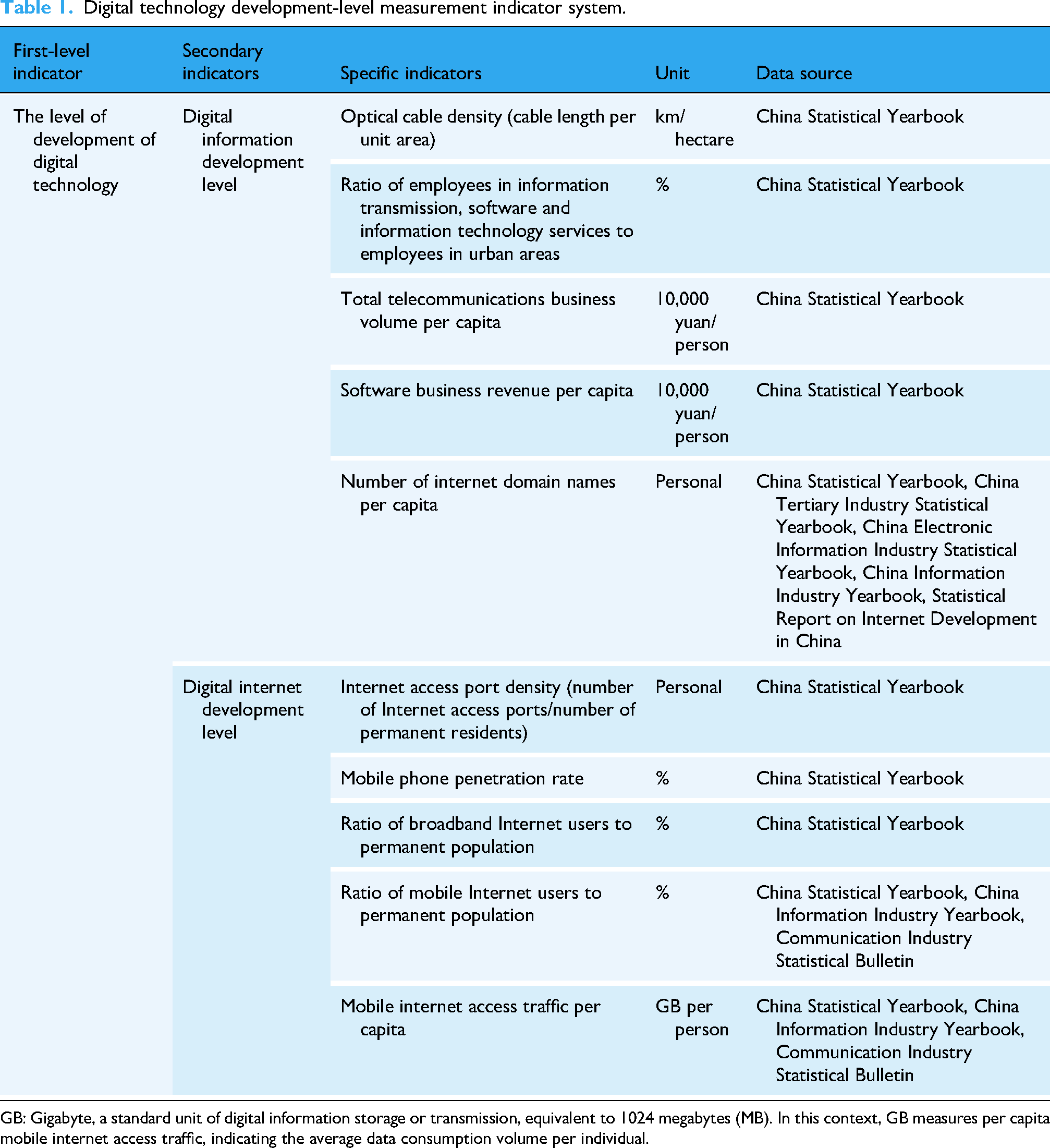
GB: Gigabyte, a standard unit of digital information storage or transmission, equivalent to 1024 megabytes (MB). In this context, GB measures per capita mobile internet access traffic, indicating the average data consumption volume per individual.
Mediating variables
This study aims to investigate the mediating roles of CAP, the proportion of funds allocated to new product development, and the level of DE in order to uncover the underlying mechanisms of DIG's impact on the older adults care industry. The following is a specific definition of the mediating variable:
CAP
Operational definition: CAP aims to measure how effectively nursing homes use their invested capital to generate income. A higher CAP generally indicates that resources are used more optimally, which helps to improve the quality of nursing services and achieve sustainable development. This study uses the “ratio of annual income to total annual fixed asset investment” of nursing homes to quantify this efficiency.
Theoretical basis and source: This measurement method refers to the research of Xu and Tao, 115 who pointed out that factor allocation efficiency is an important guarantee for achieving sustainable and high-quality development, and capital allocation efficiency is a key link. Higher capital allocation efficiency indicates that the high-quality development of nursing services will be better. We draw on this view and use the annual income and annual fixed asset investment data of nursing homes disclosed in the China Statistical Yearbook to calculate the value of CAP. 116 Taking into account the availability of data related to nursing services, we measure the core factor input with fixed asset investment (fixed assets of nursing homes) and measure the benefit output with annual income, thereby reflecting the efficiency of capital allocation. 117
New product development ratio
Operational definition: The NPD aims to reflect the intensity of innovation input of elderly care service institutions and considers its relationship with the macroeconomic development background. It is reflected by measuring the proportion of expenditure on new product development to regional GDP.
Theoretical basis and source: The design of this indicator draws on the research of Wang and Wang 111 on the construction of “new quality productivity” indicators, especially the consideration of scientific and technological innovation indicators in intangible means of production. We use the formula “new product development expenditure/regional GDP” to calculate NPD. Among them, the new product development expenditure data come from the China Science and Technology Statistical Yearbook and the China Statistical Yearbook, and the GDP data uses the official provincial data of the China Statistical Yearbook.
DE
Operational definition: DE aims to quantify the level of progress of elderly care service institutions in digital transformation. We measure it by analyzing the frequency of keywords reflecting digital transformation in the annual reports of listed companies.
Theoretical basis and source: This method draws on the research ideas of Wu et al. 118 and Ren et al. 119 on the measurement of enterprise digital transformation. In terms of specific operations, we first identify a series of keywords related to digitalization in the annual reports, and then count the total frequency of these keywords in the annual reports of all relevant listed companies in each province based on the degree of digital development of enterprises in the corresponding provinces, and finally take the average value as the proxy indicator (DE) of the degree of digitalization of enterprises in the province.120,121
Control variables
Drawing upon the research of Li and Qu, 122 this paper selects the following control variables: infrastructure level (INF), measured by per capita urban road area; government intervention (GOV), represented by the ratio of fiscal expenditure to regional GDP; economic openness level, indicated by the ratio of total imports and exports to regional GDP; and the proportion of the tertiary industry (TIT), calculated as the value added of the TIT divided by regional GDP. The definitions of the main variables are presented in Table 2.
Main variable definitions.

CAP: capital allocation efficiency; NPD: new product development; DE: enterprise digitalization; DIG: digital technology; INF: infrastructure level; GOV: government intervention; FDI: economic openness level; TIR: the ratio of the tertiary industry; GDP: gross domestic product.
Econometric model construction
First, in order to test the direct impact of DIG on the development of the older adults care industry, the following benchmark regression model is constructed:

In formula (1), OAV is the output value of the older adults care industry, DIG is the development level of DIG, and X is the control variable of this paper. A is the individual fixed effect, which controls the factors that do not change over time at the provincial level, such as geographical location; B is the time fixed effect.
Second, in order to further test the indirect effect between DIG and the development of the older adults care industry, the following model is constructed:


In formula (2), CAP represents CAP. And in formula (3), NPD represents new product development. DE stands for the degree of digitalization of the enterprise in formula (4).
Results
To provide an overview of the dataset, Table 3 displays the descriptive statistics. These statistics offer initial insights into the variability and range of the data.
Descriptive statistics of variables.

CAP: capital allocation efficiency; NPD: new product development; DE: enterprise digitalization; DIG: digital technology; INF: infrastructure level; GOV: government intervention; FDI: economic openness level; TIR: the ratio of the tertiary industry.
Primary effect regression
This paper presents the regression results from both ordinary least squares and fixed effects models, as shown in Table 4.
Main effect test.

Note. ***, **, and * denote significance levels of 1%, 5%, and 10% respectively, with the t values provided in parentheses. OAV: older adult industry value; DIG: digital technology; INF: infrastructure level; GOV: government intervention; FDI: economic openness level; TIR: the ratio of the tertiary industry.
An internal consistency check was conducted to identify and address discrepancies and outliers, ensuring data quality. Utilizing R-squared, we evaluated the reliability of our scales or indices. Our Stata regression analysis yielded an R value of 0.946, indicating a near-perfect fit and explaining 94.6% of the dependent variable's variance. This R value confirming it as a valid tool for understanding variable relationships and influencing factors.
Primary effect regression analysis
The results of the regression analysis indicate that the regression coefficient for the DIG index (DIG) is 2.9929, and it is statistically significant at the 1% level. This finding suggests a significant positive correlation between the advancement of DIG and the growth in the value of the older adults care industry. Specifically, for every one-unit increase in the DIG index, the value of the older adults care industry is expected to increase by 2.9929 units. Consequently, we can conclude that with the continuous progress and development of DIG, the value of the older adults care industry exhibits a marked trend of growth. This indicates that the application and promotion of DIG play a positive role in driving the development of the older adults care industry.
Indirect effect test
Based on the research hypotheses, we analyzed the impact of DIG on the output value of the OAV, testing the mediating effects of CAP, NPD rate, and DE level (Table 5).
Indirect effect test.

Note. ***, **, and * denote significance levels of 1%, 5%, and 10% respectively, with the t values provided in parentheses. CAP: capital allocation efficiency; NPD: new product development; DE: enterprise digitalization; DIG: digital technology; INF: infrastructure level; GOV: government intervention; FDI: economic openness level; TIR: the ratio of the tertiary industry.
The analysis shows that DIG has a significant positive direct effect on OAV (coefficient = 0.0013). This result supports Hypothesis 1. DIG has a significant positive effect on CAP. Concurrently, CAP also has a significant positive effect on OAV. These findings support Hypothesis 2. DIG has a significant positive effect on NPD (coefficient = 8.6243). Concurrently, NPD also has a significant positive effect on OAV. These findings support Hypothesis 3. DIG has a significant positive effect on DE (coefficient = 29.6912). Concurrently, DE also has a significant positive effect on OAV. These findings support Hypothesis 4.
Regional heterogeneity
Some scholars have pointed out that the differences in the development of the digital economy have a heterogeneous impact on the level of development of the service industry across different regions. 123 Consequently, the promotional effect of DIG on the output value of the older adults care industry may also exhibit regional heterogeneity. It is therefore necessary to conduct further research and analysis. This study categorizes China's 30 provinces into eastern, central, and western regions for a regional heterogeneity analysis. The results of this analysis are presented in the Table 6.
Regional heterogeneity.
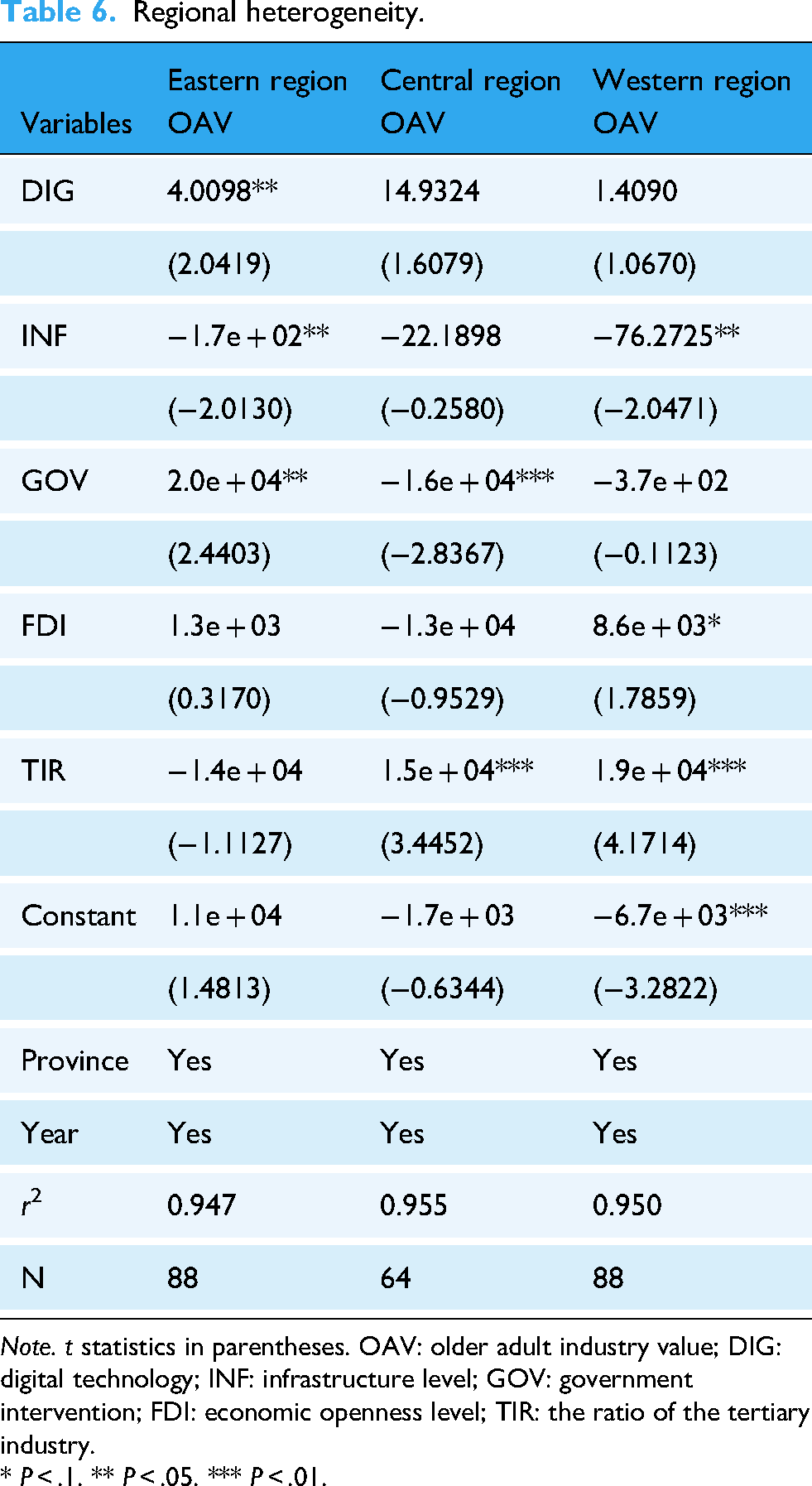
Note. t statistics in parentheses. OAV: older adult industry value; DIG: digital technology; INF: infrastructure level; GOV: government intervention; FDI: economic openness level; TIR: the ratio of the tertiary industry.
* P < .1. ** P < .05. *** P < .01.
The impact of economic factors such as DIG on the output of the older adults care industry shows significant regional characteristics. Specifically, in the eastern region, the coefficient of the DIG variable is significantly positive, and the coefficients of INF and GOV are also significant, indicating that these factors have jointly promoted the development of the older adults care industry in the region.
In contrast, the coefficient of the DIG variable in the central region is not significant, but the coefficients of INF, GOV, economic openness and the proportion of the TIT are all significant, indicating that the driving factors of industrial development in the region are different.
In the western region, the coefficient of the DIG variable is also not significant. Although the coefficients of INF GOV, economic openness and the proportion of the TIT are all significant, the impact pattern of these factors is different from that of the eastern and central regions, suggesting that the region may face more complex development constraints.
Regional heterogeneity analysis
The results of the econometric analysis reveal significant differences in the factors affecting the output of the older adults care industry in various regions of China. In the eastern region, the statistical model clearly shows that DIG, INF, and GOV all have a significant positive impact on industrial output. This means that in these regions, the application of DIG, good hardware facilities, and government policies and resource inputs are associated with higher levels of industrial output, and this association is statistically reliable.
The model in the central region presents a different picture: the coefficient of DIG fails to reach a statistically significant level, indicating that its association with industrial output is not yet clear or strong enough; however, the level of infrastructure, GOV, economic openness, and the proportion of the TIT still show a significant impact on industrial output, suggesting that these factors are the key statistical correlation factors driving the current industrial development in this region.
The situation in the western region further highlights the regional heterogeneity: DIG also does not show a statistically significant impact, while infrastructure, GOV, economic openness, and the proportion of the TIT remain significant, but their specific impact patterns are different from those in the east and central regions. This difference in statistical correlation patterns among regions provides basic data support for understanding the driving force behind the development of the older adults care industry in different regions.
Robustness checks for variables
Robustness test of replacement variables. Since the measurement method of the level of DIG development is not limited to the indicator system selected in this paper, in order to ensure the reliability of the research conclusions, this paper re-estimates the model by adopting different indicator measurement systems. Some scholars have shown that the DIG measurement indicator system is reconstructed from the two aspects of communication technology development and information technology and related service development. The regression results are shown in Table 7. The coefficient sign and significance of DIG are basically consistent with the previous regression results, proving that the research results are relatively robust and reliable.
Robustness checks using alternative measures and instrumental variables.

OAV: older adult industry value; DIG: digital technology; INF: infrastructure level; GOV: government intervention; FDI: economic openness level; TIR: the ratio of the tertiary industry.
In Table 7, we show the robustness test results of the impact of DIG on the output value of the older adults industry using the instrumental variable method. By using the DIG variable lagged by one period as an instrumental variable, we effectively control the endogeneity problem of the model, thereby providing more reliable estimation results. The data show that the regression coefficient of DIG is positive and statistically significant, which is consistent with our previous findings. Specifically, the coefficient of DIG is 8.1973, indicating that when other factors remain unchanged, the output value of the older adults industry will increase by 8.1973 units on average for every unit increase in DIG. This result confirms that the positive impact of DIG on the output value of the older adults industry is robust and is not affected by model settings and potential endogeneity problems. Therefore, we can conclude that the development of DIG is an important factor in promoting the growth of the older adults industry.
Discussion
Through rigorous empirical analysis, this study confirms that DIG has a significant positive effect on the development of China's older adults care industry (hypothesis 1 is established). This finding profoundly confirms Marx's core assertion that “labor productivity develops with the progress of science and technology.” 124 Based on Marx's three-factor theoretical framework of productivity (producers, means of production, and objects of production),125–127 this paper innovatively reveals that DIG drives development by penetrating and reconstructing the older adults care industry through three intermediary paths (H2–H4). The establishment of the path provides empirical support for the above path and systematically analyzes the microprocess of DIG promoting industrial development through intermediary mechanisms. Regional heterogeneity further reveals the spatial imbalance between technology application and industrial development. It is worth noting that Marx's three-factor framework of productivity has shown continuous explanatory power in contemporary research in various fields: for example, interpreting the impact of AI on employment structure, 128 driving agricultural digital transformation, 129 and even using relevant Marxist ideas to analyze health inequality issues, demonstrating its theoretical adaptability. 130
Research data show that CAP has a significant positive impact on the development of the older adults care industry (H2). The specific reason may be the transformation of traditional elderly care facilities to digital means of production such as smart elderly care equipment and IoT platforms131–133 As mentioned in the previous literature review, the application of technologies such as smart nursing beds and remote monitoring systems has greatly improved the accuracy of resource utilization.132,134 This phenomenon also echoes Marx's discussion on “continuous innovation of means of production” 135 and is supported by many studies on ICT improving industrial capital efficiency.133,136,137
The new product development rate has a significant positive effect on the development of the older adults care industry (H3 is established). New product investment has spawned digital service forms 138 such as telemedicine and VR health care services, breaking through the physical boundaries of traditional elderly care.132,139,140 This confirms Marx's classic prediction that “technology creates diversified use value" 141 and forms a theoretical mutual verification with China's smart elderly care innovation research.142–144 It is worth noting that this mechanism also shows universality at the cross-industry level145–147 empirical studies in new energy,148,149 smart manufacturing,150,151 finance 152 and other fields have reported similar positive correlations. Some scholars have proposed that there is industry heterogeneity in the innovation path of DIG. In technology application industries, DIG indirectly improves performance through service innovation. 153 In technology R&D industries, DIG directly optimizes production efficiency and drives innovation iteration. 154 As a typical technology application industry, the older adults care industry has significantly confirmed the effectiveness of the intermediary mechanism proposed in this paper.
Research evidence shows that the digital level of enterprises also has a significant positive impact on the older adults care industry (H4). This is also evident in other areas, such as the improvement of digitalization level promotes the value creation of manufacturing enterprises. 155 The possible reason is that the digitalization of enterprises directly promotes the transformation of elderly care service producers. 156 Through tools such as smart terminals and health data analysis platforms, practitioners have developed into compound caregivers with digital skills.157,158 Empirical evidence shows that the improvement of digital skills significantly optimizes service efficiency, which is consistent with the research conclusion that digital literacy improves human capital in the service industry.159,160
There are significant differences in the effect of regional DIG empowering industrial output. Eastern regions, such as the Yangtze River Delta and the Pearl River Delta, rely on dense 5G networks, cloud computing centers, active innovation ecosystems, and high digital literacy of residents.161,162 DIG has made significant positive contributions to industries such as smart elderly care platforms and remote medical monitoring.163,164 These industries have made significant positive contributions, confirming their status as economic engines.
In contrast, the central and western regions face a “digital divide,” and the impact of DIG on the older adults care industry is not significant. 165 The main reasons may include: first, digital infrastructure, such as poor network coverage and poor quality in remote villages 166 ; second, weak local digital talent reserves and innovation capabilities 167 ; third, poor digital adaptability of the elderly 168 ; fourth, differences in market maturity and capital investment preferences. 169 Despite this, the development of these regions still relies on traditional factors such as transportation and government guidance, 170 indicating that they may be in a development stage that relies on basic factors and government guidance, 171 and the enabling role of DIG has not yet been fully exerted, and the path of its role is also different from that in the east. 172
This study has profound implications for policy making, industrial development and regional coordination. At the policy level, it is necessary to abandon a single model and face up to regional heterogeneity. Differentiated strategies should be formulated for the central and western regions, by strengthening digital infrastructure (such as rural 5G coverage), carrying out “silver digital skills” training, and guiding social capital investment. Narrow the digital gap divide and stimulate the potential of local DIG. At the industrial level, the research results verify that improving capital efficiency, new product development and DE level are the key paths for DIG to empower the older adults care industry. This means that companies should focus on the application of digital tools, service model innovation, and employee digital literacy improvement. Enterprises in the eastern region should take on the responsibility of technology transfer and model output. At the regional development level, the study highlights the significant gap between the eastern and central and western regions in the application of DIG. It shows that the development of the central and western regions still partially relies on traditional factors, and the enabling role of DIG has not yet been fully exerted. This requires the country to prioritize narrowing the regional digital divide and promoting regional balanced and inclusive development in the process of development. This will ultimately achieve the deep integration and coordinated development of DIG and the older adults care industry across the country through precise policy implementation.
Limitations
This study has the following limitations. First, the data used in this paper span only from 2014 to 2021, which is relatively short. During this period, although China's digital economy and older adults care industry were in a phase of rapid development, long-term trends and profound impacts may not have fully emerged. Second, this study is primarily based on provincial panel data for macro-level analysis. While this helps reveal overall trends, it may overlook more nuanced differences and specific issues within regions. For example, provincial data may not fully reflect the specific circumstances and issues at the municipal or county level. Third, this paper focuses on three empowerment transmission paths: CAP, new product development expenditure, and DE level. However, the impact of the digital economy on the older adults care industry may involve other key factors, such as policy support, social and cultural context, education levels, and medical resource allocation. Fourth, considering the rapid development of DIG, the impact of technological iteration on the older adults care industry is dynamically significant. The data and analytical models used in this paper may not have fully captured the effects of the latest technological advancements. Finally, this paper primarily employs panel data regression analysis, which is effective in revealing relationships between variables but may have limitations in terms of causal inference.
Directions for future research
In light of these limitations, future research can be deepened in the following directions: expanding the time span of the data to observe the long-term impact of DIG on the older adults care industry; refining the data level to utilize municipal or county-level data for more in-depth analysis; increasing the diversity of variables to construct a more comprehensive analytical framework; updating research models to keep pace with technological developments; considering internal regional heterogeneity to propose more targeted policy recommendations; and employing a variety of research methods, including randomized controlled trial, difference-in-differences, and other techniques to more accurately identify and validate causal relationships. Through these deeper research and exploration efforts, we can gain a more comprehensive understanding of the empowerment mechanisms of the digital economy on the older adults care industry and provide more solid theoretical and empirical support for the high-quality development of the older adults care industry.
Conclusion
This study aims to explore the impact of DIG on the output value of China's older adults care industry and its mechanism of action and examines the mediating effects of CAP, new product development rate and DE level while examining regional heterogeneity. The results show that DIG has a significant positive direct effect on the output value of the older adults care industry, confirming that DIG is an important driving force for the value growth of the industry. Furthermore, the study reveals that DIG indirectly promotes the output value of the industry through three intermediary paths: improving CAP, accelerating new product development, and enhancing the digitalization level of enterprises. This shows that the impact of DIG is not a single dimension but works together through multiple mechanisms such as optimizing resources, stimulating innovation and improving capabilities.
It is particularly noteworthy that this study found that there is significant regional heterogeneity in the impact of DIG on the output value of the older adults care industry. In the eastern region, DIG, infrastructure and GOV form a synergistic effect and jointly promote industrial prosperity; while in the central and western regions, the impact of DIG is not significant, and the dominant factors of industrial development turn to infrastructure, GOV, economic openness and industrial structure, and the action mode of these factors also shows regional differences, which may reflect the unique development constraints and challenges faced by different regions.
Recommendations
Policy makers: implementing a regional gradient empowerment strategy
In response to the regional heterogeneity of DIG's impact, policy formulation should establish a differentiated support system. Eastern regions, leveraging their technological advantages, should establish innovation hubs to breakthrough critical technologies and enhance data security legislation. Central and western regions should implement the “Digital Infrastructure Westward Expansion Project” to increase the digital coverage of elderly care institutions and establish technology transfer mechanisms between Eastern and Western regions. At the national level, key performance indicators such as CAP, new product development rate, and DE level should be incorporated into performance evaluations. Concurrently, establishing provincial-level elderly care data platforms is essential to dismantle data silos.
Corporate actions: focusing on triple capability building
Enterprises should anchor their strategies on three core pathways enabled by DIG: optimizing CAP, potentially through promoting smart equipment financing and leasing; strengthening new product development, with a focus on creating age-friendly smart product portfolios; and deepening DE, including establishing digital skills certification systems for caregivers and promoting human–robot collaborative service upgrades. Encouraging central state-owned enterprises to lead the formation of industry alliances and supporting small and medium-sized enterprises to focus on innovative solutions for niche scenarios are also crucial.
Social collaboration: constructing an inclusive support network
At the societal level, it is vital to address the challenge of DIG accessibility and construct an inclusive support network. Community-based “silver digital classrooms” should be utilized to enhance the digital literacy of the elderly, coupled with the implementation of mandatory accessibility standards for user interfaces. Furthermore, innovative participation mechanisms should be fostered, including promoting the “Time Bank” mutual care model for the elderly and developing comprehensive liability insurance for smart elderly care. Building a diversified support network integrating “family-community insurance” ensures the equitable sharing of the benefits derived from DIG across the entire population.
Footnotes
Acknowledgements
I would like to express my sincere gratitude to Professor Sui Dangchen for his invaluable guidance and patient mentorship throughout the process of writing this article. Additionally, I am deeply appreciative of the financial support provided by Professor Sui, which was instrumental in the completion of this work.

Ethical approval
This article does not contain any studies with human participants or animals performed by any of the authors.
Funding
The author(s) disclosed receipt of the following financial support for the research, authorship, and/or publication of this article: This research was supported by the Humanities and Social Sciences Fund Project of the Ministry of Education of China (22YJA840009), under the grant of one of the authors, Sui Dangchen.
Declaration of conflicting interests
The author(s) declared no potential conflicts of interest with respect to the research, authorship, and/or publication of this article.