




Abstract
Aim
This study aimed to evaluate perceptions and expectations towards artificial intelligence (AI) applications in diagnostic radiology among radiologists across academic, non-academic and private practice settings in the Federal State of Styria, Austria. It also sought to determine how participant's characteristics and AI-specific knowledge might influence these views.
Methods
An online quantitative survey comprising 20 multiple-choice questions in German language was distributed via email to radiologists in outpatient and hospital settings throughout Styria in 2024.
Results
Out of 149 radiologists contacted, 66 responded. Of these, 75.4% reported having basic knowledge of AI, 13.8% indicated good to very good knowledge and only 10.8% had minimal AI-specific knowledge. The majority (84.4%) expressed willingness to use certified AI software in diagnostics. About half of the respondents (50.8%) believed that AI would not fully replace radiologists in the next 10–15 years, although 46.0% anticipated partial replacement. Additionally, 87.7% did not foresee a decrease in professional income due to AI integration. 64.6% anticipated improvement in diagnostic tasks through AI, with this expectation being significantly linked to an academic career (χ2 = 8.97, p = 0.01). However, opinions varied on AI's potential to outperform radiologists in diagnostics in the near future. There was no statistically significant relationship between participant's AI-specific knowledge and perceptions and expectations towards AI.
Conclusion
The study reveals a generally positive attitude towards AI among radiologists, with uncertainties about its future performance compared to human radiologists. Although AI is anticipated to positively influence workload without reducing income, there may be a discrepancy between these expectations and actual outcomes.
Introduction
Artificial intelligence (AI) is considered a branch of computer science that seeks to understand and develop intelligent entities, often based on software programs utilizing machine or deep learning for pattern recognition. 1 The concept to implement AI applications in medicine is not new. When computers and the concept of AI were developed almost simultaneously in the 1940s and 1950s, medicine quickly recognized their potential importance and benefits.1,2 In the mid-1980s, radiology began to explore computer-aided diagnosis (CAD) as a way to assist radiologists. 3 Due to breakthroughs in computing power and research progress, the application of AI in medicine has gained enormous momentum recently. AI can intervene in the whole imaging chain. When interpreting images and writing reports, AI may aid radiologists in interpreting and analysing images, preparing reports and providing further advice or recommendations to referring physicians and patients. 4 Through targeted triage and automated exclusion of inconspicuous exams from the radiologists’ workflow, AI could potentially reduce the radiologist's workload, for example, in reading mammograms.5,6 Diagnostic performance of AI has been reported to be comparable to clinicians in fracture diagnosis 7 and screening digital mammography. 8 In emergency radiology imaging, AI may expediently notify radiologists of abnormal findings, enabling rapid patient care and potentially improving outcomes. 9 In addition to improving diagnosis and facilitating workflows, it has been shown that AI applications can have a positive impact on cost-effectiveness.10,11 Given these potentials, AI could be seen not only as an aid but also as a threat to the future professional role of radiologists. 12 However, contrary to the original intention of AI applications in radiology, data showed that AI applications in medical imaging do not necessarily have the desired effect of reducing workload.13,14 Moreover, there may be discrepancies between the reported and real-world performances of AI applications when data are absent and uninterpretable or the pathology is outside the AI's scope. 15 These uncertainties regarding the future role of AI in radiology and its implications for the radiology profession were reflected in the results of recent surveys among radiologists.16–19
The aim of the present study was to assess the current perceptions and expectations of AI applications in diagnostic radiology among radiologists in the Federal State of Styria, Austria, in academic, non-academic and private practice settings and to identify potential influencing factors, such as participant's demographic characteristics, training level and AI-specific knowledge, on these perceptions and expectations and to relate the findings to international results.
Methods
An online survey was created and distributed via email to all radiologists in the Federal State of Styria, Austria (population size ∼ 1.3 million 20 ). Its main focus was to determine whether AI is seen primarily as an opportunity for improvement and increased efficiency, or if AI has the potential for replacing radiologists through autonomous, software-supported diagnostics and whether this is influenced by participant's demographic characteristics, training level and AI-specific knowledge.
Data collection was conducted using an online quantitative survey in German language consisting of 20 multiple-choice questions with predefined response options. The questionnaire was initially piloted with two radiology trainees and three board-certified radiologists to assess clarity and adjust questions based on verbal feedback. Subsequently, the link to the online survey was emailed to online publicly available addresses of radiologists in both outpatient and hospital settings in the Federal State of Styria, Austria, in January 2024. The email emphasized the voluntary and anonymous nature of participation. In accordance with the decision of the local Institutional Ethics Committee, completion of the questionnaire was regarded as an expression of consent to participate in the study, without the need for a separate signed consent declaration. A reminder email was sent 2 weeks after the initial invitation, with an additional 2-week deadline for survey completion. The complete questionnaire is provided in the Supplemental Material of this manuscript.
Results were analysed across three predefined categories: ‘demographic data and training level of survey participants’, ‘previous experience of survey participants with AI’ and ‘perceptions and expectations of participants towards AI applications in radiology’.
To test for a possible relationship between participant's demographic characteristics, training level or reported AI-specific knowledge and an anticipated future impact of AI on the diagnostic routine work, a chi-square test was performed. A p-value < 0.05 was considered statistically significant.
Statistical data analysis was conducted with IBM SPSS Statistics for Windows (Version 28: IBM Corp.).
During the preparation of this work, the authors used ChatGPT4o (OpenAI) in order to help refine language. After using this tool, the authors reviewed and edited the content as needed and take full responsibility for the content of the publication.
Before initialization, the study was approved by the local Institutional Ethics Committee. Data of this survey were partly used for an academic thesis in German language of one of the authors (G.A. initials blinded for review).
Results
Demographic data and training level
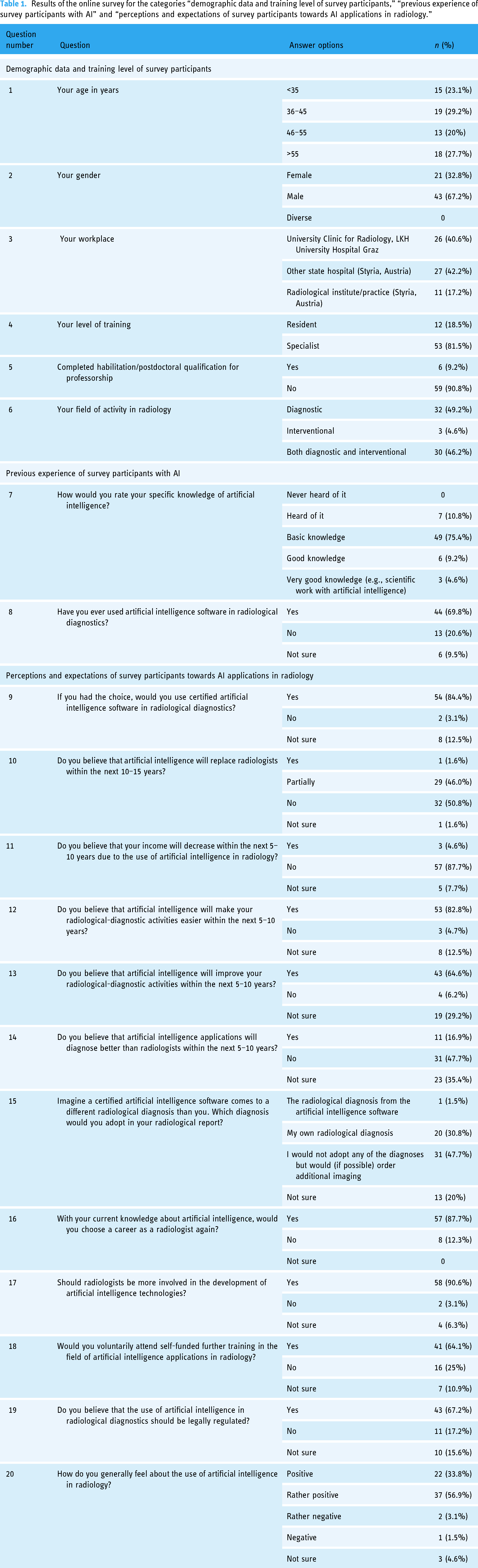
The questionnaire was sent to a total of 149 individuals who, at the time of the survey, were working either as board-certified radiologists or radiologists-in-training in the Federal State of Styria, Austria. Sixty-six participants responded to the questionnaire up to the second deadline. The response rate of the questionnaire was 44%. One participant completed the questionnaire without a valid response. Not all participants answered every question. The majority of responses came from the hospital setting (82.8%).
Exploring the characteristics and AI familiarity of radiology professionals participating in the survey, the majority of respondents (81.5%) identified as board-certified radiologists, with residents making up 18.5% of the participants. The majority (90.8%) had not completed postdoctoral qualification for professorship.
Participants’ involvement in radiology was fairly divided with 49.2% primarily engaged in diagnostic radiology and 46.2% involved in both diagnostic and interventional practices with a minority of 4.6% involved in interventional radiology only.
More detailed data are demonstrated in Table 1.
Results of the online survey for the categories “demographic data and training level of survey participants,” “previous experience of survey participants with AI” and “perceptions and expectations of survey participants towards AI applications in radiology.”
Previous experience with AI
When asked about their familiarity with AI, most participants (75.4%) reported having basic knowledge. A smaller proportion possessed good (9.2%) or very good knowledge (4.6%). Only 10.8% had merely heard of AI, and none were completely unaware of it. Additionally, the integration of AI in professional practice was significant, with 69.8% of the respondents having used AI software in radiological diagnostics. However, 20.6% had not used AI software, and 9.5% were unsure if they had.
Perceptions and expectations towards AI applications in radiology
The survey results revealed a strong inclination towards adopting AI technologies, with 84.4% of the respondents expressing willingness to use certified AI software in diagnostics. The majority believe that AI will not fully replace radiologists within the next 10–15 years, with 50.8% opposing the idea completely and 46.0% foreseeing only partial replacement.
Concerning the impact of AI on professional income, 87.7% of respondents do not anticipate a decrease in their earnings due to AI in the next 5–10 years. Moreover, 82.8% expect AI to ease their diagnostic activities, and 64.6% believe it will improve their diagnostic capabilities.
Opinions are mixed regarding AI surpassing radiologist performance in diagnostics within the next 5–10 years; 47.7% disagree, while 16.9% agree and 35.4% remain unsure. When faced with conflicting diagnoses between their own assessment and AI, 47.7% would opt for additional imaging rather than solely relying on AI or their diagnosis.
Despite the evolving role of AI, 87.7% would still choose a career in radiology, and 90.6% believe radiologists should be more involved in AI development. Interest in self-funded AI training is high, with 64.1% willing to pursue it.
Finally, the survey highlighted a strong consensus for the legal regulation of AI in radiology, supported by 67.2% of the respondents.
Overall, the sentiment towards AI in radiology is predominantly positive or rather positive, shared by 90.7% of participants.
In univariate analysis, the sole statistically significant relationship was found for the participant's characteristic “Completed habilitation/postdoctoral qualification for professorship” and the survey question “Do you believe that artificial intelligence will improve your radiological-diagnostic activities within the next 5–10 years?” (χ2 = 8.97, p = 0.01). Detailed results of the statistical analyses are presented in Supplemental Table 2. Testing for a relationship between self-reported AI-specific knowledge of the participants and fear of replacement, anticipated performance of AI applications compared to radiologists and assumed improvement of diagnostics through AI yielded no statistical significance in univariate analysis (p = 0.13, p = 0.39 and p = 0.11; Figures 1 to 3).
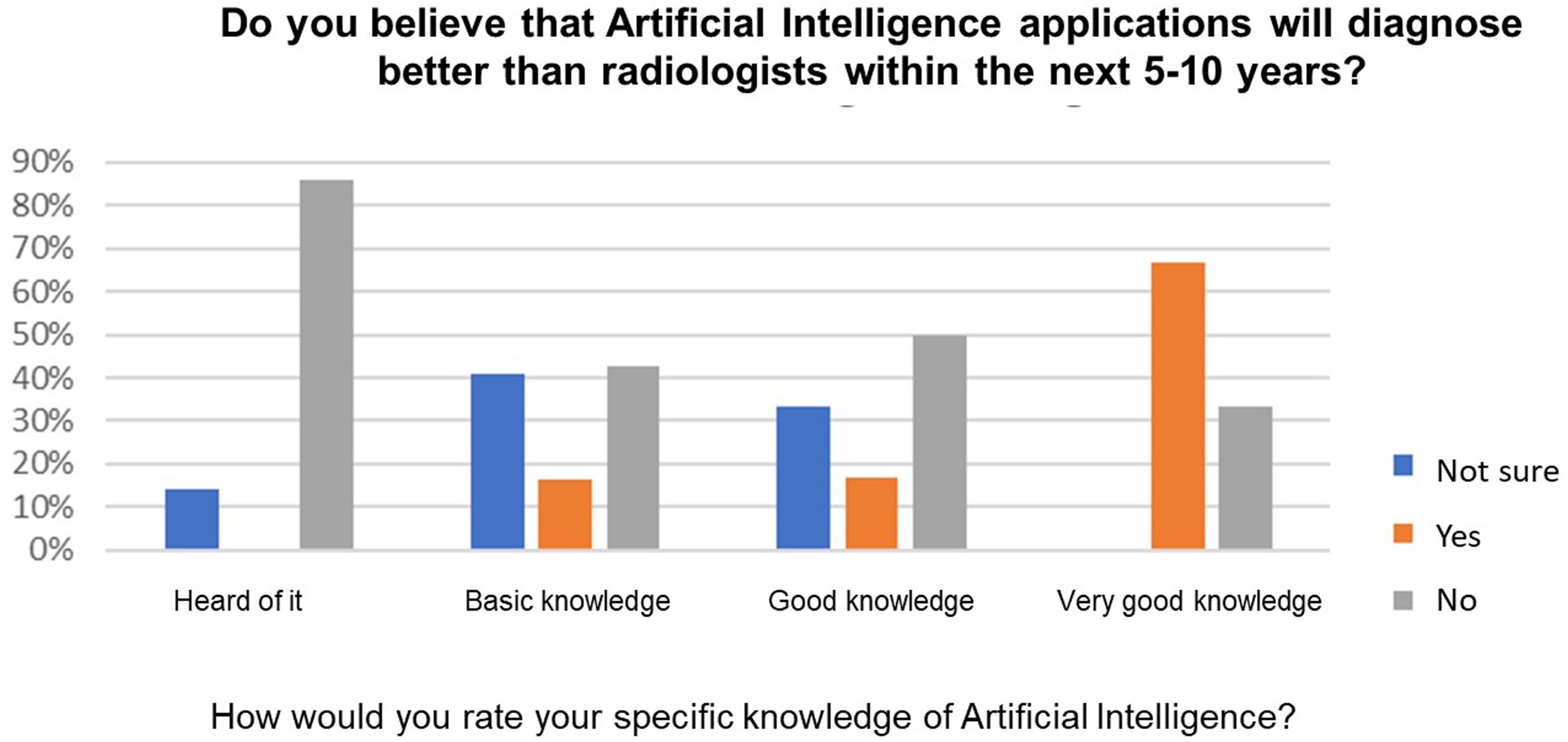
Responses to the survey question “Do you believe that AI applications will diagnose better than radiologists within the next 5–10 years?” grouped according to self-reported AI-specific knowledge.

Responses to the survey question “Do you believe that AI will replace radiologists within the next 10–15 years?” grouped according to self-reported AI-specific knowledge.

Responses to the survey-question “Do you believe that AI will improve your radiological-diagnostic activities within the next 5–10 years?” grouped according to self-reported AI-specific knowledge.
Discussion
This questionnaire-survey data on specialists and trainees in radiology in the Federal State of Styria, Austria, assessed perceptions and expectations towards AI applications in radiology. The participants were primarily recruited from hospital settings and radiology consultant staff. Overall, there appears to be a predominantly positive and optimistic attitude among the participants towards AI applications in radiology. Furthermore, the future impact of AI on aspects such as salaries in radiology is also viewed positively. However, there are uncertainties regarding the future performance of AI applications compared to human radiologists.
In an international survey of 675 radiologists, 55.6% anticipated an impact of AI on job opportunities in radiology, with 58.1% predicting an increase and 41.9% forecasting a decrease. Additionally, 74.7% of respondents expected changes in the overall workload associated with radiological reporting, with 50.8% anticipating a reduction and 49.2% expecting an increase. 16 Participants in the current survey responded more positively than those in the referenced survey to the expectation that the use of AI will facilitate radiologic-diagnostic activities, with 83% in agreement. A potential reason for this discrepancy may be that approximately 42% of the participants in the cited study 16 were involved in AI research projects, whereas only 4.6% of the participants in the present survey possess significant expertise or scientific research experience in AI, although no statistically significant relationship could be found. It may be concluded from these results that relatively lower AI expertise is associated with higher expectations for the performance of AI applications in radiology, while experts in the field may more critically consider the weaknesses and limitations of AI in their evaluations. The hypothesis that attitudes towards the future performance of AI applications depend on the background of users was additionally supported by our study's result, where a significant relationship was found between an academic career and the belief that future AI applications will improve diagnostics in radiology.
Approximately 91% of the participants in the present study believe that radiologists should be more involved in the development of AI technologies. This aligns with the results of other surveys, in which a majority indicated that radiologists should lead the development of AI technologies, 16 particularly among men and those with basic or advanced AI-specific knowledge. 17
Overall, there appears to be a positive sentiment towards AI in radiology among the participants of the current survey. About 90% of the participants had a very or somewhat positive attitude towards the use of AI in radiology, with nearly half predicting at least a partial replacement of radiologists by AI within the next 10–15 years and only 1.6% predicting total replacement by AI. An international survey 17 of 1086 specialists in the field of radiology showed that fear of being replaced by AI was present in 38% of the participants (13% answered with “Yes”, 25% with “Maybe”), particularly pronounced among men and individuals with basic AI knowledge. This fear decreased with age and higher levels of AI knowledge. Discrepancies between the current survey and the cited study could be explained by a spread in AI-specific knowledge of the respondents. The survey in the present work revealed varied self-assessments of AI-specific knowledge, with only 4.6% reporting a very good level of AI-specific knowledge or scientific work with AI algorithms, about 11% having heard of AI before and approximately 75% possessing basic knowledge. In contrast, the cited survey 17 found that a minority (21%) of participants had only a basic knowledge of AI and 17% of respondents possessed advanced knowledge or were actively involved in the research and development of AI. In a survey among Italian radiologists, 18.9% of respondents stated a fear of being replaced by AI, with most participants having a positive attitude towards AI applications. 19 Although this result can only be compared to a limited extent with our study's results (the present survey distinguished between fear of complete and partial replacement), it additionally supports the assumption that there is an interdependent relationship between the fear of replacement by AI in radiology and the general attitude towards AI.
Even though there is a strong desire among participants of the current survey to play an active role in the development of AI technologies (with over 90% of participants expressing this), only about 14% of participants had a good or very good understanding of AI.
The majority of participants (88%) would choose to pursue a career as a radiologist again with their current level of knowledge about AI. However, these results may conflict with questions evaluating the performance of future AI applications compared to human radiologists. Notably, 17% of survey respondents believed that AI applications will be able to diagnose better than radiologists in the next 10–15 years, and 35% were unsure about making a prediction on this issue. Approximately two-thirds of the participants felt that AI applications would improve radiological diagnostics in the coming 10–15 years, and about half of the participants would trust an AI's diagnosis enough that if it differed from their own, they would initiate further imaging procedures. Drawing direct conclusions from these results is challenging due to multiple influencing factors and the small sample size. However, a trend can be discerned from the survey results: the future performance of AI applications in radiological diagnostics is seen as promising with significant impacts on routine operations, yet the use of AI is not perceived as a direct threat to the discipline of radiology. Furthermore, the very optimistic assessment of the impact of AI applications on future income of survey participants may be too optimistic, considering an analysis indicating that AI could reduce annual healthcare costs in the US by up to $150 billion by 2026. 21
In the present study, the willingness to utilize certified AI software in radiological diagnostics was notably high, with 84% of respondents expressing their readiness to adopt such technologies. The product's performance and the benefits for a practice are considered the most important clinical factors for the introduction of AI systems. 22 To enhance the acceptance of AI among healthcare professionals, results of an integrative review recommended involving end-users in the early stages of AI development, providing training tailored to the needs of healthcare applications and establishing appropriate infrastructure. 23 According to the Technology Acceptance Model 2, 24 social influence is more effective than mandatory approaches in enhancing perceived usefulness and adoption of new systems. Therefore, radiological professional societies could play a significant role in the future implementation of AI systems in routine radiological practice.
The major limitation of the present trial is the small sample size. Nevertheless, the survey had a good response rate, and the sample represents a rather heterogeneous, representative population, recruited from university, private practice and hospital settings. However, it remains unclear whether the results of this local survey can be applied to larger populations. This may be the topic of future trials with larger cohorts and multivariate analyses.
Another limitation of the study is that the questionnaire, while tested in a trial run for clarity and coherence, was not formally validated and remains exploratory in nature.
Conclusion
This study examined perceptions and expectations of AI applications in radiology among a representative sample of Austrian radiologists, revealing a generally positive attitude but noting uncertainties about its future performance compared to human radiologists. While AI is expected to positively affect workload without a negative impact on income, expectations often diverge from real-world data. The findings suggest that involving radiologists more in AI development could bridge the gap between positive attitudes and practical application and effectiveness in clinical routine settings.
Contributorship
GA and HS contributed to the study conception and design. HS is the guarantor of this study. Material preparation, data collection and analysis were performed by GA. The first draft of the manuscript was written by GA and all authors commented on previous versions of the manuscript. All authors read and approved the final manuscript.
Supplemental Material
sj-docx-1-dhj-10.1177_20552076241298472 - Supplemental material for Facing the AI challenge in radiology: Lessons learned from a regional survey among Austrian radiologists in academic and non-academic settings on perceptions and expectations towards artificial intelligence
Supplemental material, sj-docx-1-dhj-10.1177_20552076241298472 for Facing the AI challenge in radiology: Lessons learned from a regional survey among Austrian radiologists in academic and non-academic settings on perceptions and expectations towards artificial intelligence by Gabriel Adelsmayr, Michael Janisch, Maximilian Pohl, Michael Fuchsjäger and Helmut Schöllnast in DIGITAL HEALTH
Supplemental Material
sj-docx-2-dhj-10.1177_20552076241298472 - Supplemental material for Facing the AI challenge in radiology: Lessons learned from a regional survey among Austrian radiologists in academic and non-academic settings on perceptions and expectations towards artificial intelligence
Supplemental material, sj-docx-2-dhj-10.1177_20552076241298472 for Facing the AI challenge in radiology: Lessons learned from a regional survey among Austrian radiologists in academic and non-academic settings on perceptions and expectations towards artificial intelligence by Gabriel Adelsmayr, Michael Janisch, Maximilian Pohl, Michael Fuchsjäger and Helmut Schöllnast in DIGITAL HEALTH
Supplemental Material
sj-docx-3-dhj-10.1177_20552076241298472 - Supplemental material for Facing the AI challenge in radiology: Lessons learned from a regional survey among Austrian radiologists in academic and non-academic settings on perceptions and expectations towards artificial intelligence
Supplemental material, sj-docx-3-dhj-10.1177_20552076241298472 for Facing the AI challenge in radiology: Lessons learned from a regional survey among Austrian radiologists in academic and non-academic settings on perceptions and expectations towards artificial intelligence by Gabriel Adelsmayr, Michael Janisch, Maximilian Pohl, Michael Fuchsjäger and Helmut Schöllnast in DIGITAL HEALTH
Footnotes
Declaration of conflicting interests
The authors declared no potential conflicts of interest with respect to the research, authorship, and/or publication of this article.
Ethical considerations
The study was approved by the local Institutional Ethics Committee of the Medical University Graz (EK-Nr. 36-053 ex 23/24).
Funding
The authors received no financial support for the research, authorship, and/or publication of this article.

Supplemental material
Supplemental material for this article is available online.
References
Supplementary Material
Please find the following supplemental material available below.
For Open Access articles published under a Creative Commons License, all supplemental material carries the same license as the article it is associated with.
For non-Open Access articles published, all supplemental material carries a non-exclusive license, and permission requests for re-use of supplemental material or any part of supplemental material shall be sent directly to the copyright owner as specified in the copyright notice associated with the article.
