



Abstract
Background
Digital health literacy (DHL) enables healthy decisions, improves protective behaviors and adherence to COVID-19 measures, especially during the era of the “infodemic”, and enhances psychological well-being.
Objective
We aimed to explore the mediating roles of fear of COVID-19, information satisfaction, and the importance of online information searching on the association between DHL and well-being.
Methods
A cross-sectional web-based survey was conducted among 1631 Taiwanese university students, aged 18 years and above, from June 2021 to March 2022. The collected data include sociodemographic characteristics (sex, age, social status, and financial satisfaction), the importance of online information searching, information satisfaction, fear of COVID-19, DHL, and well-being. A linear regression model was utilized to investigate factors associated with well-being, followed by a pathway analysis to assess the direct and indirect relationship between DHL and well-being.
Results
The scores of DHL and overall well-being were 3.1 ±
Conclusion
Higher DHL scores show direct and indirect associations with higher well-being scores. Fear, importance of online information searching, and information satisfaction significantly contributed to the association.
Introduction
The novel coronavirus, SARS-COV-2, caused the first cluster of COVID-19 in Wuhan, China, in 2019 and rapidly spread globally. According to the World Health Organization report on November 2022, more than 632 million confirmed COVID-19 cases and over 6.5 million deaths were reported. 1 The COVID-19 crisis is a catalyst for population mental health problems. 2 As highlighted by UNICEF for Latin America and the Caribbean, 27% and 15% of the youths suffered from anxiety feeling and depression, respectively. 3 Patients in the United States (18.1%) were also given a psychiatric diagnosis, such as anxiety, depression, or insomnia within 3 months of receiving a COVID-19 diagnosis. 4 Marahwa et al. conducted an online survey among 636 participants including African university students in China, Chinese university students in China, and African university students in Africa indicated that 35.6% of Chinese students experienced depression and 13.1% anxiety, while 70.3% of African students had depression and 45.0% anxiety diagnoses.5,6 A study by Dodd et al. showed that 33.8% and 31.5% of students examined reported low and very low psychological well-being, respectively, during the pandemic. 7 Although studies found Taiwanese students lower levels of psychological distress compared with those in other Asia countries, there was a relationship between the susceptibility of COVID-19, the pandemic measurement, and anxiety. 8
Due to social distancing measures during the COVID-19 era, the use of online information has surged significantly, leading to a concern called infodemic. According to World Health Organization, the infodemic refers to the oversupplying of information on online platforms, disseminating reliable and unreliable information during a disease outbreak. 9 The phenomenon exacerbated the spread of misinformation on COVID-19 diagnosis, treatment, preventive measures,7,9 and conspiracy theories. 10 As a result, the navigation of COVID-19 information became increasingly complex and challenging, raising concerns about anxiety, 11 and the well-being of students who often spent a large amount of time exposed to digital content, 9,12,15 leading to feelings of confusion and stress.9,16 Pramukti et al. showed receiving more information regarding COVID-19 significantly increased the level of anxiety among Taiwanese students. 8 Another study in Germany and Slovenia found that university students in particular struggle to judge the veracity of media information on COVID-19 and its associated health issues.17,18 In addition, the exposure of threat perceptions was related to acquiring wrong knowledge and increasing belief in conspiracy claims. 10
Digital health literacy (DHL) can help to alleviate the distress caused by the COVID-19 infodemic, and to reduce maladaptive behaviors to preventive measures.17,19,20 DHL refers to online users applying HL in the digital context and when using electronic resources. 21
The impacts of DHL on mental health were found to lower perceived stress, depressive symptoms, and impulsivity.22,23 Previous studies demonstrated that DHL in university students was a protective effect in reducing anxiety and stress,20,24 as well as a protective factor from fear of COVID-19.20,25 A study in Pakistan indicated that 54.3% of the students had high DHL score, and gender, sense of coherence, and importance of information were associated with higher DHL score. 26 Another study showed that DHL was positively associated with psychological well-being. 27
Fear, information search, and satisfaction might contribute to the association between DHL and well-being. DHL played an important role in improving well-being during the COVID-19 pandemic. 28 Besides, the previous study found that fear of COVID-19 was associated with lower health literacy levels, and online information satisfaction was essential to have a deeper insight into COVID-19 infection routes, as well as following precautionary measures and regulations. 22 Moreover, the DHL of students is an important predictor of information satisfaction with online sources, which in turn may be beneficial to assist people in making decisions about their health. Through the importance of DHL during the pandemic, COVID-19 information searches and the fear of COVID-19 may indirectly influence people's well-being. 29 Therefore, we aimed to explore mediating roles of fear of COVID-19, information satisfaction, and the importance of internet information search on the association between DHL and well-being among Taiwanese university students.
Methods
Study design and participants
We conducted a cross-sectional web-based study on Taiwanese university students from June 2021 to March 2022. Inclusion criteria were the following: (1) being at least 18 years old, (2) Taiwanese university students understanding the Chinese language, and (3) experience in searching for COVID-19 information during the COVID-19 pandemic in Taiwan. The respondents were asked “Have you searched the Internet in the last four weeks for information about the coronavirus?” If the respondents answered “Yes”, it means that they had experience in searching, and we included these respondents in our final analysis. In contrast, if the respondents answered “No”, we excluded them from our final analysis.
The final sample size was used for analysis included 1631 university students, derived from a total of 1783 responses (152 of them not meeting the inclusion criteria were excluded).
Instruments and measurements
The Chinese questionnaire was utilized as provided by the COVID-HL Network Survey on university students.26,30 Data were gathered on sociodemographic characteristics, subjective social status, information satisfaction, the importance of online information searching, fear of COVID-19, DHL, and well-being.
Sociodemographic information
The sociodemographic section collected information about age (year), gender (male/female), and study program (bachelors/masters/PhD).
Subjective social status
The subjective social status was assessed using the MacArthur Scale. 31 The respondents answered a question about their social position in Taiwan with a ladder of 10 rungs. The score ranged from 0 to 10, with 0 representing the group with the social standing, 10 representing the group with the best financial, educational standing, and the most respected jobs.
DHL
DHL was assessed using the Digital Health Literacy Instrument (DHLI). 32 This scale was adjusted and adapted to the context of the COVID-19 pandemic. The original scale had 21 items to assess different skill dimensions. However, we used only five dimensions in this study including (1) information seeking, (2) adding self-generated content, (3) evaluating reliability, (4) determining relevance, and (5) protecting privacy. Each dimension contains three questions that could be answered on a 4-point Likert scale, ranging from 1 “very difficult” to 4 “very easy”, with a higher DHL score representing a better DHL level. The DHLI dimensions including information seeking, adding self-generated content, evaluating reliability, and determining relevance reached good reliability scores (Cronbach's alpha = 0.85, 0.85, 0.83, 0.85, respectively).
Regarding the “protecting privacy” dimension, the following response options were used: “frequently” = 1, “many times” = 2, “once” = 3, and “never” = 4. As this DHLI dimension only reached a low-reliability score (Cronbach's alpha = 0.55), we excluded it in calculating the overall DHL score. The DHL score was calculated by summing the values of 12 questions of four dimensions (1–4), with a higher score representing a higher DHL. The DHLI scale reached a good level of reliability (Cronbach's alpha = 0.88). 33
Information satisfaction
The participants were asked regarding their satisfaction with searching for information on COVID-19 on the internet, for example, how satisfied are you with the information you find on the internet about coronavirus. The 5-point Likert scale was used to score the questions, ranging from 1 (very unhappy) to 5 (very satisfied). In this study, information satisfaction was used as an independent variable and a potential mediator of the association between DHL and well-being.
Importance of information searching
Six items that were presented with “How important is it to you that…?” were used to assess the importance of searching for COVID-19-related information, including (1) being updated, (2) verified, (3) quickly learning the most important things, (4) having information from official sources, (5) representing different opinions, and (6) dealing with the topic comprehensively. In this study, the importance of searching for information was used as an independent variable and as a mediator of the association between DHL and well-being.
Fear of COVID-19
Fear of COVID-19 was assessed using the fear of COVID-19 scale developed by Ahorsu et al. 34 It consists of seven items, and responses were recorded on a 5-point Likert scale, ranging from 1 “strongly disagree” to 5 “strongly agree”. The total score ranges from 7 to 35, with higher fear of COVID-19 score representing greater fear of COVID-19. In this study, the fear of COVID-19 was used as an independent variable and as a mediator of the association between DHL and well-being. The good reliability of this scale was confirmed as Cronbach's alpha = 0.88. 33
Well-being
The well-being of university students was measured using the WHO-5 well-being index.35,36 It consists of five questions with six possible responses, ranging from 0 “at no time” to 5 “all of the time”. The raw score for each item has been multiplied by 4, resulting in a transformed scale from 0 (lowest well-being) to 100 (highest well-being). The subjective well-being scale reached excellent reliability (α = 0.88). 33
Statistical analysis
All analyses were carried out using R (Version 4.3.1) and RStudio. The descriptive analysis was presented as the mean, and standard deviation for continuous variables, whereas the categorical variables were presented as frequency and percentages.
The bivariate and multivariable linear regression models with 95% confidence intervals (CIs) were applied to investigate the association between factors and well-being. We checked correlations among the independent variables by Spearman correlation to avoid multicollinearity. If an independent variable correlated with one another at rho ≥ 0.3, one representative variable was selected for the multivariate models. A p-value of < 0.05 was used as an indicator of statistical significance.
We developed the conceptual framework based on our literature review, which included the association between demographic variables, DHL, information satisfaction, the importance of online searching for information related to COVID-19, fear of COVID-19, and well-being .17,20,29,37 The structural equation model (SEM) was utilized to analyze the indirect effects, direct effects, and total effects of mediators on the association between DHL and well-being. Lavaan package in R was employed to establish the SEM and conducted pathway analysis. 38
Results
General characteristics of participants
The mean age was 22.6 ± 4.7. The majority of respondents were female (73.3%), with bachelor's degree (75.3%), and studying non-medicine and health sciences (90.3%) (Table 1).
Participants’ characteristics and well-being (n = 1631).
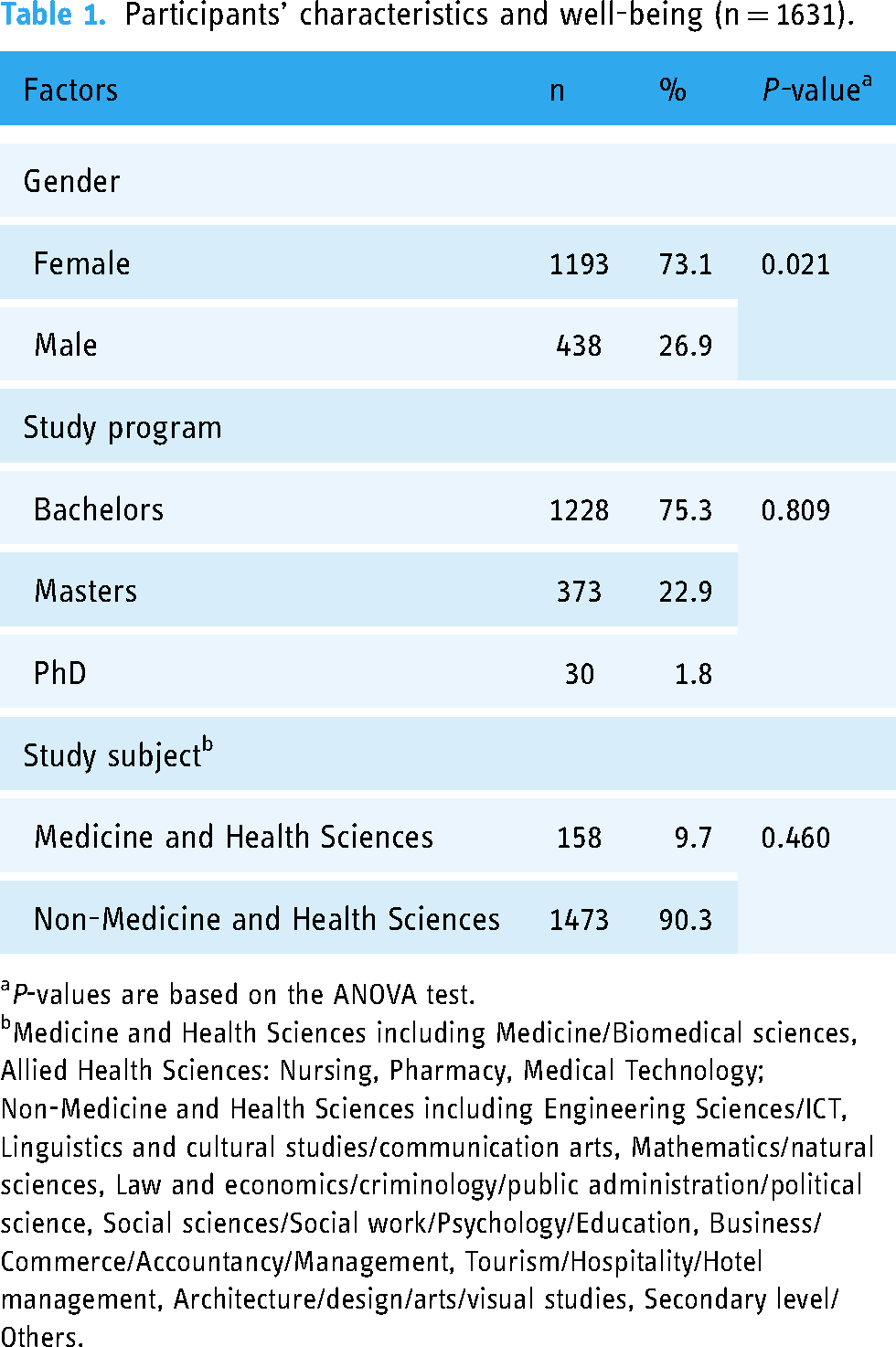
P-values are based on the ANOVA test.
Medicine and Health Sciences including Medicine/Biomedical sciences, Allied Health Sciences: Nursing, Pharmacy, Medical Technology; Non-Medicine and Health Sciences including Engineering Sciences/ICT, Linguistics and cultural studies/communication arts, Mathematics/natural sciences, Law and economics/criminology/public administration/political science, Social sciences/Social work/Psychology/Education, Business/Commerce/Accountancy/Management, Tourism/Hospitality/Hotel management, Architecture/design/arts/visual studies, Secondary level/Others.
The means of DHL score, fear of COVID-19, information satisfaction, the importance of online information searching, and well-being were 3.1 ±
Correlation matrix and well-being (n = 1631).

COVID-19: coronavirus disease 2019; DHL: digital health literacy; Rho: Correlation coefficient calculated by the Pearson test; SD: standard deviation.
Associated factors of well-being
Table 3 shows that the well-being score was positively associated with subjective social status, DHL, the importance of online information searching, information satisfaction, and negatively associated with gender and fear of COVID-19. Each variable explained a small proportion of the variance of well-being, with information satisfaction explaining the highest amount (R2 = 5.0%), followed by subjective social status (R2 = 4.1%), and DHL (R2 = 2.7%).
Linear regression model of factors associated with well-being (n = 1631).

B: regression coefficient; CI: confidence interval; COVID-19: coronavirus disease 2019; DHL: digital health literacy;R2, variance.
The multivariate linear regression model indicated that students with higher subjective social status (B = 2.40, 95% CI 1.73–3.07; p < 0.001), higher DHL score (B = 0.29, 95% CI 0.10–0.49, p < 0.001), greater importance attached to online information searching (B = 0.78, 95% CI 0.38–1.17, p < 0.001), and a higher level of information satisfaction (B = 3.59, 95% CI 2.22–4.94, p < 0.001) had better well-being. In contrast, well-being was significantly lower in students with higher levels of fear of COVID-19 (B −0.38, 95% CI −0.55-(−0.21), p < 0.001) and for female students (B = 2.99, 95% CI −5.02–0.6, p = 0.004; Table 2).
Mediating effects of the importance of online information searching, information satisfaction, and fear of COVID-19
Figure 1 demonstrates the findings of the pathway analysis on the associations between fear of COVID-19, the importance of searching for information online, information satisfaction, DHL, and well-being. The model has good model fit parameters with Comparative Fit Index (CFI): 0.911, Tucker Lewis index (TLI): 0.902, Root Mean Square Error of Approximation (RMSEA): 0.050, and StandardizedRoot Mean Square Residual (SRMR): 0.047. According to the model, fear of COVID-19 was found to be negatively associated with well-being (B = −0.12, p < 0.001). In turn, DHL (B = 0.14, p < 0.001), information satisfaction (B = 0.12, p < 0.001), and the importance of searching for information online (B = 0.09, p < 0.001) showed positive associations with well-being. Additionally, DHL was negatively associated with fear of COVID-19 (B = −0.12, p < 0.001), while the importance of searching for information online displayed a positive association with fear of COVID-19 (B = −0.13, p < 0.001). We also found that the greater importance of searching information (B = 0.33, p < 0.001) and the greater information satisfaction (B = 0.38, p < 0.001) were linked to a higher level of DHL.

Pathway analysis for digital health literacy (DHL), mediators, and well-being.
Table 4 presents the results of the mediation analysis using SEM. The findings indicate that the significant association between DHL and well-being was mediated by fear of COVID-19, the importance of information search, and information satisfaction. The standardized regression coefficients for the indirect association of DHL and well-being mediated by fear of COVID-19, information satisfaction, and importance of information search were 0.03 (95%CI 0.016–0.04, p < 0.001), 0.05 (95% CI 0.023–0.067, p < 0.001), and 0.032 (95% CI 0.01–0.05, p = 0.005), respectively. In addition, the standardized regression coefficient for the direct and total effects between DHL and well-being were 0.138 (95% CI 0.07–0.2, p < 0.001) and 0.25 (95% CI 0.2–0.3, p < 0.001), respectively.
Effects mediated by fear of COVID-19, information satisfaction, and importance of information search on the association between DHL and well-being.

B: regression coefficient; CI: confidence interval; COVID-19: coronavirus disease 2019; DHL: digital health literacy
Discussion
In the current study, we found that the well-being score was higher in students with higher scores of subjective social status, DHL, importance of online information searching, and information satisfaction, whereas lower in ones with greater fear of COVID-19 and being female. In addition, pathway analysis revealed that the associations between DHL and well-being were mediated by fear of COVID-19, information satisfaction, and importance of online information searching.
The overall DHL score of students in our study (3.1 ± 0.4) was relatively higher than the score of the university students (2.87 ± 0.3) in East and South-East Asia countries.37,39 The score of DHL items related to assessing information reliability (2.9 ± 0.5) was the lowest compared to other DHL components. This finding was consistent with the results of European university students who also struggled with assessing the reliability of available online-based health information.17,40,41 During the COVID-19 pandemic, people's need for information increased, that digital information plays a vital role in searching for information, particularly for young adults. However, students at medical universities have reported moderate to low levels of DHL, which could indicate that making health decisions and finding information about COVID-19 is challenging even for those with higher qualifications in health sciences. 40
The study demonstrated that male gender, higher subjective social status, higher DHL score, higher level of the importance of online information searching, and higher level of information satisfaction were positively associated with higher well-being scores. Recent studies showed a positive association between DHL and well-being.37,42 The DHL was reported to serve as a protective factor from COVID-19-related psychological issues, such as alleviating stress and anxiety, 23 mitigating negative effects on perceived stress, depressive symptoms, and impulsivity, 43 and lowering fear of COVID-19. 20 In addition, it was proved that dimension information searching and evaluating reliability were associated with better information satisfaction. 29
Our multivariable model also illustrated the relationship between higher subjective social status as well as the male gender with higher well-being. This result is consistent with a previous study that found that students with a higher subjective social status had better mental and physical health, 22 and that the male gender was significantly associated with higher scores of well-being.24,44
The pathway analysis showed that fear of COVID-19 significantly modified the association between DHL and well-being. A one-point increase in DHL mediated by fear of COVID-19 can increase the well-being score by 0.03 points. Our finding was consistent with a previous study in Hong Kong. 20 Students with fear of COVID-19 might search for health information through various digital platforms and their resourceful social networks. The ubiquity of social media platforms enables many public health applications, including the communication of public health messages, real-time monitoring of population health, and potential predictions such as infectious disease outbreaks. 45 Numerous public health applications of social media were beneficial to shedding light on knowledge related to COVID-19 in the previous outbreak. 46
The pathway analysis also elucidated the mediating role of information satisfaction on COVID-19 in the relationship between perceived DHL and well-being. In particular, information satisfaction on COVID-19 could constitute a vital pathway by which DHL enhances the well-being of university students. In addition, the effect of DHL on subjective well-being was improved with the importance attached to online information searches on COVID-19. Our finding was in line with previous studies with Australian university students and the general population.47,48
Information searching was found to be intentional and motivated by personal needs. 49 Therefore, individuals who perceived information seeking on COVID-19-related topics as essential were more likely to actively search for this information than those who did not. This might result in improving their knowledge of online health issues and, in turn, making positive effects on well-being via enhancing health knowledge and self-care ability.50,51 Additionally, DHL is linked to the search for information online, 52 and is increasingly important in helping access health information as well as interacting with health and public systems. 53 All of these factors might promote people's well-being, 54 and possibly explain the indirect effect of DHL on well-being via the importance of COVID-19 information searching during the pandemic.
The present study has some limitations. First, the sample was collected through an online survey and is not representative of all Taiwanese university students. Second, the study might have excluded those students with limited access to the internet or without experience with online surveys, which might have resulted in a potential bias. Last, this is a cross-sectional study revealing the associations instead of causality between DHL and well-being.
Conclusions
The results highlighted that Taiwanese university students had a relatively good DHL score. Subjective social status, DHL, the importance of online information searching, and information satisfaction were positively associated with well-being, whereas fear of COVID-19 and females were negatively associated with well-being. Importantly, fear of COVID-19, the importance of online information searching, and information satisfaction were found to be mediators in the relationship between DHL and well-being. Universities and health-related organizations are suggested to promote the population's DHL, and develop digital health information and service environments. This may support COVID-19 control and precaution measures and adherence to health behavior recommendations and further increase the well-being of students.
Footnotes
Acknowledgments
The authors would like to thank the coordinators helping with collecting the data and thank the students who agreed and completed the survey.
Contributorship
SCC, NTHN, and TVD analyzed the data and drafted the manuscript. SCC, NTHN, LDH, CYL, CFL, LTD, NYH, TTPN, NLTT, TNP, KD, OO, and TVD contributed to conceptualization, investigation, methodology, validation, and manuscript revision. NTHN, SSC, LDH, CYL, CFL, LTD, NYH, TTPN, NLTT, KD, OO, and TVD conducted data curation. All authors read and approved the final manuscript.
Declaration of conflicting interests
The authors declared no potential conflicts of interest with respect to the research, authorship, and/or publication of this article.
Ethical approval
The study was approved by the Research Ethics Committee of National Chengchi University (IRB No. NCCU-REC-202106-I066).
Funding
The authors disclosed receipt of the following financial support for the research, authorship, and/or publication of this article: This research was supported by the National Science and Technology Council, Taiwan (grant number MOST 111-2410-H-004-146-MY2).
Guarantor
SCC.
