




Abstract
During the coronavirus disease 2019 (COVID-19) pandemic, it is difficult for travelers to choose suitable nature-based leisure travel destinations because many factors are related to health risks and are highly uncertain. This research proposes a type-II fuzzy approach with explainable artificial intelligence to overcome this difficulty. First, an innovative type-II alpha-cut operations fuzzy collaborative intelligence method was used to derive the fuzzy priorities of factors critical for nature-based leisure travel destination selection. Subsequently, a type-II fuzzy Vise Kriterijumska Optimizacija I Kompromisno Resenje method, which is also novel, was employed to evaluate and compare the overall performance of nature-based leisure travel destinations. Furthermore, several measures were taken to enhance the explainability of the selection process and result. The effectiveness of the proposed type-II fuzzy approach was evaluated in a regional experiment conducted in Taichung City, Taiwan, during the COVID-19 pandemic.
Keywords
Introduction
After the initial stages of the coronavirus disease 2019 (COVID-19) pandemic, domestic tourism gradually resumed,1,2 especially domestic tourism. People travel to resorts close to natural scenery, such as forests or the seaside. In addition to the relaxation of tension during the COVID-19 pandemic, nature-based leisure travel can also avoid cross-infection. However, during the COVID-19 pandemic, it is difficult for travelers to choose suitable nature-based leisure travel destinations because many factors are related to health risks and are highly uncertain. The objective of this study is to overcome this difficulty.
In this study, a type-II fuzzy approach with explainable artificial intelligence (XAI) is proposed to assist travelers in choosing suitable nature-based leisure travel destinations amid the COVID-19 pandemic. In the proposed methodology, first, for each traveler, the type-II alpha-cut operations (ACO) method is applied to precisely derive the priorities of factors essential for choosing a suitable nature-based leisure travel destination. Subsequently, type-II fuzzy collaborative intelligence (FCI) is applied to aggregate the priorities of factors derived by all travelers. Based on the aggregation result, the fuzzy Vise Kriterijumska Optimizacija I Kompromisno Resenje (fuzzy VIKOR) method is applied to evaluate and compare the overall performances of nature-based leisure travel destinations.
Compared with similar methods in the literature,3,4 the proposed methodology has the following novelties. In existing methods, the lower and upper membership functions of a type-II fuzzy priority are usually subjectively specified or fitted according to the distribution of the collected data. In contrast, in the proposed methodology, the lower and upper membership functions of a type-II fuzzy priority are from the consensus among travelers. In addition, the ACO is applied to precisely derive the priorities of essential factors for choosing a suitable nature-based leisure travel destination. The result cannot be described in triangular or trapezoidal fuzzy sets. Further, type-II FCI is applied to aggregate the priorities of factors derived by all travelers into a type-II fuzzy set. Finally, several XAI measures have been taken to enhance the explainability of the selection process and result.
In summary, the contributions of this study are as follows:
A systematic procedure is established to assist travelers in comparing nature-based leisure travel destinations by considering health-related risks and uncertainties during the COVID pandemic. Several measures are proposed to enhance the explainability of the proposed methodology so that the decision-making result is more acceptable to travelers.
The remainder of this paper is organized as follows. Section “Literature review” presents the literature review. Section “Methodology” introduces the type-II fuzzy approach with XAI proposed in this study. Section “Case study” details the application of the type-II fuzzy approach in a regional study. Finally, Section “Conclusions” concludes this study and provides directions for future research.
Literature review
Nature-based leisure travel amid the COVID-19 pandemic
According to Ye and Li, 5 the increase in leisure time and emphasis on the ecological environment are the two driving forces for nature-based leisure travel activities. Jang et al. 6 identified the four objectives of nature-based leisure travel as health promotion, education, relaxation, and leisure sports. However, people with jobs related to the natural environment have more difficulty relaxing during nature-based leisure travel activities. 7
In addition, travelers’ demographic backgrounds affect their objectives. 8 Different objectives lead to different considerations when choosing suitable nature-based leisure travel destinations. Nevertheless, common considerations include season, costs, travel time, and other factors. During the COVID-19 pandemic, the completeness of pandemic prevention measures is an important consideration. 9 In contrast, the number of recreational facilities at a nature-based leisure travel destination has become less important. 10
How to disperse people moving in a nature-based leisure travel destination to reduce the risk of cross-infection is an urgent task. To this end, Li et al. 11 explored the use of agent technologies to visualize the trajectories of people in a nature-based leisure travel destination. During the COVID-19 pandemic, apps were designed to determine the density of people at a certain point. 12 However, cell phone reception at a nature-based leisure travel destination may be a problem, unlike in other types of leisure travel destinations. 13 Nevertheless, similar techniques are still helpful for this purpose.
XAI in medicine and healthcare
Generally, XAI is a trend in artificial intelligence (AI) that enhances the practicality of an AI technology by explaining its execution process and results. 14 However, which AI technologies are explainable is inconclusive. Among the existing AI technologies, ensemble methods, random forecasts, decision trees, Bayesian networks, sparse linear models, and others are highly explainable, whereas artificial neural networks, deep learning, support vector machines, and others are less explainable. 15
In addition, AI technologies have been widely applied in manufacturing and healthcare. However, fundamental differences exist in the applications of AI technologies in these two fields. The results of an AI technology application in manufacturing may be directly put into practice without human intervention. In contrast, the results of an AI technology application in healthcare often require human approval or decision-making. Therefore, XAI is particularly critical in the medical and healthcare fields.
Type-II fuzzy logic for group decision-making
Type-II fuzzy logic can better account for the uncertainty of human judgment and has recently been widely used in multicriteria decision-making.16–18 Many related applications exist in medicine19,20 and healthcare.21–23 Several advanced type-II fuzzy methods have been proposed in the literature to assist group decision-making.
For example, Chiu and Chen 23 formulated and optimized an interval type-II fuzzy mixed integer-linear programming model to choose the three-dimensional printing facility suitable for printing dentures. Moreover, Zhang and Li 24 evaluated and enhanced the consistency between decision-makers’ judgments expressed in linguistic terms. To this end, a minimum adjustment consensus model was formulated and optimized.
Further, Sun et al. 25 established a systematic procedure to advise decision-makers with inconsistent judgments to revise their judgments to achieve a certain consensus. In addition, Wang et al. 26 identified subgroups among decision-makers and measured the consensus inside and outside the subgroups. A two-phase feedback mechanism was also established to enhance both types of consensus.
The proposed method is similar to the method by Wang et al. 26 because two types of consensus were measured. However, in the proposed methodology, decision-makers were not divided into subgroups.
Methodology
The symbols, variables, and parameters used in this study are defined as follows:
ω: weight of D(): defuzzification function N(): normalization function RI: random consistency index. Step 1. Collect data on nature-based leisure travel destinations. Step 2. Construct (or modify) a fuzzy judgment matrix by performing pairwise comparisons of the relative priorities of factors critical to selecting a suitable nature-based leisure travel destination (for each traveler). Step 3. Evaluate the fuzzy consistency ratio of the fuzzy judgment matrix (for each traveler). Step 4. Proceed to Step 5 if the fuzzy consistency ratio is small enough (for each traveler); otherwise, return to Step 2. Step 5. Derive the fuzzy priorities of critical factors using ACO (for each traveler). Step 6. Aggregate the priorities derived for all travelers using type-II FCI. Step 7. Evaluate the overall performance of each nature-based leisure travel destination based on the aggregation results using type-II fuzzy VIKOR. Step 8. Rank nature-based leisure travel destinations according to the overall performance results to choose the top-performing nature-based leisure travel destination. Color management: The colors and shapes of objects representing different concepts should be differentiated to facilitate comparison. Common expressions: Technical terms and variable names should be replaced with common expressions. Annotated figures: The legend of each object should be placed close to the object. Traceable aggregation: Simultaneously presenting the original data and aggregation result contributes to its credibility. Segmented distance diagram: A suitable segmented distance diagram is designed for methods that compare alternatives by measuring their distances to the ideal or anti-ideal solution.
The type-II fuzzy approach for nature-based leisure travel destination selection comprises the following steps:
There is no absolute way to improve the explainability of AI technology. In this study, the following measurements are taken to enhance the explainability of the execution process and results (Figure 1):

Measurements to enhance explainability.
Type-II fuzzy logic: An introduction
First, the definition of an interval type-II fuzzy set is given.
An interval type-II fuzzy set
Moreover,


Interval type-II TrFN.
In addition,
ACO for deriving fuzzy priorities of critical factors
Calculation process
In the beginning, each traveler compares the relative priorities of critical factors in pairs. The results for traveler k are placed into
The ACO derives the fuzzy priorities of critical factors by solving the following equations29–31:




Enhancing explainability
The ACO is an iterative eigenanalysis. An eigenanalysis is the basic mechanism of the principal component analysis
33
and analytic hierarchy process
28
and has been widely used in various fields. The computational process of an eigenanalysis is not necessarily easy to understand. Nevertheless, the calculation results are easy to communicate. When traveler k assigns a high value to

Differences in the fuzzy priorities of factors.
In addition, ACO precisely derives the fuzzy priorities of factors. Therefore, the results are explainable. In contrast, approximation methods, such as the fuzzy geometric mean (FGM) and fuzzy extent analysis, may overestimate or underestimate the fuzzy priorities of factors. 34 As a result, the explainability of the derivation results may be low.
Type-II FCI for aggregating the fuzzy priorities derived by travelers
Calculation process
Subsequently, type-II FCI is applied to aggregate the fuzzy priorities derived for all travelers into a type-II fuzzy set, as illustrated in Figure 4.

Comparison of the proposed methodology with the existing methods.
The priorities of critical factor i derived for all travelers are aggregated as
In the proposed methodology,


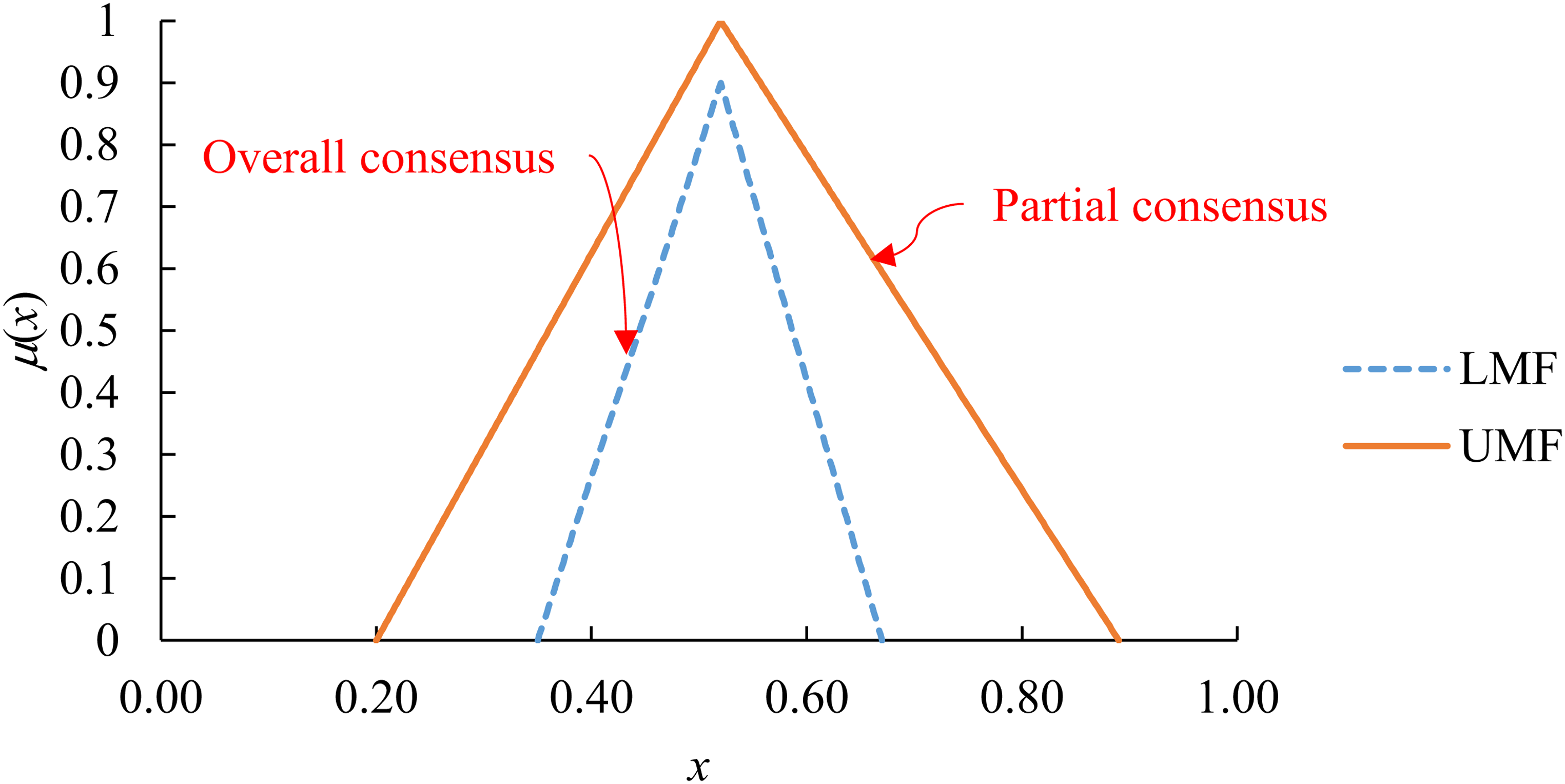
Different consensus degrees in the type-II aggregation results.
However, the α cut of the UMF may contain multiple disjointed intervals, as illustrated in Figure 6. The UMF is modified by connecting the disjointed intervals to facilitate the subsequent operations, as depicted in Figure 7.

Aggregation results.

Modified aggregation results.
As a result,


Enhancing explainability
The aggregation result is the fuzzy priority of a factor. Therefore, the treatments in the previous step can also be applied to enhance the explainability of the aggregation result. An example is provided in Figure 8. Furthermore, in this figure, the original data (i.e. the fuzzy priority derived for each traveler) are placed alongside the aggregation results for tracking and comparison. The presentation of the original data should remove redundant information to avoid distracting the focus. The traceability of the aggregation results is very helpful for interpretability. If some travelers feel that the priority of a factor after aggregation is not appropriate (e.g. too large, too small, too wide, or too narrow), all travelers can discuss to determine whether some of them should modify their judgments.

Traceable aggregation.
Type-II fuzzy VIKOR for evaluating nature-based leisure travel destinations
Calculation process
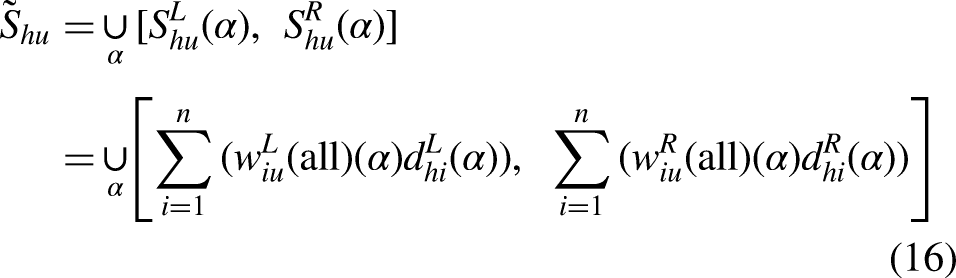
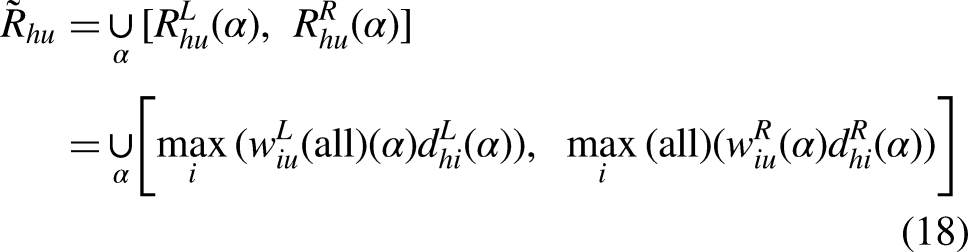
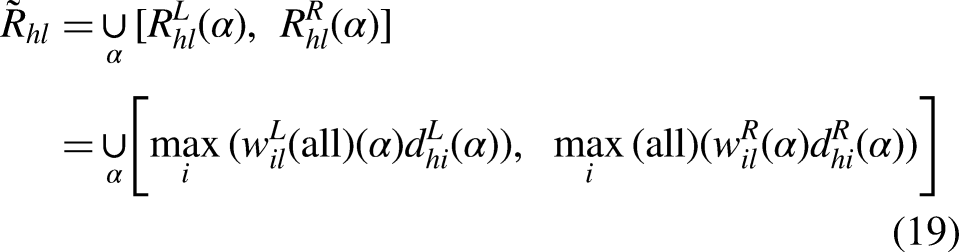
Subsequently, the type-II fuzzy VIKOR method40–43 is applied to evaluate the overall performance of a nature-based leisure travel destination. Several studies on type-II fuzzy VIKOR applications exist in the literature. However, most past studies have been based on type-II fuzzy sets with triangular or trapezoidal membership functions.40–42 In contrast, the lower and upper membership functions of the aggregation result do not belong to the two types.
The type-II fuzzy VIKOR method comprises the following steps:
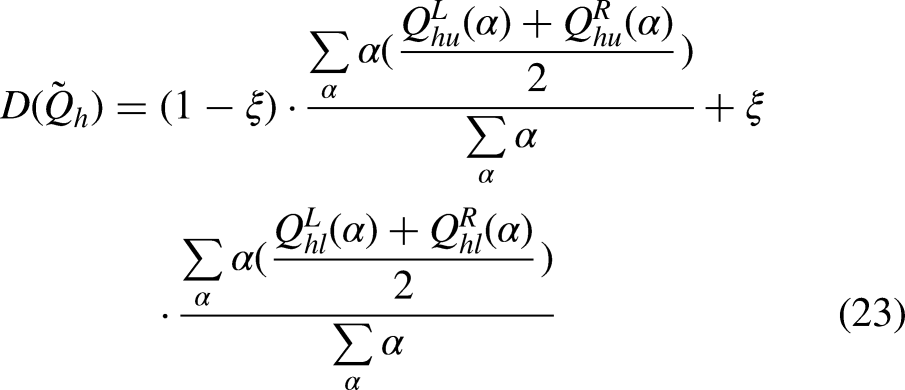
Step 1. Determine the ideal and anti-ideal performance in optimizing each factor: Step 2. Compute the normalized fuzzy distance from the ideal performance
40
: Step 3. Derive Step 4. Combine Step 5. Defuzzify Step 6. Choose the nature-based leisure travel destination that achieved the highest








Enhancing explainability
Fuzzy VIKOR is less explainable than other more intuitive methods, such as fuzzy weighted average.
46
The comparison mechanism in fuzzy VIKOR is based on the distance from an alternative to the ideal solution. Therefore, presenting the differences in the distances of alternatives from the ideal solution enhances the explainability of fuzzy VIKOR, as illustrated in Figure 9, which is called the segmented distance diagram. In this figure,
All possible alternatives surround the ideal solution. The distance between an alternative and the ideal solution is

Segmented distance diagram of the comparison mechanism in fuzzy Vise Kriterijumska Optimizacija I Kompromisno Resenje (VIKOR).
For example, in Figure 9, Alternative 2 is the best choice because it is closest to the ideal solution. In addition, the advantage of Alternative 2 over the other alternatives lies in its overall distance, which is much shorter than the others.
Case study
Background
Twenty-two national forest recreation areas exist in Taiwan, such as the Taipingshan National Forest Recreation Area and Dasyueshan National Forest Recreation Area, 47 whereas privately run forest recreation areas are rare. Most ecological reserves in national forest recreation areas are also access-control regions. When the main mountaineering routes in a national forest recreation area pass through ecological reserves and access-control regions, tourists must apply for admission permits. Entry permits are also required.
The proposed methodology has been applied in Taichung City, Taiwan, to assist 12 traveler groups in choosing suitable nearby forest recreation areas during October 2021 to evaluate its effectiveness. Subsequently, the first traveler group is used as an example to illustrate the applicability of the proposed methodology.
Application of the proposed methodology
The traveler group consisted of three travelers. After reviewing the relevant references and reports, critical factors for choosing a suitable forest recreation area were determined to be the number of confirmed COVID-19 cases in the region, the distance to the forest recreation area, the traveler's preference for the forest recreation area, area (size), and total costs (including the ticket price, parking fee, etc.).8–9,48,49 The number of pandemic prevention measures at the forest recreation areas was not included because they were all government-operated, so their pandemic prevention measures were not different. In addition, the ease of social distancing was not compared due to the large areas of these forest recreation areas.
The travelers compared the priorities of these factors in pairs. The following fuzzy judgment matrices summarize the results:


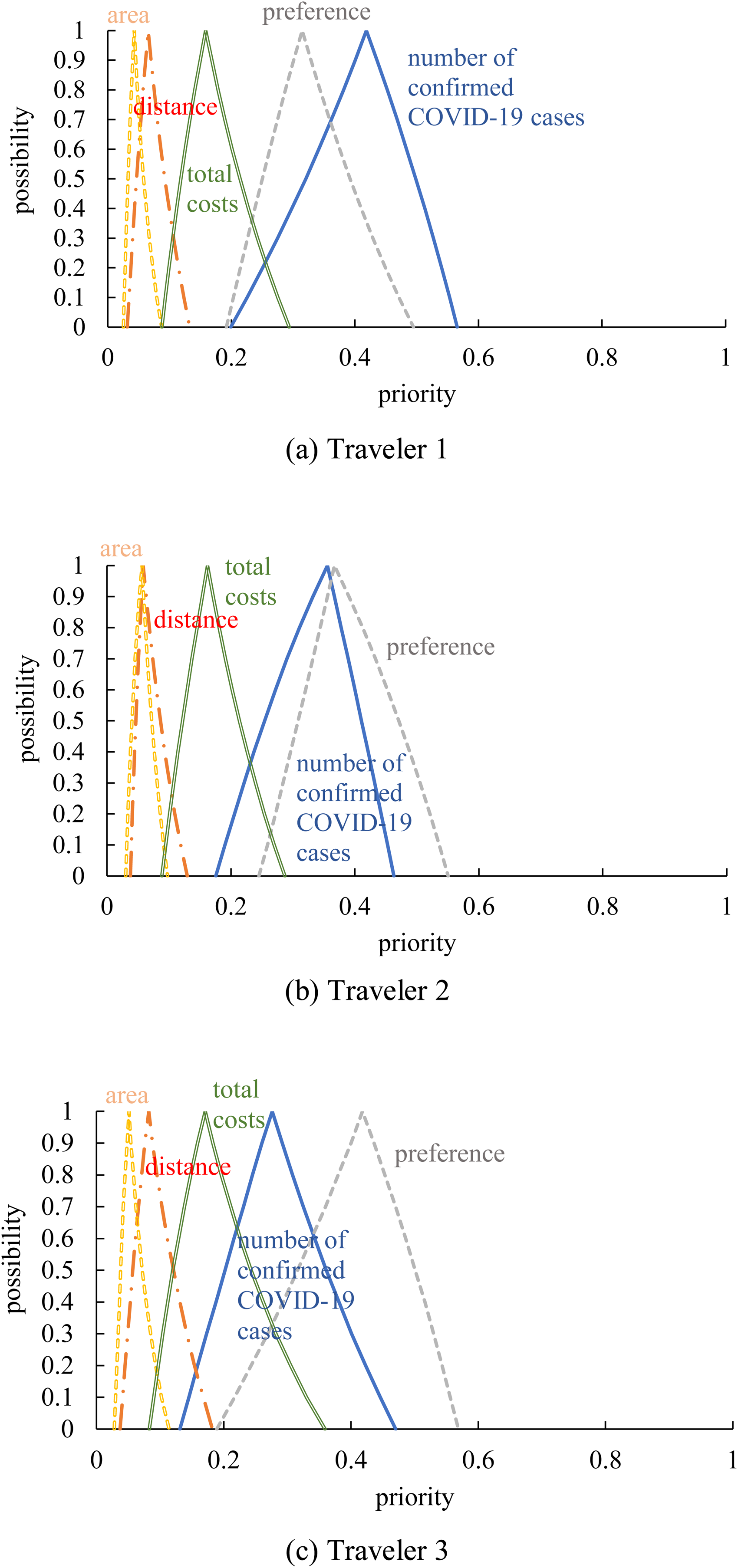
Fuzzy priorities of explainable artificial intelligence-compliant diagrams.
Subsequently, type-II FCI was applied to aggregate the fuzzy priorities derived by all travelers. For example, the aggregation result for the fuzzy priority of the number of confirmed COVID-19 cases is provided in Figure 11, ensuring high explainability.

Aggregation result using type-II alpha-cut operations (ACO).
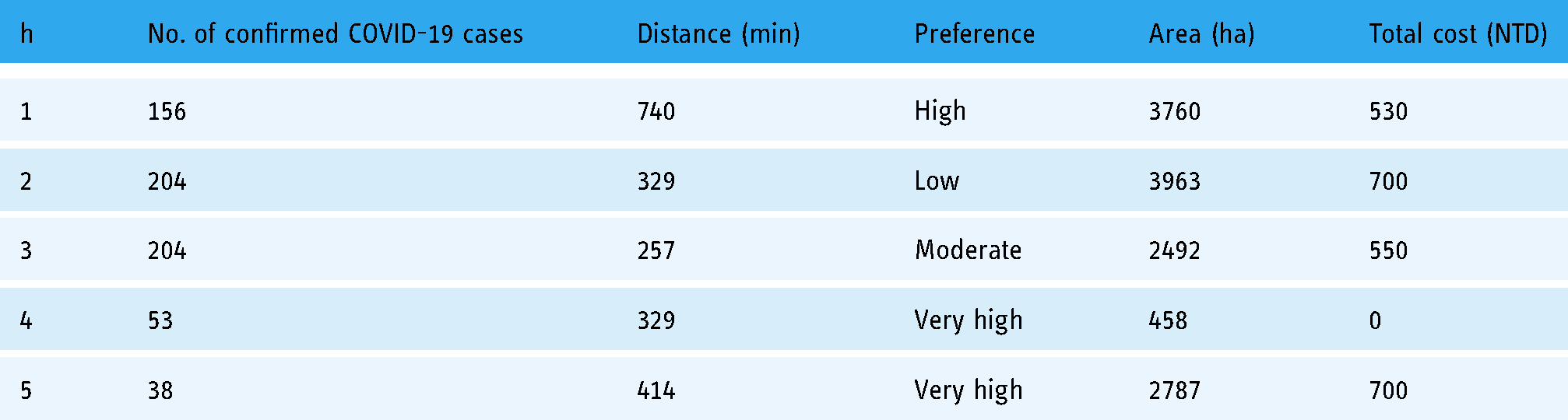
Type-II VIKOR was applied to assess and compare the overall performance results for the forest recreation areas near Taichung City. Five national forest recreation areas (h = 1 to 5) were considered. Table 1 summarizes details of these forest recreation areas.
Forest recreation area details.
Among critical factors, a higher “preference” and “area” exhibited better performance, whereas other factors had better performances for lower values. These performances were evaluated as follows:
Better performance for lower values

Evaluation results.

Subsequently, the best and worst performance results for optimizing each factor were determined. Table 3 summarizes the results.
Best and worst performance results for optimizing each factor.

The normalized fuzzy distance between each forest recreation area and the best performance was measured. Table 4 summarizes the measurement results.
Normalized fuzzy distance between each forest recreation area and the best performance.

The values of
The α cuts of the
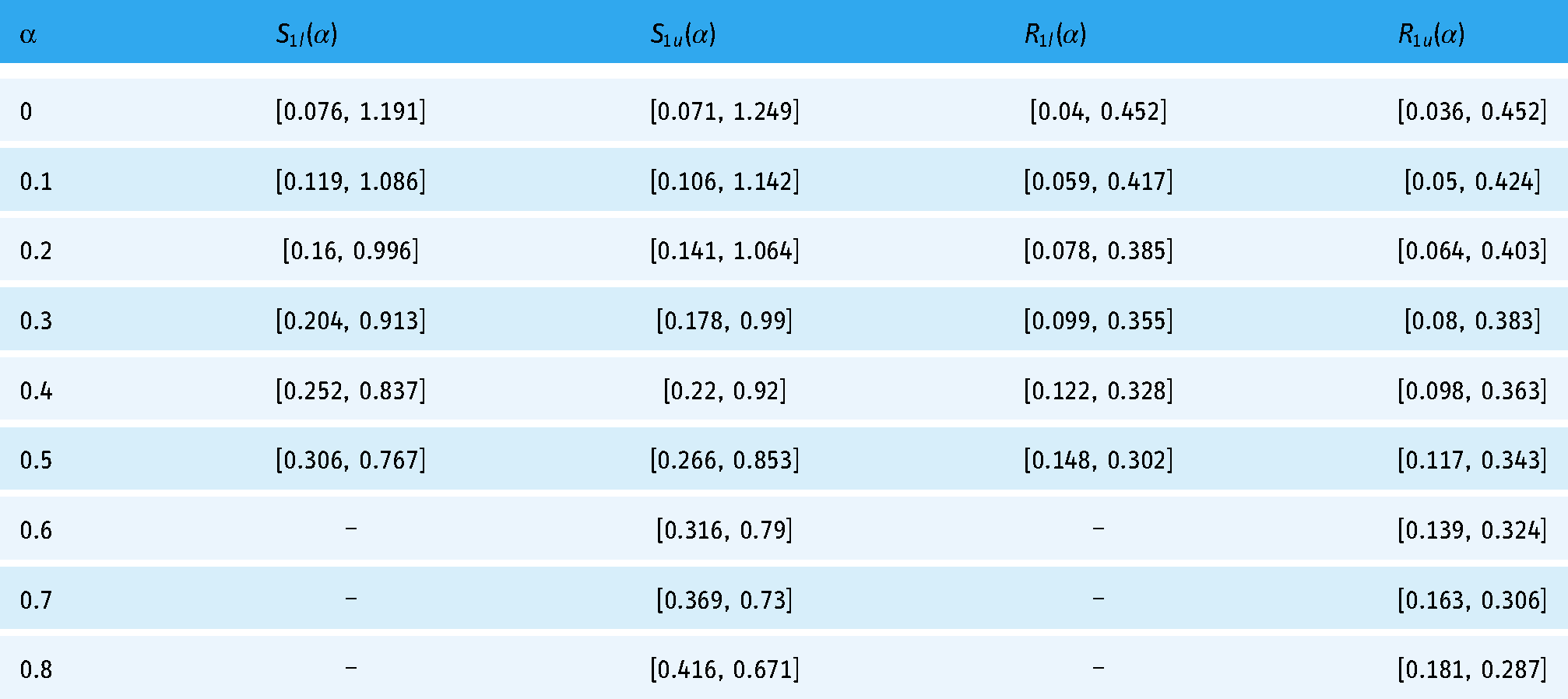
Based on the values of

Segmented distance diagram.
The α cuts of the

Defuzzification results.

Discussion
According to the experimental results, the following findings are discussed. The most crucial factor in choosing a forest recreation area in the late stages of the COVID-19 pandemic was the traveler's preference, followed by the number of confirmed COVID-19 cases in the region. In contrast, the least crucial factor was the area of a forest recreation area.
Additionally, forest recreation Area 4 achieved the lowest value of
In addition, according to Figure 12, the advantages of the top two forest recreation areas over the others were significant. Further, a parametric analysis was conducted to investigate the effect of ξ on the ranking result. Table 8 summarizes the results. Changing the value of ξ did not affect the ranking result of the forest recreation areas or the superiority of Area 4.
Results of the parametric analysis.

Finally, 11 travel groups followed the recommendations using the proposed methodology. The successful recommendation rate was 92%.
Comparison
The existing FGM-fuzzy VIKOR method42,50 was also applied to the collected data for comparison to further elaborate on the effectiveness of the proposed methodology. The FGM and fuzzy VIKOR were used to derive the priorities of factors and evaluate the overall performance of a forest recreation area, respectively. The ranking of the forest recreation areas based on their overall performance is listed in Table 9. The top-performing forest recreation area remained unchanged (i.e. forest recreation Area 4). However, the second-best forest recreation area changed from forest recreation Area 5 to 1. In addition, other forest recreation areas had different rankings.
Ranking using the FGM-fuzzy VIKOR method.

The superiority of the proposed methodology over the existing FGM-fuzzy VIKOR method is defined as follows. In the proposed methodology, ACO is applied to derive the exact fuzzy priorities of factors. In contrast, the fuzzy priorities of factors derived using FGM in the existing method are imprecise. Decisions based on such imprecise information are prone to errors. Moreover, type-II FCI is used to aggregate the fuzzy priorities derived for all travelers. In this way, the aggregation result is not an unreasonable value. In addition, only values highly acceptable to all travelers appear in the aggregation results.
Conclusions
In the later stages of the COVID-19 pandemic, people enjoy nature-based leisure activities to relax without the risk of cross-infection. However, each nature-based leisure travel destination has its advantages and disadvantages. In addition, health risks associated with the COVID-19 pandemic have complicated the situation, making selecting a suitable nature-based leisure travel destination challenging. The type-II fuzzy approach with XAI is proposed in this study to help accomplish this task. The proposed methodology is novel because the membership function of a type-II fuzzy priority is derived from the consensus among travelers. In addition, the application of several XAI techniques enhances the explainability of the type-II fuzzy approach.
The effectiveness of the type-II fuzzy approach with XAI was examined using a regional study. According to experimental results, after the outbreak of the COVID-19 pandemic, factors affecting the selection of a suitable forest recreation area changed. In addition, when choosing a suitable forest recreation area, the most critical factors include the traveler's preference and number of confirmed COVID-19 cases in the region. Finally, the ranking of forest recreation areas using the proposed methodology differed from that using an existing method.
Various types of nature-based leisure travel destinations exist The priorities of critical factors for choosing other types of nature-based leisure travel destinations may not be the same. Therefore, the same analysis must be re-performed to observe whether the experimental results in this study are still applicable. In addition, other XAI techniques also have application potential and can be investigated in future research.
This research received no external funding.
Footnotes
Author’s contribution
Both authors contributed equally to the writing of this paper.
Declaration of conflicting interests
The authors declared no potential conflicts of interest with respect to the research, authorship, and/or publication of this article.
Ethical approval
Not applicable, because this article does not contain any studies with human or animal subjects.
Funding
The authors received no financial support for the research, authorship, and/or publication of this article: The publication fee of this paper was support by Ministry of Science and Technology, Taiwan under the grant MOST 110-2622-E-240-001-CC2.
Informed consent
Not applicable, because this article does not contain any studies with human or animal subjects.

Trial registration
Not applicable, because this article does not contain any clinical trials.