




Abstract
During the COVID-19 pandemic, some smart technology applications were more effective than had been expected, whereas some others did not achieve satisfactory performance. Consequently, whether smart technology applications in healthcare are sustainable is a question that warrants investigation. To address this question, a hybridising subjective and objective fuzzy group decision-making approach with explainable artificial intelligence was proposed in this study and then used to evaluate the sustainability of smart technology applications in healthcare. The contribution of this research is its subjective evaluation of the sustainability of smart technology applications followed by correction of the evaluation outcome on the basis of the applications’ objective performance during the COVID-19 pandemic. To this end, a fuzzy nonlinear programming model was formulated and optimised. In addition, the impact of several major global events that occurred during the pandemic on the sustainability of smart technology applications was considered. The proposed methodology was applied to evaluate the sustainability levels of eight smart technology applications in healthcare. According to the experimental results, three applications—namely healthcare apps, smartwatches, and remote temperature scanners—are expected to be highly sustainable in healthcare, whereas one application, namely smart clothing, is not.
Keywords
Introduction
Before the outbreak of the COVID-19 pandemic, smart technologies were being used extensively to improve people's quality of life.1,2 However, since the onset of the pandemic, some smart technologies (e.g. remote temperature scanners) have still been frequently employed, whereas the use of others (e.g. wireless medical sensor networks) has been limited by their low effectiveness or efficiency.3,4 Several studies have investigated the application of contact-tracing apps and sensors.5–7 According to Khan et al.,
8
robotics (including drones), artificial intelligence (AI), masks, and sensors were all relatively frequently used to minimise the spread of COVID-19, and according to Chen and Wang,
9
robots, smartphone apps, wearable sensors and devices, and wireless medical sensor networks were considered the most effective smart technology applications during the pandemic. By contrast, the application of remote temperature scanners was deemed unfavourable. In summary,
Most studies conducted before or during the COVID-19 pandemic focused on the use of smart technology applications in healthcare2,10; State-of-the-art development has tended to focus on comparing the prevalence of various smart technology applications in healthcare during the COVID-19 pandemic and recommending the possible applications of such technologies5,8; and Few studies have discussed the reasons for this difference.9,11 Smart technologies that will likely be widely used after the COVID-19 pandemic may be different from those widely used during the pandemic; this topic was discussed by Chen and Wang.
9
However, the COVID-19 pandemic did not end as expected, resulting in a low reference value of previous analysis results. For example, Chen and Wang
9
did not consider remote temperature scanners as the most suitable smart technology application, yet as COVID-19 remained prevalent in society, the cost-effectiveness of remote temperature scanners increased. Now, remote temperature scanners are used extensively worldwide. Major global events that occurred during the COVID-19 pandemic—including the US–China trade war,
12
severe delays and congestion at ports and terminals due to COVID-19,
13
a global shortage of semiconductor chips,
14
inflation,
15
and the Ukraine–Russia war
16
—have influenced the application of smart technologies in healthcare.
17
Existing methods based on AI are not easy to understand or communicate.
18
To update information on the factors critical to the sustainability of smart technology applications in healthcare (i.e. the possibility that a smart technology application will continue to be used in healthcare after the COVID-19 pandemic); To consider the impact of major global events on the sustainability of smart technology applications in healthcare; and To enhance the explainability of AI methods by using explainable AI (XAI).
Thus, the following research gaps need to be addressed:
To fill these gaps, this study aimed to achieve the following goals:
This study began by conducting a survey of the relevant literature and identifying factors critical to the sustainability of smart technology applications in healthcare. Subsequently, to evaluate the sustainability of smart technology applications, a hybridising subjective and objective fuzzy group decision-making approach was proposed in which the sustainability of a smart technology application in healthcare is evaluated both subjectively and objectively. Specifically, some smart technology applications can be evaluated only objectively, whereas others can also be evaluated subjectively on the basis of their performance during the COVID-19 pandemic. The hybridising subjective and objective fuzzy group decision-making approach is a fuzzy analytic hierarchy process (FAHP) method. Other fuzzy group decision-making methods—such as the fuzzy (ordered) weighted average, fuzzy Delphi method, fuzzy technique for order preference by similarity to the ideal solution, fuzzy measuring attractiveness through a categorical-based evaluation technique, fuzzy preference ranking organisation method for enriched evaluation, fuzzy elimination and choice expressing reality method, and fuzzy TODIM method—are also applicable19–21; however, unless the costs of decisions can be quantified and compared, determining which fuzzy group decision-making method is the optimal method is difficult. Nevertheless, among FAHP methods, the proposed hybridising subjective and objective fuzzy group decision-making approach achieves high precision by deriving the exact values of fuzzy priorities, whereas other FAHP methods, such as the fuzzy geometric mean (FGM
22
) and fuzzy extent analysis (FEA
23
), only approximate the values of these priorities. Furthermore, several XAI techniques were applied to enhance the explainability of the hybridising subjective and objective fuzzy group decision-making approach. XAI techniques can be divided into two categories: those that enhance the practicality of an existing AI technology by explaining its execution process or results, and those that improve the effectiveness of existing AI technologies by incorporating easy-to-interpret visual features.24,25 The XAI techniques applied in this study fell within the first category.
The remainder of this paper is organised as follows: “Literature review” section presents a literature review. “Key factors affecting the sustainability of smart technology applications in healthcare” section identifies the key factors affecting the sustainability of smart technology applications in healthcare. “Methodology” section introduces the hybridising subjective and objective fuzzy group decision-making approach. “Case study” section details the application of the proposed methodology to evaluate the sustainability of eight smart technology applications in healthcare. Finally, “conclusion” section concludes this paper and suggests directions for future research.
Literature review
Kakderi et al. 26 highlighted the reality that the adoption of smart technologies during the COVID-19 pandemic was far less extensive than had been expected, despite government policies aimed at transitioning to smart cities. This reality has called into question whether the application of smart technologies in healthcare, especially at the individual level, is definitely sustainable and motivated the present assessment of the sustainability of smart technologies applied in healthcare.
As discussed by Waheed and Shafi, 3 in theory, the application of smart technologies can slow the spread of COVID-19. However, the practical benefits of smart technology applications appear to be far fewer in number than researchers had expected. In the face of a widespread pandemic, some traditional disposal methods are more effective, efficient, and convenient. Therefore, when cost efficiency is a priority, people may abandon the pursuit of expensive smart technologies. Some major global events that occurred during the COVID-19 pandemic, such as the aforementioned shortage of semiconductor chips and rising inflation, have increased people's economic burden, and this new reality will likely reduce people's willingness to use smart technologies in healthcare. This topic has yet to be explored in the literature, and thus the present study intended to analyse it.
Chen and Wang 9 listed some characteristics of smart technology applications in healthcare after the COVID-19 pandemic, namely allowing users to regain their freedom of movement and travel,7,26 meeting practical needs, having high effectiveness, the ability to be continually improved through software developments, and being cost-effective. In that study, restoring people's freedom of movement was considered the most crucial characteristic. Today, however, freedom of movement is no longer restricted in most regions. Therefore, other characteristics will likely start to become more important, and the present study intends to determine which characteristics these are.
Monitoring of body temperature has served as a common measure to control the spread of COVID-19. 27 For this reason, remote temperature scanners are popular, although they are more expensive and larger than wearable smart devices, such as smartwatches, smart bracelets, and smart clothing. In addition, remote temperature scanners can monitor many people visiting a public space at once, whereas one wearable smart device can monitor only one individual. Therefore, the market for such wearable smart devices may not expand as expected after the COVID-19 pandemic. In summary, the sustainability of certain applications in healthcare is questionable. Clarifying this question was one of the motivations for this study.
Key factors affecting the sustainability of smart technology applications in healthcare
The literature review shows that the sustainability of a smart technology application after the COVID-19 pandemic can be evaluated by considering the following aspects:
A smart technology application is sustainable if it can provide value-added services on the basis of vaccination information28–30: Although the demand for vaccination information from travellers is now in decline,
31
providing different services for travellers with unequal vaccination statuses can still minimise health risks.
32
A smart technology application is sustainable if it is cost-effective6,10,33: The cost of a smart technology application is determined by its supply and demand, both of which are vulnerable to influence by global events.34,35 Furthermore, the cost-effectiveness of smart technology applications cannot be directly assessed. For example, a remote temperature scanner can be used to monitor the body temperature of thousands of customers who visit a department store; therefore, the more customers who visit that store, the more cost-effective is the remote temperature scanner. A smart technology application is sustainable if it can promote healthy mobility among the public30,36: A smart technology application can reduce the risk of people becoming infected with a virus while they are on the move and remind people to take measures against such infection. A smart technology application is sustainable if it is necessary or irreplaceable36–38: During the COVID-19 pandemic, public body temperature monitoring using remote temperature scanners seemed to be more effective than having individuals use a smart bracelet to monitor their own body temperature. A smart technology application is sustainable if it can be combined with other smart technology applications to achieve synergy6,10: Remote body temperature scanners are often combined with noncontact alcohol sterilisers or automated camera devices (to track footprints). A smart technology application is sustainable if it is easy to implement and maintain36,38,39: Most smart devices can be operated intuitively. However, smart devices are difficult to repair when they malfunction. For example, Djuric
40
estimated that an Apple Watch smartwatch (original version) is only 50% repairable.
During the COVID-19 pandemic, several major global events had a considerable impact on the demand and supply of smart technologies; that such impacts are possible is not conducive to the sustainability of using smart technology applications, as illustrated in Figure 1.

Factors affecting the sustainability of a smart technology application in healthcare.
Major global events can influence the application of smart technologies in healthcare in two ways: (1) by raising the threshold for user acceptance of the technology application in question and (2) by changing users’ preferences related to specific criteria, as illustrated in Figure 2. In addition, a global event can give rise to other such events; for example, both the US–China trade war and delays and congestion at ports and terminals (owing to the COVID-19 pandemic) led to a global shortage of semiconductor chips.

Illustration of how global events give rise to other such events.
Methodology
Procedure
A hybridising subjective and objective fuzzy group decision-making approach with XAI was proposed in this study; it can be used to evaluate the sustainability of smart technology applications in healthcare. Fuzzy set theory has been used extensively to make practical management decisions related to healthcare, such as those related to the evaluation of medical waste disposal strategies and techniques, 41 the prioritisation of lean-supply-chain management initiatives in healthcare service operations, 42 and the assessment of patients’ health check results. 43
The proposed methodology comprises the following steps:
Step 1. Form a team of experts in related fields. Step 2. Compare (or modify) the relative priorities on the basis of criteria in linguistic terms.
44
Step 3. If the fuzzy judgment matrix is consistent, proceed to the next step; otherwise, return to Step 2. Step 4. Aggregate the fuzzy judgment matrixes of all the experts by using the FGM approach.
45
Step 5. Evaluate the sustainability of a smart technology application in healthcare subjectively and in linguistic terms
46
on the basis of its effectiveness during the COVID-19 pandemic. Step 6. Solve a fuzzy nonlinear programming (FNLP) problem to derive the fuzzy priorities of criteria from the aggregation result. Step 7. Evaluate the sustainability of a smart technology application in healthcare objectively on the basis of the derived fuzzy priorities.
47
The process of evaluating a methodology's sustainability is treated as a hybrid (supervised and unsupervised) optimisation problem, whereas in most existing methods, the problem in question is treated as an unsupervised fuzzy group decision-making process.2,48,49 The sustainability of a smart technology application in healthcare is evaluated both subjectively and objectively.
As illustrated in Figure 3, the proposed methodology is novel for the following reasons:

Procedure of the proposed methodology.
Steps 1–3
First, a team of K experts is formed. Expert k evaluates the relative priority of criterion i over criterion j by using a linguistic term that can be mapped to a triangular fuzzy number




The priorities of the criteria are usually presented in the form of a bar chart to facilitate a comparison of the criteria's relative values, as illustrated in Figure 4. By contrast, the fuzzy priorities of the criteria are usually compared using a line graph, as shown in Figure 5. However, presenting the fuzzy priority and the performance of a criterion simultaneously is difficult. Therefore, in the proposed methodology, two XAI techniques, namely the colour management technique and the common expression technique, 49 are applied, and a gradient bar chart is plotted to illustrate the fuzzy priorities of the criteria (Figure 6), where darker colours represent higher membership levels. The fuzzy priority and (normalised) performance of a criterion are presented simultaneously using a grouped bar chart, as illustrated in Figure 7. Figure 5 can be mapped to Figure 7, as illustrated in Figure 8.

Bar chart to compare the priorities of the criteria.

Line graph to illustrate the fuzzy priorities of the criteria.

Gradient bar chart to illustrate the fuzzy priorities of the criteria.

Grouped bar chart to compare the fuzzy priorities and (normalised) performance levels of the criteria simultaneously.

Next,

Step 4
The fuzzy judgment matrixes of all the experts are aggregated using the FGM as follows
54
:

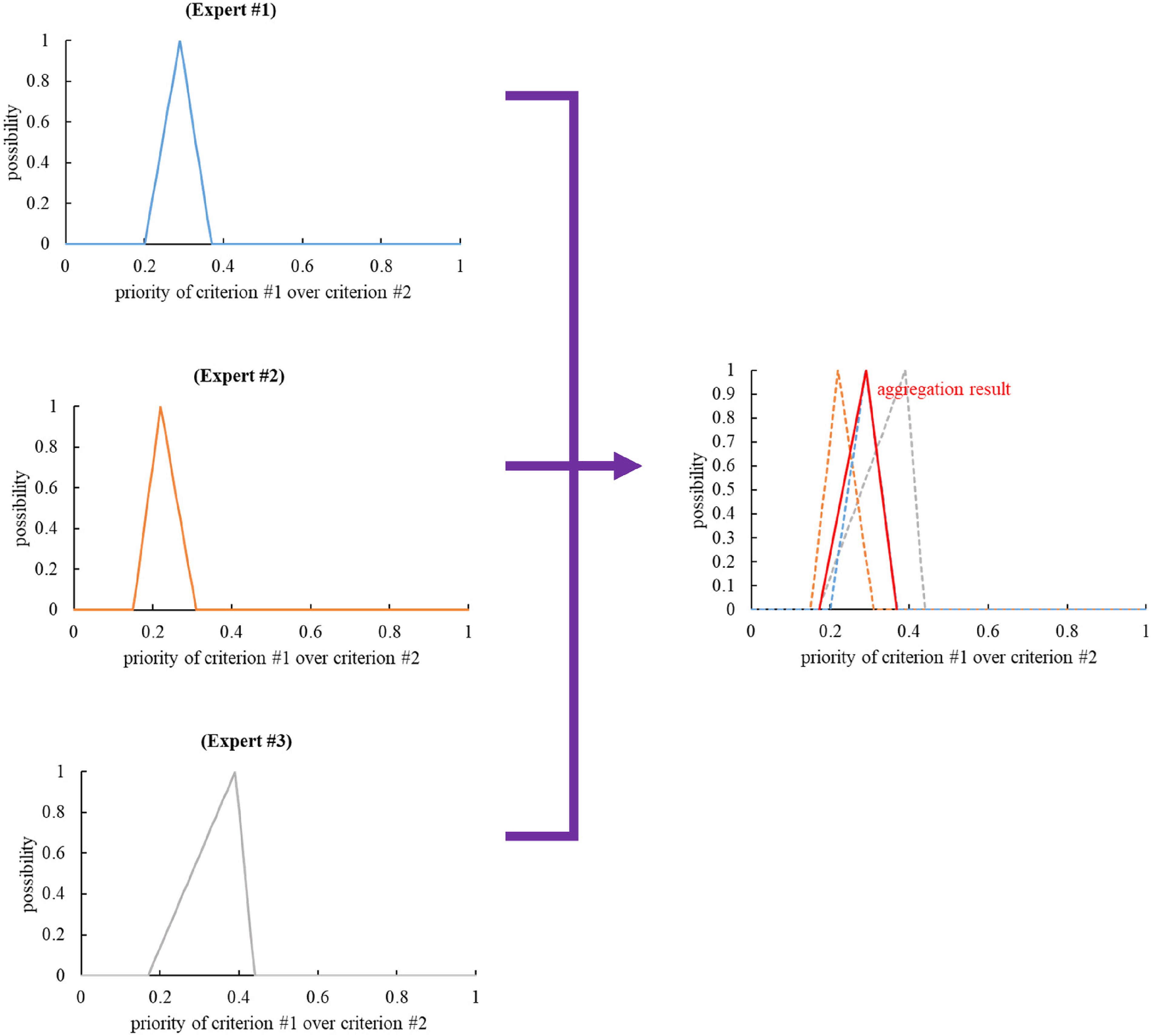
Explaining the aggregation process and result by applying the traceable aggregation technique.
Steps 5 and 6
The COVID-19 pandemic presented an opportunity to assess the sustainability of smart technology applications in healthcare. Some smart technology applications that were effective during the pandemic are now expected to be sustainable, whereas some are not, and for some others, their potential sustainability is unknown. In addition, the occurrence of specific major global events has caused people to re-examine whether they need healthcare-related smart technology applications, and this re-examination has further affected the sustainability of such applications.
Users are generally interested in the outcome rather than the process of evaluating the sustainability of smart technology applications in healthcare. In this study, the sustainability of smart technology application l evaluated subjectively by the experts is


Comparing objective and subjective evaluations of sustainability.
Consequently, the following FNLP problem needs to be solved to derive the fuzzy priorities of the criteria:








Furthermore, because








Comparing the sustainability evaluation results for several smart technology applications in healthcare.
Case study
Background
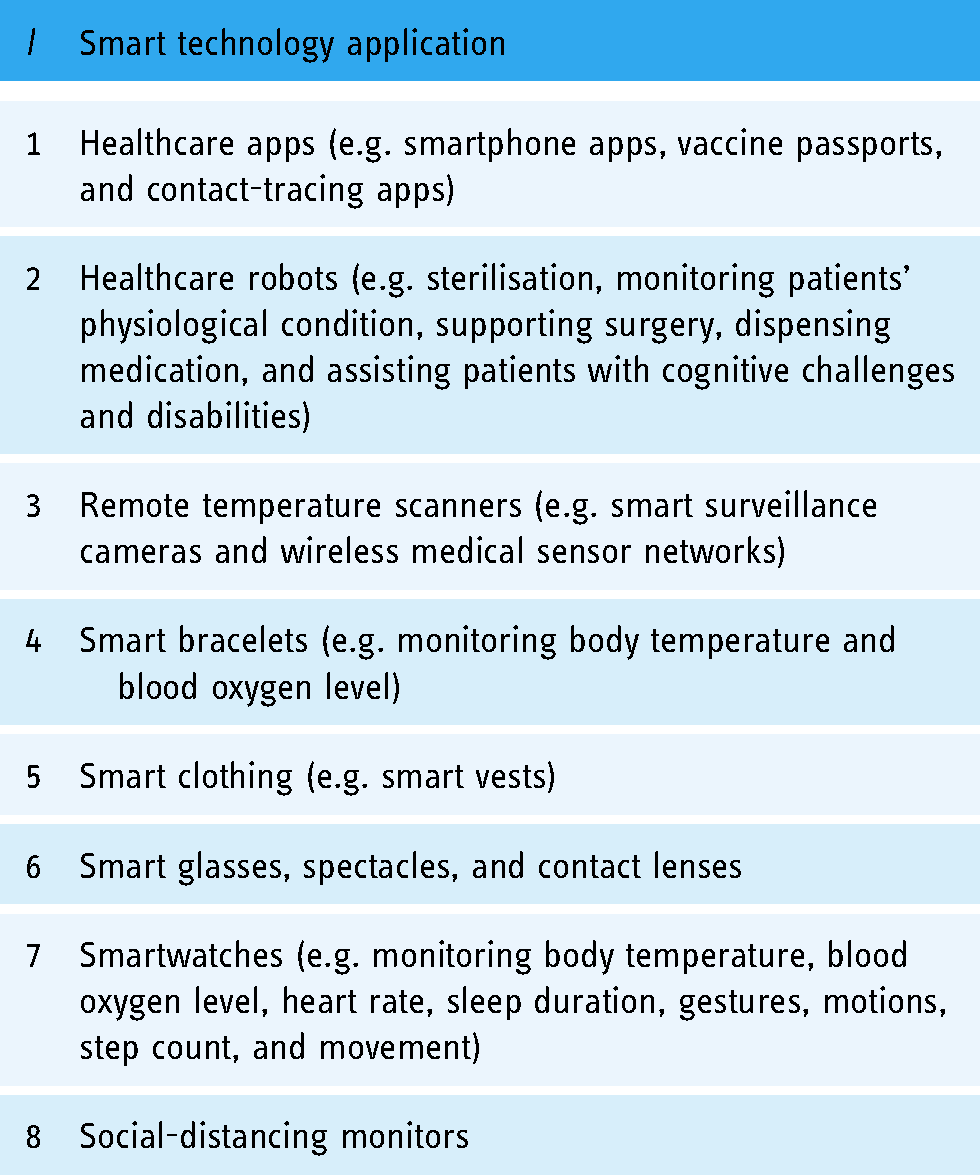
To illustrate the applicability of the proposed methodology, it was employed to evaluate the sustainability levels of eight smart technology applications in healthcare and reported in the literature5,9,28,39,55–57 (Table 1). These smart technology applications either ranked first before the COVID-19 pandemic or were widely used during the pandemic.
Eight evaluated smart technology applications in healthcare.
Application of the proposed methodology
In Step 1, a team of three experts from related fields (an industrial engineering professor, a smart device design engineer, and a medical engineer) was formed to prevent personal bias. 21
In Chen, 2 five criteria were used to evaluate the suitability of a smart technology application in healthcare before the COVID-19 pandemic: unobtrusiveness, supporting online social networking, the relaxation of related medical laws, the size of the healthcare market, and correct identification of the needs and situation of a user. Subsequently, in Chen and Wang, 9 six criteria were considered for the same purpose but focusing on the application during the pandemic: the provision of value-added services, cost-effectiveness, the promotion of healthy mobility, necessity or irreplaceability, ease of implementation and maintenance, and the ability to combine with other smart technologies. After the COVID-19 pandemic, the requirements changed again: after discussion, five criteria were considered critical to the sustainability of a smart technology application in healthcare after the COVID-19 pandemic: correct identification of the needs and situation of a user, the provision of value-added services, cost-effectiveness, necessity or irreplaceability, and ease of implementation and maintenance (Figure 12).

Critical factors affecting smart technology applications in healthcare.
In Step 2, the experts evaluated the relative priorities of criteria in pairs by using linguistic terms. In addition, the effects of the following major global events were considered:
The shortage of semiconductor chips made the necessity or irreplaceability of a smart technology application especially crucial. The Ukraine–Russia war had a similar effect. The fear of inflation has driven smart technology applications in healthcare to become more cost-effective.
The pairwise comparison results are summarised in Table 2.
Pairwise comparison results.

On the basis of the pairwise comparison results, the corresponding fuzzy judgment matrixes were constructed:


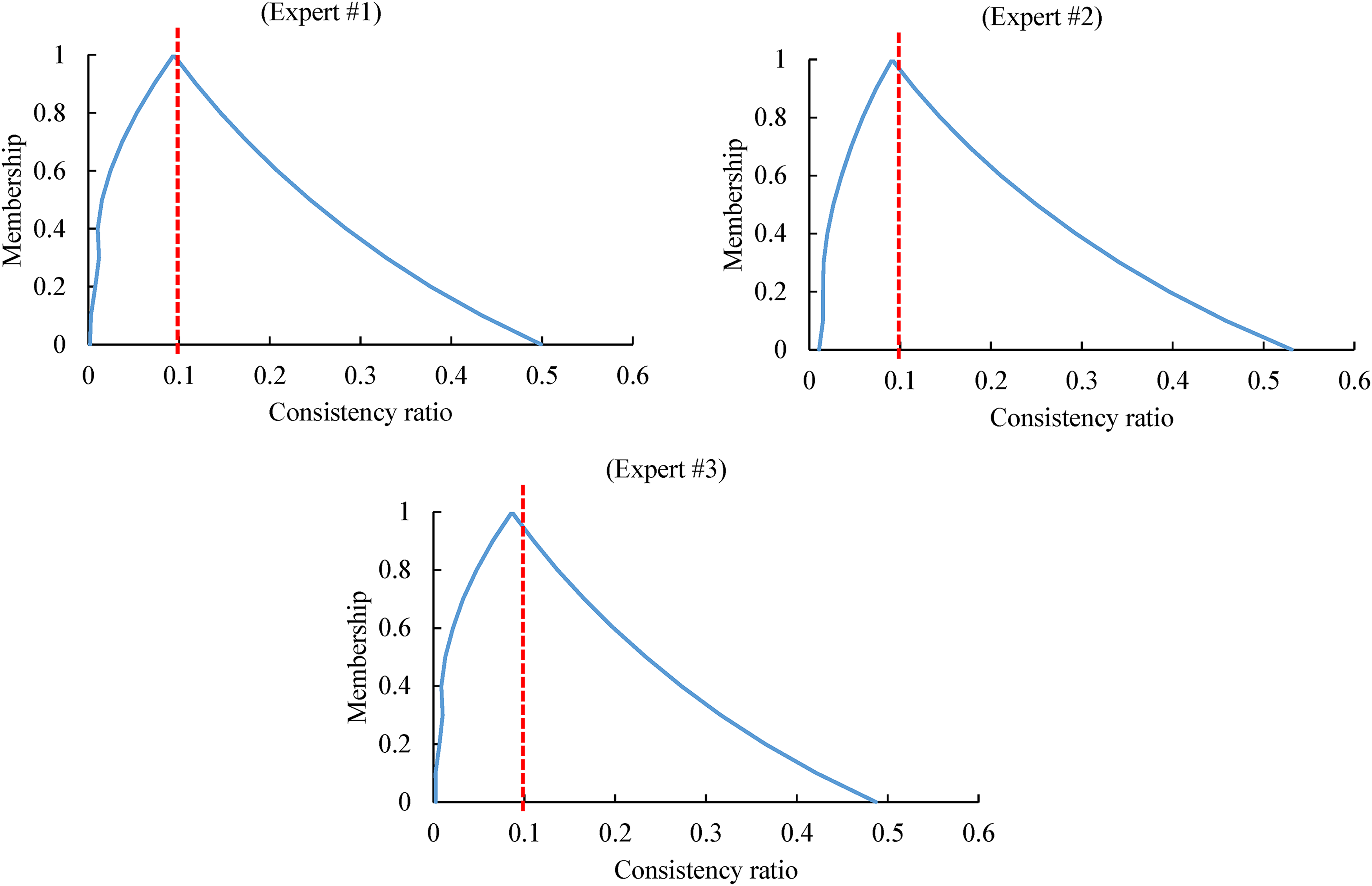
Fuzzy consistency of the fuzzy judgment matrixes.
In Step 4, the FGM was used to aggregate the fuzzy judgment matrixes. The aggregation process using XAI is illustrated in Figure 14. The fuzzy judgments can be observed to have varied.

Aggregation process with the FGM.
The aggregation result is expressed as follows:
Performance levels of smart technology applications.

In Step 5, the sustainability levels of several smart technology applications in healthcare were subjectively evaluated in accordance with their effectiveness (or lack thereof) during the COVID-19 pandemic; the corresponding results are shown in Table 4.
Subjective results of the evaluation of several smart technology applications.

In Step 6, an FNLP model for deriving the fuzzy priorities of the criteria was constructed and converted into a nonlinear programming problem to be solved using a branch-and-bound algorithm with Lingo on the same PC as that mentioned previously. For this purpose, ξ was set to 8 × 20 = 160. The execution time was less than 1 min. The derivation results are summarised in Figure 15, which presents the result of 
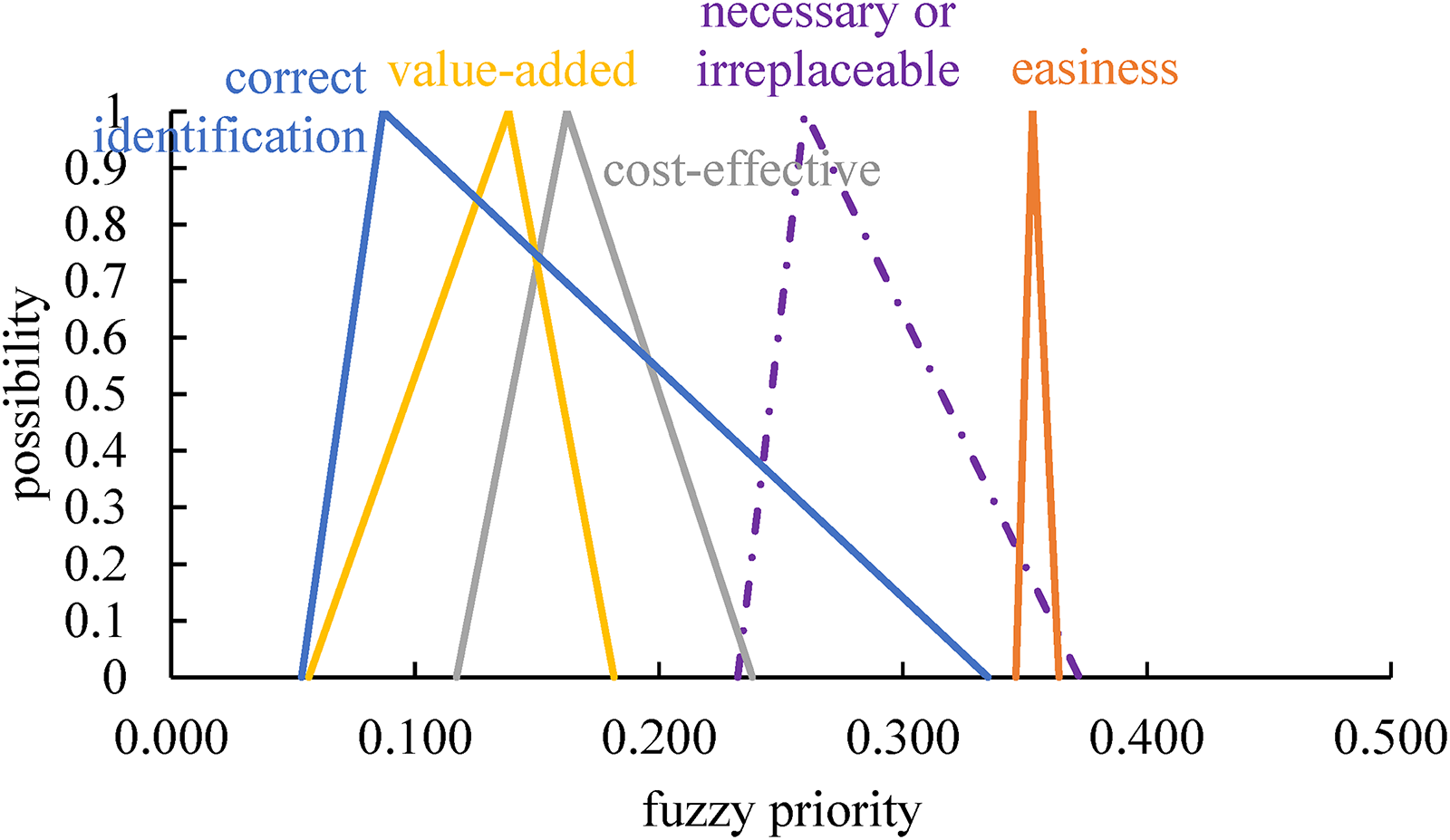
Derived fuzzy priorities of criteria.
In Step 7, the sustainability of each smart technology application in healthcare was evaluated using Equation (13). The results are shown in Figure 16. The subjective evaluations are shown in the same figure for comparison if available.

Sustainability levels of eight smart technology applications in healthcare.
Discussion
Based on the experimental results, the following items are discussed:
The sustainability levels of smart technology applications in healthcare were defuzzified using the centre-of-gravity method
58
to facilitate comparison. The results are summarised in Table 5. The most sustainable smart technology application in healthcare was discovered to be healthcare apps, followed by smartwatches and remote temperature scanners. Smart clothing was found to be the least sustainable smart technology application in healthcare. Owing to the impact of major global events, the threshold for users to accept a smart technology application in healthcare was discovered to be 3.0. Consequently, only the three most highly rated smart technology applications in healthcare will likely be sustainable. This research is timely because the COVID-19 pandemic has provided a considerable amount of evidence regarding the usefulness of several smart technology applications in healthcare. Additionally, the end of the COVID-19 pandemic has given rise to renewed interest in novel smart technology applications in healthcare. The present research provides a theoretical basis for related development. Furthermore, some major global events have severely affected the supply and demand of smart technologies, and this reality requires must be urgently considered. Compared with existing methods, the proposed methodology is novel in that it can assess the sustainability levels of smart technology applications both subjectively and objectively. In addition, this study considered the impact of major global events on the sustainability levels of smart technology applications, an impact that has not been investigated in previous studies. To further elaborate on the effectiveness of the proposed methodology, the experimental results were compared with the conclusions of several previous studies. First, the criteria used by other studies to assess the suitability or sustainability of smart technology applications in healthcare are different from those used in the present study. In addition, the priorities of the criteria in other studies have been unequal, as shown in Table 6, which illustrates how people's needs have changed over time.
Defuzzified sustainability levels.

Priorities of criteria in several studies.

Furthermore, the suitability or sustainability evaluation results related to smart technology applications in healthcare have differed among several studies, as detailed in Table 7, which indicates that some smart technology applications are merely tentative or have now proven impractical.
The one similar conclusion reached by both the present study and previous studies is that smartphone applications and smartwatches are consistently recognised as useful smart technology applications, whereas remote temperature scanners, although widely used, have been neglected.
Suitability or sustainability evaluation results related to smart technology applications in healthcare in several studies.

Conclusion
During the COVID-19 pandemic, some smart technology applications were more effective than had been expected, whereas others were less effective than had been expected and thus may not be widely used in the future. Therefore, the sustainability of smart technology applications in healthcare needs to be evaluated. To this end, a hybridising subjective and objective fuzzy group decision-making approach was proposed in this study. After applying the proposed methodology to evaluate the sustainability levels of eight smart technology applications in healthcare, the following conclusions were drawn:
The application of healthcare apps, smartwatches, and remote temperature scanners in healthcare is expected to be highly sustainable. By contrast, the sustainability of smart clothing and other applications in this field was concluded to be questionable. After optimisation, the subjective evaluations of sustainability were fairly close to the objective results. Major global events have raised the threshold for users to accept smart technology applications in healthcare. Consequently, only three smart technology applications in healthcare will likely be sustainable. Because the performance of smart technology applications during the COVID-19 pandemic was considered, the sustainability of these applications could be subjectively evaluated and corrected based on their objective performance. By contrast, most related studies have conducted assessments only from the subjective perspective.2,9,55 This study considered the impact of several major global events during the COVID-19 pandemic on the sustainability of smart technology applications. This topic had not been considered in previous related studies. This study found that the priorities of the criteria for assessing the sustainability of smart technology applications have shifted considerably because of the COVID-19 pandemic. After considering the impact of several major global events, this study found that users are placing a relatively strong emphasis on substitutability so that they may choose relatively cheap and widely available healthcare products and services. The process for solving the formulated FNLP problem was somewhat complicated. The application of XAI techniques and tools was limited to only a few steps.
The contributions of this research are described as follows:
In addition, this research adds the following scientific value:
Finally, this study has the following limitations:
Although this study assessed the sustainability of smart technology applications in healthcare, how these applications can be improved is another key issue. In addition, subjective and objective evaluation results can be integrated in ways other than those described in this paper.59–62 Furthermore, a consensus reached among experts is sometimes insufficient and thus needs to be enhanced.63,64 These issues constitute suggestions for future research.
Footnotes
Contributorship
Both authors contributed equally to the writing of this paper.
Declaration of conflicting interests
The author(s) declared no potential conflicts of interest with respect to the research, authorship, and/or publication of this article.
Ethical approval
Not required.
Funding
The author(s) disclosed receipt of the following financial support for the research, authorship, and/or publication of this article: The publication fee of this paper was support by Ministry of Science and Technology, Taiwan.
Guarantor
Not required.
