




Abstract
Background
The current coronavirus disease 2019 pandemic highlights the potential of eHealth. Drawing the knowledge map of eHealth research through data mining and visual analysis technology was helpful to systematically present the research status and future trends of global academic circles.
Methods
Based on the web of Science Core Collection (SCIE/SSCI) database, using bibliometric theory and visual analysis technology, this work analyzed the global eHealth research publications from 2000 to 2021, and introduced the interdisciplinary characteristics, hot topics and future trends in this field.
Results
A total of 10188 authors, 891 journals, 3586 institutions, 98 countries using 12 languages had conducted eHealth research in the world. The United States, the Netherlands, Australia and the United Kingdom were the main forces and international cooperation. However, the international co-operation between Eastern and Western countries was still relatively few. The frontier of global eHealth research mainly focused on #0eHealth innovation, #1physical activity, #2generalised anxiety disorder, #3lightweight authentication protocol, #4 eHealth information, #5technology readiness, #6 ehealth literacy scale, #7family carer, #8citance analysis, #9 guiding patient. Clusters #3 lightweight authentication protocol and #9 guiding patient were the latest clusters, indicating the research trend and direction of eHealth in the future.
Conclusions
Cooperation network framework at the regional, national and global levels and the cooperation of multidisciplinary teams with complementary backgrounds and expertise were needed to realize the in-depth popularization and application of eHealth knowledge. Interdisciplinary international cooperation should be the trend of eHealth research in the future.
Introduction
eHealth not only had great potential in reducing overburdened medical systems, 6 but also helped to change health-related behavior and long-term management of chronic diseases. 7 For example, in the field of health care, biometric sensor data provided a new method for health professionals to obtain objective measurements. The combination of subjective symptoms and other objective findings may contribute to personalized patient care and can be used in the preventive setting, at diagnosis, during treatment, rehabilitation, follow-up or in the palliative setting, 8 so as to realize activity monitoring and self-management, health care education, home care or symptom monitoring. At the same time, in the field of Gerontology, 9 it allowed rehabilitation in virtual space or serious games or the development of intelligent framework.10,11 The current coronavirus disease 2019 (COVID-19) pandemic highlighted some potential of eHealth, which could not only help overcome COVID-19, but also improve many aspects of health care, 12 including cancer care. 13 The long-term sustainability of eHealth depended not only on technical factors, but also on economic, social and organizational factors.14,15Health care professionals needed eHealth education and support for health consumers, 16 especially how to obtain and evaluate the quality of health information, 17 so as to effectively treat health problems through eHealth interventions. 18 Emerging universal eHealth access provided immense societal benefits in regional settings. 19
At present, many countries in the world supported the implementation of the national eHealth system by carrying out various types of activities, highlighting the necessity of eHealth education.20,21 Many scholars had studied this topic from the aspects of the basic concept,22,23 the formulated principles and framework,24,25 measurement,26,27 evaluation methods,28,29 interventions,30,31 implementation obstacles 32 and so on. To some extent, these studies provided theoretical and methodological support for a better understanding of the interdisciplinary methods involved in eHealth, but the analytical perspective was relatively single and lacked comprehensive and systematic research on the development track of the discipline. There were still some questions to answer. Firstly, which major institutions (countries, institutions and authors) promoted eHealth popularization research, and what kind of cooperation existed between them? Secondly, which publications had played a pioneering or key role in the eHealth research? Finally, what were the main themes and hotspots in the eHealth research field? And what was the relationship between different research topics? Traditional review articles could not comprehensively summarize and quantitatively analyze the development of knowledge in a certain field in a large number of publications. Reviews were often qualitative and proned to subjectivity.
Bibliometrics used mathematical and statistical measurement methods to study the distribution structure, quantitative relationship, change law and quantitative management of literature information, so as to evaluate and predict the research status and development trend, realizing the temporal and spatial analysis of large-scale literary works. 33 Bibliometrics played a unique role in quantifying knowledge production and laws of scientific development. 34 Bibliometric Analysis of food big data, 35 food waste, 36 global climate change, 37 food safety governance, 38 global health literacy, 39 eHealth40,41 and eHealth literacy 42 were reported. However, the bibliometric studies on eHealth are mainly about competencies or knowledge structures. From the perspective of research institutions and their cooperative networks of global research countries on eHealth to summarize the hot spots and future trends, there is no relevant report. Therefore, based on the core collection of web of science (SCIE/SSCI) database, using the principle of bibliometrics and visual analysis technology, this work analyzed the time trend, national or regional cooperation and influence, cooperation relations between research institutions and authors, hotspots and frontiers of global eHealth publications, so as to summarize the development trend of global eHealth research from 2000 to 2021 to provide reference for global eHealth research and development, especially in the global COVID-19 pandemic.
Methods
The editions of Science Citation Index Expanded and Social Sciences Citation Index in Web of Science Core Collection database was used to search on October 25, 2021, using the following keywords, Title = “eHealth or electronic health or ehealth or e-Health or e-health or Ehealth or EHEALTH or EHealth or E-Health”. The search time span was set to 2000–2021, including all types of publications in all languages. A total of 2989 records with the full record and cited references was obtained, details included 4193 keywords, 10188 authors, 891 journals, 3586 institutions, 98 countries and 12 languages. This data was obtained from HistCite software, which can quickly draw the development history of a field, locate the important literature in this field and the latest important literature. Anthor software of CiteSpace developed by Dr Chen Chaomei of Drexel University in the United States was used to carry out visualization analysis.
Results
Global publications on eHealth
Figure 1(a) showed the number of publications from 2000 to 2021. The number of published articles on eHealth was increasing every year. As of October 25, 2021, 2989 papers have been found based on title retrieval. Especially in 2016, the research publications on eHealth increased from 157 in 2015 to 224, an increase of 42.68%. This showed that the research of eHealth had entered a prosperous period. In 2020, the number of eHealth publications had exceeded 400, nearly 20 times that of 21 in 2000, which showed that an increased number of scholars began to focus on eHealth research.

Publications on eHealth. (a) Publications during 2000–2021. (b) Types of publications.
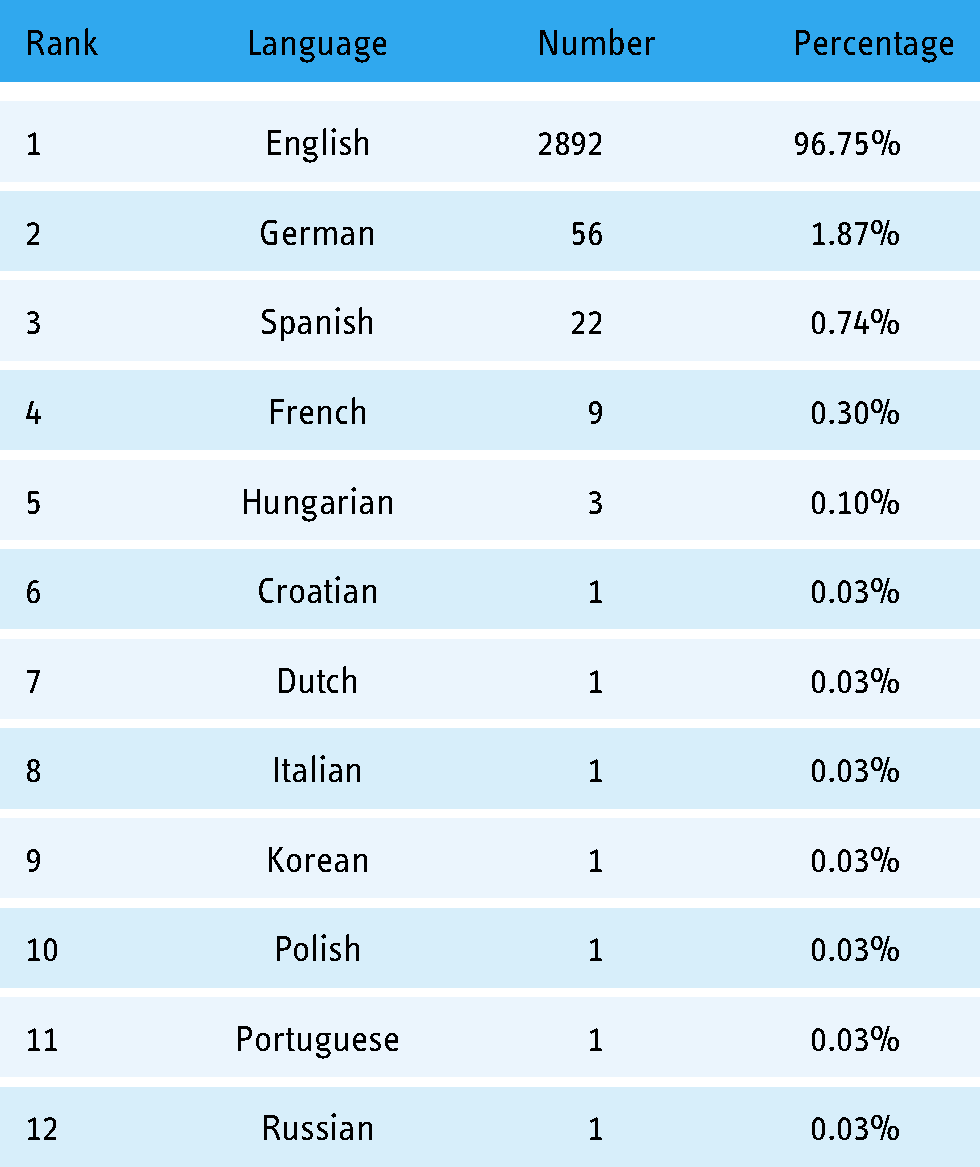
According to types of publications (Figure 1(b)), the 2989 publications mainly included 1720 research articles (57.54%). A total of 602 meeting abstracts, 306 review articles, and 221 editorial materials. Moreover, 63 proceedings papers, 56 early accesses, 56 letters, 49 news items, 26 corrections, and 9 book reviews. Publications language was mainly English (96.75%) (Table 1).
Language.
Global research countries on eHealth
A total of 98 countries around the world conducted eHealth research. Figure 2(a) showed the top 10 publications countries from 2000 to 2021, USA ranked first with 705 publications, followed by the Netherlands, UK, and Australia. China ranked seventh with 189 publications. In terms of annual publication amount, USA had always been in a leading position since 2000. Since 2008, the number of publications on eHealth had gradually increased in China. As of October 25, 2021, China had published 48 papers in 2021, second only to 59 in the United States, which showed the great potential of eHealth research in China.

Global research countries on eHealth from 2000 to 2021. (a) The top 10 publications countries. (b) Burst detection. (c) Global cooperation.
Burst detection is a computational technique used to identify sudden changes in events and other types of information. 43 Burst words refer to key terms whose frequency of occurrence increases suddenly in a short time or whose frequency of use increases significantly. 44 A burst is detected through two attributes, namely, strength and duration. 45 The red line segment of the column indicates the time period of burst detections. Through burst detection, we can further explore the frontier dynamics, attention and research trend of relevant research. Figure 2(b) showed nine countries with burst detection during 2000–2021.Of these countries, Canada exhibited the highest strength of 11.74 from 2004 to 2010. USA, Australia, and England also conducted substantial works on eHealth.
As shown in Figure 2(c), the four countries (USA, the Netherlands, Australia, and UK) with the largest number of publications worked in close cooperation with one another. In particular, the United States cooperated closely with the Netherlands, Canada, Australia, UK, Norway, Spain, China, South Korea, Israel, France, Switzerland, and other countries. China's cooperation with other countries in the world was weak, and only several countries such as the United States, the United Kingdom, Singapore, India, Pakistan carried out eHealth cooperation research.
Global research institution and cooperation
Table 2 showed the top 10 highest publishing institution on eHealth. The cooperation of research institutions was shown in Figure 3. Five are located in the Netherlands, which were Vrije University Amsterdam, University Amsterdam, Leiden University, University Twente and Maastricht University. In addition, two were located in Australia and Canada, respectively, and the other one was located in the United States. Unfortunately, none of the top 10 research institutions was from China.

The institution collaboration and burst detection. (a) The institution collaboration. (b) The institution burst detection.
Top 10 highest publishing institution.

Global research authors on eHealth
Figure 4(a) showed the top 10 publication output authors, who were mainly from the Netherlands, the United States, Germany and other countries. The most output author was Harbeck N from University Munich in Germany. Figure 4(b) showed author burst detection. There were five authors with the strongest citation bursts. The burst strongest author was Chavannes NH from Leiden University in the Netherlands. Although the Netherlands was slightly weaker than the United States in the total number of published papers on eHealth, the Netherlands performed very well among the top 10 research institutions and authors in this field.

Author collaboration. (a)The top 10 authors. (b) Author burst detection.
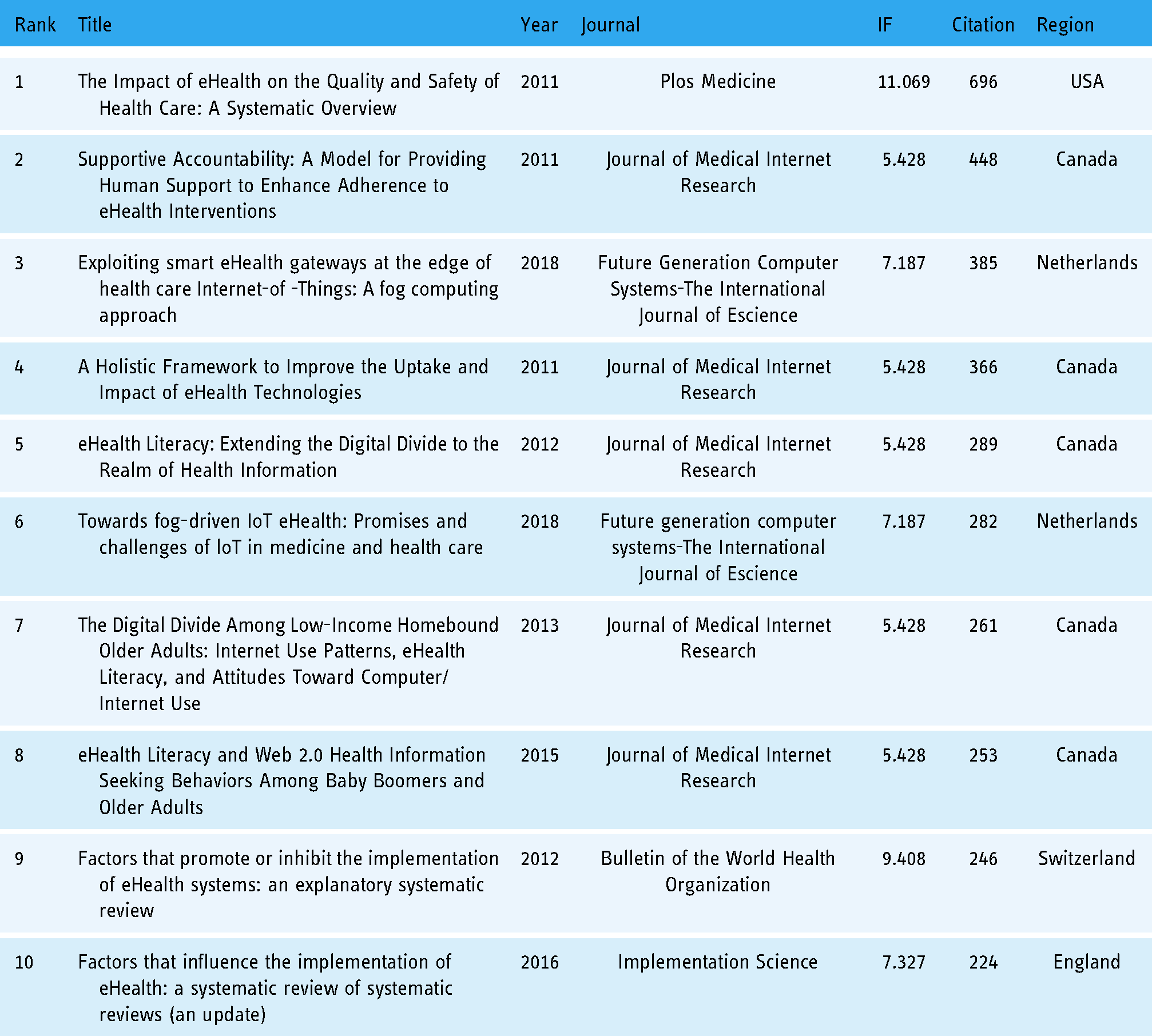
Both in terms of publications amount and highly cited papers (Tables 3 and 4), the Journal of Medical Internet Research performed quite well. As of highly cited papers, half of the top 10 highly cited papers came from the journal. As of the total number of citations and the average number of citations, this journal also performed very well. Therefore, this journal is a key for eHealth research.
Top 10 highest publishing journal.

Top 10 highly cited papers.
Research hotspots on eHealth
Figure 5(a) showed the annual distribution of keywords in global eHealth research from 2000 to 2021. As can be seen from Figure 5(a), the keywords with the highest frequency were eHealth, telemedicine, eHealth literacy, mHealth, and so on. In the past three years, the frequency of keywords implementation, digital health, cloud computing, security, hiv had increased steadily. It showed that research interest in eHealth had shifted from basic research to applied research.
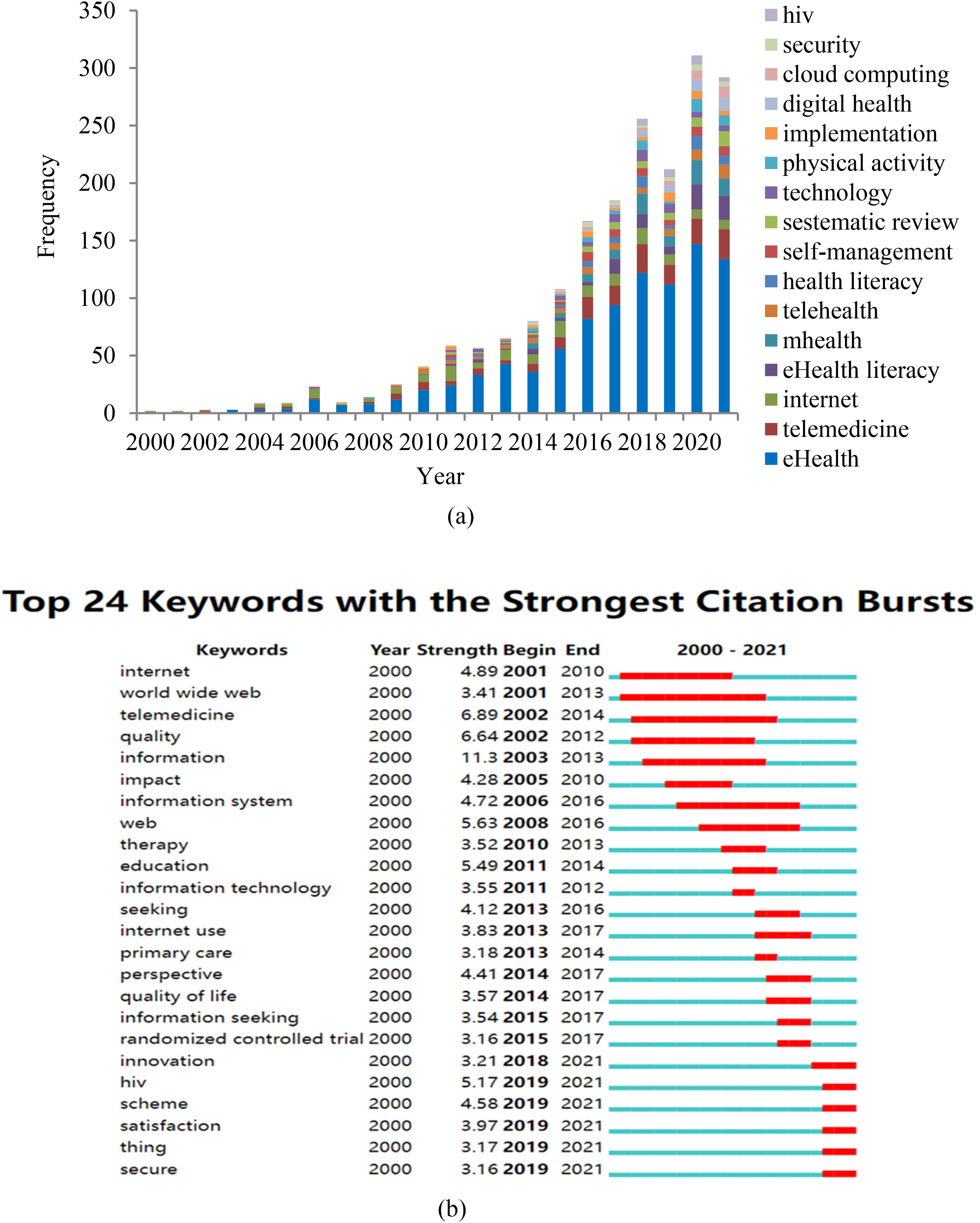
Keywords. (a) Keywords burst detection. (b) Annual distribution of main keywords.
At the fine-grained level, the keyword with burst revealed the trend of eHealth research (Figure 5(b)) 24 keywords showed burst. In recent 3 years, there were some keywords of innovation, hiv, scheme, satisfaction, thing, secure with burst. Keyword of information had the strongest burst strengths. In addition, the burst strengths of keywords telemedicine, quality, web, education, hiv all exceeded 5. These findings revealed a new trend of multidisciplinary disciplines in eHealth research.
Research frontier on eHealth
In the cluster diagram of eHealth research, modularity (Q value) and silhouette (S value) were two important indicators to reflect the overall structural characteristics of cluster network. The Q value was generally in the interval [0,1], and Q > 0.3 (empirical data) indicated that there was a real community structure. Silhouette was the average contour value of clustering. If S > 0.5, clustering was reasonable. S > 0.7 meant that clustering was efficient and convincing. In this work, the Q and S values were 0.4204 and 0.7394, respectively. The Q value was greater than 0.3, meaning the module structure of clustering was significant. And the S value was 0.7394, greater than 0.7, meaning that clustering was reasonable. In the clusters (Table 5), the least S value was 0.648 (#2), and the maximum S value was 0.878(#8), indicating that the homogeneity was relatively high.
Major clusters of co-cited references of eHealth.

The co-citation cluster map of global eHealth analysis showed that the frontier of global eHealth research mainly focused on #0eHealth innovation, #1physical activity, #2generalised anxiety disorder, #3lightweight authentication protocol, #4 eHealth information, #5technology readiness, #6 ehealth literacy scale, #7family carer, #8citance analysis, #9 guiding patient (Figure 6). #0 eHealth innovation and #1physical activity constituted the two largest clusters, with 77 and 65 members respectively (Table 5). #0, #4, and #5 were the three oldest clusters, which showed the knowledge base of eHealth research. And the other seven were relatively new, especially #3 and #9 were the latest, indicating the research trend and direction of eHealth in the future.

Future research hotspots.
Discussion
Ehealth research collaboration networks
In recent years, more and more scientific researchers had realized the importance of scientific cooperation. As a means of scientific knowledge production, it had become an important way to promote the development of science and technology, economy and society. This study provided a panoramic view of eHealth research collaboration network and academic influence through the analysis of four types of collaboration networks of country/region, institution, author and interdisciplinary provided by CiteSpace. Firstly, form the geographical distribution and the number of papers published, the United States, the Netherlands, Australia and the United Kingdom were the main research forces and had close cooperation in this field. Especially in the Netherlands, there were 5 of the top 10 eHealth research institutions in the world. The United States was a top publishing country, and the Netherlands was slightly inferior to the United States in terms of total publishing volume. Secondly, from the institutions on eHealth, the Netherlands, Australia and the United States were the main forces on eHealth research in the world. As far as high-yield authors were concerned, they were mainly from the Netherlands, the United States, Germany and other countries. Vrije University Amsterdam was the most productive and influential research institution in this field with a large number of publications and high standards. The most output author and the burst strongest author were Harbeck N from University Munich in Germany and Chavannes NH from Leiden University in the Netherlands respectively. Additionally, Leiden University and University Sydney had also done very well in eHealth research, which showed that they played an important role in promoting cooperation among world countries. It was worth noting that the transnational cooperation between Eastern and Western countries was still relatively few. Especially in China, it was very necessary to further strengthen cooperation and exchanges with the United States, the Netherlands, Australia, and the United Kingdom in the future research on eHealth. There were another prominent phenomenon was about the journal of Journal of Medical Internet Research, which was a key for eHealth research, and half of the top ten highly cited papers came from the journal. 46 Finally, the analysis of interdisciplinary cooperation in eHealth research showed that interdisciplinary cooperation was very rare in the early stage, but it had begun to flourish recently involving more fields. In the past 5 years, eHealth researchers had actively cooperated in health care sciences services, medical information, public environmental occupational health, oncology, psychology, health policy services, and so on. This showed that the eHealth research had changed from macro to micro research, from theory to application, and from independent discipline to interdisciplinary research. Therefore, interdisciplinary international cooperation should be the trend of eHealth research in the future.
Hotspots and frontiers on eHealth
According to future research keywords of hotspots, numerous scientists focused on eHealth, telemedicine, eHealth literacy, mHealth, implementation, digital health, cloud computing, security, hiv, which showed the research interest in eHealth had shifted from basic theory research to applied practice research. At the fine-grained level, burst strengths of keywords telemedicine, quality, web, education, hiv had the strongest burst since 2001. Therefore, these keywords will be the central concern of eHealth research in the near future. According to the clustering results of topics (Table 5), #0, #4 and #5 were the three oldest clusters, and #3 and #9 were the latest The lightweight authentication protocol cluster (#3) had 49 members, whose S value was 0.789. The guiding patient cluster (#9) had with 20 members, whose S value was 0.831. These showed that the internal homogeneity of cluster #9 was very high, and maybe cluster #3 had a tendency to generate new topics. The Internet had become an important source of health information for patients with chronic diseases. 47 eHealth literacy was significantly correlated with patients’ online information behavior, doctor-patient relationship, patients’ compliance and health outcomes. 48 eHealth tools and eHealth interventions had played an important role in the prevention, diagnosis and treatment of many chronic diseases, such as obesity, 49 rheumatic disease, 50 hypertension, 51 depression, 52 diabetes, 53 cancer patients, 54 psychosis 55 and so on. The population involved included the elderly, 56 adults 57 and children. 58
Strengths and limitations
This work used bibliometric analysis to comprehensively analyze the global trends and current situations of eHealth research. We systematically searched the web of science core collection and downloaded all relevant data on the same day. Then the core countries/regions, organizations, authors, journals and research priorities were determined, so as to provide a reference for eHealth research. However, like other scientometrics studies, our research also had some limitations. Firstly, we only search the eHealth papers in the web of science core collection, but the papers in other large databases such as PubMed, Scopus and Google Scholar were not included, which maybe omitted some important publications. Nevertheless, most of the key publications were included in WoS database, and WoS was the most commonly used database in bibliometric analysis. 59 Secondly, all data were identified by computer software or tools, such as CiteSpace, WoS, and HistCite, rather than manually selected and collected. And CiteSpace software would lead to inevitable errors in the process of data processing and conversion occasionally, such as incomplete synonyms or ununified literature types. 60 These data may be biased, although this did not affect the trends and conclusions identified in this work. Finally, CiteSpace analysis focused on quantitative analysis. In the future, the qualitative research method of interview should be used to make up for the defects of quantitative research.
Conclusion
This work used the visualization software CiteSpace to analyze the bibliographic data collected from the Web of Science Core Collection database (SCIE/SSCI) of global eHealth research from 2000 to 2021. The results showed that a total of 10188 authors, 891 journals, 3586 institutions, 98 countries using 12 languages had conducted eHealth research in the world. The number of published articles on eHealth had steady growth and increased year by year. The United States, the Netherlands, Australia and the United Kingdom were the main forces in this field and international cooperation. Vrije University Amsterdam in the Netherlands was the most productive and influential research institution. The most output author and the burst strongest author were Harbeck N from University Munich in Germany and Chavannes NH from Leiden University in the Netherlands, respectively. And the most influential journal was Journal of Medical Internet Research. The international co-operation between Eastern and Western countries was still relatively few. The frontier of global eHealth research mainly focused on #0eHealth innovation, #1physical activity, #2generalised anxiety disorder, #3lightweight authentication protocol, #4eHealth information, #5technology readiness, #6ehealth literacy scale, #7family carer, #8citance analysis, #9guiding patient. In the past 5 years, eHealth researchers had actively cooperated in health care sciences services, medical information, public environmental occupational health, oncology, psychology, health policy services, and so on. On the whole, eHealth was a combination of information and communication technologies from different fields of science and engineering. The development of eHealth required the cooperation network framework at the regional, national and global levels, and the cooperation of multidisciplinary teams with complementary backgrounds and expertise, so as to realize the in-depth popularization and application of eHealth knowledge.
Footnotes
Acknowledgments
The authors appreciate the help received from Key project of the Ministry of education in the 13th 5-year plan of National Educational Science.
Author contributions
Huatian and Jiechen designed this study together. Huatian performed the statistical analysis and drafted the manuscript. Jiechen revised the manuscript. Both authors read and approved the final manuscript.
Declaration of conflicting interests
The authors declared no potential conflicts of interest with respect to the research, authorship, and/or publication of this article.
Funding
The authors disclosed receipt of the following financial support for the research, authorship, and/or publication of this article: This work was supported by the Key project of the Ministry of education in the 13th 5-year plan of National Educational Science (grant number DEA190361).
Guarantor
HT.
