




Abstract
Background
Digital therapeutics (DTx) are emerging as a dynamic field at the intersection of healthcare and technology, utilising software-driven interventions to prevent, manage, or treat medical conditions. Within rehabilitation, DTx has gained prominence for its potential to improve patient outcomes and refine therapeutic strategies. This article conducts a bibliometric analysis of existing literature to uncover current research trends and offer insights for future investigations.
Methods
The Science Citation Index Expanded database from the Web of Science Core Collection was used to retrieve articles and reviews related to DTx in rehabilitation. The data were subjected to systematic analysis using the VOSviewer and Citespace software tools, which facilitated the examination of publication data at the country, institutional, author, journal, citation, and keyword levels.
Results
A total of 6593 papers published between 2000 and 2024 were reviewed. The volume of publications has steadily increased over the past two decades, reaching a peak in 2022 (n = 832). Leading contributors to research output and citation impact include the United States, Italy, China, Canada, and United Kingdom. Current research hotspots include the efficacy of DTx in rehabilitation, with a focus on innovative applications in psychiatric disorders, telerehabilitation, and cognitive rehabilitation. The top 10 researchers were all from Italy, and half of them were affiliated to the Centro Neurolesi Bonino Pulejo Messina.
Conclusions
This study represents the first comprehensive bibliometric analysis of DTx within the rehabilitation field. It identifies current research frontiers and emerging directions, serving as a valuable resource for scholars and researchers investigating DTx's impact on rehabilitation practices.
Introduction
The concept of ‘digital health’ originates from the domain of ‘eHealth’, which is characterised by the application of information and communication technology within the realms of health and related areas. 1 The term “digital health” is employed to describe an assortment of systems, platforms and technologies that are intended to engage consumers for the purpose of promoting wellness, fostering healthy lifestyles, and enhancing general health. These technologies encompass the capture, storage, and transmission of health data and are utilised for supporting the operations of the life sciences industry and clinical settings. 2 The Digital Therapeutics Alliance (DTA) defines digital therapeutics (DTx) as ‘software-driven, evidence-based therapeutic interventions for the prevention, management, or treatment of medical disorders or diseases’. Such tools are deployed either as standalone solutions or in conjunction with other therapeutic modalities. 3
During the ongoing pandemic, DTx have provided the means for remote consultations and the simultaneous transmission of images and information, thus reducing the workload of frontline medical staff while enhancing patient care and health outcomes. This expeditious development of DTx evinces its prospective capacity to offset several inherent constraints of traditional clinical practice. 4 DTx demonstrates considerable potential in addressing a range of challenges inherent to traditional healthcare models, including the financial burdens associated with in-person medical visits, the necessity for enhanced compliance with healthy behaviours and prescribed medications, the requirement for continuous monitoring, and the streamlining of administrative tasks and routine communication. 5 It can be reasonably concluded that DTx offers significant potential for individuals managing a variety of chronic and debilitating conditions. The tools utilised in DTx encompass a plethora of screen devices, including computers, smartphones, video game platforms and tablets. The incorporation of software algorithms into these devices represents a pivotal aspect of DTx. 6
Rehabilitation is a fundamental component of the universal health coverage framework, serving to reinforce initiatives aimed at fostering optimal health, preventing illnesses, and providing treatment and palliative care. Technological developments have provided healthcare professionals and patients with the tools to effectively monitor and manage acute and chronic health conditions.7,8 The use of DTx signifies the implementation of a sophisticated and comprehensive technological solution, which has the potential to markedly enhance the efficacy of rehabilitation intervention. The incorporation of digital health solutions offers significant promise for the improvement of access to rehabilitation treatments, reduction of healthcare costs, enhancement of patient safety and care quality, and ultimate improvement in health outcomes. 9 Furthermore, DTx facilitates a more profound comprehension of potential avenues for optimising patient services, thereby heralding a transformative shift in rehabilitative practices. 10 As indicated in the DTA, DTx is positioned to facilitate the provision of novel treatment modalities to address previously unfilled medical needs. These modalities have the capacity to operate autonomously, complement existing treatments, augment current therapies, or reduce reliance on specific medications or therapies. The potential applications of DTx in rehabilitation are numerous. 3
In light of the growing demand for rehabilitation, the increasing application of DTx represents a significant research area with promising prospects for the treatment of chronic diseases. The application of DTx is not confined to a single stage of the rehabilitation process. Instead, it can be employed at every stage, including the initial assessment of the patient's condition, the subsequent therapy, monitoring the patient's progress, educating the patient, and finally providing ongoing support. 11 The possibility of DTx facilitating the creation of a unified and standardised treatment plan in clinical practice has yet to be fully actualised. Nevertheless, no studies have yet provided a detailed bibliometric overview of the domain of DTx in rehabilitation. Moreover, existing DTx studies often suffer from fragmented evaluation approaches and limited interdisciplinary integration, which hinders a cohesive understanding of the field. A bibliometric analysis can systematically reveal these evaluation inconsistencies and collaboration gaps, thereby justifying its adoption. This bibliometric study addresses the aforementioned gap in quantitative analysis by providing a comprehensive overview of the global scientific output in DTx in rehabilitation from 2000 to 2024. The analysis was performed using the Citespace and VOSviewer software, and comprised an exhaustive examination of publications sourced from the Web of Science Core Collection (WoSCC) database. The objective of this article is twofold. Primarily, this study aims to provide a thorough and comprehensive understanding of the contemporary issues and emerging trends within this field, which will inform clinical decision-making and guide future research and advancements in the field. Secondarily, it seeks to identify key contributing countries, institutions, authors, and journals, as well as visualise collaboration networks and citation patterns, in order to map the scientific landscape and guide future research collaboration and resource allocation.
Materials and methods
Data sources and search strategy
The aim of this research methodology is to ensure the authenticity and legitimacy of the data analysed. To this end, publications on related subjects were sought from the Science Citation Index Expanded of the WoSCC database, with the temporal scope extending from 2000 to 2024. The search was conducted up to 13 April 2024. Two authors conducted the process of searching for and retrieving relevant literature independently, and the search strategy is presented in the supplemental material. The selected literature consisted of articles and reviews written in the English language, all of which were required to have undergone peer review. It is essential that the data undergo pre-processing prior to analysis in order to ensure the integrity of the results. The bibliometric data were subsequently imported into Zotero, whereupon two researchers undertook an independent review of the titles, abstracts, and full texts of the included papers with a view to identifying those studies that met the requisite criteria for inclusion. Duplicates were handled using Zotero's automated de-duplication feature, with manual verification for any remaining duplicates to ensure data integrity. The study adhered to predefined exclusion criteria, which included: (1) Interventions not classified as DTx; (2) Conditions not related to rehabilitation; (3) Papers not focusing on the use of DTx in rehabilitation. At the conclusion of the process, 6593 valid documents were identified. The process undertaken in order to identify and collate the relevant material is outlined in the flowchart presented in Figure 1.
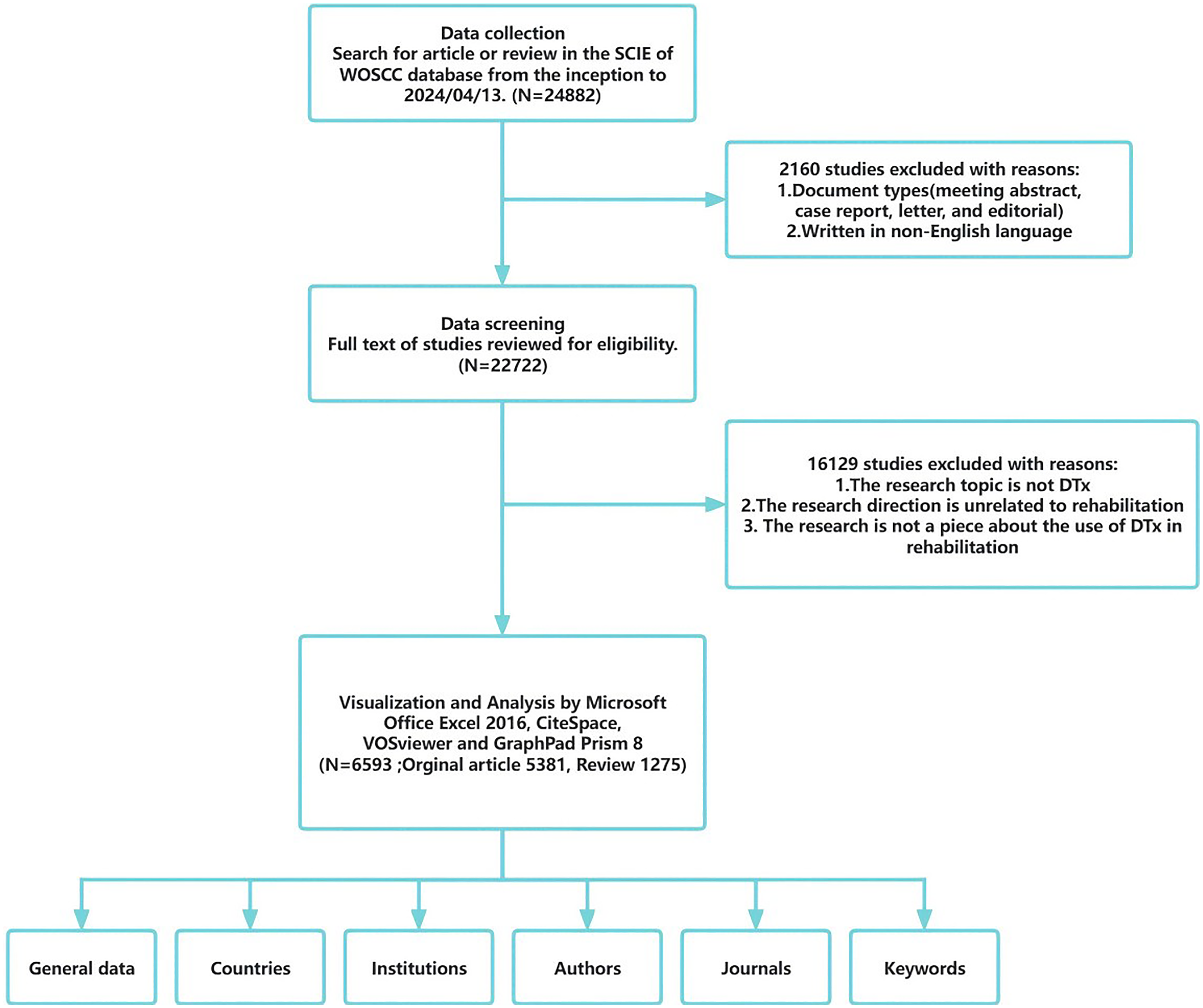
Flow chart of the bibliometric search and analysis process.
Data extraction and analysis
Following screening and verification using Zotero, a selection of documents was manually extracted from the WOS database. Analysis of the plain texts containing information on the downloaded documents from the WOS database was then conducted using VOSviewer 1.6.19.0 and Citespace 6.2 R4 for the purpose of mapping and visualising the bibliometric networks of scientific publications (see Supplemental Material S2).The software packages VOSviewer and Microsoft Excel were employed for the purpose of extracting essential data and the generation of co-occurrence or co-citation maps, with respect to a range of different countries, institutions, authors and journals. In the VOSviewer co-occurrence graph, node size reflects the volume of publications, while connecting lines indicate collaboration levels. Node colour shows cluster affiliation. Additionally, Citespace was used to analyse keyword co-occurrence networks, clusters, and burst keywords to highlight emerging trends and new knowledge areas. This process is referred to as co-word analysis, a common bibliometric method that examines the frequency and co-occurrence patterns of keywords within documents to uncover the conceptual structure and thematic evolution of a research field. GraphPad Prism 8 was utilised to analyse and visualise publication counts by country and their collaborative engagement.
Results
Publication outputs and growth trend
The preliminary search of the WoSCC database returned 24,882 publications. Following the exclusion of documents of an irrelevant nature, documents in languages other than English, as well as research topics deemed to be unrelated, a sample comprising 6593 papers was selected for analysis. These comprised 5381 articles and 1275 reviews. The publications included in this analysis span the period from 2000 to 2024. Figure 2 presents a visual representation of the annual publication trends observed in the 6593 papers included in this analysis. The timeline of publication can be divided into three phases: a period of slow growth (2000–2013), an undulating phase (2014–2019), and a period of rapid growth (2020–2024). During the slow-growth phase, the number of annual publications remained consistently below 200, with the exception of 2013. The undulating phase was characterised by minor peaks in 2018, which were followed by a decline in the subsequent year. In the subsequent rapid-growth phase, there was a marked increase in the number of publications, with over 500 papers published annually. The final phase saw the release of almost half of all publications, with a record 832 papers published in 2022. Furthermore, an analysis of the data using a linear regression model revealed that the number of publications was strongly and positively correlated with the publication year (R² = 0.9933, p < .001). Based on these findings, it is reasonable to anticipate that future research in this field will continue to expand.

Trend of publication outputs from 2000 to 2024 on DTx in rehabilitation topic.
Active countries
A total of 108 countries were represented in the published literature on DTx in rehabilitation. The ten countries with the highest number of papers, totalling 280 or more, are presented in Figure 3. The five countries with the highest level of activity were the United States (1824, 27.7%), Italy (884, 13.4%), China (623, 9.4%), Canada (449, 6.8%), and United Kingdom (420, 6.4%). It is notable that of the 10 countries that demonstrated the highest output of publications, only China was classified as a developing country, while the remainder were identified as developed countries. The research conducted in the United States was the most frequently cited, with 71,043 citations, followed by that conducted in Italy (27,195 citations) and Canada (16,499 citations). With regard to the number of citations per paper, the Australia also occupied the leading position (398.9), followed by the United States (389.5), and Switzerland (381.7). The data pertaining to the geographical locations of the papers included in the study were extracted using the VOSviewer software and transferred to the Scimago Graphica platform, where they were employed to construct the collaborative network among countries illustrated in Figure 4. It is evident that there is a close collaborative relationship between the top five countries in terms of publications, with the United States at the centre, forming a polygonal nuclear group. The most robust collaborative relationship was observed between the United States and United Kingdom.

The number of publications, total citations, and citations per paper in the top 10 prolific countries.

The co-operative network visualisation map of countries.
Institution distributions
In accordance with the author's address, a total of 313 institutions were responsible for contributing to the 6593 publications in question. Figure 5 presents a list of the 10 most productive institutions, publishing in excess of 60 papers. The institution that demonstrated the highest level of productivity was Northwestern University, based in the United States, which contributed a total of 109 papers to the corpus. The next most productive institutions were the Centro Neurolesi Bonino Pulejo Messina in Italy (88 papers) and the University of Toronto in Canada (83 papers). The papers published by the Massachusetts Institute of Technology received the greatest number of citations (6563) and exhibited the highest citation rate per paper (93.76). Figure 6 depicts the collaborative network among the leading institutions engaged in the application of DTx in rehabilitation research. The leading organisations exhibited a high level of interconnectivity with other institutions, as indicated by the density of cooperation represented by the yellow colour block. It is notable that there was a considerable degree of collaboration between a number of institutions, particularly between Northwestern University, the Swiss Federal Institute of Technology Lausanne, the Hong Kong Polytechnic University, the University of Toronto, and the Centro Neurolesi Bonino Pulejo Messina.

The number of publications, total citations, and citations per paper in the top 10 active institutions.

The density visualisation map of institutions. Proximity indicates stronger collaboration, and brighter colours represent higher collaboration density.
Author analysis
The documents on DTx in the field of rehabilitation received input from a total of 26,063 authors. Table 1 presents the ten most prolific authors, accompanied by a brief description of their contributions. In this study, all authors’ institutional affiliations listed in each publication were used for institutional analysis. The three most prolific authors were Calabro (97 papers), De Luca (49 papers), Naro (41 papers) and Magglo (41 papers). All of the top 10 authors were from Italy, although they were affiliated with a number of different agencies. Please note that the values presented refer solely to the top 10 authors, in contrast to Figure 5, where the data represent all institutions. In terms of both total citations and citations per paper, the Centro Neurolesi Bonino Pulejo Messina was the most highly cited institution (8721 citations, 37 citations/paper), as illustrated in Table 1. Furthermore, the H-index is an effective metric for assessing an author's academic achievement. Bramanti Placido 12 and Riva Giuseppe 13 were the most prolific researchers in this field, according to their H-index, and exerted a significant influence on subsequent studies. Figure 7 depicts the results of an author co-occurrence analysis generated using the VOSviewer software. This visual representation forms a principal cluster centred on Calabro, Rocco and Riener Robert, indicating a robust partnership around them.

Network map of active authors contributed to DTx in rehabilitation research.
The top 10 active authors who published literature on DTx in rehabilitation.
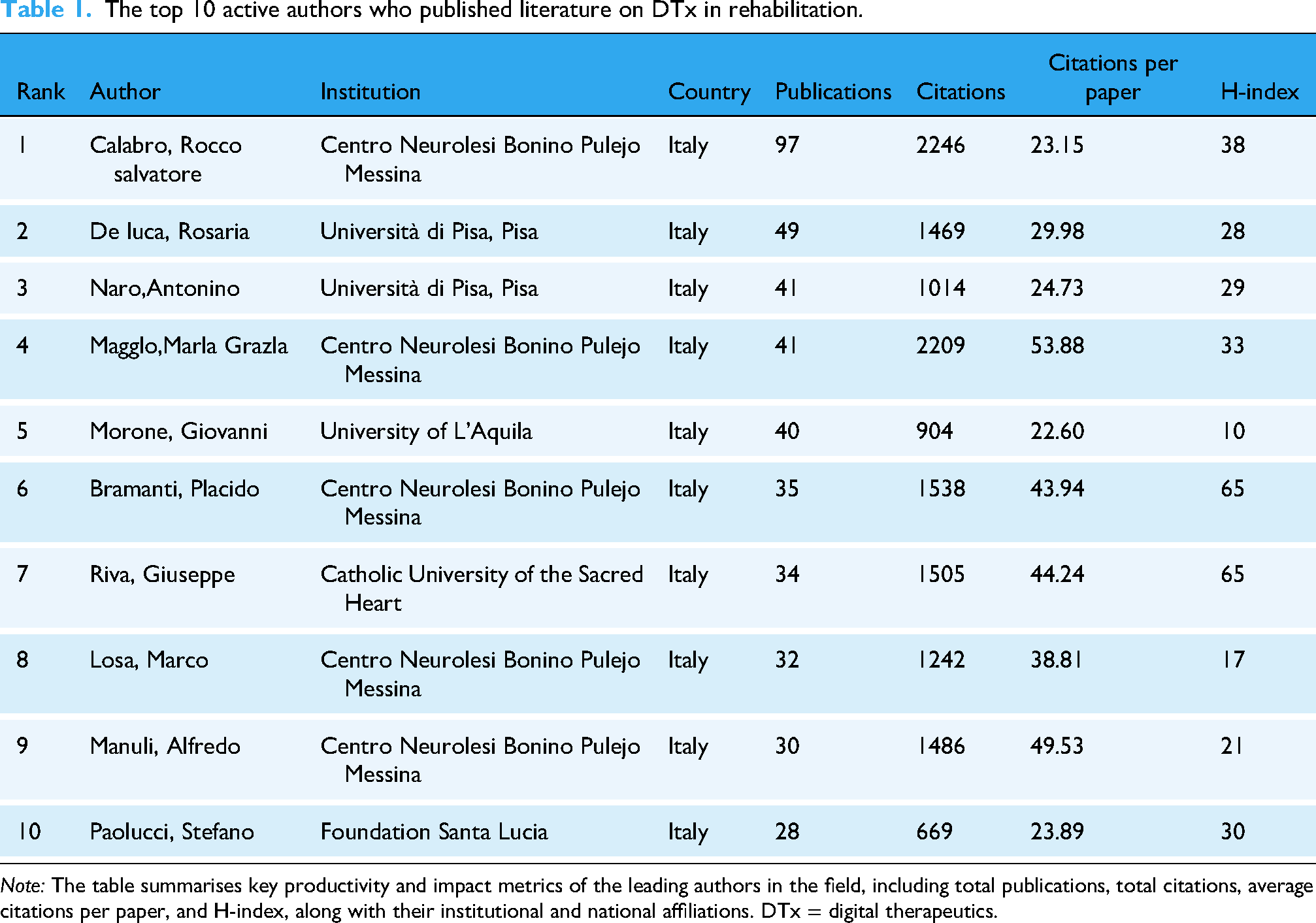
Note: The table summarises key productivity and impact metrics of the leading authors in the field, including total publications, total citations, average citations per paper, and H-index, along with their institutional and national affiliations. DTx = digital therapeutics.
Journal characteristic
A total of 829 academic journals were found to have published the included publications. In alignment with Bradford's law, the most pertinent journals were identified as those that published over one-third of all papers related to the subject matter. This resulted in the identification of 275 journals that were considered to be core, along with 554 that were deemed to be non-core within the field of research under consideration. Table 2 shows that the top 10 journals contributed 21.6% (1426 papers) of the total research output. The Journal of Neuroengineering and Rehabilitation had the highest number of publications (330), followed by IEEE Transactions on Neural Systems and Rehabilitation Engineering (224) and Frontiers in Neurology (150). In terms of the journals’ impact factor (IF), two of the top 10 were found to have an IF in excess of 5.000. The remaining eight journals demonstrated an IF within the range of 2.000 to 5.000.VOSviewer software was used to generate a co-citation map of 678 journals, each with a minimum of 100 citations. The most commonly co-cited journals were the Archives of Physical Medicine and Rehabilitation (4.3), the Journal of Neuroengineering and Rehabilitation (5.1), and Stroke (8.3). These journals illustrate the field and demonstrate a high level of expertise (Figure 8).

Co-citation network map of journals.
The top 10 most productive journals in the DTx in rehabilitation.
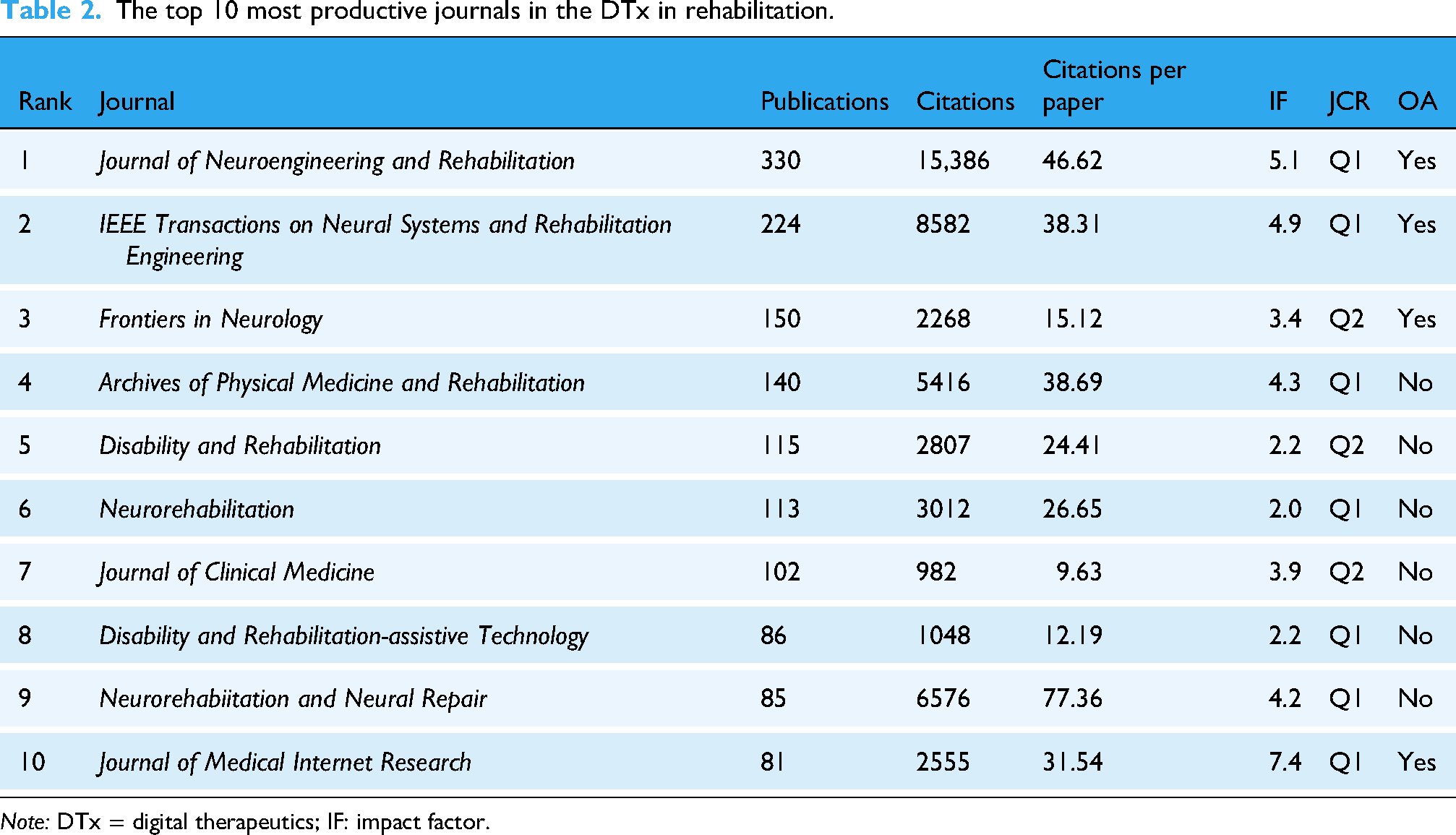
Note: DTx = digital therapeutics; IF: impact factor.
Analysis of keywords
Keywords represent the fundamental summary of a given paper. The high frequency or burst keywords may be indicative of current research themes and potential future avenues of investigation. As illustrated in Figure 9, the three most frequently occurring keywords were rehabilitation, stroke, and virtual reality (VR). A total of 11 clusters of overall keywords could be discerned, classified according to their typology (Figure 10). Clusters #0, #3, #4, #5, and #6 predominantly characterised the principal intervention modalities of DTx. Clusters #1 and #2 indicated the different types of diseases that were primarily targeted, including stroke. Furthermore, Citespace was employed to identify the 25 most significant keywords, as illustrated in Figure 11, exhibited a notable surge in popularity. Keywords were classified into three temporal categories based on their burst time: the period from 2000 to 2013, the period from 2014 to 2019, and the period from 2020 to 2024. Of the identified keywords, those pertaining to brain injury and the arm exhibited the greatest burst strength. The most recent burst keywords, namely rehabilitation medicine, anxiety, digital health, augmented reality (AR), machine learning and task analysis, indicate potential research directions in the near future.

The keyword co-occurrence network map.

The keyword cluster map.

The top 25 keywords with the strongest citation bursts.
Discussion
Overview of the results
The present bibliometric study encompasses 6593 papers that concentrate on the use of DTx in the context of rehabilitation. The visualisation of these papers was conducted using VOSviewer and Citespace with the objective of identifying key research areas and emerging trends within the field. A detailed examination of publications on related subjects indicates that research activity and productivity exhibit notable variations over time, which can be grouped into three discernible phases. Prior to 2013, there was a gradual increase in the number of publications. The application of DTx in the medical field was constrained by the limitations of existing research. Prior studies have explored a range of approaches preceding the conceptualisation of DTx. These include treatments for brain injuries, spinal cord injuries and preliminary studies of emerging interventions such as VR and machine learning. 14 At the outset, there was a paucity of evidence pertaining to the advent of DTx, with the majority of studies concentrating on isolated functional deficits. 15 From the 2010s onwards, there has been a noticeable increase in research activity on the topic of the interaction between cognitive and motor functions, accompanied by the publication of a growing corpus of research output that has captured the attention of both medical professionals and researchers. Cognitive digital therapy is being employed for the purposes of both screening and diagnosis, in relation to individuals affected by the processes of aging, neurological diseases, mental illnesses and other systemic conditions. It employs intelligent algorithms for intervention, real-time data upload and management, and facilitates effective connections between hospitals, communities, families, and patients. The extant evidence indicates that cognitive DTx has the potential to reduce healthcare costs, improve diagnosis and treatment efficiency, enhance patient compliance, and optimise treatment outcomes.16,17 The number of publications has exhibited a marked increase since 2019, reaching a total of 832 in 2022. This growth can be attributed to an increased focus on DTx within the research community and the emergence of innovative technologies for the management of chronic diseases associated with aging. Such developments include brain–computer interfaces, telemedicine, rehabilitation robots, and other advanced intervention methods that are scalable, cost-effective, and accessible, thereby addressing the challenges posed by aging populations.18–21It thus follows that the quest for optimal combinations of DTx and rehabilitation medicine remains a prominent area of investigation. Over the past decade, the number of publications on DTx in rehabilitation has increased markedly, particularly in the most recent phase in comparison to earlier stages. It seems reasonable to suggest that this field of research will continue to attract interest and develop in the near future.
In terms of the nationality of the researchers involved, over half of the countries in the world contributed to publications on DTx in rehabilitation. As might be expected, the United States, China, Italy, Canada and the United Kingdom are the countries with the greatest influence in DTx field, and are also at the forefront of other areas of rehabilitation. 22 This can be attributed to the substantial national gross domestic product, which provides considerable financial backing for clinical research, and the fact that family members of recovered patients are more inclined to pursue a comprehensive treatment plan for their conservative management. 23 Approximately 33% of the top 10 research institutions are located in Canada and the United States, followed by Italy (20%), China (10%), and Switzerland (10%). We observed that five countries – the United States, China, Italy, Spain, and Australia – are engaged in close collaboration. Furthermore, the predominant collaboration is concentrated in the United States. In terms of research institutions, there is a notable degree of collaboration, exemplified by the partnerships between Northwestern University, The Hong Kong Polytechnic University, University of Toronto, Swiss Federal Institute of Technology Lausanne and Centro Neurolesi Bonino Pulejo Messina. A regional distribution of cooperation between countries was identified. However, our findings indicated that, despite IRCCS and Centro Neurolesi Bonino Pulejo Messina publishing the second highest number of articles, a minimal level of collaboration with other institutions was observed. This may prove detrimental to the long-term advancement of academically oriented research. While some degree of collaboration exists between countries, the extent and the strength of collaboration remains suboptimal. To illustrate, there is a paucity of collaboration between institutions in Italy and China It is clear that this situation will have an adverse effect on the long-term development of the research field. Evidently, the enhancement of collaboration could potentially encourage research development. However, it must be acknowledged that the current absence of collaboration does not, in and of itself, act as an impediment to the progression of this domain. It is recommended that research institutions in diverse countries collaborate extensively and communicate proactively with the objective of collectively advancing the development of DTx in rehabilitation. From an author perspective, Calabro Rocco Salvatore, De Luca Rosaria, Naro Antonino, Magglo Marla Grazla and Morone Giovanni published the most papers, with 54 papers per capita. As shown in Table 1, the top 10 researchers were all from Italy, and half of them were affiliated to the Centro Neurolesi Bonino Pulejo Messina, and all had higher citations than those from other Italian organisations. The IRCCS Centro Neurolesi ‘Bonino di Pulejo’ in Messina is one of the most important neurorehabilitation centres in the country, with relevant technological resources ranging from robotics to VR. 24 The dominance of Italy in authorship may be due to the concentration of expertise and funding, particularly from institutions like Centro Neurolesi Bonino Pulejo Messina, a leading neurorehabilitation centre. Furthermore, the aforementioned indicators, in conjunction with the number of publications in leading journals, may facilitate a comprehensive understanding of a particular academic discipline. A review of the literature revealed that more than 20% of the total number publications were distributed across the 10 most highly regarded academic journals. These findings indicate that publications on DTx in rehabilitation are concentrated in a limited number of journals. Moreover, the majority of the most active journals lacked an IF, with only two journals achieving a score of 5. It is thus evident that enhancements must be made to the standard and quality of studies on DTx in rehabilitation. Furthermore, there is a pressing need for increased international collaboration between authors in order to facilitate the production of high-quality clinical study.
Hotspots analysis
Author clustering can provide valuable insights into past, present, and future hotspots within a specific field. As illustrated in Figure 7, analysis of authors contributing to 6593 papers identifies two prominent groups, led by Calabro Rocco Salvatore and Riener Robert. The team of Calabro Rocco Salvatore focuses on telerehabilitation and VR, particularly related to upper extremity rehabilitation.25,26 With the advancement of digital technology, three key concepts have emerged: Digital Health, Digital Medicine, and DTx. 27 Although these concepts may appear similar, digital health is a field that encompasses technological solutions, software platforms, and systems that engage consumers for the purpose of promoting lifestyle, wellness, and health-related outcomes. Furthermore, it encompasses technologies that are capable of capturing, storing, or transmitting health data, as well as those that facilitate the operations of the life sciences and clinical settings. 28 Digital medicine is defined as the field of study and practice that incorporates evidence-based software and/or hardware products designed to assess and/or intervene in human health. 29 The defining feature of DTx is its capacity to deliver medical interventions for the purpose of treating, managing, or preventing disease. 30
As of this writing, DTx products are either available or under development for various physical and behavioural conditions, with a focus on chronic diseases such as diabetes, management of oncology treatments, depression, attention-deficit/hyperactivity disorder, substance use disorders, and anxiety disorders insomnia. A review of the literature on DTx and digital health products identifies six key factors crucial for their successful and thorough development: integration, intelligence, socialisation, interoperability, outcomes, and engagement. 31 It is, however, important to note that not all products meet the aforementioned favourable criteria. There is still considerable room for improvement in terms of product quality. Notwithstanding the dearth of rigorous research substantiating the efficacy of DTx in rehabilitation, extant evidence indicates that DTx employ technologies such as data analytics, artificial intelligence (AI), and behavioural psychology to pioneer novel approaches to disease treatment, management, and prevention. It is imperative that rigorous research be conducted before the widespread adoption of DTx in clinical practice can be recommended.
The appearance of references with citation bursts indicates the emergence of new topics within the DTx research field. 32 An analysis of the references with strong citation bursts (Table 3) reveals that the current major research topics in digital technology for rehabilitation include the study of the therapeutic effects of such technology and the exploration of diverse disease treatments that utilise digital technology. The technologies in question include telerehabilitation, VR, brain–computer interfaces and robots and AR designed for rehabilitation purposes.
The principal research topics addressed in the 15 references with the highest citation frequencies.

Keywords and trend analysis
A cluster analysis of co-occurrence and burst keywords is a useful technique for the rapid identification of hotspots within the field of DTx in rehabilitation, providing insight into their distribution and evolution. Inferences from the clustering analysis indicate that cognitive impairment and movement disorders are the principal targets for DTx in rehabilitation. In addition, evidence from the broader literature shows that DTx has also been applied to conditions such as diabetes and psychiatric disorders, suggesting potential for further expansion beyond the core clusters identified. A description was provided of DTx tools, emphasising their function in the management and treatment of symptoms pertaining to the motor and sensory systems, cognitive impairment and compliance among patients. Additionally, studies have examined the reliability and validity of patient compliance in both short- and long-term contexts. Furthermore, research has explored the role of DTx in managing symptoms of the motor and sensory systems, cognitive impairment, and enhancing patients’ compliance. Of these areas, VR has received the most extensive study to date and has been demonstrated to be an effective method. 5
Figure 11 illustrates that the topics of the included studies evolved through three distinct phases: Phase I (2000–2013), Phase II (2014–2019), and Phase III (2020–2024). Before 2013, the literature was mainly focused on motor dysfunction due to neurological disorders, with little content on DTx. Since 2013, there has been a noticeable increase in interest from researchers around the world in adapting DTx to provide new treatment options for unmet medical needs. These adaptations have been explored as standalone therapies, complementary treatments, enhancements to existing therapies, or as alternatives to certain medications. In particular, there has been interest in using DTx to improve the condition of patients with adolescent idiopathic scoliosis experiencing low back pain. 33 Although not a dominant theme, recent publications (n = 16) have explored the role of DTx in managing pain and posture in adolescent idiopathic scoliosis. One of the key benefits of DTx is its ability to deliver personalised treatments straight to the patient, ensuring that the right therapy is given at the correct time and in the appropriate dose. 34
In the wake of the advent of DTx in the 2010s, a multitude of combinations of DTx with an array of devices and DTx-related applications have been devised, employing more standardised research designs, including randomised controlled trials (RCTs). In the preceding three years, research has integrated the concepts, content, and advancements of DTx in collaboration with various disciplines within the field of rehabilitation. The primary focus of high-quality RCTs has been to verify the efficacy of DTx in patients requiring rehabilitation, representing the current cutting-edge trend in DTx in rehabilitation.
Summary of DTx intervention
Over the past few decades, there has been a growing consensus that DTx can be used effectively as a standalone intervention or in conjunction with other pharmacological and non-pharmacological modalities in the management of a diverse range of neurological and psychiatric conditions. These conditions include motor dysfunction, cognitive impairment and psychological issues that arise from various diseases.5–39 However, several obstacles hinder the successful application of DTx: (1) Under the regulatory framework for medical devices, clinical experts hold differing opinions on the clinical use (prescription/over-the-counter) of digital therapeutic products, which often depends on the product positioning of the company. Therefore, ensuring appropriate application of DTx products in the correct patient populations, mitigating risks, and optimising the allocation of medical resources remains a significant challenge. 40 (2) Compared to traditional medical devices, digital therapeutic products introduce risks such as patient privacy protection and human factors engineering. Regulators should promptly issue guidelines for the registration and review of DTx to guide companies in implementing best practices for designing, manufacturing, and ensuring the quality of these products, thereby safeguarding public safety.41,42 (3) DTx should be closely integrated with advancements in cognitive medical science, leveraging evidence-based medicine to offer prevention, assessment, diagnosis, treatment, and management strategies for individuals with diverse functional impairments. There is a need to strengthen the clinical validation of digital devices beyond English-speaking populations to establish consensus on outcome measures, training duration/intensity, and treatment types to assess the clinical efficacy of DTx interventions.42,43 (4) Globally, while DTx appears to alleviate the burden on healthcare systems and provide interventions to a broader patient base, scaling these solutions remains challenging. Implementation hurdles in low-resource settings include inadequate infrastructure, patient reluctance towards DTx, and limited technical support for widespread healthcare digitalisation.44,45 (5) DTx find applications across various fields including psychiatry, neurology, respiratory care, endocrinology, cardiovascular health, ophthalmology, dermatology, gastroenterology, and others. Mainly, DTx are utilised for psychiatric interventions, neurological disorders like Parkinson's disease, dermatological conditions, brain disorders, and chronic disease management. 46 Our study's findings aim to offer guidance and inspire further research and clinical applications in this burgeoning field. Interestingly, our results revealed that brain-injury-related rehabilitation dominates the DTx field, which may overshadow other equally important areas such as musculoskeletal or cardiopulmonary rehabilitation. This imbalance was somewhat unexpected and may reflect funding priorities or entrenched clinical traditions. Future research should test whether rebalancing research attention could accelerate translation across diverse rehabilitation needs.
In addition to clinical efficacy, the deployment of DTx in rehabilitation must navigate key ethical and practical considerations. Ethically, telerehabilitation settings demand vigilant attention to patient data privacy and security, as remote interventions can effectively ‘open the door’ into patients’ homes and personal lives. Ensuring informed consent and robust data protection protocols is critical to maintaining patient trust. Equally important is the commitment to equity in access: without deliberate strategies to support patients in low-resource or underserved communities, DTx could exacerbate digital divides in healthcare, creating a two-tiered (‘two-speed’) rehabilitation system split along socioeconomic lines. From a practical standpoint, cost-effectiveness has emerged as a deciding factor in the adoption of DTx solutions. Payers and health systems increasingly require solid evidence that DTx can improve outcomes at lower or comparable cost before reimbursing them, and indeed the lack of long-term efficacy and economic data has so far limited widespread insurance coverage for DTx interventions. Major barriers to clinical adoption persist, including unclear reimbursement pathways, insufficient provider training in digital tools, and difficulties integrating new DTx platforms into existing healthcare workflows and electronic record systems. Overcoming these hurdles – through updated reimbursement policies, targeted clinician education, and seamless technical integration – is essential for translating the promise of DTx into routine rehabilitation practice.
To enhance the translational value of DTx interventions, future studies should: First, the evaluation of efficacy and cost-effectiveness in low-resource settings is imperative. Conduct RCTs or pragmatic trials in rural areas or low- and middle-income countries, assessing both clinical outcomes and implementation barriers such as digital literacy, infrastructure, and affordability. Secondly, the utilisation of AI-driven adaptive interventions, facilitated by real-world sensing, is a pivotal strategy in contemporary healthcare management. Develop and test DTx platforms that dynamically adjust therapeutic modules using data from wearable sensors and user interaction patterns; analyse contextual usage analytics to improve engagement and adherence. In addition, the integration of co-creation and interoperability frameworks is paramount in fostering innovation within the domain of education. Engage local stakeholders (patients, clinicians, community health workers) in codesign workshops to tailor DTx tools for diverse cultural and resource contexts, and pilot integration with WHO SMART-compatible digital health systems to ensure scalability and data privacy.
Strength and limitations
This review represents the inaugural attempt to synthesise extant publications and prospective development trends of DTx in rehabilitation through bibliometric analysis. It is thus intended to offer comprehensive guidance for scholars engaged in related research. The study collected 6593 pertinent papers published over the past 24 years from the WoSCC database to guarantee a systematic and comprehensive evaluation. Moreover, we employed established bibliometric software, namely Citespace and VOSviewer, to conduct a quantitative analysis of the field of DTx in rehabilitation. The analysis encompassed specific data points related to countries, institutions, authors, journals, citations, and keywords.
However, it's important to acknowledge the limitations of our work. First, data were only collected from the Web of Science, and incorporating additional databases like PubMed and Scopus might have increased the document volume and provided more comprehensive insights. Second, our inclusion criteria restricted studies to those published in English, which may have led to the exclusion of relevant non-English papers. Third, self-citation bias may inflate citation-based metrics, particularly for highly productive authors or institutions. Fourthly, journal IF bias could skew citation patterns, as high-IF journals tend to attract more attention regardless of content quality. Finally, while our study provides a broad overview of the research area, further high-quality trials or systematic reviews are needed to clarify the specific therapeutic effects and application methods of DTx in rehabilitation, which would be valuable for developing clinical guidelines.
Conclusions
A deeper understanding of the existing research on DTx in rehabilitation is provided by the present bibliometric study. DTx have a significant value for research and a promising perspective for application in rehabilitation. The number of studies in this area has increased significantly over the past 24 years, with the United States, China and Western Europe being the leading countries in terms of both publications and total citations. Nevertheless, enhanced collaboration and communication between countries and institutions is imperative. The majority of journals have a relatively low IF, which warrants greater attention in future. The authors’ co-occurrence analysis revealed a preponderant cluster of studies focusing on rehabilitation treatments integrating diverse types of DTx modalities with advanced non-pharmaceutical devices. This cluster is spearheaded by Calabro Rocco Salvatore. In particular, in addition to the publication of regulations and reimbursement guidelines, efforts should be made to strengthen integration with clinical practice, increase international cooperation, simplify operational modes and accelerate dissemination. These findings may be useful for future researchers in terms of a better understanding of the current hotspots and frontiers in the field.
Supplemental Material
sj-docx-1-dhj-10.1177_20552076251390283 - Supplemental material for Global trends and hotspots of the digital therapeutics in rehabilitation: A bibliometric analysis
Supplemental material, sj-docx-1-dhj-10.1177_20552076251390283 for Global trends and hotspots of the digital therapeutics in rehabilitation: A bibliometric analysis by Runting Ma, Yuan Chen, Huiyan Song, Yixin Wei, Yitong Qiu, Li Zhang and Qiang Gao in DIGITAL HEALTH
Supplemental Material
sj-docx-2-dhj-10.1177_20552076251390283 - Supplemental material for Global trends and hotspots of the digital therapeutics in rehabilitation: A bibliometric analysis
Supplemental material, sj-docx-2-dhj-10.1177_20552076251390283 for Global trends and hotspots of the digital therapeutics in rehabilitation: A bibliometric analysis by Runting Ma, Yuan Chen, Huiyan Song, Yixin Wei, Yitong Qiu, Li Zhang and Qiang Gao in DIGITAL HEALTH
Supplemental Material
sj-pdf-3-dhj-10.1177_20552076251390283 - Supplemental material for Global trends and hotspots of the digital therapeutics in rehabilitation: A bibliometric analysis
Supplemental material, sj-pdf-3-dhj-10.1177_20552076251390283 for Global trends and hotspots of the digital therapeutics in rehabilitation: A bibliometric analysis by Runting Ma, Yuan Chen, Huiyan Song, Yixin Wei, Yitong Qiu, Li Zhang and Qiang Gao in DIGITAL HEALTH
Footnotes
Acknowledgements
We would like to express our sincere gratitude to all the researchers, institutions, and funding bodies whose contributions made this study possible. Special thanks to the Web of Science for providing the data, and to the authors whose work greatly informed our research.

Ethical considerations
This study did not involve human participants or clinical trials, and therefore did not require approval from an ethics review board. All data were sourced from the publicly available Web of Science database, adhering to basic ethical standards of data privacy and academic integrity.
Author contributions
R-TM, YC, H-YS and Y-XW performed acquisition, data analysis and manuscript writing. R-TM, LZ and QG conducted the research, obtained the study information, and edited the manuscript. All authors made contributions to and approved the final version of the article.
Funding
This study is funded by the 2023-YF09-00044-SN from Chengdu Science and Technology Bureau.
Declaration of conflicting interests
The authors declare that they have no known competing financial interests or personal relationships that could have appeared to influence the work reported in this article.
Supplemental material
Supplemental material for this article is available online.
References
Supplementary Material
Please find the following supplemental material available below.
For Open Access articles published under a Creative Commons License, all supplemental material carries the same license as the article it is associated with.
For non-Open Access articles published, all supplemental material carries a non-exclusive license, and permission requests for re-use of supplemental material or any part of supplemental material shall be sent directly to the copyright owner as specified in the copyright notice associated with the article.
