




Abstract
Objective
To explore which features of wearable fitness trackers are used and deemed helpful.
Methods
Forty-seven participants took part in an online survey. All participants were over 18 years of age and owned a wearable device that objectively measured physical activity and provided feedback. The survey included questions related to the acceptance of different features of wearables, and exercise information, self-efficacy, exercise identity, motivation, and general demographics of the wearer. Seven participants took part in focus groups in an effort to gain further insight into the acceptability and utilization of wearables. Data were examined using means and frequencies.
Results
Participants were mostly young adults (18–24 years, 48.9%), White (63.8%), female (80.9%), overweight (body mass index 26.0±6.2), students (42.6%) and generally healthy. Fitbit was the most commonly owned wearable device (42.6%). Most participants had owned their device for 6–12 months (27.7%) and they wore their device daily (80.9%). The most commonly used features were rewards/badges (59.6%), notifications (52.2%), and challenges (42.6%). The features that were reportedly the most helpful, however, were motivational cues (83.3%), general health information (82.4%), and challenges (75.0%).
Conclusions
The reported use and helpfulness ratings of various features of wearables appeared to vary based on the wearer’s gender, race/ethnicity, exercise goal, exercise proficiency, preferred type of exercise, and psychosocial metrics but the results are inconclusive. Future research should evaluate whether engagement with certain features is strongly associated with improved outcomes and whether the use of these features is significantly associated with wearer characteristics.
Introduction
Wearable fitness trackers (wearables) have become a staple in health and fitness. The wearables industry is valued at US$18 million currently and is expected to reach a value of US$64 million by 2023. 1 Globally, wearables generate an estimated US$26 billion in sales with over 170 million units sold in 2018. 2 These devices are more than a fitness accessory; they are a motivational tool that can help improve physical activity. Wearables incorporate various psychological techniques associated with behavior change. 3 These techniques, or features, include social support (socialization), rewards, badges, notifications, and providing feedback.3,4 In particular, social support, personalization, prompts, and activity tracking may be the most essential features to facilitate change in physical activity. 5
Researchers have found that wearables are valid and efficacious when used in a research intervention. These devices may not be the gold standard in measuring exercise, but they can measure steps and sedentary activity to an acceptable degree.6,7 This provides the wearer with a reasonable estimate of their physical activity behavior. This validity translates into improvements in all measures of physical activity. Brickwood et al. assessed the use of wearables in interventions and found that, compared with comparator groups, the wearable resulted in a significant increase in daily step count, moderate and vigorous activity, and overall energy expenditure. 8 The wearables have been shown to be efficacious in interventions across diverse populations, but they appear not to be as effective as traditional behavioral interventions.9,10 Furthermore, the efficaciousness of wearables could be improved with advances in functionality and usability in order to increase engagement.
There are several factors that contribute to engagement with the device. These factors include the accuracy of tracking, social functionality, aesthetics, and the physical form of the device. 11 There is some consensus that an ideal wearable would be prettier, bigger, and more comfortable to wear. 12 Results from a diary study of individuals using a wearable device for the first time discovered that their engagement was dependent on how the data was tracked, managed, visualized, and used. 13 To improve these factors, the authors suggest that researchers and manufacturers should do the following: (a) build systems that elicit empathetic reactions to tracking data, (b) give users control of their data and allow users to help each other, (c) incorporate an avatar that mirrors the user, (d) provide tailored reports and goals, and (e) allow the user to relive their data. 13 These suggestions are most applicable to first-time users, but the most effective wearable behaviors among continued users to elicit prolonged behavior change have yet to be determined.
Researchers agree that there is a need to evaluate barriers and facilitators to wearable ownership and use.14–16 This is not limited to the features of the device, but extends to the characteristics and psychosocial metrics of the wearer.15,16 Preliminary work by Jarrahi et al. suggests that the motivational features of wearables, whether it be behavioral change techniques or functionality, are merely complements to the pre-existing motivations of the wearer. 17 In order to maximize engagement in an effort to greatly improve physical activity outcomes, researchers need a deeper understanding of the utility of wearables. The present observational, mixed methods study aims to explore the combined impact of wearable design and wearer characteristics on the utility of the device. In particular, this study aims to explore wearer engagement by evaluating which device features are used and most helpful. Results from this study will guide future research to optimize engagement with wearable devices.
Methods
Recruitment
The study protocol and procedures were approved by the Loyola Marymount University Institutional Review Board (LMU IRB 2018 FA 22) and this report follows STROBE reporting guidelines for observational studies.
Participants were recruited between October 2018 and January 2019 to take part in an online, anonymous survey and/or focus group. Participants were recruited via: physical flyers with a QR code to access the survey, presentations in student organizations, university email announcements, and social media postings (e.g. Instagram, Snapchat, Facebook). Participants included a convenient sample of wearable owners who either attended or worked at the university or were friends with the research team on social media. Individuals were eligible to participate in the study if they were 18 years of age or older and owned a wearable. Wearables were defined as any device that objectively measures physical activity and provides feedback. 9 Individuals were excluded if they were pregnant or did not provide information consent to participate.
Survey procedures
The survey was administered online through Qualtrics using a secure, anonymous URL. The survey included questions related to the acceptance of different wearable features, and exercise information, self-efficacy, exercise identity, motivation, and general demographics of the wearer. Participants reported the use of various features and rated their helpfulness on a Likert scale. The features included socialization (e.g. likes and comments), competitions/leaderboard, motivational cues during exercise, general health information, rewards/badges, challenges, and exercise notifications. When asked if they used the feature, participants responded with 0 “my device does not have this feature,” 3 “I’m not sure,” 2 “No,” or 1 “Yes.” When asked if they found the feature to be helpful, participants responded with 5 “No, it is not helpful at all,” 4 “No, it is mostly not helpful,” 3 “Indifferent,” 2 “Yes, it is mostly helpful,” or 1 “Yes, it is extremely helpful.” Included in the survey was the self-efficacy scale,18,19 the exercise identity questionnaire (EIS), 20 and the Behavioral Regulation in Exercise Questionnaire version 2 (BREQ–2). 21 The self-efficacy scale estimates barrier (nine-items) and task (four-items) self-efficacy with participants rating their confidence in each measure on a scale of 0 to 10. The EIS is a nine-item scale, with responses ranging from 1 “strongly disagree” to 5 “strongly agree,” which evaluates exercise beliefs and exercise role identity. The BREQ–2 is a 19-item questionnaire with items scored on a scale of 0 to 4. The BREQ–2 has a sub-scale from amotivation, and intrinsic, identified, introjected, and external regulation sub-scales for exercise motivation. 21 Participants also reported their age group, preferred exercise, exercise goal, exercise frequency, exercise proficiency, health conditions, as well as their exercise and weight change since owning their wearable device.
Focus group procedures
Three focus groups were administered to gain further insight into the acceptability and utilization of wearables. The sessions consisted of two or three individuals and lasted for one hour. The principal investigator (PI), trained in qualitative methods, facilitated all of the groups. The co-authors (LP, ALP, MJMT) each attended one focus group to assist the PI with discussion facilitation and provide initial transcriptions of the discussions. Participants were asked open-ended questions related to their likes/dislikes about wearables. They were also asked what qualities and features they would include if they could design their own wearable. The groups were recorded audibly with a tape recorder (Yemenren) and visually via Zoom video conferencing. The co-authors (LP, ALP, MJMT) used the recordings independently to transcribe the focus groups verbatim. Each co-author transcribed the discussion they attended and analyzed the other two focus group discussions.
Efforts to reduce bias
Given the observational nature of this study there is a risk of selection, information, and confounding bias. 22 To abate the possible biases, the following methods were implemented. Participants were recruited across the entire university; not within a single department or college. Furthermore, participants were not restricted to affiliates of the university. Expanding participant recruitment beyond the university decreased the possibility of selection bias while increasing the heterogeneity of the sample in order to capture variability in wearer engagement. The survey relied on self-reported information which may lead to participants unknowingly reporting incorrect information. The focus groups aimed to gain further insight into responses in the survey. In addition, the survey included a myriad of questions related to the wearable’s features and the participant’s characteristics in an effort to gather as much information as possible and identify possible associations.
Statistical analyses
The Statistical Package for the Social Sciences (version 25) was used to perform the analyses. Descriptive analyses were conducted using means for body mass index (BMI), exercise identity, and self-efficacy. The remaining variables were categorical variables and were described using frequencies. The primary variables of interest were the use and the helpfulness of the various wearable features. This is an exploratory evaluation that only included data from participants with complete responses and there were no pre-determined hypotheses or power calculations.
Thematic analysis was used to analyze the focus groups. 23 Initial codes were developed systemically and independently after the focus groups were completed. Final codes were grouped into themes by the PI (ZHL).
Results
Demographics
The survey was available from October 2018 to January 2019 for responses. Eight-one individuals started the survey, 58 individuals provided consent and participated in the survey but 11 of the responses were incomplete; resulting in a completion rate of 56.6% (n = 47). Seven of these individuals participated in the focus groups. The complete demographic information of the participants and the wearable they owned is displayed in Table 1.
Demographics of participants (n = 47).
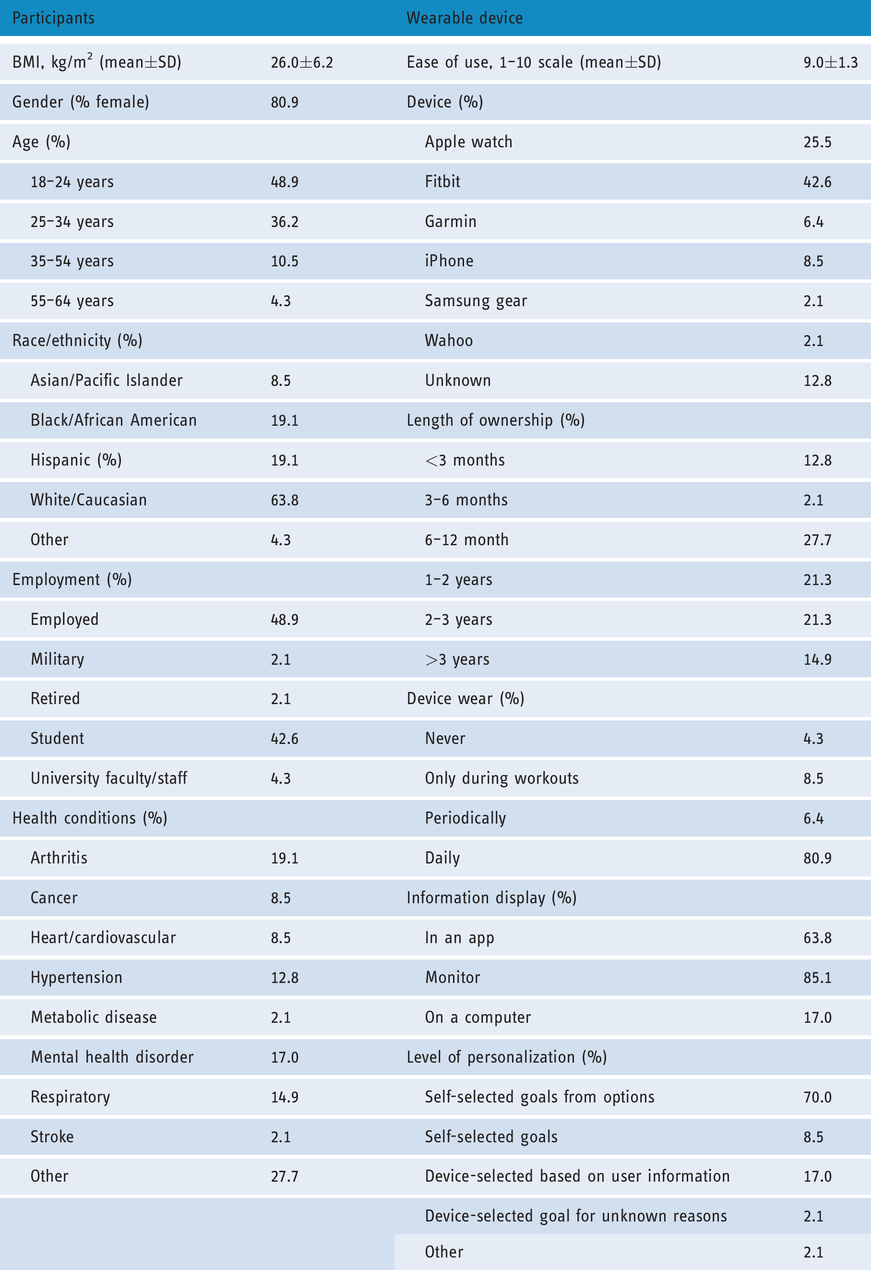
Participants were mostly young adults (18–24 years, 48.9%), White (63.8%), female (80.9%), overweight (BMI 26.0 ± 6.2), students (42.6%), and generally healthy. Most participants reported an increase in their exercise habits after owning their device (66.0%), with most participating in planned exercise at least three days a week (63.8%). Participants self-identified as intermediate exercisers (51.1%) with a weight loss goal (44.7%), who prefer aerobic activity (63.8%). Psychosocial measures suggest that on average participants had a strong task self-efficacy 18 and modest barrier self-efficacy, 18 role identity, 24 exercise beliefs, 24 and internal motivation. 21
The most commonly owned wearable device was Fitbit (42.6%) followed by the Apple watch (25.5%). Most participants had owned their device for 6–12 months (27.7%), one–two years (21.3%) or two–three years (21.3%) and they wore their device daily (80.9%). On average, the participants found their wearable devices easy to use, on a 10-point scale (9.0±1.3). Feedback from the devices was often displayed on the monitor (85.1%) and/or within an app (63.8%) and the devices allowed the wearers to self-select their goal based on personal recommendations. The most commonly used features were rewards/badges (59.6%), notifications (52.2%), and challenges (42.6%). The features that were deemed to be the most helpful, however, were motivational cues (83.3%), general health information (82.4%), and challenges (75.0%). The usage and helpfulness rates of the various features is displayed in Table 2.
Use and perceived helpfulness of wearable features (%).

Wearable features
Tables 3 and 4 display a cross examination of the participants’ demographics by the features of the wearable that are used and those deemed helpful, respectively. Among the features used, general health information and notifications were used at a higher rate among male (55.6%, 77.8%) and Black/African American (66.7%, 87.5%) participants. There is a marked difference in the use of the challenge feature among participants 35–54 years of age (80%) and the competition/leaderboard feature among participants younger than 25 years (8.7%). Healthier participants used the challenge (50%) and reward/badges (66.7%) features at a higher rate than participants with at least one chronic health condition. There were a few striking differences in perceived helpfulness among demographic subgroups. Male participants, participants aged 25–34 years, and participants with a chronic health condition found the socialization feature more helpful, while White participants seldom found it helpful. Helpfulness rates were high (83.3%–100%) across all features among Black/Africa American participants, which suggests that this group only utilized features that were deemed helpful.
Cross examination between demographics and features used (%).
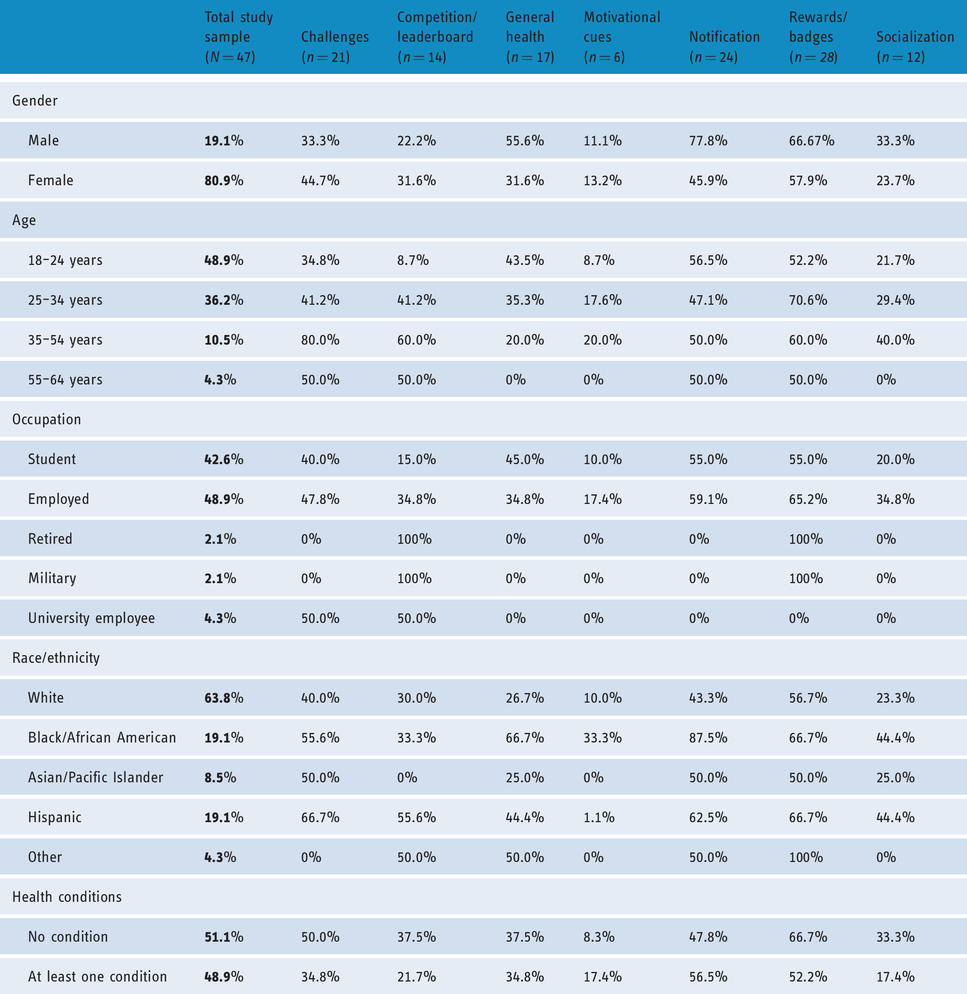
Cross examination of demographics and perceived helpfulness of features (%).

Tables 5 and 6 illustrate the distribution of participants’ characteristics based on the features used and perceived helpfulness, respectively. The distribution of characteristics across different features emulates the distribution of the total sample with a few notable deviations. For participants who use the socialization and notification features, there is a higher rate of participants with an exercise goal other than weight loss, muscle gain, or fat loss, at 25.0%. A larger proportion of participants who used the competition/leaderboard feature had a weight loss goal (71.4%). There was a higher-than-expected rate of intermediate proficient exercisers who used challenges (65.0%) and competition/leaderboard (64.3%). The distribution of participant characteristics had the most deviation among those who used motivational cues. A larger than expected proportion of these participants aimed to gain muscle (33.3%), had intermediate exercise proficiency (83.3%), and preferred aerobic exercise (83.3%). This deviation may be due to the small sample of individuals that utilize this feature (n = 6).
Distribution of participant characteristics by features used %, mean± SD.

Distribution of participant characteristics by features deemed helpful %, mean ± SD.

Generally, participants who found a particular feature to be helpful had intermediate exercise proficiency and preferred aerobic exercise. Intermediately proficient users made up the largest portion of individuals who found the socialization (83.3%), competition/leaderboard (80.0%), and motivational cues (80.0%) features helpful. Similarly, those who preferred aerobic exercise were 80%, 100%, and 73.9% of those who found competition/leaderboard, motivational cues, and notification features helpful, respectively. Other notable deviations include beginner exercisers deeming reward/badges helpful (33.3%) and individuals who prefer strengthening exercise deem socialization helpful (33.3%).
Focus group feedback
Participants in the focus groups expressed that they liked tracking their activity with the wearable. They also liked the functionality and the compartmentalization of the device. However, there were several qualities that they did not like. Participants found the aesthetics of the device unfavorable: I do want to look more professional when… in certain, in many contexts, in my work day. You know, I’m always telling students, “Be professional.” And then I have this watch on. (Garmin, 55–64 years old).
Reliability and functional limitations were also a concern for participants: It just was very like, unreliable for me. Sometimes I would go and do a workout and it would say that like, my steps were less than a day at work, kind of thing. So I felt like it didn’t track me very well. So I didn’t base anything off of it, and then for a while I was like, oh I’m just wearing this for no reason, you know? (Fitbit, 18–24 years old).
Participants also expressed issues with the device’s durability and ease of use. Some individuals stated that these issues were not worth the price of the device: For one how expensive it is. Two, it can break really easily. Three, I feel like it’s a lot of effort to get the full usage out of it. I feel like I have to put a lot of information about myself before I am able to utilize these resources and I am just too lazy to do that to be honest and I feel like I don’t want to put in the effort when I can just go find an app and put my weight, age, and it will be basically the same I guess. (iPhone, 18–24 years old).
Although the participants generally liked their device, there were several features and qualities that they desired. This included a discrete appearance and wear location on the body, incorporation of international normative data for comparison, and capability to objectively measure multiple behaviors and to offer advance tracking that can capture data on biometrics, exercise outcomes (e.g. VO2max, EPOC), and competitions: Okay, well, not on my wrist, but I understand if you want to take something like a pulse, you need some kind of sensor. So I would want something that could take into account what my arms were doing, what my legs were doing, what my torso was doing, but that would be putting all sorts of stickers everywhere. And how they would solve that… I do have an exercise program at home, and you have to put a band and a sensor on your leg, and you also have something on your wrist. And that, I mean it knows when you’re cheating on your squats. It’s kind of creepy. You know, if the wearable could do something like that, keep track of your heart rate, calories, CO2 coming out… I don’t know, but I mean… I think data is really important, and when you have all those analytics, whether you choose to have them or not… that would be fantastic. (Garmin, 55–64 years old).
There was some disagreement on which features and qualities would be ideal. Some expressed that they would like the wearable to be independent of any other mobile device; while others wanted their wearable to be an extension of their smartphone: Now I have a new thing that I have to keep track of. Like if I want to see that data, I have to go down on my phone and pull up the app or wherever my wearable is and check that. You know, if they’re all sync’d then my phone is my one stop. And you know, I already am blending my phone more than I should. I have my work email, my home email, I only have one phone number – I don’t have a work phone number and a home phone number – so I’m already blending all those things, I would just blend all my health data in there too. (iPhone, 35–54 years old). This affirms that one universal design may not work for all wearers.
Discussion
This is a descriptive summary of an exploratory observational study that evaluated the utility of various features among individuals who own a wearable fitness device. These results add to the greater body of research aimed to provide empirical evidence of the helpfulness of wearable devices. The current study sample is similar to the general population of individuals who either own or use a wearable device in that the sample is mostly female, less than 60 years of age, have at least some post-secondary education, meet physical activity guidelines, and are overweight. 14 Other researchers have found that approximately three-quarters of owners of wearables actually find them helpful. 15 Our results go beyond overall helpfulness and suggest that motivational cues, general health information, and challenges were the most helpful aspects of the device. Furthermore, feedback from the focus groups indicates that improved aesthetic designs and capturing more comprehensive data may transform the wearable into an ideal device. Other research suggests that comfort, 16 design, 16 general feedback features, 16 ease of use, 25 and reliability 25 may improve the perceived helpfulness of the wearable device. Kim et al. suggest that characteristics of the wearer, such as self-efficacy regarding the device, may also have an impact on helpfulness. 25 More research is needed to determine the correlates of the device’s perceived helpfulness.
Beyond the perceived experience of the wearer, a comprehensive evaluation of how the wearer interacts with the device may give insight into how these devices can change health outcomes.15,16 Nelson et al. suggest that six specific elements of these devices (attractiveness, monitoring, feedback, privacy protection, readability, and gamification) explain 38% of the health empowerment of the wearer. 26 Of these elements, gamification and readability seem to have the strongest correlation with health empowerment, which is correlated to normative and affective commitment. 26 The current study focused on the specific gamified features (e.g. notification, socialization, rewards/badges) which were utilized at various rates but used regularly by 85.1% of participants. The high reported use relates to a reported change in exercise behavior among 66.0% of the sample. It cannot be determined whether the use of features is partially responsible for the increase in exercise, as Nelson and colleagues suggest. 26 Prior motivation of the wearer may explain the use, and disuse, of these features.
In a qualitative study, Jarrahi et al. interviewed Fitbit owners and classified them based on their motivation level. 17 The authors then analyzed and compared the participants’ behavior with their Fitbit based on their motivation. As a result, Jarrahi et al. suggested that Fitbit owners fall into one of five categories: curious immobiles who are not physically active and lack motivation; aspiring starters who are not physically active but motivated; motivation seekers who are physically active and want at least to maintain their level of activity; quantified selfers who want to consistently generate a targeted set of information; and persistent movers who are physically active with a clear motivational structure. 17 Curious immobile and persistent movers interact with their device the least, only tracking their activity. Quantified selfers are also low-frequency users; they track their activity and use the visual feedback. Aspiring starters and motivation seekers are the highest-frequency users because they track their activity, set goals, use rewards and visual feedback, and socialize. 17 The participants in the current study may fall into these two categories as they, on average, exercised at least three times a week and had moderate motivation based on the psychosocial measures. We observed that there was some variation in reported use of features based on the participant’s exercise characteristics, however, the relationship was not statistically analyzed. Future research should further evaluate the relationship between characteristics of the wearer (including motivational level and exercise experience) and their behavior with their device.
Implications for future research
Evaluating specific wearable features provides some novel insight into how subgroups of individuals are utilizing their devices. The utilization may have different implications for different subgroups, which should be taken into consideration in future research. For example, both males, who are historically more physically active than females, 27 and Black/African Americans, who are historically more inactive, 27 used general health information and notification features at higher rates. Similarly, socialization is used at higher rates among historically active populations (men and young to middle-aged adults 27 ) but also used among subgroups that may benefit the most from increased physical activity (individuals with chronic health conditions 28 and racial minority groups 27 ). Future research should determine the cause and effect relationship of these features and physical activity rates. Future research should also consider that utilized and helpful features are determined by individuals of particular exercise experience. We found that intermediate and aerobic exercisers make up a moderate part of the overall study sample, but they make up the majority in some particular features. Alternatively, participants with a goal of fat loss or of muscle gain and beginner exercisers make up approximately 20% of the total sample but they are not represented in the rates of some particular features. Future research should continue to investigate the potential impact of psychometric metrics. Our sample had moderate motivation and there were no notable variances by wearable feature. This may not be true among individuals with low or high exercise motivation.
Limitations and strengths
The observational design and small sample of this study limit the analysis to reported frequencies and means. Significant associations and causality cannot be determined. Furthermore, the use of self-report measures may not have provided reliable data. A convenience sample was recruited. The sample may not be representative of the general population; however, the current sample of wearable owners is similar to wearable owners in a nationally representative survey. 14 Lastly, the focus groups did not reach saturation and other thematic codes may not have been identified. Despite this limitation, our findings complement the results of previous qualitative research among wearable owners.11,13,17 Our findings also expand the current research by evaluating the specific features of the wearables in relation to individual characteristics. This warrants further research into how the individuality of the device and the wearer may promote prolonged wearable use and improve physical activity outcomes.
Conclusion
This mixed methods, observational study aimed to fill in some of the knowledge gaps in research into wearable devices.15,16 We evaluated the utility of the devices’ features in relation to the characteristics and psychosocial metrics of the wearers. Like most owners of wearables, participants in the study were predominantly young, female, educated, physically active, and overweight. 14 The most popular wearable device was a Fitbit. The most commonly used features were rewards/badges, notifications, and challenges; while the features deemed most helpful were motivational cues, general health information, and challenges. The reported use and helpfulness ratings appeared to vary based on the wearer’s gender, race/ethnicity, exercise goal, exercise proficiency, preferred type of exercise, and psychosocial metrics. Future research should examine whether wearer characteristics are significantly associated with the use and perceived helpfulness of the features. Future research should also evaluate whether engagement with certain features has a stronger association with improved health outcomes.
Footnotes
Acknowledgements
The authors thank Dr Courtney Monroe and Dr Amanda Staiano for their assistance and guidance in this research.
Contributorship
ZHL contributed to all aspects of this study including, but not limited to: researched literature, conceived the study, protocol development, gaining ethical approval, patient recruitment, data analysis and drafting the manuscript. ALP, MJT, and LP were involved with protocol development, patient recruitment and data analysis. All authors reviewed and edited the manuscript and approved the final version of the manuscript.
Declaration of Conflicting Interests
The authors declare that this is no conflict of interest.
Ethical approval
The ethics committee of Loyola Marymount University approved this study (LMU IRB 2018 FA 22)
Funding
This research received no specific grant from any funding agency in the public, commercial, or not-for-profit sector.
Guarantor
ZHL
Peer review
Dr. Siyu Zhou, Waseda University have reviewed this manuscript.
