




Abstract
Background
Non-suicidal self-injury (NSSI) is a serious public health concern facing adolescents and young adults worldwide. Despite growing concern that accessing NSSI content on the internet may negatively influence perceptions toward NSSI recovery, no studies have examined actual impacts.
Objectives
This experimental pilot study assessed the impact of exposure to hopeless versus hopeful peer messages on perceptions toward NSSI recovery. It was hypothesized that exposure to hopeless messages would lead to more negative perceptions about NSSI recovery whereas the opposite would occur for hopeful messages.
Methods
We developed fictional peer comments embedded in a screenshot of an NSSI-themed YouTube video and randomly assigned participants to either hopeless or hopeful recovery-oriented comments. Participants’ attitudes toward NSSI recovery, recovery-oriented subjective norms, and recovery self-efficacy were measured pre- and post-exposure using an online questionnaire.
Results
Sixty-one participants with a self-reported NSSI history (mean age 20.89 years) completed the online survey. There was a statistically significant effect for attitudes toward recovery. Within the hopeful comment condition, there was an increase in positive attitudes toward recovery and in recovery-oriented subjective norms. Participants exposed to hopeless peer messages did not report an increase in hopeless attitudes toward NSSI recovery.
Conclusions
Our pilot study indicated that exposure to hopeful online messages improved positive attitudes toward recovery and recovery-oriented subjective norms, while exposure to hopeless messages did not increase hopeless attitudes. Future research on the impacts of online peer comments on one’s attitude toward NSSI recovery and support-seeking behavior could further inform practices and policies.
Introduction
Non-suicidal self-injury (NSSI), the purposeful destruction of one’s body tissue without suicidal intent (e.g. cutting, burning), 1 represents a serious public health concern across the world, with lifetime rates among adolescents and emerging adults (i.e. 12–24 years of age) ranging from 14 to 21%. 2 Engagement in NSSI elevates risk for repeated NSSI, residual scarring, isolation, and myriad mental health difficulties, including suicide risk. 3
One area of research garnering increasing attention is NSSI-themed user-generated content on the internet.4–7 There are prevalent concerns that some online content presents NSSI in ways that convey recovery from NSSI in bleak or pessimistic ways.5,6,8,9 For example, research has suggested that NSSI YouTube videos often depict NSSI with little hope of recovery 5 and many viewers favorably rated such videos and endorsed the belief that recovery is infeasible. 6 Continued access to such messages may instill a belief that can impede recovery efforts and contribute to continued NSSI engagement.6,9 Meanwhile, research also indicates that hopeful, pro-recovery messages are presented online 9 and learning from peers who have recovered may inspire or propel recovery efforts by imparting a sense that recovery is possible. 10 Taken together, these potential outcomes of online NSSI activity seem to cohere with Nock’s social-learning hypothesis of NSSI in that individuals who self-injure may be differentially influenced by different media (in this case online media) presentations of NSSI.11,12 Although this framing of NSSI largely has to do with its explanation of why individuals self-injure or continue to self-injure, it may have utility in understanding what may impede continuation of NSSI.
However, evidence regarding the actual impact of online NSSI content is virtually non-existent. Almost all studies in this area do not explore whether accessing virtual peer comments impact factors related to NSSI recovery. To fill the knowledge gap, this experimental pilot study examined whether brief exposure to hopeless or hopeful peer comments posted to a YouTube video would influence NSSI recovery perceptions. YouTube was considered an optimal setting because of the marked popularity among individuals who self-injure.5,6,13 We hypothesized, in line with Nock’s social-learning theory for NSSI,11,12 that the exposure to hopeless comments would lead to more negative attitudes toward NSSI recovery, less concern about what others think about recovery (subjective norms), less recovery self-efficacy, and negative mood. The opposite effect was anticipated for hopeful comments.
Methods
Study setting
Inspired by recent research using YouTube to study effects of peer feedback on adolescent body perception,14,15 we developed two screenshots of a fictional YouTube video entitled “My Self-Injury Story” using Adobe Photoshop (Figure 1). Six viewer comments relating to hopeful attitudes toward NSSI recovery and six comments indicating hopeless attitudes were devised in consultation with prior research
6
and embedded in the screenshots. We imitated common phrasing used by YouTube users to render the comments more ecologically valid. Other textual elements (e.g. video description, usernames) were blurred to avoid conveying irrelevant information and participants were informed of this. Prior to the study, we also showed the screenshots and the specific comments to a group of university students who indicated that both images and wordings seemed to mirror what may be observed on YouTube.
Screenshot of YouTube video.
We recruited participants with an NSSI history from online NSSI communities and social media platforms (e.g. Reddit, Facebook). Study advertisements were posted on social media platforms specific to NSSI (e.g. subreddits) with permission from site moderators. Interested individuals who accessed the hyperlink were then directed to the study’s information and consent page. Here, participants were asked to read the consent form and then respond to three multiple-choice questions about the nature of the study. Those who responded correctly to these questions clicked a button to access the survey. Those who did not answer these questions correctly were not granted access to the study website and thanked for their time.
Upon entering the study via its website, participants were first asked baseline questions and randomly assigned to one of the two YouTube screenshots with either hopeless (e.g. “its impossible to stop cutting yourself. 3 years and counting …”) or hopeful comments (e.g. “I stopped selfharming like 3 months ago. I’ll be honest it was really hard but if u keep trying, u can do it too!!!!”). Next they answered post-intervention questions. Upon completion, participants took part in a brief mood augmentation task and received a debriefing letter and online NSSI recovery resources. Figure 2 depicts the study procedures. Participation occurred in a single sitting. We conducted the study in this manner as we were interested in understanding how individuals may respond to the presentation of hopeful and hopeless messages in-the-moment, when first interacting with them. To provide an incentive for participation, each participant who completed the survey was made eligible to enter in a draw for one of four $25 Amazon gift cards.
Overview of study procedure.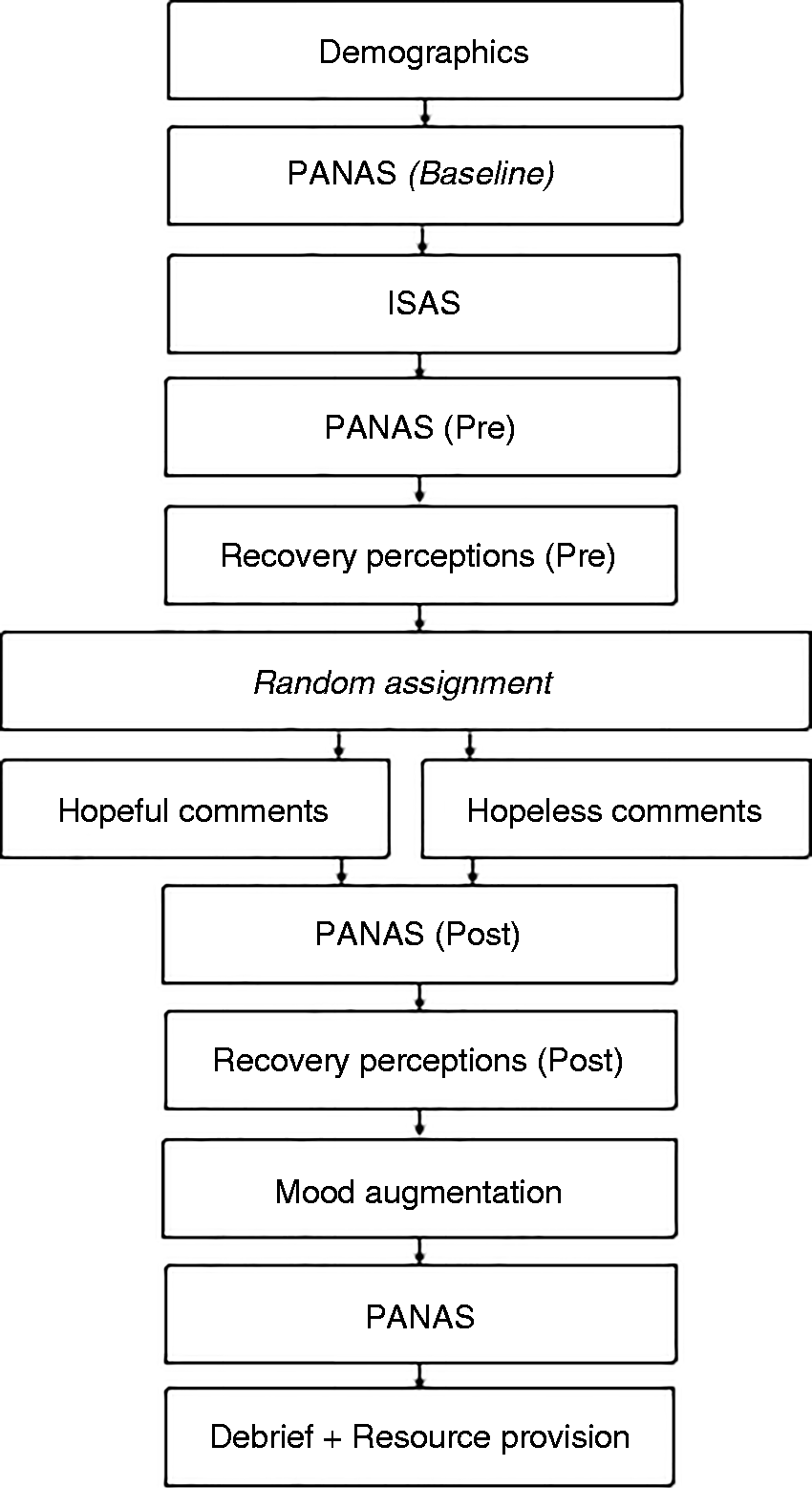
Participants
Sixty-four individuals signed up for the study. Three were excluded, however, as their NSSI status could not be confirmed (as they did not complete the NSSI scale noted below). Thus, 61 participants took part in the study; 38 self-identified as female, 17 as male, and 2 as female to male transgender, and the remaining 4 did not identify a gender status. Participants were between the ages of 16 and 34 (M = 20.89, SD = .59) and most reported a Caucasian ethnicity (91.8%). Thirty-six participants (59%) self-identified themselves as non-heterosexual, either bisexual, lesbian, gay, queer, questioning, or other. Participants’ age-at-onset of NSSI ranged from 5 to 23 years (M = 13.73, SD = .40). Most (88.5%) reported cutting as their main NSSI method and most (86.83%) reported past year NSSI. We intended to exclude those individuals who just selected hair-pulling and wound interference as these are generally not considered NSSI,1,2 but no such cases were present in the data.
Measures
NSSI history
Participants’ NSSI history was assessed using the Inventory of Statements About Self-injury (ISAS) 16 that assessed lifetime history of 12 NSSI behaviors (e.g. banging/hitting self, biting, burning, carving, cutting).
State mood
State-level mood was assessed using a brief version of the Positive and Negative Affect Schedule (PANAS) containing 10 positive affect terms (e.g. active, enthusiastic) and 10 negative affect terms (e.g. distressed, scared).17,18 Before experimental manipulation Cronbach’s alpha was .86 and .80 for positive affect and negative affect, respectively; after experimental manipulation Cronbach’s alpha was .91 and .84, respectively.
NSSI recovery perceptions
This measure was developed for the current study based on literature concerning NSSI recovery 19 and clinical experience working with clients who self-injure. Participants rated each of the following three domains on a 7-point Likert scale. The first domain, comprising five items, pertained to attitudes toward NSSI recovery (i.e. viewing recovery positively/negatively). An example item was “For me, recovery from self-injury is” to which respondents indicated the degree to which they endorsed this (e.g. useless to useful). Cronbach’s alpha for attitudes was .91 before and after experimental manipulation. The second domain, again comprising five items, pertained to recovery-oriented subjective norm (i.e. whether what others would think about NSSI recovery was salient to the participant). An example item was “Most people who are important to me think that recovery from self-injury is” to which respondents indicated the degree to which they believed this (e.g. unimportant to important). Cronbach’s alpha for subjective norms was .65 and .71 before and after manipulation, respectively. The final category, comprising six items, pertained to recovery self-efficacy (i.e. confidence in one’s ability to recover). An example item was “I am confident that I can recover from self-injury” to which respondents indicated their level of agreement from completely disagree to completely agree. Cronbach’s alpha for these items was .83 and .84 before and after experimental manipulation, respectively.
Results
Summary of means and standard errors from the analysis of variance results before and after exposure to YouTube comment conditions.

Denotes significance (p < .05).
NSSI: non-suicidal self-injury; PANAS: Positive and Negative Affect Schedule.
Attitudes toward NSSI recovery
There was a significant within-subject main effect for attitudes toward NSSI recovery (F(1,58) = 7.09; p = .010; ηp = .109) and a significant interaction between recovery message condition and attitudes toward NSSI recovery (F(1,58) = 4.72; p = .034; ηp = .075), indicating a medium effect size. Post hoc dependent t-tests revealed that within the hopeful message condition, there was a significant increase in positive attitudes toward recovery comparing pre- and post-message exposure scores (t(29) = 3.10; p = .004), while no statistically significant change was observed within hopeless message condition (t(29) = .39; p = .697).
Recovery-oriented subjective norms
There was no main effect for recovery-oriented subjective norms (F(1,58) = .52; p = .470). However, there was a significant interaction between recovery message condition and recovery-oriented subjective norms (F(1,58) = 4.43; p = .040; ηp = .071), indicating a medium effect size. Post hoc dependent t-tests revealed that within the hopeful message condition, there was a significant increase in recovery-oriented subjective norms (i.e. believing that what other people important to them thought about NSSI recovery mattered to a greater degree) comparing pre- and post-message exposure scores (t(29) = 2.13; p = .042), while this was not the case for hopeless messages (t(29) = .93; p = .359).
Recovery self-efficacy
There was no within-subject main effect for recovery self-efficacy (F(1,58) = .27; p = .603) nor was there a significant interaction between message condition and recovery self-efficacy (i.e. confidence in one’s ability to recover) regarding NSSI recovery (F(1,58) = .10; p = .748). There was also no significant between-group main effect for message condition (F(1,58) = .99; p = .322).
Positive and negative mood
There was no within-subject main effect for positive (F(1,58) = 1.35; p = .250) or negative (F(1,58) = .32; p = .576) state mood, nor was there a significant interaction between positive (F(1,58) = .26; p = .589) or negative (F(1,58) = .32; p = .576) state mood and message condition.
Discussion
Our pilot study offers preliminary evidence that exposure to positive online messages about NSSI recovery may instill at least a temporary sense of hope. It is conceivable that participants viewed these messages as those posted by actual individuals who had recovered from NSSI. If this is the case, the message content may have been relatable (because of a shared NSSI experience) and thus may have elicited thoughts that recovery is possible. This finding is noteworthy because most research and media reports to date assert that online NSSI activity is largely deleterious.4–6 Furthermore, it may be that social-learning approaches to understanding the potentially positive impact of online activity merit consideration. Likewise, hopeful recovery comments online may have impacted cognitions about others’ perceptions of their own recovery (i.e. subjective norms). More specifically, reading hopeful messages may have evoked thoughts about what others (who are important in their own lives) may wish for them with respect to recovery. For example, if they believed that others important to them would want them to recover, this may have influenced how they responded to subjective norms items. Future research ought to elucidate what aspects of subjective norms are especially salient.
Unexpectedly, and inconsistent with certain theoretical frameworks such as Nock’s social-learning hypothesis,11,12 our findings did not support the notion that hopeless messages would negatively impact recovery-based attitudes. It may be that these messages do not carry the risk others have purported,5,6,13 that the comments were not to a degree of hopelessness that would yield an effect, or that hopeless messages only have an effect after continued exposure. Future research should explore this possibility and consider the nature of people’s past online NSSI activity (e.g. time accessing NSSI content). Similarly, consideration of other variables, including the degree of hopelessness conveyed, is needed. Such approaches would offer a more comprehensive examination of the social-learning hypothesis11,12 related to the impact of media exposure on NSSI engagement.
One limitation of our results was the absence of a control group. To best of the authors’ knowledge, as this was the first experimental study in this area, we sought to provide a preliminary examination of the potential impact of online peer comments in a straightforward manner without a control group. Future research should address the generalizability and transferability of these findings using a larger sample and control group. In line with this, a more comprehensive examination of NSSI using a larger sample seems warranted. This would allow for greater insight into whether (and how) aspects of people’s NSSI histories (e.g. greater frequency, multiple or more severe methods) or clinical comorbid conditions play a role in the potential impact of online NSSI activity; relatedly, examination of key subgroups (e.g. those who meet the proposed DSM-5 criteria for NSSI versus those who do not) should also be considered. Longitudinal approaches would also help to make inferences about the long-term effects of NSSI recovery comments regarding whether the changes observed in this study would persist. Finally, we did not do a formal manipulation check by ascertaining whether participants read all of the comments. Instead, we accounted for the time it would take for an individual to complete the entire study (including reading comments) before we launched the current project. The time it took for participants tended to map onto our estimated time frame, suggesting that they did read the questions. Nevertheless, this is an important issue to address in future work using this procedure and findings should be interpreted with this in mind.
Conclusion
Our pilot study suggests that harnessing the benefits of online peer support would make social media more conducive to NSSI recovery. Acknowledging both the positive and negative impacts of the internet could thus help clinicians understand why those who self-injure initially turn to the internet. Assessing who is more susceptible to negative peer messages with the “double-edged” potential of online activities 9 in mind may help clinicians provide optimal support to clients who self-injure and engage in related online activity. There may be utility in more proactive interventions to leverage recovery-oriented, hopeful messages through techniques such as search word optimization and promotion of narratives emphasizing NSSI recovery as a source of peer motivation.
Footnotes
Contributorship
SPL designed the study and analyzed the data. PJ coordinated and managed data collection and carried out initial analyses. SPL and YS co-wrote the manuscript and reviewed and revised the manuscript. All authors edited the manuscript and approved the final version of the manuscript.
Declaration of conflicting interests
The authors declared no potential conflicts of interest with respect to the research, authorship, and/or publication of this article.
Ethical approval
This research received ethics approval from the University of Guelph Research Ethics Board (reference number: 16FE030).
Funding
This research received no specific grant from any funding agency in the public, commercial, or not-for-profit sectors.
Guarantor
SPL.
Peer review
This manuscript was reviewed by two reviewers, the authors have elected for these individuals to remain anonymous.