




Abstract
Objectives
#selfharm has been blocked by Instagram, but manoeuvring hashtags (e.g. #selfharn) are beginning to appear in order for secret non-suicidal self-injury (NSSI) communities to communicate. The purpose of this study was to (a) determine the nature of the #selfharn conversation on Instagram, (b) analyze common properties of the visual content (i.e. images and videos; n = 93) tagged with #selfharn, and (c) discover what kind of environment the authors (n = 50) of #selfharn were creating.
Methods
A multi-method approach was utilized for this study. Netlytic was used to generate a text and content analysis to examine the authors’ captions and comments (n = 8772) associated with #selfharn (collected over a seven-day period).
Results
After removing #selfharn from the dataset, the text analysis revealed that #depression (n = 3081) and #suicide (n = 2270) were the most commonly used terms associated with #selfharn. Overall, 52% (n = 4386) of the popular words/phrases related with #selfharn posts were categorized as ‘bad feelings’. Through manual coding, it was determined that the majority of #selfharn visual content (n = 92; 99%) did not generate an advisory warning but did contain a wound (n = 70; 75%). The #selfharn author analysis suggests that most were women (n = 18; 36%) with a dark-coloured profile aesthetic (n = 37; 74%) determined by an overwhelming amount of grey, black, blue, red, or purple colours.
Conclusion
According to the text and content analyses, #selfharn on Instagram may be contributing negatively to an online community of mental-health issues. More resources should be provided by Instagram to those who are involved in the NSSI Instagram community.
Introduction
Social networking sites (SNSs) are web-based services that allow users to create a public or semi-public profile, articulate a list of users who share a common connection, as well as view and communicate with that list of connections. 1 Moreover, SNSs allow users to search posts of interest using hashtags that function as a descriptor for individual visual content (e.g. images, videos) and themed pages.2,3 Through the use of hashtags, SNS users are able to connect over common interests. These connections create online social networks that have been found to foster a sense of community 4 and a desire to belong.5,6 Recently, researchers have begun exploring emerging SNS communities that revolve around mental-health issues.7,8 Creating online spaces (i.e. communities) that allow users to self-express, create interactions and construct interest-driven exploration and browsing has led to atmospheres with both positive7,9,10,11 and negative effects for users.12,13 Along with the support and understanding these online communities can provide, unhealthy behaviours can be validated by members of these environments which may lead individuals into dangerous health situations.
One such dangerous health situation, that is becoming a concern in online communities, is surrounding the mental-health issues categorized as non-suicidal self-injury (NSSI). NSSI is defined as the intentional destruction or harm towards bodily tissue without the intent of suicide but is distinctly separated from socially condoned behaviours (i.e. tattoos or piercing).14,15 NSSI behaviour and visual content are becoming common among SNSs, specifically Instagram, having around 11 million posts tagged with NSSI related hashtags each year. 16 Past research has found that those engaging in NSSI content claim that expressing their feelings through art-based platforms (such as Instagram compared to Twitter) are convenient for instantaneous visual content creation and publication. 17 Instagram has attempted to mitigate the formation of a large quantity of NSSI-related visual content by placing warning labels on posts that contain NSSI content and has removed certain hashtags pertaining to NSSI behaviours such as #selfharm. 8 However, the warning labels will only be present if another user reports the visual content and it is reviewed by an Instagram employee that confirms whether or not the content is sensitive. 18 The Instagram warning labels integrate a help-centre link available to users who are posting NSSI content and/or have witnessed NSSI activity within content shared. 19 Furthermore, in regard to mitigating NSSI behaviour, Instagram’s policy states that the goal is to ‘maintain our supportive environment by not glorifying self-injury’. 19 However, users are finding ways around the warning labels and hashtags in order to continue posting NSSI content 8 by using other similar or ‘manoeuvring’ hashtags (e.g. #selfharmmm or #selfharn instead of #selfharm). For instance, previous literature has investigated #selfharmmm and found that users utilizing the hashtag wanted to connect with a ‘secret’ NSSI community within Instagram. 8 These ‘secret’ communities are called as such, because most individuals create an anonymous NSSI Instagram account so they can develop a separate online persona. 8 In addition, using words with a double meaning (i.e. #cat can be utilized for those engaging in self harm or for users who are referencing the actual animal) helps creates a ‘secret’ community within an existing one so that users can continue posting NSSI content. 8 Within these ‘secret’ NSSI communities, comments left on tagged visual content that may be seen as positive to those community members (i.e. encouraging more self-harm or admiring the NSSI image) but may be unintentionally further perpetuating dangerous and unhealthy behaviour. 16 In all, the community feeling that the NSSI users are creating gives those involved a sense of togetherness compared to their offline world, which may feel isolating. 20
The Computer Mediated Communication (CMC) theory encourages self-disclosure, 21 which suggests those who become online friends tend to self-disclose about feelings, thoughts and experiences more often than those who use face-to-face communication.21–23 Research suggests that people who participate in NSSI online do so as to communicate with like-minded others, feel accepted in a community socially and receive validation.24–29 SNSs have been thought of as mediums to redefine the identity of the user 8 and utilizing the CMC theory as a basis, it may allow users to engage in a self-discovery, where different personas and anonymity may be experimented within the online world.30,31 The anonymity of the NSSI community strengthens the CMC’s foundation of self-disclosure by increasing self-worth emotions and being more honest about one’s personal problems.32,33 Through the CMC theory and SNSs, conversations can take place between the user and their followers, or between multiple people who comment on the same post.
The Communications Process Model (CPM) 34 is a circuit that presents the online diction on SNSs between the author, who is considered the ‘sender’ posting the content, and their followers, the ‘receivers’. 35 The CPM can be used to support the CMC, as the feedback loop involves constant communication between both the sender and receiver, therefore strengthening the CMC theory, which could lead to more self-disclosure compared to interactions via face-to-face communication.22,36–38 As more authors self-disclose and receive feedback, either positive or negative, this could strengthen the intensity of the CPM feedback loop. Strengthening the intensity of the CPM feedback loop, in turn, could increase the receivers’ motivation to share and self-disclose on an even deeper level, 36 ultimately contributing to more posts and opinions that could be increasingly dangerous to the community of NSSI. The CPM is important to take into consideration as it can help explain the underlying reason for why a sender is posting the content that they are, and how that contributes to not only their overall online persona, but to the NSSI community.
The de-sensitization of NSSI is thought to have occurred because of the frequency of peers engaging in this behaviour.8,39,40 Similar to #selfharmmm,
8
at the time of the current study, #selfharn (a manoeuvring hashtag of #selfharm) had escaped from Instagram’s content policies and had over 70,000 posts (retrieved 21September 2018).
19
However, to emphasize the relevance of exploring the online community surrounding #selfharn, it is important to note that as of February 2019, Instagram has updated their policy and has since removed the #selfharn hashtag from being utilized any further.41,42 In addition to this change, Instagram states that no graphic NSSI visual content will be allowed and hashtags will be removed when reported.
19
Thus, the current analysis of the #selfharn data provides an important contribution to the literature in understanding a piece of online discourse that may not be able to be explored in subsequent years. Therefore, using both the CMC theory of self-disclosure and the CPM feedback loop strength, the current study used #selfharn to further explore the impact of NSSI visual content and the nature of the conversations surrounding NSSI on Instagram. Using #selfharn, an attempt to gain a better understanding of the online conversation surrounding NSSI visual content between the senders and receivers was explored, as were the elements of NSSI visual content. Specifically, the current study addressed the following research questions (RQs): RQ 1: Descriptively, what is the nature of #selfharn conversation on Instagram? RQ 2: Among visual content tagged with #selfharn (i.e. images and videos), what are the common properties of a purposeful subsample of NSSI visual content? RQ 3: What kind of environment are authors of #selfharn creating through their Instagram accounts and posts (i.e. users names, biographies, additional hashtags and page aesthetic)?
Methods
Data collection and Netlytic analysis
Using the Netlytic program, 43 an open-source software, all tagged visual content with the #selfharn hashtag were downloaded in real time from Instagram (i.e. when the post was tagged, not necessarily when it was posted). The download occurred on 5 December 2017 (all posts with the tag are captured every hour for seven days: 5–12 December 2017) capturing only publicly available data.
Specifically for this study, Netlytic was used to find emerging themes of discussion based on the text (i.e. caption and comments) within the #selfharn tagged visual content. 43 Popular topics of conversation in the #selfharn data set were measured by word frequency. Word frequency analysis removes ‘filler words’ (i.e. the, a, if) and punctuation, resulting in a final set of meaningful words and hashtags. Netlytic also creates categories of words and phrases to represent broader categories (i.e. positive v. negative words) based on pre-determined synonyms, and then automatically identifies what entries belong to what category (see Figure 1 for category names and distribution of words). 43 There were no alterations to Netlytic’s pre-populated lists of terms in order to be specific to this study.

Categories of popular words/phrases associated with #selfharn posts (n = 8767).
An output file (in Excel) was created that reported the link to the visual content (which has been tagged with #selfharn either in the caption or comment section), publication date, author of the record (users who left text, either a caption or comment, on the visual content), the record (the actual text of the caption or comment left by the author on the visual content), the geographical location and to whom the post was directed (if applicable). The records (n = 8772) downloaded from the Netlytic program were sorted to include only visual content where the author of the record had used #selfharn in the caption (n = 8767). For visual-content analysis and authors’ content analysis (described below) a subsample of the data corpus was selected. Of the remaining 8767 records, a purposeful subsample of 100 links to the visual content were manually chosen to include only visual content where NSSI behaviour is present. 43 The researchers chose to sample 100 links to the visual content since manual coding of the visual content was performed and this number was deemed to be reasonably manageable. 44
Visual-content analysis
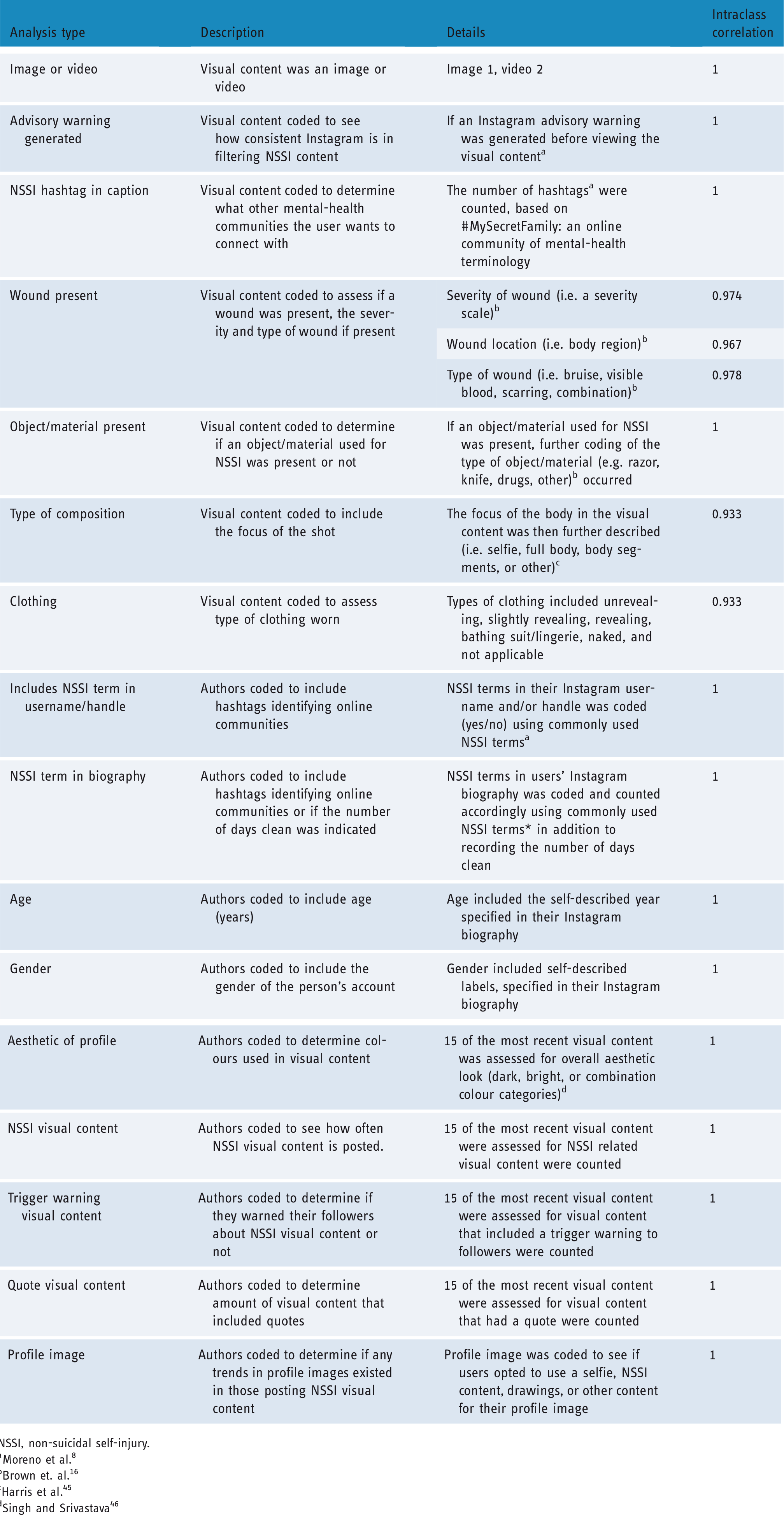
The study used a novel content analysis/coding scheme. The coding scheme was developed through a combination process of both deductive (a priori) and emergent processes. Elements of the coding scheme used in this study were based on findings from Moreno 8 around NSSI hashtags and advisory warnings, the policies Instagram has established for NSSI content, as well as wound presence and characteristics.16,19 In addition, components from Harris 45 were used to determine the type of composition, and Singh and Srivastava’s 46 work helped define the author profile aesthetics. Table 1 describes further details about the coding scheme. Emergent coding often evolves from the data and are different from the a priori codes. 47 After a preliminary review of the visual content, emergent coding was used to further develop the subcategories for if a wound was present and if an object or material that could be used for the act of self-harm was present. In addition, emergent coding also was developed for instances when coding clothing was not applicable, as well as whether coding a trigger warning was present within the visual content. Three coders, screened for NSSI behaviours using the Inventory of Statements about Self-Injury (ISAS), 48 assessed 100 links to the visual content (i.e. the Instagram user’s caption on the visual content and the elements within the visual content) individually by hand. A codebook with examples and instructions was created for the coding process. As presented in Table 1, the coders (n = 3) produced acceptable levels of agreement on all variables, based on minimum acceptable values of an intraclass correlation coefficient (i.e. 0.40–0.75). 49 Once the coders individually assessed each link to the visual content (n = 100), the coders came together to discuss and agree on an answer. The negotiated style of coding is beneficial for studies implementing new coding procedures such as the one utilized in this study. 50
Description of content analysis/coding scheme of a subsample of #selfharn images (n = 93) and unique authors (n = 50).
NSSI, non-suicidal self-injury.
Moreno et al. 8
Brown et. al. 16
Harris et al. 45
Singh and Srivastava 46
Authors’ content analysis
The study used a novel content analysis/coding scheme that was developed through a combination process of both deductive and emergent processes. Among the 100 links to the visual content, duplicate authors (i.e. Instagram user to whom the link was attached to) were deleted (n = 50), leaving 50 unique authors for analysis. Only unique authors were utilized because Instagram allows for multiple photos or videos to be shared within one visual-content post. This means the author may have had a number of pieces of visual content within the analysis due to this feature on Instagram. An additional codebook was developed to include author-specific characteristics in order to analyse the authors’ content. The Instagram handle and biography of the author were assessed for the inclusion of NSSI terms from Moreno 8 (e.g. #MySecretFamily and #selfinjuryyy), so that comparison to previous research could be conducted. Other characteristics of the authors’ account that were recorded manually included the total number of visual-content posts on their account, the number of followers they have and the number of users they are following. Furthermore, to get a general idea about the persona of the author the coders were instructed to analyse the aesthetic and content of the profile of the most recent 15 visual-content posts (i.e. pictures or videos posted by the author to their own profile; see Table 1). The authors’ content analysis was done by manually visiting the users’ profile on Instagram to evaluate the first 15 visual-content posts available. From there, the codebook was referenced to code for aesthetic and content of the profile. An in-depth author analysis was conducted on the same day, with all coders present. Coding was completed in this way for consistency, as Instagram not only allows users to edit their profiles at any time (e.g. change profile image, change handle) but their profile characteristics (e.g. number of followers and visual-content posts) is constantly in flux. Thus, for all coders to code the same author content, at a given time point, coding occurred as a group.
Results
Netlytic analysis
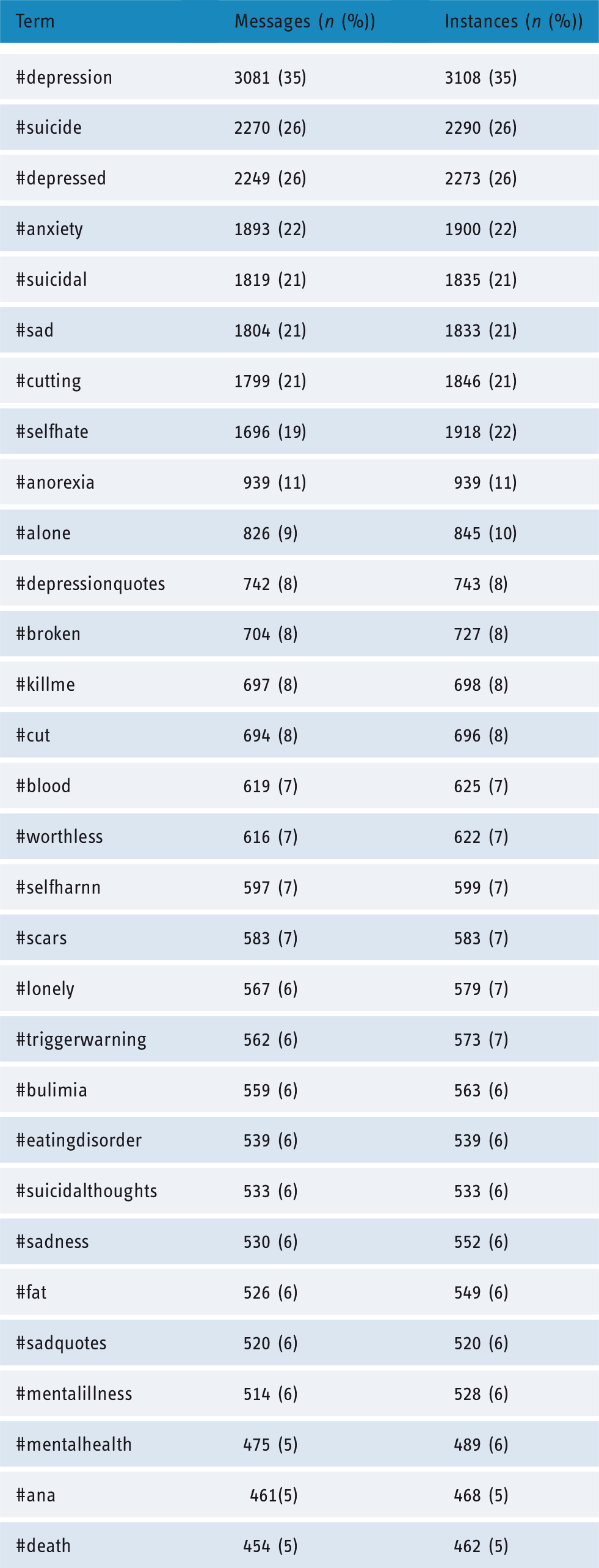
Among the 8767 records (i.e. visual content where the author of the record had used #selfharn in the caption), there were 126,716 unique, meaningful words/hashtags associated with #selfharn. The most frequent word/hashtag was #selfharn and, thus, was not included in the 30 most frequently used words/hashtags for further analysis, as it was the topic of this study. The top 30 most commonly used terms were all hashtags and are described in Table 2 with the top terms being #depression (n = 3108) and #suicide (n = 2290). When placed into content categories, the majority of the records were ‘Bad Feelings’ (52%; see Figure 1).
Most commonly used words associated with #selfharn (n = 8767).
Visual-content analysis
Beginning with 100 unique links to the visual content (i.e. the Instagram user’s caption on the visual content and the elements within the visual content), listwise deletions occurred if the account was deleted (n = 5), the user changed their handle (n = 1) and/or if the link was dead/had been deleted (n = 1). Of the remaining 93 links to the visual content, the majority were images (n = 87; 93%), opposed to videos (n = 6; 7%). Almost all (n = 92; 99%) of the links to the visual content did not generate an advisory warning. The majority of the links to the visual content had a wound present (n = 70; 75%), did not have the presence of an object/material (n = 78; 84%) and the composition resulted in the user showing only a section of a specific body region (n = 73; 79%), hence the clothing category was mainly not applicable (n = 76; 82%). Further coding details can be found outlined in Table 3.
Unique #selfharn visual-content characteristics (n = 93).

NSSI, non-suicidal self-injury.
Authors’ content analysis
Among the unique authors (n = 50), only 17 (34%) shared their age in their biographies (the mean age was 16 years, SD = 3.4). The authors had approximately 99 visual-content posts (SD = 170.9), with an average of 447 followers (SD = 1018.5) and were following 97 (SD = 218.5) other accounts. The majority of authors had visual-content posts that contained a quote (n = 32; 64%) with an average of 4.12 (SD = 4.5). In addition, only 12% of authors (n = 6) had NSSI visual content in their most recent 15 posts, with an average of four (SD = 4.5) visual-content posts per author. This means when the researchers opened the user profile to the most recent 15 visual-content posts, there was an average of four NSSI related visual-content posts per author. Lastly, only a small portion of authors mentioned ‘days clean’ (n = 10; 20%) and/or a ‘trigger warning’ (n = 3; 6%) statement in their biography. Refer to Table 4 for more details on author analysis.
Unique #selfharn author characteristics (n = 50).

NSSI, non-suicidal self-injury.
Discussion
This study aimed to use Instagram to explore the conversation surrounding #selfharn, the common properties of the visual content tagged, and the type of environments #selfharn authors were creating through their accounts. In past literature, NSSI visual-content sharing on SNSs other than Instagram was found to distract authors from engaging in NSSI behaviour and to support and encourage others struggling with NSSI to seek help.17,51 However, the current findings do not support this, 51 and as over half of the popular words/phrases associated with #selfharn were categorized as ‘Bad Feelings’ possibly suggesting that #selfharn visual content, on Instagram, are not providing a supportive and motivating environment and does not positively influence others. According to Seko 17 based on interviewing NSSI visual-content creators, those posting NSSI content on their own SNS accounts perceived it as educational and helpful to their followers. There seems to be a disconnect and unrealistic concept on how NSSI visual-content posts are being processed. Future research is needed to explore authors’ intentions behind posting NSSI visual content and the potential influence on their followers/other Instagram user’s thoughts and feelings. However, the relationship between the author and their followers can be explained through the CMC theory and CPM, 34 as the interactions between the ‘sender’ and ‘receiver’ may be strengthened but could be reinforced in a very negative way. Past studies have found that NSSI authors experienced positive social reinforcement when followers gave direct feedback (e.g. comments or likes).16,52 With the knowledge that the majority of the popular words/phrases in the current study were ‘Bad Feelings’, it can be thought that these interactions are being negatively reinforced through the feedback being received. Further exploring how the NSSI visual-content influences followers could assist in halting the feedback loop of NSSI behaviour. 22,36,37,38 In addition, making NSSI visual-content authors more aware of the impact they have on their followers may help decrease the ‘Bad Feelings’ records in future studies, as they will be able to alter the content they share with others.
The text analysis indicated that the two most commonly used words associated with #selfharn were #depression and #suicide. The current study based its text analysis coding from the study done by Moreno, 8 which highlighted several unique, ‘secret’ hashtags associated with NSSI content (e.g. to represent NSSI content, a user might use the secret hashtag #cat to not only connect with members of the NSSI community but to avoid Instagram deleting the content). It is important to note that of the text presented in Table 2, #ana was the only word that matches a term on the list from Moreno. 8 The lack of terms utilized by authors may suggest that the NSSI terms highlighted by Moreno 8 may not be tagged as frequently, and that more broad terms (e.g. #depression and #suicide) are being utilized. However, at the time of the current study, six of the hashtags in the Moreno 8 list were blocked by Instagram and may be a partial explanation for the lack of NSSI terms present. Additionally, Brown 16 discussed how it may become increasingly difficult to find all the ‘secret’ hashtags that the NSSI community is using on Instagram, as hashtags change quickly and Instagram seems to be adapting their policies accordingly. 19 The secrecy of the NSSI community online reflects the anonymous nature of NSSI in the real world, 53 and may be a reason why these hashtags develop and change so rapidly. With the quickness of hashtag modifications, Instagram may have a difficult time adapting and interpreting the ‘secret’ hashtags. However, it is promising to take note that Instagram recently recognized the dangers of these NSSI hashtags and is making appropriate changes. 19
Moreover, future research to determine which hashtags are being used to connect the NSSI community to other mental-health communities will be substantial for healthcare professionals working alongside youth. In the current study, the most commonly used words associated with #selfharn included eating disorder terminology (e.g. #anorexia, #bulimia, #eatingdisorder, #fat, #ana), words associated with mental illness (e.g. #depression, #suicide, #anxiety) and overall negative feelings (e.g. #sad, #killme, #death). Connecting a strong relationship with NSSI hashtags and certain other mental-health disorder hashtags may assist healthcare professionals in the treatment of a co-morbid diagnosis. In a clinical perspective, there have been guidelines created to assess the environment and depth of the NSSI visual content that may be helpful for identifying and treating those who participate in online NSSI.25,28
Previous literature suggests that those posting NSSI visual content feel that accompanying their post with a trigger warning is an important measure to protect susceptible ‘receivers’ (i.e. ensure followers know that there may be triggering content within the post). 17 Moreover, studies have indicated that ‘receivers’ may experience NSSI urges (e.g. cutting or restricting food intake) when viewing NSSI visual content or reading descriptions. 24,25,54The majority of authors in the current study decided not to present a trigger warning when posting NSSI visual content on Instagram. Trigger warnings were underutilized in the current study, which is consistent with previous literature regarding the use of trigger warnings in YouTube videos. 55 Further, our findings suggest that the Instagram graphic warning label was almost non-existent, even though Instagram has certain rules and regulations about NSSI content. This was observed through the lack of advisory warnings generated, where online friends are not reporting the graphic content they see in the community. Exploring the norms within these groups would be a worthwhile opportunity for future research. Instagram’s policy about posting NSSI visual content is clear that they will delete accounts that glorify NSSI and try to provide education and resources within the platform for those triggered or struggling with NSSI. 19 The unfortunate note about the policy is that Instagram can only disable accounts if the user is reported. Instagram is simply dependent on all who use the application to alert them if an account is posting NSSI visual content. Since this research was conducted, however, Instagram has become more diligent in protecting the vulnerable and has set new standards for themselves to decrease the amount of NSSI content. 19 In addition, users of Instagram have a responsibility to report accounts that may be displaying some type of NSSI behaviour. Instagram has admitted that ‘they are not perfect’ in protecting users from all graphic content and rely heavily on these reports. 19 Although Instagram should be taking ‘secret’ NSSI hashtag analyses into consideration, the majority of their actions are due to users taking initiative and alerting the application.
Similar to Brown, 16 the majority of NSSI visual content presented in the current analysis displayed wounds that were medium/large in size, presented with blood and located on an extremity. The importance of trigger warnings should be discussed once again, as normalizing the visual content of NSSI can become an issue in ‘receivers’ feeling urges to engage in NSSI behaviour.16,54 According to the CPM, if Instagram continues to not generate advisory warnings, and subsequently cannot produce a trigger warning, it could contribute to a heightened increase in motivation for users to share and self-disclose NSSI content more intensely. 36 Ultimately, the increase in sharing NSSI will contribute to more triggering visual content being produced. Even though Instagram has updated its policy since this research was conducted, the platform cannot delete every single piece of visual content or hashtag related to NSSI. 19 In addition, Instagram admits they have focused for many years on the author of the NSSI post but must consider how other users will feel and react to the content. 19 Future research should investigate how to stop the feedback loop from happening by scanning pictures for any and all NSSI-related content.
Among the authors of the #selfharn visual content, the majority identified as women with the average self-reported age being 16 years. Consistent with previous research, more women compared to men engage in NSSI activity16,55 and NSSI is most prevalent among 15–17-year old adolescents.16,56 In addition, the current study found that one user identified as ‘they/them’ in their biography. To the authors’ knowledge, no study to date has discussed the relationship between NSSI and SNS with those who identify outside of the binary gender classification of man or woman. Previous studies have discussed that NSSI may be more prevalent within the Sexual and Gender Minority (SGM; also referred to as LGBTQIA+ youth) community.57–59 Higher NSSI in the SGM community may be because compared to their heterosexual and cisgender peers, SGM adolescents will have an increased amount of stress, more psychiatric problems and an overall decreased quality of life.40,60–62 Thus, moving forward with research, investigators should take into account genders other than woman or man and draw conclusions about the differences in NSSI visual content between/across genders.
The majority of authors did not have an NSSI term in their biography or in their handle. Majority of the authors had a dark-coloured page (e.g. red and black colours), suggesting that those posting NSSI content may be trying to convey a dark, gloomy and negative atmosphere. Previous work has focused on utilizing Instagram photos to predict depression in users, 63 which findings are similar to the current study, whereby the photos posted by depressed users tended to have darker hues. Profile aesthetic should continue to be considered for future research in order to view and discover trends across authors using the same hashtags. Specifically, for NSSI hashtags, such as #selfharn, it is significant to see if authors are dedicating the entire profile to NSSI visual content, or perhaps they may have a random post about NSSI (e.g. for an awareness day or to celebrate an NSSI-free anniversary). This can help researchers determine if an author is trying to create an entire environment around NSSI and assist in comparing other profiles using ‘secret’ mental-health hashtags (e.g. #ana) to those using NSSI hashtags.
Additionally, authors did not seem to have a profile ‘selfie’ (e.g. a picture of themselves using a forward-facing camera), but rather had drawings, quotes, or flowers to represent their profile picture. It should be noted that based on the methodology used in the current study, the coding was subjective, and coders were unable to identify if the author was sharing content of their true self. The idea that authors tend to be anonymous (i.e. do not have visual content that confirms their identity), is consistent with current research. 16 Furthermore, the idea of anonymity supports the CMC theory, as online friends will self-disclose, in this case about NSSI, more often than those who use face-to-face communication.21–23 Future research should continue to focus on the interaction that occurs between the ‘senders’ and ‘receivers’ of NSSI visual content, as the relationships between authors could be dangerous and unhealthy.
Although this was one of the first studies to examine the conversation and environment among #selfharn visual content and authors posted to Instagram, this study is not without limitations. Firstly, the study’s sample of #selfharn visual content at the time of data collection was very small compared to the vast number that are published in the online world. A larger sample size may have been valuable to the authors to create more conclusions compared to the small sample size used. However, coding was completed by hand and was deemed manageable and supported by previous literature with similar methodology. 8 For future studies, collecting visual content at different seasons and over a longer period of time may be more appropriate. Second, the number of unique authors was a small sample, and it may be worthwhile to investigate gender differences, by using a larger sample size as further understanding of gender diversity may be possible in helping draw conclusions about online NSSI activity in the SGM community. The research was also limited to public profiles, and there may be even more NSSI content occurring in private accounts. The anonymous nature of those engaging in NSSI leads the authors to believe that this is a possibility, and something that may be valuable to evaluate in future research. From previous research done with the hashtag #depression, it has been found that SNS users may delete posts due to negative comments or make their accounts private so others are unable to locate them. 64 The behaviour of anonymity has been consistent with other online mental-health research and leads the authors of this paper to believe that it is not unusual for authors to make their public profiles into private accounts. Finally, analysis of the #selfharn visual content was limited to the attributes and dimensions coded. Future research should aim to distinguish the extent to which those who post with the an NSSI hashtag are doing so because of their self-harming behaviour or bringing awareness and resources to others to help with NSSI recovery. In addition to this, Netlytic cannot identify the sentiment of online conversation. This limits further understanding of feelings between users (e.g. empathy for another user). Further research that wishes to replicate the current study could possibly examine a number of other dimensions (e.g. completing more in-depth coding by hand to include the sentiment of conversation, and whether the interaction is supporting or deterring the behaviour) and explore meaningful differences between visual-content captions and comments within the post.
Overall, this study suggested that #selfharn visual-content posts are associated with ‘Bad Feelings’, graphic wounds and authors who were women. The CMC theory and CMP were found to be strengthened within the context of NSSI, as the interaction between ‘sender’ and the ‘receiver’ were negatively reinforced. Moving forward, Instagram has a challenge to be more aware of ‘secret’ NSSI hashtags, and although hashtags are constantly changing/emerging, it is up to Instagram to encourage users to report profiles in order to establish more content warnings. It is believed that the current findings will assist clinicians and health professionals in understanding the type of visual content that is available to vulnerable individuals experiencing NSSI, and help may help promote strategies/awareness when seeing this content online.
Footnotes
Contributorship
JF, SD, and EO researched the literature and conceived the study. JF lead in the data collection, analysis, and writing of the manuscript under the supervision of SS and SW. All authors reviewed, edited, and approved the final manuscript.
Declaration of Conflicting Interests
The author(s) declared no potential conflicts of interest with respect to the research, authorship, and/or publication of this article.
Ethical approval
Not applicable.
Funding
The authors received no financial support for the research, authorship, and/or publication of this article.
Guarantor
SW.

Peer review
This manuscript was reviewed by reviewers who have chosen to remain anonymous.