




Abstract
Background
Self-harm behaviour is prevalent among young people and online communication about self-harm is frequent. These online communications are associated with potential harms and potential benefits. To date, few studies have explored the motivations and mechanisms involved in youth online communication about self-harm.
Objective
This study aimed to explore why young people communicate online about self-harm and the perceived benefits and harms of these communications.
Methods
Twenty young people aged between 18 and 25 years completed an online interview. Interviews were audio recorded and transcribed verbatim. Thematic analysis was used to identify themes.
Results
Four main themes are reported: (1) crossing from offline to online—the double-edged affordances of social media: young people engaged in online communication about self-harm because they were unable or unwilling to speak about their experiences in offline contexts. Online spaces afforded anonymity and peer support, which were associated with benefits and harms; (2) user-generated is not quite the same as user-resonated: perceptions were influenced by whether the young person created or viewed or responded to the content. Written and visual content had pros and cons; (3) it's not just you, it's mostly me—individual characteristics influence perceptions: age and mental state influenced perceptions and behavior; and (4) beyond individuals—parameters are protective: leadership and platform policies and procedures aided safety.
Conclusions
Online communication about self-harm is neither entirely helpful nor harmful. Perceptions are influenced by individual, social, and systematic factors. Evidence-based guidelines are needed to increase young people's online self-harm literacy and help them build effective communication skills to buffer psychological and potentially physical harm.
Introduction
Self-harm, which can be defined as any act of intentional self-injury or self-poisoning, irrespective of motive or suicidal intent, 1 is common among young people. The term young people is used to describe those aged between 12 and 25 years and includes the adolescent developmental stages and young adulthood.2,3 Adolescence is the peak period of onset for self-harm behavior, 4 and rates of self-harm are increasing, particularly among young females.5,6 Self-harm is a complex and nuanced behavior, which is reflected in its unselective association with several mental disorders as well as its presence without psychiatric comorbidities,7,8 debate about its classification as a standalone disorder,9,10 and the several theories that have been proposed to explain its initiation and maintenance.8,11 In addition to direct problems, self-harm is associated with a range of adverse outcomes including increased risk of future suicide. 12 Despite this, young people do not always seek help or engage in clinical care, with public and self-stigma and associated fear of discrimination and other negative consequences frequently cited as barriers. 13 Indeed, it is known that self-harm is highly stigmatized and that common misconceptions such as it being an attention-seeking, manipulative, transitory, teenage, or female behavior may result in discrimination including in the context of healthcare services. 14 Related to this, the discourse and language surrounding self-harm stem from models of infectious disease, for example, terms such as contagion, relapse, and recovery. All of which serve to perpetuate self-harm stigma and discrimination against the people who engage in it. 15
As such, generally, young people prefer to seek support from their peers rather than professionals.16,17 One way that young people communicate with peers about self-harm, including to express themselves and seek information and support, is via online platforms. Several reviews have shown that online exposure to, and communication about, self-harm is associated with both potential risks and potential benefits for young people.18–25 Potential harms include the promotion of self-harm, increased self-harm urges and behavior, the sharing of self-harm methods, or rivalry among users. In contrast, potential benefits include opportunities for self-disclosure, providing and receiving social support, curbing self-harm urges, and using online sources as an alternative to self-harming.18–25
To date, only a handful of qualitative studies have explored how and why people create, view, and interact with online content about self-harm,26–30 and, of these, only three have focused on young people.27,28,30 These studies identified that for the most part people who go online to communicate about self-harm are already engaging in self-harm behavior and initiate and maintain these communications for both self-orientated (e.g. knowledge acquisition and self-expression) and social reasons (e.g. to connect with similar others and exchange support26–30). Importantly, one of these studies also identified that content that has traditionally been considered unsafe and harmful such as graphic photos depicting wounds can be used to elicit care and can be helpful to the content creator. 28 Although these studies provide valuable insights, the qualitative literature is currently limited, and we still do not understand the intricacies of these communications nor the factors that influence perceptions of helpfulness or harmfulness.
In response to some of the risks and harms associated with online communication about self-harm, most social media companies have developed policies and procedures to restrict potentially unsafe content on their platforms. These include removing, hiding, or blurring self-harm content via reporting functions and content moderation. Yet, these are not always reliably implemented by the platforms and are not necessarily user-informed, and many young people are unaware such features exist. 31 Some young people also seek ways to circumvent restrictions by using coded language and maneuvering hashtags to avoid being detected and flagged (e.g. “selfharn” instead of “selfharm”) or migrating to more obscure platforms.23,30,32,33 Furthermore, censoring content and blanket bans and regulations can be harmful to creators as well as viewers .19,34
One strategy to ensure that young people feel equipped and able to keep themselves and their peers safe online is to better educate them about how to safely communicate online about self-harm and what safety tools and functions are available to them within the platforms that they use. This approach has been adopted by the #chatsafe suicide prevention program. 35 #chatsafe encompasses the world's first evidence-informed guidelines on safe online communication about suicide, co-designed suicide prevention social media campaigns, online postvention responses, work in schools, and associated materials such as resources for bereaved communities, educators, and parents and carers.35–37 The social media campaign has been preliminarily shown to be a safe, acceptable, and beneficial universal and selective youth suicide prevention intervention. 38 A randomized controlled trial is currently underway (database, ANZCTR; trial registration number, ACTRN12622001397707). Nonetheless, a key gap of #chatsafe is that it currently focuses solely on suicide and does not provide any guidance on how to safely navigate online communication about self-harm.
The current study aims to explore why young people communicate online about self-harm, the perceived harms and benefits associated with these communications, and what factors influence how experiences are perceived. The findings will inform an updated and expanded version of the #chatsafe guidelines, which will include guidance on how to safely communicate online about self-harm as well as suicide.
Methods
Research design
This study employed a qualitative design that utilized one-on-one online interviews with 20 young people.
Recruitment
Young people were eligible to take part in this study if they: (1) were aged between 18 and 25 years inclusive, (2) had lived experience of self-harm, (3) had proactively or reactively communicated about self-harm on at least one social media platform in the past 6 months, (4) lived in Australia, (5) were proficient in written and spoken English, and (6) consented for their interview to be audio recorded for accuracy. Young people were excluded if they did not meet one or more of these criteria.
Participants were recruited via organic and paid advertisements on Instagram and via the #chatsafe email list, which contained the emails of all the young people who had taken part in a #chatsafe co-design or consultation workshop. 37 All potential participants were provided with a summary of the study. Those who were interested, were asked to follow a link to an online survey hosted on Qualtrics. The survey contained an eligibility screening measure and downloadable Plain Language Statement and Consent Form. Young people who were eligible and consented to participate were asked to provide basic demographic information and complete a Wellness Plan. 37
The age range between 18 and 25 years was selected for safety and practical reasons including meeting Orygen's definition of young people, obtaining ethical approval to conduct an online study during the COVID-19 pandemic and associated lockdowns, and forgoing third-party consent. Although the participants were young adults, their interview responses were not only focused on their current experiences, but also included reflections on their past experiences and adolescence.
Participants
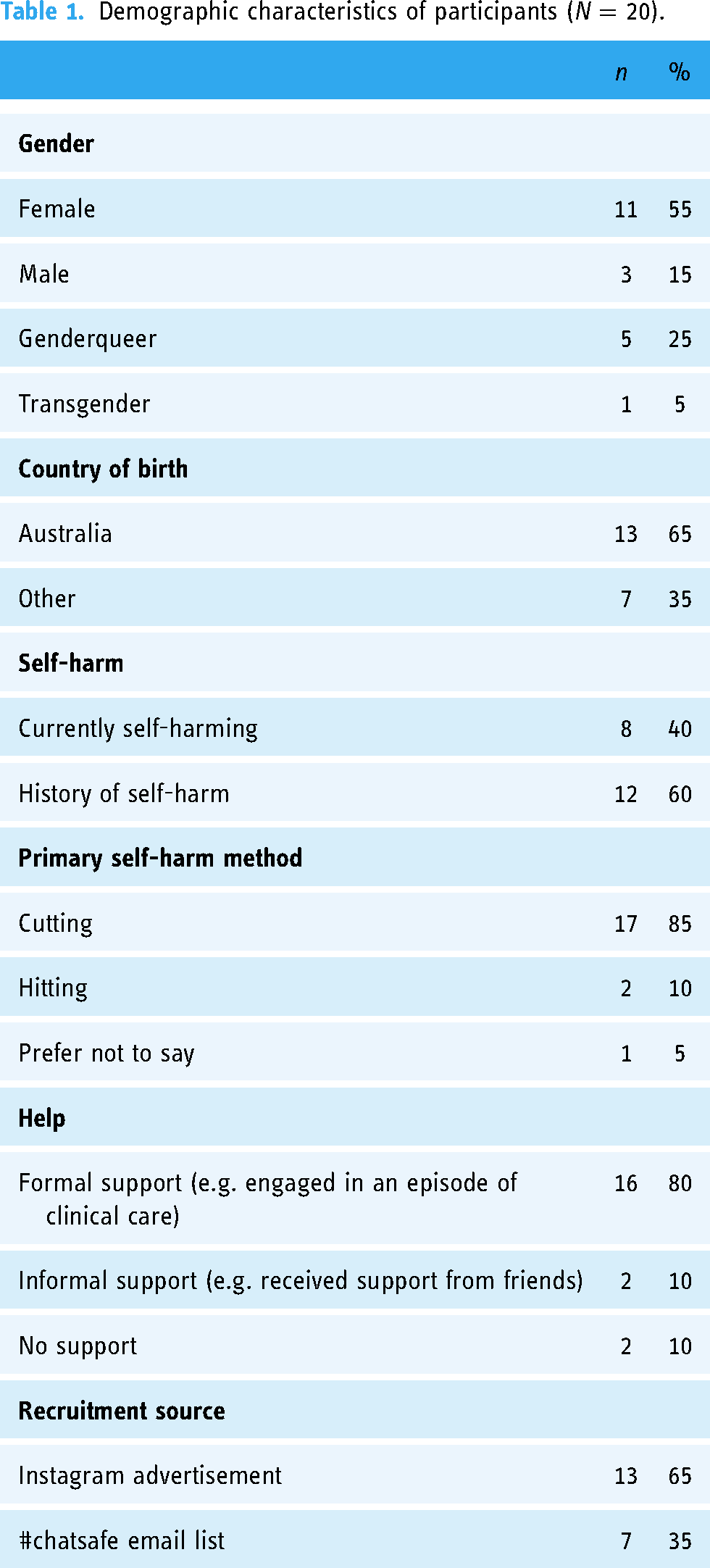
The final sample comprised 20 participants aged between 18 and 25 years (M = 20.55, SD = 2.01 years; see Table 1).
Demographic characteristics of participants (N = 20).
Data collection
The semi-structured interview schedule (see Supplemental Multimedia Appendix 1) was developed by PT and JR. Although interviews were semi-structured, all questions were asked in each interview.
Interviews were conducted on Zoom between November 2020 and February 2021. They lasted between 30 and 90 min (average time was 64.4 min), with only PT and the participant present, except in one case where a participant felt more comfortable being accompanied by their partner. Interviews were audio recorded and transcribed verbatim.
Participants were reimbursed AUD$15.00 for completing the demographic information and Wellness Plan and an additional AUD$30.00 per hour for participating in the interview.
Ethics
This study received approval from The University of Melbourne Human Research Ethics Committee (ID: 2057308). There were no adverse events reported.
Data analysis
All 20 transcripts were analyzed by lead author, PT, using thematic analysis as per the six-phase process outlined by Braun and Clarke (2006, 2022). An experiential and semantic approach was taken, and themes were predominately generated inductively; however, a degree of deductive analysis was employed to ensure that codes were meaningful to the research aims. First, PT immersed and familiarized herself with the data and considered the breadth of experiences by reading and rereading each transcript. She then coded the entire dataset, line by line, for pieces of information were relevant to addressing the research aims. Twenty percent of the data was double-coded by LLS using the initial coding frame developed by PT; there were no notable coding differences. PT then collapsed codes and identified candidate themes. Throughout this process, PT met with LLS and SH to debrief and discuss codes and potential themes. Final themes were reviewed and refined by PT in consultation with JR. Trustworthiness of the findings was established by these iterative discussions with LLS, SH, and JR, independent review by SR and ML, and acknowledgment and reflection upon all analysts’ experiences, values, and biases.
Results
The findings from this study underscore online communication about self-harm is variable and neither entirely helpful nor harmful. Based on participant responses, benefits and harms associated with online communication about self-harm are influenced by individual, interpersonal, and social factors, as well as systematic factors such as the policies and practices of social media companies. To describe these influences, four themes and two subthemes were identified. These are presented in Table 2 and described in more detail below. Data extracts have been used illustratively to provide examples of analytic points.
Summary of characteristics for each theme.

Theme 1: Crossing from offline to online: The double-edged affordances of social media
Most participants were already self-harming when they went searching for self-harm content or self-harm communities on the popular platforms that they already used. They wanted to obtain information and exchange support with similar others, quickly and easily, in a non-judgmental environment. However, individual motives were dynamic and diverse and could be adaptive or maladaptive. Participants were unable or unwilling to engage in offline conversations due to anticipated and experienced negative social experiences and perceived burdensomeness: I was afraid if I talk about it with my family, they would react negatively…and the situation would get worse… Even with my closest friends, I was still really afraid. I was scared I was like burdening them… like my biggest motivation for communicating online is still like vent things out… somewhere where other people can see and acknowledge it. It sort of brings some relief to me… (P7, aged 20 years)
…in the past when it was more a negative thing… I wanted to find other people who were doing maybe the same. Whereas now… it's more looking for people who've been through similar experiences and are doing better or are past that stage in their life… in the past there were things like Pinterest… there was Tumblr… Whereas now, it's more things like Instagram or TikTok. It kind of depends on the social media that's popular…If [there's] a way to message other people, then it can be used to talk to other people about those things… if it's like TikTok or something, it's more like videos about things, so you're just consuming rather than talking to other people about it… (P1, aged 19 years)
Subtheme 1.1: The anonymity paradox. Participants reported that the anonymity offered by (some) platforms provided a sense of privacy (especially from parents) and impunity, which allowed them to be less inhibited, communicate freely, and feel seen and heard. However, they could quantify the level of engagement with their posts (via metrics), which could reinforce unhelpful thoughts and negative emotions: …you have insights as to how many people you reach…you have an idea how many people can look past your stuff… nobody really cares even though you want to believe that there is a lot of people, but there's only a few very selected people who actually care. (P8, aged 21 years)
Impersonality was unhelpful to those receiving and providing support. Posters questioned whether unfamiliar responders were emotionally available or genuinely cared and preferred meaningful responses from familiar others. Reflecting this, participants were more likely to respond to a user whom they were already familiar with. They also found it easier to construct responses when they had more information about the user and their story. Overall, both posters and responders preferred phone calls, video calls, or offline discussions over text-based communication: …A video call is a bit better than just text…you can see the person telling you and their expressions and things like that… [as a responder, it] takes a bit longer to reply in text, because you have a bit more time to think about your words. So, it's easier in [that] aspect…you're making sure you're not saying anything wrong, but if it's in-person, you know it's a bit more personal… For the receiver…having someone there, seeing their face and expressions and knowing that they're taking time out of their day to actually be there and help you is a lot more useful… (P13, aged 18 years)
Subtheme 1.2: The peer support paradox. Participants reported that interactions with similar others could easily (and quickly) shift from being beneficial to being harmful. Benefits included provision of information and support (e.g. coping strategies), encouragement of help-seeking, modeling how to safely speak about lived experience, and reinforcement of adaptive behavior and achievements. Self-disclosure was cathartic, and validation from others was helpful. It was enjoyable to view humorous content that was created by others who had lived experience: I got sort of a small community of people who understood exactly what I was going through and when I said stuff like, I’m really feeling the urge right now. They were like, okay this is something that you can do. So, they kind of helped me and we celebrated milestones together so when I went one month, I commented and they were like, that's amazing… It made me feel better and it made me feel as though I could actually…recover… I’m not alone…Humor is a must… [A poster with lived experience] would do a series about self-harm strategies to recover. Sometimes she would do one about stupid excuses to give to people when they asked about your scars, and I found that really funny. It made it less shameful… it's bad but when you put some dark humor to it, it's not as bad as what it looks like. Recovery is possible. Sometimes you forget that. (P18, aged 21 years)
Online peer support had limitations. Participants struggled to respond when they did not fully understand the motivations of the poster and they lacked the knowledge, skills, and confidence to effectively navigate conversations including communicating boundaries and exiting, which was compounded by the lack of time constraints and easy and unlimited access to others in online environments. Responder distress increased when the poster impressed as emotionally dysregulated or communicated in an aggressive manner. Similarly, posters felt worse when a responder could not tolerate or effectively respond to their thoughts, feelings, and behavior: …I’m obviously not a psychologist and when I did tell them…you should seek professional help, they would go, no, I can’t, no, I can’t. Then they would constantly be messaging me, or if I didn’t message them fast enough, they would say that it was my fault, or that they were going to kill themselves… she messaged me saying, like you’re the only person I have to talk about this, you can’t leave me…I don’t want that on my conscience. I could never live with that if they did end their life because I wasn't there for them…I was losing sleep and I was in school, so I did see a drop in my work ethic, just because I was constantly worried about this one person. So, yeah, I eventually just told them you need to see a psychologist, I’m not the person to talk about this with and then I just blocked them. (P6, 18 years)
Problematically, self-harm experiences could be compared when communicating with similar others, with the effect of minimizing or invalidating milder injuries or situations, which, in turn, could lead to the worsening of self-harm, as well as the deterioration of general mental health. Viewing the deterioration in mental state of others was also distressing: At first, you think this is great because they understand me and they get me, but also, they have the same issues as you… it can become that echo chamber or thoughts and feelings that just you can't escape from…it kind of feels like a competition of who's had it worse? Who cuts deeper? Who hurts themselves worse? (P5, aged 19 years)
Online communities could turn into echo chambers where normalization and validation of self-harm could become collusive and social connectedness could be contingent on continuous self-harm behavior. As such, the community could inadvertently encourage and reinforce self-harm, and, thereby, impede recovery: …I was locked into that kind of community where self-harm was the main identity, the only way that I could maintain that empathy and understanding was if I continued posting that or self-harming and engaging in that… it was conditional in that I had to almost continue to conceptualize myself as broken in a way in order to get that connection from those specific people.’ (P11, aged 22 years)
Theme 2: User-generated is not quite the same as user-resonated
Written and visual content served different functions for posters. Posting text was considered less impulsive (than posting photos or videos), words could be considered, and detailed and contextualized narratives could be provided. Posting photos was considered easier, and users did not need to find the words to describe their experiences or directly ask for help: Sometimes [posting a photo] felt like the easiest way to reach out for support. Rather than having to try and explain all these feelings that I could hardly put into words, it was like, well, it's right there. These other people [in the community] seem like they're going to understand that … Maybe a couple of messages asking how I was and that was enough for me to justify doing it at the time.’ (P2, 18 years)
Written and visual content had different effects on, and functions for, viewers and responders. The extra information in text posts, including captions (on photo posts), helped responders consider and construct their responses. However, the text could be distressing for responders because they could be overexposed to details and overidentify with the poster because the text lacked identifying features such as someone's voice or face: Sometimes reading things…I read it sort of in my own voice, because I don’t know who the person is that's saying it, so I don’t hear their voice. It's sort of like I read it and imagine that it's me. So sometimes, like words can have a very powerful impact, so I find that sometimes reading things hits maybe a little bit closer to home because I sort of read it as if it's myself. (P17, aged 25 years)
Viewing graphic photos of wounds and scars could be distressing and was associated with identification, comparisons (both upward and downward), and inspiration. Wounds, regardless of how they were presented, due to their gory nature, evoked a stronger visceral reaction than scars (e.g. fear and disgust), and images could mentally linger. Viewing graphic video content was considered particularly distressing. Problematically, these videos were noted to be the most spreadable type of content. Videos depicting distressed people crying and talking about their thoughts about self-harm were also distressing but were not associated with increased self-harm urges or behaviors. In contrast, viewing scars that were covered by tattoos was not considered harmful per se: …it's very, very triggering for me to see other people's scars and other people's wounds… it kind of feels like a competition of who's had it worse? Who cuts deeper? Who hurts themselves worse? Kind of makes you feel invalidated… (P5, aged 19 years)
… she would go on livestreams and basically be a hysterical mess and have her items of - tools, I suppose, that she would use to self-harm, ready to do so… it's very triggering and very upsetting… you’d have some people that would post chronologically what they were doing…it's quite concerning… [some] post an image or a story that could be them crying hysterically and sobbing and talking about them wanting to harm themselves … that can also be triggering as well. (P20, aged 24 years)
I think with the tattoos covering self-harm scars, I actually find that quite beautiful. I also see that as potentially an opportunity for inspiration… It can help give people confidence…. (P17, aged 25 years).
Theme 3: It's not just you, it's mostly me: Individual characteristics influence perceptions
Participants reported that their mental state influenced their perceptions. If they were experiencing mental health problems and already feeling vulnerable, viewing graphic self-harm content, or responding to others, could be distressing and exacerbate their own difficulties. They noted that viewing stories of help, hope, and recovery, in any format but particularly videos, while they were feeling distressed was “comforting” (P17, aged 25 years) and “encouraging” (P17, aged 25 years): …there sometimes reaches a point where one person can't help the other, but it's very difficult to say “hi, I'm sorry, I can't help you right now because I'm dealing with my own thing” … I think people need to know when they've reached their own limits for dealing with or talking with people about their problems because none of us are trained therapists. We're just people. We have to be careful of our own thoughts and feelings. There have been times where I've been trying to help people talk through them and it's started making me feel more distressed. (P10, aged 20 years)
Participants reported that age also influenced perceptions and behavior. Younger adolescents were at higher risk of being harmful to others and harmed themselves. Participants noted that on reflection, when they were younger, they often did not have the knowledge, skills, or confidence to decline entering or withdrawing from difficult interactions. They also did not have the insight to recognize their increased vulnerability. Younger adolescents were perceived as behaving harmfully in public spaces when they were emotionally dysregulated , disclosed too much, and could not recognize the negative impact their behavior had on others as well as the adverse social consequences for themselves: …I’ll say kids in particular, like younger people, have a tendency to say stuff carelessly without any regard for how it can affect people and… just continue saying stuff that make people uncomfortable… They’re trying to maybe vent or try and relieve some of their emotions, but they just keep going and it's emotionally draining for other people… they haven’t reached the emotional maturity to understand that it has that effect on other people. Because all they can think is it hurts me, and I need to deal with it in some way. Which is also partially why I tend to avoid any communities with younger people. (P14, aged 23 years)
…it was a lot for my friends who were following me. I didn’t really realize that until I had one of my friends…kind of be like hey, I’ve had your page muted for a while because every other post is just like how bad you feel and it’s really—it’s not constructive to anyone around you… It kind of seems very attention-seeking…I cried the entire time because that's the last thing that I wanted to do to people. I had no idea until someone told me that that was the effect that it was having on people, and I just felt so awful and so guilty… (P5, aged 19 years)
Theme 4: Beyond individuals: Parameters are protective
Participants reported that rules and regulations absolved them of complete personal responsibility and could be protective. They liked reporting tools and supported the removal of unsafe content by platforms; however, it was noted that blanket bans were unhelpful. For example, the removal of content that depicted but was not focused on self-harm scars could be distressing for the poster and viewers with lived experience, as well as inadvertently perpetuate existing stigma and discrimination: I follow one Instagram user who has a lot of self-harm scars… Instagram will flag her content as graphic… To someone who's going through the process of recovery… that's really hurtful … Saying her picture of herself, if she doesn’t photoshop out all her scars is not suitable for the platform. It's like how are you meant to destigmatize mental health when you are literally censoring people who are trying to showcase their recovery and prove that you can get better? (P14, aged 23 years)
Participants noted that platform policies and procedures needed to become more sophisticated by considering context and offering personalized experiences, for example, allowing the user to comment on why they were reporting the content and hiding the content from public view rather than deleting it altogether. They also believed it would be helpful if users whose content had been reported or removed received a tailored explanation, relevant psychoeducation, and links to support services: … it's important to have that option to report something… I think it's helpful if maybe the person can write why that's upsetting them instead of just flat out reporting it… otherwise then it makes it sort of hard to reflect on these things. Are people getting upset because it's just something they don’t want to see or they don’t like it, or is it getting reported because people genuinely find it triggering or upsetting? … You’re the person who's using the platform and if they think that you’re doing something that could harm others or that breaches their sort of terms and conditions, then I think they have every right to remove content that is better not there to help the greater good. (P17, aged 25 years)
…I’d have been less angry if the message was less automated…[and was] more like… hi, someone reported your post because they found it upsetting. Our mods wanted to check in on you or this post has been privated…so only you can see it… because it’s against our community guidelines, things like that rather than just this is reported, it’s gone now, screw you… (P5, aged 19 years)
Participants liked leadership in online communities. For example, it was helpful to have moderators who set, communicated, and upheld clear rules. Moderators were considered harmful when they abused their position of power or were ineffective at managing the community. Online environments without any management or that had bad management were more likely to be harmful: Whereas with the bigger [self-harm] groups where there was like maybe 100 people, those had moderators… admins… So, they were the people who you could go to… [and say] hi, this person is saying something that I don't think is appropriate and then they would talk to that person and say, hi, we’ve had some complaints that this is making people uncomfortable, we’d like for you to not say that. So that it's not like a confrontational process… Sometimes it's easier to have someone who is kind of in charge to be able to talk to those people… People usually were very respectful of the moderator and say, oh I’m sorry, I didn’t mean for this to offend anyone or cause any problems, I’ll stop. That's why they were usually such good communities. There were a couple of communities that were really bad… moderators would start fights with people or cause trouble. I remember one particularly bad one where the moderators were just straight up bullying people. Those are the ones that you just leave because there's nothing you can do and it's not safe. (P10, aged 20 years)
Discussion
Principal results
The findings from this study support the notion that online communication about self-harm is neither entirely beneficial nor entirely harmful. Further, what is helpful for one young person may be experienced as unhelpful for another. Our findings expand the incipient qualitative literature and offer some insights into the factors that influence online communication experiences, perceptions, and impacts.
There is a delicate balance between what is helpful and what is harmful. Each potential beneficial factor appears to be accompanied by an opposing or parallel potential harmful factor. Most of these factors are not fixed, but variable, and depend on which side of the interaction the young person is on (creator versus viewer or responder), the type of content, the relationship between people, and the person's age and mental state at the time of communication.
Preferred pathway to information and support
Our findings echo previous studies that have found that most people who communicate online about self-harm are already engaging in self-harm behavior offline.28,30 Participants reported that they used the platforms they were already using to communicate about self-harm, rather than seeking out alternative platforms for the specific purpose of communication about self-harm, and they did so because they were unable or unwilling to communicate about self-harm in their offline worlds. This was expected, as it is widely known that young people are generally reluctant to seek formal help for mental health, particularly for self-harm, 17 and when they do engage in professional care, the experiences can be negative. 39
As with previous studies,26–30 participants in the present study reported actively initiating and maintaining online communication about self-harm for both self-orientated reasons and social reasons. Online communication provided some unique benefits that were not available in the offline context . For example, online communication provided a real-time and accessible means of exchanging information and support; this has been demonstrated previously in the suicide prevention literature 40 and appears to also apply to self-harm. Online communication was appealing to young people as it reduced the risk of invasions of privacy by concerned or curious parents, including non-consensual formal care, and came without judgment and stigma. Again, it is known that online help-seeking is attractive to young people because it allows for easy and immediate access to information and support for sensitive topics such as self-harm while simultaneously preserving anonymity, privacy, autonomy, and control. 41
Online interactions appeared to help people in their offline worlds. For example, through their online experiences, participants learned how to better express themselves and were encouraged to engage in offline formal support. This bridging and gateway effect has also been found in the literature focused on broader mental health, which suggest online interactions provide an opportunity for observational learning and are associated with improved communication skills and increased offline help-seeking in a staged manner, particularly for stigmatized topics and among marginalized populations.42,43
Given that social media appears to be the preferred, and in some cases, the only pathway for information and help-seeking, it is pertinent to destigmatize self-harm in online spaces and upskill young people to safely express themselves and effectively respond to others rather than prohibiting these communications.
Subjectivity
Reflecting the findings from recently published reviews,18–25 our findings suggest that online communication about self-harm has distinct harms and distinct benefits, but the phenomenon is variable and cannot, in and of itself, be viewed as purely helpful or harmful. Indeed, our findings, like those of Brennan et al., 19 imply that the impact of online communication about self-harm should not be separated from the complex interplay of intrapersonal, interpersonal, and environmental factors in which it occurs. Many of our participants indicated that one of the key intrapersonal factors that influenced their perceptions and, therefore, their experience of online communication was their own mental state at the time of communication, as opposed to solely the nature of the content they were exposed to.
Aligning with the findings by Lavis et al., 28 our study found that content created as a “cry for help,” and, therefore, an opportunity for intervention, was not necessarily received well by viewers. Indeed, this type of content was often image or video-based and posted at a time of crisis. As such, it was not carefully considered or well curated and was often found to be distressing by those exposed to it. Perhaps, during moments of emotional crisis, young people are unable to find the appropriate words to effectively express themselves and consider the consequences of their online behavior. Therefore, they may resort to relying on visual communication as it is more reactive, effortless, and immediate than textual descriptions. Moreover, many young people post photos and videos of everything in their lives, which is reflected in the popularity of image-based platforms. For young people, this behavior is commonplace, intuitive, and possibly indiscriminate. By contrast, written texts, which were noted as being cathartic and reflective but editable for creators, were more commonly retrospective in nature and presumably written when the crisis had passed. Written text in the form of captions that accompanied images also seemed to be more well-received by consumers.
While videos were often considered to be the most harmful type of content, they were also identified as the most popular because they are engaging, comprehensive, and comprehendible due to the combination of subject matter, visuals, and sound. And, therefore, videos are potentially the best medium to deliver and consume helpful information. This aligns with the popularity of platforms that afford video content, and although research is limited, other new studies also show that creators use video-based platforms such as YouTube to share their self-harm recovery stories with large audiences 44 and that this type of content is promising. 45
One area where participants unanimously agreed was that instructional video content that depicted the process and outcomes of self-harm methods was unsafe and harmful, and they could not think of any circumstances in which this type of content would be helpful. Perhaps aversion to content focused on self-harm processes, which are inherently graphic, is intuitively linked with contagion, which is one of the most frequently identified harms of online communication about self-harm.18–25 However, at present, there is a lack of research on self-harm videos or live streams and no theoretical models to help us understand these behaviors and their impacts. In the suicide literature, harmful effects associated with media reporting of suicide such as contagion are linked with the Werther effect, which is based on the suicide of the protagonist of Goethe's novel The Sorrows of Young Werther (1774) and posits that exposure to suicide and suicide stories can lead to imitative suicide acts. 46
However, reporting style can be modified and improved and have an educative and preventative effect when adaptive strategies to cope with problems are presented. This is explained by the Papageno effect, which is based on a character from Mozart's opera, The Magic Flute (1791), who refrained from on acting on his suicidal ideation after speaking with his friends and learning alternative coping strategies to manage his distress. 47 Consequently, media guidelines were developed on the safe reporting of suicide to educate reporters, 48 and studies have found that media reporting can indeed have positive and negative effects related to the information portrayed. 49 We acknowledge that the term contagion can have negative connotations and is rooted in infectious disease models; however, at present it is the term used.
Finally, age was reported to be an important individual factor, with participants reporting that younger users were more likely to post unsafe content and perceive content negatively. This may be linked with increased reactivity, increased impulsivity, and lack of experience during adolescence.50,51 Clearly, psychological mechanisms are at play when creating or viewing and responding to content, and nuanced and age-appropriate guidance is needed to cater to the multifaceted needs.
Peer support
Another factor influencing the online experience was the exchange of social support and the interpersonal relationships and dynamics between users, which came with opportunities and challenges for both support providers and recipients.52,53 Despite the benefits of anonymity, participants reported that they were more likely to provide support to a user with whom they had a personal relationship. They also preferred to receive support from someone they had a personal relationship with, and that support from familiar sources was more effective. Moreover, while social media was easily accessible, it also created an unbounded space and the pressure to always be readily available.
Peer support is increasingly recognized as an important component of mental health care,54,55 and young people have previously noted that both providing and receiving peer support were unique benefits of online communication.40,56 However, self-harm is complex, and participants in the current study reported that although they wanted to support their peers, they often became distressed and felt responsible if the individual's mental state deteriorated and their level of risk increased. This was compounded when the young person providing the support was already feeling vulnerable or experiencing similar issues themselves. In turn, as recipients of support, participants felt their needs were at best only partially met, and they often felt unsatisfied and frustrated after the interaction. This effect has been found in other studies where recipients of support felt better after the interaction, whereas providers of support felt worse. 57
One way to ameliorate these effects may be for people creating content to provide context and where possible explicitly state their motivations and needs when they post. However, this may not be realistic for people posting during a crisis. This speaks to the importance of social media companies building features into their platforms that cue their users. It also speaks to upskilling young people on the availability of such social media features and how they could safely respond to their peers including how to sensitively communicate limits, exit conversations, and refer to qualified formal sources of help.
Othering at the user level
Interestingly, while attempting to avert negative evaluations offline and despite the perceived anonymity and inclusivity associated with online environments, participants still encountered judgment and exclusivity online. Social norms in some communities appeared to facilitate both internal and environmental hierarchization of self-harm in public spaces and private messages. In some cases, those who were appraised to have easier lives and less severe injuries felt attacked or bullied by others. Moreover, access to, and, therefore, belonging to, a community was contingent on continued self-harm. Social inclusion and connectedness are traditionally protective against self-harm 58 ; however, in these unregulated environments, these factors could become positive reinforcers and maintaining factors of self-harm. As aforementioned, most participants reached out to people online for support because they were unable or unwilling to disclose their self-harm to people offline, partly due to stigma and a poor sense of belonging and partly for fear of burdening others. Both thwarted belongingness and perceived burdensomeness are known risk factors of suicide, 59 and young people who self-harm are often already at greater risk of suicide than their peers. 60 This speaks to the need to educate young people and destigmatize online communications about self-harm, thereby, increasing the safety of online spaces and potentially reducing risk profiles.
Othering at the systematic level
Young people were largely supportive of social media companies showing leadership in maintaining safety in their online communities, and this included the different reporting features and content removal or blurring policies and procedures. Partly because they provided some containment in an otherwise uncontained space and partly because it reduced the burden of personal responsibility. However, participants also noted that this could contribute to othering. Flagging or removing self-harm content could be harmful to creators as well as other users by serving to further stigmatize self-harm, compromise a safe space for expression, and reduce the likelihood of future help-seeking.
Responses were also mixed when discussing the reporting and removal of content depicting self-harm scars. On the one hand, viewing scars could precipitate comparisons and urges. On the other hand, removal of such content could exacerbate stigma and perpetuate shame, isolation, hopelessness, and a sense of punishment. Based on what participants reported, it appeared that the best way to address these concerns was to keep content that featured, but was not focused on, scars and to remove content that was purposefully focused on scars (i.e. when self-harm was the subject of the photo). This finding is of particular significance as research on self-harm imagery is largely focused on wounds, and the literature on the effects of exposure to self-harm scars is scarce.
Semantics
At a semantic level, the words participants used to describe their experiences reflected language commonly used to talk about substance use, a stigmatized and often criminalized behavior. Participants frequently used terms such as clean, relapse, and recovery. In fact, one potential participant was excluded from this study because they conceptualized alcohol misuse as self-harm behavior.
Interestingly, normalization and validation were terms that were used both positively and negatively by participants. Participants reported feeling defective because they engaged in self-harm, which suggests that they perceived it as an abnormal or undesirable behavior (perhaps due to the offline discourse surrounding self-harm and internalized stigma), and, therefore, ventured online in search of normalization, which they experienced as helpful. However, normalization in online spaces could become harmful when self-harm was promoted and became the norm or ideal coping strategy rather than an understandable behavior that did not indicate deviance. The implication of this level of acceptance is that people did not need to seek help or engage in alternative coping strategies. Conversely, framing normalization negatively, as is often done in the literature and by professionals, may also imply that this behavior should remain outside the realm of normal experience, which may further stigmatize self-harm and encourage discrimination against those who engage in it.
Similarly, participants found it helpful when others validated their experiences. However, endorsement of self-harm via written text or reactions such as likes could become harmful by positively reinforcing the self-harm behavior rather than validating the person engaging in it, thereby perpetuating self-harm.
Social media safety regulations
Despite the efforts that many social media companies go to, blanket policies for self-harm content are not appropriate, 61 as what may be helpful for some users may be harmful to others. Furthermore, many of our participants were unaware of the safety policies and features of the different platforms. Similar findings have been reported elsewhere, 31 thus highlighting the need for (a) social media companies to advance and better promote their platform's safety features and their consequences (e.g. will the reporter remain anonymous?), for their moderators to consider context during decision-making when possible, and where feasible to send content creators more personalized and explanatory messages; (b) experts to develop guidelines and programs that educate young people on how to safely create, view, and interact with online content about self-harm; (c) social media companies to house and deploy evidence-based guidelines in an accessible and attractive manner on their platforms; and (d) for researchers and social media companies to work in partnership with a diverse range of end users who have lived experience of self-harm.
Limitations
This study has several limitations. First, our dataset comprised self-selecting young people who had self-harmed and activity engaged (i.e. creating or interacting with content) in communication about self-harm online; therefore, themes may not resonate with the general youth population who only passively view online content about self-harm. Additionally, most of our participants were female, primarily engaged in self-cutting as a method of self-harm, were help-seeking, and had engaged in at least one episode of psychological treatment. Despite these limitations, self-cutting is a common self-harm method, and increases in self-harm prevalence are disproportionately higher among young females.6,62,63 Second, our primary method of recruitment was via Instagram, which is a visual image and video-based platform. Although it is one of the most popular social media platforms and participants did reference other platforms, our findings may not represent the views of young people who do not use Instagram. Finally, due to the interview format and retrospective nature of this study and, in some cases, familiarity with the interviewer, there may have been increased recall and social desirability biases. This is not uncommon when using qualitative methods, and quantitative approaches would not have adequately addressed the research questions of this study. As above, qualitative studies in this area are scarce but can add value to the growing body of survey-based and ethnographic quantitative research. Further, the data from these interviews were used to inform action items used in another study employing the Delphi method to update and expand the existing #chatsafe guidelines 35 and its accompanying suite of resources.
Conclusions
Our findings reinforce that the safety and utility of online communication about self-harm are mostly influenced by individual factors that can be variable and may change from moment to moment. Online experiences and perceptions are also influenced by interpersonal dynamics and relationships as well as social media policies and practices. The mixed results of this study reflect both the theoretical and practical challenges of regulating online communication about self-harm, raising questions about how to balance public safety with freedom of expression. Although it is difficult to account for the nuances associated with online communication about self-harm, and much research is still needed to better understand the mechanisms involved in these complex phenomena, our results indicate that a multidisciplinary effort to develop more sophisticated solutions is critical to mitigate harms and harness benefits. This should include efforts to better equip young people to communicate safely online about self-harm as well as efforts on the part of the social media providers to strengthen their safety policies and practices.
Supplemental Material
sj-docx-1-dhj-10.1177_20552076231176689 - Supplemental material for Motivations and perceived harms and benefits of online communication about self-harm: An interview study with young people
Supplemental material, sj-docx-1-dhj-10.1177_20552076231176689 for Motivations and perceived harms and benefits of online communication about self-harm: An interview study with young people by Pinar Thorn, Louise La Sala, Sarah Hetrick, Simon Rice, Michelle Lamblin and Jo Robinson in DIGITAL HEALTH
Footnotes
Acknowledgments
We thank the young people who took part in this study and shared their experiences with us.
Contributorship
JR conceptualized the study and acquired funding. PT and JR designed the study. PT carried out the study; collected, analyzed, and interpreted the data; and wrote the manuscript. SR provided the consultation during data collection. JR and SH supervised data analysis and interpretation. LLS contributed to data analysis. SR and ML independently reviewed the findings. ML provided administrative support. All authors were involved in reviewing and revising the manuscript and have approved the final version.
Declaration of conflicting interests
The author(s) declared no potential conflicts of interest with respect to the research, authorship, and/or publication of this article.
Ethical approval
The University of Melbourne Human Research Ethics Committee approved this study (ID: 2057308).
Funding
The author(s) declared the following potential conflicts of interest with respect to the research, authorship, and/or publication of this article: JR is funded by an NHMRC Investigator Grant (ID: 2008460) and Dame Kate Campbell Fellowship from The University of Melbourne. LLS is funded by a Suicide Prevention Australia post-doctoral fellowship. SR is funded by an NHMRC Career Development Fellowship (APP1158881) and a Dame Kate Campbell Fellowship from The University of Melbourne. The #chatsafe project including this research is funded by the Australian government, under the Department of Health's National Suicide Prevention Leadership and Support Program. It also receives funding from Future Generation Global and the William Buckland Foundation.
Guarantor
JR serves as the guarantor for the contents of this paper.

Supplemental material
Supplemental material for this article is available online.
References
Supplementary Material
Please find the following supplemental material available below.
For Open Access articles published under a Creative Commons License, all supplemental material carries the same license as the article it is associated with.
For non-Open Access articles published, all supplemental material carries a non-exclusive license, and permission requests for re-use of supplemental material or any part of supplemental material shall be sent directly to the copyright owner as specified in the copyright notice associated with the article.
