




Abstract
Objective
The tracking of one’s own physical activity with mobile devices is a way of monitoring and motivating oneself to remain healthy. Older adults’ general use of mobile devices for physical activity tracking has not yet been examined systematically. The study aimed to describe the use of physical activity trackers, smartwatches and smartphones, or tablets for tracking physical activity and to examine the reasons for the use of these technologies.
Methods
Participants aged ≥50 years (N = 1013) living in Switzerland were interviewed in a telephone survey. To address the research questions, we calculated descriptive frequency distributions, tested for differences between groups, and performed logistic regression analyses.
Results
Descriptive and multivariate analyses showed that (a) 20.5% of participants used mobile devices for physical activity tracking; (b) men, younger individuals, those with a strong interest in new technology, and those who frequently exercised had a higher likelihood of using mobile devices for physical activity tracking; and (c) participants more often agreed with reasons for use relating to tracking physical activity and motivating oneself to remain healthy than they did with reasons relating to social factors.
Conclusions
The study presented representative data about the actual use of mobile tracking technology in persons over 50 years of age. Today, mainly active and younger elderly (mostly men) with a high interest in technology are using tracking technologies. Results indicate a need for further studies on motivational and usability aspects regarding the use of mobile health tracking devices by older adults.
Introduction
Mobile physical activity tracking movement
Physical activity is defined as any bodily movement produced by skeletal muscles that results in energy expenditure. 1 The tracking and documentation of one’s own physical activity is a way of monitoring and motivating oneself to engage in physical activity. Today’s wearable tracking technologies have digitalized the process of monitoring fitness and other health-related issues.2-4 Wearable tracking technologies such as smartwatches and other wristband sensors that track physical activity (e.g. activity trackers), as well as applications on smartphones or tablets, are becoming more popular.5-7 Given the advancing distribution of commercially available systems, people are encouraged to continuously track their physical activity.8,9 The growing awareness of these topics is also present in the so-called quantified self movement. 10 The quantified self is a network bringing together providers and users of wearable technologies with the aim of integrating data acquisition into everyday life and better informing individuals about their routines and health. 11
One of the most prominent and frequently cited reasons for mobile physical activity tracking is the expected positive effect on health behavior and well-being. 12 Due to the continuous and regular feedback that is provided by tracking technology, changes in behavioral routines are expected. 13 It has been empirically shown that the level of physical activity can actually increase through mobile physical activity tracking. 14 However, in other health-related domains, results on the effectiveness of self-tracking are still unclear. 15 Despite the growing number of studies in this field, the scientific debate regarding the potential effects and drawbacks of mobile health tracking is still in its infancy. 16 Only a few studies to date have investigated the long-term effects of using this technology. 17
Mobile physical activity tracking by older persons
A further gap in knowledge relates to the groups that are considered in research. Most studies investigating the effects of mobile health tracking have focused on young or middle-aged individuals18–20 or examined effects only in individuals who are already physically active. 21 However, health-related issues and disease management gain importance as individuals get older. 22 Older adults in particular might profit from innovative approaches such as mobile physical activity tracking for individual health promotion and prophylaxis, since an appropriate level of physical activity can contribute to healthier aging processes.23,24
An increasing number of older individuals have already started to use new digital media devices. 25 Nevertheless, there is still a gap between younger and older individuals in relation to usage rates, usage intensity, and the range of commonly used functions of new media.26,27 Older adults must therefore still be considered a special target group when discussing the use of new technology. Furthermore, it has been shown that older adults have specific requirements when handling mobile applications 28,29 and that lack of familiarity is an important reason for non-use. 30 Similar patterns can be assumed for the use of mobile physical activity tracking technologies.
The potential use of technology for coping with everyday life and health have been well discussed.31–34 However, only a few studies have focused on wearable technologies among older adults. These studies mainly examined older adults’ general acceptance of smartphone technology, 35 the usability and usefulness of wearable tracking systems,36–40 or which consumer health technologies older individuals are ready to use. 41 Previous research has shown that older individuals who use new technology differ from those who do not.42,43 In particular, research has found that older individuals who use mobile devices are more likely to be younger, better educated, male, and more interested in new technology. 27 A German explorative study found that the desire to continuously monitor physical activity, the incentive to be more active, and positive effects on personal well-being were important reasons for tracking physical activity with an activity tracker among older adults aged 67 to 78 years. 44 A second finding of this study was that users mainly focused on counting steps, while many other functionalities (e.g. tracking of sleep patterns) were not utilized, resulting in a rather passive everyday use of the devices in the long-term. 37
A major drawback of these studies is that analyses were either based on convenience samples or small sample sizes. For this reason, generalization to the general older population is hardly possible. Considering the potential benefits of mobile physical activity tracking on users, understanding older adults’ intentions to use this type of technology and examining actual usage behavior in the general population are becoming increasingly relevant.
Research questions
Against this background, we were interested in the use of mobile devices (specifically, activity trackers, smartwatches, smartphones, and tablets) for tracking physical activity and the reasons for their use. The current research interest was divided into three research questions, as follows.
To the best of our knowledge, no study to date has investigated the representative distribution of mobile physical activity tracking in the general population of older individuals. Therefore, our first research question was: How many individuals over 50 years of age are using mobile devices for tracking physical activity?
Our second research question was: How do individuals who track their physical activity with mobile devices differ from those who do not track their activity? Based on the work of Seifert and Schelling 27 we assumed that the likelihood of tracking physical activity with wearable technologies would be higher for those who were younger, male, more educated, and more interested in new technology.
Beyond the general usage rates it is equally important to study individual reasons for using mobile physical activity tracking. This leads to the third research question: what are the most common reasons for using mobile devices to track physical activity? In the present study, we aimed to describe the use of and examine the reasons for using mobile devices with wearable technologies to track physical activity in a representative sample of older individuals. Based on the work of Schlomann et al.,37,44 we assumed that the continuous monitoring of physical activity and incentives to be more active would be the most frequently mentioned reasons for using this technology.
Methods
Sample
Individual characteristics as a percentage of the sample (n = 1013).

Measures
We analyzed the use of mobile physical activity tracking via activity trackers (wristbands with accelerometer technology for monitoring and tracking fitness-related behavior; mostly based on counting steps and time periods of physical activity), smartwatches (computerized wristbands with various functionalities and applications similar to smartphones, which run on their own operating systems) with the purpose of tracking physical activity, as well as smartphone or tablet applications with the purpose of tracking physical activity. The use of these devices/applications was measured by self-report (1 = never, 2 = seldom, 3 = once a week, 4 = daily). Individuals who used any of these devices/applications at least “seldom” are referred to hereafter as the “mobile devices plus physical activity tracking group” (MD+PAT group). To differentiate between individuals who tracked their physical activity and those who did not, but who used a smartwatch not for the purpose of tracking physical activity, or who used a smartphone or tablet for general purposes, we defined a second group, referred to as the “mobile devices only group” (MDnoPAT group). To differentiate between these two groups and individuals who did not use any of these aforementioned mobile technologies, we defined a third group, referred to as the “no mobile devices group” (NoMD group).
To analyze possible reasons for tracking physical activity, a set of five statements on possible reasons was included (scale: agree/disagree). The provided reasons referred to self-control and self-motivation factors, sleep, and social factors, such as documenting data for physicians and exchanging data with friends (see Table 5 for exact item wording).
A set of further predictor variables established in previous research was taken into account. The following sociodemographic variables were included in the analyses: age (continuous, in years), gender (female or male), and education (1 = obligatory school, 2 = secondary school, 3 = tertiary education). Interest in new technology was measured by a self-report question (“I’m strongly interested in new technology”) measured on a 5-point Likert scale (1 = does not apply at all, 5 = applies fully). Based on this variable we calculated a binary variable (1–3 = “low interest” and 4–5 = “strong interest”). To measure exercise frequency, we used a self-report question (“How often do you exercise normally?”) measured on a 6-point Likert scale (1 =daily to never). We then divided exercise frequency into three categories: “low level of exercise” (never or less than several times a month), “medium level of exercise” (several times a month to once a week), and “high level of exercise” (several times a week or daily). To measure satisfaction with personal health, we used a self-report question (“How satisfied are you with your own health?”), measured on a 5-point Likert scale (not satisfied at all–fully satisfied). Based on this variable, we calculated a binary variable (1–3 = “very bad/bad” and 4–5 = “good/very good”).
Statistical analyses
SPSS version 24 (IBM Statistics, Amos, NY, USA) was used for statistical analyses. To answer the first and second research questions, we first calculated descriptive frequency distributions and group differences referring to age, gender, and interest in new technology by applying Cramér’s V. Secondly, we performed two logistic regressions based on the three user groups (MD+PAT, MDnoPAT, and NoMD) to analyze the interdependent factors for the use of mobile devices for physical activity tracking. Missing data was excluded listwise. To answer the third research question, we focused only on participants in the MD+PAT group and analyzed their reasons for tracking physical activity, referring to age, gender, and subjective health by applying Cramér’s V.
Results
Frequency of use of physical activity tracking devices
Use of mobile devices and applications.

Note: Percentages in columns for each row. V = Cramér’s V. Interest in new technology measured on a 5-point Likert scale: 4–5 = strong interest, 1–3 = low interest.
Smartwatches were used by 6.6% of participants: among these, 71.2% used smartwatches daily. In addition, individuals with a strong interest in new technology used smartwatches significantly more often (V = 0.13, p < 0.001) than did those with a low interest in new technology. Significant differences between age groups and gender were not found. Overall, 1.7% of all participants used a smartwatch to track their physical activity, thus, approximately a quarter (25.8%) of individuals who used a smartwatch did so for the purpose of tracking physical activity. More men compared with women (V = 0.29, p = 0.017) and more individuals with a strong compared with a low interest in new technology (V = 0.36, p = 0.004) used a smartwatch to track physical activity. No significant differences according to age could be observed.
Results indicated that 45.0% of all participants used a tablet and 62.3% used a smartphone. Younger age groups were significantly (V = 0.23, p < 0.001) more often tablet users than were older age groups; 54.6% of individuals aged <65 years reported using a tablet, compared with 39.5% of those aged 65 to 79 years and 21.5% of those aged >79 years. In addition, individuals with a strong interest in new technology used tablets significantly more often (V = 0.21, p < 0.001) than did those with a low interest in new technology. Similar findings emerged for smartphone use. Younger age groups used a smartphone significantly more often than did older age groups (V = 0.39, p < 0.001); 78.4% of the youngest age group used a smartphone. In addition, men used smartphones significantly more often (V = 0.12, p < 0.001) compared with women, as did individuals with a strong compared with a low interest in new technology (V = 0.21, p < 0.001).
Besides general use of the devices, we asked about the specific use of a smartphone or tablet to track physical activity (via a mobile application). Results indicated that 15.1% of all participants—more specifically, 24.1% of all smartphone users and 26.5% of all tablet users—used one or more mobile applications to track physical activity. Furthermore, more than half (51.0%) of participants who used a smartphone or tablet to track physical activity used it daily. Younger age groups tracked their physical activity significantly (V = 0.10, p = 0.041) more often than did older age groups. In the oldest age group (≥80 years), only 6.8% used a smartphone or tablet application to track their physical activity. Finally, men (V = 0.10, p = 0.006) used a smartphone or tablet more often compared with women, as did individuals with a strong compared with a low interest in new technology (V = 0.16, p < 0.001).
In order to better understand the use of mobile (smartphone or tablet) applications for tracking physical activity, we additionally collected information on the use of three other health-related applications. Taking into account all participants who reported using a smartphone or tablet, 22.0% used applications to track physical activity, 16.5% used applications to document general well-being, 12.9% used applications to document eating habits and body weight, and 3.9% used applications to control medication intake.
Variables predicting physical activity tracking with mobile devices
Characteristics of user groups regarding mobile devices and mobile tracking.
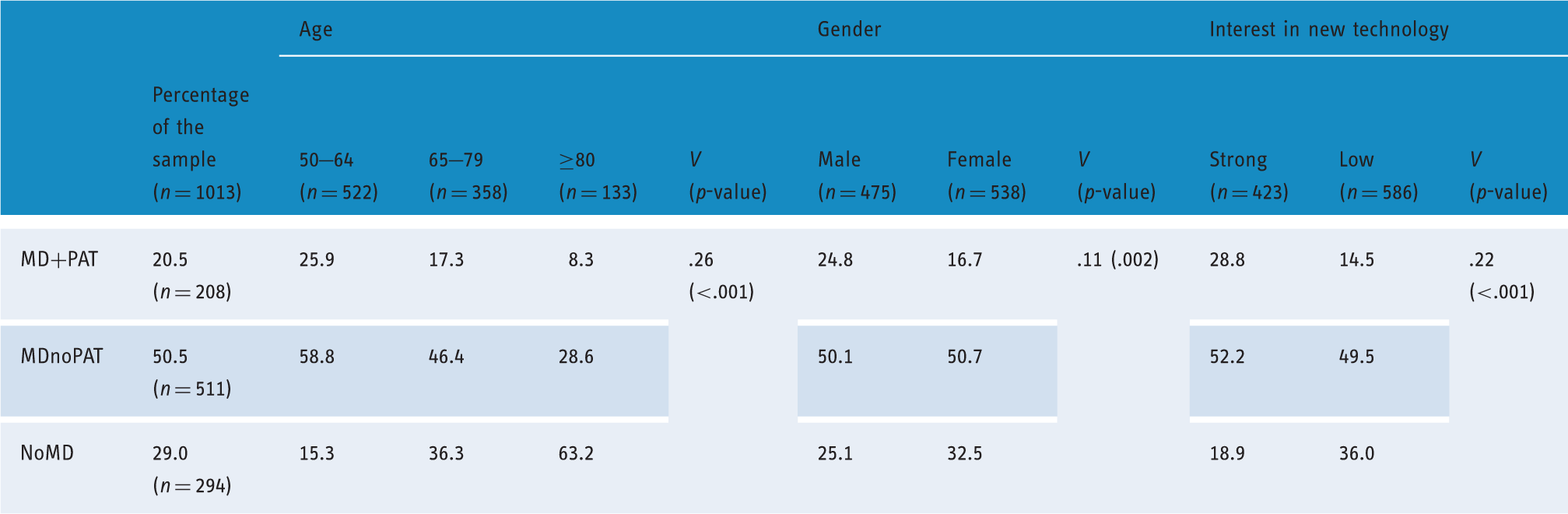
Note: Percentages in columns. V = Cramér’s V.
Multivariate logistic regression analysis for the predictors of mobile technology usage.
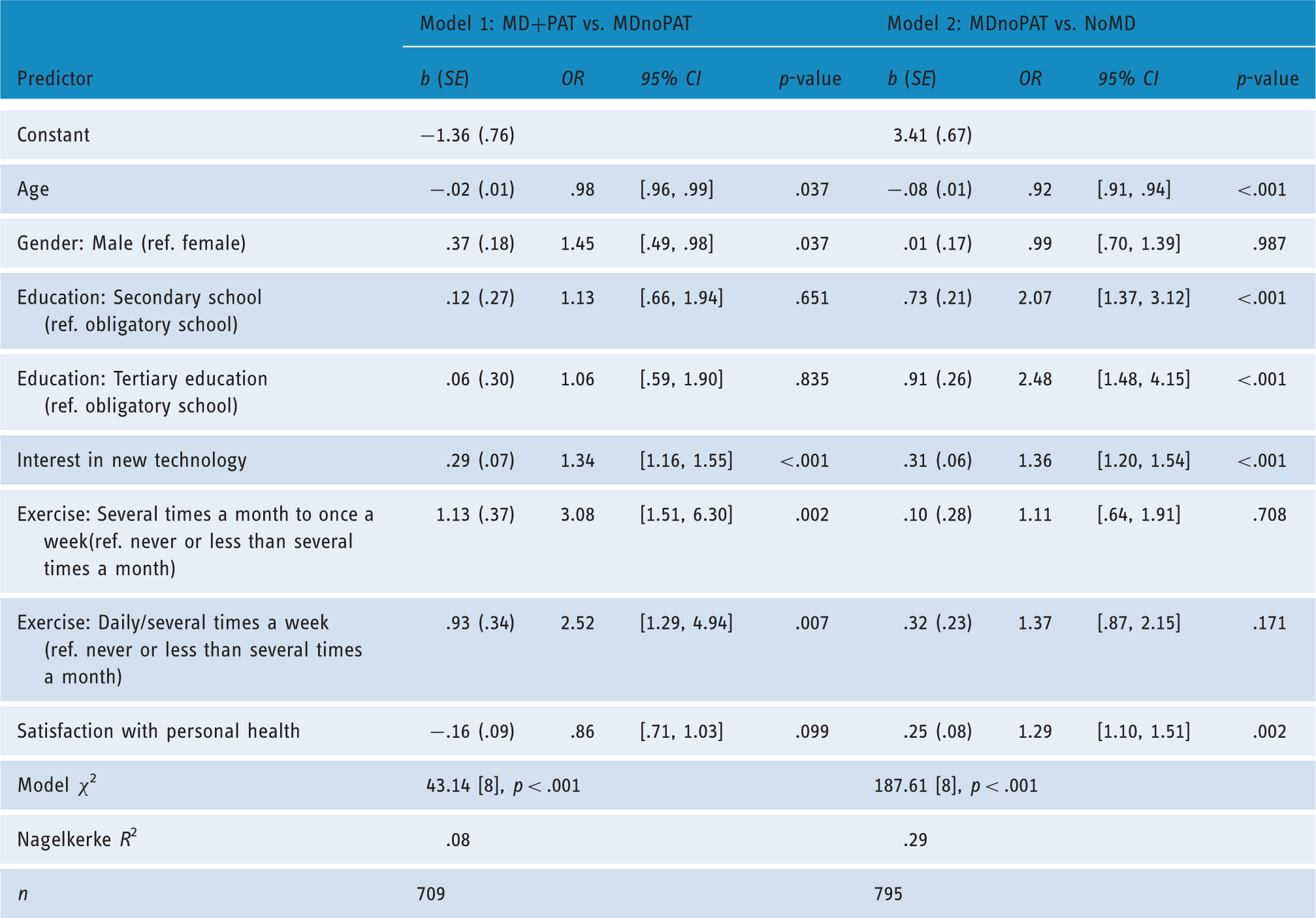
Note: b = logits. SE = standard errors. OR = odds ratios. 95% CI = 95% confidence interval for odds ratios. Missing data was excluded listwise.
Reasons for mobile physical activity tracking.

Note: Percentages columns for each row. V = Cramér’s V.
To analyze the bivariate findings regarding the group differences between the three groups in more detail, two multivariate binary logistic regressions were performed (Table 4). The first model included only participants from the MD+PAT and MDnoPAT groups (i.e. only participants who used mobile devices). Group was entered as the dependent variable (1 = MD+PAT, 0 = MDnoPAT). In order to analyze differences between the two groups, several independent variables were included. Specifically, we included the sociodemographic factors age, gender, and education; the variable “interest in new technology” was also included as an indicator of technical affinity. Finally, exercise frequency and satisfaction with personal health were included as independent variables to analyze differences regarding subjective fitness and health status between groups.
The model was statistically significant overall, indicating that, as a set, the predictors (age, gender, education, interest in new technology, exercise frequency, satisfaction with personal health) reliably distinguished between the MD+PAT and MDnoPAT groups (X2 [8] = 43.14, p < 0.001, Nagelkerke R2 = 0.08). Overall, the likelihood of the model at predicting group membership was 70.9%. Age, gender, interest in new technology, and exercise frequency significantly contributed to prediction (0.001 < p < 0.037), whereas education and satisfaction with personal health were not significant predictors (0.099 < p < 0.835). Men, younger individuals, those with a strong interest in new technology, and those who exercised frequently had a higher likelihood of being in the MD+PAT group compared with women, older individuals, those with a low interest in new technology, and those who exercised less than several times a month.
We then calculated a second model using the MDnoPAT and NoMD groups only, in order to examine differences between individuals who used mobile devices for general purposes (without the purpose of physical activity tracking) and those who did not use mobile devices at all. Group was entered as the dependent variable (1 = MDnoPAT, 0 = NoMD). We entered the same independent variables as used in the first model. The model was statistically significant overall (X2 [8] = 187.61, p < 0.001; Nagelkerke R2 = 0.29). The likelihood of the model at predicting group membership was 72.2%. The second model revealed that age, education, interest in new technology, and satisfaction with personal health significantly contributed to prediction (0.001 < p < 0.002), whereas gender and exercise were not significant predictors (0.171 < p < 0.940). Younger individuals, those with a higher level of education, those with a strong interest in new technology, and those who were more satisfied with their health had a higher likelihood of being in the MDnoPAT group compared with older individuals, those with a lower level of education, those with a low interest in new technology, and those who were less satisfied with their health.
Reasons for using mobile devices to track physical activity
Five potential reasons (Table 5) for using mobile devices for physical activity tracking were provided to the MD+PAT group and participants could express their agreement with those. The most common reason selected was “to track daily physical activity” (65.8%), followed by “to motivate myself to remain healthy” (58.9%), “to exchange data on physical activity and health with friends” (21.5%), “to document my data on physical activity and health for my physician” (17.2%), and “to track my sleep quality” (13.7%).
When comparing the five reasons across age, gender, and subjective health (Table 5), results indicated that only two reasons, “to track my daily physical activity” (p = 0.017) and “to document my data on physical activity and health for my physician” (p < 0.001), differed significantly between age groups. Younger individuals agreed to the first reason more often than did older individuals, but older individuals agreed to the second reason more often than did younger individuals (Table 5). No significant differences were found for gender or subjective health.
Discussion
The present study was the first in Switzerland—and to our knowledge, among the first internationally—to examine the use of mobile devices for physical activity tracking in a representative sample of individuals aged ≥50 years. Our study was based on a sample of 1013 older individuals, and aimed to describe the current use of mobile physical activity tracking and to examine the reasons for the use of this technology in this population.
Use of mobile devices for physical activity tracking
Our first research question addressed the general use of mobile devices and their specific use for tracking physical activity in everyday life among individuals aged 50 years and older. Results indicated that about 1 in 5 participants (20.5%) used mobile devices for physical activity tracking. Persons before retirement (50–64 years old) were more likely to use mobile devices for physical activity tracking compared with persons in retirement. More participants used smartphones or tablets than activity trackers or smartwatches to track their physical activity. These first results must be discussed in consideration of the overall trend of increased use of mobile devices among older age groups. 27 As a comparison, data from a Swiss marketing study of individuals aged 18 years and older found that 10% of participants used a smartwatch; in our study, 6.6% used a smartwatch. 46 Although the usage rates of younger age groups have not yet been matched by older age groups, a growing number of older individuals are incorporating new mobile technologies into their daily routines, and previous reports have discussed whether the “digital divide” between younger and older individuals will diminish or even vanish in the near future. 47 This general trend is relevant to the use of mobile physical activity tracking since the use of mobile devices is one of its key prerequisites. Indeed, individuals who use mobile devices such as smartphones or smartwatches for general purposes are more likely to also use those devices for mobile physical activity tracking. In our sample, only 29% of participants did not use a mobile device.
Correlates of physical activity tracking
Our second research question addressed the differences between individuals who used mobile devices for physical activity tracking and those who did not use this form of tracking. Our results revealed that men, younger individuals, those with a strong interest in new technology, and those who frequently exercised had a higher likelihood of tracking physical activity with mobile devices compared with women, older individuals, those with a low interest in new technology, and those who exercised less than several times a month. The data provide only a cross-sectional view and can therefore only report correlations between exercise frequency and physical activity tracking. There may be bidirectional causality: the tracking device might promote exercising by motivating individuals to be more physically active. However, it might also be that individuals that are more active are also more likely to use the devices to monitor their physical activity. With the data provided, we could not clarify this causality problem.
The significant effects of age and gender reveal that sociodemographic barriers remain, and technical affinity also emerged as an important factor. These barriers have also been found for the general use of mobile devices. 27 However, research has also found that once individuals have started to use new technology (e.g. mobile devices or the Internet), they soon acknowledge their potential for heightened connectivity and safety. 32 At the same time, our data revealed that when older individuals use mobile devices or applications for physical activity tracking, many of them use it every day. Along with their strong interest in new technology, today’s older technology users can be described as “early adopters” according to Roger’s Innovation Diffusion Theory, 48 and it is safe to assume that the number of older users will continue to rise. On the other hand, research on technology acceptance has described barriers (beyond sociodemographic factors) to the further spread of mobile physical activity tracking in older individuals. These include a lack of trust in technology, 30 a lack of support while learning to use it, 49 and low relevance of technology to everyday life. 50 These barriers must be considered when examining and evaluating older individuals’ use of mobile devices for physical activity tracking.
Reasons for physical activity tracking
Our third research question addressed the reasons for using mobile devices to track physical activity. Reasons relating to tracking physical activity and motivating oneself to remain healthy were more often agreed with than were social factors such as the exchange of personal data with friends or documenting data for physicians.
Self-control and incentives for being active were identified as reasons for using activity trackers in a previous qualitative study. 44 These findings also fit well with the fact that the most commonly used behavior change techniques in current applications that promote physical activity are providing feedback, self-monitoring, and goal-setting. 51
On another note, the low rates of agreement for reasons for use related to exchanging data indicate that another potential application of physical activity tracking currently remains unused. The social exchange of mobile activity tracking data or social reflection-in-action or reflection-on-action can be extrinsic motivations for fitness and health maintenance through collaboration, competition, and social support. 52 Documentation of activity and health data for physicians might also contribute to better healthcare provision, as older individuals have been found to highly value the advice of physicians. 53 When implemented in regular healthcare settings, mobile technologies might even be used to evaluate the effectiveness of interventions or the sustainability of rehabilitation by providing cost-effective opportunities to continuously monitor everyday activities. 54 In this way, exchanging objective data on physical activity might be an additional resource for longer and healthier lives.
Practical implications
Physical activity-tracking products currently available on the market tend to appeal specifically to targeted groups such as athletes. New designs and features are needed that are geared toward achieving possible health benefits and that target the specific needs (especially in terms of usability) of older users. In order to achieve high acceptance rates, the target group should ideally participate in design decisions.30,39,55
Additionally, it should be acknowledged that most current devices and applications have been developed without considering health psychology or gerontology theories. It is therefore unlikely that current devices for physical activity tracking have been designed in ways that lead to long-term use or sustainable success among older users. Structured physical activity interventions with systematic training progression are important. 56 Scientists should therefore take responsibility for the integration of profound theories into the development of new technologies and mobile applications. One possibility might be to add dynamic concepts that allow for customization to different users as well as to individual development over time. Only when incentives change and adapt is it reasonable to expect long-term success. 57
Limitations
As the present study had a specific regional focus, generalization of our findings is limited. The data provide only a cross-sectional view of the phenomena, but it is quite likely that there will be a further increase in mobile activity and health tracking among older individuals in general. Further research including longitudinal data is required to examine this further increase and to make causal inferences related to mobile activity tracking and subjective well-being/health over time and within individuals.
While some limitations exist in telephone surveys (e.g. telephone accessibility, non-availability, brief questionnaire, interviewer’s bias , acoustic problems, self-reported data, trust in telephone surveys), the advantages outweigh the disadvantages, “resulting in an efficient and effective method for collecting data”. 58
Furthermore, in this first study in this population, data on important background factors (such as technology knowledge, attitudes toward technology, objective health status), fitness status (objective measures of exercise, fitness status, and activity levels), everyday life factors (coping with activities of daily life, social contact), and psychological factors (attitudes toward health prevention and one’s own life and aging, personality, well-being) were unavailable. Further studies with a wider range of variables and a longitudinal design are therefore required to examine the study topic in more detail.
Conclusion
The study presented representative data about the actual use of mobile tracking technology in a population where new mobile devices are not in everyday use. Today, it is mainly the active and younger elderly (mostly men) with a high interest in technology who want to stay healthy are using tracking technologies. The current study provides evidence of the potential of mobile physical activity tracking by older individuals. Especially for older individuals, new mobile devices can facilitate easy, longitudinal monitoring and documentation of their own health status. However, not every older adult uses these mobile devices, and civil society can support education surrounding new technologies by providing informal assistance and supporting formal learning settings in all local areas.
Footnotes
Acknowledgements
The authors would like to thank the older adults who participated in the study. We thank M. Martin for fruitful discussions on the study.
Contributorship
ASe and HRS conceived the study and organized the data collection. ASe and ASch researched literature and carried out data analysis, and prepared the first draft of the manuscript. ASe and ASch wrote the paper and HRS and CR reviewed the manuscript. All authors edited the manuscript and approved the final version of the manuscript.
Declaration of Conflicting Interests
The author(s) declared no potential conflicts of interest with respect to the research, authorship, and/or publication of this article.
Ethical approval
Not applicable. 45
Funding
The author(s) received no financial support for the research, authorship, and/or publication of this article.
Guarantor
ASe/ASch
Peer review
This manuscript was reviewed by Kenji Tsunoda, Yamaguchi Prefectural University, Japan and one other individual who has chosen to remain anonymous.