




Abstract
There is growing evidence that digital interventions can successfully effect meaningful changes in health-related behaviour. However, optimisation of digital intervention delivery is challenged by low usage, high attrition and small effect sizes. Whilst a number of conceptual frameworks and models exist to guide intervention planning and development, insufficient attention has been paid to how existing psychological theory could inform the optimal implementation and delivery of the design features commonly used in digital health behaviour change interventions. This paper provides a critical review of psychological theories and models in order to consider their implications for the design of digital interventions. The theories reviewed include theories of: persuasion and attitude change; motivation; volition and self-regulation; patient preferences for participation in medical decision making; and social support. A set of theory-based guidelines is provided to inform the development of future interventions.
Introduction
The feasibility and potential for digital interventions (DIs) to effect change in health-related outcomes have been established for a variety of health issues.1,2 However, low reported effect sizes and lack of sustained usage of DIs highlights the need to further understand how engagement with, and effectiveness of, DIs can be optimised.3,4 Several models and frameworks have been developed to guide the design and development of DIs that provide a useful starting point for selecting specific design features or behaviour change techniques (BCTs).5–8 Psychological theory is also commonly used to inform the content and underlying philosophy of health behaviour change interventions, i.e. what design features and/or BCTs are used. Meta-analyses examining the role of theory have reported mixed results; while some support the use of theory 2 others indicate that theory-based interventions are not necessarily more effective at changing health-related behaviour. 9
A limitation of these models, frameworks and meta-analyses is that they do not specify or examine the different ways in which theory can be translated and implemented within a behaviour change intervention, that is how specific design features or BCTs can be implemented and the implications of implementing features in different ways. This means that additional theory-based guidance is needed to inform the optimal implementation of different design features and BCTs within different intervention contexts.
This review represents an exploratory exercise to understand what insights psychological theory can provide for the optimal implementation and communication of DI content. As such, no formal criteria were used to select theories for inclusion in this review. Instead, a sample of commonly cited theories and models that are used to understand health-related behaviour and communication in healthcare are considered. This review is not intended to provide a systematic or exhaustive set of recommendations based on all relevant theory, nor does it suggest that the theories included are superior to those that have not been discussed. For the purposes of this review, a DI is defined as a self-guided Internet- or computer-based health behaviour change intervention. While many of the insights and recommendations from the review are likely to be relevant to other forms of DI (e.g. mobile/smartphone-based interventions) it is beyond the scope of this review to provide an in depth consideration of all digital platforms that each offer additional unique capabilities (e.g. context-aware sensing).
Each theory will be discussed under wider conceptual categories in order to minimise repetitiveness and enhance integration of individual theories and overlapping concepts/implications. The sections that follow will critically discuss specific theories under the categories of persuasion and attitude change, motivation, volition and self-regulation, patient preferences for participation in medical decision making, and social support. For simplicity, specific theories will be discussed under one of the above categories only. An amalgamated set of theory-based recommendations for DI design is then presented. It is beyond the scope of this review to provide an exhaustive summary of the evidence in support for individual theories.
Theories of persuasion and attitude change
Theories of persuasion and attitude change offer guidance on what particular tailoring strategies may be more acceptable and effective in particular contexts. Tailoring refers to the provision of information, advice and support that is individualised to the user based on their known characteristics, behaviours or scores on relevant theoretical constructs. 10 With the onset of mobile computing the Internet is increasingly being considered as a way to access information quickly, efficiently and, in some cases, fleetingly. Tailored DI content and delivery enables direct access to personally relevant information and thus may enhance attitude change and subsequent behaviour as well as initial uptake and usage of DIs. Within the health domain, providing tailored content may also reassure users that they are receiving and following advice that is right for them. While self-guided DIs cannot be individualised to the same extent as guided or face-to-face interventions, automated algorithms can be used to tailor interventions in a number of ways according to pre-known variables or data entered by individual users.
According to the elaboration likelihood model (ELM), tailored DIs are more likely to result in durable attitude change and consequent behaviour change because they increase the perceived personal relevance of the intervention content, thus increasing motivation to thoughtfully (centrally) process the arguments presented. 11 Tailored intervention content may also contain less ‘noise’, which decreases the cognitive load placed on users enabling attention to be focused on the most important and personally relevant messages. 12
A number of different approaches and strategies for tailoring DI content are available ranging from the relatively simple (e.g. inserting a person's name) to the relatively more complex (e.g. adapting presented content according to a number of individual variables). 13 In order to select the strategy that will best encourage thoughtful elaboration it is vital to establish why and how tailoring works. The self-reference encoding model 14 argues that tailored intervention content will only encourage effortful processing when self-relevant cues are provided (e.g. person's name). Planting self-relevant cues within computer-based generic information (e.g. name, the number and type of cigarettes smoked, number of years a participant had smoked, risk awareness) was associated with greater self-reported smoking cessation behaviour than implicitly adapting the intervention content according to participants' characteristics and theoretical variables. 15 Sophisticated algorithms for adaptive intervention tailoring may not then be necessary if simple personalisation strategies are sufficient for triggering self-referent encoding and thus behavioural change. This finding also has important resource implications for the development of DIs since complex, adaptive interventions require more time and technical expertise to develop and test.
However, increasing the personal relevance of information may also have adverse effects on attitude and persuasion. 16 For example, an increased motivation to consider tailored arguments due to high personal relevance may only result in persuasion if the tailored arguments themselves are convincing. 17 Careful consideration of weak arguments, or arguments that evoke negative reactions, may be less likely to result in persuasion. If DI content is likely to be unpopular or unconvincing it may be preferable to encourage users to process information peripherally. Additionally, tailored DI content has been perceived as less credible than non-tailored DI content. 18 According to ELM, if tailored arguments are not congruent with prior attitudes or beliefs, this may inadvertently promote careful critique of the arguments in a bid to maintain cognitive consistency, 16 and in the context of DIs may lead to early drop out. Increasing the personal relevance of information through tailoring may not always encourage users to follow the central route to persuasion. If the information presented is already highly salient to the user, or the user is knowledgeable in the topic area, this may actually decrease motivation to think carefully about the intervention content. 11 In this instance, providing untailored intervention content may better attract and retain users' attention, thus encouraging continued DI usage.
In a self-guided digital setting it is not usually possible to know users in advance or to flexibly adapt automated tailoring algorithms to counteract any adverse reactions or counterarguments that may arise. This highlights the need to conduct sufficient, in-depth qualitative pilot studies to build an understanding of the prior experiences of the target population and the contexts in which they will be seeking to use and follow the intervention. 19 In this way relevant beliefs, prior knowledge, and potential adverse reactions can be acknowledged and addressed before any new contradictory information is introduced.
Remaining questions
Theoretical explanations of tailoring do not fully explain whether and/or how self-referent encoding or effortful information processing can lead to changes in behaviour. Current hypotheses propose that self-referent encoding leads to cognitive changes (e.g. changes in intention or increased accessibility of information) that result in greater motivation to perform behaviour. 20 Building a clearer picture of whether and how the use of tailoring can influence both usage of DIs and subsequent behaviour change may serve to enhance the effectiveness of DIs and ensure those effects can be reproduced.
Theories of motivation
Health behaviour change typically requires a considerable degree of self-regulatory effort and is therefore not usually considered to be an inherently enjoyable activity. This can undermine motivation to engage in the behaviour change process. DIs may further discourage continued usage by using tunnelled, 21 session-based delivery that may be incompatible with the perceived advantages of technology such as quick, flexible and on-the-go access to information. Theories of motivation can offer guidance on how best to implement a range of DI features in a way that will enhance rather than thwart users' motivation to engage with the behaviour change process and use DIs.
Self-determination theory (SDT) proposes that the initiation, performance and maintenance of any behaviour will be more likely if that behaviour is autonomously motivated, that is, the behaviour is performed out of a sense of choice rather than external pressure. 22 SDT further argues that autonomous motivation can be enhanced by supporting individuals' need for autonomy (i.e. behaviour is under volitional control), relatedness (i.e. support from and connection to others) and competence (i.e. confidence and ability to perform a behaviour). Identifying strategies for providing choice and flexibility within tunnelled architectures may help to enhance users' sense of autonomy. 23 For example, users can be empowered to self-select their own health-related goals or invited to try out different suggestions for behavioural change that are accompanied by a meaningful rationale, rather than instructed to follow specific behavioural directives. 19 Interventions may also enhance users' sense of autonomy by encouraging the user to reflect on their own personal, intrinsic reasons for health behaviour change or DI usage (see Yardley et al. 2014), 24 and how these reasons fit with other core values (e.g. long-term health, quality of life, vitality etc.).25,26 Following SDT, the provision of positively framed tailored feedback (e.g. in response to goal setting, self-assessment, self-monitoring) can address users' need for competence. 22
It can be more difficult to address users' need for relatedness within DIs as computer-mediated peer support may arguably offer a poor substitute for ‘real’ social support, particularly for users who have a stronger need for relatedness outside of the intervention context. 27 Indeed, there is mixed evidence in support of computer-mediated support tools across the health domain. 8 Where it is not appropriate or necessary to mediate social interaction, DIs may alternatively satisfy users' need for relatedness by ensuring that users feel listened to (e.g. by acknowledging barriers to health behaviour change, see Yardley et al. 2011), 28 providing opportunities for the user to offer feedback to the research team, introducing the research team via ‘meet the team’ pages etc.).
The extent to which users' motivation and autonomy can be supported through DI design may differ according to other psychological characteristics, including health locus of control. 29 An internal health locus of control has been argued to have a positive association with health-related outcomes. 30 Design features that offer choice and flexibility may help to enhance perceived internal locus of control by encouraging users to make their own decisions and self-manage their behaviour change process and DI usage. However, users with a strong external locus of control may appreciate more tunnelled design architectures and more frequent and directive contacts with the intervention.
Remaining questions
Theories of motivation offer useful design strategies for enhancing motivation to change health-related behaviours and to use and engage with DIs. However, some uncertainties in implementation remain. For example, at what point does providing positively-framed feedback on goal progress become an extrinsic motivator, and thus undermine autonomous motivation? Similarly, at what point does providing choice become burdensome and overwhelming, and thus discourage continued behaviour change or usage of a DI? Indeed, research on patient preferences for medical decision making (discussed later) highlights that not all users may want to take an active autonomous role in the management of their health.
Theories of volition and self-regulation
Goal setting and self-monitoring are commonly employed behaviour change techniques within health interventions. 8 As previously discussed, theories of motivation emphasise the value of enabling choice and flexibility in how an intervention can be followed. However, users may not always choose or self-set appropriate goals when following a self-guided DI. Providing feedback on goal progress is further challenged by DI delivery as it requires considerable resource input in order to adequately tailor feedback to individual users and provide sufficiently varied motivational messages. Yet evidence suggests that tailored feedback may be a vital component of DIs that require active interaction or engagement from the user. 31 Early drop out from the behaviour change process and usage of DIs may result if users pursue inappropriate goals and are not sufficiently motivated by automated feedback messages from the DI. Theories of volition and self-regulation provide guidance on the types of goals and progress feedback that will better support users to change health-related behaviour and the considerations that need to be made when developing and tailoring relevant DI design features.
Goal-setting theory and social cognitive theory (SCT) argue that goals will be more effective at motivating behaviour when they are specific, learning orientated, achievable in the short-term but sufficiently challenging, and linked to a longer-term, distal goal.32–39 Given the number of complex characteristics associated with appropriate and successful goals it is vital that DIs do not assume that users have adequate prior knowledge about the goal-setting process or how to choose appropriate goals for themselves. Sufficient time and space should be dedicated within DIs for building a clear rationale that explains why goal setting will be useful and how it can be done using examples and templates (see Yardley et al. 2012). 40 In line with motivational theories, guidance for the goal-setting process needs to be provided in a way that will support autonomous motivation For example, users can be invited to choose from a set of assigned goals. Following theories of attitude change and persuasion, it should also be made clear to users when the recommended goal options have been informed from their collaborative input (i.e. tailored based on data provided by the user) rather than arbitrary assignment.
Feedback on goal progress is argued to facilitate the ongoing self-regulation of goal-directed behaviour.41,42 Users' satisfaction with their goal progress and feedback can influence their motivation to continue goal pursuit. Evidence from goal-setting theory and SCT for the role of satisfaction in goal motivation points to an inverted-U relationship whereby abandonment or disengagement from goal pursuit may result if goal progress is well below the expected standard or if the positive progress made decreases the salience of a health goal.36,41,43 The health action process approach posits that individuals' self-efficacy beliefs facilitate the regulation of behaviour and thus feedback on goal performance should contain resource communication rather than risk communication, that is, increase individuals' perceptions of their capability to change behaviour rather than highlight the implications of not changing behaviour. 44 The common sense model of illness emphasises the role of coherence and thus feedback on goal performance or self-monitoring may regulate ongoing positive behavioural changes more effectively if it can provide a clear and persuasive demonstration of how planned or actual behaviour directly affects anticipated or actual health outcomes.45,46 According to temporal self-regulation theory, behaviour is motivated by a decisional balance exercise that weighs up the immediate costs of performing a behaviour against the longer-term benefits – if immediate costs are high and benefits low, motivation to pursue a health-related goal will be lower regardless of any previously held intentions. 47 Thus, feedback focused on the immediate benefits of behaviour may be optimal during the early stages of behaviour change. However, as behaviour change progresses and users experience mastery via positive cumulative feedback loops, feedback focused on the longer-term benefits of health behaviour may be more appropriate.
In sum, automated algorithms for tailoring goal-related progress feedback need to encourage a sufficient level of satisfaction, be sensitive to and address challenges to self-efficacy, strengthen the perceived connection between current goal pursuit and future beneficial outcomes, and adapt to the changing needs or mastery experiences of the user. Appropriate and theory-based implementation of progress feedback may also have implications for DI usage. Motivation to continue using a DI may wane if users are dissatisfied or discouraged by their goal-related progress and/or if the immediate costs to using DIs are high (e.g. time, effort) compared to longer term health gains. This highlights the importance of providing feedback that not only reinforces goal-directed behaviour, but also provides a positive, affective experience that reinforces DI usage in the short-term. In the longer-term, DI usage may naturally and appropriately wane as users experience mastery and acquire the tools needed to sustain behavioural change.
Remaining questions
Although it is evident that providing choice and flexibility in the delivery of DIs can enhance autonomous motivation, it is not yet clear to what extent users should/want to be involved in the goal-setting process specifically. While there is evidence to suggest that goal-directed behaviour can be higher for self- or jointly set health goals 48 there is also evidence to suggest that self-set and collaboratively set goals are not always more effective for promoting some health behaviours, such as diet and physical activity. 38 In a health context, expert input or more directive guidance within the DI may be appreciated and thus assigned goals may not necessarily undermine autonomous motivation. More empirical research is needed to establish the specific contexts and health behaviours for which directive versus non-directive goal-setting guidance is associated with the greatest motivational and health-related benefit. In reality, users will have many salient goals competing for limited cognitive attention, with health goals potentially decreasing in salience outside of the intervention context. It is necessary to identify and test strategies for designing automated goal-setting features so that they accommodate and facilitate multiple goal pursuit. 49 For example, goal-setting features could attempt to reduce goal conflict and increase goal salience by supporting users to identify health goals that fit with highly valued personal goals or self-conceptions. 50 Implementation intentions (or if-then planning) have also shown promise in supporting individuals to initiate goal-directed health behaviour at critical moments. 51 However, as previously discussed, users can have difficulty following the principles of if-then planning in the context of self-guided DIs. 40
Patient preferences for participation in medical decision making
Unguided DIs require users to autonomously interpret, follow and implement the intervention advice provided. Not all users will be confident to make health-related behavioural changes with only minimal, automated guidance, which may subsequently undermine the possible health-related impact of DIs and/or their uptake and continued usage. Models of patient preferences for participation in medical decision making can provide guidance on design features that can be used to support varied preferences for user involvement in DI delivery within a health-based context.
Examinations of patient preferences for participation in medical decision making do not appear to reveal a clear superior model.52–54 While the majority of patients appear to prefer a shared decision-making model, a significant minority do prefer to take on a more or less active role in medical encounters. A range of factors appear to moderate patient preferences including, demographic variables, previous experience of health/medical encounters, and familiarity with one's health condition.52–55 Preferences for participation are not necessarily mutually exclusive and can vary at different stages of the decision-making or intervention process, such as: knowledge gathering; information provision and disclosure of treatment choices; discussion of treatment choices; decision making and selection of treatment choices.53,56
Given the possibility of varied preferences for participation between individual users and at different stages, DI delivery could be tailored to users' self-reported preferences for involvement informed by a screening measure or qualitative pilot work. However, there does not appear to be strong prospective evidence that tailoring to individuals' preferences results in better health outcomes or satisfaction. 57 Given that preferences also appear to be governed by contextual variables that are likely to change over the course of an intervention, a one-off screening measure at the start of an intervention may not be sufficient. 55 Instead, the providers' belief in a participation model and the concordance between patients' and providers' preferences for a participation model can result in better outcomes. 57 Better DI health outcome and intervention engagement may be seen if DI developers can convey a clear rationale for the intervention design and the opportunities offered for user involvement rather than seeking to tailor to individual preferences.
A further possibility may be to offer a range of optional supportive tools that can be used to successfully engage users who are less comfortable taking an entirely autonomous role in the behaviour change process. For example, optional contact with the intervention team could be offered where resources permit (e.g. email or telephone coaching). 58 Alternatively, providing optional additional information or vignettes from other real or hypothetical DI users may be a useful strategy where resources are more limited (see Strecher et al.). 59 Providing additional information or supportive features as an option ensures that users who require greater support can be successfully engaged without burdening users who desire more freedom and control. 60
Remaining questions
Much of the empirical research on preferences for decision making is based on the self-report of patients in hypothetical contexts. This says little about patients' actual behaviour in patient-provider communication. 55 Similarly, knowing what users prefer does not necessarily identify what is actually effective in practice. The theory and empirical research has also been largely developed within the context of face-to-face medical encounters. Additional empirical research is needed to explore models of participation and decision making in the context of self-guided DIs and the association with health behaviour change and intervention usage.
Social support theory
DIs can offer computer-mediated forms of social support that are qualitatively different from face-to-face social interactions with peers or health professionals. The types of computer-mediated social support available and the sophistication with which they are implemented can be wide-ranging and are often constrained by available resources or technical skills of the development team (e.g. asynchronous versus synchronous; animated avatars; intelligent, adaptive conversation systems; moderated peer support discussions etc.). Social support theory provides guidance on the extent to which offering computer-mediated social interaction can offer health-related benefit and the contexts in which users may experience the greatest benefit.
Several factors appear to influence the association between social support and health, including demographic characteristics, the presence of psychosocial stressors, and characteristics of the health problem.61,62 For example, the buffering hypothesis argues that social support will only have a positive effect on health in the presence of psychosocial stressors. 63 Weak tie network theory further argues that computer-mediated communication or support, characterised by weaker ties or interaction with strangers, will be particularly beneficial for users managing stigmatised conditions. 64 Hupcey 62 argues that support needs are time sensitive, that is, individuals' support needs will change through the course of an illness or the process of behaviour change. It seems then that not all users of a DI will benefit from the inclusion of features designed to provide social support. DI features enabling social interaction are likely to result in greater health-related benefit when users are facing psychosocial stressors (e.g. perceived stigma, chronic illness) and when the level and type of social interaction offered is tailored to their current and changing support needs. DI features that enable interaction with strangers (i.e. weak ties) are likely to offer greatest benefit to users facing psychosocial stressors that threaten or change their perceived sense of identity. DI features that enable interaction with the user's existing social network (i.e. close ties) are likely to offer greatest benefit to users facing psychosocial stressors that reinforce their perceived sense of identity.
Social support does not always have beneficial effects on health-related outcomes, and in some contexts may actually have a detrimental effect on health. 65 Interpersonal conceptualisations of social support 65 and models such as reciprocation, stressful interactions and negative provider support 62 propose characteristics that are detrimental to the relationship between social support and health, such as: social regulation or control; relational demands or conflict; feelings of guilt, anxiety, or of being a burden; and low levels of reciprocity. There is also evidence to suggest that providing social support may have greater health benefits than receiving it. 66 Careful monitoring or regulation of design features enabling social interaction are therefore essential to ensure that they do not create an atmosphere detrimental to health outcomes (e.g. conflict between users, obligation to interact with other users, low participation from users). This is even more vital for asynchronous DI features that are not facilitated by a health professional. If provision of support is more important than receipt users will only find benefit from DI features enabling social interaction when they actively participate. A clear rationale for the inclusion of social support features can help to ensure that users do not perceive them as contrived or fake. However, given that ‘lurking’ in chat rooms or discussion forums can be more common than active participation 67 it may require considerable resource input and moderation for social interaction provided by DIs to offer any substantial health-related benefit.
Remaining questions
The precise mechanisms underlying the effect of support on health have not yet been established. Some have suggested an affective mechanism.61,66 That is, social support evokes positive emotions and reduces the effects of negative emotions. Other explanations suggest that social support may facilitate the adoption of more adaptive coping behaviour or health promoting behaviours. 68 Building a clearer understanding of the mechanisms underlying the association between social support and health will enable the provision of more persuasive rationales to users that may help to encourage greater engagement with and benefit from social support features. It seems clear that providing or allowing for social support within an intervention will have specific benefits for specific populations who actively participate. However, what does not seem clear is whether social support is associated with health promotion or whether a lack of social support is associated with morbidity and mortality. If the latter is true, this again emphasises that features enabling social interaction should only be included for those who need it, and not for those who already feel supported. Dimensions of social support are also reported to have lower predictive power for explaining health-related outcomes than other psychosocial variables including motivation and self-efficacy. 69 It may not then be wise to prioritise inclusion of DI features that enable social interaction where resources are limited given the inconsistency prevalent in research on social support and health coupled with the high resource requirements to ensure that they are credible, beneficial and appropriately engaged with.
Summary and conclusion
Theory-based recommendations for the design of digital health interventions.
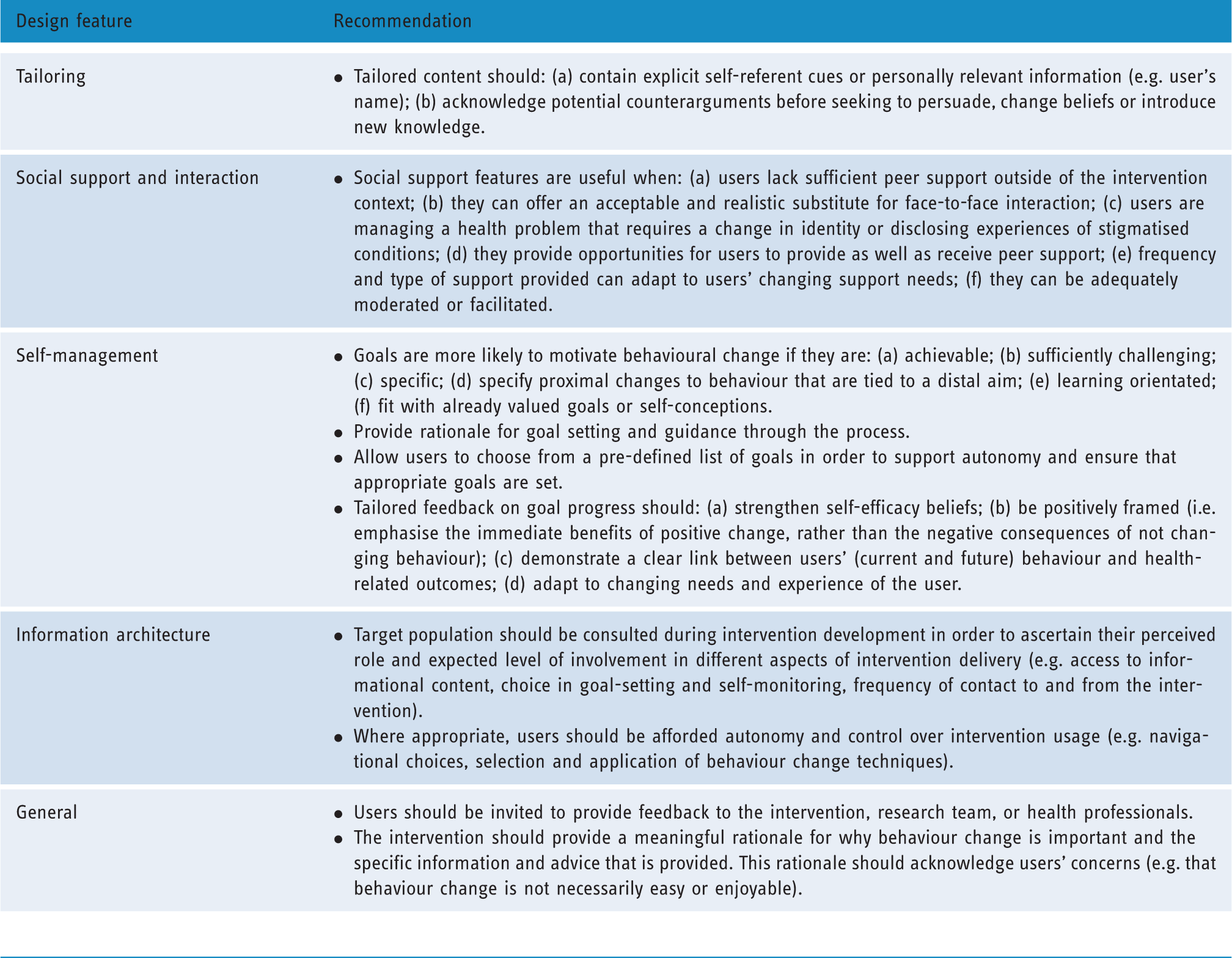
The findings from this review have two implications for the future development of DIs. First, this review provides a number of theory-based recommendations that may guide the implementation of specific BCTs (e.g. goals and planning, feedback and monitoring) and suggest the contexts in which specific BCTs (e.g. social support) may be more/less appropriate. For example, the qualities of goals and feedback that appear to maximise the benefits of planning and monitoring techniques and the support needed to facilitate successful goal setting are suggested. The provision of support from health professionals and/or peers may only be relevant and useful for users who are managing chronic or stigmatising health conditions or who have stronger perceived support needs.
Second, this review provides a number of theory-based recommendations for optimising users' overall experiences of engaging with DIs. For example, the implementation of any design feature or BCT needs to support users' sense of autonomy where possible and appropriate by offering choice and flexibility in how they use the intervention or engage with the behaviour change process. This may be achieving a balance between tailoring intervention content to relevant theoretical variables whilst still allowing users to choose the information and support they feel they need and/or want (e.g. ‘self-tailoring’). 71
Additional empirical study is required to confirm whether interventions that follow these theory-based recommendations are associated with greater uptake, usage, engagement and improvement in health-related outcomes. Further systematic and comprehensive reviews are also needed to generate theory-based recommendations for implementing the full range of BCTs defined within existing taxonomies. 70 This review has highlighted a number of unanswered questions concerning how psychological theory can be translated to inform optimal intervention design. It is hoped that these questions may inspire and stimulate further empirical study.
Footnotes
Funding
This work was supported by the UK Economic and Social Research Council under Grant number RES-149-25-1069.
Conflict of interest
The author declares that there is no conflict of interest.
Ethical approval
Not applicable
Guarantor
LM
Contributorship
LM reviewed the literature and drafted the manuscript.
Peer-review
This manuscript was reviewed by TL Webb, University of Sheffield and M van Vugt, VU University Medical Center.
Acknowledgements
The author would like to thank Prof Lucy Yardley for her constructive comments on drafts of the manuscript.