




Abstract
Background:
Climate change impacts health and threatens the stability of care delivery systems, while healthcare is mobilizing to reduce its significant environmental impact.
Objective:
This study aimed to assess knowledge, attitudes, and practices (KAP) about climate change among Canadian kidney care providers.
Design, setting, participants, measurements, and methods:
An electronic KAP survey, created by the Canadian Society of Nephrology-Sustainable Nephrology Action Planning committee, was distributed to kidney care providers across Canada, from March to April 2023.
Results:
A total of 516 people responded to the survey. Most respondents (79%) identified as women; 83% were aged 30 to 59 years. Nurses and nephrologists made up 44% and 23% of respondents, respectively. About half of the participants felt informed about climate change to an average degree. Most respondents (71%; 349/495 and 62%; 300/489) were either extremely or very concerned about climate change and waste generated in their kidney care program, respectively. The vast majority of respondents (89%; 441/495) reported taking steps to lower their personal carbon footprint. People who felt more informed about climate change presented higher degrees of concern. Similarly, both those who felt more informed and those who reported higher degrees of concern about climate change were more likely to take steps to reduce their carbon footprint. Over 80% of respondents (314/386) were at least moderately interested in learning sessions about environmentally sustainable initiatives in care.
Limitations:
This survey is at risk of social acceptability, representative, and subjective bias. Overrepresentation from Quebec and British Columbia, as well as the majority of respondents identifying as women and working in academic centers, may affect generalizability of the findings.
Conclusions:
Most kidney care providers who responded to this survey are informed and concerned about climate change, and their knowledge is directly associated with attitude and practices. This indicates that educational initiatives to increase awareness and knowledge on climate change will likely lead to practice changes.
Introduction
Climate change is impacting the health of Canadians while threatening the stability of care delivery systems. 1 Healthcare emits 5.2% of annual global greenhouse gas emissions, 2 and Canadian health care emits 4.2% of our nation’s yearly emissions. 3 As professionals obligated to improve the health of individuals and populations,4-7 working within systems and jurisdictions increasingly aligned and committed to net zero and climate resilience,8,9 Canadian healthcare providers (HCPs) are positioned to take novel actions, both personally and professionally, in their realms of expertise and influence.
Climate change knowledge has been shown to be an important predictor of concern and attitude to mitigation,10,11 in addition to important socio-psychological variables, such as gender and age.10,12 A review found that many North American HCPs have at least basic awareness of the health impacts of climate change, whereas the North American public remains largely unaware of these impacts. 13 Practicing nurses from Alberta were shown to have varying levels of knowledge about climate change and its relationship with practice and health, while also recognizing that they did not readily recognize their role in addressing climate change. 14 The integration of climate change and health’s intricate consequences as part of the medical15,16 and nursing17,18 education curricula is gaining interest and has shown feasibility, acceptance, and purposefulness.19,20 The Canadian Medical Association’s recent policy on environmentally sustainable health systems in Canada included numerous calls to action including incorporation of climate change education to medical training. 21
The knowledge, attitude, and practices (KAP) of Canadian HCPs toward climate change are largely unknown. In the field of nephrology, an exemplar with disproportionately large environmental impact due in part to the waste generated from kidney replacement therapies,7,22-24 there is increasing advocacy for environmentally sustainable practices in kidney care.5,6,25-30 We aimed to assess the KAP of kidney care providers about climate change to explore factors that may facilitate or hinder behavioral changes in their personal and professional spheres. We hypothesize that kidney care providers have high awareness of climate change and concern for the impact of care on the environment.
Methods
Design
A cross-sectional survey study was conducted using a KAP framework. The KAP methodology aims to assess what is known (knowledge), believed (attitude), and done (practices) on a particular topic, using structured questionnaires that can collect both quantitative and qualitative information.31,32 The survey (Supplemental file 1) was created by members of the Canadian Society of Nephrology’s (CSN) Sustainable Nephrology Action Planning committee, incorporating rigorous design principles 33 and similar themes used in other surveys on sustainable dialysis practices.34-36 Participants were asked basic demographic questions followed by questions about awareness, attitude, and response to climate change in both their personal and professional lives. Then, participants were asked about potential strategies already in place in their local kidney care services; these results will be reported elsewhere. Participants’ interest in learning sessions about environmentally sustainable kidney care was assessed, and additional comments were welcomed. The detailed methods in accordance with the CHERRIES checklist for reporting of internet e-surveys are provided in Supplemental file 2.
Sample and Survey Administration
We used a convenience sample of healthcare professionals in kidney care who were recruited from the email roster of the CSN and its collaborative societies/associations (e.g. Société Québécoise de Néphrologie, Canadian Association of Pediatric Nephrologist, Canadian Association of Nephrology Nurses and Technologists). The online survey, available in French and English versions, was distributed via e-mail. HCPs were invited to share the survey with their colleagues. The survey was hosted on the secured REDCap server of the Center de Recherche du Center Hospitalier de l’Université de Montréal (CHUM) and was self-administered electronically from March 9, 2023, to April 18, 2023. Ethics approval was obtained from the research ethics board of the CHUM.
Data Analysis
Descriptive analyses and chi-square tests were used to assess KAP about climate change among participants and to identify significant correlations between participants’ characteristics (age, self-reported gender, province of practice, type of clinical practice) and KAP responses. Analyses were performed using Stata/SE 15.1 for Mac (College Station, TX). A P-value <.05 was reported as statistically significant. Thematic analysis to generate themes from text (generated by IE and confirmed by SS) was used to assess open-ended responses. Sensitivity analyses including only respondents who fully completed the survey (n = 386) were undertaken and showed very similar results to the main analyses (results not shown).
Results
Participants’ Characteristics
A total of 516 Canadian kidney HCPs participated, of which 386 people completed all sections of the survey. Most participants (95%) completed the sections described in this report (n = 489), with the exception of the last two questions (n = 444 and 386). For each section of the survey, the number of responses and the number of respondents are presented. The majority of respondents were from Quebec (38%), British Columbia (34%), and Alberta (14%). Most respondents (79%) identified as women and were aged 30 to 59 years (83%). Kidney care nurses and consultant nephrologists made up 44% and 23% of respondents, respectively (Supplemental Figure 1). A majority (62%) of respondents worked in academic centers. Of note, there was no statistically significant difference in participant characteristics between those who fully versus partially completed the survey (P > .05; Table 1).
Participants’ Characteristics.

There were no statistically significant differences between participants’ completing the survey vs. participants providing incomplete survey responses (P > .1 for all characteristics, except job title P = .059).
Knowledge
Ninety-two percent of respondents (456/495) felt they were informed about climate change to at least an average degree, with 31% and 7% reporting being above average or very well informed, respectively (Figure 1A). Women, compared to men, reported feeling less informed about climate change (P < .001). Respondents aged ≥60 years, and those <30 years, felt more informed (P = .008; Supplemental Figure 2). No other characteristics were associated with being informed about climate change.

Knowledge (A), attitude (B), and practices (C) of Canadian kidney care providers about climate change.
Attitudes
Most respondents (71%; 349/495) were either extremely (25%) or very (46%) concerned about climate change (Figure 1B) and extremely (23%) or very (39%) concerned about the amount of waste generated by their kidney care program (300/489). There was no statistically significant correlation between age, gender, job title, and type of center and the degree of concern (Supplemental Figure 3). However, there were differences in the degree of concern across provinces, with Manitoba and Western provinces (British Columbia and Alberta) reporting higher degrees of concern about climate change (P = .001) as well as waste generated (P = .004; Figure 2).

Level of concern of respondents about climate change (A) and about the amount of waste generated in kidney care programs (B) overall and according to province.
A vast majority of respondents deemed it important to reduce the carbon footprint in their personal life (452/495; very 39%; important 35%; fairly 17%) and in kidney care services (435/489; very 34%; important 37%; fairly 18%). However, only 5% (27/495) and 0.4% (2/488) of people reported having calculated their personal and kidney program carbon footprint, respectively. None of the participants’ characteristics were associated with the importance given to reduction of carbon footprint.
Interrelations Between Knowledge, Attitudes, and Practices
People who felt more informed about climate change presented higher degrees of concern about climate change and waste generated by kidney care services (Figure 3). Similarly, both those who felt more informed and those who reported higher degrees of concern about climate change indicated more importance to reducing the carbon footprint of both their personal life and kidney care services (Supplemental Figure 4) and were more likely to take steps to reduce their carbon footprint (Figure 4).

Degree of concern about climate change (A) and about the waste generated by kidney care services (B) according to how informed respondents reported they were about climate change.
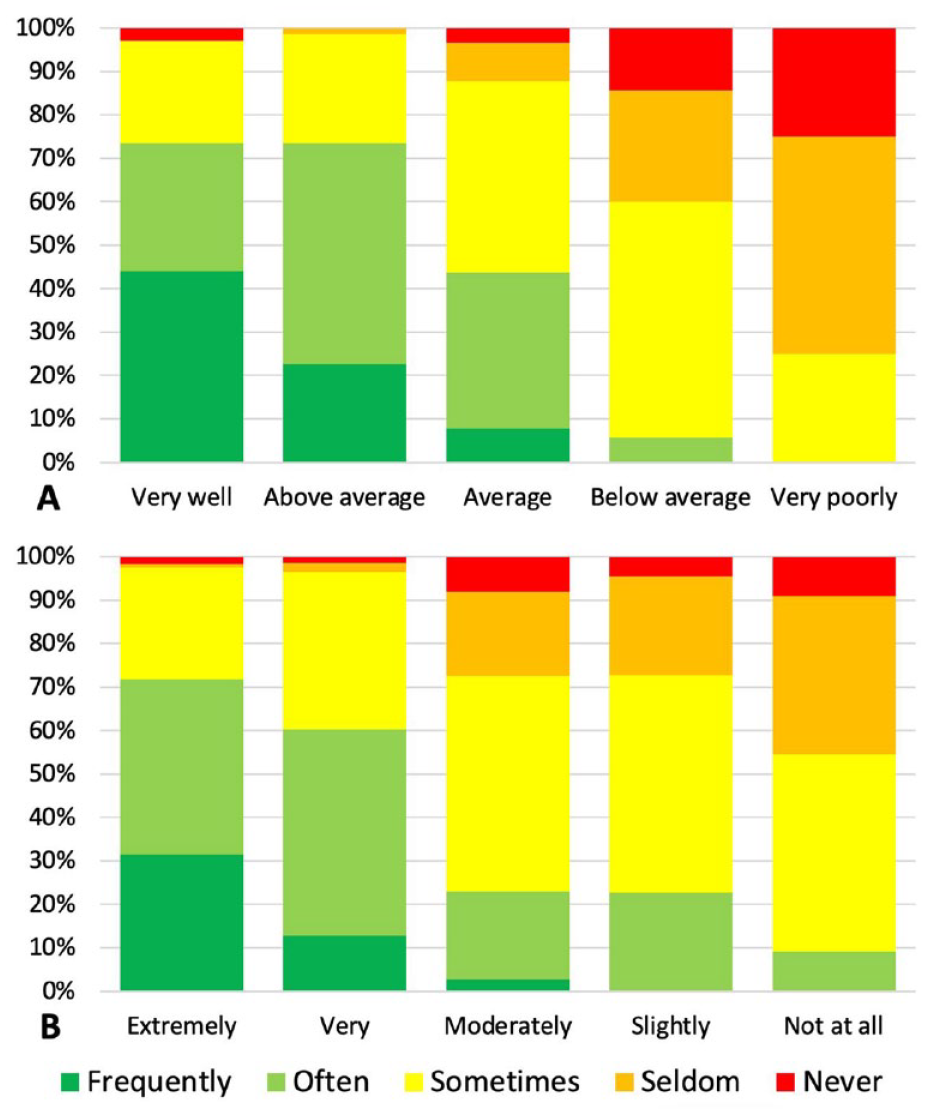
Degree of steps taken by respondents to reduce their personal carbon footprint according to how informed they feel (A) and how concerned they are (B) about climate change.
Practices
Most respondents reported taking steps to some degree in their personal life to reduce their carbon footprint (441/495; sometimes 37%; often 38%; frequently 14%; Figure 1C). The 5 most frequent steps reported, selected from a list of 10 options, were: the increased use of locally produced food (62%), reduced vehicle travel (56%), reduced meat consumption (51%), cycling or walking to work (31%), and reduced airplane travel (30%).
When asked to rank the importance from a list of reasons provided for carbon footprint reduction in kidney care services from 1 (most important) to 5 (least important), ordering was as follows (444 respondents): (1) active involvement in a time of climate crises, (2) reduction of harm to patients from particle pollution or heat illness, (3) reduction of the cost of provision, (4) contribution to the national goal of carbon neutrality, and (5) being a good example to patients/colleagues in stewarding resources wisely (Figure 5).
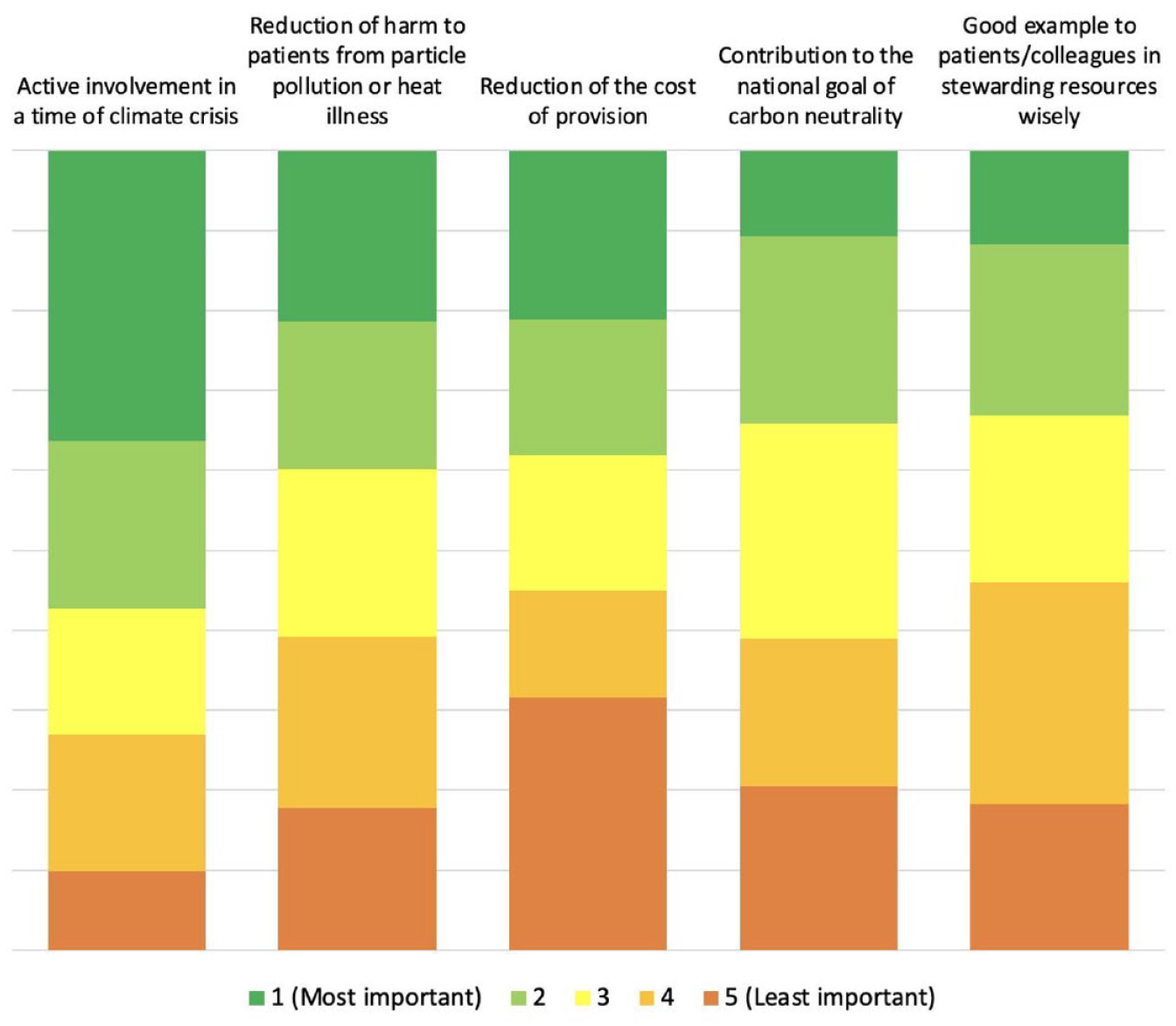
Relative importance, given by respondents, to the following reasons for carbon footprint reduction in kidney care services.
Interest in Education on Environmental Sustainability Initiatives in Healthcare
Of the 386 respondents who fully completed the survey, most were extremely (19%), very (37%), or moderately (26%) interested in learning sessions through the CSN about environmental sustainability initiatives in kidney care services. Those that were not interested at all were asked to provide a reason as open text. The main reasons listed fell into 4 categories: (1) lack of interest, (2) lack of time, (3) competing priorities, and (4) other (such as favoring prioritization of guidelines rather than learning sessions, or perceived appropriateness of targeting big companies rather than individuals; Table 2). None of the participants’ characteristics were associated with their interest in learning sessions. However, interest varied according to degree of concern and how informed respondents felt about climate change: Interest was consistently higher in respondents showing higher degree of concern and who were more informed about climate change, except for participants reporting being very well informed who had various degrees of interest in learning sessions (Figure 6).
Thematic Analysis and Relevant Quotes of the Reasons Provided by Respondents Reporting Having No Interest at All in Learning Sessions About Environmental Sustainability Initiatives in Kidney Care Services (n = 22).

Responses that did not apply to the question were not analyzed.

Interest of respondents in learning sessions about environmental sustainability initiatives in kidney care services according to how informed they feel (A) and how concerned they are (B) about climate change.
Discussion
As citizens of a northern country that is warming at least twice the global rate and experiencing climate crises affecting both health care and general infrastructure, 37 this survey provides a reflection on the high awareness and motivation of the kidney care workforce toward personal and professional climate action. We report that among the 516 Canadian kidney care providers who participated in this survey, 92% reported being informed to at least at an average degree on climate change, and 71% were very to extremely concerned about climate change. The majority of kidney HCPs (62%) were also concerned about the amount of waste generated by kidney care services. About 90% of respondents deemed it important to reduce the carbon footprint in their personal life and in kidney care services, with 89% having taken steps to lower their personal environmental impact, and over 80% at least moderately interested in learning about environmental sustainability initiatives in kidney care.
The most important findings of our study are that most kidney care providers (both adult and pediatric) who responded to this survey are informed and concerned about climate change, taking climate action in their personal lives, and that their KAP were interrelated. This indicates that educational initiatives to further increase awareness and knowledge on climate change will likely lead to practice changes. Pertinent to health systems broadly, how well informed and how concerned participants felt about climate change impacted the importance given to the reduction of workplace environmental impact, and crucially, the consequential efforts to do so. This interconnection of knowledge, attitude, and environmentally sustainable practices has also been documented in other settings.10,12,38-40
Most responding kidney care providers are interested in education on environmental sustainability initiatives in kidney care. While studies have explored the inclusion of climate change education as part of medical and nursing curricula,15,16,18-20 a study on climate change–related knowledge and attitudes among the general population in Egypt highlighted that about 80% of participants agreed that completing the questionnaire itself drew their attention to climate change and its impacts, 38 which was in fact one of the motivating factors of our survey. As such, participation of 516 kidney care providers may have had a positive impact on future engagement of the Canadian nephrology community on climate change.
In addition, we report gender differences in the KAP of participants. Although 80% of survey respondents identified as women, men (compared to women) reported feeling more informed about climate change. Selm et al 41 describe an interaction between education and gender where women with high levels of education had lower self-perceived knowledge than men and that learning abilities of people who question their knowledge are often better; hence, highly educated women may be more successful in learning about climate change than men. Furthermore, a recent study assessing the perceptions of the health impacts of climate change among Canadians showed that women, as well as people with a higher level of education, were more concerned about health-related impacts of climate change. 42 Of note, in our survey, 92% of nurses, 86% of “other” providers, and 47% of nephrologists (comprising adult and pediatric consultants and trainees) identified as women. This highlights the importance of engaging nurses in education about climate change and environmentally sustainable kidney care delivery as their active involvement in mitigation is crucial. In particular, some advocate for the adoption of a planetary health perspective to support the advancements in nursing education to ensure that nurses understand climate change as a social, political, economic, and public health issue. 43 In addition, it may be helpful to explore whether different or novel messaging and engagement strategies might be more effective in reaching male care providers, regardless of their profession.
How well informed respondents felt also varied according to age, with a higher proportion of participants reporting being informed very well or above average in both younger and older age categories. Institution-based learning has been identified as being important for younger people, whereas experiential learning was more relevant for older generations, 44 highlighting the importance of including different engagement strategies at various career stages. Other studies, by contrast, have found no difference in how climate change was viewed across generations and noted that age was weakly related with environmental values or behaviors.12,44
Although no personal characteristics of the participants’ were associated with their level of concern about climate change, differences in level of concern were seen across provinces, with people from Manitoba, British Columbia, and Alberta feeling more concerned than their counterparts from Quebec. This might be explained by more acute impacts of climate change being recorded in these provinces (e.g. droughts, increasing vector-borne diseases such as Lyme disease, floodings, forest fires), as well as their economic reliance on natural resources.45-49 However, this survey was completed a few months before Quebec experienced unprecedented forest fires in summer 2023, which have been directly related to climate change by some experts. 50
A strength of this study is our large sample size, the KAP approach, and diversity of respondents. Given the important role of nurses in healthcare delivery, another major strength of our work is the high number of responses from kidney nurses. Although it was not possible to calculate a response rate, over 500 HCPs, a group that has been identified as challenging to engage in survey studies,51-53 responded. Of note, there is no registry of kidney care providers in Canada, and recruitment approaches overlapped; hence, a response rate could not be calculated. Like any survey, our study is at risk of social acceptability and representative bias. It should be highlighted that it is likely that more environmentally minded people responded, thereby generating more eco-conscious responses. Moreover, there is a risk of subjective bias (such as potentially lower self-perceived knowledge in women). Some limitations may affect generalizability such as overrepresentation from Quebec and British Columbia and the majority of respondents identifying as women and working in academic centers.
It should be noted that even in this sample of potentially more environmentally aware people, a small proportion of providers reported below-average knowledge and slight or no concern about climate change, as well as little interest in learning sessions about environmental sustainability initiatives in kidney care. Education plays an important role in climate change mitigation efforts, but a supportive system and top-down leadership are also essential. The need for health system transformation to environmentally sustainable care is not unique to nephrology. Organizational transformation can be achieved by a range of interventions, and when successful, it energizes and inspires the workforce by intentionally harnessing positive energy, viewing change as a continuous process, and setting aspirational values-based goals. Other necessary factors include presence of, and adherence to, quality standards. It is hoped that with culture change (noting our survey was a bidirectional informational tool partially intended to draw attention to numerous environmentally sustainable kidney care opportunities), a “virtuous cycle” of increased awareness, practice improvement, and broad stakeholder engagement will ensue.54-56
Conclusion
In conclusion, as our health system is beginning the difficult work transitioning to high resiliency and low emissions, we describe a kidney HCP workforce that is informed and concerned about climate change, taking climate action in their personal lives, and ready to incorporate their values in their professional work. The results from this survey helped target areas of potential improvement in terms of understanding, perceptions, and behaviors toward the mitigation of the environmental impact of healthcare, while also identifying an interest for future educational initiatives to reach this goal.
Supplemental Material
sj-docx-1-cjk-10.1177_20543581241287286 – Supplemental material for Climate Change and Environmentally Sustainable Kidney Care in Canada: A Knowledge, Attitudes, and Practices Survey of Kidney Care Providers
Supplemental material, sj-docx-1-cjk-10.1177_20543581241287286 for Climate Change and Environmentally Sustainable Kidney Care in Canada: A Knowledge, Attitudes, and Practices Survey of Kidney Care Providers by Isabelle Ethier, Shaifali Sandal, Ahmad Raed Tarakji, S. Neil Finkle, Bhavneet Kahlon, Kristen Pederson, Ratna Samanta and Caroline Stigant in Canadian Journal of Kidney Health and Disease
Supplemental Material
sj-docx-2-cjk-10.1177_20543581241287286 – Supplemental material for Climate Change and Environmentally Sustainable Kidney Care in Canada: A Knowledge, Attitudes, and Practices Survey of Kidney Care Providers
Supplemental material, sj-docx-2-cjk-10.1177_20543581241287286 for Climate Change and Environmentally Sustainable Kidney Care in Canada: A Knowledge, Attitudes, and Practices Survey of Kidney Care Providers by Isabelle Ethier, Shaifali Sandal, Ahmad Raed Tarakji, S. Neil Finkle, Bhavneet Kahlon, Kristen Pederson, Ratna Samanta and Caroline Stigant in Canadian Journal of Kidney Health and Disease
Supplemental Material
sj-docx-3-cjk-10.1177_20543581241287286 – Supplemental material for Climate Change and Environmentally Sustainable Kidney Care in Canada: A Knowledge, Attitudes, and Practices Survey of Kidney Care Providers
Supplemental material, sj-docx-3-cjk-10.1177_20543581241287286 for Climate Change and Environmentally Sustainable Kidney Care in Canada: A Knowledge, Attitudes, and Practices Survey of Kidney Care Providers by Isabelle Ethier, Shaifali Sandal, Ahmad Raed Tarakji, S. Neil Finkle, Bhavneet Kahlon, Kristen Pederson, Ratna Samanta and Caroline Stigant in Canadian Journal of Kidney Health and Disease
Footnotes
Acknowledgements
We would like to thank all survey participants for their time responding to the survey, as well as the CSN, la Société Québécoise de Néphrologie, the Canadian Association of Pediatric Nephrologist, the Canadian Association of Nephrology Nurses and Technologists, the Renal Pharmacists Network, and the Canadian Association of Nephrology Dietitians for disseminating the survey link to their members. The authors would also like to acknowledge the members of the CSN’s Sustainable Nephrology Action Planning committee for their contribution to the creation and testing of the survey. Drs. Ethier and Sandal are supported by the Chercheur boursier clinicien—Junior 1 award from the Fonds de recherche du Québec—Santé. Dr. Stigant is supported by the Marcia Bell Distinguished Scholar Award. This work was not funded by either the Fonds de recherche du Québec - Santé, nor the Marcia Bell award. These awards are not conflict of interest either. The Fonds de recherche du Québec recommends to be acknowledged in all publications from the Chercheur boursier clinicien recipients.
Ethics Approval and Consent to Participate
Ethics approval was obtained from the research ethics board of the Centre Hospitalier de l’Université de Montréal. Informed consent was obtained from participants.
Consent for Publication
Consent for publication was obtained from all authors.
Availability of Data and Materials
The data supporting the results of this study will be made available on reasonable request to the corresponding author (IE) and following ethics approval and a contract agreement between institutions.
Declaration of Conflicting Interest
The author(s) declared the following potential conflicts of interest with respect to the research, authorship, and/or publication of this article: Dr. Sandal has received an education grant from Amgen Canada to increase living donor kidney transplantation and improve outcomes of patients with graft failure. Dr. Samanta has received honoraria from GSK, Novartis, Otsuka, and Amgen. The rest of the authors have no relevant conflict of interest to disclose. The funding organizations had no role in the study design and conduct, data collection and management, interpretation of the results, and manuscript preparation.
Funding
The author(s) received no financial support for the research, authorship, and/or publication of this article.

Supplemental Material
Supplemental material for this article is available online.
References
Supplementary Material
Please find the following supplemental material available below.
For Open Access articles published under a Creative Commons License, all supplemental material carries the same license as the article it is associated with.
For non-Open Access articles published, all supplemental material carries a non-exclusive license, and permission requests for re-use of supplemental material or any part of supplemental material shall be sent directly to the copyright owner as specified in the copyright notice associated with the article.
