




Abstract
This study investigated the factors that influence individuals’ privacy helplessness in the context of social media and mobile application use. An integrative research model was proposed, simultaneously examining both rational evaluation processes and directional motivated reasoning. The integrative research model was tested using national survey data collected from Facebook users (Study 1, n = 660) and mobile application users (Study 2, n = 385) in the US. The findings demonstrated significant associations between privacy helplessness and factors related to directional motivated reasoning (e.g. perceived rewards, costs, and benefits) as well as the rational evaluation model (e.g. perceived privacy control, trust in the provider, and response efficacy). Moreover, the interaction effects observed in the studies suggest that the two mechanisms either reinforced or attenuated each other's influence. In conclusion, the results emphasize that privacy research should explore both theoretical mechanisms concurrently, as opposed to independently, since they not only operate in conjunction but also interact to define boundary conditions for one another.
This article is a part of special theme on Digital Resignation and Privacy Cynicism. To see a full list of all articles in this special theme, please click here: https://journals.sagepub.com/page/bds/digitalresignationandprivacycynicism
Recent studies have demonstrated that numerous online users display privacy resignation or helplessness, under the belief that privacy infringements are inescapable in the digital society and attempts to manage information privacy are futile (Cho, 2022; Lutz et al., 2020). In a broad sense, privacy resignation refers to the perception of one's helplessness to control or protect information privacy in the face of the growing ubiquity of data collection, behavioral tracking, and surveillance in our information-rich digital society. This sensation can manifest as helplessness (Cho, 2022), resignation (Draper and Turow, 2019), apathy (Hargittai and Marwick, 2016), fatigue (Choi et al., 2018), or cynicism (Lutz et al., 2020).
Previous research has proposed two primary sets of processes and corresponding factors contributing to the pervasive sentiment of privacy resignation or helplessness. Firstly, privacy helplessness arises from an individual's relatively rational evaluation of factors, such as self/agency (e.g. perceived [lack of] control), interactional/transactional parties (e.g. trustworthiness of providers), and the environment (e.g. availability of countermeasures in a given environment). From this standpoint, privacy helplessness is a rational response to seemingly inevitable and uncontrollable privacy risks due to the pervasive corporate practice of data collection and consumer surveillance in digital capitalism (Draper and Turow, 2019; Lutz et al., 2020).
Secondly, privacy helplessness is hypothesized to be constructed through directional motivated reasoning or biased processing (Cho, 2022; Lutz et al., 2020). Privacy resignation also arises when individuals feel compelled to disclose personal information to access particular services or benefits, which are crucial for sustaining daily routines in the digital era (Draper and Turow, 2019; Hoffmann et al., 2016). This rationalization is reinforced as individuals amplify their beliefs that efforts to mitigate privacy risks are costly or that maladaptive responses are rewarding (Cho, 2022). From this perspective, privacy helplessness is constructed through directional motivated reasoning, where individuals purposely justify their beliefs and desires favoring privacy inaction by convincing themselves that their actions would be futile and privacy loss is inescapable.
It is noteworthy to acknowledge that both of these theoretical perspectives (rational evaluation and directional motivated reasoning) are grounded in the premise of active information processing within the realm of privacy decision-making. However, they differ in the degree of rationality and directionality attributed to this processing. This spectrum ranges from rational evaluation, where individuals engage in limited but sound decision-making based on a relatively rational evaluation of available information within the constraints of their cognitive capacity, to directional motivated reasoning, where individuals selectively process information to align their judgments and decisions with their pre-existing beliefs, emotional states, or desires (Kunda, 1990). The former is driven by the accuracy goal to reach a relatively logical conclusion whereas the latter is motivated by the directional goal to arrive at a predetermined conclusion, often consistent with standing beliefs (Druckman and McGrath, 2019).
Although prior studies have begun identifying multiple factors and mechanisms contributing to privacy helplessness, a significant gap exists in the existing literature. Specifically, most previous studies have examined a selected set of factors related to either one of these processes in isolation, thus making it difficult to determine whether these theoretical processes function in parallel, in competition, or in mutual reinforcement. This study posits that, in reality, both processes operate simultaneously and mutually influence to determine the degree to which people exhibit privacy helplessness online. However, the nature of the interplay between these processes remains underexplored and uncertain.
Concurrent examination of multiple theoretical processes and their interactions is imperative because it enables a deeper and more precise understanding of the complex phenomena under investigation, which may remain concealed when scrutinizing each process in isolation. For example, the research can specify when and how privacy helplessness constructed through rational evaluation can be reinforced or suppressed by another mechanism rooted in directional motivated reasoning. Moreover, this approach aids in specifying boundary conditions for these theoretical processes, leading to a more refined understanding of when privacy helplessness is more or less likely to occur. Therefore, the objectives of the present study are threefold: (a) to identify the conditions that make privacy helplessness likely to manifest among users, (b) to uncover the multifaceted theoretical mechanism(s) underlying privacy helplessness, and (c) to understand the interplay between these two theoretical mechanisms.
This study conducted two survey studies using nationally representative survey data collected from American Facebook users (Study 1; n = 660) and mobile application users (Study 2; n = 385). The two contexts were selected as they represent data-intensive online services and everyday media use by the general population. Though two study contexts (i.e. Facebook and mobile app use) overlap, the initial study focuses on privacy helplessness within a specific social media platform, while the subsequent study extends its scope to encompass a broader spectrum of user contexts, including social media, mobile commerce, entertainment, etc. This expansion allows for a comprehensive understanding of privacy helplessness across a variety of user scenarios beyond a single social media platform.
Literature review
Digital resignation, privacy cynicism, and privacy helplessness
Studies have shown that numerous users abandon attempts to address privacy risks and purposefully disengage. For instance, a majority of online users (57%) exhibit feelings of digital resignation (Turow et al., 2015), and over 90% of Americans agreed that “consumers have lost control of how personal information is collected and used by companies” (Rainie, 2016). Such pervasive feelings of resignation or helplessness contribute to the active normalization of surveillance within digital capitalism (Dencik and Cable, 2017) where consumers have to engage in social structures that demand information disclosure (Draper and Turow, 2019). Privacy resignation can significantly affect individuals’ well-being and potentially lead to broader societal consequences. When people start to believe they have no control over their personal information and lose trust in institutions and systems responsible for managing and safeguarding data, this erosion of trust not only harms individuals but also undermines the integrity of the overall digital ecosystem.
Prior studies have employed various terms to describe these phenomena, such as hopelessness (Rainie and Duggan, 2016), surveillance realism (Dencik and Cable, 2017), privacy apathy (Hargittai and Marwick, 2016), privacy cynicism (Hoffmann et al., 2016; Lutz et al., 2020), privacy fatigue (Choi et al., 2018), digital resignation (Draper and Turow, 2019), and privacy helplessness (Cho, 2022). Despite the diversity of terminology, these concepts share commonalities, and researchers have used them interchangeably (e.g. van Ooijen et al., 2022). For example, digital resignation is characterized by feelings of futility or resignation which is a rational response to seemingly inevitable negative outcomes (Draper and Turow, 2019). This sense of helplessness is cultivated institutionally through the widespread corporate practice of digital surveillance and data collection (Draper and Turow, 2019). Privacy helplessness shares similarities and is defined as beliefs about the inevitability, failure, and futility (cognitive aspect), feelings of helplessness (emotional aspect), and motivational deficit/disengagement (motivational aspect) related to privacy risks and prevention (Cho, 2022). Privacy cynicism represents a comprehensive construct, encompassing an attitude of uncertainty, powerlessness, mistrust regarding how digital platforms handle personal data, and privacy resignation, leading to a subjective sense of futility in protecting privacy (Hoffmann et al., 2016; Lutz et al., 2020). It is noteworthy that powerlessness/helplessness is commonly conceptualized as a core dimension across these various concepts.
Within a cluster of analogous terms, the present study centers its investigation on the concept of privacy helplessness for three primary reasons. Firstly, as reviewed earlier, privacy helplessness is construed as a foundational dimension that interconnects various related concepts, including privacy resignation, privacy cynicism, and hopelessness. The examination of privacy helplessness thus allows the study to clarify a critical aspect common to a spectrum of related phenomena. Secondly, by scrutinizing this shared and central element, the study aims to generate findings that are more broadly applicable to a diverse range of concepts and phenomena associated with information privacy and resignation. Thirdly, while previous studies have utilized multiple concepts defined with subtle variations, there is a concurrent call in scholarly discourse for conceptual clarity (Ranzini et al., 2023). Therefore, the present study opts for a more specific concentration on privacy helplessness—a narrower conceptualization that proves advantageous when a detailed examination of a specific facet of a variable is essential to avoid ambiguity and enhance analytical clarity.
Building on this rationale, the current study further refines its focus to the cognitive dimension of privacy helplessness. This decision aligns with the overarching aim of the study, which is to scrutinize two theoretical cognitive processes—rational evaluation and directional motivated reasoning. While the broader concept of privacy helplessness encompasses emotional and motivational elements (Cho, 2022), this deliberate focus on the cognitive dimension allows for a more detailed analysis of the multiple cognitive processes at play. This focused approach aims to provide an in-depth understanding of the cognitive underpinnings of privacy helplessness.
It is crucial to acknowledge that the decision between narrow and broad conceptualizations hinges on research goals, questions, and context. The emphasis on privacy helplessness in the present study does not imply the superiority of this concept over others; rather, it serves the purpose of augmenting conceptual clarity and theoretical relevance within the specific research context.
Related studies, research model, and hypotheses
Privacy helplessness as a consequence of rational evaluation and judgments
Previous research has primarily employed two distinct theoretical approaches to understand how privacy helplessness is formed: rational evaluation on the one hand, and motivated or biased processes on the other hand. It is important to note that these two perspectives are not mutually exclusive or dichotomous, as rational evaluation can be influenced by motivated reasoning, and vice versa (Kunda, 1990). Moreover, both perspectives acknowledge that rationality and reasoning are bounded by cognitive limitations and are not immune to errors (Kunda, 1990; Simon, 1955).
However, this current study distinguishes between these perspectives because they are based on differing assumptions about the “primary” cognitive mechanisms and motivations involved in shaping privacy helplessness. For example, rational evaluation is driven by a motivation for accuracy, which entails reasoning aimed at reaching a logically sound conclusion despite limitations in cognitive capacity. In contrast, motivated reasoning is fueled by a directional objective, striving to reach a specific conclusion that aligns with one's pre-existing beliefs or emotional states (Druckman and McGrath, 2019; Kunda, 1990). While the information itself (e.g. beliefs and perceptions) could be biased regardless of processing, how individuals process and evaluate them differs depending on the approach taken.
On the one hand, privacy helplessness is viewed as a rational response and judgment by users. From this viewpoint, privacy helplessness arises as a consequence of users engaging in relatively thoughtful assessments regarding agency/self, proxy agency/external party, and the overall environment. Although individuals operate with bounded rationality (Simon, 1955), it is assumed that people evaluate information in a manner that maximizes the likelihood of arriving at an accurate estimation of the true state of affairs (Druckman and McGrath, 2019; Kunda, 1990).
To investigate the degree to which privacy helplessness is constructed through rational evaluative processes, the present study concentrates on three factors: perceived control, trust in providers, and response efficacy. These factors were selected because they encompass three critical facets: agency (such as their perceived lack of control over privacy), the reliability of external parties (such as the trustworthiness of data handlers), and the overall environment (including the availability of protective measures on a platform). Firstly, perceived control refers to “the belief that one can determine one's own internal states and behavior, influence one's environment, and/or bring about desired outcomes” (Wallston et al., 1987: 5). Perceived control can impact an individual's thoughts, emotions, and behaviors, as this assessment of agency control shapes their expectations regarding what they can achieve and how they will respond to specific situations.
Previous privacy research has demonstrated that perceived control plays a significant role in shaping privacy attitudes and behaviors on social media (Hajli and Lin, 2016; Krasnova et al., 2010). While social media allows users to manage their information and privacy, many individuals remain unaware of their ability to control information (Hajli and Lin, 2016). Furthermore, pervasive data collection and behavioral tracking make people feel a lack of control over privacy. This sense of helplessness can be exacerbated by uncertainties about how organizations utilize their personal information (Rainie, 2016). As such, a lack of perceived control is a central reason why many users experience privacy helplessness, cynicism, or resignation (Cho, 2022; Hoffmann et al., 2016). Thus, it is predicted that:
H1: Perceived control of information privacy will be negatively associated with privacy helplessness.
In uncertain or aversive situations, individuals also seek to assess whether a proxy agency (e.g. a significant other, transaction partner, or service provider) possesses good intentions and the capacity to address the situation (Bandura, 2001). Several studies have revealed that many social media users distrust service providers and platforms, leading to privacy cynicism or resignation (Hoffmann et al., 2016). The perception that social media platform providers are motivated by self-interest and intend to misuse personal information engenders mistrust and privacy cynicism (Lutz et al., 2020). Moreover, social media users perceive a lack of transparency regarding how companies use individuals’ data, further contributing to feelings of uncertainty, helplessness, and distrust (Lutz et al., 2020).
In general, trust is based on an individual's evaluation of the competence, benevolence, and integrity of the other party. When individuals perceive that the entities responsible for handling their personal information are unwilling, incapable, or not transparent about protecting their privacy, they conclude that privacy violations are unavoidable and that privacy protection is futile (Draper and Turow, 2019). Hence,
H2: Trust in the provider will be negatively associated with privacy helplessness.
Response efficacy refers to an individual's belief or confidence in the effectiveness of a specific action, measure, or intervention in addressing a particular issue or achieving a desired outcome (Maddux and Rogers, 1983). In the context of information privacy, response efficacy relates to the perceived effectiveness of various privacy protection strategies, tools, or practices in securing one's personal information and maintaining control over its use.
Protection motivation theory suggests that response efficacy constitutes a fundamental factor influencing an individual's motivation to engage in adaptive actions as well as maladaptive responses, including helplessness (Maddux and Rogers, 1983). When individuals perceive the available measures (e.g. privacy-enhancing technologies or privacy settings) as effective in safeguarding their privacy, they are inclined to experience an enhanced sense of control regarding data and privacy. This heightened confidence can alleviate privacy helplessness, prompting individuals to proactively manage their privacy. Conversely, the perception of privacy protection as futile emerges when measures are deemed ineffective or insufficient. This sense of helplessness may be exacerbated by the complexities of privacy policies and settings on various online platforms, which often prove challenging to navigate and leave individuals feeling overwhelmed and uncertain about the available privacy protection strategies. Therefore, it is hypothesized that:
H3: Response efficacy beliefs will be negatively associated with privacy helplessness.
Privacy helplessness as a consequence of directional motivated reasoning
H1 to H3 are premised on the assumption that privacy helplessness results from a relatively rational assessment of three key factors affecting privacy: self, target/third party, and the environment. However, it is widely acknowledged that privacy-related judgments and decisions frequently rely on biased cognitive processes (Acquisti et al., 2015; Meier and Krämer, 2022).
According to motivated reasoning, “people are more likely to arrive at conclusions that they want to arrive at” (Kunda, 1990: 480). Individuals often pursue directional goals in information processing instead of striving for accuracy by taking biased cognitive processes, such as biased assimilation, selective perception, and perceptual screening (Lodge and Taber, 2013). Similarly, researchers have proposed that privacy helplessness is constructed through cognitive biases, such as motivated reasoning or confirmation biases, leading users to justify their reckless information-sharing behavior by embracing the belief that privacy risks are inevitable anyway (Cho, 2022).
To explore the impact of motivated reasoning on the development of privacy helplessness, this study concentrates on three factors: the anticipated rewards of maladaptive responses, the perceived benefits of information disclosure, and the perceived costs of taking adaptive privacy actions. These factors were chosen for two primary reasons. First, anticipated rewards and perceived costs were selected because they play vital roles in motivating individuals to either adopt adaptive or maladaptive responses to risks, as indicated by the protection motivation theory (Maddux and Rogers, 1983). Second, the third factor, perceived benefits of information sharing, holds significant importance as it acts as the primary driver in privacy decision-making (Dinev and Hart, 2006). These three factors, together, encompass the motivational elements that can guide directional motivated reasoning, ultimately contributing to the development of privacy helplessness.
According to protection motivation theory, rewards (or anticipated rewards of maladaptive responses hereafter) refer to the perceived benefits that individuals associate with engaging in risky or maladaptive behavior, despite the potential threats it may pose (Floyd et al., 2000). In the context of privacy and information disclosure, the rewards can be convenience or easy access to online resources. Response costs (or perceived costs of adaptive actions hereafter) denote the perceived negative consequences, obstacles, or drawbacks linked to the implementation of protective behavior (Floyd et al., 2000; Maddux and Rogers, 1983). These costs can encompass financial expenditures, time and effort needed, or any other burdens that an individual may associate with implementing a particular protective measure.
Protection motivation theory asserts that individuals are prone to selecting maladaptive responses when they perceive either the benefits of such responses as high or the costs of taking adaptive actions as substantial (Floyd et al., 2000; Maddux and Rogers, 1983). From this perspective, engaging in risky privacy behavior can also be conceived as a rational response since an individual's decision is based on a logical cost–benefit analysis. However, according to protection motivation theory, individuals’ appraisals of aversive events are also substantially shaped by “cognitive and motivational biases” (Floyd et al., 2000: 421). Similarly, motivated reasoning posits that “the motivation to arrive at particular conclusions enhances use of those that are considered most likely to yield the desired conclusion” (Kunda, 1990: 480).
Scholars have suggested that privacy helplessness should stem from the escalating use of technology and social media platforms, which can render maintaining privacy in the digital age challenging and costly. In addition, individuals may feel compelled to adhere to the requirements of participating in the digital landscape to access the benefits it offers, even if they are uncomfortable with the potential negative consequences. In this situation, people are motivated to believe that privacy risks are unavoidable, digital surveillance is normative, and preventive actions are futile (Cho, 2022; Hoffmann et al., 2016; Lutz et al., 2020) because such helpless beliefs align with their motivations and can be more easily assimilated into their existing belief system (Kunda, 1990).
Research has shown that those who perceive maladaptive responses as rewarding or adaptive actions as costly are motivated to interpret situations as hopeless, unavoidable, inevitable, or unpreventable, even when preventive measures are readily available (Floyd et al., 2000). In a similar vein, privacy research has also revealed that individuals tend to rationalize their lack of privacy actions by overemphasizing the rewards associated with privacy inaction or by highlighting the inappropriateness or uncertainties associated with privacy actions (Cho, 2022; Krasnova et al., 2010). Hence,
H4 and H5: Perceived costs of adaptive actions (H4) and anticipated rewards of maladaptive responses (H5) will be positively associated with privacy helplessness.
People disclose personal information to receive the benefits (e.g. personalization and improved services) despite potential privacy risks. This is often justified by persuading themselves that privacy risks are unpreventable regardless of their efforts (Draper and Turow, 2019). The concept of perceived benefits of information disclosure is related to anticipated rewards of maladaptive action, given that both concepts reflect privacy actions/inactions triggered by perceived benefits or rewards. However, perceived benefits of information disclosure were incorporated as a separate and distinct factor in the research model, given that information disclosure is not necessarily maladaptive.
It is important to recognize that perceived benefits of information disclosure are typically viewed as a rational component within the privacy calculus framework wherein individuals weigh the anticipated benefits of information sharing against potential privacy risks (Dinev and Hart, 2006). As such, conventional explanations for the association between perceived benefits of information disclosure and information disclosure have often rested on rational choice models.
However, our focus is on the cognitive dimension of privacy helplessness, which involves individuals’ expectations regarding the inevitability of negative outcomes, failure, and futility. Consequently, a purely logical rationale cannot fully explain why the perceived benefits of information disclosure lead to the belief that privacy loss is an unavoidable consequence or that efforts to mitigate privacy risks are inherently futile unless rationalization based on motivated reasoning is accounted for. When individuals are motivated to rationalize their inclination to disclose information due to the perceived benefits they expect, they are more inclined to interpret privacy risks as something inevitable and beyond their control (Lutz et al., 2020). This process of rationalization and justification aligns with motivated reasoning. Therefore, the present study suggests that the relationship between perceived benefits and privacy helplessness can be more accurately understood by applying the framework of motivated reasoning.
When people perceive advantages in sharing their information, they may actively seek reasons to support this behavior, even if it means overlooking potential privacy risks (Cho, 2022). This form of motivated reasoning can lead them to believe that privacy breaches are an inherent aspect of the digital landscape and that there is little they can do to prevent them (Lutz et al., 2020). As a result, they develop a sense of helplessness concerning their privacy, as their motivation to enjoy the benefits of information sharing takes precedence over potential risks (Meier and Krämer, 2022). This inclination leads them to favor a maladaptive approach to privacy, often choosing inaction or resignation over taking preventive measures. Hence,
H6: Perceived benefits of information sharing will be positively associated with privacy helplessness.
In sum, previous studies reviewed above have suggested that privacy helplessness should result from dualistic processes that operate simultaneously. However, as noted earlier, most prior studies have examined a selected set of factors pertaining to either one of those processes, making it difficult to determine whether these distinct processes operate in parallel, compete with each other, or mutually reinforce one another. Understanding the dynamics between them is crucial, as it would provide a more comprehensive comprehension of the intricate theoretical processes contributing to the formation of privacy helplessness. As a result, the current study proposes that privacy research should investigate both theoretical mechanisms simultaneously rather than in isolation, as they not only coexist but also interact with each other, establishing boundary conditions for each other's effects. Given the limited number of studies exploring this specific research topic, this study poses the following research question instead of formulating specific research hypotheses:
Research Question 1: To what extent do the two sets of factors, namely perceived control, trust, and response efficacy within the framework of rational evaluation, and anticipated rewards, perceived costs, and perceived benefits within the framework of motivated reasoning, interact to shape privacy helplessness? What is the nature of the interplay between these two theoretical mechanisms?
Figure 1 provides a visual representation of the research model, hypotheses, and research question addressed in this study.

Research model.
Study 1
Method
Sample and data collection
A web-based survey was administered via the Qualtrics platform to collect data from a national sample of active US-based Facebook users in 2016. Participation eligibility was restricted to users who accessed their Facebook pages at least once every two weeks. Quotas were established for age and gender to ensure that the selected sample represented the general US Facebook user population concerning these demographics. The survey included a total of 660 participants, with 355 (53.9%) identifying as female. The average age of respondents was 40.34 years (SD = 15.73).
Measures
Variables within the research model were evaluated using multiple-item scales adapted from pre-validated measures. Online Appendix A presents the survey items employed to measure the variables in both Study 1 and Study 2 (https://drive.google.com/file/d/13q2WeMnedYSLs8VvzktHLV8PuV7UYMQw/view?usp=sharing). All items were assessed using a 7-point Likert scale.
Privacy helplessness was assessed on a five-item scale (M = 3.53, SD = 1.39, α = .85), which was adapted from Cho (2022). The scale aimed to capture expectations of failure, fate, or futility concerning privacy loss or protection on Facebook. Sample items include: “Almost any activities on Facebook lead to privacy loss,” and “I sometimes feel it's almost useless to try to control my privacy.”
Perceived information control was evaluated using a three-item scale (M = 4.85, SD = 1.39, α = .89) adapted from Cho et al. (2010). A sample item includes “I can control personal information I post on Facebook.”
Response efficacy beliefs were assessed using a three-item scale (M = 5.40, SD = 1.06, α = .88) adapted from Zhang and McDowell (2009). A sample item includes “When using Facebook, I believe that there are effective ways of reducing my likelihood of losing my privacy.”
Trust in providers was assessed using a four-item scale (M = 4.66, SD = 1.36, α = .93) adapted from Lankton and McKnight (2011). A sample item includes “Facebook does its best to protect my personal information.”
Perceived costs of adaptive actions (M = 3.63, SD = 1.60, α = .87) were assessed on three-item scales adapted from Workman et al. (2008). A sample item includes “When using Facebook, protecting myself from privacy risks requires a considerable amount of effort.”
Anticipated rewards of maladaptive responses were evaluated using a three-item scale (M = 3.68, SD = 1.58, α = .91) adapted from Workman et al. (2008). A sample item includes “By loosening my control over privacy on Facebook, I can get connected with more friends.”
Perceived benefits of information disclosure were assessed using a four-item scale (M = 5.68, SD = 1.09, α = .90) that was adapted from previous research by Lowry et al. (2011). Sample items include “Facebook helps me interact with friends and people.”
Results
The current study examined its research model and hypotheses utilizing hierarchical multiple regression analyses. Data analyses were conducted using SPSS version 27. As Table 1 demonstrates, the first model incorporated control variables such as age, gender, and education level. In the second and third steps, factors related to the two perspectives (rational/evaluative processes vs. motivated reasoning processes) were added. Finally, interaction terms between these two sets of factors were included in the fourth model. All independent variables were z-standardized for easy interpretation of interaction effects.
Results of hierarchical regression analyses predicting privacy helplessness (Study 1).

SE: standard error; PC: perceived control; T: trust in Facebook: RE: response efficiency; PCA: perceived costs of adaptive actions; AR: anticipated rewards of maladaptive responses; PB: perceived benefits of information disclosure.
Table 1 summarizes the results. With regard to the main effects, four out of six predictors were significantly associated with privacy helplessness. Specifically, among the three factors related to the rational model, perceived control of information (B = −.24, p < .001) and trust in provider (B = −.21, p < .001) were negatively associated with privacy helplessness. Among the factors related to motivated reasonings, perceived costs of adaptive action (B = .33, p < .001) and anticipated rewards of maladaptive responses (B = .31, p < .001) were positively associated with privacy helplessness. The results showed that Facebook users were likely to experience higher levels of privacy helplessness when they believed that personal information was out of their control, distrusted Facebook as a provider, and when adaptive responses to privacy risks were costly and maladaptive responses were perceived to be rewarding. Hence, H1, H2, H4, and H5 were supported.
However, response efficacy (B = .04, p = . 479) and perceived benefits of information disclosure (B = .06, p = . 308) had nonsignificant associations with privacy helplessness. Hence, H3 and H6 were not supported.
Concerning Research Question 1, the results showed four significant two-way interaction effects between two sets of factors. Specifically, the interaction between response efficacy and perceived benefits of information disclosure (B = −.17, p < .001), between response efficacy and anticipated rewards of maladaptive responses (B = −.15, p = .026), between trust in Facebook and anticipated rewards of maladaptive actions (B = .15, p = .008), and between perceived control and perceived costs of adaptive actions (B = .14, p = .023) were statistically significant. To probe into the significant interaction effects observed in Study 1, interaction plots were examined (see Figures 2 to 5).

Two-way interaction plot between anticipated rewards of maladaptive action and response efficacy.

Two-way interaction plot between trust and perceived rewards of maladaptive responses.

Two-way interaction plot between perceived costs of adaptive responses and perceived control.

Two-way interaction plot between perceived benefits of information disclosure and response efficacy.
Figure 2 delineates the interaction effect between response efficacy and anticipated rewards on privacy helplessness. As Figure 2 shows, individuals exhibited higher levels of privacy helplessness beliefs when they perceived the rewards of maladaptive responses to be significant. In alignment with the results of H5, participants seemed to rationalize privacy inaction by convincing themselves that privacy risks were inevitable. However, when individuals possessed a high level of response efficacy, this biased reasoning exerted minimal influence on privacy helplessness. The confidence-related judgments in privacy measures and strategies appear to mitigate the formation of privacy helplessness based on directional motivated reasoning.
Figure 3 illustrates the interaction effect between anticipated rewards of maladaptive responses and trust. It shows that Facebook users demonstrated a higher level of privacy helplessness when the anticipated rewards of maladaptive actions were high. However, this effect was stronger when the level of trust in providers was high, as opposed to low. Interestingly, this outcome is somewhat contradictory to the interaction pattern observed in Figure 2. One potential explanation for the results may be that both variables, trust in providers and anticipated rewards of maladaptive responses, contain survey items related to service provider's ability to offer benefits to users, such as access to more services through relaxed privacy management or the use of the social media platform. This might have resulted in the reinforcing interaction effect observed in Figure 3.
Figure 4 exhibits a similar interaction pattern between perceived costs of adaptive actions and perceived information control. In line with H4, when users perceived that adaptive privacy actions were costly, they were more likely to exhibit higher levels of privacy helplessness. Similar to the interaction patterns observed in Figure 3, this effect was stronger (vs. negligible) when perceived control was high (vs. low). It seems that perceived costs coupled with perceived control exerted a more significant impact on privacy helplessness because perceived costs of adaptive privacy actions held greater personal implications when privacy management was perceived to be under their control. Conversely, perceived costs have minimal impact when people believe that information is beyond their control, rendering the cost of privacy actions irrelevant. The results demonstrated that the interaction between the two mechanisms could also be reinforced, depending on the types of interactions examined.
Lastly, Figure 5 displays an interaction effect between perceived benefits of information disclosure and response efficacy. When response efficacy was low, perceived benefits had a weak positive association with privacy helplessness. However, the relationship between them was reversed when response efficacy was high. To avoid overinterpretation, this particular unexpected result is left unexplored instead of being forced to fit into preconceived assumptions made in the present study. There may be an unexamined confounding factor at play in the present study.
Discussion of the findings in Study 1
Overall, the findings substantiate the central assertion posited in the present study that privacy helplessness is shaped by both rational evaluation and directional motivated reasoning. The four significant main effects observed in Study 1 confirm that privacy helplessness is not only grounded in users’ assessment of the self and proxy agency but also influenced by directional processing motivated by anticipated rewards of maladaptive responses or perceived costs of adaptive actions. More importantly, the significant two-way interactions between the two sets of factors imply that the two mechanisms can mitigate or reinforce each other's effects, which reveals complex mechanisms involved in the formation of privacy helplessness in the context of social media use.
Despite the significance of the findings, Study 1 is based on a specific use context and population: social media and Facebook users. Additionally, the findings are derived from a survey study conducted several years ago. Consequently, to assess the robustness and extendibility of the findings observed in Study 1, a second study (Study 2) was executed in the context of mobile application use, which encompasses a broader user population and media use contexts. By extending the inquiry to diverse realms of user experiences, Study 2 sought to provide a more comprehensive understanding of privacy helplessness, considering a multiplicity of user scenarios beyond the confines of a singular social media platform.
Study 2
Sample and data collection
In April 2023, an online survey was carried out using the CloudResearch platform to collect data from a nationally representative sample of active mobile application users in the US. Eligibility for participation was restricted to individuals who utilized mobile applications at least once every week. Quotas were established for demographic factors (gender, age, education, race, religion, etc.) based on national census data as a benchmark. A total of 407 individuals participated in this survey. Among them, six individuals indicated that they did not use mobile applications. Three participants completed the survey in less than one-third of the median completion time (median = 8 min and 19 s), and 13 respondents failed to pass an attention check item. After removing these cases, the final sample comprised 385 participants, with 194 (50.4%) being female. The average age of respondents was 44.42 years (SD = 14.99).
Post-hoc power analyses conducted using R (pwr-package) revealed that both Study 1 and Study 2 possessed sufficient statistical power to detect a medium effect size (f2 = .15) at a significance level of α = .05 (Cohen, 1988). Specifically, the statistical power was .99 for both Study 1 and Study 2. The estimated sample size needed to detect the medium effect size (f2 = .15) was 130. Consequently, the decision to utilize a smaller sample size in Study 2 compared to Study 1 did not raise concerns about a substantial decrease in statistical power.
Furthermore, the estimated minimum detectable effects (MDEs), calculated with α = .05 and power = .80, were determined as f2 = .031 for Study 1 (n = 660) and f2 = .054 for Study 2 (n = 385), respectively. As Tables 1 and 2 show, R2 for the final model (model 4) in Study 1 was .31 (f2 = .449) and .34 (f2 = .515) in Study 2, respectively. Given that the observed effect sizes exceeded the estimated MDEs and can be characterized as strong effects according to Cohen's effect size cutoff values (f2 > .35), concerns about insufficient power (failure to detect true effects below MDE) or overpowering (detecting small but inconsequential effects) were of minimal significance in this study.
Results of hierarchical regression analyses predicting privacy helplessness (Study 2).
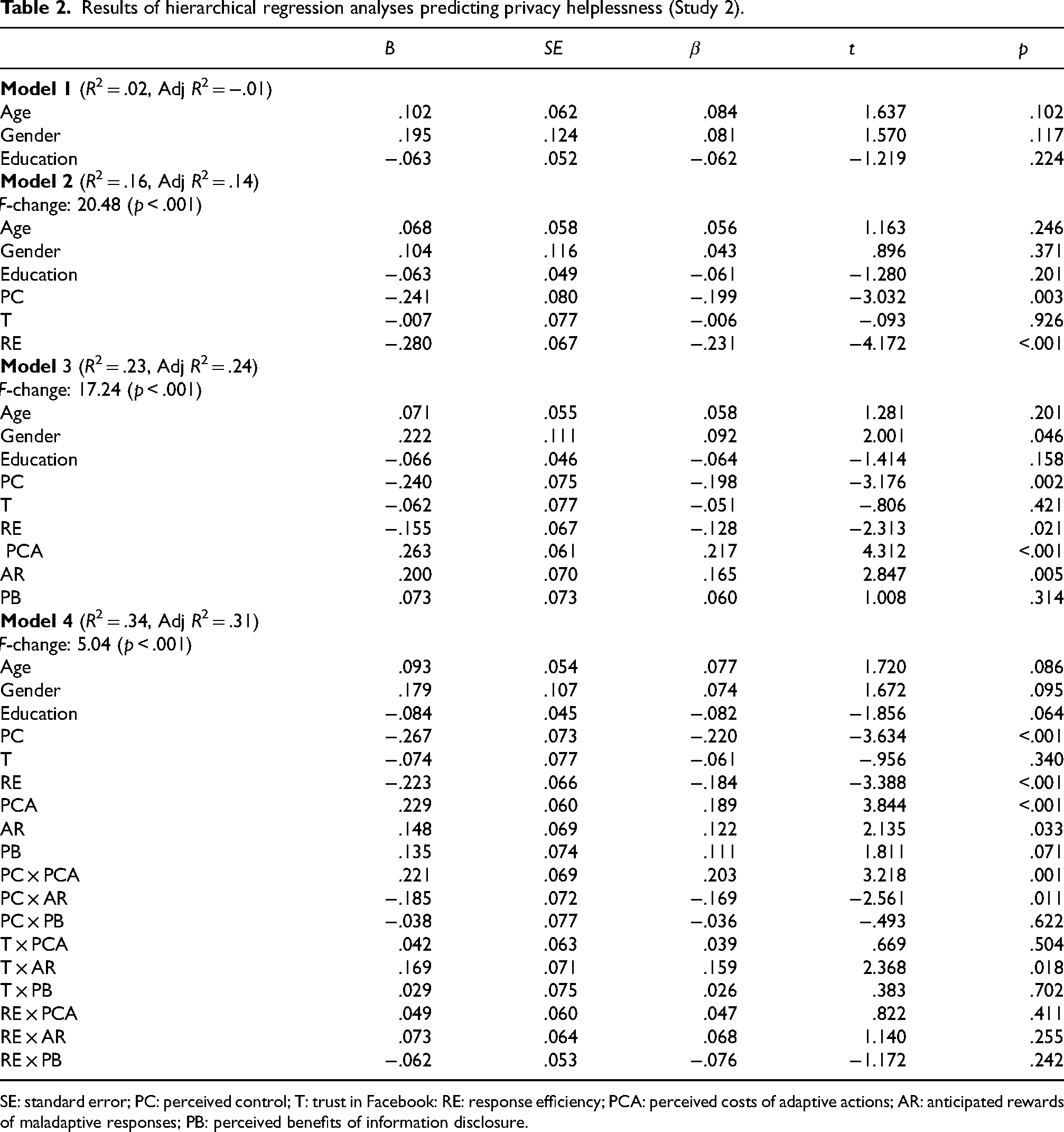
SE: standard error; PC: perceived control; T: trust in Facebook: RE: response efficiency; PCA: perceived costs of adaptive actions; AR: anticipated rewards of maladaptive responses; PB: perceived benefits of information disclosure.
Measures
Study 2 employed the same set of variables used in Study 1. To accurately reflect the context of mobile application use, slight modifications were made to the wording of the original survey items, and several new items were added to the survey scales. Given that the purpose of Study 2 is to extend Study 1 rather than directly replicate or compare the two, slight modifications of survey measures were deemed acceptable. Nonetheless, efforts were made to ensure that the meaning of the variables remained consistent across both studies.
Privacy helplessness beliefs were assessed on an 8-item scale (M = 4.45, SD = 1.21, α = .89). A sample item includes “Almost any activities through mobile applications lead to privacy loss.” Perceived information control was evaluated using a four-item scale (M = 4.66, SD = 1.32, α = .94). A sample item includes “My personal information disclosed via mobile application is under my control.” Response efficacy beliefs were assessed using a four-item scale (M = 5.29, SD = 1.02, α = .91). A sample item includes “When using mobile applications, I believe that there are effective ways of reducing my likelihood of losing privacy.” Trust in providers was assessed using a four-item scale (M = 3.81, SD = 1.44, α = .95). A sample item includes “Mobile application providers do their best to protect my personal information.” Perceived costs of adaptive actions (M = 3.87, SD = 1.52, α = .91) were assessed on a five-item scale of which a sample item included “When using mobile applications, protecting myself from privacy risks requires a considerable amount of effort.” Anticipated rewards of maladaptive responses were evaluated using a three-item scale (M = 4.22, SD = 1.51, α = .95) of which a sample item includes “By loosening my control over privacy in mobile applications, I can enjoy more advanced mobile app features.” Perceived benefits of information disclosure were assessed using a three-item scale (M = 5.90, SD = 1.02, α = .87). A sample item includes “Providing personal information to mobile apps will help me get personalized services.”
Results
Similar to Study 1, Study 2 tested the same research model and hypotheses using hierarchical multiple regression analyses. Table 2 presents a summary of the results. With regard to the main effects, four out of six predictors were significantly associated with privacy helplessness. Specifically, perceived control (B = −.27, p < .001) and response efficacy beliefs (B = −.22, p < .001) were negatively associated with privacy helplessness whereas perceived costs of adaptive actions (B = .23, p < .001) and anticipated rewards of maladaptive responses (B = .15, p = .033) were positively associated with privacy helplessness. Hence, H1, H3, H4, and H5 were supported.
However, trust in mobile application providers (B = −.07, p = .340) and perceived benefits of information disclosure (B = .14, p = .071) were not significantly associated with privacy helplessness. Therefore, H2 and H6 were not supported.
Regarding Research Question 1, the results showed three significant two-way interaction effects between two sets of factors. Specifically, the interaction between perceived control and perceived costs of adaptive actions (B = .22, p = 001), between perceived control and anticipated rewards of maladaptive responses (B = −.19, p = .011), and between trust in providers and anticipated rewards of maladaptive responses (B = .17, p = .018) were statistically significant.
The significant interaction effects observed in Study 2 were further examined using interaction plots (refer to Figures 6 to 8). Figure 6 illustrates the interaction effect between anticipated rewards of maladaptive responses and trust in providers. Consistent with the interaction pattern observed in Study 1 (Figure 3), the effect of anticipated rewards was stronger when the level of trust in providers was high rather than low.

Two-way interaction plot between anticipated rewards of maladaptive responses and trust in provider.

Two-way interaction plot between anticipated rewards of maladaptive responses and perceived control of personal information.

Two-way interaction plot between perceived costs of adaptive responses and perceived control.
Figure 7 illustrates the interaction between anticipated rewards of maladaptive responses and perceived control. In line with H5, high levels of anticipated rewards generally led to privacy helplessness. The effect of anticipated rewards of maladaptive responses was mitigated (vs. reinforced) when individuals had higher (vs. lower) levels of privacy control. It appears that the effect of directional motivated reasoning is suppressed by a factor related to rational evaluation.
Figure 8 displays a two-way interaction between perceived costs of maladaptive responses and perceived control. The results mirror the pattern observed in Study 1 (refer to Figure 4). In essence, the significance of perceived costs is amplified when individuals believe they have control over the information. This is because, for users perceiving high privacy control, the perceived costs of taking these adaptive actions carry more personal weight.
Discussion of the findings of Study 2
In Study 2, the results generally support those of Study 1, indicating that both factors associated with the rational evaluative model and the motivated reasoning model significantly predict privacy helplessness. Consistent with Study 1, the findings of Study 2 reveal that these two processes function simultaneously and have an interactive effect by suppressing or enhancing each other's impact. In sum, three significant main effects (H1, H4, and H5) and two interaction effects involving the same set of factors were observed in both Study 1 and Study 2, suggesting the consistency of the findings.
While slight variations were noticed in Study 2 in terms of specific significant predictors, the fundamental relationship patterns and their implications remained consistent. It is assumed that the disparities between the two studies could be due to variations in measurement items or the examination of privacy helplessness in distinct contexts and timeframes. Nonetheless, the outcomes of Study 2 bolster the robustness of the research findings and their implications. The findings of Study 2 demonstrated the utility of the integrative research model developed to examine privacy helplessness in a different communication technology use context.
General discussion
The issue of privacy and the factors that influence individuals’ attitudes and behaviors toward privacy have been the subject of extensive research in recent years. One theoretical perspective that has emerged in the literature is the notion of privacy helplessness and resignation. The present study sought to expand upon the existing literature on privacy helplessness by proposing and testing an integrative research model that concurrently examines rational evaluative processes and motivated or biased processes.
Overall, the findings underscore the importance of an integrative approach to understanding privacy helplessness, particularly the cognitive aspect of it. Privacy helplessness is predicted by factors related to relatively thoughtful assessments regarding agency, external party, and the overall environment. Notably, perceived control exhibited significance across both Study 1 and Study 2, underscoring its consistent impact. Trust in service providers and response efficacy were significant predictors of privacy helplessness in Study 1 and Study 2, respectively. Taken together, these findings imply that individuals’ evaluation of their capacity to control personal information, the trustworthiness of service providers, and the effectiveness of privacy safeguards shape the extent to which users perceive and experience privacy helplessness. These findings are consistent with the literature that has highlighted the importance of trust and control in the formation of privacy attitudes and behaviors (Hajli and Lin, 2016; Lutz et al., 2020).
Additionally, perceived costs and anticipated rewards were found to be significant predictors of privacy helplessness in both social media and mobile application use contexts. Motivated by a desire to maximize rewards or minimize costs, users tend to display imprudent online behavior or exhibit privacy resignation, rationalizing that privacy loss is inevitable and efforts toward privacy management are futile. This is in line with prior research that has underscored the significance of motivated reasoning and biased processing in the development of privacy attitudes and behaviors (Acquisti et al., 2015). Individuals face substantial uncertainty regarding privacy, such as the degree of concern they should have about privacy or the appropriateness of specific privacy actions, which fosters biased judgments and decision-making related to privacy (Acquisti et al., 2015).
Overall, these findings build on previous research on privacy helplessness and privacy cynicism, which has shown that individuals may experience helplessness due to a range of factors, such as a lack of awareness of privacy risks, a lack of control over their personal information, concerns about the credibility of providers, and needs to justify their information sharing to participate in digital capitalism (Cho, 2022; Draper and Turow, 2019; Lutz et al., 2020).
The current study holds a unique position as it emphasizes the interplay between rational evaluative and motivated/biased processes in shaping privacy helplessness. It unravels significant interaction effects between these processes, shedding light on how they can either strengthen or weaken each other's impact on privacy helplessness. To summarize, most of the interaction patterns observed in both Study 1 and Study 2 align with either the suppression model or the reinforcement model of interaction. These models illustrate how the two mechanisms can either mitigate or amplify each other's effects, contingent upon the specific contexts of the interactions in question.
These findings carry significant implications for research. First, the study highlights the importance of considering both directional motivated reasoning and rational evaluation processes in understanding privacy helplessness or resignation. Focusing on only one mechanism can obscure the complexity of the relationships and processes involved in privacy helplessness as described above. A crucial question is whether the two processes represent opposing conditions on a bipolar continuum, with individuals experiencing either rational evaluative or biased/motivated reasoning processes. The results of this study suggest a different perspective. In other words, the findings indicate that individuals can experience both processes simultaneously, and the prevalence of each process or the interaction between them seems to determine the degree to which people experience privacy helplessness.
As previously highlighted, it is crucial to emphasize that the distinction between two mechanisms, along with the factors associated with them, is not absolute and lacks mutual exclusivity. As posited by the dual process theories of choice and judgment (e.g. Petty et al., 1986), a factor associated with rational evaluation or judgments may also serve as a heuristic cue in biased processing, contingent upon the specific situation or individual involved. Therefore, nuanced interpretation is essential for the findings of the present study. While acknowledging the inherent complexity, the present study maintains the assumption that the conceptual distinction remains significant as this perspective provides a foundational basis for the theoretical exploration of the diverse and dynamic cognitive mechanisms contributing to privacy helplessness.
Privacy researchers underscore the need to test the applicability of findings across various technological contexts because privacy is context-specific (Nissenbaum, 2004). In light of this, the present study conducted Study 1 and Study 2, examining privacy helplessness in two user contexts: social media (Facebook) use and mobile application use. The results from both studies exhibited a considerable degree of consistency, as the observed patterns and their implications remained largely unchanged across the two studies. These consistent findings suggest that the research model proposed in this study is rather robust and can be effectively applied to diverse technology use contexts in future research. Nevertheless, both social media and mobile applications offer a wide range of features, some of which may overlap. This overlap may limit the extent to which the findings can be generalized to different usage contexts.
While Study 1 and Study 2 yielded similar findings, the differences observed between the two studies warrant a more thorough examination. Notably, trust emerged as a significant predictor of privacy helplessness in the context of Facebook use (Study 1), whereas it did not show the same significance in mobile app use (Study 2). One possible explanation for these divergent findings is the prominence of Meta/Facebook as a well-established company. In Study 1, trust in this recognized provider may have had greater diagnostic value. On the other hand, mobile apps are offered by a diverse range of companies, and trust in these various entities seemed to play a relatively minor role in Study 2. However, it is important to acknowledge that any conclusions drawn based solely on contextual differences may be premature, as there are other potential confounding variables at play. These variables could include variations in measurement items, differences in the sampling frame, and variations in the timeframe of the studies, all of which might have contributed to the variations observed between Study 1 and Study 2. To gain a deeper understanding of context-specific privacy helplessness and its potential variations across diverse technology use contexts, future research should investigate more distinct usage contexts.
The findings of the present study carry practical implications. In essence, they suggest that interventions aimed at alleviating privacy helplessness should take into account multiple factors and their intricate interactions. For example, strategic initiatives could concentrate on bolstering individuals’ perceived control over their privacy, while concurrently providing effective methods to reduce the perceived costs associated with implementing privacy actions. This approach is crucial because a heightened perceived level of control might paradoxically contribute to increased privacy helplessness when the costs of taking privacy actions are perceived to be substantial, as illustrated in the present study's findings.
To put these principles into practice, service providers are encouraged to consider the implementation of user-friendly privacy wizards or assistants that guide users through the process of configuring their privacy settings with ease. These tools can employ straightforward questions and provide recommendations based on the user's preferences. It is also important to ensure that privacy settings on platforms are easy to understand, avoiding complex terminology and offering clear, concise explanations for each setting. Additionally, users should be given the option for a quick, one-click privacy enhancement, such as a “Privacy Boost” button, which can instantly tighten their settings without the need for extensive configuration.
Limitations and directions for future studies
Several limitations of this study warrant attention. Firstly, the cross-sectional nature of the study constrains our capacity to infer causality regarding the relationship between the two mechanisms and privacy helplessness. To better comprehend the relationship between these variables, future research should employ longitudinal designs. Secondly, the study employed self-report measures, which might be susceptible to social desirability bias or recall errors. Future research could incorporate objective measures of privacy behaviors associated with helplessness, such as monitoring individuals’ online activities over time. Lastly, the study was conducted in the US, which may limit its generalizability to other cultural contexts. Future research should investigate the cross-cultural variability in the relationship between the two mechanisms and privacy helplessness.
Conclusions
Privacy is not just a fundamental human value but also an essential right. However, the widespread sense of privacy helplessness can hinder individuals from taking the appropriate actions and responses. The present study makes a substantial contribution to our understanding of privacy helplessness by unveiling the theoretical mechanisms and their interactions that underlie this phenomenon. It is hoped that this multifaceted research approach will aid in the development of a more comprehensive theoretical framework, ultimately enhancing our understanding of the intricate dynamics that govern online privacy helplessness.
Supplemental Material
sj-pdf-1-bds-10.1177_20539517241237485 - Supplemental material for The interplay of rational evaluation and motivated reasoning in privacy helplessness: An integrative approach
Supplemental material, sj-pdf-1-bds-10.1177_20539517241237485 for The interplay of rational evaluation and motivated reasoning in privacy helplessness: An integrative approach by Hichang Cho in Big Data & Society
Footnotes
Declaration of conflicting interests
The author declared no potential conflicts of interest with respect to the research, authorship, and/or publication of this article.
Funding
The author received no financial support for the research, authorship, and/or publication of this article.

Supplemental material
Supplemental material for this article is available online.
References
Supplementary Material
Please find the following supplemental material available below.
For Open Access articles published under a Creative Commons License, all supplemental material carries the same license as the article it is associated with.
For non-Open Access articles published, all supplemental material carries a non-exclusive license, and permission requests for re-use of supplemental material or any part of supplemental material shall be sent directly to the copyright owner as specified in the copyright notice associated with the article.
