




Abstract
This study aims to reveal patterns of e-petition co-signing behavior that are indicative of the political mobilization of online “communities”. We discuss the case of We the People, a US national experiment in the use of social media technology to enable users to propose and solicit support for policy suggestions to the White House. We apply Baumgartner and Jones's work on agenda setting and punctuated equilibrium, which suggests that policy issues may lie dormant for periods of time until some event triggers attention from the media, interest groups, and elected representatives. In the case study presented, we focus on 21 petitions initiated during the week after the Sandy Hook shooting (14–21 December 2012) in opposition to gun control or in support of policy proposals that are alternatives to gun control, which we view as mobilized efforts to maintain stability and equilibrium in a policy system threatening to change. Using market basket analysis and social network analysis we found a core group of petitions in the “support law-abiding gun owners” theme that were highly connected and four “communities” of e-petitioners mobilizing in opposition to change in gun control policies and in favor of alternative proposals.
Keywords
Introduction
Over the past decade, electronic petitioning systems have become stable features of national governments in Scotland, Great Britain, Germany, and Australia. In September 2011, the Obama Administration introduced its own electronic petitioning (e-petitioning) effort with the inauguration of We the People (WtP, see https://petitions.whitehouse.gov/), a web-enabled system that gives individuals the opportunity to petition the US federal government for actions of the petitioner's choosing and to register signatures from supporters.. Although popular from the outset, interest in WtP skyrocketed in November 2012 following the US presidential election and has continued, attracting thousands of petition initiators as well as millions of petition signers to the website. As of January 2013, over 5.4 million individuals had created accounts on the system, doubling the number of account holders since August 2012 (Phillips, 2013). As of September 2014, the system had attracted over 15 million total users, more than 22 million signatures for over 350,000 petitions, and registers an average of over 20,000 signatures a day (Mechaber, 2014, 23 September).
Key to some of the interests in WtP is the Obama Administration's pledge to respond to any petition that attracts more than a threshold number of signatures within a 30-day period. In practice, a very small percentage of petitions achieve this goal. However, social and political advocates can focus attention on their issues by launching petitions that become popular and ultimately successful. WtP administrators encourage e-petition initiators to use the web and social media to spread the word about their petitions and drive potential signers to the WtP website in hopes of achieving the threshold required for the Administration's response. Further magnifying these efforts, popular petitions have come to be covered by the press, making it possible for an issue's audience to grow substantially.
Over the brief history of WtP, frivolous and silly e-petitions have been initiated, to the general entertainment of all. However, it is also possible to view government e-petitioning as a practice through which individuals ask government to take an action or make a decision that solves a problem or improves their lives; when petitions make such requests, they fall into the domain of public policy (Birkland, 2011). Indeed, e-petitions that make specific policy suggestions to government may be viewed as acts of participation in problem identification, the initial phase of the policy making process. Soliciting petition signatures may be viewed as part of a further policy making phase, that of positioning a petition within the broader national policy agenda.
The data created through e-petitioning—petition texts, signatures collected over time, signers' characteristics (if available), and messages used by initiators to solicit signatures (tweets or other posts)—falls within the domain of “Big Data,” as others have noted (Hale et al., 2013; Jungherr and Jürgens, 2010). This is partly because the data streams generated by petitioning behavior may be large and evolve rapidly. But beyond simple volume and velocity, e-petitioning data tracks human action of a relatively novel kind, representing digital traces or footprints that document the ideas, political and otherwise, that individuals have expressed and supported, rather than their recollections of behavior or responses to a researcher (Bail, 2014). Initiating and signing petitions, and related activities, are behaviors with the potential to elicit other consequential actions. For example, the Obama Administration has credited e-petitions launched in January 2012 with “crystallizing” their position on Stop Online Piracy Act (SOPA) legislation then under consideration by the US Congress (Phillips, 2012). E-petitioning research is a contribution to the new “computational social science,” in which social and computer scientists partner to explore the social implications of the dissemination, patterning, structures, textual features, etc. of Internet-generated behavior (Giles, 2012; Lazer et al., 2009).
While not all e-petitions necessarily address policy issues, many of those created on WtP assuredly do. In this study, we conceptualize e-petitioning as collective political action within policy agenda setting processes and explore the dynamics and structures of e-petition signature data. Policy agenda setting theory (Baumgartner and Jones, 1993, 2009) suggests that policy issues may lie dormant for periods of time until some “focusing event” elicits extraordinary attention from issue advocates, the media, and ultimately elected representatives. Indeed the media may play an important role in these processes by focusing attention on and making particular issues salient to the public, whether the issues are novel or have been previously ignored (Wolfe et al., 2013). Such focusing events may further stimulate a process of mobilization that contributes to the definition and interpretation of the event, unless countered by “negative feedback” of several types, which may over time restore the system to equilibrium, without the policy change that had been sought.
This type of phenomenon appears to be evident following the deaths of 26 children and school personnel on Friday, 14 December 2012 at the Sandy Hook Elementary School in Newtown, Connecticut in the use of e-petitioning on WtP to stimulate a national conversation about gun control and e-petitioning intended to forestall such an action. In the week following the shootings, numerous petitions were initiated on WtP suggesting a wide range of actions for preventing such tragedies in the future, some of which focused explicitly on strengthening gun control, while others proposed alternative policy responses. Numerous petitions were also initiated that cautioned against precipitous gun control actions. By Friday, 21 December 2012, President Obama issued a formal videotaped response to a set of 33 petitions that advocated for and against gun control and that made alternative policy proposals in response to Sandy Hook; together, the set of petitions attracted 503,125 signatures. Following this response, the White House “retired” all 33 of these petitions so they were no longer able to be signed.
In the case study that follows, we explore how e-petitioning functioned as collective political action in mobilizing support for and against gun control, along with other policy options, in the aftermath of the Newtown tragedy. We begin by characterizing e-petitioning as an Internet-based tool for mobilizing collective action. Then, using policy agenda setting theory, we identify several concepts in the policy making process that may be mapped onto empirical events involving e-petitioning that took place during the week of 14–21 December 2012. In the case study that follows, we characterize the Newtown shootings as a “focusing event” with the potential to disrupt existing gun control policy equilibrium. The event gave rise to what turned out to be the single largest e-petition to appear on WtP up till that time, which ultimately attracted over 197,000 signatures, along with 11 other petitions also advocating gun control options.
However, we focus particularly on 21 petitions initiated during the week of 14–21 December 2012 in apparent counter-mobilization to gun control proposals as a policy response. Market basket analysis is used to explore questions about whether individuals who signed one anti-gun control petition also signed other anti-gun control petitions, suggesting that some signers might be engaged in more than random or singular petition signing. We also use social network analysis to determine if there are groups of individuals who sign similar anti-gun control petitions, thus suggesting the creation of “communities” of individuals whose actions were similarly aligned in opposition to gun control or in support of policy proposals that are alternatives to gun control.
E-petitioning and agenda setting
The Internet has become an effective means for organizing collective action with political consequences; considerable research attention is now devoted to exploring how such action is organized and unfolds. Studies of how Web 2.0 applications such as Twitter and Facebook are used for public e-participation as well as for mobilizing demonstrations and protest, both online and offline, are increasingly common; they often consist of social networking analyses that illuminate the social infrastructure that is the foundation for political action (Saebo et al., 2009).
Services such as Moveon.org and Change.org provide the technical infrastructure to simplify petitioning, as well as practical suggestions for targeting governments at all levels, corporations, and seemingly any other organization that comes under public scrutiny. Because it is a quick, simple, and accessible way to mobilize large numbers of activists to support a particular cause, e-petitioning has been referred to as “Protest 2.0” (Petray, 2011). As one tool within what has been called an “electronic repertoire of contention,” e-petitioning enables individuals to express their views and has the potential to create a sense of collective identity among loosely coupled advocacy groups (Rolfe, 2005; Strange, 2011). However, the very ease of e-petitioning has contributed to concern about its “slactivist” potential. Critics have wondered whether lowered transaction costs and the moral contentment of having contributed, however minimally, to publicizing a case might diminish the impacts of online activism and perhaps decrease offline democratic activism as well (Karpf, 2010; Morozov, 2009; Shulman, 2009). At this time, however, empirical studies of e-petitioning, its dynamics, and its consequences are quite rare.
Change.org and Moveon.org may be viewed as informal petitioning mechanisms since they are not subject to public law (Lindner and Riehm, 2009). However, in countries such as the US, government-sponsored e-petitioning systems enable a new form of direct communication between the public and policy makers that is subject to national law, but is unmediated by corporations, mass media, or political parties. Can such a tool be used by the public to participate in policy making? Public policy theory generally ignores the public, as Muhlberger et al. (2011) have concluded; however, e-petitioning offers a novel channel for the public to participate in policy making processes. We use some of the concepts in agenda setting theory to conceptualize how e-petitioning may contribute to the policy making process, as others have also done (Hale et al., 2013).
Policy agenda setting
Why do some policy issues produce radical changes in legislation, while others are neglected entirely or become locked over time within stable and exclusive institutional contexts? Agenda setting theory (Baumgartner and Jones, 1993, 2009) depicts the policy making process as characterized by both stability and change. Stable policy systems are marked by allegiance to the status quo, by the difficulties of marshaling change in a political system of checks and balances, and by institutional structures that limit access to the policy process and are characterized by powerful political and ideological understandings that resist alternative interpretations (Baumgartner and Jones, 2009; Jones and Baumgartner, 2005). Such systems operate at “equilibrium” until something happens in the environment that compels the attention of the excluded or the disinterested, unleashing new interests and alternative interpretations with the potential to undermine the status quo. This sequence of triggering event and subsequent attention functions as “positive” feedback, helping an issue to gain access to the political agenda, and potentially leading to major policy changes that disrupt or “punctuate” the equilibrium. But such events do not inevitably subvert policy monopolies, since access to the agenda does not guarantee major change (True et al., 2006). Challenging groups may be checked and countered by powerful institutional and macro-political forces. These counter-mobilizing moves can function as “negative” feedback, which may ultimately maintain system equilibrium (Baumgartner and Jones, 2009; True et al., 2006).
The policy agenda thus reflects the attention paid to particular issues, which can be increased by “focusing events” that can “cause issues to shoot high onto the agenda in a short period” (Baumgartner and Jones, 2009: 10). A focusing event “is sudden; relatively uncommon; can be reasonably defined as harmful or revealing the possibility of potentially greater future harms; has harms that are concentrated in a particular geographical area or community of interest; and that is known to policy makers and the public simultaneously…” (Birkland, 1998: 54). Focusing events can be characterized as indicators of policy failure by issue advocates in an attempt to broaden and mobilize their audience and move their issue to the forefront of the political agenda. On the other hand, status quo groups may well respond with counter-mobilization in an effort to preserve their interests.
Information and media
More recently, agenda setting theorists have considered how information and media affect the attention processes at the heart of the theory. Indeed, the idea of punctuated equilibrium over time has morphed into a more general theory of government information processing, since problem identification is fundamentally dependent on information flows (Jones and Baumgartner, 2012). However, policy makers are incapable of attending to all available information; their processing is “disproportionate” tending generally toward stability and under-reaction until “a scandal or crisis erupts…and they scramble to address the issue” (p. 7). Media can amplify and weight some information over others, prime audiences with certain interpretational predispositions at the expense of others, and they can contribute to positive and negative feedback cycles. Focusing events might trigger increased news coverage, which then further stimulates the attention of both the public and decision makers (Wolfe et al., 2013) in a complex positive feedback cycle. Or issue advocates can take advantage of the priming function of media by selecting news frames that suggest policy problems to the public or new attributes of a problem that can change the focus of decision makers. However, extensive media attention over time can also function as negative feedback by slowing down the speed of legislative changes (Wolfe, 2012).
Agenda setting theory has yet to consider the impact of new media technologies, the effects of which may further complicate attentional processes. A traditional role of media is to create issue salience by focusing public and decision making attention; however new media technologies may set in motion “reverse” agenda setting processes. That is, some evidence is beginning to suggest that traditional media may take their cues from the online activities of the audience, such as the frequency of terms input to search engines, and shift their news coverage to coordinate with such interests (see, e.g. Ragas et al., 2014).
Narrative case study: E-petitioning in the aftermath of the Newtown tragedy
There has been no significant gun control legislation at the federal level since the passage of the Brady Act in 1993 and the Assault Weapons Ban in 1994. As Bennett (2013) discusses in his brief history of gun safety legislation, loopholes in existing legislation enable individuals to purchase guns without background checks. Further, the Assault Weapons Ban passed in 1994 expired in 2004, without subsequent renewal. Assessing the gun control debate at the state level in the time period directly prior to the Sandy Hook shootings, Cooper (2012) wrote, “The legal and political debate over the nation's gun laws was following a familiar trajectory: toward fewer restrictions.” None of the recurring incidents of gun violence, including the most recent incident in which Representative Gabrielle Giffords was shot and nearly died, had generated sufficient momentum for legislative action.
On the morning of Friday, 14 December 2012, a masked gunman broke into Sandy Hook Elementary School in Newtown, CT, and, using a Bushmaster .223 caliber AR-15 assault rifle, shot and killed 26 children and school employees. In the context of the relative equilibrium of firearms policy, the Newtown school shootings galvanized the attention of the country. Indeed, the story ranked first in USA Today's poll of top news stories in 2012 (positioned ahead of the election) (USA Today, 2012). Dan Gross, the president of the Brady Campaign to Prevent Gun Violence, declared shortly after the Newtown shootings, “We genuinely believe that this one is different…¨because no human being can look at a tragedy like this and not be outraged by the fact that it can happen in our nation. And because this time we're really poised to harness that outrage and create a focused and sustained outcry for change” (Cooper, 2012).
Within two hours after the shootings, two e-petitions were initiated on WtP. The first proposed (at 12:42 EST) to “Start the process to enact Federal Gun control reforms.” The second (at 13:17 EST) proposed to “Immediately address the issue of gun control through the introduction of legislation in Congress.” The URL of the latter petition, which we now know was initiated by David Glynn, was disseminated using his Tumblr account, because, as he commented in retrospect, “I knew if there ever were a tipping point for effective gun control, this would be it. So I wrote a petition” (Glynn, 2013).
As Friday afternoon progressed, media outlets on the web reported on the varieties of social media response to the shooting, prominently featuring signature accumulations for Glynn's petition. Non-partisan political website TechPresident reported that the petition had attracted 9888 signatures (Stirland, 2012), followed by a Washington Post blog reporting over 15,000 signatures by 5:25 EST (Jennings, 2012), which was “several thousand more than there were just 20 minutes before.” The Huffington Post reported that, amidst a “flood” of petitions to the White House website, Glynn's petition had “quickly surged past the 25,000 signatures for a White House response” (Wing, 2012). By 7:42 EST, ABCNews also reported that the petition had surpassed the 25,000 threshold, having acquired 31,000 signatures (Bruce, 2012). On 15 December 2012, the Atlanta Blackstar reported that signature accumulation had reached 43,000 (Gordon, 2012). By 16 December, the federal technology website Nextgov called Glynn's petition “the most popular ever posted” to WtP, having now accumulated 120,000 signatures (Marks, 2012). A Forbes blogger reported 122,000 signatures, noting that the petition was shared widely, “particularly on Facebook, where you could see quickly in your timeline which friends had signed it” (Watson, 2012). On 17 December 2012, ABC News reported that the petition, “one of the fastest moving on the site ever,” had been signed by 140,000 people (Stern, 2012). That same day, the Washington Post reported that, with 145,000 signatures, the petition was the “most popular in the 16 months” history of WtP (Nakamura, 2012). The Nation claimed that the Sandy Hook shootings were “driving the largest organic push for gun control in many years” as expressed through “calls for gun regulation on the White House website [which] had eclipsed every other topic over the past year;” Glynn's petition was reported as having achieved over 150,000 signatures (Melber, 2012). Salon reported that the petition had achieved almost 152,000 signatures “but the number grows every hour” (McDonough, 2012). Figure 1 visually displays the dramatic growth of petition signatures accumulated over its lifetime of seven days, as documented by articles in the media.
Daily signature accumulation for “Immediately Address” petition punctuated with online news articles following the petition.
In the meantime, petitions making other proposals in response to Newtown's shootings were also initiated on WtP, including petitions to reform the mental health system, to protect schools with armed guards, and to forestall further gun control legislation. These petitions also began to collect signatures. Ultimately, the most popular of these petitions stated: “We ask President Obama to support law-abiding gun owners in this time of tragedy;” it was initiated on 16 December 2012 and ultimately accumulated over 57,000 signatures.
Organizations soliciting signatures for “support law-abiding gun owners” petition (accessed 22 February and 16 July 2014).

One further indication of the amount of online activity related to e-petitioning following Newtown may be found in a number of tweets referencing one or more of these petitions. We found at least 9187 tweets sent between 14 and 21 December 2012 mentioning one or more of the Newtown-related WtP petitions initiated during this period.
On the morning of 21 December 2012, the White House issued a response to all 33 petitions initiated on WtP in response to Newtown taking the form of a videotaped message from President Obama explicitly addressing petition signers (Reed, 2012). The White House subsequently disabled all 33 petitions, making it no longer possible to register signatures. On the same day, the National Rifle Association (NRA) conducted a press conference in which Wayne LaPierre, executive vice-president of the NRA, called on Congress immediately to appropriate “whatever is necessary to put armed police officers in every single school in this nation” (Washington Post, 2012).
The remainder of the analysis that follows focuses on the set of 33 petitions addressed by the White House, which includes petitions that call for gun control legislation, as well as petitions that argue against gun control, that advocate improvements in mental health care, and that propose arming protectors within the school system. We argued in the narrative above that Sandy Hook, as a focusing event, stimulated e-petitioning activity in an effort by individuals to express policy preferences and influence decision making in response to Sandy Hook. In the analysis below, we suggest that some individuals initiated petitions to mobilize opposition to the apparent surge in support for gun control that followed the shootings, and that this activity can be seen in patterns of petition signatures revealed through data mining techniques. To support this claim, we were explicitly interested in exploring answers to the following research questions:
Can we find evidence of collective action by identifying consistent thematic policy preferences through a market basket analysis of petitioning signing behavior? Can we find evidence of e-petitioners mobilizing and forming core groups or “communities” that are characterized by particular policy preferences expressed as a result of the Sandy Hook shootings?
Data mining analyses: E-petitioning in the aftermath of Newtown
Data mining methods
Data mining refers to the process of discovering hidden patterns in data. It is widely used in many domains including business analytics, sociology, medicine, and weather forecasting. Under the umbrella of data mining, many different techniques have been developed for analyzing data and identifying patterns/trends that cannot be readily detected using standard statistical methods. In this paper, we use two of these techniques, namely market basket analysis and social network analysis, to analyze the data collected from the White House petitioning site. Market basket analysis and social network analysis provide related, but somewhat different, types of insights about the use of e-petitioning in this case. Brief overviews of these two techniques appear below; additional details can be found in many references (e.g. Easley and Kleinberg, 2010; Newman, 2010; Tan et al., 2006; Wasserman and Faust 1994).
Data description
Twelve pro-gun control petitions.

“Support Law-Abiding Gun Owners” petitions.

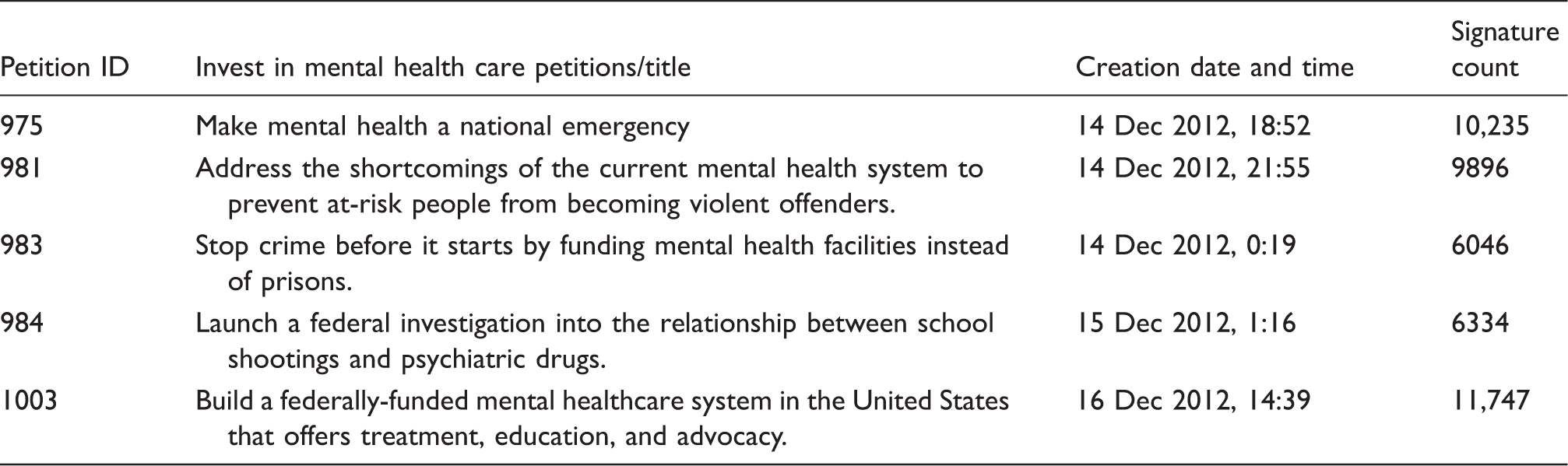
“Invest in Mental Health Care” petitions.
“Guard our schools” petitions.

Number of nodes for i number (1–15) of common petitions signed.

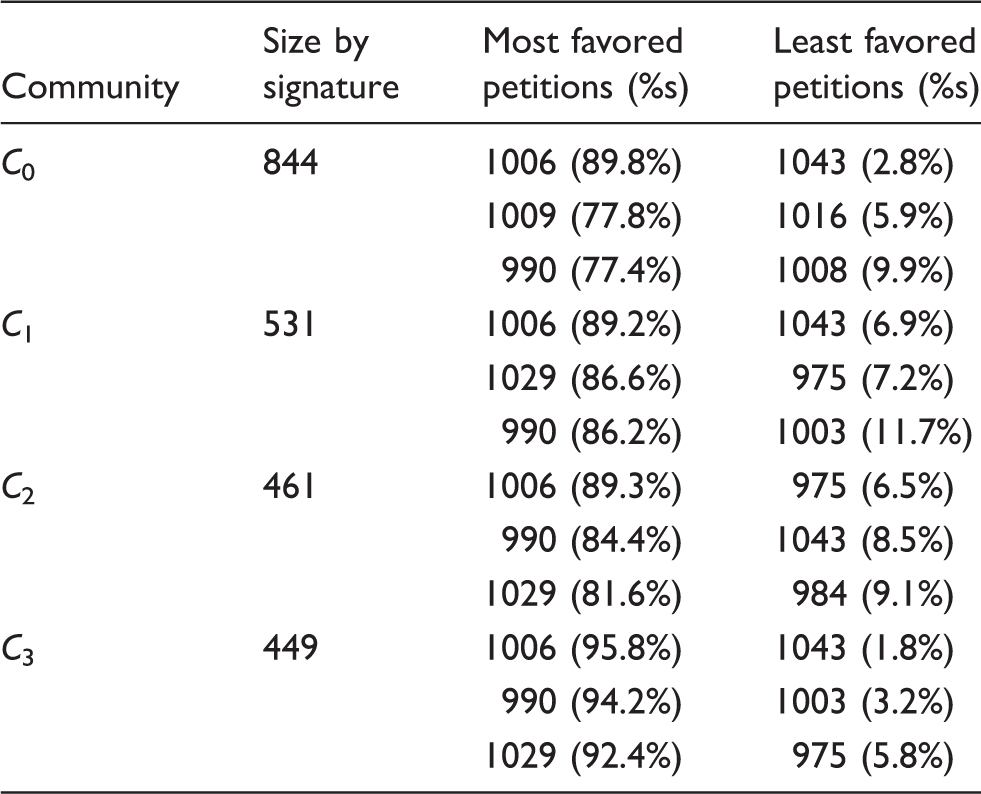
Community size and three highest and lowest signed petitions in the four communities with percentages of signers.
Percentage of petitions signed by the four communities.

We divided the petitions into two general groups differentiating between those that expressed a clear preference “pro” gun control and those that expressed other preferences; this produced a cluster of 12 “pro-gun control” petitions, and a remaining group of 21. The group of 21 was sorted further into three thematic clusters: a sub-group in support of law-abiding gun owners (“support law-abiding gun owners”); a sub-group advocating investment in the improvement of mental health care (“invest in mental health care”); and a final sub-group advocating using firearms to guard our schools (“guard our schools”). Tables 2 to 5 reflect this categorization.
Figure 2 enables one to get a temporal sense of when these two groups (“pro” gun control and those that expressed other preferences) signed the 33 petitions. It is apparent from this figure (and the data in Tables 3 to 5) that petitions in favor of gun control were registered largely in the first hours following the shootings. Some petitions in favor of mental health care and guarding the schools were registered later on 14 December while petitions advocating against gun control began to appear on 15 December. As mentioned earlier, petition 971 “Immediately address the issue of gun control through the introduction of legislation in Congress” in the “Pro” gun control laws group was created hours after the Sandy Hook shootings and garnered the most signatures (197,073) of all 33 of the gun control petitions. Additionally, petition 1006 “We ask President Obama to support law-abiding gun owners in this time of tragedy” was initiated on 16 December 2012 and garnered the most signatures (57,670) of the “Other” or those who expressed other preferences (See Table 3 which contains petition 1006. Note that the signature count in Table 3 for petition 1006 is 53,677. The signature data set we used for this analysis includes first and last initials and a valid 5-digit zip code.).
Signature count over time for 33 gun control petitions.
We began by asking whether individuals who signed “pro-gun control” petitions also signed petitions in any of the three other groups. Of the 316,311 distinct signers, the vast majority of those who signed a pro-gun control petition did not sign any petitions that were categorized in the anti-gun control group (which also contained petitions that advocated in favor of an alternative policy option). However, a subset of 24,156 individuals who signed one or more pro-gun control petitions also signed one or more petitions in the other group. Of these, 73% (17,754) signed at least one petition in the sub-group we categorized as “invest in mental health care” (i.e. petitions with IDs 975, 981, 983, 984, and 1003). The remaining 6402 signed petitions in one of the two remaining sub-groups. 2
The remaining analyses focus further on the 21 petitions appearing in these three groups (“support law-abiding gun owners”; “invest in mental health care”; and “guard our schools”), which received a total of 190,720 signatures. 3
Market basket analysis: A brief overview
The primary goal of market basket analysis is to identify patterns in the co-occurrences of objects. The basic idea can be readily understood through a simple example. Consider a supermarket, where each transaction (or market basket) consists of a set of items bought by a customer. By collecting and analyzing transactions that occur over a period of time, managers can identify sets of items that are frequently bought together by customers. Such sets of items can be placed in adjacent shelves to make it more convenient for customers to shop at the store.
A few definitions are needed to precisely describe the notion of frequent co-occurrence of objects in the context of supermarket data. Any set of items is called an itemset. As mentioned above, each transaction consists of a set of items bought by a customer. The support of an itemset S is the fraction of transactions that include all the items in S; that is, the support for S is the ratio of the number of transactions that include all the items in S to the total number of transactions. Any itemset S whose support exceeds a chosen support level is called a frequent itemset. Thus, frequent itemsets represent sets of items that are bought together often by customers.
In addition to frequent itemsets, analysis of market basket data can also reveal other patterns related to co-occurrences. For example, for some items x, y, and z, a large fraction of customers who buy items x and y may also buy z. Such patterns are captured through an association rule which is usually shown as {x,y} → {z}. The importance of an association rule is specified using a measure called confidence. The confidence of the association rule {x,y} → {z} is the ratio of the number of transactions that contain all the items x, y, and z to the number of transactions that contain the two items x and y. (Formally, confidence gives the conditional probability that a customer's basket contains item z given that it contains both x and y.) Thus, association rules with large confidence values also provide insights regarding co-occurrences.
Applying market basket analysis to petition data
We used market basket analysis on the data collected for the 21 petitions that do not reflect “pro-gun control” preferences. In our case, each person who signed at least one of the 21 petitions represents a market basket and the subset of the 21 petitions signed by the person represents the items in that basket. Since a total of 190,720 people signed one or more of these petitions, our dataset for market basket analysis consisted of more than 190,720 baskets, with each basket containing at most 21 items. A number of algorithms are known for identifying frequent itemsets and association rules (Tan et al., 2006). We used the algorithm discussed by Han et al. (2000) for identifying frequent itemsets since a public domain software tool based on this algorithm is available. We generated association rules and their confidence values using a software tool available at http://orange.biolab.si.
Results
We computed the confidence values of various association rules of the form {x} → {y}, where both x and y represent the IDs of one of the 21 petitions. For visualization purposes, we considered five different confidence values, namely 50%, 40%, 30%, 20%, and 10%. For each confidence value c, we constructed the following graph with 21 nodes: each node of the graph represents a petition ID and each edge x,y implies that the association rule {x} → {y} has a confidence value of at least c. The five graphs constructed in this manner are shown in Figure 3(a) through (e).
4
Association rules at various confidence levels. (a): 50% confidence level; (b): 40% confidence level; (c): 30% confidence level; (d): 20% confidence level; (e): 10% confidence level.
The nodes contain a petition ID and are colored according to our three thematic clusters: red: “support law-abiding gun owners”; blue: “invest in mental health care”; and green: “guard our schools”.
The following conclusions can be drawn by observing the structure of these graphs.
At the largest confidence value (50%), there is a core group of seven petitions (which can be characterized by the common theme “support law-abiding gun owners”), with petition 1006 playing a central role. (Petition 1006 has the largest number of signatures among the group of petitions considered here.) These petitions were highly connected on the basis of common signers and constituted a “frequent itemset”; petitions in the other two categories are not highly connected. That is, individuals signing a petition in this itemset were more likely to sign others in the set, but not petitions in the other two clusters.
When the confidence value is decreased to 40% additional associations appear among the core group and a few associations begin to appear between the core group and a couple of petitions that we characterize as “guard our schools”. (These petitions deal with arming teachers in school.)
As we decrease confidence level again to 30%, we see a group of three “invest in mental health care” petitions forming a cluster not connected to the main core. The two “guard our schools” petitions become more cohesive to the main core by connecting with more of the “support law-abiding gun owners” petitions.
At the 20% confidence level, the “invest in mental health care” cluster gets larger and connects to the main core. Even at a low confidence value of 10%, many of the petitions color-coded as green circles do not appear in association rules. These petitions fall into the category of “guard our schools”.
Our market basket analysis showed that three association rules involving petitions in the “support law-abiding gun owners” had the largest confidence value, namely 73%. The three association rules themselves are 990 → 1006, 1009 → 1006, and 1010 → 1006. We recall that petition 990 has the title “Not punish tens of millions of law-abiding gun owners with ineffective and unconstitutional assault weapons bans”; petition 1009 has the title “Dissolve any petitions on assault weapons ban as unconstitutional under Amendment II of the Constitution”; petition 1010 has the title “End gun free zones and We the People demand a vote on the Citizens Protection Act H.R. 2613”; and petition 1006 has the title “We ask President Obama to support law abiding gun owners in this time of tragedy”. The confidence value shows that 73% of the people who signed any of the petitions 990, 1009, and 1010 also signed 1006. We also note that the support for the itemsets {990, 1006}, {1009, 1006}, and {1010, 1006} derived from the association rules varied from 3% to 5%. Since the 21 petitions collected a total of 190,720 signatures, it follows that these three groups of petitions (each consisting of two petitions) were signed by 5700 to 9500 people.
These three rules provide evidence of a core group of people who are actively mobilizing in the “support law-abiding gun owners” category of policy issues, which would appear to be a reaction to the first two pro-gun control petitions 970 (“Start the process to enact Federal Gun control reforms”) and 971 (“Immediately address the issue of gun control through the introduction of legislation in Congress”). The latter, which has the most signatures of all 33 petitions having garnished 197,073 signatures, and, as discussed earlier in our analysis, was the topic of repeated news coverage in online media.
Among the “Invest in mental healthcare” petitions, the association rule with the highest confidence value is 983 → 981. We recall that petition 983 has the title “Stop crime before it starts by funding mental health facilities instead of prisons” and 981 has the title “Address the shortcomings of the current mental health system to prevent at-risk people from becoming violent”. This rule has a confidence value of 48%. The itemset {981, 983} has a support of 2.4%, indicating that these two petitions were co-signed by more than 4575 people. The rule with the second highest confidence value is 983 → 1003, where petition 1003 has the title “Build a federally-funded mental healthcare system in the United States that offers treatment, education and advocacy”. This rule had a confidence value of 32% and the itemset {983, 1003} had a support of 1.6%, indicating that these two petitions were co-signed by about 3050 people.
In summary, we note that market basket analysis of e-petition data is helpful in identifying strong relationships among the petitions and therefore meaningful thematically based patterns in petition signing behavior.
Social network analysis: A brief overview
Large-scale networks are ubiquitous in modern society; examples include the Internet, friendship networks (such as Facebook), professional networks (such as LinkedIn), and social media networks such as Twitter. Social network analysis provides methods to understand the roles of participants and the nature of interactions among the participants in such networks. These methods have been applied to study behaviors in various networked systems such as computer communication networks, biological networks, economic networks, and terrorist networks (Newman, 2010; Wasserman and Faust, 1994).
The notion of centrality, introduced by Freeman (1979), is commonly used to characterize the level of importance of a participant in a social network. Freeman's seminal paper and subsequent work by other researchers have identified a variety of centrality measures for social networks (Newman, 2010; Wasserman and Faust, 1994). We provide a short description of three centrality measures (namely, closeness centrality, betweenness centrality and eigenvector centrality) used in our work. Precise mathematical definitions of these measures, their properties, and applications are discussed in Wasserman and Faust (1994), Newman (2010), and Easley and Kleinberg (2010).
In a social network modeled as a connected undirected graph, there may be many paths between any pair of nodes. A shortest path between a pair of nodes is one that uses the smallest number of edges. For any node v, its closeness centrality is defined as the reciprocal sum of the shortest path in distances from v to all other nodes of the graph. As discussed in Wasserman and Faust (1994) and Newman (2010), nodes with high closeness centrality values may have more direct influence on the other nodes of the network. The betweenness centrality measure for a node v provides an indication of how frequently the node appears in shortest paths between other pairs of vertices. Nodes with high betweenness centrality values in a network are important because they can control the communication between many pairs of nodes in the network (Newman, 2010). The eigenvector centrality measure, as demonstrated by Bonacich (1972, 2007), is an extension of degree centrality; the latter simply counts the number of neighbors of a node and does not account for the possibility that different neighbors may have different levels of importance in the network. Eigenvector centrality is defined through an iterative computational procedure on the network and explicitly accounts for the differences in the importance levels of the neighbors of each node. It has been shown (Bonacich, 1972; Newman, 2010) that when the procedure converges, the values assigned to nodes correspond to the eigenvector of the largest eigenvalue of a certain matrix that represents the given graph. The well-known page rank measure for web pages is based on eigenvector centrality (Easley and Kleinberg 2010; Newman 2010).
The notion of community (or cluster) is used to identify a group of nodes with similar behavior in a social network. There are several ways to define similarity in behavior and algorithms are available for partitioning the nodes of a social network into communities according to those definitions (Newman, 2010). In the section titled “Community detection”, we will provide a brief discussion of the algorithm (called the Louvain Algorithm) used in our work.
Applying social network analysis to petition data
From the petition data, we constructed an appropriate social network (an undirected graph) that enabled us to identify highly central participants and groups of similar participants. To ensure that our conclusions were not affected by users who exhibited low levels of petitioning activity, we restricted the network to users who signed at least seven of the 21 petitions that did not reflect “pro-gun control” preferences. Thus, in the constructed network, each node represents a person who signed at least seven petitions. An edge was added between two nodes if the corresponding pair of users co-signed at least seven petitions. The resulting graph had 2285 nodes and 487,336 edges.
The graph consists of two connected components containing 2267 and 18 nodes, respectively. Thus, the larger component (called the giant component) of the network consisted of a very large fraction (99.21%) of all the nodes. This behavior is exhibited by most social networks considered in the literature (Easley and Kleinberg, 2010).
In the above discussion, we considered a social network in which each node represents a person who signed at least seven petitions. Table 7 shows how the number of nodes in the graph drops rapidly as we increase the level of petition signing activity from 1 to 15. (In the table, we use G i to denote the graph where each node represents a person who signed at least i petitions.)
Table 6 also shows that out of the 21 gun control petitions garnering a total of 190,720 signatures, 26,895 people (14%) signed more than one petition in the set. After two petitions, the number of people signing more petitions decreases rapidly. Over 5000 individuals signed five petitions and 2285 signed seven petitions, while far fewer individuals signed substantially more petitions. We see that 80 people signed at least 15 petitions, 127 people signed at least 14 petitions, 178 people signed at least 13 petitions, and 278 people signed at least 12 petitions. Conversely, we see that most people (163,825 = 190,720 − 26,895) signed only one petition. Clearly, individuals with such radically different signing behaviors would seem to have differential investments in the petitioning process during this event.
After constructing the network for people signing at least seven petitions (G7), we computed three centrality values (namely, closeness, betweenness and eigenvector) for each node. These computations were carried out using CINET, an interactive software tool for network analysis, developed by the Network Dynamics and Simulation Science Laboratory (NDSSL) of Virginia Tech. For each centrality measure, we computed the set of 500 nodes with the highest values. We found that 416 of the 500 nodes (i.e. 83.2%) appeared in all three sets, indicating the group of nodes playing an important role in determining the behavior of the network are roughly the same, no matter which of the three centrality measures is used to find such nodes. We also computed these centrality measures for the top 500 nodes for graph G8 (where each node represents a person signing at least 8 petitions). We found that 439 nodes (i.e. 87.8%) appeared in all three sets. These results are very similar to the centrality measures for individuals in network G7.
Community detection
We used a software tool (Blondel, 2011) for identifying communities in a network. This tool implements a well-known algorithm, called the Louvain Algorithm (Blondel et al., 2008), for finding communities. In a social network, each community consists of a subset of nodes and there is no overlap between different communities. In general, the connections between nodes of each community are more dense compared to their connections to nodes outside the community. This informal notion of connectivity can be formalized in many ways to express the community detection problem as an appropriate optimization problem on the social network (Newman, 2010). The Louvain Algorithm uses a formalization based on maximizing a graph theoretic measure called modularity. This algorithm performs well in practice and has been used in a number of studies (Blondel, 2011). For our social network, the Louvain Algorithm found four communities, denoted by C0, C1, C2, and C3, with sizes shown in Table 7. We also used two variants of this algorithm (Louvain Algorithm with multi-level refinement and smart local moving) and the results were basically the same. We chose to report the results for the original Louvain Algorithm.
For each community, we computed the three most favored petitions (i.e. the petitions which had the three highest signature counts among the people in the community) and the three least favored petitions (i.e. the petitions which had the three lowest signature counts among the people in the community). In order to further qualitatively distinguish between the four communities, we calculated the percentage of people within each community that signed each petition (the three most favored and the three least favored) by taking the ratio of the number of people that signed each petition to the number of people in each community. Table 7 shows the results of these computations.
There are two petitions that were most favored by all four communities: 990 (“Not punish the tens of millions of law-abiding gun owners with ineffective and unconstitutional assault weapons / bans) and 1006 (“We ask President Obama to support law-abiding gun owners in this time of tragedy”). Petition 1029 (“Keep guns in America! No weapons ban!”) appears among the most favored petitions in C1, C2, and C3 but not in C0. All three of these petitions fall within the category of “support law-abiding gun owners” and suggest a strong mobilization of opposition to gun control laws across all four communities.
Two petitions stand out as being least favored. Petition 1043 (“Place police officers and metal detectors in all of our schools”) appears among the least favored petitions in all four communities. Petition 975 (“Make mental health a national emergency”) appears among the least favored petitions in three of the four communities, C1, C2, and C3. These petitions fall into the other two categories which are alternative policy proposals within the counter mobilization to gun control: “guard our schools” and “invest in mental healthcare”, respectively. These results are not surprising since they are the alternative policy proposals; in other words, one might suspect that the main purpose of these petitions was to prevent the pursuit of gun control laws. However, there is evidence of a core group of people in C0 that are mobilizing to support the “invest in mental healthcare” policy issue. This is demonstrated by the fact that it was signed by 33% of the people in C0. Two other petitions that fall into “invest in mental healthcare” – 1003 (“Build a federally-funded mental health system in the United States that offers treatment, education, and advocacy”) and 984 (“Launch a federal investigation in to the relationship between school shootings and psychiatric drugs”) – are supported by 42.8% and 34%, respectively, of the people in C0.
Petition 1008 (“Hire military veterans as armed resource officers in all public schools throughout America”) (under the theme “guard our schools”) appears among the least favored petitions in C0. (It was signed by only 9.9% of the people in C0.) It is the fourth least favorite petition (signed by only 7.12% of the people) in C3. However, it has a significant signature count in C1 (48.9%) and C2 (58.8%).
Petition 1016 “Stop demonizing guns” also appears among the least favored petitions in C0. (It was signed by just 5.9% of the people in C0.) In C1, C2, and C3, this petition was signed by 23.9%, 16.27%, and 34% of the people, respectively.
For each support level p (expressed as a percentage of the size of a community), Table 8 shows the set of petitions that were signed by at least p percent of the people in the community.
We now observe that the above Table 8 provides additional evidence of mobilization against the pursuit of gun control laws. For example, “Support law-abiding gun owners” petitions 1006 (“We ask President Obama to support law-abiding gun owners in this time of tragedy”), 990 (“Not punish the tens of millions of law-abiding gun owners with ineffective and unconstitutional assault weapons/bans”), and 1029 (“Keep guns in America! No weapons ban!”) have a strong mobilization of signers with at least 80% support in three of the four communities, C1, C2, and C3. All three of these petitions (1006, 990 and 1029) have the highest support recorded of 90% in only one community, namely C3.
C0 is the only community that shows support for any of the “Invest in mental healthcare” category. At the 60% level, one petition, namely 981 (“Address the shortcomings of the current mental health systems to prevent at-risk people from becoming violent offenders”), is supported. Petition 983 (“Stop crime before it starts by funding mental health facilities instead of prisons”) characterizes the community at the 50% support level.
At the 50% level for community C2 only, we see the emergence of petitions related to arming the schools. Petitions 982 (“Place Security Guards in Schools Nationwide: the Safe & Sound Schools Initiative”), 1008 (“Hire military veterans as armed resource officers in all public schools throughout America”), and 1025 (“Employ competent veterans as armed security guards for America's schools”) characterize community C2.
In summary, our results from social network analysis also provide evidence of mobilization for alternatives to gun control laws, suggesting that e-petitioning functioned as a locus for collective political action.
Conclusions
The case of Newtown appears to conform to the generalized depiction of policy action described by agenda setting theorists. We see that in the ongoing equilibrium of the gun control issue, the Newtown shootings functioned as a “focusing event” that re-opened the gun control controversy and stimulated the creation of policy proposals of several different kinds. In this case, WtP served as a site that could be used by individuals to advocate policy proposals that the public could view as well as register support in favor of them. The news media (at least online news media) called continuing attention to the most active of these proposals, which was to “immediately address” gun control as a legislative issue, alerting others to the growing support in favor of gun control action. Given the Twitter traffic mentioning petitions (which we have not yet analyzed), we can only surmise that considerable discussion of these petitions took place. However, Figure 2 provides evidence of subsequent counter-mobilization, interestingly not from the NRA (if press reports are to be believed), but from individuals seeking to maintain their ownership rights. The case reveals at least two other policy proposals that were offered to address the Newtown tragedy, each of which would make legislative steps to curtail gun ownership unnecessary.
The analysis of signature data available from WtP provides insight into the effort to curtail the seeming surge of support for gun control legislation. The market basket analysis and the social network analysis provide related, but somewhat different, types of insights about the use of e-petitioning in this case. We used market basket analysis to understand how different petitions were related to each other through patterns of co-signing. With the social network analysis we were able to look at the formation of groups within the petitioners based upon support for the same petitions. Both of these methods broadly support our a priori categorization of the petitions into the three sub-groups: “support law-abiding gun owners”, “invest in mental health care”, and “guard the schools”. The market basket analysis shows numerous connections between the petitions in each of these sub-groups, and fewer bridges across the sub-groups. The co-signing of petitions within each of these categories indicates that signers recognize similarities in the policy positions expressed, and endorse multiple petitions with thematic similarities. It is also useful to see how these linkages among policy proposals are structured into communities that support particular policy proposals that conform to a theme. Behavior such as this suggests that e-petitioning was used strategically by individuals to express their opinions and influence the future of gun control policy.
Using market basket analysis we found a core group of seven petitions in the “support law-abiding gun owners” theme that were highly connected at the largest confidence level of 50%. Individuals who signed one of these petitions in this core group were more likely to sign other petitions in this group. We also found three association rules with the largest confidence value of 73% that contained petitions within the “support law-abiding gun owners” category. Here we see evidence of active counter-mobilization of e-petitioners signing these similar anti-gun control petitions. It is clear that these signers are engaged in more than random, one time only, or singular signing. Counter-mobilizing moves can function as “negative” feedback, which may ultimately function to maintain system equilibrium (Baumgartner and Jones, 2009; True et al., 2006).
We also see the emergence of two policy alternatives: investing in mental health care and arming staff in schools. Two association rules containing petitions falling into the “invest in mental health care” theme have confidence values of 48% and 32%. Thus, the focusing event of the Sandy Hook shootings stimulated the development of additional policy alternatives that are related to anti-gun control efforts since these actions would eliminate the need for gun control legislation. The issues of investing in mental health care and putting armed guards in schools are indicative of how multiple issues may complete for a place on the policy agenda.
The social network analysis enables us to identify groups of individuals that had signed some of the same petitions and that had also similarly refrained from signing others. As we have seen, the analysis supports the thematic clusters made evident by the market basket analysis. It is interesting to note that out of 190,720 unique signature IDs, a full 14% (26,895) of these signed more than one petition, and 7% (14,107) signed three, suggesting an interest in finding more than one opportunity to express an opinion related to the Sandy Hook event. In some cases, signing multiple petitions on the site would involve searching for other open petitions that an individual would be willing to sign, which might be relatively easy. However, since these 21 petitions were created at different periods of time during the seven days including and after the Sandy Hook shooting, the possibilities are strong that people who came to WtP to sign one petition subsequently went back to WtP to see if there were other petitions that they could sign, suggesting greater levels of investment in the issues relevant to this event. In this respect our data is consistent with Jungherr and Jürgens's (2010) study of the German e-petitioning system. They found a small but notable percentage of petition signers whom they characterized as “Hit and Run Activists,” that is, individuals who signed multiple petitions on a similar topic over a short period of time. In our case, we cannot tell if these individuals came back to WtP to sign other petitions initiated over time. However, it does seem clear that many individuals did more than simply sign one petition, and quite a few sought out opportunities to sign more. Such behavior would seem to argue against the “slactivist” critique of e-petitioning, but, of course, little can be said definitively on the basis of one case study.
However, some individuals within each of the communities can be rightfully labeled “activists” since they sign many similar petitions, presumably in an effort to promote their policy preferences. It is interesting to note that most of the same individuals turned up in the three different analyses of centrality indicating that regardless of how centrality is measured, and regardless of whether the graph is based on seven or eight signed petitions, these particular individuals turn up as core or integral to connecting others in the graph. We would need more information about these individuals to know for sure, but these individuals may also warrant the label “policy entrepreneurs” (Kingdon, 1995) if they are willing to invest their time and other resources in their promotion efforts and can recognize opportunities for such promotion when presented. It is not possible to tell from this particular analysis, but we would expect that these same individuals are generating tweets and soliciting signatures on topically related web discussion boards. An interesting further analysis would investigate the relationship between tweeting and behaviors related to other social media, and subsequent signature accumulation. Such a study would enable us to determine if the structural “communities” found through the use of social network analysis are based upon the communicative connections typically involved in “communities” as the term is generally used in social scientific disciplines. Such a study would make it possible to create a more fine-tuned and interactional view of the way that digital activism evolves.
It is worth noting that the number of anti-gun control activists involved in this particular policy episode is small, far smaller than the number of actual anti-gun control activists, leading one to reasonable questions about the significance of activism using e-petitioning as it contributes to policy agenda setting more generally and the possibility for self-selection bias. However, it is also worth noting that December 2012 was still relatively early in the brief history of WtP (which was initiated in September 2011) and in the use of e-petitioning more generally. Since then, the use of WtP has increased dramatically, rising from 2.7 million users in 2012 to 15 million users in 2014, producing petitions that generated 3.3 million signatures in 2012 and 22 million signatures in 2014 (see Mechaber, 2014 and Phillips, 2012). Worldwide, e-petitioning has become an increasingly popular way of expressing opinions about a wide range of topics, including government actions. The number of users of private e-petitioning platforms such as Move-On is unknown, but Change.org, which calls itself the “world's platform for change”, now registers over 98 million users (see Change.org, 2014). It seems plausible to expect that e-petitioning will be used increasingly to influence policy agenda-setting and that activism more generally will have a substantial online component.
The analysis of petition signature data also provides some interesting insights into public support for specific policy options related to gun control. For example, it would seem that “invest in mental health care” petitions present a non-gun related policy proposal with somewhat surprising traction in this event. Proponents of mental health care sign petitions that are pro-gun control and also appear in communities that are connected through their support of “support law-abiding gun owner” petitions. This may present a policy proposal that bridges the concerns of gun control advocates and detractors. It is not clear why, but signing these multiple petitions does not appear to be random behavior.
It is also interesting to note that the NRA's official proposal, announced on 21 December, to put armed police officers into every single school does not receive substantial support in terms of signatures for the cluster of petitions in the “guard the schools” group. The frequency of signatures for these petitions is low. Further, as stated earlier, petitions related to this cluster are relevant for only community C2 at the 50% level. This raises the question of whether NRA issued their policy position and mobilized too late, or if gun owners are principally more concerned with safeguarding support for the right to keep arms.
We have argued that e-petitioning produces texts that individuals create to articulate their policy preferences, which suggests that we should develop a better understanding of the digital traces or footprints that document the ideas, political and otherwise, that individuals express and the digital pathways through which support for these ideas is generated. Studies of e-petitioning as a form of “Big Data” are a novel and timely example of the type of research that can be rightfully placed within the field of computational social science. The data that is being generated by networking activities and the meaning and significance of it is still very much to be explored. This dataset is novel and it is worth noting that although the number of nodes is not very large, the number of computational steps for certain computations, such as the centrality measures, is quite large. The reason is that the number of steps used in such computations varies as the cube of the number of vertices (Easley and Kleinberg, 2010). Thus, for graphs with 1000 nodes, the computations need a few billion steps. For graphs with 10,000 nodes, the number of steps used increases to a few trillion. In addition, the number of intermediate results that must be kept in memory during such computations also imposes a significant storage burden on a computing system. Thus, such computations can surpass the capacity of most sophisticated analysis tools such as CINET, the tool we used for this analysis. This explains why we were not able to provide analyses of social network graphs that are larger than G7 (G6 and beyond). But this observation also suggests a different way of looking at what is actually “big” about Big Data. While we are encouraged by the possibilities of including even greater numbers of cases in Big Data analyses, this does not necessarily mean that computational capacities will be available at corresponding levels for all types of analyses.
As this case study has shown, e-petitioning is a formidable tool for the expression of public opinion, and the application of data mining techniques coupled with the social science framework of policy agenda setting theory demonstrates that individuals use e-petitioning in patterned and strategic ways. The popularity of e-petitioning suggests that it may become an increasingly important vehicle for citizen participation in policy making that should, perhaps, be integrated into agenda setting theory. Doing so would have the additional effect of beginning to incorporate citizen voices into the study of public policy (Muhlberger et al., 2011).
A further contribution of this study is that it serves as a logical starting point in opening up inquiry into patterned activity related to e-petitions and how such patterns are related to the social circumstances in which the petitioning takes place. We have shown that within a political environment of policy equilibrium related to the issue of gun control, a tragic event can trigger the creation of e-petitions that propose divergent policy responses that their respective supporters appear to seek to display as highly supported. Analysts can find additional opportunities to address such patterns through case studies such as ours that involve close examination of certain petitions, their patterns of signature accumulation, their positioning within political, social, cultural, and media environments, and focusing events occurring at the time. Such studies, necessarily descriptive at this point in time, may become the foundation for theory generation leading to predictive analyses in the future.
Footnotes
Acknowledgements
We thank the reviewers and the Associate Editor for providing valuable suggestions for improving the paper. We also thank the Network Dynamics and Simulation Sciences Laboratory (NDSSL) of Virginia Bioinformatics Institute, Virginia Tech, for allowing us to use the CINET system. Further, we thank Mark Beauharnois (Atmospheric Sciences Research Center, University at Albany, State University of New York) for creating the original database of petition data and computer science graduate students Rachit Pant and Pavani Rangavajhula for their help in creating the final database.
Declaration of conflicting interest
The author(s) declared no potential conflicts of interest with respect to the research, authorship, and/or publication of this article.
Funding
The author(s) disclosed receipt of the following financial support for the research, authorship, and/or publication of this article: seed funding provided by the Faculty Research Awards Program (FRAP) of the University at Albany, State University of New York.
