




Abstract
This article analyzes the relationship between the consumption of different types of media and political trust, while also additionally contributing to discussions in several sub-branches of agenda-setting theories. To test the hypotheses, this article runs several linear regression models at the European Union, regional, and national levels. The European Union–level analysis is based on the 94th Eurobarometer survey data of 2020/2021. It is then further complemented with some country-level comparisons. The regression models account for various socio-economic and socio-political confounding factors. The results of the analysis demonstrate that there is a significant positive relationship between press consumption and political trust. As for social media, their negative effect is visible and consistent only when they are designated as the respondent’s main source of information. Other media types do not demonstrate a visible and statistically significant effect. This article’s findings, also through the country-level comparisons, provide new research avenues not only for quantitative research as well as for comparative case studies of individual European Union Member States.
Introduction
Conceptually, the rise of the internet and social media should have contributed to better access to information and more pro-active political discussions (Shirky, 2011; Song & Lee, 2016), both of which are important foundations of any healthy democratic society. At the same time, this research shows that increased consumption of online media might also have adverse impacts on political trust in democratic contexts (Brady et al., 2017; Limaye et al., 2020).
There are ongoing debates about the effects of social media and, broadly, internet usage, on the political life of democratic societies. One of the most contentious areas is the impact of online media usage on the trust of citizens in the political institutions of their countries, given the agenda-setting power of the media. Some studies find that there is no relationship between them (Ceron, 2015; Ceron & Memoli, 2016). Others do find some impact but cannot agree on the nature of the relationship and the possible causal mechanisms at play. Specifically, some researchers argue that the relationship is negative (e.g., Lu et al., 2019), while others claim that it could even be positive (Song & Lee, 2016). A major gap in these studies as demonstrated by literature review is that their methodological design often does not account for certain important confounding factors (such as consumption of other media types or public services provision), while in some cases their analyses are not sufficiently theory driven. Furthermore, the external validity of the existing studies could benefit from further replication, especially in the aftermath of the COVID-19 pandemic.
This observational study contributes to the growing body of literature on political trust by using the Eurobarometer 94 survey data from 27 European Union (EU) Member States. The EU as of 2023 is the largest politico-economic union of democracies in the world, which is why it is particularly suitable for studying the relationship between media consumption and political trust in a democratic context. Specifically, this article further develops the existing literature by introducing a more comprehensive list of control variables based on a robust theoretical framework, which integrates insights from the agenda-setting theories and echo-chamber literature. It also shows the importance of differentiating not just between online and traditional media but also between individual media types to gain more granular analytical insights. For example, increases in the social networking services (SNS) usage do not have a consistent negative effect on political trust, but using SNS as the main source of information certainly does. This article also supplements the EU-level findings with some country-level analyses, providing additional insights into the difference of the effects’ scale of media consumption in individual Member States. These could be then further developed in additional country-level case studies.
This article consists of four main parts. The first section is a detailed literature review on the topic, which also explains the relevance of the study and identifies the research gap in the existing literature. The second section outlines the theoretical approach that this article adopts and develops the main hypotheses. The third section outlines the methodological/research design framework of this article. The fourth section presents the descriptive statistics and developed regression models. The last section concludes with a discussion of the article’s limitations and future research avenues.
Literature review and research gap
The agenda-setting function of media outlets and their power to influence political trust has been a subject of both theoretical and empirical works in the political science academia for a long time (Akinola et al., 2022; Kim et al., 2017; McCombs & Shaw, 1972; Wanta & Alkazemi, 2017). Unsurprisingly, with the rise of online media throughout the 1990s–2010s, more and more policymakers and academics have started to debate their political potential and power (Ceron, 2015; Klein & Robison, 2019; Shirky, 2011). There are several studies stressing the important role of online media in shaping political trust of citizens in democratic societies (Casero-Ripollés, 2018, p. 970; Citrin & Stoker, 2018). For example, in the cases of the 2016 Brexit referendum, as well as both the 2016 and 2020 US presidential elections, online media played a crucial role in negatively impacting the political trust of the citizens and similarly for the COVID-19 pandemic (Brady et al., 2017; Limaye et al., 2020). For example, in the case of COVID-19, negative messaging about governments’ policies on prevention and combating of the pandemic, as well as of vaccination online, have shown a significant impact on the political trust of citizens in the existing political systems (Limaye et al., 2020).
However, there is still the lack of consensus on the media effects on political attitudes, given how notoriously hard are those to identify (Citrin & Stoker, 2018), especially when it comes to such phenomena as political trust. Research on the topic is also constrained by the lack of cross-country data (Ceron, 2015; Håkansson & Witmer, 2015; Yu & Wang, 2020) and inability to conduct randomized control trials. One stream of the existing research based on the World Values Survey (WVS) indicates that the usage of online media generates significant downward pressure on political trust in democracies and nondemocracies alike (Berzina, 2018; Yu & Wang, 2020). While broad usage of social media might have potential benefits for democratization with more critical information being available online to the citizens of authoritarian countries (Jungherr et al., 2020, chap. 8), it could also be manipulated to undermine political trust in democratic contexts (Berzina, 2018; Brady et al., 2017; Citrin & Stoker, 2018). Usually, unverified, or purposefully falsified information that has not been properly moderated but keeps circulating through the media is only one example of how online media can undermine political and general social trust as opposed to traditional media (Citrin & Stoker, 2018). While there are some studies indicating a positive relationship between online media consumption and political trust, they are not as widespread. A South Korean study indicates that this positive relationship holds in certain cases, but only if it is conditioned on the quality of the digital public services (Song & Lee, 2016). Finally, several studies also conclude that there is no relationship between online media consumption and political trust whatsoever (Ceron, 2015; Ceron & Memoli, 2016), as opposed to traditional media, the consumption of which tends to have a positive effect on political trust (Citrin & Stoker, 2018; Yu & Wang, 2020).
There are also operationalization and measurement issues in the existing studies, which could be improved. Some studies also limit themselves only to a narrow approach of measuring trust in government rather than the broader political system holistically (e.g., Schroeder et al., 2021; Song & Lee, 2016; Yu & Wang, 2020). Other studies fail to differentiate between media not only between online media and traditional media but also between media types such as press, social media, TV, and so forth. For example, in their study on citizens’ use of social media and its relationship with the trust in government, Song and Lee (2016) do not control for any other types of media consumption, which is an important confounding variable. The research project conducted by Lu et al. (2019) suffers from a similar problem, but from a different angle, it does not differentiate between traditional and online media when controlling for media exposure. Furthermore, it relies on a fragmented dataset from different countries at different points in time, which causes comparability and external validity issues. As the literature on online communication shows, the workings of trust-related mechanisms can be different in social media where the phenomena of echo-chambers and spread of disinformation are more commonplace (Barberá, 2020; Guess & Lyons, 2020).
While there is research, which provides a more differentiated approach to the operationalization of media consumption, it does not always account for important confounding variables. The study by Ceron (2015) has one of the most robust research designs, accounting for different confounding factors at two different levels. However, it omits ideology and citizens’ satisfaction with public services, both of which are considered to have a strong relationship with political trust (Lu et al., 2019; Rieger & Wang, 2021; Schroeder et al., 2021). A study on the impact of social media consumption on the political trust in the EU institutions by Kiratli (2023), for example, faces a similar problem and also does not account for radio and internet consumption. Furthermore, while being an EU-level study, it does not provide insights into the country-level developments, which can be crucial for further investigating the link between the two (e.g., through the analysis of possible causal mechanisms).
Finally, there is also need for strengthening the external validity of the few existing studies on the topic—both temporally and geographically. So far, the literature examining the links between different types of media consumption has been limited and temporally—often to the data from the 2010s (Ceron, 2015; Ceron & Memoli, 2016; Song & Lee, 2016; Yu & Wang, 2020). Given the huge importance of the COVID-19 pandemic for the issues of both online communication and political trust, assessing the relationship between the two in the aftermath of 2020 would be necessary.
To sum up, this article aims to address such shortcomings through a research design, which looks at political trust form a broader perspective and places the analysis into the debates related to the agenda-setting theories. Fundamentally, it asks two research questions. First, what is the relationship between different types of media consumption and political trust in the EU? Second, if such a relationship is established, is there any meaningful regional or country-level variation in it? This article’s research design accounts for a greater variety of confounding variables, while also differentiating between five types of media consumption—as opposed to just looking at online media versus traditional media. It also leverages a large dataset from the COVID-19 era (winter of late 2020-early 2021). This would allow to see whether there have been any major changes compared to the previous studies, which could be attributed to the pandemic. Moreover, the EU-level analysis is also supplemented by the insights from individual country regressions, which allows for more evidence-based case selection in the future research of this relationship’s nature. Finally, by linking the findings not only to the literature on political trust, but also to the theoretical discussions in the literature of agenda-setting and media echo-chambers, it opens additional research avenues.
Theoretical embedding and hypotheses
Conceptually, this article adopts a broad approach to defining political trust to capture a wide variety of institutional actors in the political systems. It uses the definition developed by Zmerli (2014), who defines political trust as “citizens’ assessments of the core institutions of the polity and entails a positive evaluation of the most relevant attributes that make each political institution trustworthy, such as credibility, fairness, competence, transparency in its policy-making, and openness to competing views.” Political trust is an important determinant of any regime’s legitimacy—be it a democratic regime or not (Claassen, 2020; Inglehart & Welzel, 2003; Newton et al., 2018). Naturally, both traditional and online media as agenda setters play an enormous role as communication channels in determining the levels of trust of citizens in the overall political system, which is why governments with various regime types tend to be so interested in them (Yu & Wang, 2020).
The functions and powers of the media in setting the (political) agendas of both individuals and the public are discussed in the broad literature stream on the agenda-setting theories. The central argument of the classical agenda-setting theory is that the media can highlight specific issues while ignoring others of equal importance. The media can so do through their creative processes and gatekeeping functions (McCombs & Shaw, 1972). Thus, given how passive the audiences are, public opinion about issues—including political ones—is shaped mostly by the media. This argument has evolved significantly ever since its emergence in the 1970s, branching out into various subtheories to account for ongoing changes in the media landscape and make the arguments more nuanced (Kim et al., 2017; Wanta & Alkazemi, 2017). Naturally, with the rise of the internet, online communications, and social media in the 1990s and 2000s, came the biggest shift in the agenda-setting literature (Akinola et al., 2022; Kim et al., 2017; Wanta & Alkazemi, 2017).
Network agenda theory (Kim et al., 2017, pp. 8–9), agenda melding theory (McCombs et al., 2014), as well as the intermedia agenda-setting theory came in to as to account for the rise of social media and transfers of content between different media and their potential impacts (Harder et al., 2017, p. 2). While the network agenda theory has remained relatively uncontroversial in its suggestions that “networks of objects and attributes of media on the networks of the public” are salient (Kim et al., 2017, p. 9), there have been more intensive discussions surrounding the intermedia agenda-setting theory and its treatment of media and their effects as homogeneous entities (e.g., see Ceron et al., 2014; Rogstad, 2016, but see criticism by Harder et al., 2017). Empirically, it remains unclear whether the media effects on political trust are also becoming homogeneous in the digital age.
By contrast, the agenda melding theory shows how social media and internet users decide, and even create and share information to influence other users based on their own personal experiences (McCombs et al., 2014). If contrasted with the original theory, agenda melding gives the audience a more prominent role to set agendas. As Akinola et al. (2022, p. 1463) point out, in the context of this specific theory, social media users gather various agendas to create the personal communities in which they consciously choose to live. While it does provide some contextual understanding of the media effects, it does not elaborate on what their connecting mechanisms could be.
This theory’s insights connect well with the echo-chambers literature to understand why online media consumption might bring about negative effects on political trust (Barberá, 2020; Citrin & Stoker, 2018). The echo-chambers of citizens creating their own critical agendas emerge online, which could be one of the possible causal mechanisms at play. As the standards of life keep growing and citizens receive more opportunities to learn about the external world, the gap between public expectations for government performance and reality is growing, which fosters disappointment with the existing political system (Norris, 1999). The internet in general and social networks in particular have empowered these “critical citizens” by providing a pluralistic platform of information exchange and public debates. On these platforms, readers are not necessarily mere passive receivers of information. Instead, they can interact with each other and, sometimes, with the publisher as well (Lu et al., 2019; Norris, 1999), which goes in line with the agenda melding theories too. From this perspective, the platforms can multiply the effect of self-selection in media consumption, thus, limiting the spectrum of views available to a reader and creating echo-chambers (Barberá, 2020). Thus, “critical citizens” keep reinforcing each other’s anti-system/anti-government views and lower the average level of political trust.
However, there can be an alternative explanatory mechanism—the spread of disinformation—given that it aims to directly undermine trust in political institutions (Guess & Lyons, 2020; Guess et al., 2018). There is evidence suggesting that online sources and especially social media seem to be more vulnerable to disseminating such information (Brady et al., 2017; Limaye et al., 2020). For example, Guess and Lyons demonstrate that the disinformation produced on social media has a conducive environment for quick spread and effect multiplication. Specifically, when a piece of disinformation is circulated through other network members (e.g., friends), it becomes more and more impactful (2020). Once published, misinformation can also be magnified by the algorithmic bias of social media that prioritizes popular rather than trustworthy content (Guess & Lyons, 2020).
By contrast to online media, traditional mass-media such as press, television, and radio are usually portrayed as more reliable sources of information positively associated with political trust (Ceron, 2015). Research and existing industry standards show that information materials in traditional media outlets are usually produced and distributed by professionally qualified specialists (e.g., journalists and editors), and various moderation mechanisms must be employed. Furthermore, even though most traditional media also have a political watchdog function, the research demonstrates that both the agenda-setting and news making in traditional media are and can often be impacted by the elites (Citrin & Stoker, 2018). In such cases, media messaging is less critical of the government and positively impacts the political trust of the readers. This goes in line with the debate surrounding the intermedia agenda theory—that is, if we expect to see heterogeneity as the more critical scholars assert (Harder et al., 2017), then we should see different types of effects with the traditional media. On top of this, given that traditional media outlets tend to have stricter filtration and fact-checking systems in place, disinformation pieces do not go through them as easily, which should undermine the causal mechanism for lower political trust (Guess & Lyons, 2020; Owen et al., 2020).
Naturally, apart from the media themselves, citizens are also impacted by a variety of confounding variables when it comes to determining their political trust. The existing framework of political trust theories provides us with a list of such factors. For example, even early publications and research dating back to the third wave of democratization demonstrate that socio-economic and socio-demographic indicators such as the individuals’ satisfaction with public services (also referred to as perception of government performance), their age, gender, and education play an important role in shaping an individual’s level of political trust (Chanley et al., 2000; Christensen & Lægreid, 2005). Christensen and Lægreid also point out that socio-political factors such as general satisfaction with democracy or very high levels of trust in at least one public institution can play an important role in impacting the overall level of trust (2005). With the rise of the social media phenomenon, researchers have started to point out that one’s ideological orientation, social class, as well as the type of media one consumes can be important factors (Cordero et al., 2024; Lu et al., 2019; Rieger & Wang, 2021; Schroeder et al., 2021). All of these will also be considered in the methodological section.
Given the theoretical insights above regarding online media consumption, the study hypothesizes the following:
H1. Online media consumption (IV) is negatively associated with political trust in national institutions (DV), if controlling for socio-demographic characteristics and socio-political factors.
H1a. Internet websites consumption (IV) is negatively associated with political trust in national institutions (DV), if controlling for socio-demographic characteristics and socio-political factors.
H1b. Consumption of social media (IV) is negatively associated with political trust in national institutions (DV), if controlling for socio-demographic characteristics and socio-political factors.
H1c. Consumption of either internet or social media as the main source of information is negatively associated with political trust in national institutions (DV), if controlling for socio-demographic characteristics and socio-political factors.
The last hypothesis (H1c) is also relevant because it might provide some initial insights into the question of possible causal mechanisms through country-level case studies. If the individuals using online media as their main sources of information, exhibit particularly strong drops in political trust, it would be important to investigate why this happens (e.g., whether this is caused by echo-chambers or other factors).
As for the traditional media consumption, the study hypothesizes the following:
H2. Traditional media consumption (IV) is positively associated with political trust in national institutions (DV), if controlling for socio-demographic characteristics and socio-political factors.
H2a. Radio consumption is positively associated with political trust in national institutions (DV), if controlling for socio-demographic characteristics and socio-political factors.
H2b. TV consumption is positively associated with political trust in national institutions (DV), if controlling for socio-demographic characteristics and socio-political factors.
H2c. Printed press consumption is positively associated with political trust in national institutions (DV), if controlling for socio-demographic characteristics and socio-political factors.
Methodology
To test the hypotheses, this article uses several linear regression models applied to the data of the Eurobarometer 94 survey—separately for trust in the national political institutions. The analysis is focused only on the citizens of the EU Member States (i.e., 27,427 responses out of more than 38,000 total Eurobarometer respondents). I have pre-selected the EU Member States because it allows to maintain geographical consistency and provides comparable data which are most detailed, if compared to other regions in the Eurobarometer dataset, allowing for a larger number of control variables. This article presents the findings for the entirety of the EU but also complements it with insights from regional and country-level analyses.
Trust in the national political system is defined as the main dependent variable. Its operationalization is based on the following survey question:
QA6b.1—QA6b.6; QA6b.8—QA6b.9. 1 How much trust do you have in certain institutions? (National government, national parliament, political parties, justice system, policy, army, public administration, regional and local authorities).
For each of the following institutions, do you tend to trust it or tend not to trust it? (a) Tend to trust; (b) Tend not to trust; (c) Do not know.
Since this article examines trust in a country’s overall political system, the variable is operationalized as an aggregated index calculated using the average trust across eight categories (national parliament; national government; national judiciary, as well as political parties; local authorities; public administration; the police; and the army). This aggregated index does not account for the options where citizens chose the “Do not know” option (those responses are marked as N/A and removed). 2 For the “Tend to trust” answer, each listed entity received 1 point, that is, a maximum of 8 points in the aggregated index (which means the highest level of political trust in all national institutions). The aggregated index was then converted into a scale from 0 to 100 with steps of 12.5 to make the presentation of findings easier. Individual components of this composite index are allocated the same weighting due to the lack of comprehensive research on the relative importance of these aspects as constituent factors of the overall political trust.
As for the main independent variables, they are operationalized through the question on the extent of media consumption. Eurobarometer provides some basic differentiation between traditional media versus online media. Operationalization of media consumption, therefore, is based on the following survey question:
QD3. Could you tell to what extent you. . .: (a) Watch television on a TV set; (b) Listen to the radio; (c) Read the written press; (d) Use the internet; (e) Use online social networks.
1—Everyday/ Almost everyday; 2—Two or three times a week; 3—About once a week; 4—Two or three times a month; 5—Less often; 6—Never; 7—No access to this medium 8—Don’t know
For the purpose of better interpretability, the question’s scale was reversed, with 6 (Never) being assigned the score of 0, while 1 (Everyday) being assigned the score of 5. This practically means that all the media consumption variables varied on the scale from 0 to 5. The answers with no access to the medium or “Do not know” responses were treated as NAs.
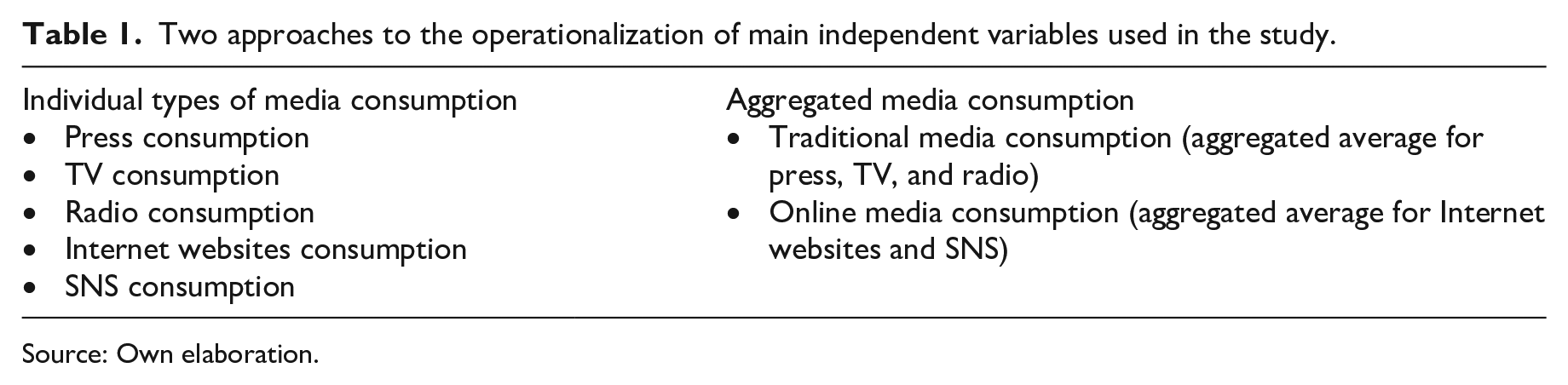
Given that the Eurobarometer does not actively differentiate between traditional versus online media but rather provides an overview for press, TV, radio, internet, and SNS consumption, two types of operationalization of the main independent variables were chosen. These are illustrated in Table 1. The first approach looks at the consumption of all media types individually, while the second approach looks at the aggregated averages of traditional media versus online media. Given that there is no strong evidence against using either of the two approaches, models involving both operationalization approaches are used in the paper.
Two approaches to the operationalization of main independent variables used in the study.
Source: Own elaboration.
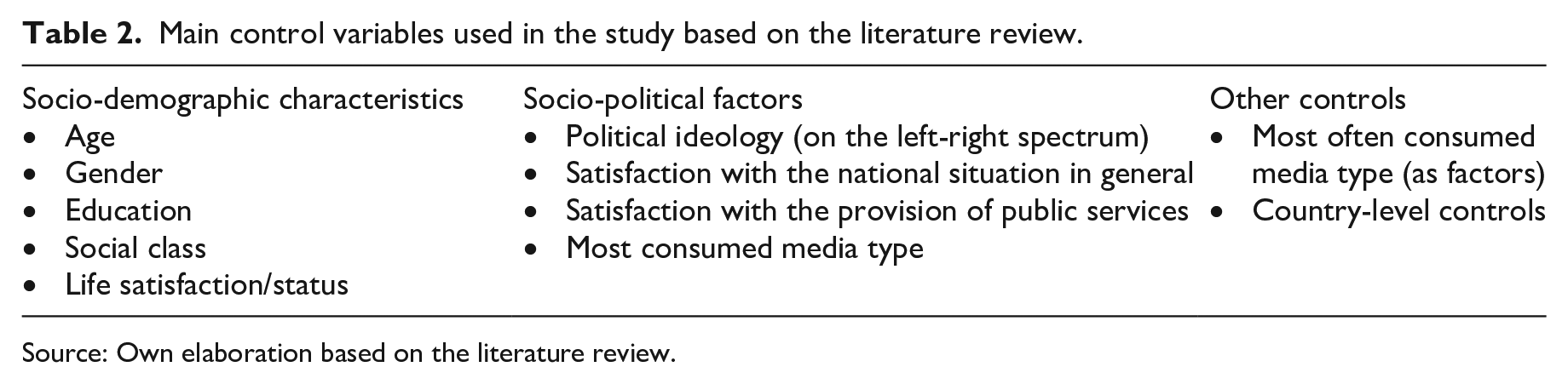
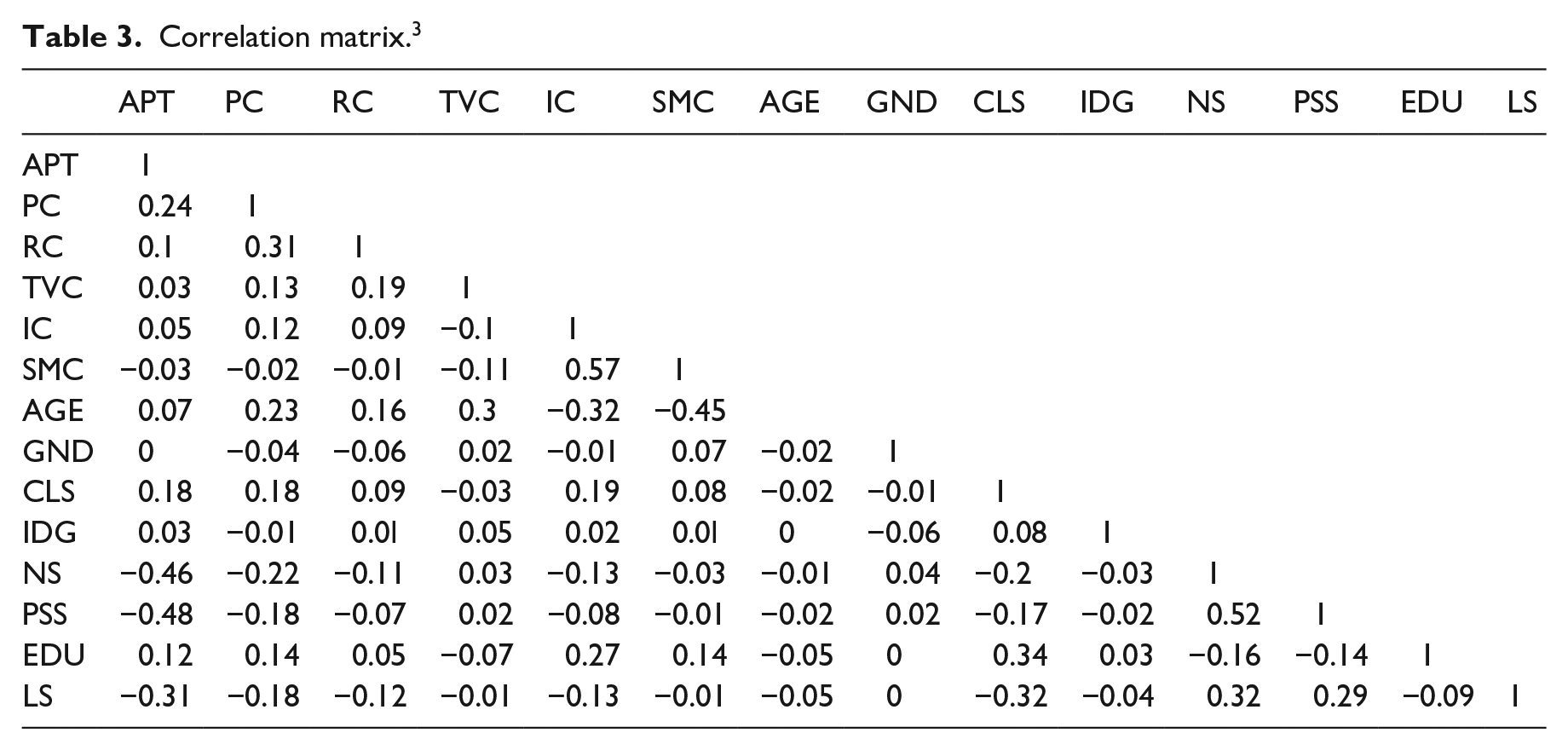
All models also feature the same set of control variables. Table 2 provides a detailed list of control variables, which I use in this article based on the theoretical section above. The Pearson correlation matrix in Table 4 demonstrates that there are no strong relationships between individual pairs of variables, which somewhat alleviates the potential problem of multicollinearity.
Main control variables used in the study based on the literature review.
Source: Own elaboration based on the literature review.
The regression models were run while holding other potentially confounding variables constant. All of them account for any potential country-level effects (i.e., differentiation in variance across different individual Member States). The latter parts are not visually presented in the regression tables but can be found in the supplementary materials. I develop three models, which add different controls in three separate parts—first socio-demographic characteristics, then socio-political factors, and then controls for the most consumed media type in line with Hypothesis 1c.
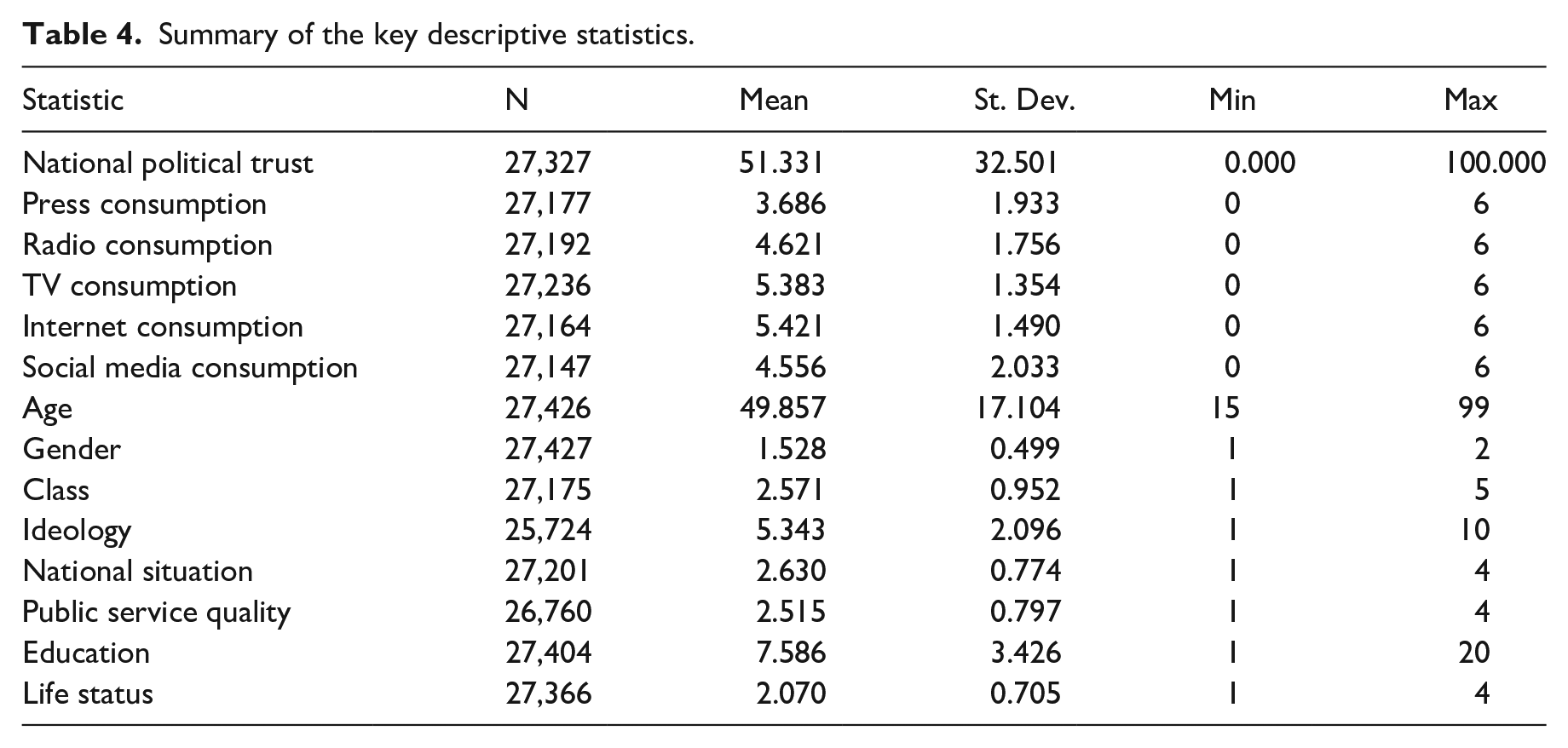
In terms of data quality, the Eurobarometer survey offers a diverse randomized population sample without any unexpected skews that could significantly impact the analysis results (see Annex with RMD code and descriptions for more details). Table 3 presents the correlation matrix, while Table 4 summarizes the descriptive data related to the key variables.
Correlation matrix. 3
Summary of the key descriptive statistics.
Finally, given the large scope of the dataset, the robustness of the EU-level analysis is tested by using the jackknife resampling method to ensure that no Member State has strongly skewing effects on the overall result. The analysis is also supplemented with additional insights from regional and country-level analysis. In the regional analysis, the dataset is broken down into four United Nations–designated regions of Eastern, Northern, Southern, and Western Europe. In the country-level analysis supplement, regressions are run for every individual Member State. No other changes in terms of independent or control variables are made in the output models for regions or countries.
Owing to the large scope of these outputs, they are placed in the annex with supplementary materials, but occasionally referenced in the main body of the text.
Results and discussion
Descriptive statistics tentatively demonstrate that, when we distinguish between broad media types (traditional vs. online), the EU citizens consuming traditional media sources (i.e., newspapers, radio, TV) seem to be somewhat more inclined to trust in their political systems. As Figures 1 and 2 show, this observation tends to be generally valid across the entire ideological spectrum. An interesting outlier and, hence, a potential avenue for research is the lower numbers for the value of 5 in both figures since the causes of this low value are unclear.
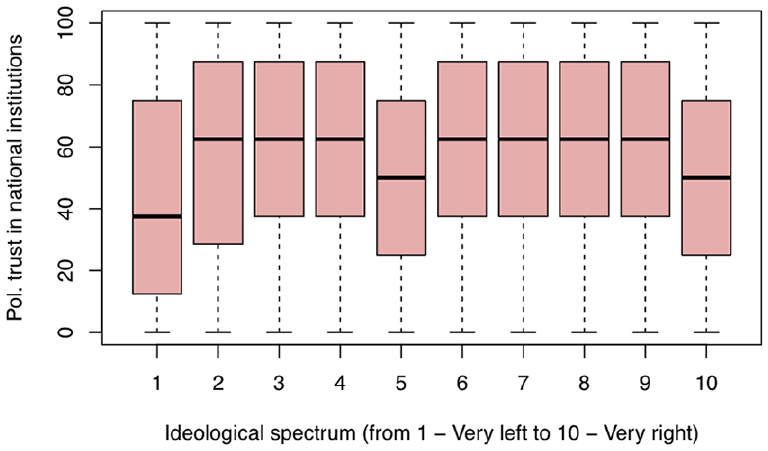
Average trust of traditional media users in national institutions by ideological spectrum.
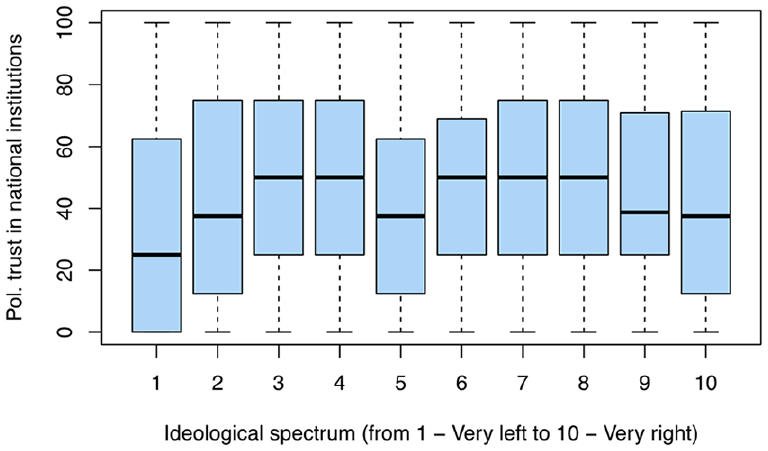
Average trust of social media users in national institutions by ideological spectrum.
A similar picture can be observed when we distinguish between five different media sub-types. As the boxplots in Figure 3 illustrate, online media users also tend to display lower levels of political trust in national institutions, if compared to traditional media users. This assumption holds throughout the entire ideological spectrum from left to right (see the RMD Annex for more details). However, without controlling for any other variables and looking into different types of media consumption, we cannot yet draw any conclusions related to causalities or even correlations.
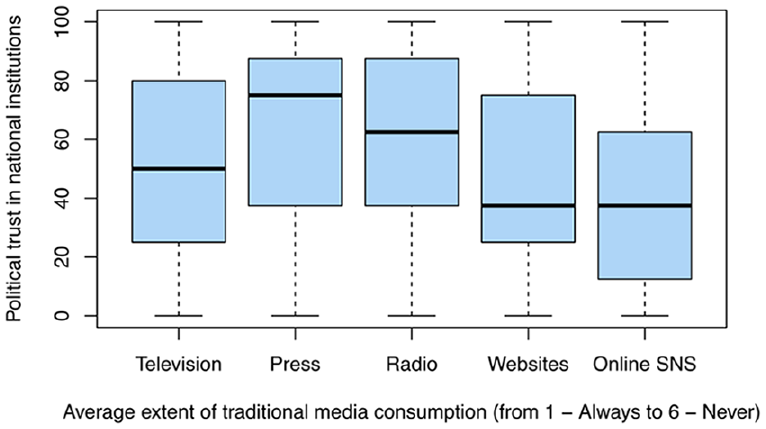
Political trust by media consumption type.
To control for the main potentially confounding variables, two types of regression models are presented (see the tables below for the summaries). The first type differentiates between individual media types (radio, TV, newspapers, internet, social media). Those models are labeled as 1, 2, and 3, respectively. The second type of models examines the difference at a broader level: cumulative traditional media versus cumulative online media. Those models are labeled as 1a, 2a, and 3a, respectively. The confidence intervals of all explanatory variables are indicated in the regression tables in brackets. Country-level controls have been implemented but are not explicitly depicted in the tables due to space limitations.
At first glance, both model types (with aggregated and non-aggregated media consumption) seemingly feed into confirming the aggregated hypotheses 1 and 2. In terms of explanatory power, Model 2 and Model 2a as well as Model 3 and Model 3a seem to perform comparatively well. However, Model 3 and Model 3a show a slightly higher adjusted R squared and provide additional insights into media consumption as opposed to Model 2 and Model 2a. Model 3a indicates that the more you consume traditional media, the more you tend to trust your political system. The EU-level analysis shows that the more online media you consume, the less likely you are to trust the system at the macro-level. The results of the jackknife resampling demonstrate that no individual Member State in either of the model types had a strong skewing result on the average coefficients (see the supplementary material for more details).
However, the detailed breakdown in Model 3 indicates that there are significant differences across individual media types and that the effects can be quite heterogeneous. For example, in terms of individual predictors, the relationship between the social media consumption and political trust is existent, but the effect itself is small (−0.274). The internet consumption seems to have a stronger effect (−0.509), but still rather small. Furthermore, the insights from the regional and country-level analyses also demonstrate that the negative effect of the SNS consumption is statistically significant only in a select number of EU Member States such as Austria, Germany, Luxembourg, and the Netherlands (with Austria exhibiting both a strong negative effect with generally low levels of trust, which could make it a good case study).
Interestingly, however, citizens’ tendency to designate both the internet generally and SNS specifically as the main source of information has a much stronger negative impact on political trust (although we have to be mindful of slightly different measurement scales here 4 ). This is also confirmed by both regional and country-level analyses, feeding into the confirmation of sub-hypothesis 1c. The small size of p values indicates that almost all the discussed relationships are statistically significant (although to a varying extent), which means that we can reject the null hypothesis at least at the 5% significance level (in some cases even smaller – 1%). Nevertheless, there might be a problem of self-selection at play, when citizens trusting or distrusting political institutions self-select themselves into consuming specific types of media, which is hard to measure in an observational study. The country-level results in the supplementary materials reveal that SNS consumption in Estonia exhibits the strongest and most statistically significant negative effect in the EU (−17.532). This could be possibly related to the issue of the disinformation content consumed by its Russian minority through the SNS channels in the context of the Russian-speaking echo chambers, that is, a possible interaction between the mechanism of echo-chambers and disinformation (Dougherty & Kaljurand, 2015). The outlier size of the effect could make Estonia a particularly interesting case study, along with Latvia, which exhibits similar but weaker results (−5.108). Overall, not only the case of Estonia, but the role of echo-chambers in general should most certainly be explored in the future studies on the topic, also through a qualitative perspective.
As for the consumption of traditional media, reading the press seems to have the most noticeable positive effect on the trust of citizens in their national political systems, in line with the literature expectations. The country-level analysis shows that this positive effect tends to be stronger and more statistically significant in the countries where the average levels of political trust are on the lower end 5 such as Croatia, Czechia, Greece, France, Ireland, Italy, Latvia, Slovenia, or average 6 such as Bulgaria, Finland, Slovakia, and Sweden. Consumption of other media types (such as radio and TV), however, have a visibly weaker effect and they are slightly less statistically significant—both at the EU and Member State levels. In fact, press consumption is the only independent variable that has both visible and statistically significant positive effects in all types of analyses (EU-wide, regional, and country-level). This means that there is strong supporting evidence for sub-hypothesis 2c, implying that the press is a stronger political agenda-setter in the EU context, compared to other traditional media outlets.
Unlike with the SNS, however, designating press as the main source of information does not seem to be a visible and statistically significant at the country level. At the same time, results in both Tables 5 and 6 show that the usage of radio as the main source of information, on the contrary, reverses the effect from positive to slightly negative in both model types (−1.689 and −1.758). This raises the question of whether echo-chambers might be possible in the process of regular radio consumption as well given a slightly more interactive nature of the radio format as opposed to the press. Theorizing the mechanism of reversal and/or considering potential intervening variables would be the first step to answer this question.
Model summaries 1–3 (using variables measuring the consumption of individual media types—press, radio, TV, internet, and SNS).
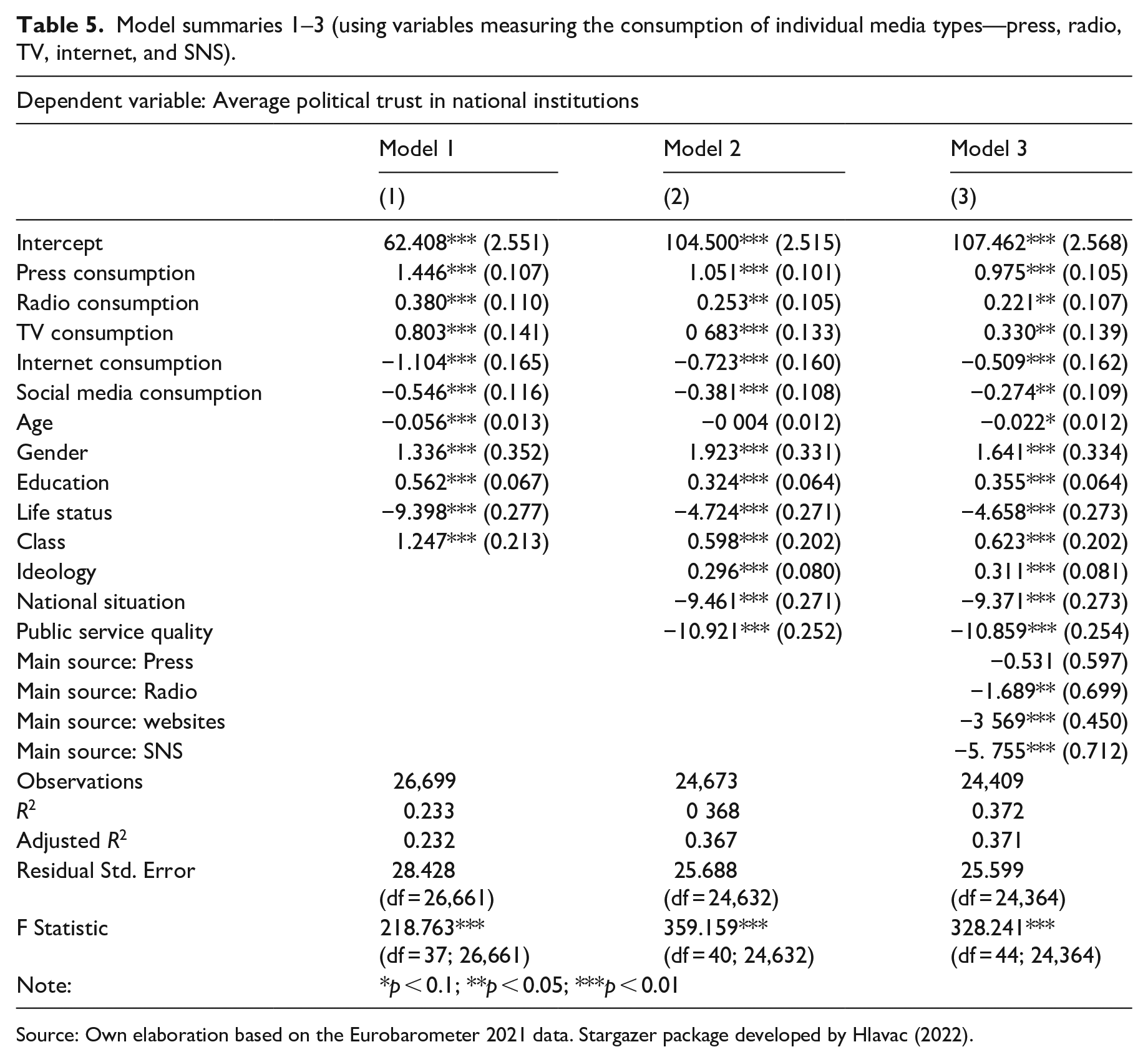
Source: Own elaboration based on the Eurobarometer 2021 data. Stargazer package developed by Hlavac (2022).
Model summaries 1a–3a (using variables measuring the aggregated consumption of traditional and online media).
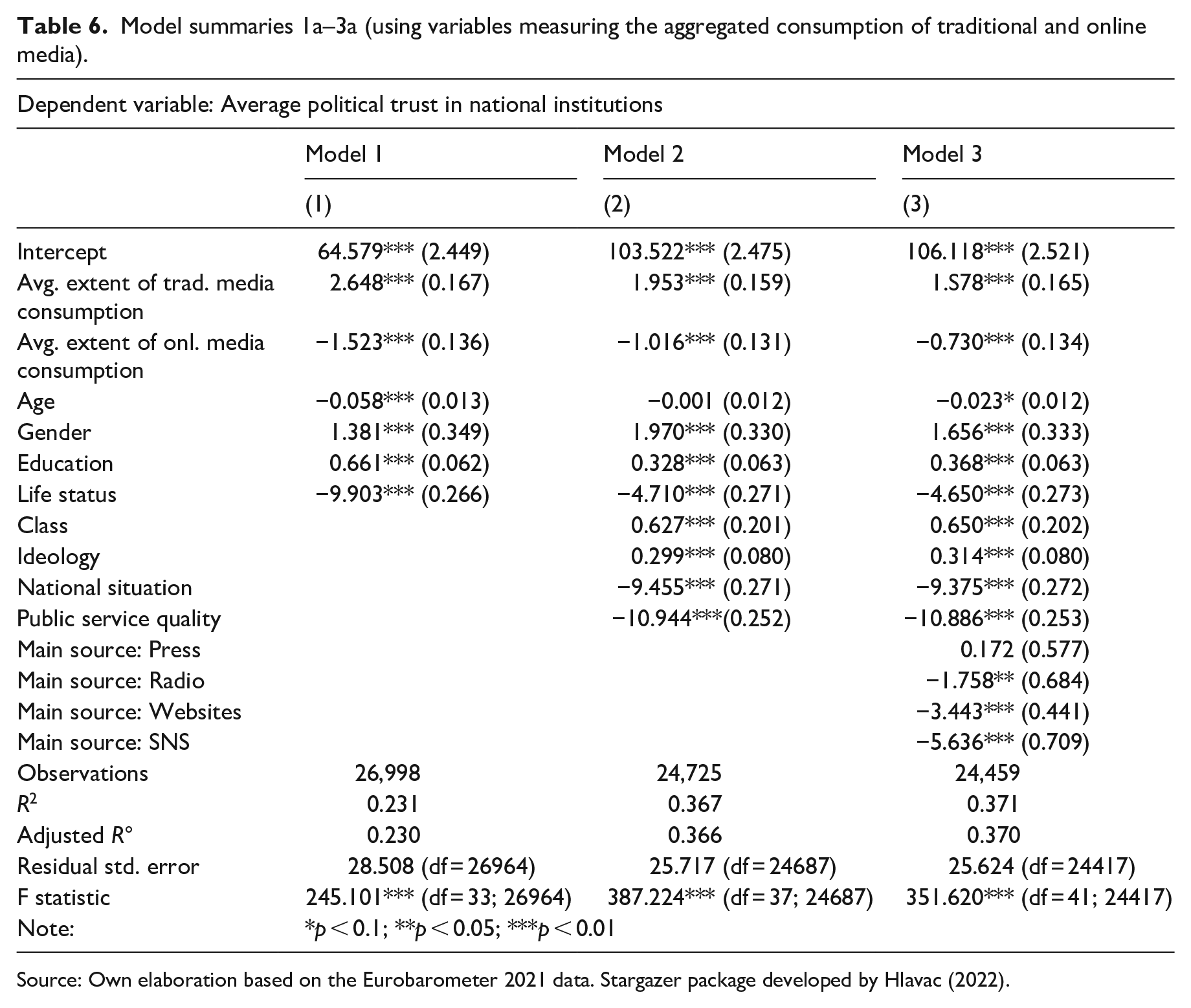
Source: Own elaboration based on the Eurobarometer 2021 data. Stargazer package developed by Hlavac (2022).
Overall, looking at the effects of individual media sub-types provides more insights as demonstrated by the analysis above as opposed to the online versus traditional differentiation. Unsurprisingly, other expected factors such as the citizens’ general assessment of the overall national situation or satisfaction with the quality of provided public services have a much stronger impact on political trust. This means that the more highly the respondents assess the overall national situation or the better the quality of public services is, the more they trust national political institutions. By contrast, socio-demographic factors such as gender, age, and education do not seem to have a very significant effect on political trust even though most of them are statistically significant.
Conclusion
While the EU-level analyses show tentative support for hypotheses 1 and 2, the picture becomes more complex when individual media types are taken into consideration. On one hand, the examination of the data at both EU and country-level has fed into rejecting sub-hypothesis 1b on the negative relationship between social media consumption and political trust. There are very significant country-level variations, and the effect is not always strong and statistically significant in all countries. The findings indicate that conducting a comparative case study of Estonia and Latvia or examining the case of Austria, which all demonstrate much stronger negative effects of SNS consumption unlike other EU Member States. Focusing on the possible causal mechanisms would be particularly relevant for the research on the factors negatively impacting political trust. However, there is very consistent negative effect of using social media as the main source of information.
Furthermore, the analysis confirms sub-hypothesis 2c about the positive relationship between press consumption and political trust at all levels (EU; regional; and national) in line with the literature expectations. On the contrary, with regard to other sub-hypotheses, although there is some supporting evidence for sub-hypotheses 1a and 1b at the EU-level, the evidence at the level of individual Member State seems to be mixed. As for sub-hypotheses 2a and 2b (on the roles of TV and radio), no large and statistically significant effects on political trust were found partly contrary to Ceron’s (2015) findings. Thus, we do observe a relative divergence of media effects despite the theoretical expectations of homogeneity in line with the classical intermedia agenda-setting theory.
Naturally, there are several limitations to the findings of this article. First and foremost, there are objective limitations to the research findings imposed by the scope conditions of the research project. In terms of internal validity, this is an observational study, which cannot possibly control for all the potentially confounding variables. Thus, it cannot fully claim causality in the established associational relationships. In terms of external validity, the findings of this study apply only to the EU Member States and, potentially, other European countries (e.g., the United Kingdom, Norway, Switzerland, etc.). However, they do not apply to hybrid regimes or competitive authoritarian regimes, where responses to such questions about political trust might suffer from significant biases due to, for example, self-censorship. That being said, additional replication studies in other democracies such as Australia, Japan, New Zealand, South Korea, the United States are still necessary. Furthermore, an exploration of political trust in the European institutional system could also be insightful (incl., from a comparative perspective—national vs. European political system).
As for the research design, there could also be potential improvements in the future. The first one could be introducing an additional level of control variables at the country-level or conducting multilevel analysis to further strengthen the reliability of its findings. Furthermore, this article’s method of developing a composite index of political trust does not offer a differentiated approach to the weighting of its individual components (e.g., whether trust in the national government is more or less important than trust in the national parliament). Finally, the question of possibly reverse and/or cyclic causality could be explored in subsequent studies through a cross-lagged panel model with fixed effects once more Eurobarometer data on media is available (Leszczensky & Wolbring, 2019).
In terms of data quality, there is a limitation caused by the Eurobarometer questionnaire’s design. The survey’s binary approach to measuring trust in individual political institutions could have contributed to a significant oversimplification of the overall picture despite the paper’s attempt to provide a more fine-grained overview through the development of an aggregate index. 7 In this respect, a %-based scale from 0 to 100 or a Likert-type scale with several options would have been much more effective in the future surveys. Moreover, there is a conceptual problem at play with more and more traditional media migrating online and blurring the distinction between traditional and online media, which makes it somewhat unclear how Eurobarometer defines “internet websites” and how the concept is interpreted by respondents. Future studies will require new, more fine-grained typologies and measurement instruments.
To conclude, despite its limitations, this study has contributed to the growing body of literature linking media consumption and political trust. Theoretically, it has shown heterogeneous media effects on political trust despite the expectations of the intermedia agenda-setting theory—different media types have different relationships with political trust whatsoever. Furthermore, while strengthening the external validity of the previous studies on the relationship between social media consumption and political trust, also in the COVID-19 era, it has shown that there is significant divergence in effects across individual Member States. This article shows that increases in the SNS consumption do not have a consistent negative effect on political trust but using SNS as the main source of information certainly does. In terms of measurements, this article has shown the importance of differentiating between individual media types (rather than using generalizations of media consumption or traditional vs. online media) because this granular approach reveals that some media types have much stronger effects than others (e.g., SNS and press). Finally, this article’s findings provide a fruitful ground for evidence-based country-level case studies of individual Member States such as Austria, Estonia, and Latvia, where the negative effect of the SNS consumption is much more prominent than in other EU countries. Analyzing such outliers and the causal mechanisms linking political trust and media consumption in them, also through qualitative research, could further advance our understanding of how political trust is shaped and produce more evidence-based policy measures strengthening trust in democracies.
Supplemental Material
sj-rmd-1-ctp-10.1177_0748806820980862 – Supplemental material for Relationship between the type of media consumption and political trust in the European Union: Evidence from the 94th Eurobarometer 2020/2021 Survey
Supplemental material, sj-rmd-1-ctp-10.1177_0748806820980862 for Relationship between the type of media consumption and political trust in the European Union: Evidence from the 94th Eurobarometer 2020/2021 Survey by Ildar Daminov in Communication and the Public
Footnotes
Acknowledgements
The author thanks Mariyana Angelova, Ljubica Nedelkoska, Ameni Mehrez, and two anonymous reviewers for their useful and kind feedback. In loving memory of Robin NC Bellers, who greatly helped with proofreading this text.

Supplemental material
Supplemental material for this article is available online.
Notes
Author biography
References
Supplementary Material
Please find the following supplemental material available below.
For Open Access articles published under a Creative Commons License, all supplemental material carries the same license as the article it is associated with.
For non-Open Access articles published, all supplemental material carries a non-exclusive license, and permission requests for re-use of supplemental material or any part of supplemental material shall be sent directly to the copyright owner as specified in the copyright notice associated with the article.
