




Abstract
Do congressional candidates benefit electorally from the public’s disdain of political action committees (PACs)? Despite the large sums of money given by PACs, an increasing number of candidates have sworn off corporate PAC money. In this research note, we investigate whether the decision to accept or reject PAC contributions in general affects voters’ evaluation of candidates and their willingness to vote for them. To test these questions, we use a pre-registered candidate evaluation survey experiment that was fielded as part of the 2020 Cooperative Congressional Election Study. We find that voters are more likely to vote for, donate to, and trust candidates that reject PAC contributions. Surprisingly, we fail to find evidence that this effect is moderated by party ID. The evidence indicates that Republican and Democratic voters alike penalize candidates that accept PAC money. This study is among the first to investigate how candidates’ campaign financing choices influence their perceptions among voters.
Keywords
Introduction
As reflected by prior surveys, the American public disdains money in politics. When a 2017 Washington Post survey asked U.S. respondents what they saw as the primary cause of political dysfunction (Wagner and Clement, 2017), the top two answers were money in politics and wealthy political donors. A similar survey in 2018 conducted by the Pew Research Center found that 74% of respondents believe that big donors have more political influence than other people (Jones, 2018). Presumably in response to these public sentiments, candidates have begun making efforts to distance themselves from political action committees (PACs), which are a major source of campaign contributions.
In the 2024 election cycle, for example, PACs contributed approximately 65%, amounting to $5.6 billion, for Congressional and presidential campaigns (USAFacts, 2024). A prominent example of these distancing efforts is Senator Elizabeth Warren (D-Massachusetts), who, during her 2020 campaign, “swore off PAC money to make a statement” (Nilsen, 2019). In an email to her supporters, Warren explained, “For every time you see a presidential candidate talking with voters at a town hall, rally, or local diner, those same candidates are spending three or four or five times as long with wealthy donors—on the phone, or in conference rooms at hedge fund offices, or at fancy receptions and intimate dinners—all behind closed doors” (Nilsen, 2019). Senator Warren was not alone in swearing off PAC money. 52 members of the 116th Congress refused corporate PAC money (Evers-Hillstrom, 2018). In the 2020 elections, Democratic candidates were almost in competition with one another to distance themselves as far as they could from PACs and other moneyed special interests.
Although Democratic candidates are those primarily adopting anti-PAC contributions, some prominent Republicans have also sworn off PAC money. In a Wall Street Journal oped dated April 2021, Senator Ted Cruz (R-Texas) pledged to refuse PAC dollars in response to his perception that “woke” CEOs were seeking undue influence in politics after several major CEOs, (e.g., James Quincey the CEO of Coca-Cola), voiced opposition to Georgia’s Election Integrity Act of 2021.
There are obvious costs to anti-PAC pledges, but are there larger benefits to be had? Are candidates who refuse PAC money rewarded electorally? We argue that anti-PAC pledges lead voters to perceive candidates as more trustworthy and thus be more likely to vote and donate to them. To test this claim, we fielded a pre-registered candidate evaluation survey experiment as part of the 2020 Cooperative Congressional Election Study (CCES). Survey respondents were presented with a description of a hypothetical co-partisan congressional candidate where we experimentally manipulated the candidates’ attributes, with our attribute of interest being whether a candidate explicitly states that they accept or reject PAC contributions. We find that voters, regardless of political party, are more likely to trust, vote for, and donate to congressional candidates who reject PAC money than they are for candidates who accept PAC money. This study contributes to a growing and nascent literature on how the sources of a candidate’s campaign financing influences voters’ evaluation of candidates (Bowler and Donovan, 2016; Dowling et al., 2014; Primo and Milyo, 2020; Riggs, 2017; Robinson, 2022). The most prominent examples of PACs in the public consciousness may be corporate PACs—Coca-Cola, Amazon, ExxonMobil and other major corporations have PACs—but they aren’t the only form of PACs active in campaigns. There are ideological PACs, such as the right-leaning National Rifle Association Political Victory Fund and the left-leaning EMILY’s List. This paper explores the general effect of accepting/rejecting PAC contributions on candidate evaluations, although future research may wish to test if the public distinguishes between type of PAC and/or if the effect of PAC contributions on candidate evaluations is otherwise contextual. Previous research suggests that, while the public may disdain money in politics, they lack sophisticated campaign finance knowledge Little Public Awareness of Outside CampaignBoom, 2012. Goodliffe and Townsend (2024) theorize that most voters either do not care about or are not knowledgeable enough to understand the complexities of American campaign finance rules and regulations due to the complicated nature of said system. Goodliffe and Townsend (2024) further conclude that voters are generally distrustful of money in politics, regardless of the source. Further indicating that voters do not make distinctions across different PAC categorizations.
The most prominent examples of PACs in the public consciousness may be corporate PACs—Coca-Cola, Amazon, ExxonMobil and other major corporations have PACs—but they aren’t the only form of PACs active in campaigns. There are ideological PACs, such as the right-leaning National Rifle Association Political Victory Fund and the left-leaning EMILY’s List. This paper explores the general effect of accepting/rejecting PAC contributions on candidate evaluations, although future research may wish to test if the public distinguishes between type of PAC and/or if the effect of PAC contributions on candidate evaluations is otherwise contextual. Previous research suggests that, while the public may disdain money in politics, they lack sophisticated campaign finance knowledge. Little Public Awareness of Outside CampaignBoom, 2012, Goodliffe and Townsend (2024) theorize that most voters either do not care about or are not knowledgeable enough to understand the complexities of American campaign finance rules and regulations due to the complicated nature of said system. Goodliffe and Townsend (2024) further conclude that voters are generally distrustful of money in politics, regardless of the source. Further indicating that voters do not make distinctions across different PAC categorizations.
Money in politics
Previous research has investigated the role of money in politics and campaigns from many different perspectives. Scholars have examined the (in)ability of campaign finance legislation and the Federal Election Commission (FEC) to limit the undue influence of large donors (Magleby and Nelson, 2010; Raja, 2008), why donors donate (Barber et al., 2017), to what extent their donations increase access to politicians (Jenkins et al., 2020; Kalla and Broockman, 2016), and what their donation strategies are (Francia et al., 2003). Researchers have also investigated questions related to how individuals perceive money in politics. For example, Bowler and Donovan (2016) investigated how different sources of campaign finance affect voter’s perceptions of corruption. Using a survey experiment, they find that beliefs about whether any particular contribution is corrupt is dependent on an individual’s partisanship and the information they have about where the contribution came from. Their findings indicate that voters care about where campaign contributions come from and that messages about campaign finance may alter how they perceive candidates. By announcing opposition to PAC contributions, candidates may provide an information signal to voters that PAC contributions produce adverse representational effects and that pursuing campaign financing through alternative means, such as small donations from the general public, is a more “ethical” strategy. This strategy may be particularly effective for candidates refusing corporate PAC money since voters believe that contributions to candidates from corporations are more corrupt than contributions from individuals (Bowler and Donovan, 2016). Based on these findings, we argue that candidates who refuse PAC money should be evaluated more favorably by voters. Specifically, we argue that candidates that reject PAC money will be seen as more trustworthy than candidates who accept PAC money.
Since congressional candidates are competing to serve as the public’s agents, trust is an essential part of the principal-agent relationship between voters and their representatives (Lupia and McCubbins, 1998). Candidates who accept PAC money are plausibly seen as less trustworthy and less likely to carry out the public’s (the principal’s) preferred agenda because voters believe them to be beholden to PAC contributors. 1 Given this, candidates may be able to strategically advertise that they will not accept PAC contributions in order to prime voters to think they are more trustworthy. This leads to our first hypothesis:
Respondents will perceive a candidate who rejects PAC contributions as more trustworthy than a candidate who accepts PAC contributions.
Candidates perceived as trustworthy are desirable to voters because of, as discussed above, the principal-agent relationship between constituents and their representatives. Voters believe that a trustworthy candidate is more likely to carry out their policy preferences in office as opposed to the preferences of third parties, like campaign donors. If voters believe candidates who reject PAC contributions are more trustworthy and that trustworthy candidates are more likely to execute their preferred policy preferences, then voters should also be more likely to vote for these candidates. Thus, we also hypothesize that voters will be more willing to vote for candidates who reject PAC contributions than they are for candidates who accept PAC money. This expectation is consistent with extant evidence on the role of trust on vote choice (Hetherington, 1999; Parker, 1989). This is our second hypothesis:
Respondents will be more likely to vote for a candidate who rejects PAC contributions than a candidate who accepts PAC contributions.
Campaigns are extraordinarily expensive, and rejecting contributions from large donors means that candidates will need to replace these funds with those from other sources. The most commonly discussed substitution among candidates who refuse PAC money is small-dollar donations. Candidates like Senator Bernie Sanders (D-Vermont) advertise the fact that they do not accept PAC money while aggressively soliciting small individual donations. Throughout his campaign, Senator Sanders proudly emphasized that the average donation made to his campaign in 2020 was twenty-seven dollars (Gambino, 2019). This strategy is not only meant to galvanize supporters to donate, but since voters perceive small-dollar donations from individuals as more honest (Bowler and Donovan, 2016), it also creates an image of trustworthiness. Whether candidates can raise enough money from small-donors to replace PAC money is unclear. Nilsen (2019) called Senator Elizabeth Warren’s more extreme strategy of saying no to, “... PAC[s], corporate PAC[s], or Super PAC money, [and] no donations from federal lobbyists” a “risky move.” Unless there is a more covert strategy in making an anti-PAC pledge, these candidates seem to hope that their public stances against large-dollar donations will excite their supporters enough to have them donate to their campaigns.
There are multiple non-exclusive reasons why rejecting PAC contributions may increase the likelihood of the general public donating to candidates. As discussed above, the general public may feel compelled to donate to the candidate(s) in an effort to substitute the funds forgone by rejecting PAC money. Furthermore, candidates who reject PAC contributions may be perceived as more ethical, responsive to voter interests, less corrupt, and more electable by voters (Dudley and Neff, 2025). Collectively, the signal sent by rejecting PAC contributions may produce a warm glow effect Andreoni (1990) that encourages the general public to donate to candidates who reject PAC contributions Koerth (2018).
Prior observational work finds that candidates that adopt no PAC pledges substitute lost donations with other sources (Richter and Werner, 2017); our survey experiment potentially allows us to provide additional experimental support. If we find evidence that rejecting PAC contributions increases donations among the general public, future work should explore the underlying mechanism.
This leads to our third hypothesis:
Respondents will be more likely to donate to a candidate who rejects PAC contributions than a candidate who accepts PAC contributions.
Finally, the fact that anti-PAC pledges are concentrated among Democratic candidates suggests that Democrats specifically may expect this strategy to be popular with their sup- porters (Evers-Hillstrom, 2018; Fischer, 2019; Lerer, 2018). During the 116th Congress, 52 Democratic members of Congress (MCs) refused contributions from PACs during their campaigns while only two Republican MCs refused PAC money during the same cycle (Evers- Hillstrom, 2018). This trend continued in the 2020 election cycle with 44 candidates (43 Democrats and one Republican) refusing PAC money (Baumgart, 2019). The concentration of pledges to refuse PAC contributions among Democratic candidates seems to be an attempt to galvanize Democratic voters who may be more troubled by money in politics than Republicans. Numerous surveys find that Democrats are more supportive of campaign finance reform than Republicans. According to Pew Research Center (2015), 85% of Democrats and 71% of Republicans believe there should be spending limits for individuals and organizations. When asked if wealthy donors do not have more influence than others, 50% of Democrats said this is not an accurate description compared to 35% of Republicans—a gap of 15% points. This leads to our fourth hypothesis:
Democratic respondents will be more likely than Republican respondents to vote for, trust, and donate to a candidate who rejects corporate PAC money.
Data and methods
To evaluate these hypotheses, we fielded a candidate evaluation survey experiment in the 2020 CCES. 2 Respondents were presented with a hypothetical congressional candidate in a primary election from the respondent’s political party. Independents were randomly asked about a Republican or Democratic primary. We experimentally randomized the candidate’s prior political experience, gender, and whether they accept or reject PAC contributions. Prior studies have found that political experience and gender are significant determinants of candidate evaluations (Fulton and Dhima, 2021; Kirkland and Coppock, 2018). Conjoint designs like ours are common in political science to elicit candidate evaluations (Carlson, 2015; Hainmueller et al., 2014).
Our manipulation of interest is whether candidates accept or reject PAC contributions.
3
Figure 1 in Appendix A shows how the conjoint design was implemented in the CCES.
4
After reading the randomized description of the candidate, respondents were asked to rate how likely they are to vote for, donate to, and trust the candidate on a 7-point scale. With these data, we estimate the average marginal component effect (AMCE) (Bansak et al., 2023) of refusing PAC contributions on respondent perceptions. The average marginal component effect of refusing PAC contributions on voter perceptions of a candidate respondents are more willing to vote for, donate to, and trust candidates that do not accept PAC contributions.
A total of 998 CCES respondents completed our study. In the sample, there are 220 Republicans, 334 Democrats, and 258 Independents. 5 Figure 1 summarizes the responses of all CCES participants for each question. Our expectations hold on both ends of each scale. Respondents report being more likely to vote for, donate to, and trust candidates who do not accept PAC contributions. Moreover, respondents report more answers on the negative end of the scale for candidates who accept PAC contributions. 6
Results
The results of the initial three models are summarized in Figure 1. Higher values indicate a greater expressed willingness to vote, donate, or trust a given candidate using our 7- point scales. We follow best practices in conjoint experiment analyze by estimating ACMEs (Bansak et al., 2023) in the main manuscript, but we specified a different estimation strategy in our pre-registration plan. We present the results from this earlier estimation strategy in Appendix B; results are substantively the same regardless of estimation strategy.
The experiment provides strong evidence in support of our first three hypotheses. Respondents report being less likely to vote (coef: −0.6311, p-value <.001), donate (coef: −0.5234, p-value <.001), and trust candidates (coef: −0.4716, p-value <.001) that accept PAC contributions compared to candidates who reject PAC contributions.
These findings show that the average voter electorally rewards candidates who accept PAC contributions, views a candidate who rejects PAC contributions as more trustworthy, and is more likely to donate to these candidates. These results suggest that candidates can eschew PAC contributions in exchange for greater electoral support and donations from the average voter. Candidates who reject PAC contributions are also rated as more trustworthy than candidates who accept PAC money. This increased trustworthiness translates to an increase in the likelihood of being voted for and an increase in the likelihood of receiving a donation. The former, increased electoral support, is intrinsically important in electoral politics. The latter, an increase in donations, suggests that candidates may be able to substitute financial support from PACs with donations from small-dollar donors. Future research should attempt to estimate how much candidates can raise by rejecting PAC money and whether or not PAC contributions can be effectively substituted with small-dollar donations.
Finally, we test our fourth hypothesis that the effects of refusing PAC contributions will be stronger for Democrats. As shown in Figure 2, we fail to find any strong evidence of a party moderation effect. Republican and Democratic voters alike seem to be equally likely to penalize candidates that accept PAC contributions. This is a surprising finding because most candidates who have rejected PAC contributions are Democrats. Only a handful of Republican candidates have rejected PAC money. Additional research is needed to understand why Republican candidates are less likely to reject PAC contributions despite both Democratic and Republican respondents preferring candidates who reject PAC contributions. One possibility, as showcased by Senator Cruz’ 2021 anti-PAC pledge and subsequent reactions, is that grass roots Republican voters hold anti-PAC sentiment but have thus far been constrained by Republican elites. An enterprising Republican candidate could potentially tap into grass root voters’ anti-PAC sentiment. Another explanation is that while disdain for PACs is maintained across party lines, Democrats and Republicans may perceive PACs differently. For example, Democrats may readily think of right leaning PACs (e.g., the NRA and Koch Bro. funded PACs), and Republicans may think of left leaning PACs (e.g., EMILYs List and George Soros funded PACs). Future research should investigate how the general public perceives PACs and whether it differs across party lines. The average marginal component effect of refusing PAC contributions on voter perceptions of candidates by party ID. These figures show that both democrats and republicans evaluate candidates who refuse PAC contributions similarly. ACME results for the prior experience and candidate gender are estimated, but suppressed for brevity.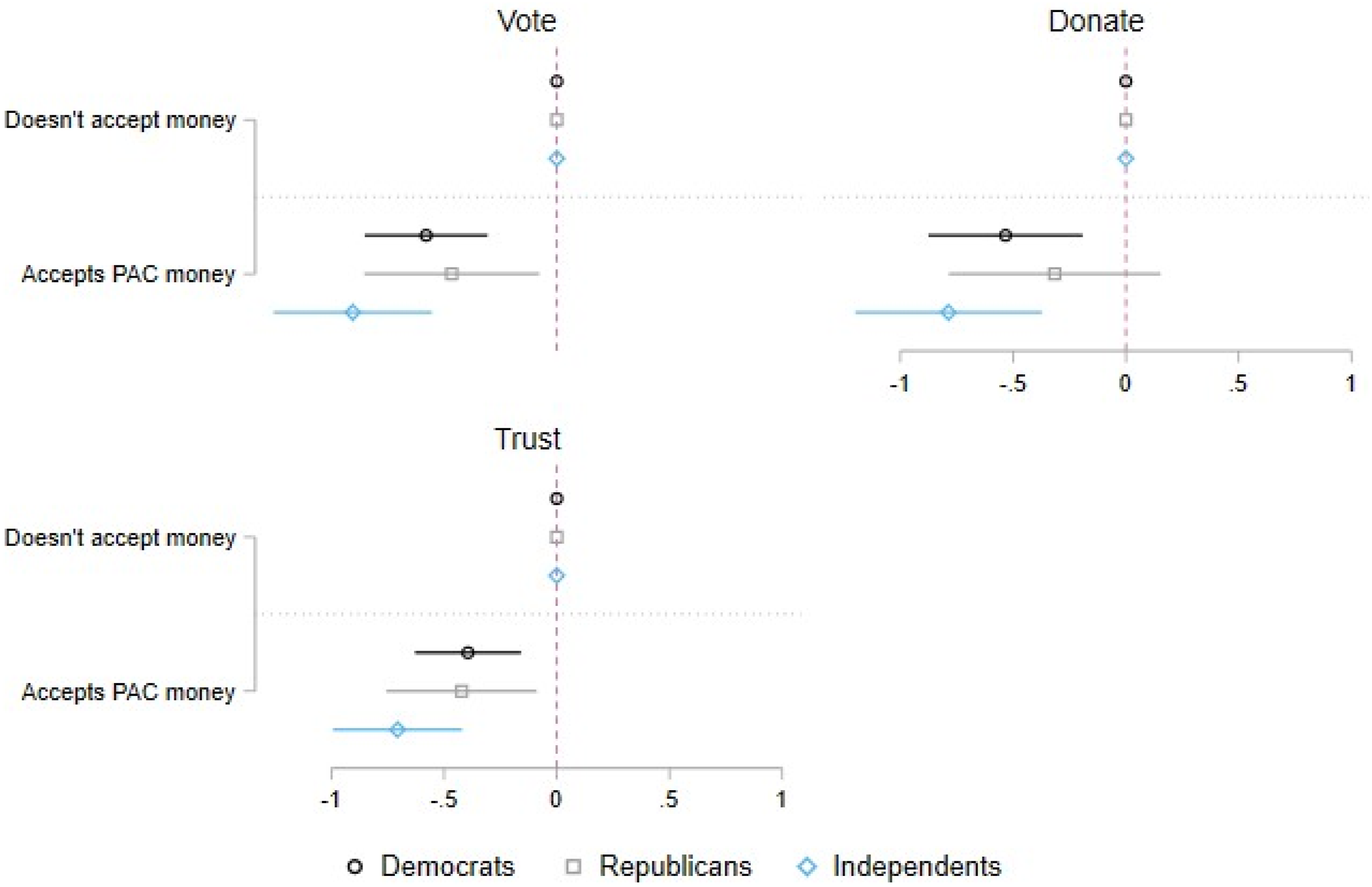
Conclusion
Political action committees are a prominent facet of American electoral politics, but voters’ disdain for wealthy donors may present candidates with electoral opportunities. Using a conjoint survey experiment fielded in the CCES, we find that voters perceive candidates who refuse PAC contributions as more trustworthy than candidates who accept PAC contributions and that voters are more likely to both vote for and donate to them. These results contribute to a growing literature on voters’ reactions to campaign financing. They also help us better understand why some candidates may choose to reject PAC contributions. We fail, however, to find evidence of a partisan divide—both Democratic and Republican respondents favored candidates that reject PAC campaign contributions. This suggests that the partisan divide among candidates regarding PAC contributions is driven by factors beyond voter attitudes towards money in politics. In this manuscript, we have provided experimental evidence that candidates who reject PAC contributions receive more favorable evaluations among the general public, but additional research is needed to answer secondary questions. In addition to the extensions proposed throughout the main text—for example, testing the effect of rejecting different types of PACs—it is important to test the effect of rejecting PACs on real-world electoral performance. Does the general public continue to reward candidates who reject PAC contributions when faced with other salient policy issues, such as gun control or abortion? How do institutional and electoral factors moderate the effect?
Supplemental Material
Supplemental Material - Do congressional candidates benefit from rejecting PAC contributions? Evidence from a pre-registered candidate evaluation survey experiment
Supplemental Material for Do congressional candidates benefit from rejecting PAC contributions? Evidence from a pre-registered candidate evaluation survey experiment by Nicholas R. Jenkins, Michelangelo Landgrave, and Aubree J. Hardesty in Research & Politics
Supplemental Material
Supplemental Material—Do congressional candidates benefit from rejecting PAC contributions? Evidence from a pre-registered candidate evaluation survey experiment
Supplemental Material for Do congressional candidates benefit from rejecting PAC contributions? Evidence from a pre-registered candidate evaluation survey experiment by Nicholas R. Jenkins, Michelangelo Landgrave and Aubree J. Hardesty in Research & Politics
Footnotes
Acknowledgements
We thank Madeline Kittler for research assistance.

Funding
The authors disclosed receipt of the following financial support forthe research, authorship, and/or publication of this article: Publication of this article was funded by the University of Colorado Boulder Libraries Open Access Fund.
Declaration of conflicting interests
The authors declared no potential conflicts of interest with respect to the research, authorship, and/or publication of this article.
Carnegie Corporation of New York Grant
This publication was made possible (in part) by a grant from the Carnegie Corporation of New York. The statements made and views expressed are solely the responsibility of the author.
Supplemental Material
Notes
References
Supplementary Material
Please find the following supplemental material available below.
For Open Access articles published under a Creative Commons License, all supplemental material carries the same license as the article it is associated with.
For non-Open Access articles published, all supplemental material carries a non-exclusive license, and permission requests for re-use of supplemental material or any part of supplemental material shall be sent directly to the copyright owner as specified in the copyright notice associated with the article.
