




Abstract
Campaigns use different strategies across communication channels. How does this affect voters? What are the consequences of being exposed to targeted campaign messages? How do voters react when they are exposed to campaign messages that are aimed at different voters? Does mistargeting always punish candidates or does it reward them under certain conditions? In a survey experiment relying on a sample of 1137 U.S. adults, participants evaluated a fictional candidate running for the U.S. Senate after being exposed to various sets of campaign messages originally delivered via e-mail and TV. A fictional candidate was used to prevent the effects of prior knowledge while the campaign information given to the participants was based on a real campaign’s e-mails and television ads to achieve a degree of realism. Voters perceive the same candidate differently depending on the messages they receive. Politicians may benefit or suffer from mistargeting.
Political campaigns target voters, and there is a growing body of literature on the effects of targeted campaign messages. Studies examine how voters react to group-directed pandering (Hersh & Schaffner, 2013), often focusing specifically on appeals that are based on class (Robison et al., 2021), race (Valenzuela & Michelson, 2016), gender (Holman et al., 2015), religion (Albertson, 2015), and issue positions (Endres, 2020). This research adds to the literature by examining the effects of additional targeting variations (i.e., the messages campaigns use when targeting supporters vs. swing voters) and by connecting the literature to a related scholarship on campaigning across media (Bode & Vraga, 2018). In doing so, it tries to address the following research questions: What are the consequences of being exposed to targeted campaign messages? How do voters (e.g., strong Democrats or strong Republicans) react when they are exposed to campaign messages that are aimed at different voters (e.g., swing voters)? Does mistargeting always punish candidates or does it reward them under certain conditions?
Through a survey experiment (N = 1137), I examine how people evaluate the same candidate differently after being exposed to campaign messages that are aimed at supporters, messages that are aimed at swing voters, and a combination of the two (and compared to when they receive no campaign message at all). A fictional candidate was used to prevent the effects of prior knowledge while the campaign information given to the participants was based on a real campaign’s e-mails (for the messages aimed at supporters) and television ads (for the messages aimed at swing voters) to achieve a degree of realism.
The major findings are as follows. First, participants in Condition 2 (exposed to the campaign messages that were aimed at campaign supporters) perceived the candidate to be ideologically more extreme and more partisan. Second, participants perceived the same candidate’s issue priority/position differently depending on the information they received. Third, the candidate’s favorability varied across the conditions, and the treatment effects were conditional on one’s party identification. For example, Republicans evaluated the Democratic candidate more favorably when they were exposed to the candidate’s messages aimed at swing voters (Condition 3) while the same messages lowered the favorability of the candidate for those who identified themselves as “Strong Democrats.” In other words, “mistargeting” (Hersh & Schaffner, 2013) can both reward and punish a candidate depending on the type of targeted messages and the targeted person’s party identification. Lastly, participants were more likely to feel certain about their evaluations of the candidate when they received any types of campaign messages (Condition 2, 3, 4), compared to when they received no campaign message at all (Condition 1). Interestingly, those in Condition 4 who received inconsistent campaign messages (e.g., partisan messages and bipartisan messages) were as confident about their evaluations of the candidate as those in Condition 2 and 3 who received consistent campaign messages. That said, those in Condition 4 seemed to average across appeals. For example, they perceived the candidate to be more liberal than those in Condition 3 did but less liberal than those in Condition 2 did.
Background and Literature Review
Hersh and Schaffner (2013) suggest that “group-directed pandering” which targets such groups as Latinos, gun-owners, and born-again Christians may not necessarily work well for campaigns. Politicians may benefit, according to the authors, from broad-based, or ambiguous, appeals while mistargeted voters may penalize politicians. Subsequent studies (Albertson, 2015; Endres, 2020; Holman et al., 2015; Robison et al., 2021; Valenzuela & Michelson, 2016) focus on specific types of targeted messages – those aimed at working class, Democrats whose position on an issue is similar to the position held by the Republican candidate, Latinos, females, and religious voters.
One way to engage with this scholarship is to examine a different type of campaign targeting – messages aimed at campaign supporters versus those aimed at swing voters. I focus on this kind of targeting in an effort to connect the abovementioned scholarship to another growing literature on how campaigns use various communication channels and platforms.
Political campaigns use different strategies across communication channels and platforms (Ballard et al., 2016; Bode et al., 2016; Bode & Vraga, 2018; Borah et al., 2018; Elmelund-Præstekær, 2011; Fowler et al., 2021, 2023; Frankel & Hillygus, 2014; Hillygus & Shields, 2008; Kang et al., 2018; Kim et al., 2018; Stromer-Galley, 2019). For example, campaigns target their supporters when using e-mail while they focus on persuading swing voters when using television advertising (Epstein & Broxmeyer, 2020; Frankel & Hillygus, 2014; Gaynor & Gimpel, 2021; Kang, 2016; Lovett & Peress, 2015; Marland & Mathews, 2017; Mathur et al., 2023; Ridout et al., 2012; Williams & Trammell, 2005). While there are many ways to compare such channel-based (or platform-based) campaign strategies, here I focus on the two communication channels through which campaigns pursue clearly different strategies: Television advertising and e-mail.
When using television advertising, campaigns mainly target swing voters by airing most of their ads during local news programs, with the primary goal of persuading them to vote for their candidates (Lovett & Peress, 2015; Ridout et al., 2014). Both Democratic and Republican campaigns focus on local news programs not because these programs have the highest ratings but because they tend to have consistently centrist audiences (Lovett & Peress, 2015). Campaigns and media consultants may have increased their efforts to target more partisan voters by placing their ads on heavily “Democratic” or “Republican” shows (Franz, 2018; Ridout et al., 2012), but the vast majority of the ads sponsored by both parties’ candidates are still aired during the programs with more moderate viewers, which seems to imply that the primary goal of television advertising is persuasion, not mobilization (Lovett & Peress, 2015).
By contrast, e-mails tend to be used for communicating with campaign supporters (Epstein & Broxmeyer, 2020; Gaynor & Gimpel, 2021; Kang, 2016; Marland & Mathews, 2017; Mathur et al., 2023; Williams & Trammell, 2005). From the perspective of campaigns, it is hard to target swing voters via e-mail. People receive campaign e-mails typically because they visit campaign websites and sign up to receive campaign messages via e-mail. Those involved in the creation of campaign websites at the congressional level report that highly engaged voters and supportive voters more frequently visit their campaign websites than voters in general and undecided voters do (Druckman et al., 2009). A swing voter who does not visit a candidate’s website may not receive a single e-mail from the candidate’s campaign. In fact, none of the e-mail messages examined in this study were delivered to a separate account actively monitored by the author during the data collection period (the account was never used for visiting campaign websites and signing up for campaign updates). In addition, only 1–2% of registered voters turn to the e-mails sent by the opposing candidate (Shearer, 2016). In other words, campaigns can safely assume that their e-mails reach a relatively homogenous group of supporters who do not need to be persuaded again to favor their candidates. Consistent with this assumption, studies on campaigns’ use of e-mail suggest that the mundane Internet tool (Nielsen, 2011) is primarily used for fundraising and mobilization (Epstein & Broxmeyer, 2020; Kang, 2016).
In this study, I focus on the messages delivered via e-mail and television advertising because the theoretical mechanisms by which the use of each channel and the use of certain messages are connected are clear and because, empirically, there is growing evidence suggesting that campaigns use distinct strategies between the two channels. For example, campaigns rarely promote outgroups in their e-mails while their television ads sometimes mention outgroups in a positive way (Kang, 2016).
Of course, campaigns use many more channels and platforms. For example, campaigns are more likely to mention “wedge” issues when communicating with voters through direct mail while they tend to focus on more generic issues in their television advertising (Hillygus & Shields, 2008). Campaigns’ Facebook advertising is also distinguishable from their television advertising in that the former tends to be more positive and less issue-focused (Fowler et al., 2021, 2023). Furthermore, studies demonstrate that the strategies campaigns pursue in their online display ads (Ballard et al., 2016) and Twitter (Bode et al., 2016) differ from their television advertising strategies. However difficult they may be, future studies will need to test the consequences of being exposed to campaign messages delivered via each of the communication channels and platforms as well as the consequences of being exposed to various combinations of them during a single election cycle.
Expectations
In the absence of the information from other sources such as the mass media or opinion leaders, what would be the consequences of being exposed to targeted campaign messages? Before laying out the specific hypotheses, all of which are based on the common idea that campaign messages affect voters’ evaluations of the candidate, it is useful to explain how they are related to previous approaches.
Consistent with the on-line model of candidate evaluation (Lodge et al., 1995) and the informational model (Hersh & Schaffner, 2013), when voters are exposed to campaign information, certain considerations (e.g., a candidate’s position on an issue, his willingness to work with the other side, and etc.) may become more salient in their minds (Zaller, 1992). This should affect how voters evaluate the candidate, other things being equal. For example, after watching a TV ad portraying a Democratic candidate as a bipartisan, a Republican voter may perceive the candidate to be ideologically moderate. In addition, she may feel more warmly towards the candidate, compared to how she feels toward typical Democrats.
Unlike the ambiguous political world in which strategic politicians avoid taking clear positions (Page, 1978), participants in the experiment (see Experimental Design and Supplementary Materials for more details) received relatively clear messages (e.g., the candidate’s position on immigration, what the candidate thinks about the other side, and etc.). Accordingly, they did not need to rely heavily on inference (e.g., based on the candidate’s gender, race, religion, or party affiliation) in evaluating the candidate (Feldman & Conover, 1983; Fulton & Gershon, 2018; Jacobsmeier, 2013; Koch, 2000). For example, minority candidates tend to be viewed as being more liberal than they actually are (Fulton & Gershon, 2018), but such factors are controlled in the current study.
Broadly speaking, voters should develop different impressions of the same candidate depending on the types of campaign messages they are exposed to. Other things being equal, what a candidate says should affect the ways in which a voter perceives her ideology, partisanship, issue position, and favorability. Specifically, the first set of hypotheses is as follows:
When exposed to the messages aimed at campaign supporters (Condition 2), participants are more likely to evaluate the candidate’s ideology and partisanship to be extreme, compared to those in other conditions.
When exposed to the messages aimed at swing voters (Condition 3), participants are more likely to evaluate the candidate’s ideology and partisanship to be less extreme, compared to those in other conditions.
Again, such expectations are based on what we know from recent studies on campaigns’ use of various communication channels. Campaigns can try to appeal to both the median voter (Downs, 1957) and the base voters (Panagopoulos, 2020) during the same election cycle. When communicating with their supporters (e.g., via campaign e-mails), campaigns tend to use clearly ideological and partisan appeals (Kang, 2016). A candidate may believe that presenting herself as an ideologically principled candidate is an effective strategy for satisfying her campaign supporters. In fact, one of the messages used in Condition 2, which comes from an actual campaign e-mail message, was clearly ideological and partisan (e.g., “Mitch McConnell and the Koch Brothers will…gamble Social Security, end Medicare as we know it, roll back 30 years of women’s rights, and pass a grab bag of billionaire tax giveaways.”). By contrast, when campaigns target swing voters with their television ads (Lovett & Peress, 2015; Ridout et al., 2012), they often present their candidates as a bipartisan consensus-builder to persuade the audience. For example, one of the messages used in Condition 3 which comes from an actual television ad, used a bipartisan appeal (e.g., “It’s why I work across party lines and try to take the best from both parties to get things done for our state.“). Therefore, other things being equal, voters should evaluate the same candidate differently depending on what they hear from a campaign.
Next, participants in Condition 2 and 3 should evaluate the candidate’s issue position (as well as his issue priorities 1 ) differently. One of the messages in Condition 3 (messages aimed at swing voters) clearly mentions the candidate’s position on immigration, which could be called “Republican” or “tough.” Being exposed to this message should decrease the likelihood that a participant evaluates the candidate’s position on the issue to be Democratic” or “soft.” By contrast, none of the messages in Condition 2 (messages aimed at campaign supporters) mention the candidate’s position on immigration. In the absence of the direct evidence, the participants should be more likely to choose the “Don’t know” option or infer that the candidate is soft on immigration “based on known characteristics and the association of these characteristics with policy positions” (Franklin, 1991, p. 1196), with the party affiliation of the candidate (i.e., Democratic) being the known characteristic in this case. The next hypothesis, therefore, is the following:
Participants in Condition 3 (exposed to the messages aimed at swing voters) are less likely to evaluate the candidate’s issue position to be liberal, compared to those in other conditions.
Ditto and Mastronarde (2009) provide an important insight into how voters evaluate a politician when a politician who is from their own party crosses party lines and when a politician from the other party does so. Applied to the current study’s context, the Democratic candidate’s conservative position on immigration should make Republican voters evaluate him more positively while lowering his favorability among Democrats. By contrast, the candidate’s harsh language towards the other side may cause Republican voters to evaluate him more negatively. Of course, these types of mistargeting may not occur frequently in real life. For example, Republican voters may not pay close attention to Democratic politicians’ campaign e-mails which tend to include harsh language towards the other side (Kang, 2016). However, this type of “what if” analysis is interesting in that it allows us to test when mistargeting is likely to reward a candidate and when it is likely to punish him. In other words, mistargeted voters may penalize candidates in some cases (Hersh & Schaffner, 2013), but not always. That said, the above reasoning leads me to the following hypotheses:
Republicans who are exposed to the messages aimed at swing voters (Condition 3) should evaluate the candidate more positively, compared to Republicans who are exposed to the messages aimed at campaign supporters (Condition 2).
Democrats who are exposed to the messages aimed at swing voters (Condition 3) should evaluate the candidate more negatively, compared to Democrats who are exposed to the messages aimed at campaign supporters (Condition 2).
Furthermore, participants should evaluate the candidate with a higher level of confidence as they receive more information (Condition 2, 3, and 4), compared to when the only available information is a short overview of the race and a brief description of the candidate (Condition 1). Studies show that one way for campaign information to affect voters is to alter how uncertain voters are about the candidates (Peterson, 2009). Overall, being exposed to campaign information should make voters feel more confident about their evaluation of the candidate, and even one’s level of political information efficacy (Lee Kaid et al., 2011). Therefore, as participants receive more campaign information (i.e., Condition 2, 3, and 4 vs. Condition 1), they should be more certain and confident about their evaluations of the candidate.
Participants who receive no additional information about the candidate (Condition 1) are less likely to be confident about their evaluations of the candidate, compared to those who receive additional information about the candidate (Condition 2, 3, and 4).
However, it is possible that the participants in Condition 4 feel less confident about evaluating the candidate’s ideology and partisanship, compared to those in Condition 2 and 3. Those in Condition 4 receive mixed signals about the candidate. In other words, the political world for those in Condition 4 is more ambiguous (Page, 1978). Judging from the messages aimed at campaign supporters, the candidate should sound like a liberal Democrat. From the messages aimed at swing voters, on the other hand, the same candidate should look like a moderate (or even a conservative) or a bipartisan who wants to work with the Republican partners. Based on this reasoning, I anticipate the following:
Participants who are exposed to conflicting campaign messages (Condition 4) are less likely to be confident about their evaluations of the candidate, compared to those who receive consistent campaign messages (Condition 2 and 3).
Experimental Design
To examine how voters react to targeted campaign messages, I fielded a survey experiment using Amazon.com’s Mechanical Turk (MTurk) interface after going through the IRB process (Certification Number: 15991–001). The use of MTurk samples is appropriate as the primary goal of the current study is to test the causal effect of experimental treatments (Berinsky et al., 2012). After pilot testing the experiment with 50 MTurkers and 80 college students, I recruited 1137 respondents (see Figure 1) to participate in the study between May 26 and June 5, 2017. To make sure the online participants were paying attention, I included two validation questions (See Supplementary Materials which includes detailed information about the experimental design, randomization of participants, and survey questions). 160 participants were removed from the analyses because they failed to answer the validation questions (N = 50) or because they did not complete the experiment (N = 110).
Experimental Conditions.

Participants in the first condition (the control group) did not receive any campaign messages. Everyone, including those in Condition 1, received a short overview of the race and a brief description of James Johnson, a fictional candidate running for the U.S. Senate. Those in Condition 2, 3, and 4 were exposed to one of the following sets of campaign messages: campaign messages aimed at campaign supporters (Condition 2), campaign messages aimed at swing voters (Condition 3), and a combination of the messages aimed at campaign supporters and those aimed at swing voters (Condition 4). Participants then were asked to answer questions about their perception of James Johnson: his ideology, partisanship, issue priority, issue position, and favorability.
The campaign information used in the experiment was based on the 2014 U.S. Senate race in Arkansas in which Tom Cotton (R) challenged the Democratic incumbent Mark Pryor (D). Specifically, the candidate description was based on Mark Pryor’s profile on Ballotpedia (https://ballotpedia.org/Mark_Pryor). The messages aimed at campaign supporters were based on his e-mails collected during the election period. The messages aimed at swing voters were based on his television advertisements tracked by the Wesleyan Media Project. The race and candidate were chosen because Mark Pryor’s e-mails and television advertisements have enough variations in the types of messages. In other words, the universe of Pryor’s campaign messages is comprehensive enough to include both appeals aimed at swing voters (TV ads) and appeals aimed at campaign supporters (e-mails). The candidate and his campaign messages chosen here are by no means representative of all campaigns in America, but they serve the goal of this study well in that the messages properly match the characteristics of the experimental conditions and in that the messages are based on real campaigns as opposed to being completely fake.
Another important aspect of the experimental design is that the messages (i.e., e-mails and TV ads) were presented to the participants in the same format (i.e., text-based messages). The main goal of this study is to test the effects of campaign messages delivered via different communication channels, not the effects of communication channels per se. In other words, the study aims at examining how the messages that are designed for a group of voters (e.g., partisan supporters) influence them differently than the messages that are designed for another group of voters (e.g., swing voters). Therefore, all messages were standardized to the same format (i.e., text-based messages) to minimize the effects of channel-based differences (text vs. video). As a result, rather than watching short video clips of television advertisements, participants in Condition 3 and 4 read the transcripts of the advertisements. Without such transformations, it would be difficult to rule out the potential effect of the message format (i.e., text vs. video) on the participants’ answers.
It should also be noted that some participants were exposed to the messages that they would not see in their real lives. In other words, the experiment included some unlikely “what if” (or mistargeting) scenarios. For example, in Condition 2 and 4, participants who identify as Republican read the Democratic candidate’s messages that are, in reality, sent almost exclusively to Democratic supporters. Of course, this rarely happens in America – only 1–2% of registered voters turn to the e-mails sent by the opposing candidate (Shearer, 2016). While artificial, this helps us understand how voters with various characteristics would react to partisan or bipartisan appeals differently, which cannot be examined in observational studies. Experiment flowchart.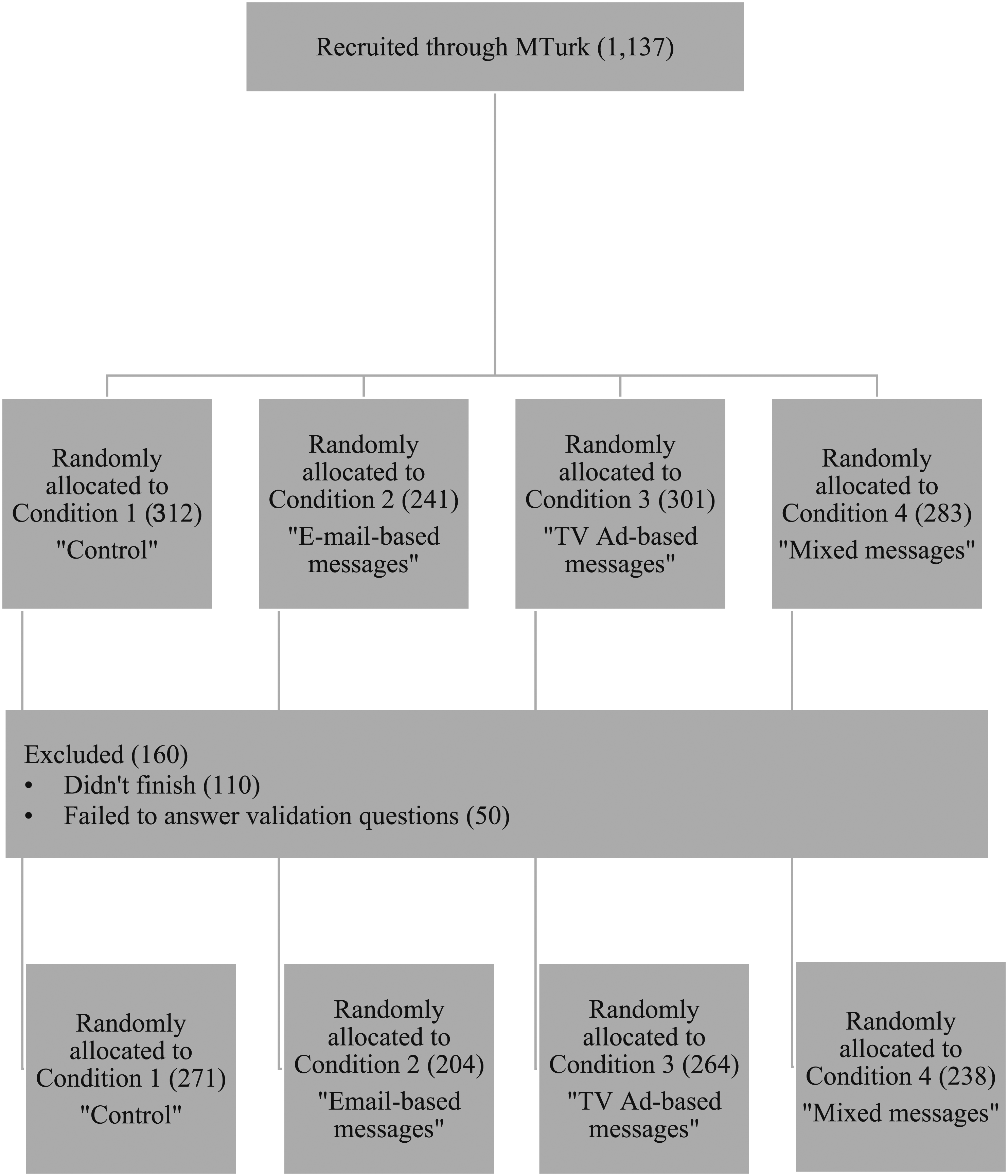
Results
All hypotheses but H4b were supported. First, as expected, participants perceived the candidate to be ideologically more extreme when they were exposed to the messages aimed at campaign supporters (Figure 2). Perceived Ideology was measured based on a 7-point scale (very conservative, conservative, slightly conservative, moderate or middle of the road; slightly liberal, liberal, and very liberal) and was recoded such that the highest number indicates “very liberal.” The mean of the variable was 5.6728 for Condition 2, which was higher than the ideology perceived by those in Condition 3 (4.0115). The difference was statistically significant at the 95% confidence level (p < .0001). The difference between Condition 1 and 2 was significant as well (p < .0001). Perceived ideology of candidate. Notes: Question wording: “Where would you place James Johnson on this scale?” Answer options: Very conservative, Conservative, Slightly conservative, Moderate; middle of the road, Slightly liberal, Liberal, Very liberal, Don’t know. N = 873. “Don’t Know” excluded.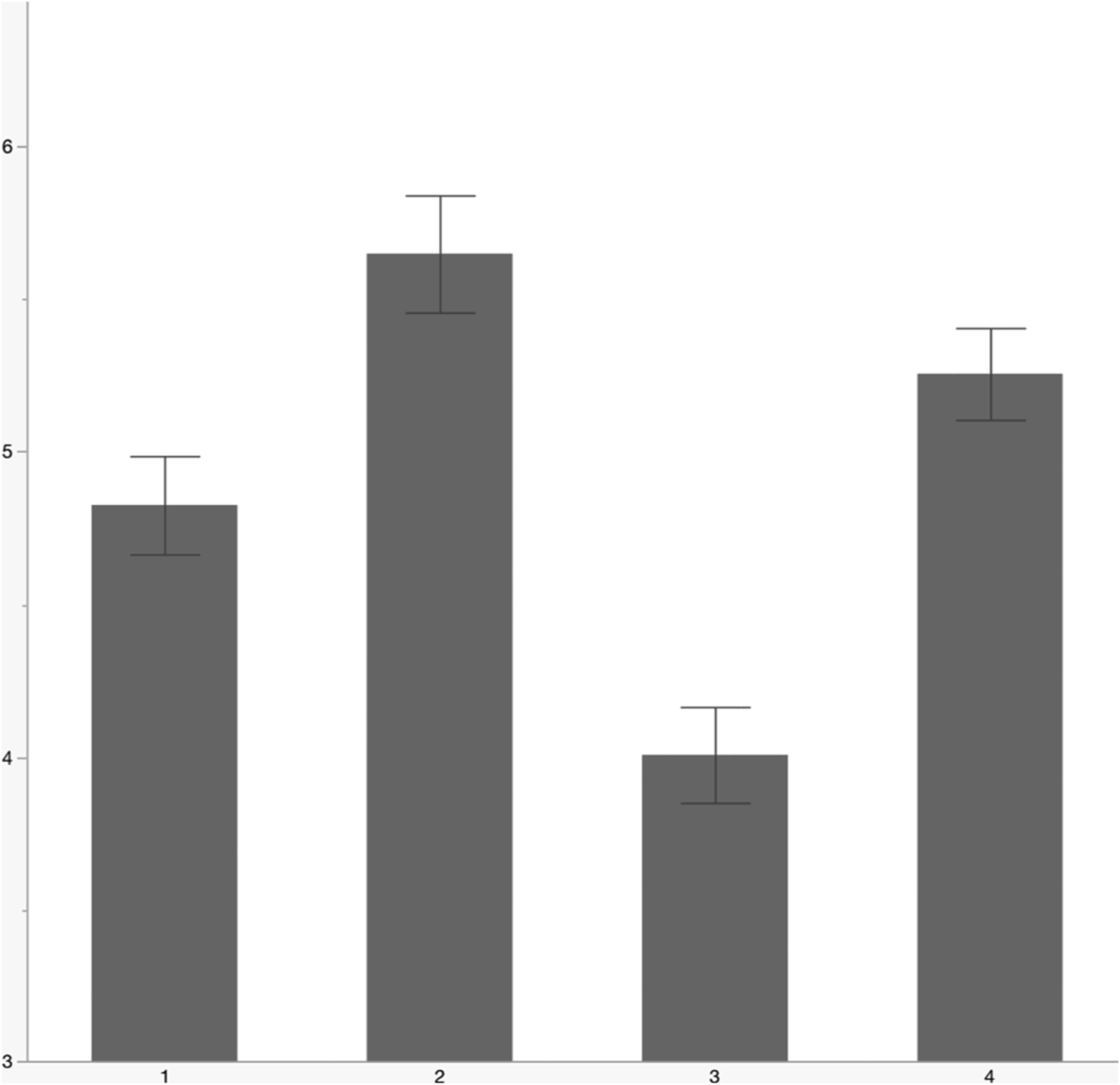
The pattern was the same for the variable measuring the perceived level of bipartisanship. Perceived Bipartisanship was measured on a 6-point scale (very partisan, partisan, slightly partisan, slightly bipartisan, bipartisan, very bipartisan), and was recoded such that the highest number indicates “very bipartisan.” To make sure everyone interprets the term bipartisanship the same way, the following was provided at the beginning of the question: “Partisan: politicians who strongly support their party's policies and are reluctant to compromise with their political opponents. Bipartisan: politicians who try to find common ground with their political opponents through compromise.”
As shown in Figure 3, participants in Condition 2 evaluated the candidate to be more partisan (1.8945) than those in Condition 1 (3.4818), Condition 3 (4.3852), and Condition 4 (3.3487). These differences were statistically significant at the 95% confidence level (p < .0001 for all three pairs of comparison). Therefore, the findings support the ideas that voters are more likely to see a candidate as ideologically more extreme and more partisan as a result of being exposed to the messages aimed at campaign supporters and that they tend to see a candidate as ideologically less extreme and less partisan when exposed to the messages aimed at swing voters. Interestingly, those in Condition 4 (exposed to inconsistent messages) perceived the candidate to be more liberal/partisan than those in Condition 3 did but less liberal/partisan than those in Condition 2 did. This may imply that the effects of partisan messages were reduced by bipartisan messages, and vice versa. Perceived bipartisanship of candidate. Notes: Question wording: “Partisan: politicians who strongly support their party’s policies and are reluctant to compromise with their political opponents. Bipartisan: politicians who try to find common ground with their political opponents through compromise. Where would you place James Johnson on this scale?” Answer options: Very bipartisan, Bipartisan, Slightly bipartisan, Slightly partisan, Partisan, Very partisan, Don’t know. N = 937. “Don’t Know” excluded.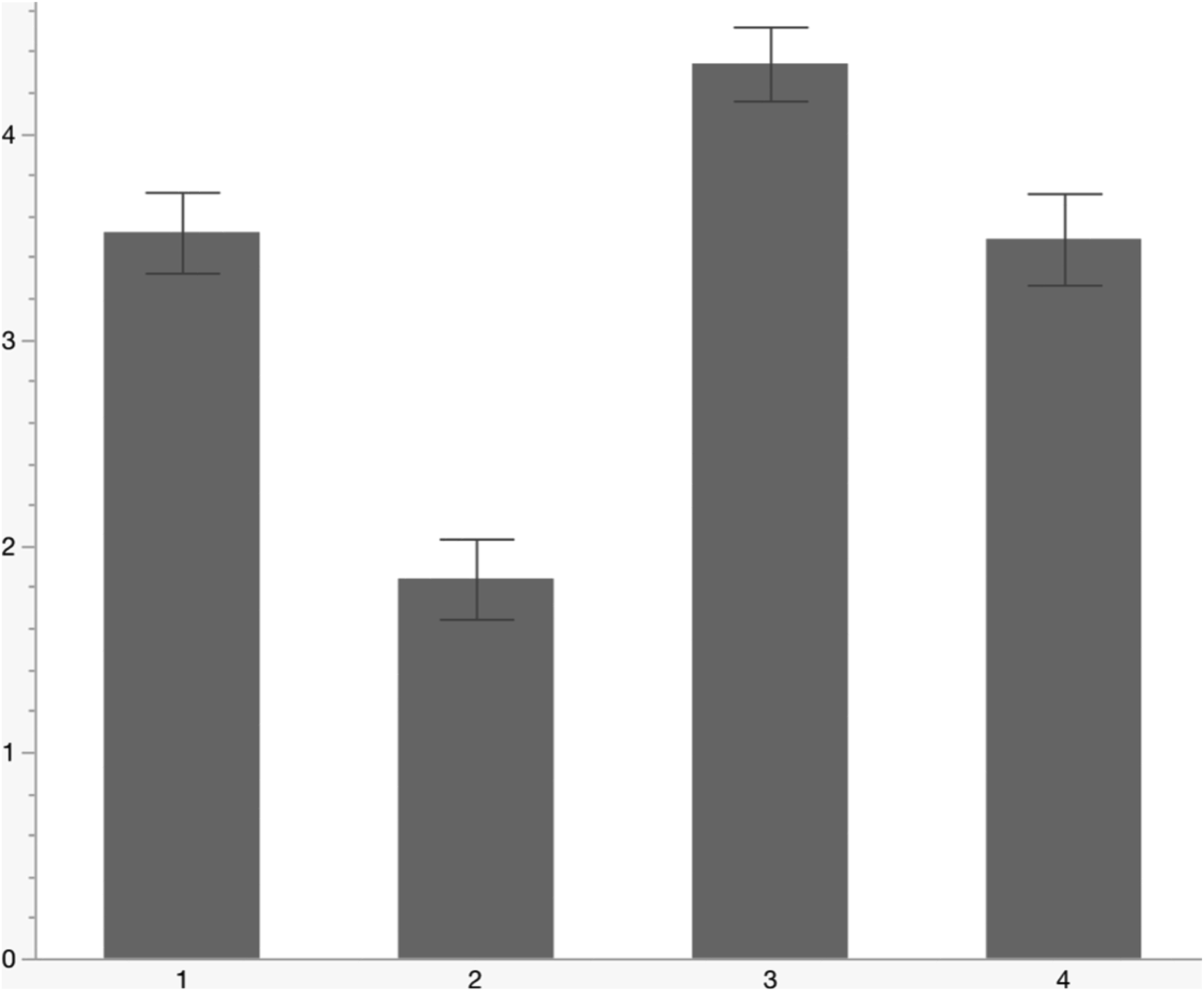
Next, the candidate’s issue position was understood differently by the participants (Figure 4), which is consistent with the expectation (H2). Specifically, those in Condition 3 were more likely to report that the candidate holds a “tough” position on immigration (.7091) than those in Condition 1 (.1429), Condition 2 (.0576), and Condition 4 (.0467). The candidate’s position on immigration was coded based on the participants’ answers to the following question: Where do you think that James Johnson stands on the issue of Immigration? The answers were coded 0 if a participant chose “Undocumented immigrants living in the U.S. who meet certain requirements should be allowed to stay in the country legally” and 1 if a participant chose “Undocumented immigrants living in the U.S. who meet certain requirements should NOT be allowed to stay in the country legally” (291 participants who chose “Don’t Know” were excluded from the analysis). A message shown to those in Condition 3 clearly discusses the candidate’s tough position on immigration while the issue was not directly discussed in the other conditions (Given the experimental design, those in Condition 3 were least likely to choose the “Don’t Know” option. Condition 1 = 35%, Condition 2 = 31%, Condition 3 = 17%, Condition 4 = 37%). Therefore, many participants in Condition 1, 2, and 4 seemed to infer the candidate’s position on the issue from his party affiliation (Franklin, 1991) as opposed to just choosing “Don’t Know.” Perceived position on immigration. Notes: Question wording: “Where do you think that James Johnson stands on the issue of Immigration?” Answer options: Undocumented immigrants living in the U.S. who meet certain requirements should be allowed to stay in the country legally (0), Undocumented immigrants living in the U.S. who meet certain requirements should NOT be allowed to stay in the country legally (1), Don’t know. N = 684. “Don’t Know” Excluded.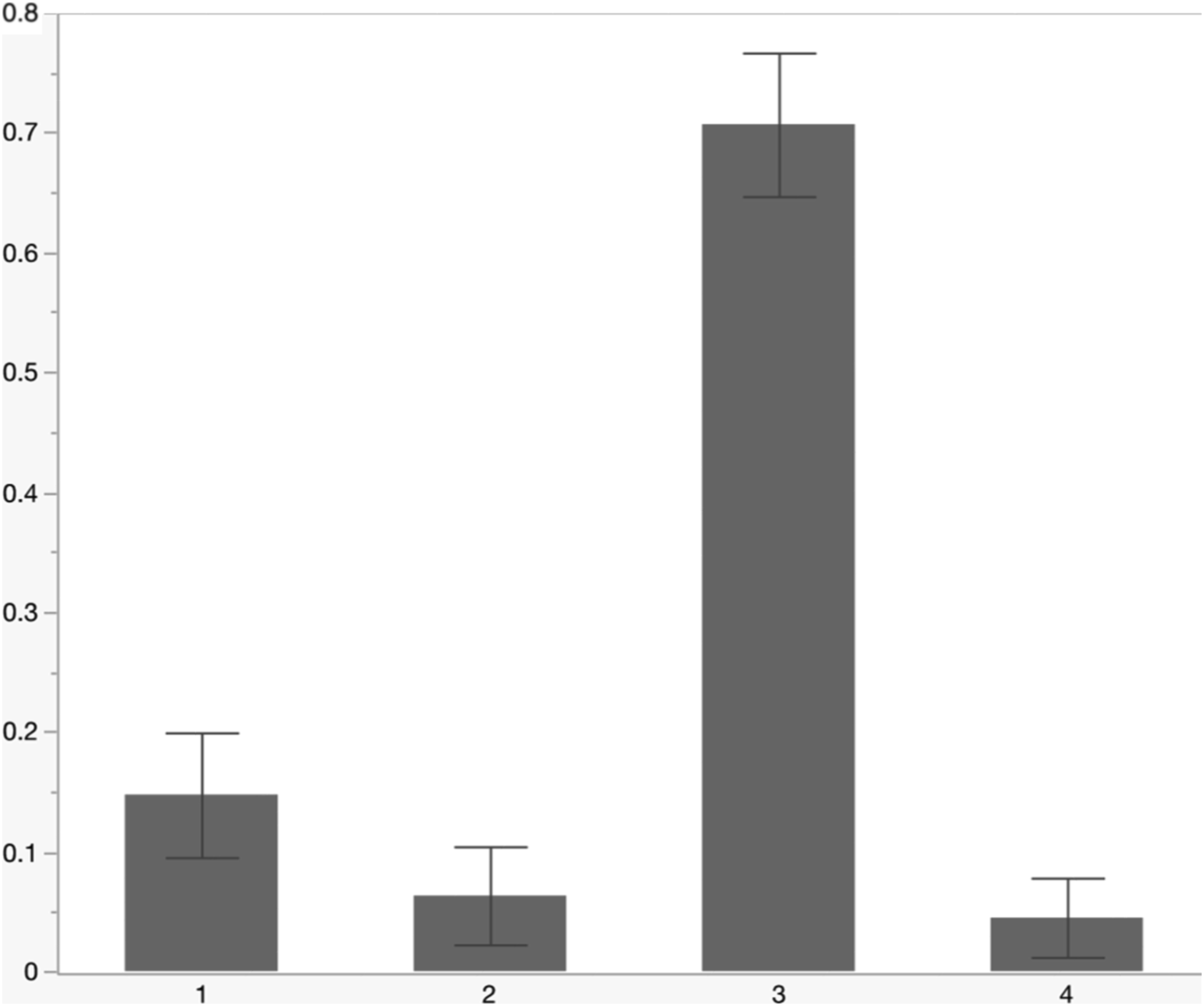
Favorability of Candidate by Party Identification and Condition (3 vs. 2).
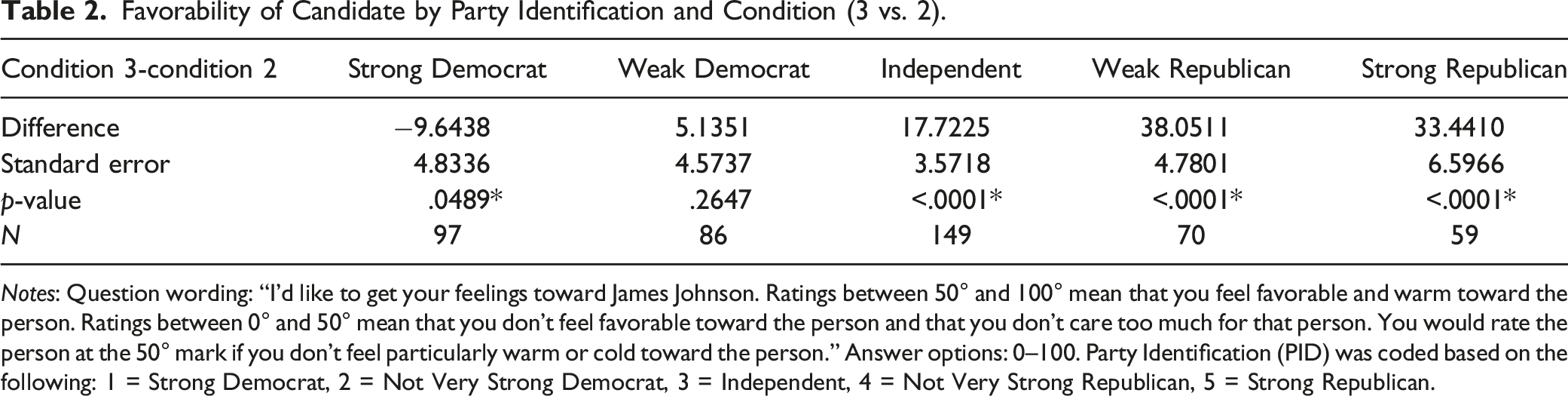
Notes: Question wording: “I’d like to get your feelings toward James Johnson. Ratings between 50° and 100° mean that you feel favorable and warm toward the person. Ratings between 0° and 50° mean that you don’t feel favorable toward the person and that you don’t care too much for that person. You would rate the person at the 50° mark if you don’t feel particularly warm or cold toward the person.” Answer options: 0–100. Party Identification (PID) was coded based on the following: 1 = Strong Democrat, 2 = Not Very Strong Democrat, 3 = Independent, 4 = Not Very Strong Republican, 5 = Strong Republican.
% of Participants Feeling Uncertain About Candidate Ideology and Partisanship.
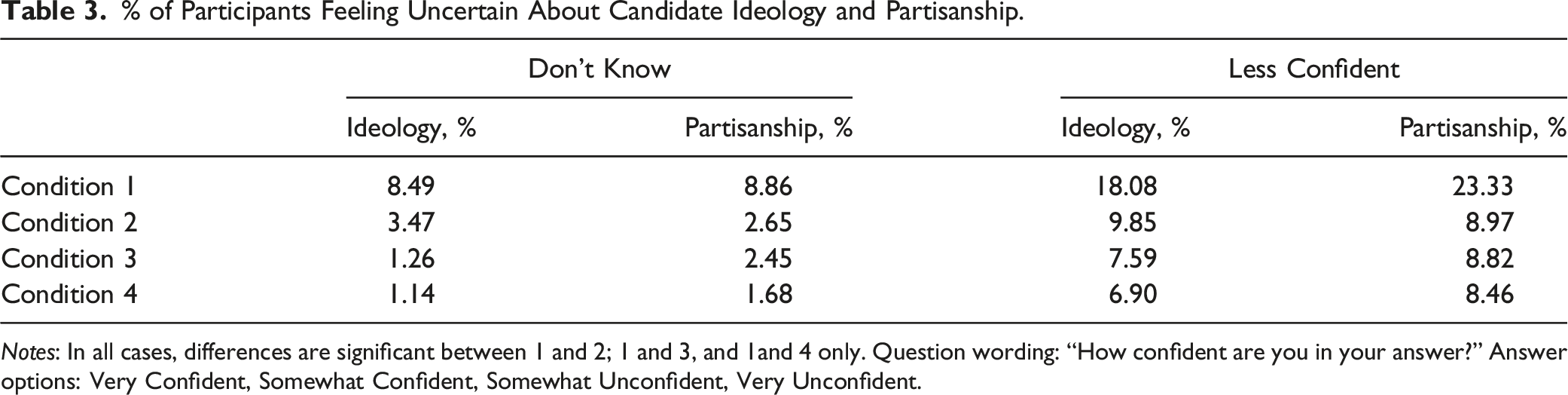
Notes: In all cases, differences are significant between 1 and 2; 1 and 3, and 1and 4 only. Question wording: “How confident are you in your answer?” Answer options: Very Confident, Somewhat Confident, Somewhat Unconfident, Very Unconfident.
Among those who chose the answer options other than “Don’t Know” (in other words, those who did evaluate the candidate’s ideology and partisanship), participants in Condition 1 were still different from those in the other conditions in that they were less confident about their evaluations. Specifically, 18.08% of the participants in Condition 1 reported that even though they answered the question about the candidate’s ideology, they were not confident about their answer. As for the candidate’s partisanship, 23.33% of the participants in Condition 1 reported that they were not confident about their answers. While I expected those in Condition 4 (exposed to both types of, or inconsistent, messages) to be less certain about the candidate’s ideology and partisanship than those in Condition 2 and 3 (exposed to consistent messages), I did not find statistically significant differences. It is interesting that those in Condition 4 were not particularly uncertain about the candidate’s ideology/partisanship despite the confusing messages they received. It is possible that those in Condition 4 did not choose “Don’t Know” with a higher frequency because they did not see the mixed messages as a source of confusion. Instead, they might think that they had an opportunity to see diverse aspects of a campaign. Similarly, inconsistent or conflicting signals might not increase uncertainty possibly because those in Condition 4 “averaged” across these appeals, rather than being confused by them. In fact, as shown in Figures 2 and 3, those in Condition 4 evaluated the candidate to be less extreme than those in Condition 2, but more extreme than those in Condition 3. Therefore, it is possible that voters adjust their evaluations of the candidates in a reasonable and predictable manner when exposed to conflicting messages, and the politician’s ambiguous messages do not necessarily decrease voters’ confidence about their choices.
Discussion
The findings presented in this study speak to the consequences of being exposed to campaigns’ audience-specific messages. An increasing number of studies examine how campaigns target voters across communication channels and platforms. This study tries to connect studies on the effects of targeted messages with those on campaigning across media. Overall, voters may become more confident about their choices as they receive more messages from political campaigns. However, campaigns’ use of targeted messages causes voters to perceive the same candidate differently. If a person relies solely on campaign e-mails, a candidate may be seen as someone who is ideologically extreme and strongly partisan. If a voter’s knowledge about the candidate is shaped mostly by the campaign’s television ads, the candidate may be understood as a bipartisan who is ideologically moderate.
As for the limitations of this research, it should be noted that the experiment may have a low external validity. The experimental conditions used in this research differ from most of the real campaign environments. Outside the experimental conditions, many people receive much more campaign information, and from much more diverse sources. Factors that influence or erase the effects of campaign messages (e.g., one’s prior knowledge about the candidate and various characteristics of the candidate) were controlled in this study as well. Furthermore, I measured the campaign effects immediately after the participants were exposed to the campaign messages. Even those who argue that campaign effects are minimal (Kalla & Broockman, 2018) note that persuasive effects exist in such circumstances. In other words, the findings from this study should not be interpreted to suggest that campaigns matter in all contexts. That said, the primary goal of this study is not to mimic what happens in real life, but to isolate the effects of targeted campaign messages in an artificial setting. I tried to isolate the effects of specific types of campaign messages, rather than designing a study where the effects of campaign messages, media coverage of campaigns, interest group messages, statements from opinion leaders, and the like are inseparable from each other. The experimental design achieved a degree of realism by using the campaign messages used in an actual political campaign.
Future studies should employ more experimental conditions, varying the characteristics of the candidates and the information treatments. For example, one may systematically compare whether Democrats and Republicans react similarly to a candidate who takes bipartisan approaches or a candidate who takes issue positions that are similar to the positions typically associated with her opponent’s party. In order to do so, the study would need to vary the candidate’s party affiliation. In addition, one should consider testing the effect of an individual message before focusing on the aggregate effects of the messages delivered via a communication channel. It is also possible to include other types of campaign information (e.g., media coverage, interest group messages, and etc.) and examine how voters react differently to each type of, and some combinations of, the messages.
Another fruitful area of research is to focus more clearly on voters’ emotional responses to different types of campaign messages. For example, in a pilot test, I find that many voters perceive a candidate less favorably after being exposed to the messages aimed at campaign supporters (i.e., campaign e-mails). For example, Independents who were exposed to campaign messages aimed at campaign supporters (Condition 2) evaluated the candidate more negatively (Feeling Thermometer = 41.6) than Independents in Condition 1 (52.8), Condition 3 (58.8) and Condition 4 (54.5) did. Even partisans who generally support the candidate’s party seemed to react negatively to campaign e-mails. For example, those who described themselves as Not-So-Strong Democrats evaluated the Democratic candidate at 55.9 in Condition 2, which is lower than 66.6 (Condition 1), 61.3 (Condition 3), and 63.6 (Condition 4). It is possible that voters, including campaign supporters, are disappointed by the fact that campaigns focus heavily on fundraising (Epstein & Broxmeyer, 2020) in messages aimed at campaign supporters.
Supplemental Material
Supplemental Material - The Effects of Targeted Campaign Messages on Candidate Evaluations
Supplemental Material for The Effects of Targeted Campaign Messages on Candidate Evaluations by Taewoo Kang in American Politics Research.
Footnotes
Declaration of Conflicting Interests
The authors declared no potential conflicts of interest with respect to the research, authorship, and/or publication of this article.
Funding
The authors received no financial support for the research, authorship, and/or publication of this article.

Supplemental Material
Supplemental material for this article is available online.
Note
Author Biography
References
Supplementary Material
Please find the following supplemental material available below.
For Open Access articles published under a Creative Commons License, all supplemental material carries the same license as the article it is associated with.
For non-Open Access articles published, all supplemental material carries a non-exclusive license, and permission requests for re-use of supplemental material or any part of supplemental material shall be sent directly to the copyright owner as specified in the copyright notice associated with the article.
