



Abstract
Are members of Congress who receive more of their campaign funding from organized interests more supportive of democratic norms compared to members who receive more of their contributions from individual donors? We analyze the campaign receipts of Republican House members in the 2020 campaign cycle and votes to object to electors for Joe Biden from Arizona and Pennsylvania and find that greater contributions to members’ campaigns from business PACs are associated with a lower probability that members voted to object to electors. Further, members’ own margin of victory in 2020 has no association with these votes when controlling for other factors, but members from districts where Trump performed better are more likely to have objected to counting Electoral College votes for his opponent. Our results demonstrate a positive association between campaign contributions from corporate PACs and support for democratic institutions within the Republican caucus in the U.S. House.
Introduction
January 6, 2021, was an unprecedented test of the United States’ political institutions. As Congress prepared to certify election results that the incumbent and defeated President Trump refused to accept, a mob of Trump’s supporters breached the Capitol and forced members of Congress and Vice President Pence to flee. After order was restored hours later Congress resumed its business of certifying the votes. During this process, two-thirds of House Republicans objected to counting electors from at least one state, joined by eight Republican Senators. 1
The objections by so many House and Senate Republicans even after Trump’s supporters stormed the Capitol triggered outrage from both citizens and interest groups. Two-thirds of the 30 largest corporate political action committees (PACs) immediately suspended donations to Republicans who voted to object (Macmillan and McGregor 2021), though many eventually resumed donations, with some Republicans receiving even more than their pre-2020 totals (Evers-Hillstrom 2021). While some companies such as Microsoft and Dow Chemical maintained their ban on PAC donations to objectors (Ackley 2022), they are also among 13 firms with executives and lobbyists who continued to make direct individual donations to the objecting members (Birnbaum et al., 2022).
Analysis of this phenomenon in Li and DiSalvo (2022) shows that firms pledging to cease PAC donations specifically to those members objecting to electors have stuck with the commitments more durably than firms announcing blanket pauses of all donations to federal candidates. In addition, firms with more Democratic-leaning employees, customers, and shareholders were more likely to withhold PAC contributions, indicating that businesses’ willingness to engage in corporate advocacy for democratic institutions is at least partially contingent on the partisan leanings of the firms’ stakeholders (Li and DiSalvo, 2022).
In this article, we explore the other side of the relationship between business, legislators, and democracy, specifically: do members of Congress with greater reliance on business interests for campaign funds demonstrate a stronger preference for the preservation of democratic norms and institutions? We address this question in the context of the votes on electors on January 6th and find that the members who received more of their campaign contributions from business PACs were also members less willing to impede the peaceful transfer of power in the interest of partisan gain by objecting to the Electoral College votes from Arizona or Pennsylvania. Our results illustrate how contribution levels by business PACs appear to align with differences among Republican House members on an establishment versus populist/anti-institutionalist dimension.
PACs, individual donors, and democratic norms
The primary goal of interests making contributions through PACs is legislator access (Hall and Wayman, 1990; Snyder, 1992). As such, PAC donations mostly flow toward the lawmakers who are most likely to yield benefits for immediate policy goals (Fournaies and Hall, 2018; Grenzke, 1989). The most effective legislators are those most likely to achieve policy outcomes and thus are most likely to receive business PAC support (Heberlig and Larson, 2022). In the process of seeking access to the most productive legislators for their interests, PACs largely direct money toward moderates and incumbents (Fouirnaies and Hall, 2014; Grimmer and Powell, 2013). Indeed, research leveraging variation across states demonstrates that campaign finance systems advantaging PACs over individual donations yield more moderate legislatures (Barber, 2016a).
As a group, business PACs represent a category of interests with substantial heterogeneity in individual policy goals (Crosson et al., 2020), but there is some reason to expect that these groups might share a preference for durable, predictable democratic institutions. Business interests in the United States and abroad have not been shown to be advocates of democracy, but cross-national studies demonstrate that political stability in terms of robust property rights, durable legislatures, and constraints on executives are associated with greater economic growth and foreign investment (Alesina et al., 1996; Li and Resnick, 2003). Greater political uncertainty in a nation on the other hand is associated with a reduction of investment by business interests (Chen, Nie, and Ge, 2019; Julio and Yook, 2016). In the U.S. case, political stability includes durable democratic institutions with the orderly transfer of power after elections. Business interests will not likely welcome the uncertainty and turbulence that might accompany democratic decline.
The general public, however, shows less concern for institutional stability. Graham and Slovik (2020) demonstrate that voters in candidate choice experiments are willing to trade off democratic norms for partisan gain. And the individuals who comprise the pool of donors to candidates tend to be more ideological and less moderate than the overall American electorate (Francia, et al., 2003; La Raja and Schaffner, 2015). Further, individual donors are more ideologically extreme than the legislators’ constituents (Bafumi and Herron, 2010; Barber, 2016b).
These more extreme partisans who are disproportionately represented within each party’s individual donor base are less supportive of constitutional protections of democratic principles when their own party holds the reins of power (Kingzette et al., 2021). Finally, the violence of January 6th itself is a powerful example of a “radical partisanship” among extreme activists that rejects the legitimacy of political opponents (Kalmoe and Mason, 2022).
The different level of importance each of these categories of campaign donors assign to the stability of democratic institutions should be reflected in legislator behavior. While there is no consistent pattern of PAC donations affecting votes on all legislation, several studies document individual cases of corporate PACs having increased influence on votes ranging from bank bailouts (Mian et al., 2010), to financial regulations (Stratmann, 2002), or sugar industry supports (Grier et al., 2022). Similarly, there is evidence that the preferences of individual donors exert influence on actions of legislators. In the United States, House members are responsive to individual donors, more closely reflecting the ideological position of these donors than their constituents (Baker, 2016) and casting roll call votes more in line with the policy preferences of partisan donors than with constituents (Canes-Wrone and Miller, 2022).
An attempt to overturn the results of an election runs contrary to a fundamental norm of democracy that losers must accept the results (Anderson et al., 2005). Officeholders’ acceptance of rival parties as legitimate and “the idea that politicians should exercise restraint in deploying their institutional prerogatives” constitute the “guardrails of democracy” (Levitsky and Ziblatt, 2019, 9). We expect that members of Congress who receive more of their campaign contributions from corporate PACs should show greater consideration for these guardrails. Specific to January 6th, members of Congress who derive more of their direct campaign funding from business interests should be less likely to attempt to block the certification of the vote for the presidential candidate of the opposing party. Formally stated, the hypothesis we evaluate is as follows:
The greater the level of donations from corporate PACs to a Republican member of Congress in the 2020 campaign, the less likely that member will vote to object to counting Electoral College votes on January 6th.
Data
Objections to the counting of electoral ballots from Arizona and Pennsylvania were joined by one or more Senators, triggering deliberation and roll call votes on the objections in both chambers. The dependent variable in the analyses that follow is a vote to object, coded 1 when the Republican member in the House voted “yea” to object to the Electoral College votes from either or both states. The variable is coded 0 for members who voted “nay” on either or both questions and did not vote “yea” on the other question. The seven Republican members who did not vote on either question are dropped. Democratic members are not included in this analysis since none voted to object. Senate votes are not included because PAC donations and most other variables in this study are not comparable across chambers; thus, the cases cannot be pooled with House observations, and a separate parallel analysis of Senate votes is underpowered (N = 50 with 7 votes to object).
The independent variable of interest, donations from business PACs, is operationalized in two ways: first, as a percentage of the member’s total campaign receipts from all sources in the 2020 cycle and second, in millions of US dollars of receipts from business PACs. 2 Contribution totals from business, labor, ideological, and other PACs in the 2020 election cycle were provided by OpenSecrets, and total campaign receipts were obtained from the Federal Election Commission (2022). 3
Because more moderate legislators could both attract greater business PAC contributions and be separately less likely to vote to object, we account for members’ overall ideological position relative to their colleagues within the Republican caucus with the first dimension DW-NOMINATE (Lewis et al., 2022). 4 For ease of interpretation in the models, the scores are rescaled −100 to 100 with higher values indicating the member is more conservative. Similarly, since PACs often reward more effective legislators and more effective legislators may display greater adherence to institutional norms, we also estimate additional models that include Volden and Wiseman’s (2014) Legislative Effectiveness Scores.
We expect that members who had larger margins of victory in their 2020 election campaigns could be less concerned about constituent disapproval of using congressional procedure to advance the partisan interest of objecting to electors. To account for this, we include the percentage of the total vote the member received in their district in 2020, obtained from the MIT Election Data and Science Lab (2022). Similarly, taking action in Congress for the benefit of Donald Trump may have been more appealing to members from districts where the President received greater support, so we also include a variable for Trump’s vote percentage in the member’s district in 2020 (DailyKos, 2022). Relatedly, because some members could show greater fealty to Trump personally, we use an indicator variable for Trump’s endorsement of their 2020 candidacy in an alternate specification in the Supplemental Appendix.
Finally, newer members of the Republican caucus could be more reflective of an emerging antidemocratic streak in the party and could be more likely to support objections to the election. Because PACs tend to offer greater support to incumbents, these newer members could also be systematically less likely to receive PAC donations. To account for this potential confound, we include a count variable for the number of terms the member has served in Congress and in an alternate specification in the Supplemental Appendix as an indicator variable for new members of the 117th Congress.
Analysis
We estimate probit models to test for a systematic relationship between the level of corporate PAC contributions to a Republican member in the 2020 campaign and that member’s probability of voting to object to the Electoral College votes from either or both Arizona and Pennsylvania on January 6, 2021.
Predictors of Electoral College vote objection.
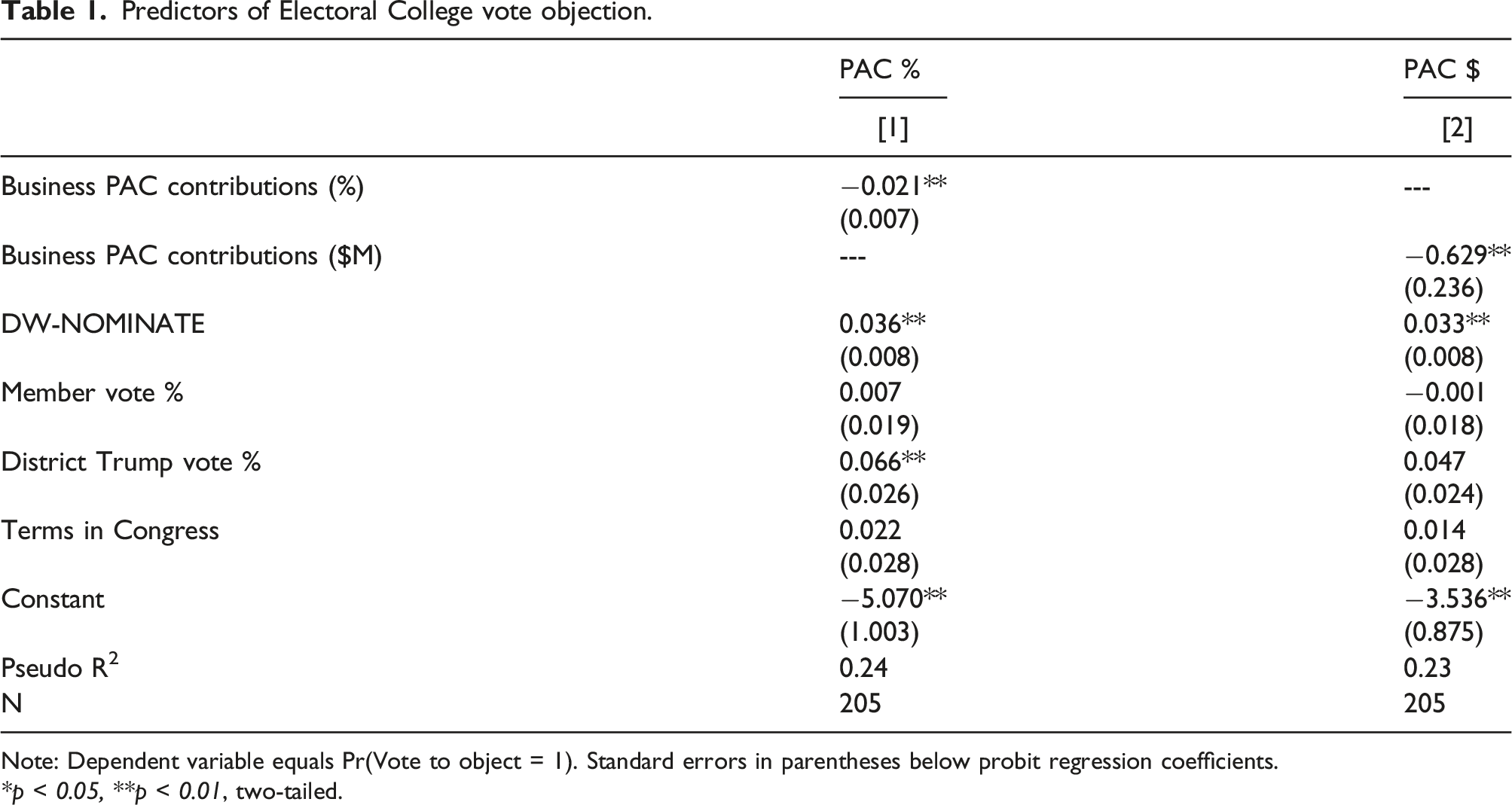
Note: Dependent variable equals Pr(Vote to object = 1). Standard errors in parentheses below probit regression coefficients.
*p < 0.05, **p < 0.01, two-tailed.
The marginal effects of PAC donations on the predicted probability of objecting to electors from Arizona and/or Pennsylvania are shown in Figure 1. Holding other covariates at their means, a 10-percentage point increase in a member’s campaign funds coming from business PACs is associated with about a 6-point decline in the probability of voting to object to counting electors from one or both states. In terms of contribution volume, $500k in additional business PAC donations are associated with an approximately 11-point decline in the probability of voting to object. Marginal effects of business PAC contributions on probability of vote to object.
We also consider the possibility that members who received more of their money from small individual donors were more likely to vote to object to counting the electors. There is some evidence for this relationship. Models provided in the Supplemental Appendix (Tables A3 and A4) regressing the percentage of campaign receipts from small donors (less than $200) instead of corporate PACs on these votes show a positive association between the proportion of campaign receipts from small donors and voting to object, though the model measuring small donations in total US dollars does not yield a statistically significant association.
Moving to the control variables, more conservative ideology as measured by DW-NOMINATE is significantly associated with the probability of objecting to electors. 6 We expect that PAC donation levels are correlated with an institutionalist- vs.-populist dimension among Republican lawmakers that is distinct from members’ left-right ideological position. One potential concern is that business PAC donations simply flow to more moderate members who were also less likely to object to the certification of the Electoral College vote count; however, the percentages of members’ 2020 campaign receipts from business PACs are weakly correlated with legislators’ ideology (ρ = −0.11), and corporate PAC donations remain associated with the January 6th votes when DW-NOMINATE is included in the models. Similarly, in additional models provided in Tables A3 and A4 of the Supplemental Appendix that include Legislative Effectiveness Scores, effectiveness is not associated with the votes to object and business PAC donations remain a significant predictor. 7
The 2020 election results had unexpected associations with Republican members’ votes on the objections. Controlling for other factors, members’ percentage of the vote in 2020 has no association with the probability of voting to object. But Trump’s 2020 electoral strength in the members’ districts is a significant predictor. Members from districts voting more strongly for Trump were more likely to vote to object to the counting of the electors. Trump vote is positive and statistically significant in Column [1] measuring PAC donations as a percentage and positive but significant only in a one-tailed test (p = 0.09 two-tailed) in Column [2] where PAC support is measured in millions of US dollars.
Relatedly, we assess if members endorsed by Trump in the 2020 election campaign were more likely to object to Biden’s electors out of personal loyalty or sense of obligation to Trump. The models in Tables A3 and A4 of the Supplemental Appendix with a dummy variable for Trump's endorsement find no significant association between endorsement and the roll call votes when controlling for the other factors in the models.
Member vote percentage could have no association with the January 6th votes because member vote is simply a noisier measure of district partisan lean compared to Trump vote. A handful of members faced especially weak opposition, earning vote shares far higher than the top of the ticket. With this in mind, we also estimate models using the rated seat safety for the member. In these models (Appendix Tables A3 and A4), member seat safety still has no relationship with the roll call votes while Trump’s vote share is still positively associated with these votes.
The number of terms served by the member has no significant association with the member’s votes on the objections to the electors. The alternative approach of using a dummy variable for freshman members also does not yield significant results (Supplemental Appendix Tables A3 and A4).
Conclusion
Whether business PAC contributions are operationalized as the proportion of total campaign receipts or as the total US dollar amount, and whether PAC contributions are considered in total or restricted to corporate PAC donations, the greater the support of a member’s campaign from PACs, the lower the probability of that member voting to object to electors on January 6th. Members more conservative relative to their Republican colleagues were more likely to cast votes objecting to the electors from the two states, but members coming from safer seats were not. However, members from districts where Trump’s 2020 margin was higher were more likely to object to Biden’s electors from Arizona and/or Pennsylvania. Finally, these votes did not pit veterans of the institution against newcomers, as service time in the House is not associated with the probability to object.
It should be noted that these findings illustrate how the suspension or cessation of contributions by many corporate PACs to Electoral College objectors was hitting the members less reliant on these contributions in the first place. Coupled with the uninterrupted individual donations from executives and lobbyists of many firms, the true degree of “punishment” Republican House members have felt for objecting on January 6th appears muted.
This analysis is confined to House Republicans because the two roll call votes studied here only vary within the Republican caucus, not because we presume that an establishment-populist dimension is only present within the Republican Party. However, in this highest profile choice to date between democratic norms versus partisan advantage, only Republican members were divided; thus, only the Republican side could be studied on this question in this case.
We do not claim our results establish that greater reliance on business interests causes greater adherence to democratic norms. Instead, we view these results as describing a traditional/institutionalist versus populist/anti-establishment dimension within the Republican Party that is distinct from the main left-right ideological dimension. Furthermore, this dimension is characterized by different sources of campaign funding. Establishment, business-friendly—or at least more business-funded—Republicans appear less interested than their more individually funded colleagues in challenging America’s democratic institutions.
Most broadly, these findings highlight a challenging dilemma of campaign finance in the United States. While a greater reflection of the preferences of individual donors may have the normatively attractive outcome of reducing the influence of monied interests in policymaking, it should also be worrisome that portions of the activist bases that populate the donor class may be more concerned with winning than with the health and stability of the institutions themselves.
Supplemental Material
Supplemental Material - PACs and January 6th: Campaign finance and objections to the electoral college vote count
Supplemental Material for PACs and January 6th: Campaign finance and objections to the Electoral College vote count by Kenneth M Miller, and Tanner Bates in Research & Politics
Footnotes
Acknowledgements
The authors extend their thanks to Andrew Mayersohn at OpenSecrets for providing corporate PAC contribution data and are grateful for helpful comments from David Damore, Michele Kuenzi, Dan Lee, Zhao Li, Danielle Thomsen, and the anonymous reviewers.
Declaration of conflicting interests
The author(s) declared no potential conflicts of interest with respect to the research, authorship, and/or publication of this article.
Funding
The author(s) received no financial support for the research, authorship, and/or publication of this article.

Supplemental Material
Supplemental material for this article is available online
Notes
References
Supplementary Material
Please find the following supplemental material available below.
For Open Access articles published under a Creative Commons License, all supplemental material carries the same license as the article it is associated with.
For non-Open Access articles published, all supplemental material carries a non-exclusive license, and permission requests for re-use of supplemental material or any part of supplemental material shall be sent directly to the copyright owner as specified in the copyright notice associated with the article.
