




Abstract
Slowing the process of global warming will require sustained reductions in greenhouse gas (GHG) emissions over decades, which in turn depends on public support for decarbonization. We are beginning to see evidence of success in cutting emissions. Will wider recognition of this “good news” strengthen or soften support for further action? In contrast to previous research showing a demotivating effect of good news about climate mitigation, our pre-registered survey experiment finds no average impact of factual reports of climate progress on Americans’ worries about climate change, perception of efficacy in fighting climate change, willingness to pay additional taxes, support for green industrial policy, or willingness to donate to a climate NGO, and no evidence of heterogeneous effects across relevant subgroups. Given the importance of sustained public support for decarbonization, these null results can be seen as good news for mitigation policy, but more research is needed to assess the impact of the perceived tractability of climate mitigation on support for mitigation efforts.
Introduction
Although the global average temperature continues to rise and severe weather events have become more common in recent years due to global warming, 1 there are also encouraging recent signs that GHG emissions can be contained and reduced. Notably, the cost of generating renewable energy from solar and wind power has steadily declined, such that utility-scale solar plants recently became the cheapest-ever way of generating energy, 2 and the production of renewable energy is rising quickly in many countries. Emissions have been declining in the US and the European Union for 15 years, and some analysts expect global emissions to start steadily declining by 2025. 3
In this paper, we seek to better understand how the public reacts to these encouraging but not-yet-widely known pieces of good news about climate change. As Hornsey and Fielding (2016) note, learning about progress in addressing climate change could make people more supportive of further action, because the problem seems more tractable; it could also make people less supportive of further action, because the problem seems less severe. Hornsey and Fielding (2016) conclude on the basis of a US survey experiment that the latter mechanism is more pervasive: an optimistic message about the trajectory of global emissions makes people less motivated to take action. This could be bad news for the mitigation of climate change, given that constraining further warming will require sustained public support for aggressive action even as emissions drop much further (Azevedo et al., 2020; Drews and Van Den Bergh, 2016). 4 Other studies find limited effects of more or less optimistic climate messages (e.g., Bernauer and McGrath, 2016; Ettinger et al., 2021). Given the mixed evidence, and the likely increasing importance of understanding how the public responds to news of progress against climate change, the topic deserves further attention.
We re-examine the effect of climate “good news” on public attitudes using an information provision experiment embedded in a pre-registered online survey of Americans (n = 2001). Instead of simply exposing respondents to different messages and measuring their responses (a design that can exaggerate information effects and bias results toward researcher expectations), we use an “ask-tell” design (Braley et al., 2023): after asking all respondents a series of factual questions about climate change mitigation, we randomly give some respondents the correct responses to select questions relating to the trajectory of US emissions, the cost of solar energy production, and the relative size of the renewable energy and coal sectors. Because most respondents underestimate progress in these areas, our information treatment conveys facts that most respondents would see as “good news.” Finally, we survey respondents’ views on climate change, their ability to address it, their support for policy responses, and their willingness to donate to a climate NGO.
We find no effect of providing encouraging news about climate mitigation on any of our outcome measures, either on average or within subsets defined by pre-treatment pessimism on these topics, political ideology, party ID, and other characteristics. This suggests, contrary to some previous research, that broader appreciation of progress in climate mitigation will not erode support for further mitigation efforts, at least in the US. Because our information treatments appear not to have substantially changed respondents’ perceptions of the tractability of climate mitigation, we view it as a still-open question how these perceptions affect citizens’ support for further mitigation efforts. We can conclude, however, that while governments and NGOs should not expect to increase average support for climate action by advertising mitigation success stories, they should also not hesitate to do so out of concern that such messages will discourage action.
Theory
How might good (or bad) news about climate mitigation affect individuals’ willingness to contribute to further mitigation efforts?
A simple decision theoretic model helps to highlight some possibilities. Suppose an individual is deciding whether to make a costly contribution to a collective project (e.g., mitigation of GHG emissions) that may or may not succeed in the future. The individual receives a fixed utility benefit B if the project succeeds and contributing to the project costs c (which could include financial costs as well as costs due to social pressure or cognitive dissonance). Whether this individual contributes then depends on B and c as well as the degree to which the individual’s contribution increases the probability of the project’s success (call this δ). Specifically, she should contribute if δB > c.
Now suppose the individual receives “good news” about the project—that is, information causing her to believe that others are contributing more than she thought, or that those contributions will be more effective than she thought. This information could affect her decision by changing δ. Before receiving the good news, the individual may believe that the project is certain to fail with or without her contribution, so that δB = 0 < c; then the good news could make her think that her contribution could make a difference, so that δB > c and she chooses to contribute. On the other hand, if the individual already was inclined to contribute, then good news could convince her that success is assured even without her contribution, reducing δ to zero and making it rational to not contribute. 5
Non-instrumental motives are likely important in decisions about contributing to a collective project like climate change mitigation. Suppose the individual’s contribution has a negligible impact on the project’s success (δ ≈ 0), so that a purely instrumental individual would never contribute. If the individual is a conformist who perceives the cost of contributing to be negative when enough others are contributing, or a team player who gets more benefit from success of the project when she herself has contributed, then information suggesting that many others are contributing and the project is likely to succeed could convince her to contribute. If she is a non-conformist or contrarian, it might have the opposite effect.
Of course, good news about climate mitigation or another collective project could also have no impact on an individual’s willingness to contribute. Beliefs about the likely success of the project or the effectiveness of individual action may be hard to change. The perceived costs of contributing c could be high compared to the benefit of success B, so that small changes in δ don’t matter. Moving further from the model, an individual could view climate mitigation as an ethical question or hold a fixed political position derived from political elites, such that her decision about contributing does not depend on her perception of the effectiveness of individual efforts. Whether individuals find “good news” about climate mitigation to be motivating, demotivating, or neither (on average or in subsets of a population) is therefore an empirical question to which we hope to contribute in this paper.
Related literature
The most relevant previous paper is Hornsey and Fielding (2016), who study the effect of different messages about the trajectory of global CO2 emissions on US respondents’ emotions and motivation to take action against climate change. In their experiment, they present survey respondents with different framings of recent carbon emissions data: for example, the optimistic framing emphasizes that year-on-year global emissions were flat in 2014 for the first time in 40 years, while the pessimistic framing states that in 2014 “there was again no reduction in emission levels” (p. 30). Hornsey and Fielding (2016)’s findings suggest that good news about emissions may on average make people feel better but do less: respondents who see the optimistic message report more hope and less distress, but they also report less motivation to do something about climate change.
Two recent studies show more modest impacts of emphasizing good or bad news about climate change mitigation efforts. Clayton and Karazsia (2020) ask US respondents to read an “empowering” message (e.g., “Wind and solar power are cheaper than ever and responsible for an increasing portion of energy use”) or a “powerless” message (e.g., “Greenhouse gases contributing to global warming have long been on the rise and are now accelerating at their fastest pace in 7 years”); most of their results are null, but they note that the empowering message reduced one of their climate anxiety measures (cognitive/emotional impairment). Ettinger et al. (2021) compare Americans’ reactions to a “hope video” (which among other things emphasizes the declining cost of renewable energy) and a “doom and gloom video” (which among other things emphasizes that renewables would need to be expanded massively to meet climate targets); they find no effect on perceptions of climate risk, likelihood of behavior change, or likelihood of climate activism.
Our analysis also relates to research examining how support for climate action depends on framing—primarily, whether one emphasizes the risks of climate change or the economic and other benefits of successful mitigation. 6 Again, results are mixed. Lockwood (2011) shows larger support for renewable energy among UK voters when it is framed as a path to energy independence rather than an economic opportunity or a way to tackle climate change; similarly, Bain et al. (2012) find that “framing climate change action as increasing consideration for others, or improving economic/technological development” was more motivating to Australian climate change skeptics than emphasizing the risks of climate change, and Dasandi et al. (2022) detect a preference for emphasizing opportunities rather than threats in the US, UK, and China (see also Dechezleprêtre et al., 2022, who compare videos about climate change impacts to videos about policy responses.) By contrast, Bernauer and McGrath (2016) find no evidence that framing mitigation in terms of technological/economic benefits or community spirit increases support among American survey respondents (including skeptics) compared to a conventional frame of avoiding harms of climate change.
Advantages of our design
Our study contributes to this literature by using a pre-registered design to measure the impact of factual messages about the success of climate mitigation efforts on a large sample of Americans. Our design differs from previous approaches in important respects.
In typical experiments measuring the effect of information treatments or framing, respondents are asked to read a text (e.g., Clayton and Karazsia, 2020; Hornsey and Fielding, 2016) or watch a video (e.g., Dechezleprêtre et al., 2022; Ettinger et al., 2021) before answering questions on the subject of the text/video. Given the lack of pretext for presenting this information, survey respondents can easily infer that the purpose of the survey is to test reactions to the information. If asked how they feel about climate change afterward, they may report feelings that align with the expected effect partly because they guess the researcher’s objective and seek to align their responses with it (though see Mummolo and Peterson, 2019). This demand effect may be exacerbated when, as in Hornsey and Fielding (2016), the researcher does not simply ask the respondent’s attitude but instead asks the respondent how the stimulus affected their attitude. 7 As a result, these studies may find that stimuli substantially affect attitudes even when the true effect is small or non-existent.
We instead employ an “ask-tell” design (Ahler, 2014; Braley et al., 2023), in which we selectively provide information in the context of a series of factual questions. This method of information provision has three main advantages compared to previous research in this area. First, because the preceding knowledge quiz asks respondents about the information we provide, we have a clear measure of what the respondent should learn from our information treatment, which is useful for interpreting treatment effects and can be used in subgroup analysis (Haaland et al., 2023). Second, by offering a pretext for providing the information (i.e., that we wanted to provide answers to some of the questions on the quiz), we may reduce experimenter demand effects. Third, participants may update factual beliefs more strongly when told that their existing knowledge is incorrect than when simply shown new information.
Our design also advances on previous work by including a real-stakes outcome (a choice to donate money to a climate NGO or keep it). Such outcomes allow for a tougher test of information effects than typical attitudinal responses (Dechezleprêtre et al., 2022).
Research design
Sample characteristics
Characteristics of the sample.
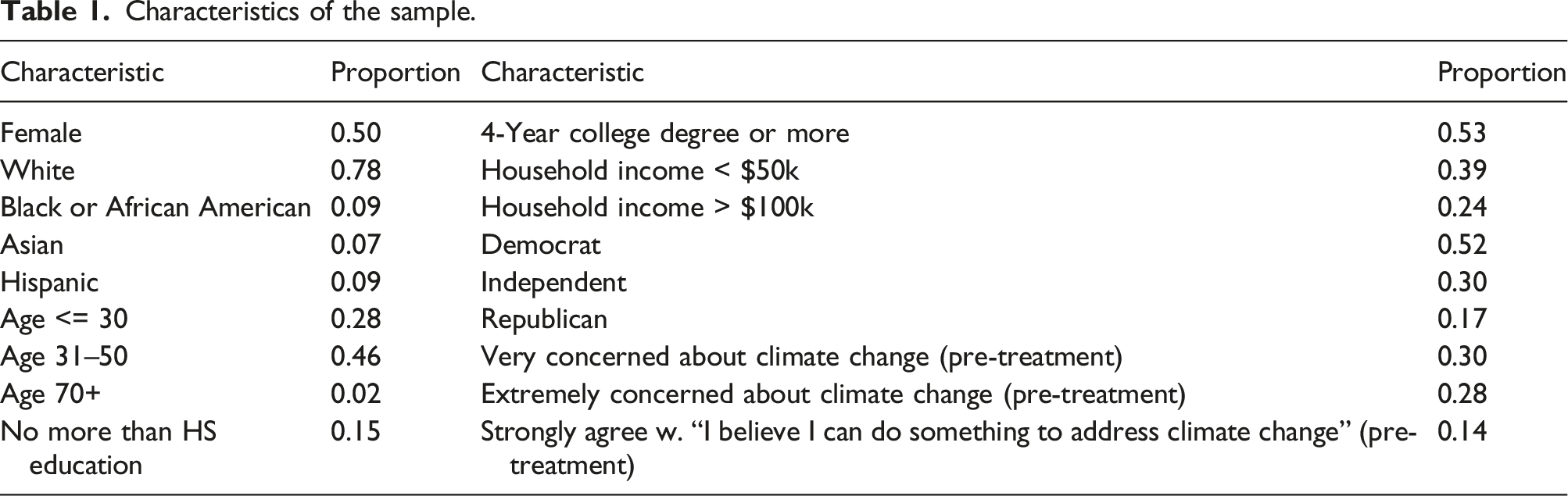
We included an attention check asking respondents to select two specific responses from a five-point agree/disagree Likert scale (exact wording appears in the appendix). Only 14 respondents (0.7%) selected just one response, indicating that they ignored the instructions entirely; another 92 respondents (4.6%) selected the wrong pair of responses, indicating some inattentiveness. Below we retain these respondents to simplify interpretation. In the Appendix, we reproduce Figure 1 and the average effects regression table without these 106 respondents, producing very similar conclusions.
Structure of the survey
Questions on our knowledge survey that form the basis of our “good news” information treatments.
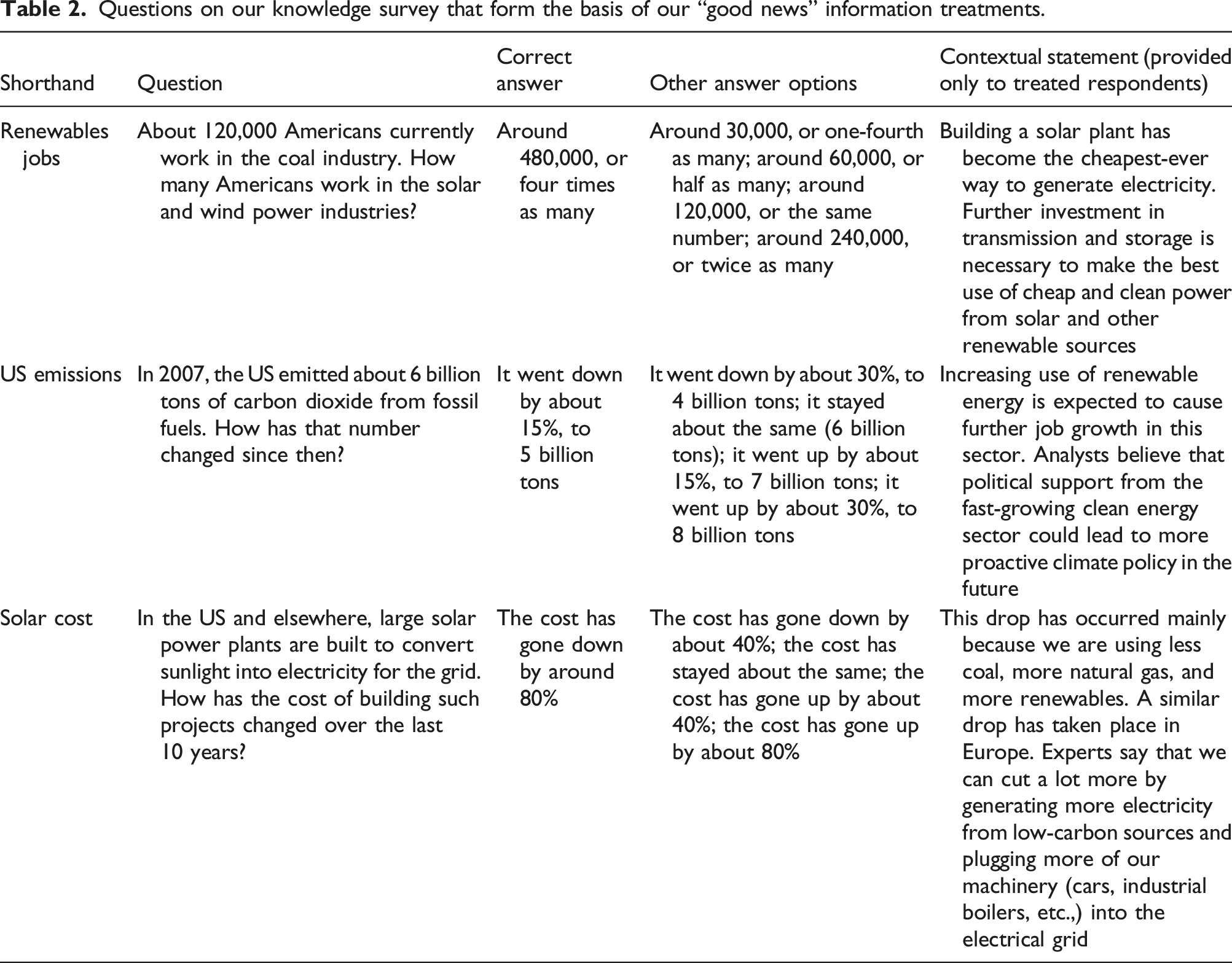
Following the knowledge quiz, we randomly provide answers to these three “good news” questions. Specifically, after the respondent has answered all questions on the knowledge quiz, we randomly determine whether the respondent is to be shown the correct answer to each of these questions before proceeding to the rest of the survey. These randomizations are independent, so that respondents are assigned to see anywhere between 0 and 3 correct answers. Those who are not assigned to receive any information treatments proceed directly to the next section. Those who are assigned to receive at least one correct answer are told that before moving to the next section of the survey “we want to share with you a few facts from our knowledge quiz that many participants find surprising,” after which we provide the information treatments for which the respondent was randomly selected. In each of these information treatments, we remind the respondent about the question that was asked, we remind them of the answer they provided, and we tell them if they were correct or incorrect. If they were incorrect, we tell them the correct answer. We also provide a source for the correct answer and a short contextual statement (appearing in the last column of Table 2) that links the fact to the US’s efforts to reduce GHG emissions. Because the three information treatments are administered according to a factorial design, we can measure the effect of each of these pieces of information separately (averaging over the other treatment statuses) and also measure the effect of providing more versus less information; we do both below.
Next, we ask all respondents a set of questions about respondents’ attitudes toward climate change. • •
Outcome variables in the survey.

At the very end of the survey, all respondents are shown correct responses to all questions on the knowledge quiz. We randomly chose one respondent as the lottery winner, and (following that respondent’s instructions) we awarded $50 to that respondent and $50 to Evergreen Action.
Results
Following our pre-analysis plan (PAP), 12 we estimated the effect of providing good news on each standardized outcome using linear regression with robust standard errors. For each outcome, we regress the variable on the number of correct answers we provided the respondent (0–3) 13 plus the (recentered) covariates we found to be most predictive of that outcome in the pilot 14 ; in the figures, we report the coefficient and 95% confidence interval for the estimated effect of an additional piece of good news. To study treatment effect heterogeneity, we add an interaction between subgroup membership indicators (e.g., levels of pre-treatment concern about climate change) and the number of pieces of good news provided; we derive the estimated effect for each subgroup from this regression and report these effects with 95% confidence intervals in the figures. Our PAP stated that we would study heterogeneity by pre-treatment factual pessimism, 15 but we show exploratory results for other interactions. The appendix contains the regression tables underlying all estimates.
Figure 1 shows the estimated effect of an additional piece of good news on average (black dots at the top of each panel) and for subgroups defined by pre-treatment covariates for each of the six outcomes in Table 3. We find no discernible effect of providing more pieces of “good news” on any outcome on average; the lowest p-value is 0.321. Estimated effects for subgroups defined by age, political ideology, party ID, pre-treatment pessimism, pre-treatment concern about climate change, and pre-treatment self-efficacy are generally small and confidence intervals include zero in all but one case. The general impression is that providing good news about climate mitigation does not affect beliefs, attitudes, or policy preferences. Effect of “good news” on six outcomes, on average and across subgroups.
The only exception to the generally null results in Figure 1 is the finding that an additional piece of good news reduces donation amounts for the most pessimistic respondents. The estimated effect for these respondents is −0.133 standard deviations (about $3.42), and the interaction term (comparing the effect for this group to the effect for the low-pessimism group) has a p-value of 0.009. Given that we are testing multiple interaction terms on multiple outcomes, adjustment for multiple testing is appropriate. Specifically, following our PAP we seek a family-wise error rate (FWER) no higher than .05 in assessing the null hypothesis that all interactions 16 between the number of good news items and terciles of pre-treatment pessimism are zero, separately for the first three outcomes (relating to attitudes and beliefs) and the second three outcomes (relating to policy preferences). We use randomization inference to determine a p-value cutoff that would lead to a false-positive rate no higher than 0.05 across these interactions and outcomes. 17 The resulting p-value cutoff for the policy preference outcomes is 0.007, which is lower than the raw p-value for this interaction. We therefore fail to reject the null hypothesis that all interactions are zero, and the effect of additional good news does not vary across levels of pre-treatment pessimism. 18
Figure 2 reports the effect of each information treatment separately on each outcome, both on average and by respondent factual pessimism.
19
Considering each test individually, we find that providing the “Renewables jobs” treatment reduces willingness to pay higher taxes by about 0.07 standard deviations across the whole sample (p-value: 0.033); all other estimates of average effects are not significant at the 0.05 level. Following the simulation procedure stated in our PAP, we determine that to obtain an FWER of 0.05 for all three information treatments across the policy preference outcomes (willingness to pay taxes, support for aggressive policy, and donation), we should apply a p-value threshold of 0.005. We therefore fail to reject the null hypothesis that there is no effect of any information treatment on any of our policy preference outcomes. Turning to treatment effect heterogeneity, and again judging by raw p-values, we find two significant interactions: the “Renewables jobs” treatment increases support for aggressive policy more among the high pessimism group than the low pessimism group (p-value: 0.036) and the “Solar cost” treatment increases willingness to pay higher taxes more among the middle pessimism group than the low pessimism group (p-value: 0.014). But our simulation procedure indicates a p-value threshold of 0.002 to maintain an FWER of 0.05 across interactions and treatments for the three policy preference outcomes, so again we fail to reject the null hypothesis that there is no differential effect of any information treatment on any of our policy preference outcomes. Effect of each information treatment, on average and by respondent pre-treatment factual pessimism.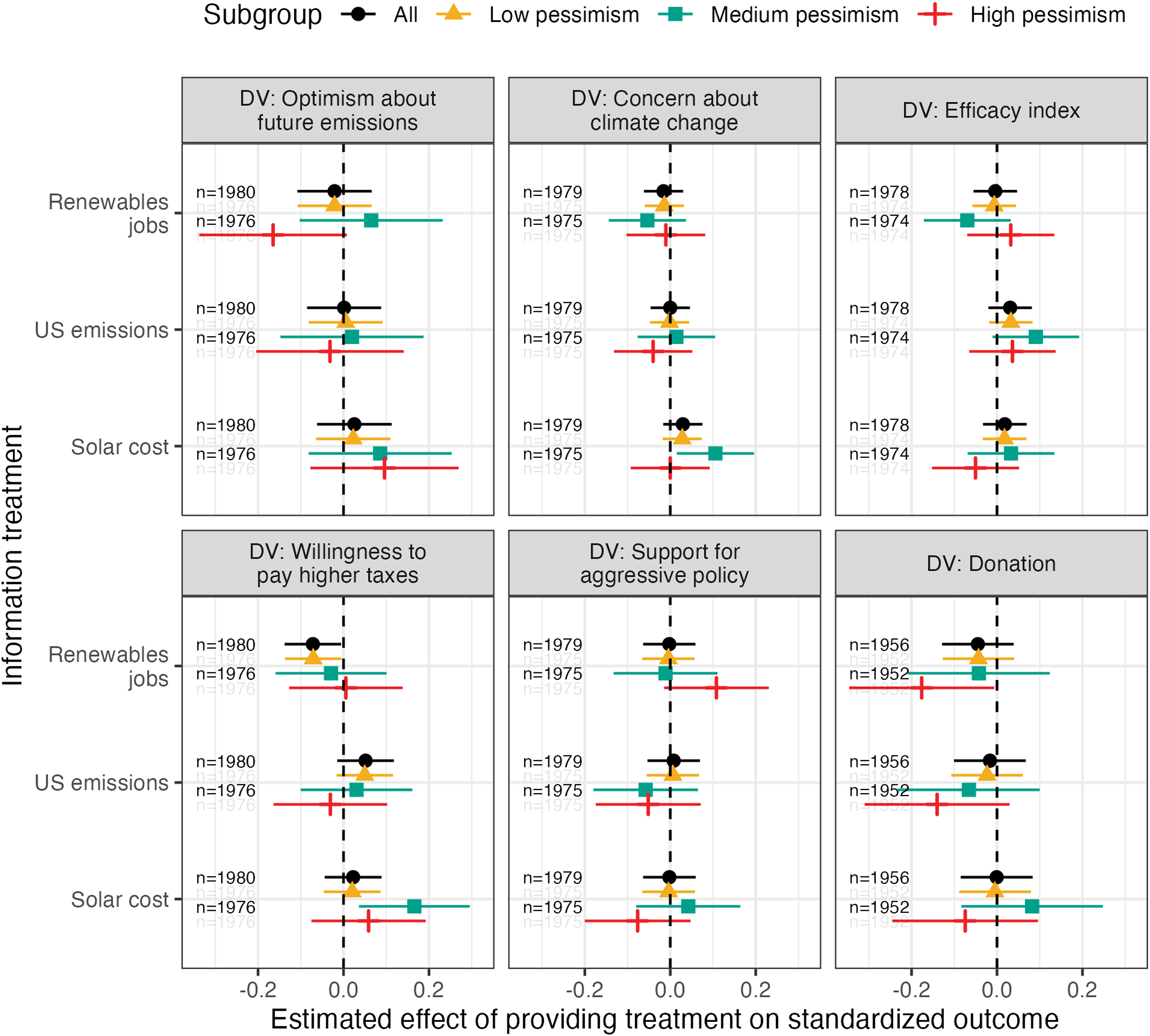
A power analysis explained and presented in the Appendix indicates that our design is likely to detect substantively meaningful effects of good news. If each piece of good news increased all six outcomes by as little as 0.05 standard deviations, then we would reject the null hypothesis of no effect with probability between .5 and .95 depending on the outcome; taking into account multiple comparisons, we would reject the null hypothesis of no effect on any outcome with probability .95 for the first three outcomes and probability .8 for the second three outcomes. Likewise, if the effect of each piece of good news differed by 0.1 standard deviations between high- and low-pessimism respondents, we would reject the null of no treatment effect heterogeneity with probability around .5 across outcomes, and with substantially higher probability when we consider families of outcomes and take into account multiple comparisons.
An important explanation for our null findings is that our information treatments appear not to have affected respondents’ confidence in the success of future mitigation efforts, as shown by the null effects of these treatments on the “Optimism about future emissions” measure both on average and in subgroups. Our information treatments were designed to increase respondents’ optimism about the possibility of limiting the effects of climate change, but they apparently did not do so. 20 In the absence of such an effect, it is not surprising that we also find no effects of these information treatments on other attitudes and preferences. In this sense, one key conclusion of our study is that Americans’ perceptions of the tractability of climate mitigation are resistant to change by factual information treatments.
Discussion
Using an “ask-tell” design to provide American survey respondents factual updates on climate change mitigation, we find no effect of “good news” on either attitudes or policy preferences among US respondents. These findings contrast with those of studies that show that emphasizing progress in addressing climate change can demotivate survey respondents (Hornsey and Fielding, 2016) as well as studies that show that optimistic reframings of climate change can reassure and motivate survey respondents (e.g., Bain et al., 2012; Dasandi et al., 2022). Our findings are more consistent with Bernauer and McGrath (2016) and Ettinger et al. (2021), who find limited impacts of such reframings.
Although our null results do not support the idea that broader recognition of progress in climate mitigation will inspire greater action, they also do not support the idea that broader recognition will reduce support for decarbonization. In that sense, our results suggest that public support for mitigation is more durable than previous studies suggest.
Our results are of course specific to the US in 2023, a setting in which opinion on climate change and climate policy is seen as stable and highly politicized (Egan and Mullin, 2017). More research is necessary to determine how factual messages emphasizing climate progress affect public opinion in other settings.
Moreover, while this study provides evidence that factual information about progress in climate mitigation has limited effects on respondent attitudes, we consider as unresolved the question of how the perceived tractability of climate change mitigation affects individuals’ willingness to take action. We had hoped to experimentally vary these perceptions by exposing participants to surprising but factual “good news” about recent progress in decarbonization, but perceptions of tractability were resistant to change. Future studies that investigate these questions should therefore focus on locating information treatments that have a stronger impact on these perceptions of tractability or subgroups whose perceptions are more easily manipulated.
Supplemental Material
Supplemental Material - Good news about good news? The limited impacts of informing Americans about recent success in climate change mitigation
Supplemental Material for Good news about good news? The limited impacts of informing Americans about recent success in climate change mitigation by Olivia Chiancone, Tara Chugh, Brayant De Leon-Duarte, Andrew C. Eggers, Benjamin Fica, Ishaan Goel, Stacia Konow, Annika Lundsgaard, Julia Margie, Zane Miller, Manuela Pinheiro, Panteleymon Semka, John Stokes, Leena Tantawy, and Panthita Triamkitsawat in Research & Politics.
Footnotes
Acknowledgments

Declaration of conflicting interests
The author(s) declared no potential conflicts of interest with respect to the research, authorship, and/or publication of this article.
Funding
The author(s) received no financial support for the research, authorship, and/or publication of this article.
Supplemental Material
Supplemental material for this article is available online.
Notes
References
Supplementary Material
Please find the following supplemental material available below.
For Open Access articles published under a Creative Commons License, all supplemental material carries the same license as the article it is associated with.
For non-Open Access articles published, all supplemental material carries a non-exclusive license, and permission requests for re-use of supplemental material or any part of supplemental material shall be sent directly to the copyright owner as specified in the copyright notice associated with the article.
