



Abstract
This article sheds light on what kinds of appeals persuade the US public on climate change. Using an experimental design, we assign a diverse sample of 330 participants to one of four conditions: an economic self-interest appeal, a moral appeal, a mixed appeal combining self-interest and morality and a control condition with no persuasive appeal.1 Participants were then asked a series of questions about their willingness to support advocacy efforts, including such actions as writing a letter to Congress, signing a petition and joining an organization. We hypothesized that for issues like climate change where it is expensive to address the problem, arguments based on self-interest are more likely to be persuasive than moral appeals. Our experiment yielded some surprising results. Knowledge was an important moderator of people’s attitudes on climate change in response to the persuasive messages. We found that among respondents who were more knowledgeable about climate change that the economic frame was most the persuasive in terms of a subject’s willingness to take actions to support the cause. However, among low knowledge respondents, the control condition without messaging yielded the most concern.
For almost two decades, legislation in the United States to address climate change has been stuck. While institutional barriers have made it difficult for the United States to ratify international climate agreements and pass domestic legislation, climate advocates also view weak public support as a problem. To that end, activists have sought to re-frame the issue to be more appealing to the American electorate who might in turn push legislators to take heed.
This article sheds light on what kinds of appeals persuade the public to take action on climate change. Using an experimental design, we assign a diverse sample of 330 participants to one of four conditions: an economic self-interest appeal, a moral appeal, a mixed appeal combining self-interest and morality and a control condition with no persuasive appeal. Participants were then asked questions about their willingness to support advocacy efforts, including writing a letter to Congress, signing a petition and joining an organization. We hypothesized that for issues like climate change, where it is expensive to address the problem, arguments based on self-interest are more likely to be persuasive than moral appeals.
Our experiment yielded some surprising results: knowledge about climate change affected whether people responded to persuasive messages on climate change. Among respondents that were more knowledgeable about climate change, the self-interest frame, which we also call the economic or consequentialist appeal, was the most persuasive in terms of a subject’s willingness to take actions to support the cause. However, among low knowledge respondents, the control condition that lacked a persuasive message had the most concerned participants.
This paper unfolds in four sections. The first section assesses the literature on framing and messaging. The second section develops an argument for frame success. The third section sketches the experimental design. The fourth section discusses our results.
Background and significance
Scholars and practitioners have sought to understand the bases of public support for action on climate change. 2 In surveys of Americans, climate change is an important environmental concern, but environmental concerns rank lower than issues such as national security and the economy (Pew Research Center, 2010a). Advocates of climate change policies must confront the challenge that the public historically has viewed climate change as physically and temporally remote (Nisbit and Myers, 2007).
A high-profile political event such as the Copenhagen climate negotiations or a weather-related catastrophe such as Hurricane Sandy catches attention and puts climate change on the political agenda. However, attitudes about the causes of climate change and the appropriate level of government response are affected by one’s sense of personal risk (Leiserowitz, 2005, 2006; Leiserowitz et al., 2008). Other factors influencing the public’s concern over climate change include their knowledge about climate change (its causes and impacts), their trust in scientists and their belief in a scientific consensus on the causes of climate change (Malka et al., 2009). However, partisanship may override the limits of individual knowledge: Democrats and Independents are much more likely than Republicans to believe there is solid evidence of global warming, by as much as a thirty point gap (Pew Research Center, 2010b). Moreover, Kahan (2014) suggests that knowledge does not explain partisan differences and that knowledge-based questions often trigger cultural identity differences.
Pollsters and public opinion scholars have sought to identify which messages resonate. For many years, environmental groups framed climate change as a global environmental crisis that demanded action (Sarewitz and Pielke, 2000). In the early 2000s, research for environmental groups found Americans were particularly interested in solutions-oriented language as crisis framing made people feel the problem was hopeless (FrameWorks Institute, 2001). Such findings informed messaging by the Rockefeller Foundation-funded effort US in the World 3 and former Vice President Al Gore’s We Can Solve it Campaign, both emphasizing the economic benefits of a low carbon economy. 4 This approach was later embodied in the “green jobs” rhetoric in the early years of the Obama presidency.
Other research has relied on experimental methods to evaluate the efficacy of frames. Frames, or ways of describing a problem, can determine how a problem is understood and who is responsible for solving it (Iyengar, 1991). Frames can also trigger different political attitudes: when understood as a First Amendment issue, most people support the right of a KKK group to demonstrate, but when understood as a public safety issue, that support dissipates (Nelson et al., 1997). We draw upon this approach, as well as a research on competitive framing, which suggests that framing effects may potentially be attenuated in real world situations where frames compete for attention (Chong and Druckman, 2007).
Two experiment-based studies on climate change have focused on how the problem is named, with “global warming” generating more support than “climate change” among Republicans (Schuldt et al., 2011; Villar and Krosnick, 2010). An alternative experimental study sought to elicit public opinion about the importance of climate change by altering question wording, asking in one instance what was the most important problem facing the country and, in the other, facing the world (Yeager et al., 2011).
Other studies have assessed whether people’s willingness to support action to address climate change depends on what other countries do and the institutional design of international mechanisms. Examining a range of surveys, Tingley and Tomz (2013) find that most people do not adjust the level of policy support contingent upon what other states do. Although not central to their analysis, they find that such unconditional support for action on climate change does not change with people who anticipate higher energy costs. Bechtel and Scheve (2013), by contrast, find that support varies based on institutional design, including principles of equitable allocation of costs. Importantly, for our purposes, they find highest support for action when the costs of action are low.
While these studies are interesting, they have less to say about the substantive appeals advocates ought to use to garner public support. Indeed, given limited public knowledge of the issue, we believe broad-brush rhetorical appeals are likely to be more important than specific features of international design or cooperation. Throughout the 2000s, advocates experimented with a variety of frames to garner public support. The original crisis frame focused on consequences, largely for future generations and humankind. We would argue that an appeal for transnational and intertemporal altruism is largely a moral claim. Indeed, some activists made this appeal through efforts such as the “What Would Jesus Drive?” campaign, an effort to link Christianity to environmental stewardship. 5 In contrast, the green jobs orientation of the early 2000s is a primarily material interest-based logic. In the late 2000s, activists also sought to tie climate change to national security (CNA Corporation, 2007). However, we have seen no systematic attempts to assess which of these approaches is more likely to be successful.
The argument
To convince Americans to care about climate change, advocates can appeal broadly to hearts and minds, or, in international relations jargon, to logics of appropriateness or consequences (March and Olsen, 1998). Our expectations are that consequentialist arguments—or self-interest—ought to be more persuasive than moral arguments. 6 Addressing climate change is a global public good with small and diffuse benefits for most people, leading to collective action problems. The primary beneficiaries are likely to be poor foreigners who will otherwise bear a disproportionate share of the costs. In such circumstances, we might imagine Americans could be persuaded on moral grounds if they are told the potential injustice is severe, if Americans are deemed responsible and if they believe that the United States is capable of acting to address the problem. However, the costs of action for Americans are significant, requiring a movement away from carbon-based fuels. In such circumstances, moral arguments can only take a global public goods campaign so far. 7
Research design
We carried out two studies designed to test this hypothesis. Both samples were recruited from a marketing firm. The subjects are not nationally representative, but they are diverse in terms of region, age, education and religion. Study 1 was designed to test the persuasiveness of a mix of nine moral arguments and self-interest arguments in a small sample of 100 participants. This first study allows us to ensure that our comparison of moral and self-interest-based arguments is not confounded by differences in argument strength. The results of Study 1 were then used to pick arguments for use in Study 2. 8
Study 2: Experimental manipulation of messages
In the second study, 330 subjects were randomly assigned to one of four conditions: subjects either received the moral obligation message, the economic message (self-interest), a mixed message or a control condition with no persuasive message. The three persuasive messages were created based on Study 1, with the messages embedded in flyers from a fictional interest group (see Appendix A for study materials). The respondents ranged in age from 18 to 90, and the average age was 43. The sample is 58% female. In terms of partisanship, 36% identified as Democrats, 30% as Republicans and 25% as Independents. Our respondents were also regionally diverse—27% classified themselves as urban, in contrast to 51% suburban and 22% rural.
After looking at the flyer, subjects were asked if they agreed with the message. There were also asked how worried they were about climate change, whether they thought it was important, how knowledgeable they felt, and whether they would be likely to participate in a series of behaviors relevant to climate change. We also asked them a series of closed-ended knowledge questions specific to climate change.
Knowledge
Given the issue’s complexity, we question whether people are especially well-informed about the topic. 9 We therefore expect that knowledge moderates the effect of persuasive messages on climate change, and that more knowledgeable subjects are more likely to respond to a persuasive message. We measure knowledge about climate change with three questions as follows.
Every time we use coal or gas, we contribute to the greenhouse effect. How true is this? (“Probably true” and “definitely true” count as correct): 82% answered this correctly.
The greenhouse effect is caused by a hole in the earth’s atmosphere. How true is this? (“Probably not true” and “definitely not true” count as correct): 39% answered this correctly.
To the best of your knowledge, what was the Bush Administration’s position on the Kyoto Protocol? (“Opposed it” counts as a correct answer): 22% answered this correctly.
Eleven percent answered all three questions correctly, while 4% did not get a single correct answer. Knowledge about climate change was related to several demographic variables. People with more education were more likely to answer the knowledge questions correctly (chi2 = 21.52, p < .05), and women were less likely to give correct answers than men (chi2 = 17.47, p < .01). Interestingly, partisanship was unrelated to climate change knowledge (chi2 = 10.21, p = .33).
We create a dichotomous variable based on this scale, splitting the sample between high knowledge (two or three questions correct, 36% of the sample) and low knowledge (no or one question correct, 64% of the sample). 10 High knowledge respondents are much less likely to say that they do not know what causes climate change, and they are more likely to believe climate change is occurring (90% versus 78%, chi2 = 7.97, p < .01). Unsurprisingly, people who have higher levels of knowledge about climate change also feel more informed (2.82 versus 2.50, p < .01).
After reading the persuasive message, subjects in the treatment conditions were asked if they agreed with the message they just read. Answers ranges from 1 (Strongly disagree) to 5 (Strongly agree) and we found that there were no differences in agreement based on experimental condition (F = 0.02, p = 0.88) among the entire sample. 11 However, we found that different arguments were persuasive, depending on one’s level of knowledge. Using knowledge as a moderator we find that less knowledgeable participants were more likely to agree with the moral message (compared with the self-interest or mixed message), while more knowledgeable participants found the moral message least persuasive (see Figure 1, full models are reported in Appendix B).

Level of agreement by message, experimental condition.
Only subjects in the three treatment conditions were asked whether they agreed with the message they received, so this analysis cannot tell us if these messages are persuading subjects beyond their pre-existing attitudes on climate change. We can only use agreement with the message to evaluate among the varied messages. We find that knowledge about climate change conditioned which message people agreed with, and therefore we use knowledge about climate change in our subsequent analysis.
Are subjects worried about climate change? We use an interaction term to test the effect of the experimental manipulation, contingent on knowledge, and find that the persuasive messages did affect level of concern (F = 2.63, p < .05) (see Figure 2).

Worry about climate change, by experimental condition.
For the high knowledge group, the economic and mixed message treatments were more likely to provoke worry over climate change when compared to the moral message. The moral message was the most likely to worry the less knowledgeable group. This difference is consistent with the agreement results, but we also have a baseline condition provided by the control condition, without any persuasive message. The control condition reveals that economic and mixed messages provoke worry among high knowledge subjects. For the low knowledge group, a moral message is more likely to provoke concern than an economic or mixed message, but they are most concerned when they have not read a persuasive message. The control condition allows us to see that the effect of persuasive messages on climate change is limited: these appeals can be effective among people who know something about climate change already. People who do not know much about climate change might counter-argue or simply reject the message.
Advocacy groups put out flyers such as the ones we use in this study because they want people to act. We tested whether these persuasive messages were able to change people’s willingness to engage in a series of behaviors, answered on a four-point scale ranging from not at all likely to very likely. Among the entire sample, we found respondents reported they were more likely to talk to friends and family about the issue or sign a petition than they were to participate in the other more costly behaviors: contacting a member of Congress, joining a group, donating money or writing a letter. Petition signing and talking are the only behaviors that were significantly affected by the persuasive messages. There was no main effect for the experimental manipulation on any of the behaviors, but the interaction between knowledge and experimental condition yielded significant effects for willingness to talk about climate change (F = 3.51, p < .05) and willingness to sign a petition (F = 2.43, p < .10) (see Figures 3 and 4).

Willingness to talk about an issue, by experimental condition.
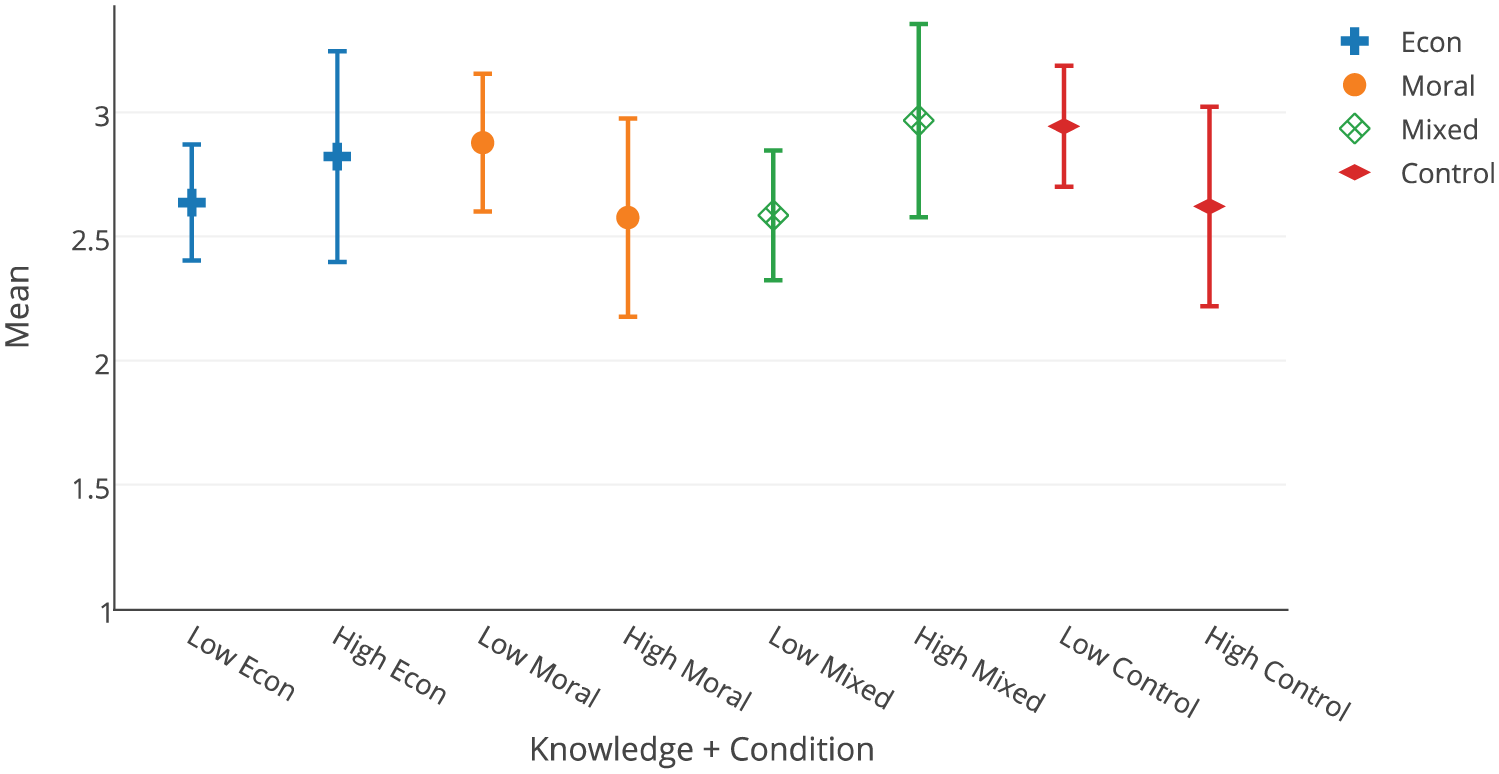
Willingness to sign a petition, by experimental condition.
For low knowledge participants, we see that persuasive messages were either ineffective or demobilizing. However, for high knowledge participants, both the econonomic self-interest message and the mixed message were effective in promoting helpful behaviors. While these messages were not effective in promoting costlier behavior, such as donating money or writing a letter, an advocacy group could use an economic message to encourage knowledgable people to participate in low-cost behaviors.
How can we explain these findings? Our expectation was that an economic self-interest frame was likely to be more persuasive given the costs of addressing climate change. In this context, high knowledge subjects may be more familiar with those costs.
The economic self-interest appeal makes a claim that addressing climate change will bring jobs and business opportunities, potentially attenuating high knowledge respondents’ costs concerns. Low knowledge subjects, by contrast, are difficult to persuade with information.
Partisanship
Given the prominence of partisanship in previous public opinion work on climate change, it is worthwhile to note the effects of partisanship in this sample. As previously discussed, partisanship (Democrats versus Republicans) was not related to the objective knowledge scale about climate change, 12 and partisanship was unrelated to how informed people felt about climate change (t = .82, p = .41). Democrats expressed a higher level of worry over climate change (Democrats: 2.89 versus Republicans: 2.21,t = 5.48, p < .01). Democrats were also more likely to participate in every behavior relevant to climate change they were asked about. Given the strong partisan effects in the previous literature and in this study, we might expect partisanship to condition the effect of persuasive appeals. However, interactions between the experimental manipulation and partisanship demonstrate no significant interactions (analysis avaliable upon request). The non-finding could be due to the small sample size (each of the four conditions has between 23 and 27 Republicans and between 25 and 32 Democrats). Our research suggests that while partisanship is related to climate change attitudes in cross-sectional data, knowledge about climate change is a more important factor in persuasion. People with some climate change knowledge can be persuaded to act, while those with little or no knowledge about climate change are difficult to move.
Conclusions
We argued that climate change, given the costs of action for Americans, would depend upon consequentialist messaging for persuasive appeal. We find mixed support for this thesis in this set of experiments. One particular frame that we did not explore was one based on the consequences of climate change for Americans, a different interest-based logic that may be increasingly salient in light of superstorm Sandy, Midwestern floods and devastating droughts across the Southwest. Two studies suggest that differences in the physical environment may make groups more likely to believe that climate change is real. Egan and Mullin (2012) took advantage of a natural experiment (differences in local temperatures) and found that “for each three degrees that local temperature rises above normal, Americans become one percentage point more likely to agree that there is ‘solid evidence’ that the earth is getting warmer.” Risen and Critcher (2011) sought to test a similar logic by altering the temperature in the room the respondents took the survey in. They found that warmth increased people’s belief in global warming, while thirst affected their judgments about drought and desertification. Accordingly, in subsequent experiments, we will test whether climate change framed in terms of local or international consequences proves more persuasive.
However, as Aklin and Urpelainen note in their own experimental work on clean energy framing, the effects of framing may dissipate when positive frames supportive of action are countered by negative frames, raising questions about whether framing is an important mechanism to generate public support for action (Aklin and Urpelainen, 2013). In subsequent work, we aim to test whether their findings are robust.
Our article asks whether hearts or minds are more persuasive guides to action on climate change. The reality of persuasive appeals is more nuanced than this simple binary. Our research indicates that knowledge is central to persuasion, and that the question is no longer about which kind of appeal is more persuasive in the aggregate, but about under what circumstances different kinds of appeals will ultimately make individuals more willing to support a cause and act.
Footnotes
Appendix A: Study 2 materials
Appendix B. Full ANOVA results.
ANOVA Tables (n = 330, unless otherwise noted):
| F | P > F | |
|---|---|---|
|
|
||
| Treatment | 0.61 | .54 |
| Knowledge | 0.00 | .95 |
| Treatment × Knowledge | 4.59** | .01 |
|
|
||
| Treatment | 0.28 | .84 |
| Knowledge | 0.06 | .81 |
| Treatment × Knowledge | 2.63** | .05 |
|
|
||
| Treatment | 0.07 | .98 |
| Knowledge | 0.02 | .90 |
| Treatment × Knowledge | 2.43* | .07 |
|
|
||
| Treatment | 0.43 | .73 |
| Knowledge | 3.28* | .07 |
| Treatment × Knowledge | 3.51** | .02 |
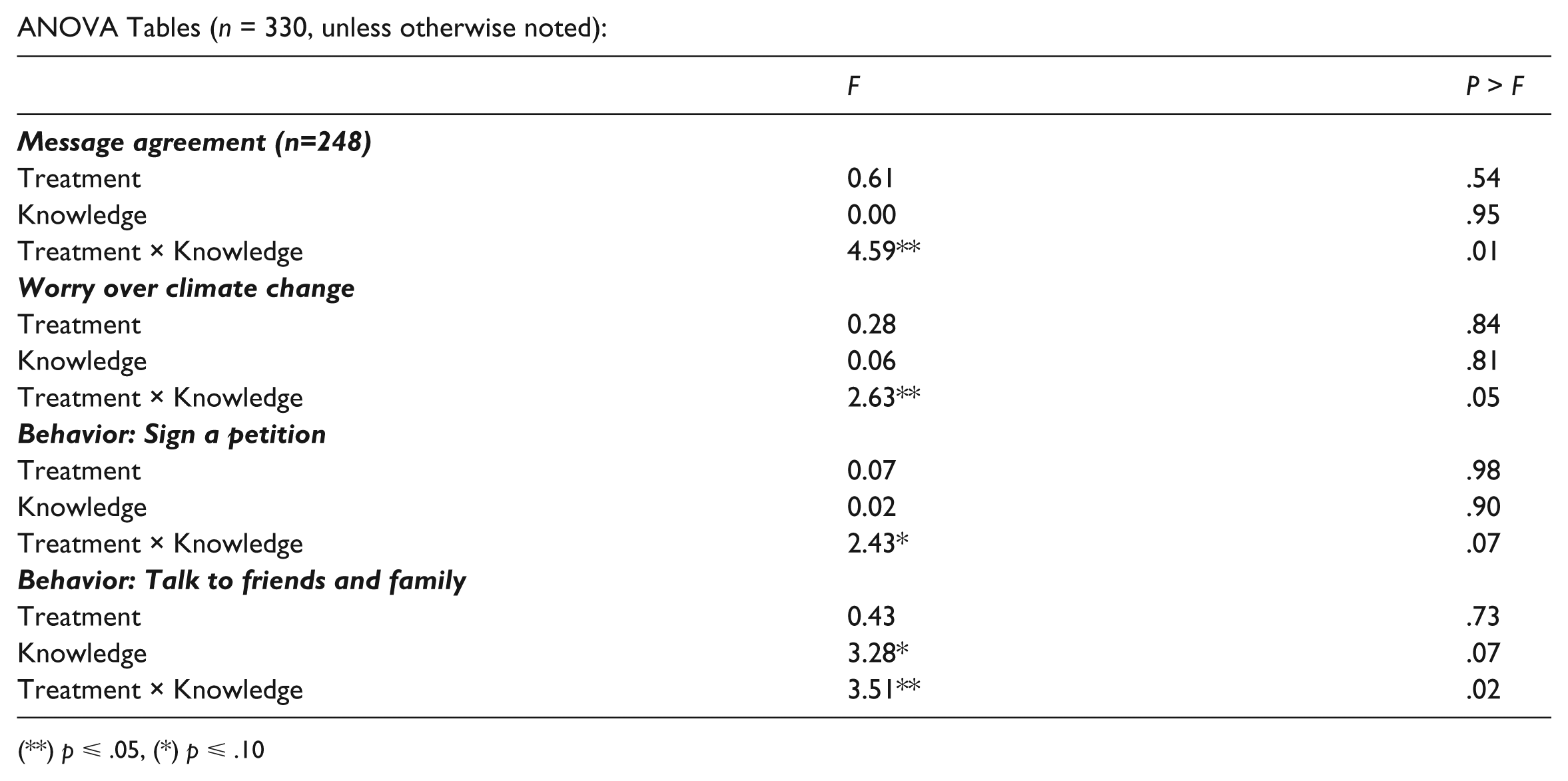
(**) p ⩽ .05, (*) p ⩽ .10
Acknowledgements
The authors wish to thank the RGK Center for Philanthropy and Community Service for financial support to carry out the research. They also wish to thank Shana Gadarian for suggestions on graphics.
Declaration of conflicting interest
The authors declare that there is no conflict of interest.
Funding
This research received no specific grant from any funding agency in the public, commercial or not-for-profit sectors.
Supplementary material
1.
In the first stage, we asked 100 subjects to rate the persuasiveness of four different frames, two based on self-interest: a security frame and an economic frame, and two based on morality: a secular moral frame and a Christian moral frame. The secular moral frame and the economic frame were rated as the most persuasive. In the second stage, we used those two frames as the basis of our experimental work.