



Abstract
Attention given to the environment by the British public has fluctuated over recent decades. Having peaked in 2007 it declined, yet has recently risen dramatically. This raises questions about why public attention to the issue changes over time and to what extent this is driven by other actors and exogenous forces. This article examines these processes at the monthly level through a system of simultaneous equations. Methodologically, protest is an important confounding factor when analysing the relationship between media and public salience. Substantively, protest itself can be predicted by prior public attention, but in turn, can be successful in increasing broader environmental salience.
Introduction
If public attention to the environment were driven by rationality, it might be expected to shift in line with the increasing urgency of the threat from climate change, especially given that trust in scientists is high and has remained largely stable over time (Wellcome Trust, 2018). However, despite increasing cognition of climate change’s seriousness, the proportion of the public ranking the environment as a political priority has been volatile in recent decades; exhibiting a non-linear trend with frequent fluctuations. This article considers the mediating factors of these dramatic fluctuations by looking at monthly changes in public salience, which is defined as the attention given to an issue by the public, relative to other political issues.
Central to agenda-setting theory is the idea that attention given to issues by public, media and political actors are contingent on one another. In this way, shifts in public attention may be a reflection of respective media or political attention. However, as investigations into these dynamics are often at the annual level and have focused on different countries, sub-annual dynamics between these actors in Britain remain unclear. Moreover, with much existing literature having been conducted in previous decades, it has yet to capture recent shifts in attention.
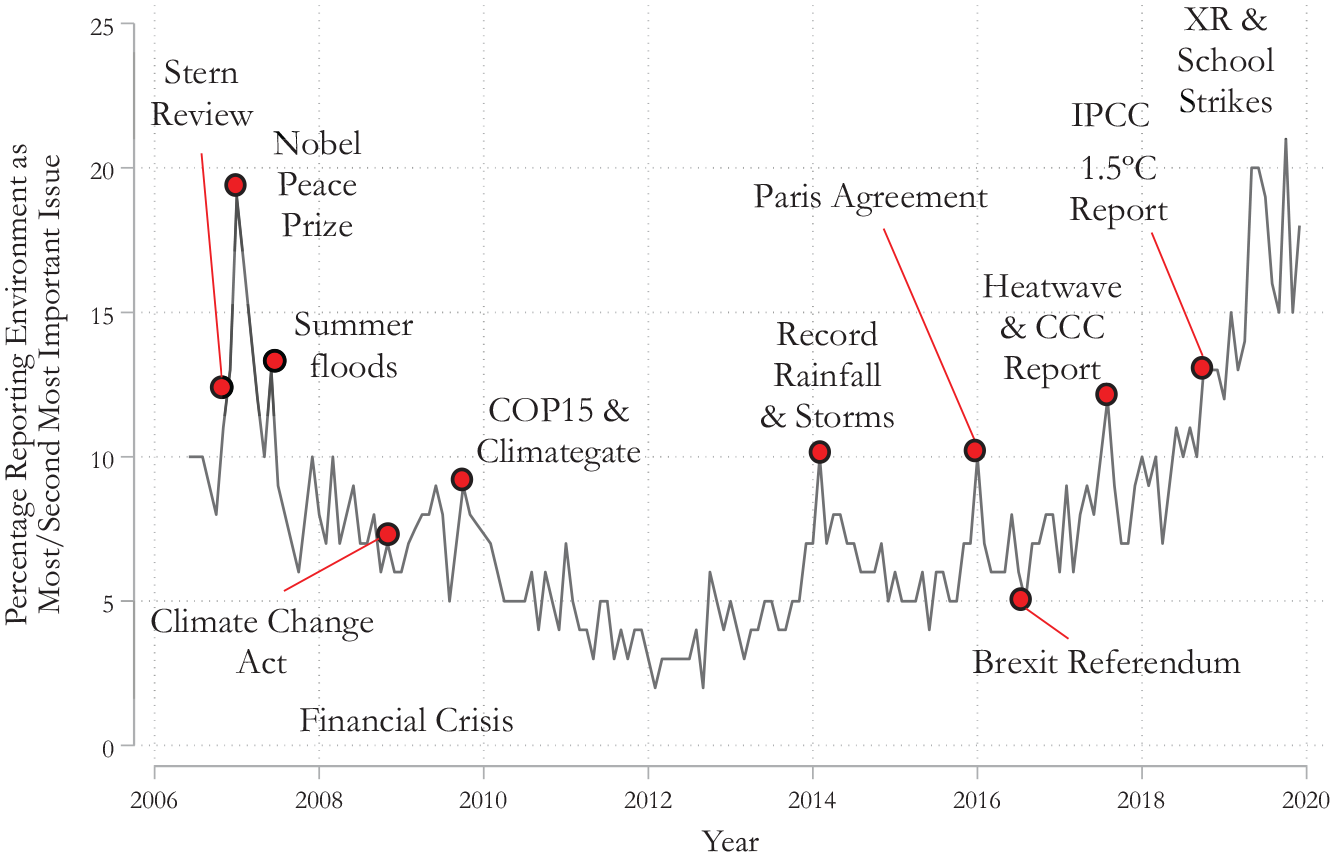
Importance of the environment to the British public.
In 2019, Britain witnessed a wave of environmentalism, with unprecedented levels of public attention co-occurring with global environmental movements including Extinction Rebellion and Greta Thunberg’s School Strikes for Climate. In light of their co-occurrence, rising public attention might partially be attributed to the success of recent protests. Previous literature says little on the power of environmental protest to change public opinion, so a key question for this research is what difference these recent movements made. They may have been vital to increasing public salience, but they may have alternatively been carried by a wave of public salience rather than created one.
This article highlights the striking fall and rise in the importance of the environment to the British public between 2006 and 2019, and empirically examines what may have caused it. In doing so, it contributes novel insight into public opinion dynamics in the British context, and the role of environmental protest. From a theoretical perspective, it also identifies how mechanisms of influence, which are often studied separately, may interact when modelled in unison. While it is commonly discussed that protest could be of importance, with environmental protest it is hard, if not impossible, to point to other studies to confirm this. This article presents the first systematic study to show significant links between environmental protest and public salience. Considering such, protest necessitates inclusion as an endogenous force, which can both shape, and be shaped by, other actors.
Although this article pays particular attention to climate change as a highly salient environmental issue, this is tested using a broader measure of environmental public salience. This is due to a lack of consistent data at the monthly level but, nonetheless, Eurobarometer surveys show the British public have consistently ranked climate change as their top environmental concern for the period of study, and there is also high correlation between concern for climate change and the environment more generally. In order to analyse these monthly changes in the amount of attention given to the environment by the public, Zellner-Aitken Seemingly Unrelated Regression (SUR) estimations are used. Relationships are established through Granger-causality, whereby a variable can be said to Granger-cause another if its values in the preceding months (lagged values) are useful in predicting the value of the secondary variable for any given month, while also controlling for the latter variable’s lagged values. For many of these variables, there are strong autocorrelation effects so, if public salience is high one month, it is likely to be high the next month. Granger-causality therefore tells us if, for example, protest activity in any month affects public salience in the following months, even controlling for that tendency for levels of salience to persist.
Findings indicate multi-directionality between protest and public opinion; protest activity can be predicted by public attention levels, but in turn, is successful in increasing broader environmental salience. Evidence suggests media coverage moves in response to public attention rather than the reciprocal, and that public attention may fall following heightened political attention. Findings also suggest that short-term exogenous factors influenced media coverage but did not consistently impact aggregate public attention over the time period.
Theory
In considering the changing importance of the environment to the British public in recent decades, this article draws upon two distinct, yet complementary, bodies of literature. The first relates to agenda-setting, which largely focuses on how the public agenda is intertwined with media and political agendas and is more pertinent to aggregate-level salience. The secondary brings together research on exogenous factors which influence public opinion, which are typically analysed at the individual level.
Agenda-setting
Under conditions of competition and finite resources, the amount of attention that can be given to any set of issues is limited, requiring some issues to be prioritised over others. Agenda-setting research explores this process by examining what causes changes in the relative salience of issues across public, media and political domains. The following subsections consider how media and politicians may have influenced public salience in Britain, as well as considering the potential role of protest.
Media
The media is argued to be influential due to the public looking to the media for information on global and domestic occurrences (Carvalho and Burgess, 2005). As newspapers have finite publishing space, they must determine which issues to prioritise coverage on and so, publication signals relevance and the extent to which attention should be directed towards an issue (McCombs and Reynolds, 2002). In line with this, some studies have found shifts in public priorities to be a reflection of media coverage (e.g. McCombs, 2004). Although, findings are mixed, with other scholars arguing media reflects, rather than drives, changes in public opinion (e.g. Hopkins et al., 2017). On the issue of the environment more specifically, while some evidence from the United States suggests media influences the public agenda at the annual level (Ader, 1995), this relationship has also been found to be bidirectional when controlling for simultaneous relationships, which will be discussed in due course (Bakaki et al., 2020; Jenner, 2012; Soroka, 2002). Although most studies have been conducted in different decades and countries, and have not focused on the environment, the recent fall and rise in public salience in Britain might reflect the respective attention given by media over time.
Political representatives
Another central set of actors in agenda-setting are political representatives. Downs’ (1972) issue ‘attention-cycle’ model proposes that environmental interest of the public and politicians goes through waves of surges and declines. This cyclical process is argued to repeat until political action is taken, highlighting how political action may lead to an adjusted level of public salience. Although there have been studies into environmental politicisation and issue salience within party politics in Britain (e.g. Carter and Little, 2020), there has been less empirical research looking at how the actions of political elites may affect public attention. Soroka and Wlezien (2004, 2005) looked at public-policy relations and find evidence of ‘public responsiveness’ and ‘policy representation’, with public preferences simultaneously being influenced by, and influencing, government spending. Indeed, there is greater evidence for an inverse relationship, with scholars finding environmental policymaking following public demand in European countries at the annual level (Anderson et al., 2017; Bakaki et al., 2020). Others have shown that while elite cues influence public concern, media coverage plays a mediating role (Carmichael and Brulle, 2017). Overall, existing findings suggest public attention may shape, and be shaped by, levels of political attention in Britain, although it is not evident whether these explain monthly fluctuations in recent decades.
Simultaneous relationships
Despite theoretical and empirical justifications for endogenous relationships between public, media and political actors, only a few studies have looked at these in conjunction. Soroka (2002) looked at Canadian dynamics at the monthly level between 1987 and 1995, finding public attention to positively impact policymaking and media coverage, as well as bidirectionality between political and media attention. Although direct effects of policymaking on the public were not modelled, Jenner (2012) extended this to the United States with further inclusion of the news photographic agenda, finding a negative effect of congressional committee meetings on public salience, and bidirectionality between public attention and print media, with each having a positive effect on the other. More recently, in a study of European dynamics which included the United Kingdom, Bakaki et al. (2020) found that, at the annual level, heightened public concern about pollution had a positive impact on renewable energy policymaking the following year. The authors also find bidirectionality between media and public concern, with public attention increasing media coverage, and media coverage reducing public concern. Bakaki et al.’s (2020) study provides one of the most comparable cases, with it being the only such study pertaining to UK dynamics. Yet, as country-year is the unit of analysis, it remains unclear whether these dynamics hold for periods below the annual level. In addition, as the study covered the period between 1983 and 2012, it does not necessarily capture newer developments which have since occurred in Britain, as evidenced by Figure 1. Importantly, despite analysing dynamic relations between actors, none of these studies have considered the effects of protest.
Protest
Although not typically included under an agenda-setting framework, given recent global environmental movements, the role of protest in shaping public attention deserves consideration. As protest has historically been characterised by a motivation to shape the political agenda, much research has analysed its success in driving policymaking (see Walgrave and Vliegenthart, 2012). Although not omitted from such analyses, public opinion is often considered an external factor to control for. Despite contemporary movements having also been concerned with shaping public opinion, there has been substantially less empirical research into protest’s cultural effects. Indeed, there are also theoretical justifications to believe the relationship between protest and other actors may in fact be reciprocal. Banaszak and Ondercin (2009) highlight that policy analyses which merely control for public opinion incorrectly assume independence from protest. Even so, looking at the US feminist movement between 1945 and 1985, they find greater evidence for protest leading public opinion than vice versa.
Empirical findings around environmental protest are likewise limited. Giugni (2004) found protest’s influence on environmental policy to be contingent on public opinion, but testing protest’s ‘indirect effects’ indicated minimal influence on public opinion. In looking at determinants of protest and congressional hearings, controlling for media salience and environmental conditions, Olzak and Soule (2009) similarly find no relationship between protest and public opinion. However, these studies were conducted in the United States, for decades prior to the millennium, and with little consideration of endogeneity. More recently, using sporadic opinion polls, Barasi (2019) highlights that in April 2019, following environmental protests in Britain, there was a surge in media coverage. At the same time, levels of public concern, having already been at their peak, rose even further. This indicates association between these actors, although whether public salience responded to heightened media coverage, or protest itself, is unclear. Existing, albeit limited, findings would suggest environmental protest might influence the public agenda, but at present, causal relations with British public opinion remain largely indeterminate.
Exogenous determinants
In addition to being shaped by other actors, short-run changes in public salience that have occurred in recent decades may also be influenced by exogenous factors. For example, as a physical phenomenon, climate change is frequently associated with environmental indicators. However, while attention might be expected to rise in accordance with the issue’s increasing urgency, prior findings suggest little influence of long-run developments (Kaufmann et al., 2011). In contrast, individuals express greater environmental concern when directly confronted with the issue, for instance during periods of extreme weather or after natural disasters (Zaval et al., 2014). Flooding across the United Kingdom in 2013/2014 influenced the perceived importance of climate change (Capstick et al., 2015) and so, public attention might similarly respond to environmental indicators over time.
Another well-documented mediator of individual-level concern is economic performance as, in accordance with value priorities, economic concerns often take precedence over environmentalism (Inglehart et al., 2017). In studying the 2008 recession, Kenny (2019) shows rising unemployment, rather than falling gross domestic product (GDP), led to the public giving lesser priority to the environment. On a sub-annual level, Brulle et al. (2012) constructed quarterly measures of US public concern between 2002 and 2010 and found elite cues and economic factors to influence perceived threat of climate change. Although most studies have been conducted annually, British public attention may also be shifting in response to changing economic conditions over shorter time periods.
There are several other factors which have been linked with increased attention to the environment, but their effects have typically been analysed for media coverage. For instance, international meetings between government officials have been associated with drawing attention to climate change, particularly United Nations Climate Change Conferences (UNCCC) (Saunders et al., 2018; Schäfer et al., 2014). In line with this, Bakaki and Bernauer (2017) analysed whether the 2014 UNCCC may have affected American public opinion, with their experiment finding that media cues influenced public awareness, but not policy preferences. Publication dates of Intergovernmental Panel on Climate Change (IPCC) reports are also found to coincide with increased media attention to climate change in the United Kingdom (Hulme, 2009). Individuals who are external to political processes might also be influential, for instance, feedback from scientists or environmental non-government organizations (ENGOs), although only the latter is found to influence media coverage (Schäfer et al., 2014). Factors such as these might similarly influence public opinion, either directly or indirectly through media coverage, although such effects have yet to be studied over time.
Cultural forces such as film premieres may also be important in understanding changes in attention given to the environment as they grant further legitimacy to the issue. Leiserowitz (2004) finds The Day After Tomorrow generated greater response than the IPCC report, which can perhaps be explained by cultural forces being less scientific and more accessible to the general public. The peak in attention around the time of the award of a Nobel Peace Prize to Al Gore and the IPCC in 2007 has also been highlighted (Barkemeyer et al., 2017; Schmidt et al., 2013). However, in practice, there is a little empirical support of such and, looking at cultural events over time, Schäfer et al. (2014) find no influence on media coverage. Therefore, while these might shape public attention, it is unclear whether they are a consistent predictor.
To conclude this section, from reviewing existing research, it is apparent there lacks consensus on the dynamics of public attention to the environment. This is further reinforced by an absence of research into public salience in the British context, with recent changes in attention yet to be explained. Few studies have considered simultaneous effects of other actors and exogenous factors, and there has also been a little research into environmental dynamics at the sub-annual level, which can largely be attributed to obstacles in systematic measurement. Despite this, agenda-setting theory indicates shifting public attention may be linked with media and political actors. Existing empirical literature on protest, albeit limited, suggests environmental protest might also be influential, although this has yet to be included under an agenda-setting framework. Exogenous environmental and economic indicators may hold individual-level influence, although it is unclear whether these apply at the aggregate or sub-annual level. There are also factors such as cultural forces and political events, which influence media coverage and might similarly shape public salience.
Data
To better understand public attention to the environment in Britain, a large-scale dataset was compiled from a variety of sources, encompassing the period of 13.5 years from 1 June 2006 to 31 December 2019. Analysis is conducted at the monthly level, covering a total of 163 months. This period was selected based upon data availability, to ensure comprehensive inclusion of relevant variables and allow for time-series analysis, which requires variables to be observed over the same, uninterrupted period of time. 1 Nonetheless, the little work that has been done on earlier decades in Britain has shown only minimal change in environmental attitudes (Norris, 1997).
Endogenous variables
A common estimate of public salience is the ‘most important problem’ measure (Soroka, 2002). Taking a similar approach, this research utilises Ipsos MORI’s (2019) ‘Issues Index’, which records unprompted responses to ‘what do you see as the most important issue facing Britain today?’ and ‘what do you see as other important issues facing Britain today’. 2 The variable comes from the coding of free text, so mentions of any environmental issues, including climate change, are coded under the environment category. The final measure represents the combined stratified percentage of respondents who reported environmental issues as of either primary or secondary importance. Six instances of missing data were imputed by averaging prior and sequential months. While a more direct measure of climate change concern might be favoured, given this reflects environmental salience as a whole, unfortunately this does not exist at the monthly level and using such would constrain analysis to sporadic polls, which would not permit detailed information about fluctuations in public opinion over shorter periods. Despite this, theory on climate change attitudes should still be expected to impact attention to the environment. This is partly justified by the recent time frame, as well as results of previous Eurobarometer surveys on the environment which show climate change consistently ranking top of environmental concerns in Britain for the period of study. 3 For example, in the 2019 Eurobarometer, 65% of British respondents reported climate change as one of the three most important environmental issues, followed by 53% waste and 52% air pollution. Of those that reported waste or air pollution, 62% and 66%, respectively, also reported climate change. This indicates the majority reporting the environment as an important issue is referencing climate change, however, even if doing so in reference to other environmental issues, individuals are likely to be concerned about climate change. Although imperfect, due to being a less direct measure, it makes it a stronger test of mechanisms and lends further strength to results.
In analysing media, this research uses Boykoff et al.’s (2020) dataset which details the number of news articles referencing ‘climate change’ or ‘global warming’. This tracks coverage across six national newspapers; broadsheets The Guardian, The Times and The Telegraph, and tabloids The Daily Mail, The Daily Mirror and The Sun. The measure reflects aggregate articles published across platforms. While this allows for an inclusive range of political leanings and journalistic styles, unfortunately, it excludes BBC coverage. Nonetheless, as news platforms follow similar cycles, the measure provides a reasonable proxy of mainstream media content. This is further strengthened by the environment being an exogenous issue, so attention is expected to differ less across platforms, as well as it being a monthly measure, whereby there is likely convergence between platforms (Vliegenthart and Walgrave, 2008). Another limitation is that this measure only reflects print media. However, in line with intermedia agenda-setting, legacy media influences other media forms and the content of traditional media and other media, including social media, are found to be interlinked (Conway et al., 2015; Vliegenthart and Walgrave, 2008). As a result, particularly at the monthly level, we can assume the measure is reasonably representative of other media forms and wider media trends.
To reflect monthly political attention to climate change, this article focuses on the behaviour of Members of Parliament (MPs). This is quantified by the number of references to the issue during debate in the House of Commons, calculated using the UK Parliament Hansard archives. This measure also incorporates the number of divisions and publications by default, due to these typically co-occurring, thus providing a comprehensive measure of political saliency.
Protest events were selected through comprehensive searches of major climate organisations’ archives, and those which had been reported online elsewhere. Information on participation numbers was partially established using Mass Mobilisation Data (Clark and Regan, 2016), however, events not listed by the latest version of the dataset were established by averaging media and organisers’ estimates. Given many events occurred over a sustained period, the final protest index was generated through multiplying attendance by duration (in days) and taking the monthly sum of such. As a key approach of Extinction Rebellion is civil disobedience (Berglund and Schmidt, 2020), the number of protest arrests were also recorded in order to proxy disruptiveness.
Exogenous variables
Two objective indicators of climate change were included; changes in global temperatures (NASA, 2020) and carbon dioxide levels (CO2) (Dlugokencky and Tans, 2020). Measures of domestic temperature were accessed through the Met Office’s climate summary archive, with anomaly measures calculated as variance from 30-year averages. Domestic and European natural disasters were recorded using the International Disaster Database (EM-DAT, 2019). 4 Measures on deaths, number affected and extent of damage (cost in $) were standardised and used to calculate a monthly index of severity.
Two measures of labour market conditions are utilised; quarterly GDP per capita growth and unemployment rate from the Office of National Statistics. Political event variables were created to record dates of general elections, as well as a cumulative variable to reflect the official election campaign. Intergovernmental events were recorded to incorporate occurrences of G8/G7 Summits, EU Summits and number of days of UNCCCs per month. Release dates of IPCC reports were also documented. To measure cultural events, release dates of documentaries on environmentalism were recorded. The premieres include those in Schäfer et al.’s (2014) study: An Inconvenient Truth, The Great Climate Swindle and Live Earth concerts, and more contemporary premieres; Blue Planet II, Planet Earth II, Cowspiracy and Our Planet. Using the Institute of Scientific Information Web of Science database, scientific articles on climate change published in British journals were accumulated to reflect scientific feedback. To measure ENGO activity, press releases published by international and UK branches of World Wide Fund (WWF) and Greenpeace were indexed.
Data transformations
To retain information on long-run trends, this article follows the established method of prior scholars in analysing endogenous variables in level form (Jenner, 2012; Soroka, 2002). Likewise, exogenous variables which were found to be non-stationary were transformed through differencing, on the basis that actors are expected to respond to changes in such rather than absolute values. Protest is modelled in square-root form to enhance model stability due to it having large variance.
Results
To illustrate changes over time and allow direct comparison, series were standardised and aggregated at the annual level. Figure 2 shows how, after peaking in 2007, public prioritisation of the environment was largely in decline until 2012. This is despite it being a period of mounting evidence for the existence and seriousness of climate change. From 2012, the percentage of people rating the environment as a top issue has been characterised by an upwards trend, reaching its apex in 2019. Data at the monthly level, plotted in Figure 3, show frequent oscillations over time, highlighting the significance of conducting analysis at the monthly level. On a monthly basis, public salience peaked in October 2019, with 21% of the public ranking the environment as either the primary or secondary most important issue facing Britain. Prior to 2019, the highest levels of attention in the period of study were during the first quarter of 2007, raising questions as to what has driven changes between this period.
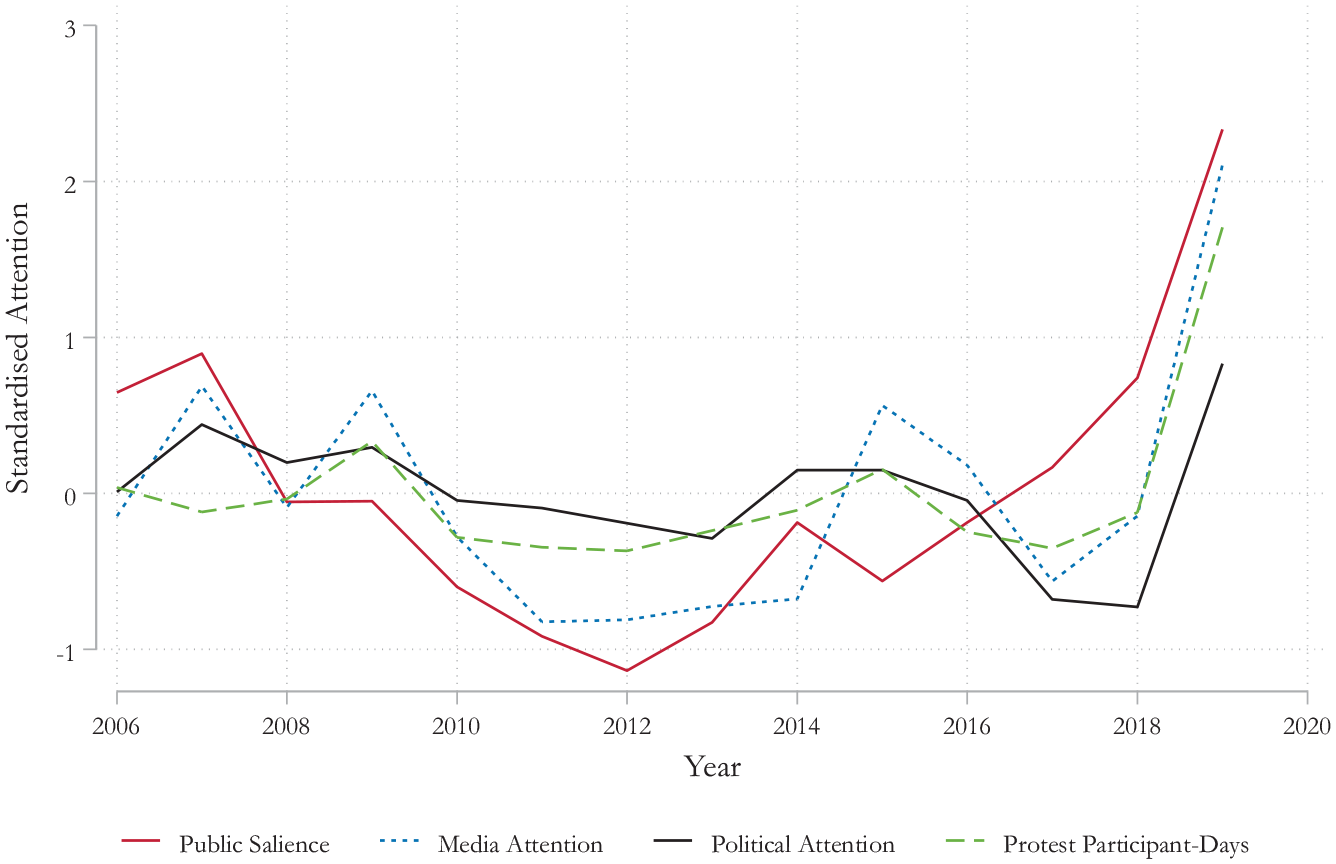
Annual trends in attention, 2006–2019.
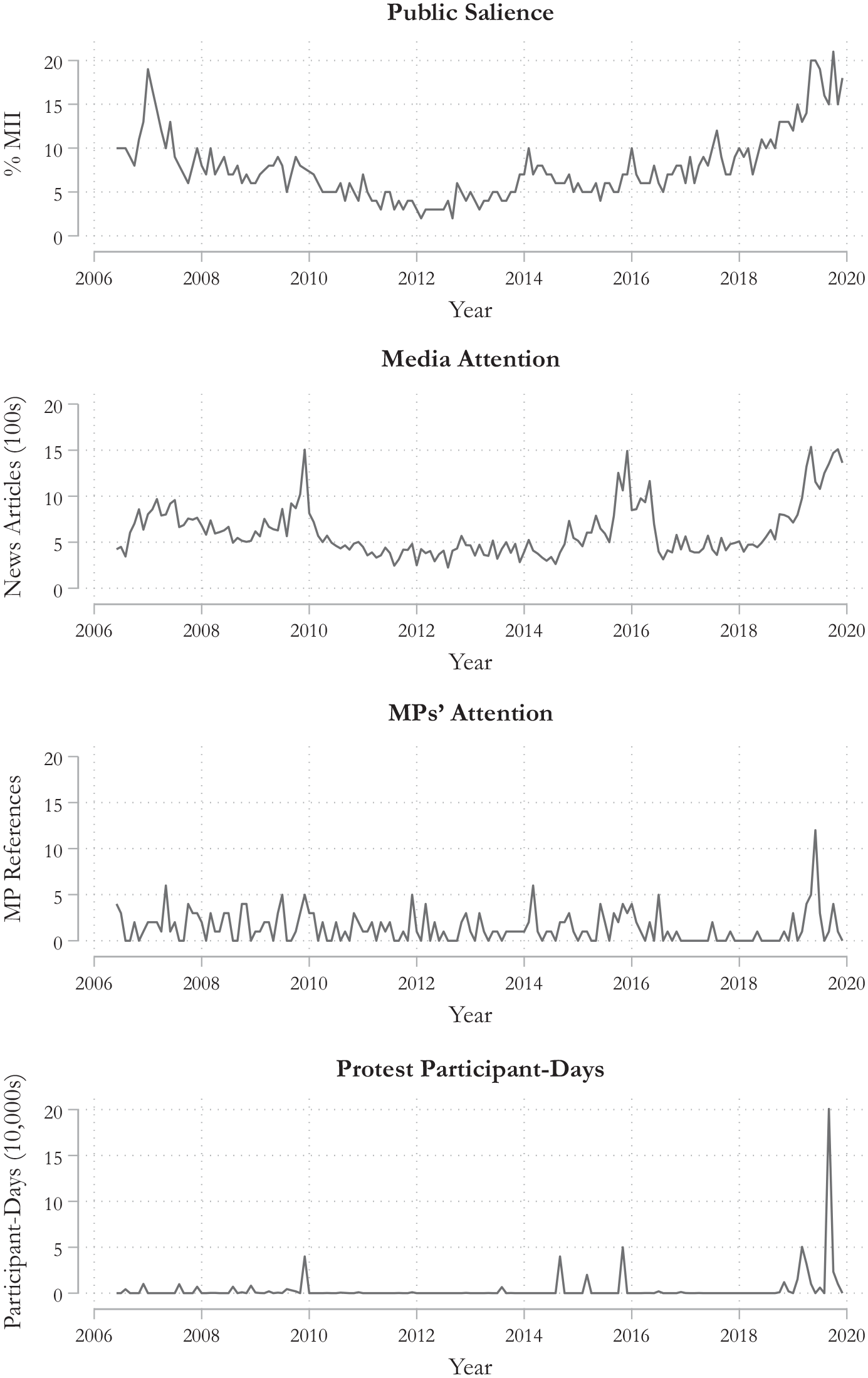
Environmental attention, 2006–2019.
Overall, the period of study exhibits far greater variability than has previously been highlighted for prior decades. However, while Norris’ (1997) study showed there was a little change in environmental concern in the 1980s, short-run changes can similarly be linked with key events. Temporal changes fit patterns of prior studies, particularly the peak in attention following the 2009 Conference of the Parties (COP15) and the award of a Nobel Peace Prize to Al Gore and the IPCC in 2007. The 2009 media spike may also be explained by its co-occurrence with ‘Climategate’, whereby leaking of scientists’ emails resulted in debate surrounding climate change’s credibility. The Paris Agreement delineated at the 2015 UNCCC is accompanied by a similar peak, under which a continuation of the 1992 Kyoto Protocol was established for greenhouse gas emissions and mitigation. 5 The 2008 Climate Change Act did not generate much attention, which can perhaps be attributed to coinciding with the financial crisis, which is associated with a trough in attention (Figure 2). Likewise, falling attention between 2010 and 2014, prior to the 2015 Paris Agreement, might reflect change to the Conservative-Liberal Democrat coalition government in 2010 and associated austerity policies, as well as politicisation of the issue (Carter and Clements, 2015). The trough between 2016 and 2018, particularly for political attention, is likely the result of politics being dominated by Brexit negotiations.
Comparing measures of attention over time gives initial indication of complex interrelationships between agenda-setting actors. At the annual level, attention has moved across all actors at around the same time, however since 2015, public salience has grown prior to, and to a greater extent, than other actors. In contrast, protest did not rise substantially until 2019, perhaps in consequence of heightened public salience the preceding year. The striking peak witnessed in 2019, which has not been captured by previous research, highlights a shift in concern. On examination of this period, shown by Figure 4, it is evident that changes in attention across actors occurred around the time of protest events. This is also coupled with measurable political change, with government amending the 2008 Climate Change Act to implement a new target of making greenhouse gas emissions net-zero by 2050. Although relations are evident across monthly trends, these graphs are characterised by far greater variation so it is harder to discern a systematic pattern. In addition, as exogenous occurrences and events can be linked with changes across actors, this raises questions as to what extent measures are driven by one another or simultaneously moving in response to real-world events.
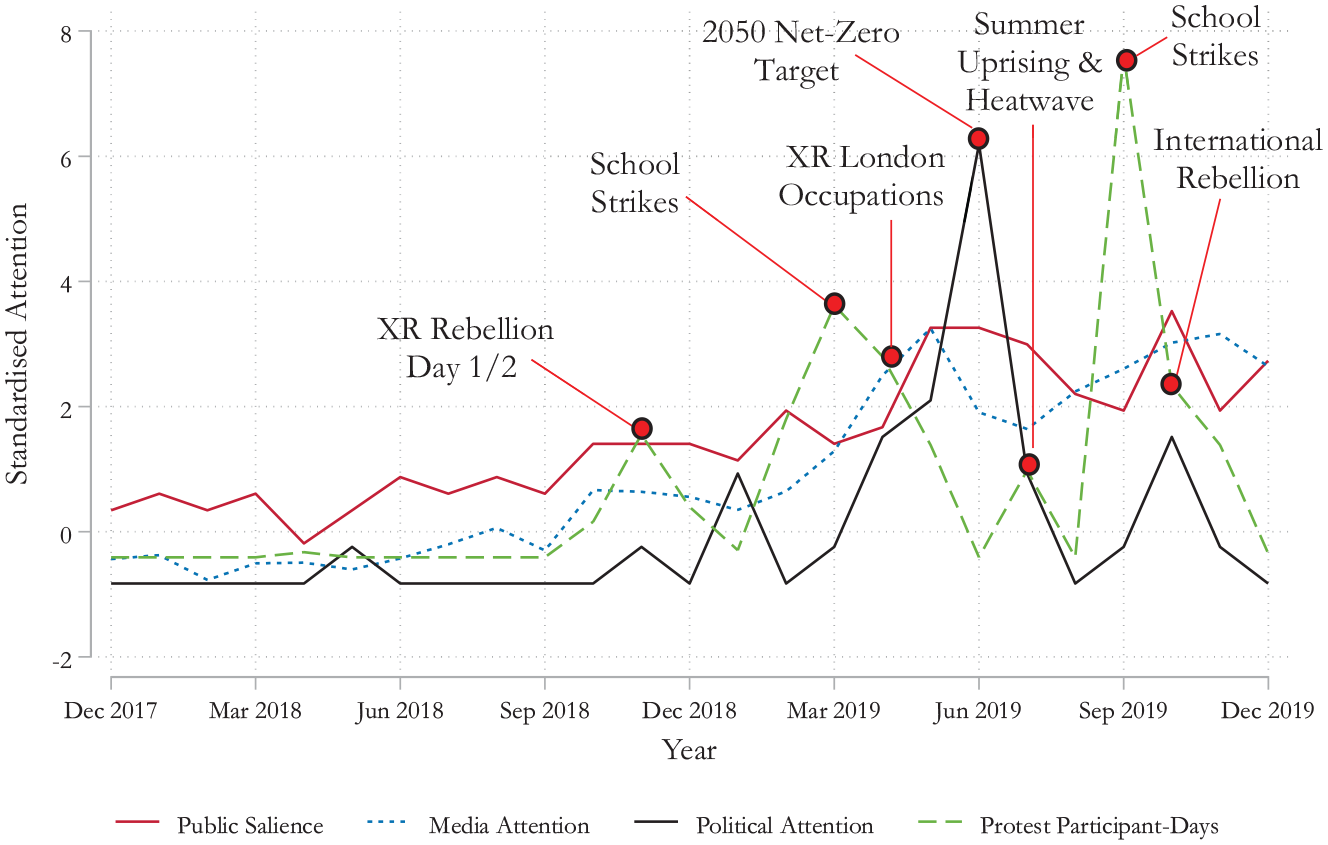
Trends in attention, 2018–2019.
Modelling public attention
To model environmental salience, Zellner-Aitken SUR estimations are used. This methodology controls for dynamic interrelationships by solving a system of equations through generalised least squares, based on an assumption of correlated error terms between equations. The method is much like vector auto-regression (VAR), with the added benefit of being able to control for different exogenous variables across equations, allowing more efficient estimation (Enders, 2010). This enabled controlling for parliamentary recess in the political equation, and general elections in media and public equations. Exogenous variables are excluded from the protest equation as variables should not directly impact protest and should instead manifest through public attention. This makes fewer assumptions about plausible causal mechanisms of protest, and information criterion tests indicated that doing so provided a higher quality model.
Due to endogenous relationships and inclusion of multiple lags, it is well-documented that, while SUR models accurately estimate relations between variables, individual coefficients are likely inaccurate (Freeman et al., 1989). Instead, it is traditional to use results in calculating Granger-causality and impulse-response functions (IRFs), which offer greater statistical utility. Granger-Causality tests provide a more robust understanding of whether causality persists as a whole; a variable can be said to Granger-cause another if the lagged values of the former (values of that variable in the preceding months) can be used to predict the latter in the present month, while also controlling for the lagged values of the latter (Granger, 1969). For example, Granger-causality tells us whether protest activity in the previous months helps explain current perceptions of the environment as a problem, even controlling for how much the environment was previously considered a problem by the public. IRFs visualise relations between variables in terms of their moving average representation, highlighting the effect magnitude over time by showing the effect of a shock in one variable on a response variable over consecutive months. IRFs were calculated using a Bernanke-Sims decomposition which restricts the effects of innovations such that a shock in each variable can affect its own model residual contemporaneously but others’ after one. Put simply, they show what the model predicts would happen to public salience in the following months, should there be a sharp increase in, for example, protest activity or media coverage of the environment in the month prior.
The number of endogenous lags to include was established through tests of joint significance, which determined a lag of 3 months to be the most appropriate. Given the high-dimensionality of potential exogenous variables and their lags, and 4 models to specify, a step-wise method was used to prevent model overspecification. Variables were first examined for reverse or bidirectional causality, and removed from the pool of candidates if Granger or Toda-Yamamoto tests indicated such. 6 A least absolute shrinkage and selection operator (LASSO) was used in model specification to determine which covariates should be included for each dependent variable. Exogenous variables were only considered at a maximum lag of one, on the basis that influence is not expected to occur beyond the concurrent or previous month. 7
Agenda-setting dynamics
Table 1 outlines Granger-causality results while IRFs are shown in Figure 5.
8
Figure 6 combines and visually summarises both of these. Public salience and media attention are found to be autoregressive processes, meaning they can be predicted by their prior levels. Results confirm the importance of analysing protest endogenously, with protest having a significant bidirectional relationship with both public salience and media attention. This indicates that the magnitude of protest is partially being driven by levels of concern in the public body, which is logical given that the protest index is a function of participation. In a longer term sense, the idea that public salience leads to protest is also supported by graphs at the annual level (Figure 2). However, in turn, public attention to the issue can be predicted by preceding protest (
Granger-causal relationships in 2006–2019 model.
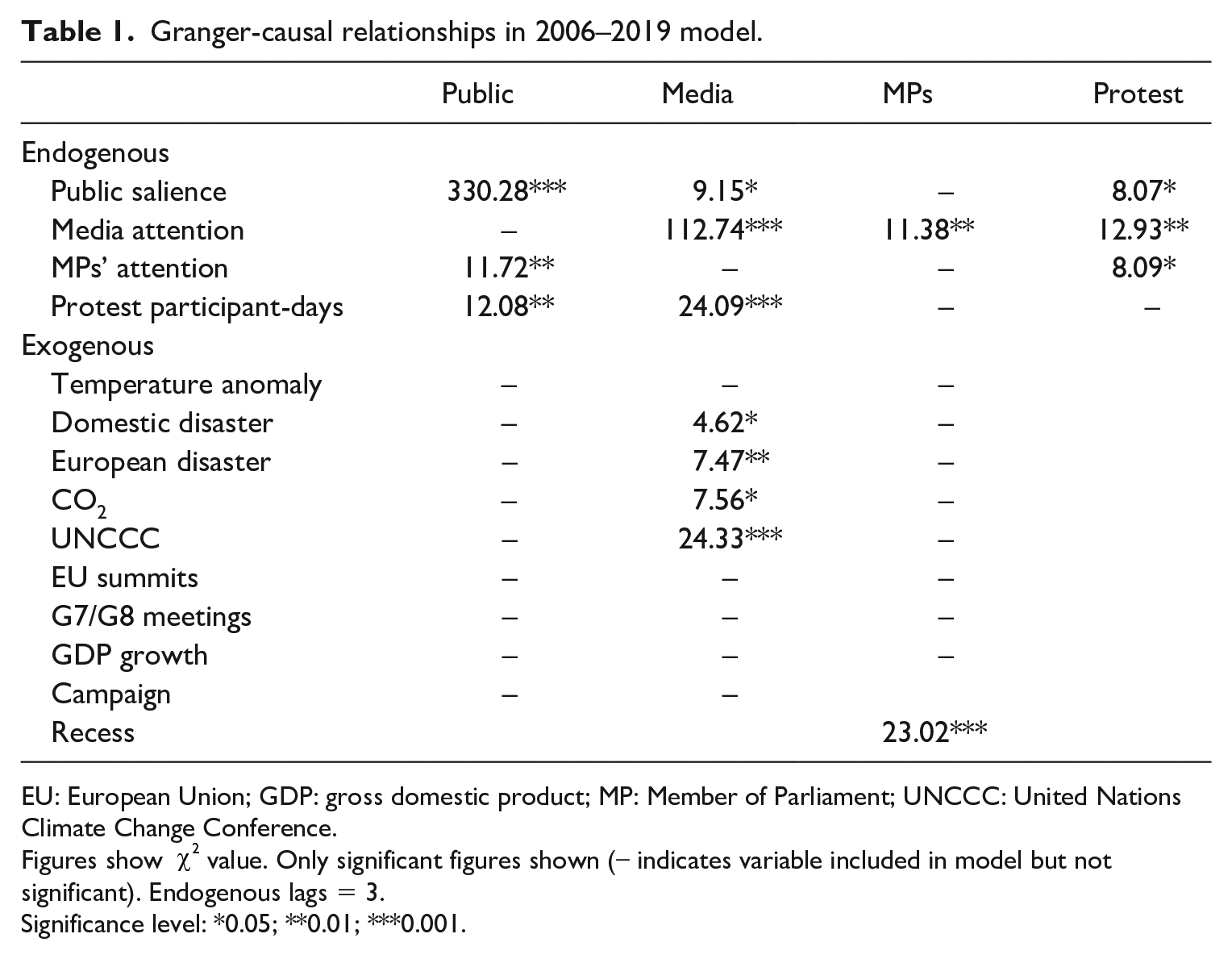
EU: European Union; GDP: gross domestic product; MP: Member of Parliament; UNCCC: United Nations Climate Change Conference.
Figures show
Significance level: *0.05; **0.01; ***0.001.
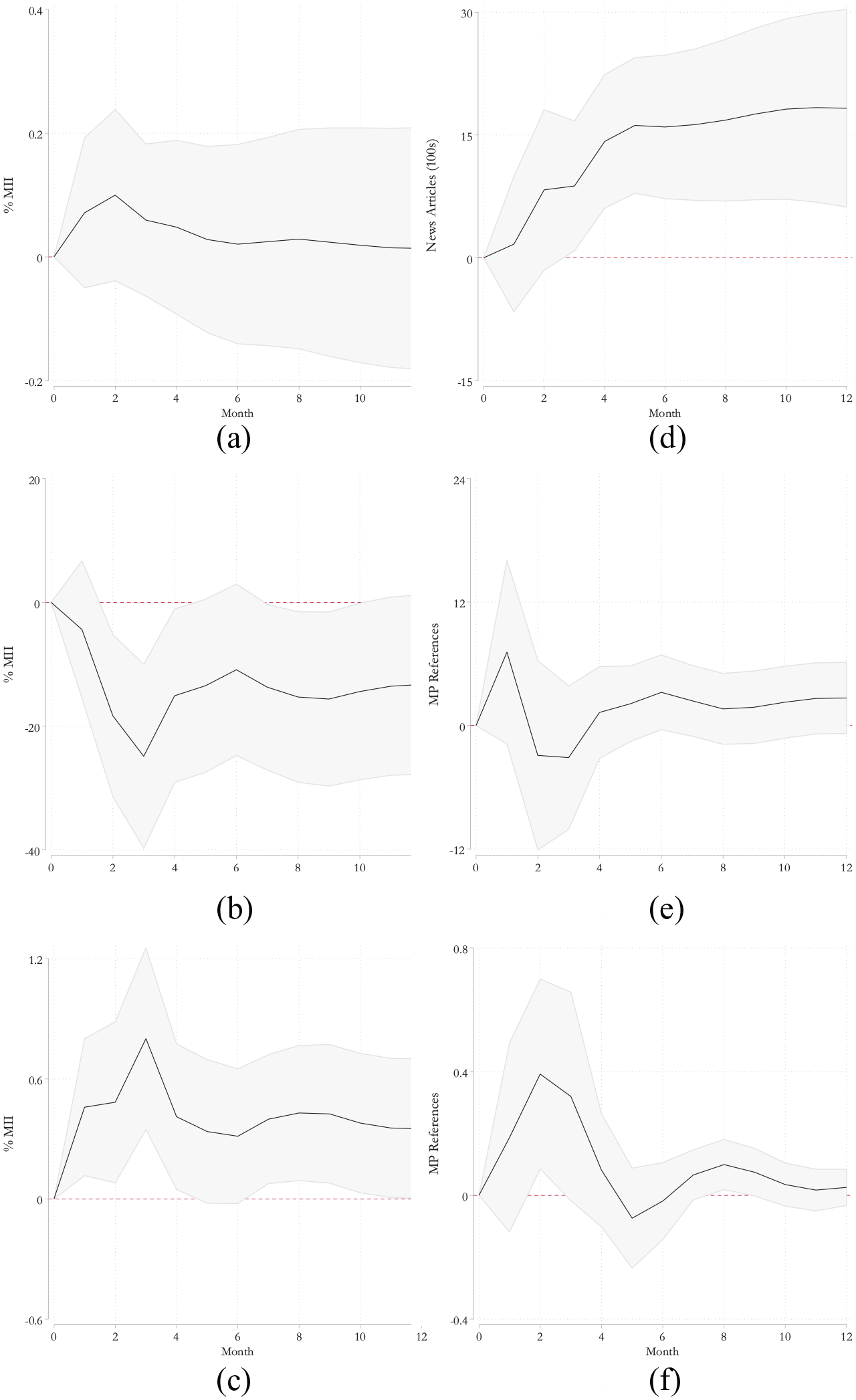
Impulse response functions from 2006 to 2019 model. (a) Media attention on public salience. (b) MPs’ attention on public salience. (c) Protest participant-days on public salience. (d) Public salience on media attention. (e) Public salience on MPs’ attention. (f) Protest participant-days on MPs’ attention.
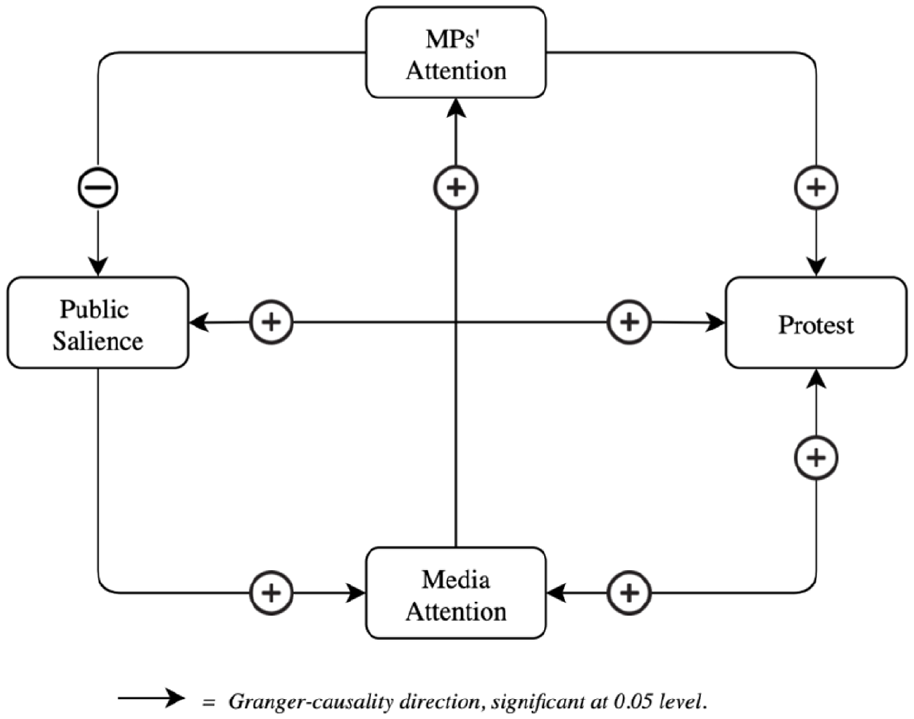
Significant Granger-causality and IRF direction.
Given that recent large-scale environmental movements only emerged in 2018, to test the robustness of these effects, the model was additionally run for the period 2006–2017. When doing so, protest had no relationship with public salience or MPs’ attention in either direction, although the bidirectional relationship between protest and media attention remained significant (see Online Supplementary Table A1). This is in keeping with research from prior decades which found no influence of environmental public opinion on protest (Olzak and Soule, 2009) or protest on public opinion (Giugni, 2004). This indicates results are largely being driven by recent protest, highlighting their effect magnitude and changing dynamics over time. While protest has been argued to hold a little political influence due to infrequency (Burstein and Sausner, 2005) and representation of only a small minority of individuals (Giugni, 2007), the converse is now true of the environmental movement which might explain its success. However, this is not to say that environmental movements did not hold influence before 2018, and it is worth noting that conventional tactics of lobbying and interest group behaviour are not captured by the measure of protest used in this study. Moreover, given the environmental movement has previously focused on raising awareness, a different measure of public opinion, such as belief in climate change, might be better expected to be influenced by earlier protest. As Extinction Rebellion has made a point of their willingness to be arrested to drive political change, a further model was run using the number of protest arrests instead of participant-days (see Online Supplementary Table A2). Doing so indicated that arrests did not Granger-cause public attention but could predict levels of media coverage. The fact arrests are not associated with shifting public salience but participant-days are might suggest that the mechanism of protest’s influence is not in its disruptiveness, and is rather the result of social influence with increasing participation and duration. 9
Of particular note, is that results of Granger-causality tests and IRFs provide no evidence for public attention systematically following changes in media coverage (
As agenda-setting studies have not typically considered protest’s effects, a further model was run excluding protest variables for comparison. Doing so resulted in significant bidirectionality between media and public opinion (see Online Supplementary Table A3). Under this specification, media is found to Granger-cause public salience (
MPs’ attention is found to Granger-cause public salience (
As public salience and protest Granger-cause media which in turn, Granger-causes parliamentary debate (
Exogenous factors
As a whole, there is remarkably little direct influence of exogenous factors on aggregate public salience. In contrast, media coverage on climate change is found to be responsive to UNCCC events, changes in CO2 levels, and both domestic and European natural disasters, fitting with prior theory which suggests media coverage to be largely event-driven. In light of this, I refrain from an in-depth consideration of such here, however, further analysis of individual exogenous variables can be found in Online Supplementary information.
Absence of association with exogenous variables is largely unsurprising, given the lack of evidence to suggest such variables influence aggregate public attention over time. This indicates that, while some exogenous factors may influence individual-level attitudes, the number of people being influenced is insufficient to cause aggregate changes in salience. Due to the nature of time-series analysis, effects of variables at a static time point may also not hold over monthly changes, or the effects of variables may occur in conflicting ways across time. For example, climate policy negotiations at some EU Summits will have been associated with increased attention to the issue, while other summits have focused on, or occurred at the same time as, other political issues such as Brexit, which will be associated with reduced attention to climate change. Overall, these findings suggest that if public attention is indeed being influenced by these exogenous factors, either they are not having a consistent influence across occurrences, or influence is not sustained beyond the contemporaneous month.
Conclusion
Despite both rising seriousness and acceptance of environmental issues such as climate change, the perceived importance of the environment to the British public has fluctuated dramatically over time. Having been at the forefront of the public agenda in 2007, the environment became less salient, with the proportion of the public ranking it as a political priority not returning to the same levels until 2019. This article aimed to better understand the short-run driving factors of these aggregate shifts in public attention, by analysing monthly changes between 2006 and 2019. In doing so, it contributes to theory on agenda-setting, protest movements and public attitudes.
This article provides the first systematic study to show that environmental protest is important for understanding public salience. Findings suggest recent social movements have played a significant role in shaping public attention to the environment, warranting inclusion of protest as an endogenous, dynamic force. There is multi-directionality between protest and public opinion; protest activity can be predicted by levels of public attention but in turn, is successful in increasing broader public environmental salience. However, while these effects hold across the period of study, this is largely the result of strong inter-dynamics from 2018 onwards, coinciding with the rise of novel environmental movements. Contrary to the supposed effectiveness of civil disobedience and disruption that Extinction Rebellion aim for, analyses suggest it is the scale of recent protest, rather than the number of arrests, that seems to shape public salience. This contributes to our understanding of how protest can, but not always, influence public opinion on a major policy issue.
This particular issue in Britain raises an important consideration about the misattribution of protest’s effects, with protest shown to have a confounding effect. As the media report on protest, and protest is associated with increased public salience, if protest is uncontrolled for then analyses might mistakenly find media effects on the public. Although findings suggest media is linked with other actors in the dynamic process, it is not playing a significant role in leading attention to the environment, rather, it can be predicted by preceding changes in public demand and protest. Although there is likely intermedia agenda-setting, the media measure is limited by it only reflecting print media and particular platforms. Future research could look more carefully into differences between newspaper platforms, or other media forms, to see if effects vary, both for the environment and other political issues more broadly.
In measuring political attention, this article focused on MPs’ behaviour in parliamentary debate, finding that a spike in attention leads to decreased public salience. This negative response is largely being driven by the changes which occurred following the legislation introduced in June 2019, which aims for net-zero carbon emissions by 2050. This pertains to Down’s (1972) issue attention-cycle model, with public salience falling in response to political action being taken. This speaks to a broader debate that net-zero legislation might not be constructive as it not only distracts from attending to policy action now, but may also make the general public less concerned about the environment.
This also raises a broader point that the interpretation of results relies on a contextual understanding of variation in models and individual variables. Without such one might be tempted to interpret variables such as MPs’ attention as a generic measure of attention, when much variation is driven by particular events and circumstances. For instance, the measure includes debate on legislation, which can ultimately be explained by government decision-making and circumstances such as the Prime Minister’s desire to achieve a legacy policy, requiring interpretation of models to be sensitive to such.
These results provide some explanation as to why public attention to the environment has fluctuated over time and they have important implications in terms of public environmental perceptions. Although, by and large, a few variables are able to consistently predict change over time. For example, while exogenous events are associated with spikes in attention in some instances, effects do not hold over the period of study. The decline in attention between 2007 and 2012 is also evidently linked with the financial crisis to some extent, but is likely the result of the fiscal narrative of media and politicians, rather than monthly labour market conditions. Likewise, the upwards shift in public attention in 2012 is unexplained by the model, with it not reflecting changes across media or political actors.
These findings may suggest shifting dynamics between actors, bringing into question the pertinence of traditional agenda-setting theory in explaining levels of attention to environmental issues. They also indicate that protest can be important, both substantively and methodologically. As protest is becoming increasingly widespread, its role in shaping public attention and the political process more broadly in years to come, should not be discounted.
Supplemental Material
sj-docx-1-bpi-10.1177_13691481221080651 – Supplemental material for Modelling the fall and rise in the importance of the environment to the British public: 2006–2019
Supplemental material, sj-docx-1-bpi-10.1177_13691481221080651 for Modelling the fall and rise in the importance of the environment to the British public: 2006–2019 by Martha Kirby in The British Journal of Politics and International Relations
Footnotes
Acknowledgements
I would like to thank Stephen Fisher, Michael Biggs, Ridhi Kashyap, John Kenny and Wouter Poortinga, as well as anonymous reviewers, for their invaluable feedback on earlier versions of this paper.
Funding
The author(s) disclosed receipt of the following financial support for the research, authorship and/or publication of this article: This work was supported by the Economic and Social Research Council: grant number ES/S50158X/1.
Data availability statement
The data that support the findings of this study are available from the corresponding author upon reasonable request.

Supplementary information
Additional supplementary information may be found with the online version of this article.
Notes
References
Supplementary Material
Please find the following supplemental material available below.
For Open Access articles published under a Creative Commons License, all supplemental material carries the same license as the article it is associated with.
For non-Open Access articles published, all supplemental material carries a non-exclusive license, and permission requests for re-use of supplemental material or any part of supplemental material shall be sent directly to the copyright owner as specified in the copyright notice associated with the article.
