




Abstract
We investigate whether entitlement (feeling more deserving than others) and several dimensions of self-conscious affect (broadly reflecting responses to shame and guilt) are associated with voting intentions during the 2020 Presidential election in the USA. We utilized a sample of 443 adults recruited through Prolific. The sample was demographically representative with respect to age, gender, and race. Participants were recruited from 12 October 2020 to 15 October 2020, approximately 3 weeks before the national election held on 3 November 2020. Results reveal that higher entitlement beliefs are associated with support for Republicans, and so are shame proneness vis-à-vis behavioral avoidance (desire to hide) and blame externalization. Inversely, guilt proneness and shame proneness vis-à-vis negative self-evaluation is associated with support for Democrats. Results also suggest that shame proneness and blame externalization most closely correspond with voting preference; specifically, negative self-evaluation drives support for Democrats, whereas blame externalization and behavioral avoidance drives support for Republicans. While these effects are often only in the small-to-medium range in terms of magnitude, their implications for a more nuanced understanding of electoral politics—and its pitfalls—are noteworthy.
Introduction
Above and beyond ideological preferences, voting choices in elections often stem from considerations steeped in the character and personality of the competing candidates (Bittner, 2011). Within this framework, recent scholarship highlights the role in the political sphere of a specific personality trait—narcissism (Fazekas and Hatemi, 2021; Federico and De Zavala, 2018). Narcissism in political leaders matters—for instance, Watts et al. (2013) show an association between this trait and policy boldness, but also tolerance for unethical behaviors in subordinates. In the U.S., the centrality of this trait seems exemplified by former U.S. President Donald Trump, known to exhibit an inflated self-esteem and frequently rely on bombastic ego-reinforcing rhetoric (Nai et al., 2019). And this might not be entirely by chance. Evidence exists indicating that traits associated with narcissism might be more likely to generalize to supporters of right-wing political parties (Brunet, 2021; Federico and De Zavala, 2018), which might support the idea of a “homophily” between the personality profile of voters and the character and personality of the leaders they support (e.g., Selfhout et al., 2010). Because “similarity in traits carries similarity in worldview and values” (Caprara and Vecchione, 2017: p. 236), consistent evidence exists that voters have a proclivity for supporting candidates showcasing traits that “match” their own personality (Caprara et al., 2007; Gerber et al., 2013; Vecchione et al., 2011).
With this in mind, and given the centrality of (collective) narcissism in world politics (Cichocka and Cislak, 2020), it is surprising that very little research exists about the dynamics of narcissism at the individual level when it comes to voting decisions, likely due to the multidimensional nature of the trait (Raskin and Terry, 1988; but see, e.g., Hart and Stekler, 2021; Yalch, 2021). In this article, we focus on one dimension of narcissism, psychological entitlement (henceforth referred to as entitlement), conceptualized as “a stable and pervasive sense that one deserves more and is entitled to more than others” (Campbell et al., 2004: p. 31). Entitlement plays an instrumental role in resource allocation and ethical decision-making (Campbell et al., 2004; Thomason and Brownlee, 2018). In this article, we investigate whether entitlement, and related dimensions of self-conscious affect (see below), are associated with voting intentions in the 2020 US Presidential election. We present results from a demographically representative sample (on the basis of age, gender, and race) of 443 adults surveyed via Prolific in October 2020, approximately 3 weeks before the national election held on 3 November 2020.
Entitlement as a manifestation of self-conscious affect
Although the entitlement and narcissism are both ego-centric, the former is distinctly driven by status-seeking comparisons between self and others. In contrast, narcissism encapsulates additional dimensions that are more self-focused and characterized by a decreased regard for and dependence on others (Rose and Anastasio, 2014). Entitlement may therefore generate systemic inequality since it explicitly requires social comparison. For example, a greater sense of entitlement is associated with demands for higher salary (Campbell et al., 2004). Other areas in which entitlement differences may arise include gender, with men reporting higher levels of entitlement than women (Campbell et al., 2004), and employment status, with higher levels of entitlement appearing in those who are unemployed (Huang and Kuo, 2020).
Entitlement is activated in response to one’s belief that they were either wronged or unfairly treated (Kimmel and Ferber, 2000; Williams et al., 2020). Earlier psychoanalytic perspectives described entitlement as a defense against shame and guilt by which individuals externalize their self-conscious emotions by directing anger or blame toward others (Bishop and Lane, 2002; Horney, 1950). These psychoanalytic conceptualizations align with the more cognitive self-conscious affect literature (e.g., Gramzow and Tangney, 1992; Rose and Anastasio, 2014), which suggests entitlement is associated with shame proneness and guilt proneness. Assessing these constructs simultaneously would elucidate which of these closely related interpersonal processes is more closely aligned with a person’s voting preference. Tangney et al. (2007) identify five unique responses to self-conscious affect: two distinct responses associated with shame proneness (i.e., negative self-evaluation, and desire to hide), two distinct responses associated with guilt proneness (i.e., desire to amend, and feelings of remorse), and a separate behavioral response of blame externalization. These distinctions allow researchers to study refined processes underlying self-conscious affect by highlighting the dimensional nature of shame proneness and guilt proneness. Although the separate dimensions of each construct remain understudied, guilt is typically seen as more adaptive than shame (Tangney et al., 2007) and is associated with prosocial behaviors (Thielmann et al., 2020).
Externalizing blame represents a common response to shame (Tangney et al., 1992). In two separate studies, Tangney and colleagues (1992) reported shame proneness was positively associated with anger and a pattern of externalizing blame in response to negative events. In relation to the present topic, politics represents a socially acceptable forum for channeling emotions that are a byproduct of shame (e.g., anger) into rigid partisan affiliation vis-à-vis blame externalization (Huddy and Bankert, 2017) while simultaneously advocating for policies rooted in entitlement. For example, the focus on immigration policy in political discourse during the 2016 presidential election entailed Republican Candidate Donald Trump casting blame on marginalized groups to explain economic insecurity (Sides et al., 2018). This narrative may have resonated with voters who felt ashamed of their low socioeconomic status by providing a target with which to project their anger onto (Ferguson et al., 2018).
Examining group differences in voting preferences as a function of Tangney and colleagues’ (2007) five responses to self-conscious affect is particularly salient at the present moment in time due to the pervasive overt and covert undercurrents of shame perpetrated by Republican Candidate and President Donald Trump throughout the two most recent U.S. presidential elections (Haslett, 2016; Schaefer, 2020; Watkins, 2018). President Donald Trump’s bombastic campaign behavior described by Nai and colleagues (2019) aligns with previous developmental research observing children with grandiose self-regard (such as entitlement) react to shame by aggressively attacking (i.e., blaming) a source of shame to offset an unflattering self-image (Thomaes et al., 2008). On the other hand, Democratic Candidate Joe Biden emphasized racial justice and environmental conservation policies (Kang, 2021; Smith and King, 2021), which are akin to making amends with historically marginalized communities (Smith and King, 2020).
The overall purpose of the present study is therefore twofold. First, no empirical research has examined connections between entitlement, self-conscious affect, and voting preferences. Uncovering basic partisan differences between entitlement and self-conscious affect provides a foundation for exploring predictors of voting preference. We suspect that individuals will be more likely to identify with and vote for political candidates who display similar patterns of entitlement and responses to self-conscious affect. Second, given the anticipated correlations between entitlement and the five dimensions of self-conscious affect outlined by Tangney and colleagues (2007), the present study will identify which of these constructs emerged as the most salient predictors of voting preference in the 2020 election after controlling for standard demographic variables such as age and income (Piff, 2014). Thus, the present study includes two research questions: RQ1: How do entitlement and self-conscious affect differ between Democratic and Republican voters in the 2020 U.S. presidential election? RQ2: Which of the aforementioned constructs were the strongest predictors of voting preference in the 2020 U.S. presidential election?
Methods
Participants and procedure
This study received approval from the Ball State University Institutional Review Board. The first author recruited 526 U.S. adults from Prolific between 12 October and 15 October 2020, approximately 3 weeks before the national election held on 3 November 2020. This sample was demographically representative with respect to age, gender, and race. Participants that failed attention checks or did not indicate intentions to vote Democratic or Republican in the upcoming election were removed from further analysis, yielding a final sample of 443 adults (49.4% male; age: M = 46.1 years, SD = 15.4; 77.9% White; 62.3% reported at least a bachelor’s degree).
Upon agreeing to the terms set forth in the informed consent, participants completed a psychological battery assessing self-conscious affect, entitlement, and a demographic questionnaire. Participants received $3.00 upon study completion (corresponding to $9.32/hour). The two psychological instruments (i.e., self-conscious affect and entitlement) were counterbalanced, and participants completed the demographic questionnaire at the end of the survey. Included in the demographic questionnaire was the following question: “Which party do you plan to vote for in the 2020 U.S. presidential election?” Participants were able to select Democrat or Republican. The names of each presidential candidate (i.e., Joe Biden and Donald Trump) did not appear next to their respective parties.
Measures
Test of self-conscious affect-4 (TOSCA-4)
The TOSCA-4 (Tangney et al., 2008) contains 15 scenarios that assess shame proneness, guilt proneness, and externalization of blame. Participants read each scenario, and then indicated their level of agreement with five possible responses to the scenario. Each possible response was rated with five-point scale (1 = not likely; 5 = very likely). An example scenario is “You borrow your friend’s car and accidentally put a dent in it while parking.” One of the five responses to this scenario is “How likely is it that you would feel like a horrible friend?” Each scenario corresponds to one of the TOSCA-4’s five subscales, and none of the responses explicitly mention shame. The two shame subscales include Negative Self Evaluation (NS) and Desire to Hide or Escape (DH). The two guilt subscales include Desire to Amend (DA) and Remorse. The Externalization of Blame subscale includes responses that project internalized self-conscious affect toward external factors (e.g., blaming the friend for having a large car). All subscales produced reliable scores in the present study (NS: α = 0.91; DH: α = 0.92; DA: α = 0.88; Remorse: α = 0.87; Ext. Blame: α = 0.92).
Psychological entitlement scale (PES)
The PES (Campbell et al., 2004) contains nine statements requiring participants to indicate their level of agreement on a seven-point scale (1 = strong disagreement; 7 = strong agreement). A sample item is “I honestly feel I’m just more deserving than others.” The PES is particularly well-suited for assessing entitlement due to its discriminant validity with social desirability (r = 0.06, ns; Campbell et al., 2004). Across nine studies with undergraduate samples, Campbell and colleagues (2004) reported mean PES scores ranging from 27.3 to 31.0. Cronbach’s alpha in the present sample was 0.92.
Data analysis
Statistical analyses were conducted in IBM SPSS Statistics (Version 27). All measures in the present study were forced response, leaving no room for missing data. As a result, all of the analyses included the final sample of 443 participants. RQ1 was examined through a series of independent samples t-tests using voting preference as the grouping variable and participants’ scores from the PES and TOSCA-4 as test variables. RQ2 was examined through a hierarchical logistic regression that positioned voting preference as the outcome variable. In order to account for demographic similarities between voting preference (e.g., Abramowitz, 2012; Gonyea and Hudson, 2020), the first step of the logistic regression included age, gender, education, income, and race (White vs non-White) as control variables. The second step of the logistic regression included participants’ scores from all five TOSCA-4 subscales.
Results
Intercorrelations, descriptive statistics, and internal consistencies of observed variables.

*p < .05; **p < .01; ***p < .001; NS = negative self-evaluation; DH = Desire to Hide; DA = Desire to Amend; Ext. = Externalization; M = mean; SD = standard deviation. Voting intention is a dichotomous variable and coded in the direction of the incumbent party at the time of data collection (i.e., Republican).
Entitlement and TOSCA-4 scores by voting intentions.

*p < .05; **p < .01; ***p < .001; TOSCA = Test of Self-Conscious Affect; NS = negative self-evaluation; DH = Desire to Hide; DA = Desire to Amend; Ext. = Externalization; M = mean; SD = standard deviation.
Logistic regression predictors of voting intentions.
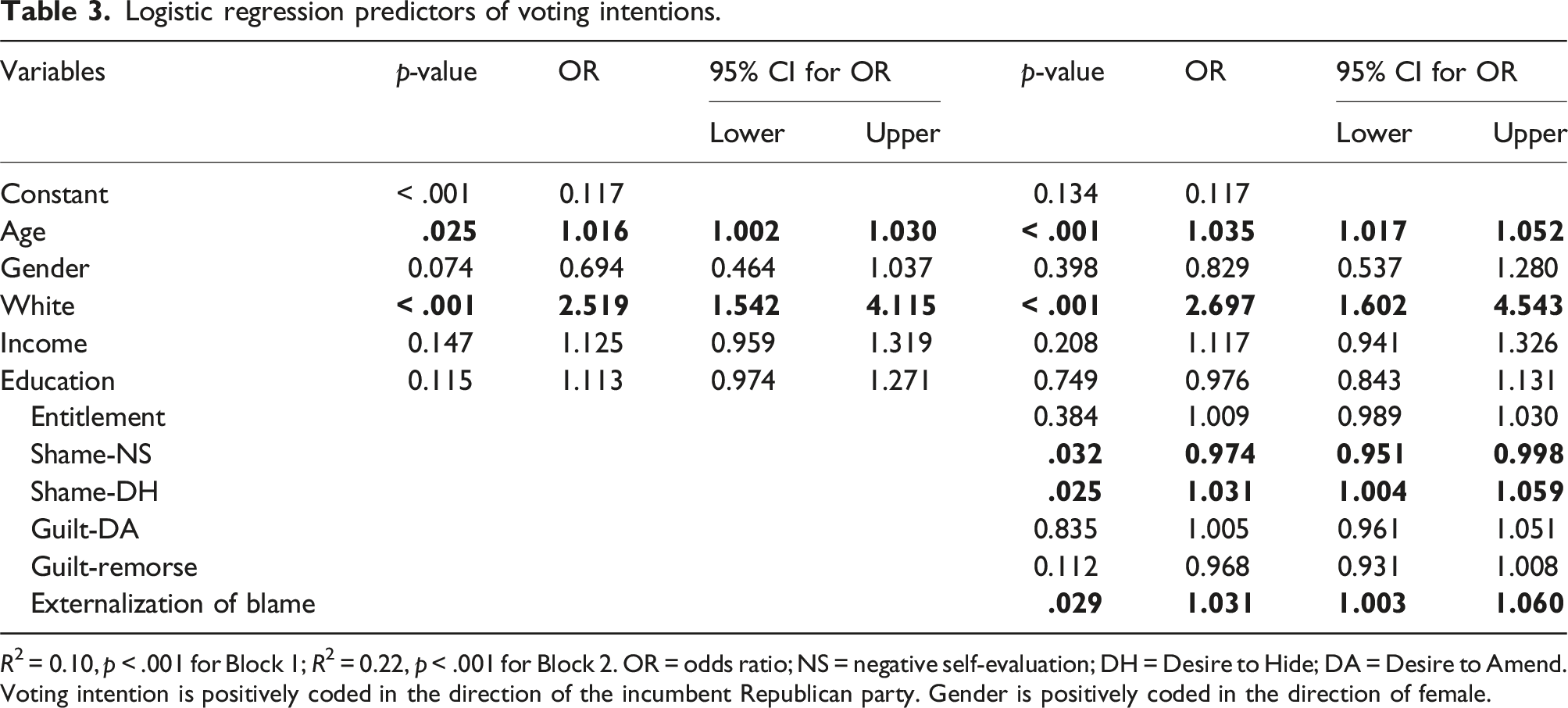
R2 = 0.10, p < .001 for Block 1; R2 = 0.22, p < .001 for Block 2. OR = odds ratio; NS = negative self-evaluation; DH = Desire to Hide; DA = Desire to Amend. Voting intention is positively coded in the direction of the incumbent Republican party. Gender is positively coded in the direction of female.
Discussion
The present study provides evidence that Democratic and Republican voters differ across entitlement and all five dimensions of self-conscious affect, at least when it comes to the 2020 U.S. presidential election. Entitlement and blame externalization were associated with each other, as well as with intentions to vote Republican. Both forms of guilt proneness were correlated with each other and with intentions to vote Democrat. Finally, the two dimensions of shame proneness, while heavily correlated with each other, significantly diverged upon examining their role in voting intentions: Democratic voters were prone to negative self-evaluation, while Republican voters were prone to behavioral avoidance.
Although voting intentions differed across all six variables of interest, the study’s inquiry into predictors of voting intentions highlight which variables are more salient indicators of political alignment. Specifically, negative self-evaluation emerged as a predictor of voting Democrat, and behavioral avoidance and blame externalization were predictors of voting Republican. Results therefore suggest these three dimensions of self-conscious affect are most germane to voting intentions when simultaneously accounting for demographic variables, entitlement, and all five dimensions of self-conscious affect. Thus, while initial group differences were observed across entitlement and guilt proneness, shame proneness and blame externalization appear to exhibit a stronger influence over voting choices. Because all of these variables are intimately intertwined (see Table 1), it is understandable that all six outcomes would differ across the two groups even if only three were associated with voting intentions when considering all six outcomes together.
Shame situates the self as the objective of negative evaluation (Lewis, 1971) and is an intensely painful affective response to perceived wrongdoing (Shen, 2018). Earlier research by Tangney (1993) shows that shame proneness is experienced by sensations of feeling physically smaller and inferior to others, a preoccupation that one is being watched, and feeling worse during the experienced event. With respect to the present study, it is understandable that shame proneness would emerge as a predictor of voting intentions if a particular candidate or party reflected—and normalized—one’s behavior in response to shame proneness.
Blame externalization is a form of emotional immaturity in response to shame by which the agent deflects accountability away from the self and toward an external source in order to protect the ego (Tangney and Dearing, 2002). This pattern of behavior is observed among individuals who lack emotional regulation skills (Linares et al., 2009) and possess an unstable self-esteem (Kuppens and Van Mechelen, 2007). Blame externalization is often a socially learned behavior modeled by primary caregivers in response to distress. The multiple pathways to blame externalization—outlined in greater detail by—Malle and colleagues (2014) would explain why blame is so prevalent. In the present study, blame externalization yielded a medium effect size when comparing prospective Democratic and Republican voters, with Republicans scoring higher on this dimension of self-conscious affect. This pattern connects back to former President Donald Trump’s pattern of casting blame on out-groups (Davey, 2020; Sides et al., 2018), which inherently reduces the distress of cognitive dissonance by finding a target with which to project self-conscious emotions.
Although entitlement and guilt proneness did not emerge as predictors of voting intentions, the combination of blame externalization and entitlement in the presence of reduced guilt proneness suggests related, but unexamined, psychological variables serve as more salient predictors of voting intentions. Identifying these variables may elucidate important constructs that could threaten democratic politics. Specifically, if the agent engaging in blame tactics controls economic resources and military forces, they possess the ability to financially and physically harm the less fortunate with reduced remorse or empathy due to a belief that the victims “deserve” their fate. In essence, blame externalization and entitlement with a reduced propensity for remorse could be a recipe for state-sanctioned violence. The present study suggests these variables may play a role in U.S. voting patterns.
Limitations and future directions
The present study generates new empirical evidence of group differences in entitlement and self-conscious affect among prospective U.S. voters from the 2020 presidential election. At the same time, these results must be placed in context of the study’s limitations. First, due to the cross-sectional nature of data collection, results cannot infer causality. One possible future direction includes testing temporal relationships between the variables examined in the present study—for instance, by looking at how the relevance of ego-centric psychological constructs evolves during the course of an election, also as a function of exposure to elites’ political rhetoric. Second, of course, many factors determine voting intentions and political preferences. Researchers may wish to extend the present results by examining associations between entitlement and self-conscious affect with additional variables such as policy affinity (Fowler, 2020) or political orientation (e.g., conservative or liberal), but also with underlying individual differences such as personality traits (e.g., Bakker et al., 2021). Third, this study captures a snapshot of the potential electorate in the 2020 U.S. presidential election. Researchers may wish to examine the stability of this phenomenon in future elections with alternate candidates representing each party. Fourth, the question assessing voting intentions asked which party participants planned to vote for, as opposed to a specific candidate. Although there would be limitations regardless of how this question was phrased, the current wording did not specifically name Donald Trump or Joe Biden and assumed participants would inherently know which candidate was affiliated with each party. At the same time, the wording of this question allowed results to be generalized to the two primary political parties in the U.S. that will continuously appear on ballots for the foreseeable future, as opposed to a specific candidate that may only run for office one more time.
Footnotes
Declaration of conflicting interests
The author(s) declared no potential conflicts of interest with respect to the research, authorship, and/or publication of this article.
Funding
The author(s) disclosed receipt of the following financial support for the research, authorship, and/or publication of this article: This work was supported by Ball State University.
Correction (June 2025):

Correction (January 2023):
This article has been updated with minor grammatical and style corrections since its original publication.
Supplemental Material
Supplemental material for this article is available online.
The files can be found at https://dataverse.harvard.edu/dataset.xhtml?persistentId=doi:10.7910/DVN/I70M1L&version=DRAFT