



Abstract
An important body of literature shows that citizens evaluate elected officials based on their past performance. In the aftermath of the 2020 presidential election, the conventional wisdom in both media and academic discourse was that Donald Trump would have been a two-term president absent an unprecedented, global force majeure. In this research note, we address a simple question: did exposure to COVID-19 impact vote choice in the 2020 presidential election? Using data from the Cooperative Election Study, we find that Trump’s vote share decreased because of COVID-19. However, there is no evidence suggesting that Joe Biden loses the election when no voter reports exposure to coronavirus cases and deaths. These negligible effects are found at both the national and state levels, and are robust to an exhaustive set of confounders across model specifications.
Introduction
The coronavirus disease 2019 (COVID-19) posed an unprecedented challenge to democracies worldwide. In response to the pandemic, governments worldwide implemented pivotal public health measures to slow the spread of the virus such as lockdowns, curfews, and mask mandates. In the US, then-President Donald Trump sought to downplay COVID-19 and its consequences, pushing for a rapid re-opening of the economy ahead of his re-election (Acosta, 2020; Parker et al., 2020). Heading into November, the US was among the hardest-hit nations in the world, with more than 80,000 daily cases and close to a quarter of a million cumulative deaths (Johns Hopkins Coronavirus Resource Center, 2021).
In the aftermath of the election, media pundits, political operatives, and academics alike contended that Trump could have won re-election if his administration had responded to the pandemic more competently (Acosta, 2020; Parker et al., 2020; Whiteley et al., 2020). Others argued that Joe Biden would likely have won regardless of COVID-19 (Masket, 2021).
Ascertaining the electoral consequences of the pandemic is politically and theoretically important. In this research note, we estimate the effects that self-reported exposure to COVID-19 cases and deaths had on two-party vote choice during the 2020 presidential election. This allows us to speculate about whether Trump would have won re-election had there not been a pandemic. Using data from the 2020 Cooperative Election Study (CES), we find that COVID-19 increased electoral support for Joe Biden over Donald Trump. This likely had only a negligible effect on the election’s outcome, however; in a simulated, no-pandemic scenario, each candidate’s vote share remains essentially the same.
Crises and retrospective voting
The retrospective voting literature posits that voters evaluate their elected officials’ performance, holding incumbents accountable at the ballot box (Ashworth 2012). Research on blind retrospection finds that governments are punished not only for their policy decisions but also for ‘acts of God’ beyond their control, such as natural disasters (Achen and Bartels, 2016; Heersink et al., 2020). In the context of the COVID-19 pandemic, approval ratings for incumbents worldwide have decreased in response to rising infection rates (Herrera et al., 2020), but increased as public health measures have been put in place (Bol et al., 2021).
Nevertheless, one should not expect sanitary crises to inevitably affect American elections. A century ago, the 1918 Spanish Flu pandemic had a negligible effect on that year’s midterm elections, despite the 600,000 deaths it caused among the then 100-million population (Abad and Maurer, 2020; Achen and Bartels, 2016). Thus, it is not clear that COVID-19 played a major role in Trump’s re-election. Public reactions to national crises are increasingly shaped by citizens’ partisan allegiances (Heersink et al., 2020). As such, the pandemic is unlikely to have changed Democrats’ overwhelmingly negative, and Republicans’ overwhelmingly positive, views of the president (Hart, 2021). In the following section, we ascertain the impact that exposure to COVID-19 had on presidential vote choice.
Exposure to COVID-19 and the 2020 presidential election
We leverage the prerelease of the 2020 CES, a two-wave, nationally representative stratified survey administered by YouGov (Shaffner et al., 2021). 1 Between September and October, 61,000 American adults were recruited for the pre-election survey; more than 50,000 of these respondents also completed the post-election survey in November. These voluminous data allow us to estimate effect sizes precisely. We note that since the (weighted) state subsamples are representative of the state populations, we are also able to conduct state-level analyses.
Our outcome of interest is the presidential vote choice, measured with the self-declared, two-party vote in the post-election questionnaire (Biden = 1, Trump = 0). We draw all independent variables from the pre-election survey, which includes a set of questions asking respondents whether they or someone they know (family members, friends, and co-workers) have been diagnosed with COVID-19, and whether they know anyone who died from the virus.
2
We code three dummies indicating if respondents themselves were diagnosed (
Table 1 presents our main results. 4 In column 1, we regress vote choice on our three COVID-19 dummies; this yields relatively large yet naive estimates, except for the variable measuring if respondents themselves contracted the virus – a null result. Columns 2 to 4 gradually introduce control variables; when doing so, the coefficients are reduced but more precisely estimated. Column 5 corresponds to our fully specified model, which includes sociodemographic characteristics, and pandemic-related and political covariates, as well as state-level fixed-effects. Knowing someone diagnosed with COVID-19 leads to a 1.4 percentage point increase in the probability of voting for Biden; knowing someone who died from the virus yields a two-percentage-point effect. As for the effect of having had the coronavirus, the coefficient is (intriguingly) negative, yet statistically and substantially insignificant. 5
Exposure to COVID-19 and vote choice in the 2020 presidential election.
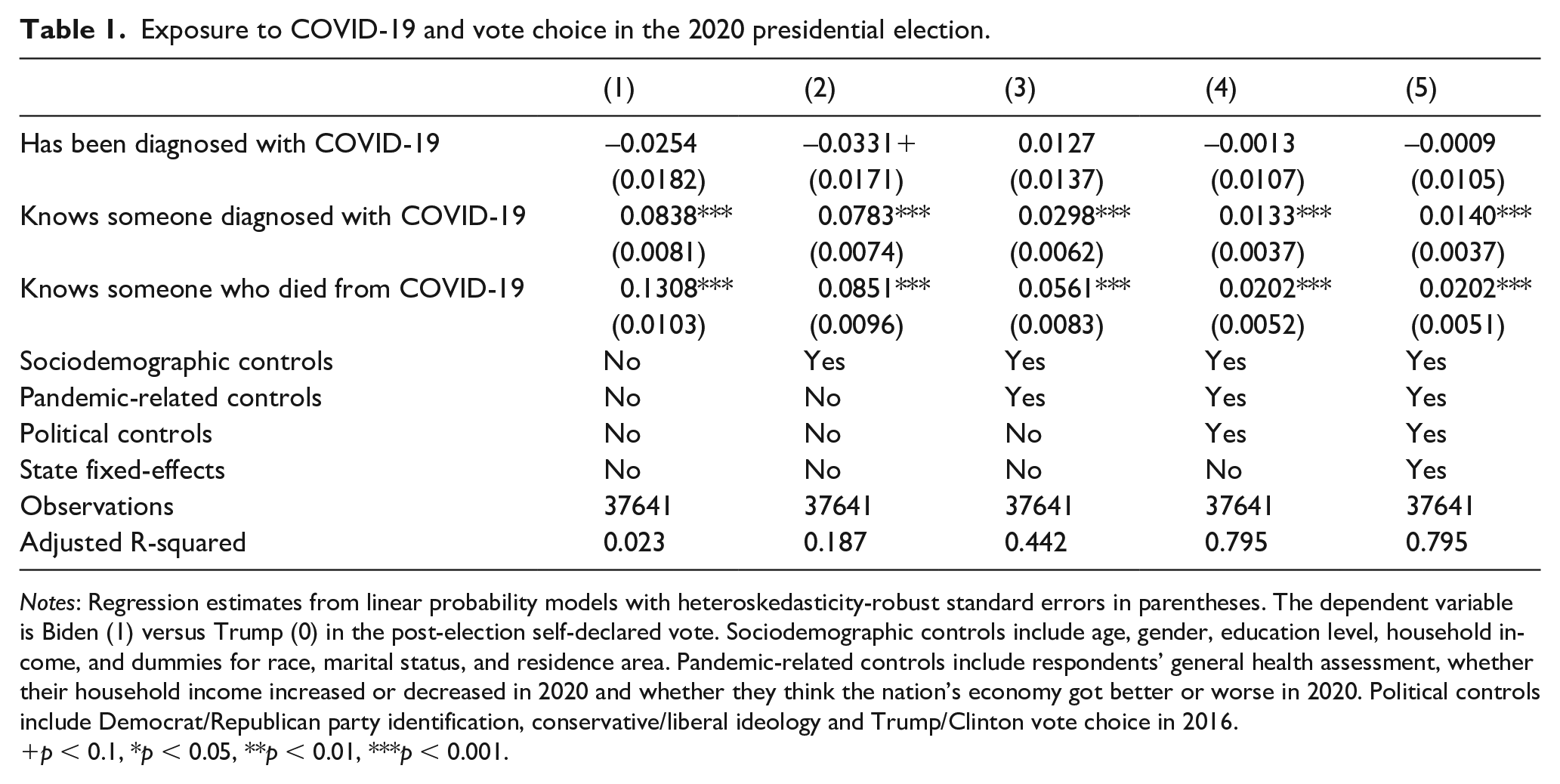
Notes: Regression estimates from linear probability models with heteroskedasticity-robust standard errors in parentheses. The dependent variable is Biden (1) versus Trump (0) in the post-election self-declared vote. Sociodemographic controls include age, gender, education level, household income, and dummies for race, marital status, and residence area. Pandemic-related controls include respondents’ general health assessment, whether their household income increased or decreased in 2020 and whether they think the nation’s economy got better or worse in 2020. Political controls include Democrat/Republican party identification, conservative/liberal ideology and Trump/Clinton vote choice in 2016.
+p < 0.1, *p < 0.05, **p < 0.01, ***p < 0.001.
Using estimates from column 5, we simulate a counterfactual scenario with no infections and no deaths by deriving the model’s predicted values when the three COVID-19 dummies are set at zero versus their population means. Trump’s predicted vote share under this no-pandemic scenario increases by only 1 percentage point. Put differently, Biden receives a slightly smaller vote share when no American is exposed to the disease.
In Appendix C, we report state-level results focusing on the four closest states in the 2020 presidential race, all won very narrowly by Biden: Georgia, Arizona, Wisconsin, and Pennsylvania.
6
Losing any three of these states would have cost Biden the election. First, we interact the COVID-19 variables with state dummies to assess if coronavirus exposure had differential effects in these four battlegrounds. None of the interaction terms is significant (
Conclusion
Following the 2020 presidential race, many pundits and academics were quick to claim that the pandemic might have altered the outcome of the election. While limited to a single instance of COVID-19’s electoral impact (i.e. self-reported exposure to the virus), our findings do not support the claim that the pandemic cost Trump his re-election. There is no doubt that COVID-19 negatively affected Trump’s electoral performance; yet our counterfactual analysis shows that the presidential two-party vote is virtually unchanged when no voter contracts the disease. 8 The null finding for those who were personally diagnosed is consistent with previous analyses having found that support for Trump increased in some of the areas that were hardest hit by COVID-19 (McMinn and Stein, 2020). Our results are also consistent with the fact that Trump’s approval ratings were remarkably stable throughout his presidency (FiveThirtyEight, 2021). In early 2020, fewer than 45% of American adults approved of Trump’s job as president. This percentage fluctuated somewhat over the year but remained in the mid-forties until January 2021. This suggests, as our results do, that the extraordinary circumstances that arose during that election year did little to change the electorate’s crystalized – and overall unfavorable – views of the 45th president.
Supplemental Material
sj-pdf-1-rap-10.1177_20531680211041505 – Supplemental material for Did exposure to COVID-19 affect vote choice in the 2020 presidential election?
Supplemental material, sj-pdf-1-rap-10.1177_20531680211041505 for Did exposure to COVID-19 affect vote choice in the 2020 presidential election? by Marco Mendoza Aviña and Semra Sevi in Research & Politics
Footnotes
Acknowledgements
We would like to thank the journal’s editors and anonymous reviewers, as well as André Blais, Vincent Arel-Bundock, and Ruth Dassonneville for their helpful comments and suggestions.
Correction (June 2025):

Declaration of conflicting interests
The authors declared no potential conflicts of interest with respect to the research, authorship and/or publication of this article.
Funding
The authors received no financial support for the research, authorship and/or publication of this article.
Supplementary materials
The supplementary files are available at http://journals.sagepub.com/doi/suppl/10.1177/20531680211041505. The replication files are found at https://dataverse.harvard.edu/dataset.xhtml?persistentId=doi%3A10.7910%2FDVN%2FVXTA6L&version=DRAFT
Notes
Carnegie Corporation of New York Grant
This publication was made possible (in part) by a grant from the Carnegie Corporation of New York. The statements made and views expressed are solely the responsibility of the author.
References
Supplementary Material
Please find the following supplemental material available below.
For Open Access articles published under a Creative Commons License, all supplemental material carries the same license as the article it is associated with.
For non-Open Access articles published, all supplemental material carries a non-exclusive license, and permission requests for re-use of supplemental material or any part of supplemental material shall be sent directly to the copyright owner as specified in the copyright notice associated with the article.
