



Abstract
This article presents version 2.0 of the Pro-Government Militias Database (PGMD). It is increasingly clear that it is untenable to assume a unified security sector, as states often rely on militias to carry out security tasks. The PGMD 2.0 provides new opportunities for studying questions such as when states rely on militias, how they chose among different types and the consequences for stability and peace. We detail how the PGMD 2.0 provides new information on the characteristics, behaviour, life cycle and organization of 504 pro-government militias across the globe between 1981 and 2014.
Introduction
It is well established that governments rely on a wide variety of actors and agencies to implement policies. What is sometimes less appreciated is how diverse their security apparatus is (De Bruin, 2021). Diversity in coercive institutions is not just found within but also outside the state’s regular security apparatus. Contrary to the expectation of a monopoly of violence, many governments create or align with armed groups on a more or less informal basis.
Using the original Pro-Government Militias Dataset (PGMD) (Carey et al., 2013), research has shown that pro-government militias are associated with greater levels of violence (Carey and González, 2021; Mitchell et al., 2014) and that governments use these forces as cheap force multipliers, for local information, deniability of violence and coup-proofing (Böhmelt and Clayton, 2018; Carey et al., 2015, 2016). Recent work on forecasting genocide and on genocidal consolidation, which finds these groups active in this type of mass violence, illustrate why pro-government militias matter beyond their counter-insurgency and coup-proofing roles (Koren, 2017; Van der Maat, 2020). Despite wide-ranging information on key group characteristics, the PGMD version 1 provides limited insights into the differences among these groups and how they are formed and terminated.
Country-specific studies (Agbiboa, 2020b; Barter, 2013; Blocq, 2014; Gutiérrez Sanín, 2019; Leenders and Giustozzi, 2019; Schubiger, 2021) offer a wealth of insights about how militias form. These groups may emerge locally in response to a security threat to civilians, either on their own accord or are set up by the government. They can improve counter-insurgency effectiveness (Peic, 2014; Agbiboa, 2020a), but they also increase the risks for civilians (Clayton and Thomson, 2016; Agbiboa, 2020a). The PGMD 2.0 provides new variables on the life cycle of these organizations, including the emergence and termination of militias, and group attributes such as recruitment and membership characteristics. It enables researchers to investigate new questions on why and under what conditions governments favour a diversified and fragmented rather than a unified security sector (e.g. Greitens, 2016) and what implications these choices have for the state, government opponents and the wider public in a global cross-temporal setting.
The revised database
The Pro-Government Militias Database version 2.0 is a fully revised, newly sourced and substantially extended version of the original database. As in the original version, it defines a pro-government militia (PGM) as ‘(1) […] pro-government or sponsored by the government (national or subnational), (2) […] not being part of the regular security forces, (3) […] armed and (4) [with] some level of organization’ (Carey et al., 2013: 250). 1 The new version differs from the previous one in substantive breadth, temporal scope and sources of information.
The PGMD 2.0 includes a wide range of new variables describing the characteristics, behaviour, life cycle and organization of 504 pro-government militias across the globe between 1981 and 2014. It expands the range of questions that can be investigated on a global scale, including questions about the formation and life cycle of groups, recruitment and treatment of militia members and the violence used by these groups.
Comparing PGMD versions 1.0 and 2.0.

The information now available on the PGM ‘Forces for the Defense of Democracy’ (FDD) in the Democratic Republic of the Congo (DRC) serves to illustrate the contributions of the PGMD 2.0 over the original version. Version 1 recorded the group as active between 1998 and 2003, consisting of foreign nationals and ethnically identified members, targeting civilians, rebels and the regular military. The new version shows that the PGM existed as a rebel group in Burundi and provides a link to the group in the UCDP Actor Dataset. The information reveals that it was armed by DRC President Kabila to support him in the Second Congo War. The new data indicate the group’s use of sexual violence and connect its members to the Hutu ethnic group in Burundi with the purpose of targeting Tutsis in Rwanda. The targeted ethnic group and those the PGM draws its members from are linked to the ethnic group classifications of the EPR Database. Version 2 also shows that the FDD ceased as a PGM because it laid down its weapons in 2003.
Next, we describe the general enhancements to the PGMD 2.0 and illustrate with the types of questions that can be examined with this new version.
Compatibility with related datasets
The PGMD 2.0 incorporates information from two prominent datasets. First, the PGM is now connected to the unique identifiers in the UCDP dataset, revealing when a PGM was coded as a rebel group in the UCDP Actor Dataset version 20.1 (Pettersson and Öberg, 2020) before or after the group was identified as a PGM. It allows researchers to explore linkages between rebel and government groups more easily. Second, it connects to the Ethnic Power Relations (EPR) Core Dataset 2019 (Vogt et al., 2015). Whenever a militia is identified as targeting an ethnic group or being recruited along ethnic lines, the PGMD 2.0 links to information from the EPR Core Dataset. The PGMD 2.0 enables scholars to investigate questions such as how ethnic membership shapes loyalty to the government, the prospects of a group achieving a formal status within the security forces and the treatment of civilians who belong to the same or a different ethnic group. 2
Data collection procedures and data structure
While the information contained in the initial release was almost exclusively drawn from news sources (Carey et al., 2013), the new version includes information from a systematic search and meta-analysis of academic research. Additionally, we searched online reports from Amnesty International and Human Rights Watch for all known PGM group names. Finally, we used Wikipedia, usually to check alternative spellings or names of the PGM but also for substantive information if it was supported by references and did not contradict other sources. 3
The PGMD 2.0 comes in the same three formats as the first version. An online relational database uses the PGM as the unit of analysis and provides the most comprehensive version of the database, including documentary evidence that informed the coding decisions. This group-level dataset can also be accessed as a static, downloadable Group Data file containing all information from the online version minus the documentary evidence. The PGMD 2.0 Country-Year Data file transforms the Group Data file into a country-year unit of analysis containing basic group characteristics to capture the time periods over which groups existed and were active. 4 Finally, we added a new online guidebook that describes the characteristics of each group in easily accessible summary texts. 5
Pro-government militias across time 6
The initial data showed a downward trend of PGMs from 2000 until the end of the coded time period in 2007 (Carey et al., 2013: 254). Figure 1 shows the number of informal, semi-official and all PGMs between 1981 and 2014.
7
The dotted line indicates the temporal difference between the PGMD 1.0 and 2.0. Carey et al. (2013: 254) suggest that the reported drop in numbers of PGM between 2000 and the end of PGMD 1.0 in 2007 could be due to lagged reporting. Figure 1 supports this assumption. PGMD 2.0 records more militias overall, and while the downward trend from 2000, driven by informal PGMs, can still be observed, it is less pronounced. After about 2010 the numbers increase again, primarily driven by the large number of PGMs operating in the Syrian civil war. Number of PGMs over time.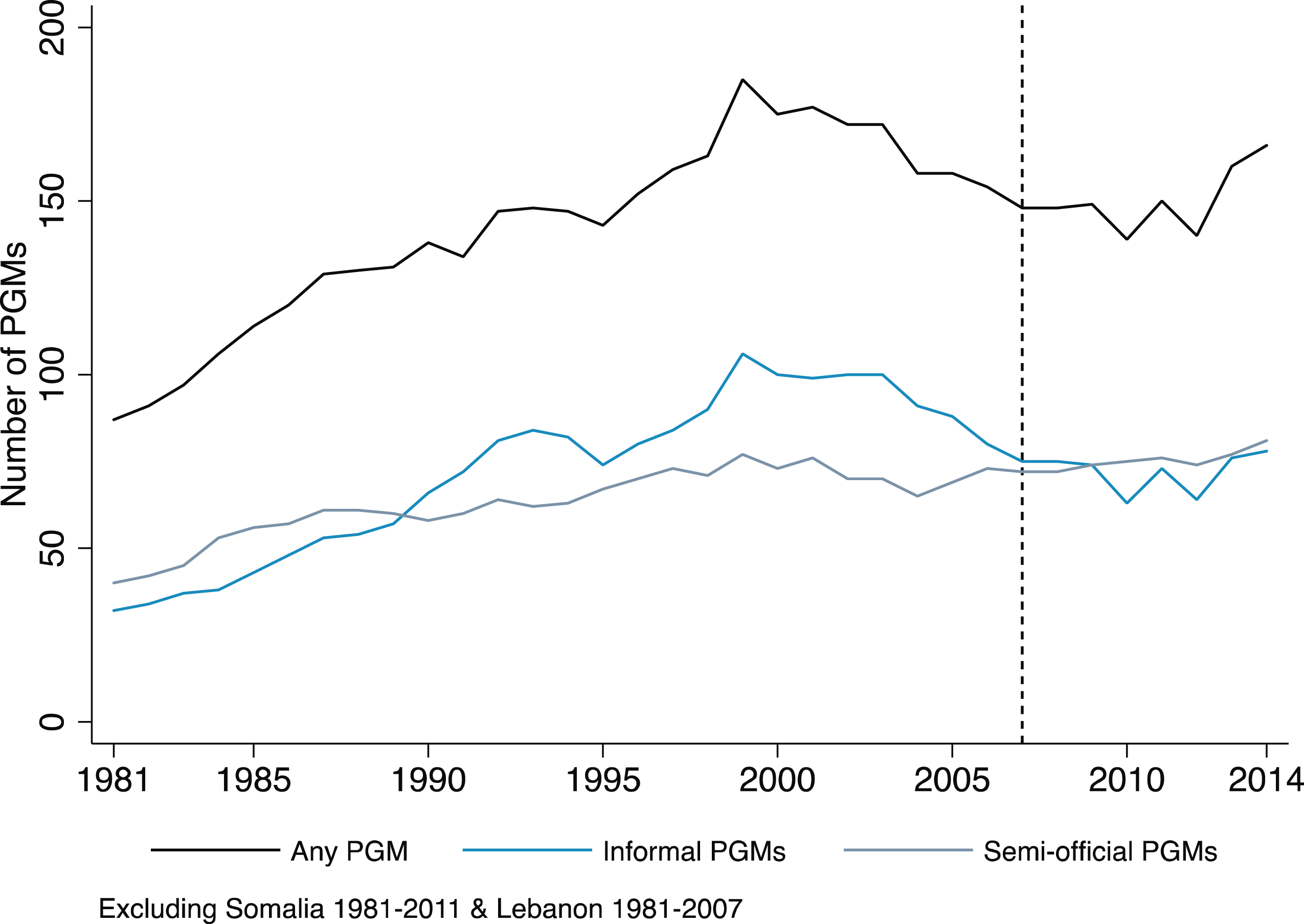
To capture the distribution of pro-government militias across countries, Figure 2 plots countries with at least one PGM, the dotted line again indicating the additional years in PGMD 2.0. Similar to the first version, between about 50 and 60 countries in any given year host at least one PGM, though again the reported drop over the last 3 years of the first version is less pronounced in version 2 and seems to have stabilized at around 50 countries. In most countries with PGMs, at least one was created by the government. The line at the bottom indicates that the number of countries with newly formed PGMs by governments remains relatively stable at around five countries in each year. Distribution of PGMs across countries and time.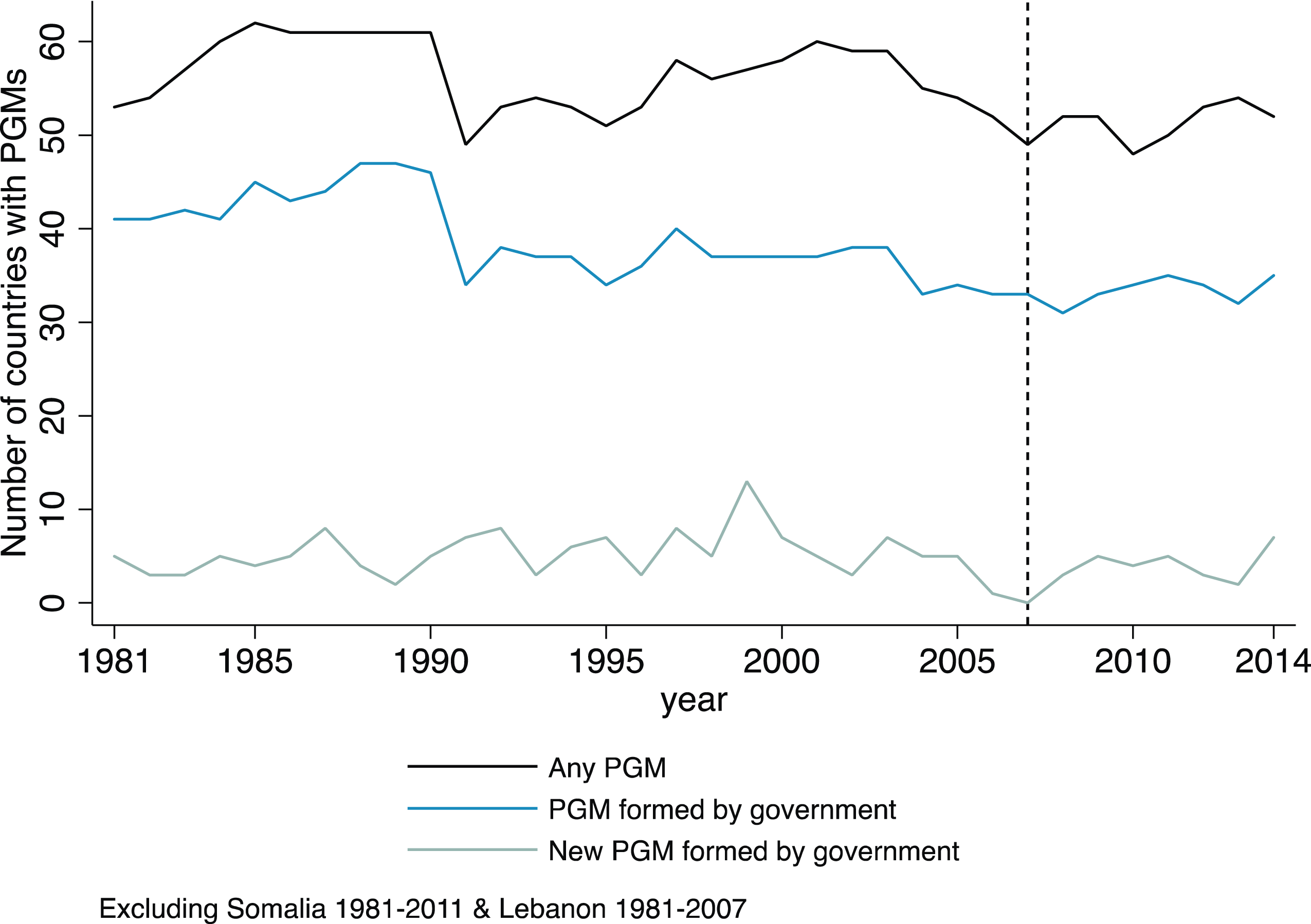
PGM characteristics and acts of violence
Research suggests that the origins of militias affect their behaviour (Jentzsch et al., 2015). Groups forming independently of the government, perhaps as self-defence forces during civil conflict (e.g. the Rondas Campesinas in Peru during the 1980s), or to protect themselves against crime (e.g. Vigilantes in Nigeria), are expected to pursue primarily defensive strategies (Clayton and Thomson, 2016; Peic, 2014; Schubiger, 2021). But governments also exploit pre-existing social cleavages to form an armed group, for example along ethnic lines (Kalyvas, 2008; Mueller, 2004).
The new data enable researchers to investigate government-driven group formation and how it shapes militia behaviour. The PGMD 2.0 identifies 209 groups (41%) as formed by a government actor (e.g. ministry, military or government official), and almost half (49%) as not initiated by the government. Formation is unclear for about 10% (49 PGMs). Of the groups formed by the government, most are traced to a particular individual within the executive (41%), as with Yemeni President Saleh’s ‘thugs', created in January 2011 to intimidate anti-government protesters. The military is the second most common initiator, constituting 23% of government-formed PGMs.
Figure 3 plots the primary membership characteristics of PGMs by whether or not the group was created by the government.8 This graph points to some unexpected patterns. While local groups are potentially better placed to solve coordination problems and form without a government lead, local PGMs are far more likely to be formed by the government (37%) than not (15%). In contrast, only about 13% of government-created PGMs are based primarily on ethnic membership, increasing to 30% for those not created by the government. We see the same imbalance for PGMs recruited on the basis of religion. These new data allow the investigation of mobilization along ethnic or religious cleavages, connecting to a tradition of research on how organizations overcome the collective action problem. Primary characteristic of PGM membership, by government formation.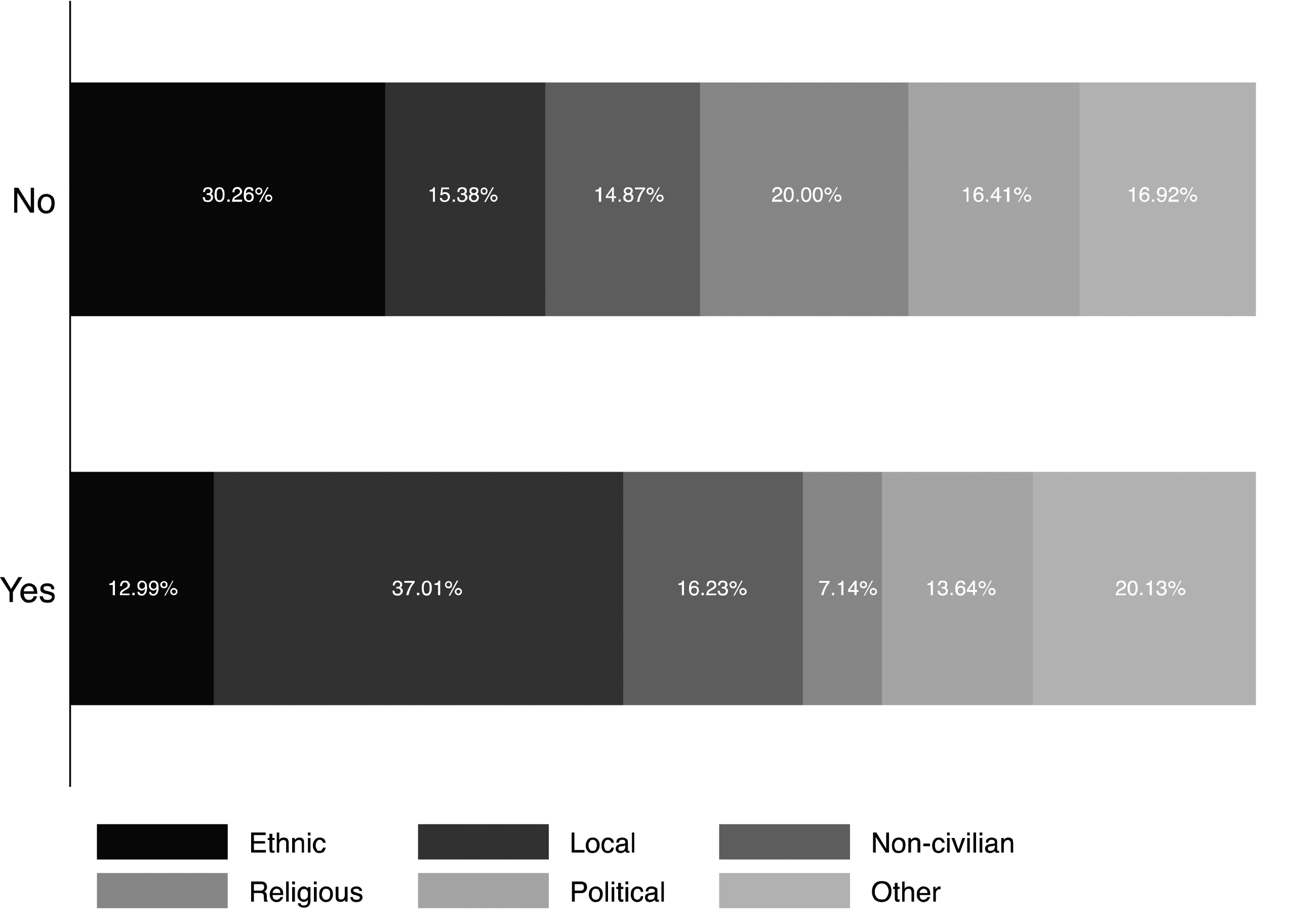
PGMD 2.0 codes different types of violence associated with a group: beating, torture, sexual violence, kidnapping and killing. For PGMs that are reported to have used violence, Figure 4 shows the three most commonly reported combinations of violence by informal and semi-official groups. Noting that all forms of violence will not be equally newsworthy, the most common form of reported violence for both types of PGMs are killings. Informal PGMs, but not semi-official ones, were reported to kidnap and torture their victims. After killings, semi-official PGMs were most frequently reported to use both killings and beatings or only beatings. Types of violence committed, three most common combinations.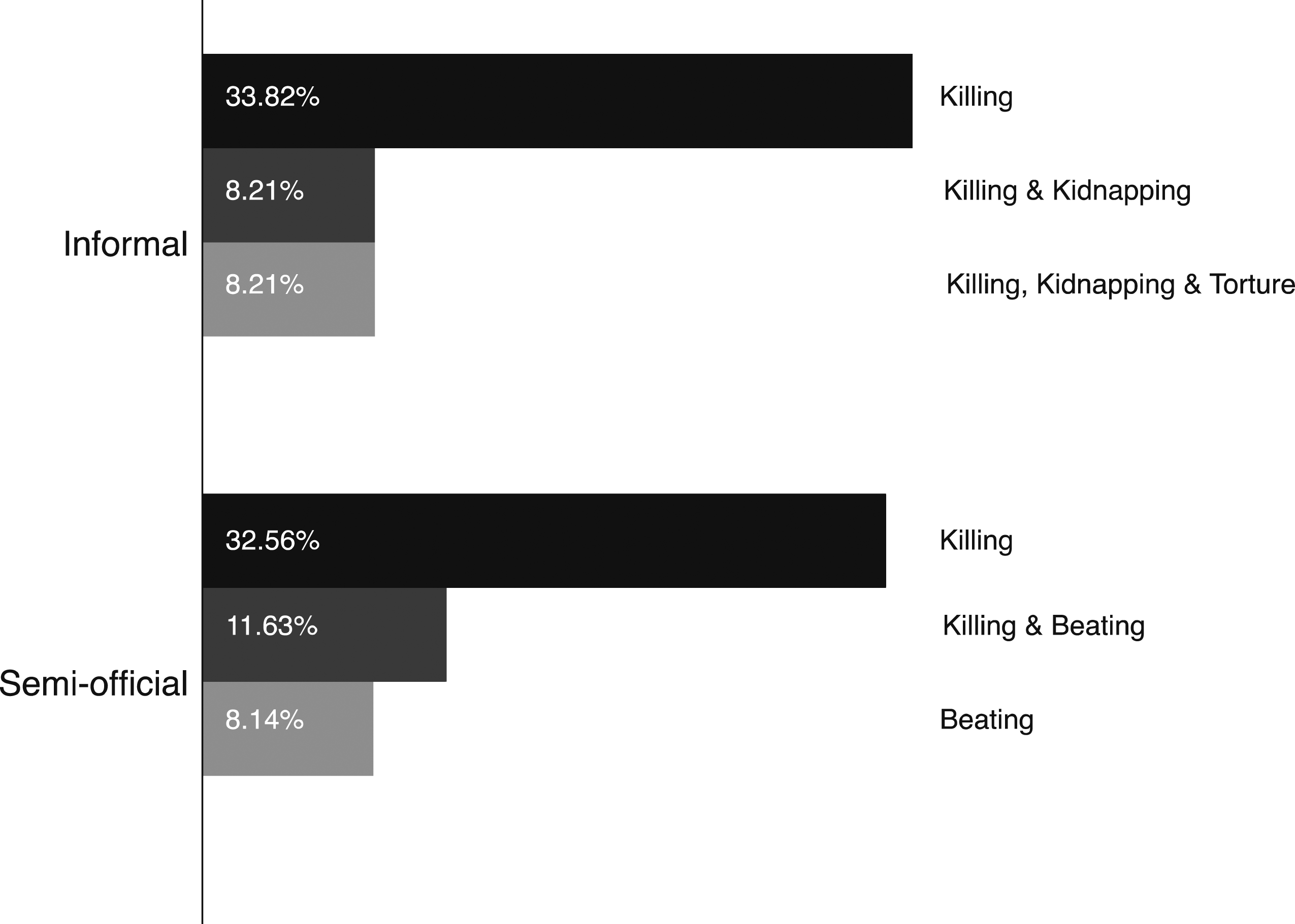
Figure 5(a)–(c) show how often PGMs were reported to use killings, beatings and sexual violence, distinguishing by whether at least some members were coerced into joining the group. The x-axis at the top indicates the share of PGMs with forced membership. Forced recruitment was reported in 12% of PGMs (59).
9
The right column shows the percentages for PGMs with coerced members, the left for those without. The y-axis represents the share of groups reported to commit that particular type of violence. The percentages within the shaded areas refer to the share of the particular category of PGM (with or without forced membership) that either was (dark grey shaded area) or was not (light grey shaded area) reported to commit that type violence at any point throughout the existence of the group. Reported violence committed by PGMs with or without forced membership.
Among PGMs reported to forcibly recruit members, the share of those that are also reported to have committed these types of violent acts is consistently higher than the share among the groups without forced recruitment. The difference is most stark for sexual violence (Figure 5(a)). About 10% of groups without forced recruitment or children among its members were reported to commit sexual violence, compared to 37% of PGMs with forced recruitment. 10
Figure 5(b) shows a similar pattern for killings. While 51% of PGMs without forced membership were never reported to use killings, this share drops to about 39% for PGMs with coerced members. Few groups appear to employ beating (Figure 5(c)), but again the share of groups that do is larger (31%) for those with forced membership than for those without (18%).
The birth and death of PGMs
Figure 6 displays the life cycle of a PGM as it is captured in the database. 36% of militias are coded as previously existing as a group before fulfilling all criteria to be coded as a PGM. Examples include Lebanese Hezbollah becoming a pro-Syrian government militia when they began fighting alongside government forces in 2011, or the Peace Brigades/Mahdi Army in Iraq. The Peace Brigades were coded as a PGM in June 2014 when they supported the government. In 2003 Muqtada al-Sadr created the Mahdi army to fight against US coalition troops and support his bid to become prime minister. When Sadr’s party, which also included Mahdi army members, joined the government in 2010 there is insufficient evidence that the group was armed at this time, therefore not fulfilling all necessary (and conservative) criteria for a PGM. In 2014 Sadr created the Mahdi army again, now named Peace Brigades. They were then armed and reported to act under government control. Pedigree of PGMs.
Consistent with these examples, over 80% of PGMs that emerged from another group, formed from previously armed groups. Only 11% of PGMs developed from an unarmed group, like the Eurasian Youth Union in Russia, which was founded already in 2005 as a youth wing of a political party and was armed in 2014. About 12% of all PGMs, or just over 41% of those that emerged from a previously armed group, began as a rebel group. 11
Figure 7 shows what happens to PGMs once they no longer fulfil all criteria, separated by type. Both types share the two most common reasons for no longer being identified as a PGM. They usually cease to exist because the government changes or cuts its ties with the militia (labelled as ‘government defected’).
12
After that, for informal militias the most common reason for termination is a border change. For example, several Indonesian pro-integration militias operated in East Timor prior to their independence referendum. Once the UN Security council established the UN Transitional Administration, these groups were no longer aligned with this administration, so no longer counted as ‘pro-government’. For semi-official PGMs, it is more common to be integrated into the regular security forces. Three most common causes of PGM termination, by government link.
Conclusion
Government collaboration with non-state actors characterizes many areas of policy-making (Donahue and Zeckhauser, 2011). The fully revised and extended Pro-Government Militias Database version 2.0, in just over 150 variables, captures the life cycles of policy collaboration in the security sector around the world. This collaboration has consequences for states and for the societies for which they have sovereign responsibility.
The descriptive findings we present indicate the types of issues that can be explored with the new database. The PGMD 2.0 is of relevance to researchers who are interested in how governments get into these collaborative relationships, who it is that they are collaborating with, what these groups do on governments’ behalf, how governments get out of these relationships, or, more broadly, in issues of collective action and organizational behaviour. There is a fascinating variety of these armed groups available to governments. Governments both in conflict and outside of conflict make use of them, and they may make use of governments.
Footnotes
Declaration of conflicting interests
The author(s) declared no potential conflicts of interest with respect to the research, authorship and/or publication of this article.
Funding
The author(s) disclosed receipt of the following financial support for the research, authorship and/or publication of this article: This article was supported by FP7 Ideas: European Research Council (grant no. 336019).
