



Abstract
Media serve as vital sources of information for conflict contexts, where civilians often confront violence threatening their safety, emotional well-being and survival. Our research explores the impact of exposure to conflict-related violence on people’s trust in different media types regarding conflict-related information and news (CRIN). We particularly investigate the factors influencing citizens’ relative trust in media within conflict settings, with a particular focus on how exposure to violence resulting from conflict conditions (i.e. involvement) and perceptions of state efficacy in security provision (i.e. blame attribution) shape trust in legacy vs social media. Based on a nationwide survey in Türkiye’s conflict zone, they discover that previous exposure to violence alone does not significantly affect media trust for seeking CRIN. Instead, the influence of exposure to violence is positively associated with trusting social media more for CRIN, conditional on the belief that the state is ineffective in providing security for its citizens. This finding suggests that the combination of exposure to violence and a perception of the state’s inadequacy in addressing an ongoing conflict may drive people to follow the developments regarding a conflict from social media. The findings offer substantial insights into how individual media choices are shaped within the larger framework of a conflict environment, utilizing original data collection from a real-world conflict setting.
Introduction
Media play a crucial role as sources of information in environments of armed conflict, where civilians often confront indiscriminate violence. In such contexts, access to timely and accurate information can be a matter of life and death in the literal sense. Citizens’ reliance on media therefore extends beyond the mere quest for news during armed conflict, transforming it into a critical instrument for navigating the multifaceted stages of conflict, from its inception to potential resolution (Kim and Jung, 2017; Lyu, 2012; Melki and Kozman, 2021).
Trust in media during conflict is not only shaped by the reliability of information sources but also by the perceived role of the state in security provision. In high-risk environments, citizens assess the credibility of media through two interrelated lenses: first, their trust in different media as sources of reliable conflict-related information (CRIN); and, second, the extent to which they blame the government for failing its social contract in providing citizen protection. These two dimensions (i.e. media trust and blame attribution), though rarely examined in tandem, are essential in understanding how citizens process conflict-related information under conditions of media control and political contestation. While media consumption is fundamentally an individual endeavour, the broader conflict environments exert a significant influence on the choices individuals make regarding where, why and how they seek information. The challenge of obtaining reliable conflict-related information and news in armed conflict zones is often exacerbated not only by misleading or false news and information but also by the strategies of states and warring factions. This is because conflict actors differ in crafting and disseminating their biased narratives to influence public perception and solidify their legitimacy, a tactic well documented in conflict research (Auerbach, 2010; Bar-Tel et al., 2014).
Historically, governments have leveraged their control over traditional media to propagate their narratives, turning them into predominantly regime media when it comes to key issues such as national security threats. Similarly, information oversight becomes more stringent during conflict as access to sensitive information often requires approval from powerful non-media actors such as the military or government due to security concerns. Consequently, the tone, completeness and timeliness of conflict-related information get heavily regulated by non-media entities.
However, this traditional dominance in conflict communication was challenged by the emergence of social media, which introduced significant competition in the news media landscape. The rise of online platforms has prompted citizens to seek information from relatively more independent and diverse sources functioning as non-regime media and offering alternative narratives outside government-controlled spaces (Wojcieszak et al., 2019). Such a transition has transformed media trust and blame dynamics as individuals now navigate a high-choice, hybrid media environment where they must assess the trustworthiness of competing narratives, particularly as unofficial accounts reporting conflict developments often face legitimacy challenges, even when offering counter evidence and alternative perspectives (Chadwick, 2017; Van Aelst et al., 2017; Zeitzoff, 2017). The extent to which individuals trust non-regime media versus regime media in such settings is thus conditioned by their level of blame attribution toward the state which is an essential but often overlooked aspect of media choice.
Although the concept of media trust continues to receive attention from scholars, the interplay between trust and blame attribution in shaping conflict-relevant media preferences remains underexplored. Drawing on Malle et al.’s (2017) blame attribution model, we conceptualize exposure to violence as a perceived norm violation or harm, which individuals evaluate along the lines of whether blame can be attributed to the agent, the government. This process involves assessing the intentionality of state-induced harm and the government’s capacity to prevent violence, shaping perceptions of state efficacy in security provision. Our research thus investigates how exposure to conflict violence and the subsequent blame attribution to the government jointly shape individuals’ relative trust in media types for CRIN. We conduct our analysis in the setting of the Türkiye–Kurdistan Workers’ Party (PKK) conflict, a context that provides a distinctive backdrop for examining how individuals navigate media trust in a politically controlled information environment. Türkiye’s prolonged conflict and the rising authoritarianism in its media landscape, where legacy media are politically and legally constrained in their critique of the state, while social media remain relatively freer, provide an ideal setting to explore how blame attribution influences trust in regime versus non-regime media.
Our findings indicate that previous exposure to violence influences relative trust in different media types conditional on perceptions of state effectiveness in tackling the conflict. Specifically, when individuals perceive the government to be ineffective in handling the conflict, they are more likely to trust non-regime media than the media that the regime openly regulates for CRIN. By integrating blame attribution and media trust within the broader framework of political communication and conflict studies, and utilizing original data collection from a real-world conflict, this study offers substantial insights into how individual media choices are shaped within the larger framework of a conflict environment. Although our research is rooted in the Türkiye–PKK conflict, these dynamics extend beyond a single case, offering insights across a wide range of political systems. Whether in authoritarian systems, hybrid systems, or polarized democracies, the interplay between media trust, blame attribution and state legitimacy affects how citizens engage with conflict-related information. By bridging gaps in the literature on political communication, political violence and conflict as well as political behaviour, this study elucidates a deeper understanding of how information is strategically contested in conflicts centred around the citizen allegiance.
Media trust and navigating conflict information environments
In today’s high-choice media environments, media trust has become a key concept for understanding how individuals meet their informational needs amid competing sources as well as increased circulation of misinformation (Van Aelst et al., 2017). As a widely researched concept in communication studies (see Strömbäck et al., 2020, for a review), trust in media inherently concerns individuals’ vulnerability to what the media offer. Specifically, it involves individuals’ imperfect assessment of the uncertainty regarding the expected benefits of topic and information selections as well as the accuracy of depictions provided by media sources (Hanitzsch et al., 2018; Kohring and Matthes, 2007; Tsfati and Cappella, 2003).
Rooted in efforts such as the exploration of credibility (Kiousis, 2001) and audiences’ perceptions about trustworthiness, fairness and accuracy (Gaziano and McGrath, 1986), the media trust scholarship suffers from the interchangeable use of adjacent concepts (e.g. distrust, credibility, confidence), disagreement over the object of trust (e.g. media types, brands, coverage) as well as the differences in operationalization (Fawzi et al., 2021). As for individual-level correlates of media trust documented by mostly cross-sectional studies, interpersonal trust (e.g. Tsfati and Ariely, 2014), trust in democratic institutions (e.g. Hanitzsch et al., 2018), political cynicism (e.g. Carr et al., 2014), ideology (e.g. Stroud and Lee, 2013; Yamamoto et al., 2016); coverage types (e.g. Hopmann et al., 2015; Molyneux and Mourão, 2019) and personal involvement (e.g. Kaskeleviciute and Matthes, 2023) are among the concepts that are found to be significantly associated with either trust in or hostile perceptions about media (see Fawzi et al., 2021). From a selective exposure perspective, there is also a line of research that demonstrates a link between low news media trust and use of non-mainstream alternatives sources (e.g., Kalogeropoulos et al., 2019; Mourão et al., 2018).
When it comes to the media coverage of armed conflicts, trust becomes a central concept for individuals in defining their relationship with state given the asymmetry of information between the parties. Historically, the dissemination of CRIN was predominantly shaped by elite-driven narratives through legacy media (Biernatzki, 2001; Nacos, 2016). However, the emergence and growth of social media have significantly altered this narrative landscape, offering more inclusive and rapid modes of information dissemination (Zeitzoff, 2017). Social media platforms, which facilitate networked communication among users through following and sharing digital content in public or semi-public spaces (Boyd and Ellison, 2007; Trottier and Fuchs, 2014), have played a particularly transformative role during crises. These platforms have broadened the array of perspectives the public can access, showcasing both pro-state and anti-establishment views and thereby enriching the media environment with a plurality of viewpoints (Gohdes, 2018; Loyle and Bestvater, 2019; Zeitzoff, 2017).
In environments where political tensions are high, a diminishing trust in legacy media and its interpretation of events is increasingly driving audiences towards these digital platforms (Fletcher and Park, 2017). Although challenges such as selective exposure and algorithmic biases on social media can result in a filtered and potentially distorted reception of information (Roberts, 2014), individuals are less likely to encounter wide ranges of critical and analytical perspectives in mainstream legacy media narratives, especially regarding pivotal events. Still, many continue to rely on legacy media as a trusted source of political information even in diverse high-choice media settings (Langer and Gruber, 2021). This trend reflects the complex interplay within the current media ecosystem, where traditional and digital media coexist, and significantly shapes audience perceptions and trust (Thorson and Wells, 2016; Van Aelst et al., 2017).
To understand the role contrasting narratives presented by official sources and regime challengers play in individuals’ experiences with CRIN, our study differentiates between regime and non-regime media in conflict settings with media types serving as the level of analysis (Strömbäck et al., 2020). Focusing on the Turkish context, where mainstream media’s conflict coverage is heavily regulated in light of the country’s antiterrorism law, we define regime media as state-aligned legacy news outlets and non-regime media as relatively more independent online platforms, particularly social media (following Wojcieszak et al.’s, 2019, approach to Iran’s state-controlled media). This is mainly because the legacy media’s coverage of non-state armed actors’ (NSAAs) activities predominantly aligns with the state’s perspective, with deviations potentially leading to punitive measures. Indeed, divergence from the state’s standpoint and/or going beyond the state’s limits of CRIN-related disclosure have previously resulted in sanctions by the Radio and Television Supreme Council as well as major lawsuits, channel shutdowns, layoffs, public defamation incidents, etc. (Freedom House, 2024).
Reopening old wounds: Exposure to conflict as a potential correlate of media trust
We argue that trust in media types for CRIN is fundamentally shaped by individuals’ experiences within a conflict, which makes personal relevance of an issue (i.e. involvement) particularly important as a correlate of media trust. In line with the hostile media effect framework, when individuals are affectively involved with an issue, their likelihood of perceiving the media as biased increases (Matthes, 2013; Matthes and Beyer, 2017). In this study, we examine how experiencing victimhood during a conflict process influences citizens’ blame attribute to the state, and how this attribution consequently impacts citizens’ relative trust in media sources that align with the state’s perspective. We thus treat the concept of exposure to violence as a proxy for high affective involvement in salient conflict settings.
On the one hand, when NSAAs commit acts of violence that harm citizens, it often triggers a ‘rally around the flag’ effect, garnering public and elite support for the government during times of crisis (Chowanietz, 2011). Terrorist attacks, a severe form of political violence, are particularly likely to generate blame toward NSAAs, regardless of the success or failure of government policies. For instance, Berrebi and Klor (2008) reveal that, in the Israeli context, when people are exposed to violence they tend to vote for right-wing parties that are known for advocating tough policies against Palestinian and Lebanese NSAAs. Similarly, studies by Toros and Birch (2019) and Kibris (2011) highlight the role of political violence in shaping voting behaviour in the context of Türkiye. Exposure to NSAAs’ violence not only mobilizes support against them but also alienates and disrupts their support base. For instance, in cases involving the IRA and Al Qaeda, NSAAs faced backlash from their constituents for employing excessive violence (Bloom, 2005; Sanchez-Cuenca, 2007). Accordingly, governments are not typically blamed for failing to prevent the ensuing violence; in fact, they are often supported for taking coercive actions against the NSAA that becomes the target of citizen blame.
On the other hand, two key dynamics may lead citizens to blame the state when they cannot avoid harm in conflicts. First, the experience of violence within a conflict context represents a breach of the social contract that traditionally binds citizens and governments. This social contract is rooted in a foundational promise made by the state: the guarantee of citizen safety in exchange for legitimacy. As conflict-related violence encroaches upon the daily lives of citizens, particularly when NSAAs employ terror tactics, the very foundations of this social contract may begin to erode. Additionally, attacks may be linked to the government’s interventionist foreign policy, leading to unwanted political consequences (Montalvo, 2011; Savun and Phillips, 2009; Valentina, 2007). Second, NSAA violence can provoke harsher government responses, including indiscriminate attacks. These responses can result in civilian casualties and erode trust in the state as a neutral entity responsible for safeguarding citizens’ rights (Carter, 2015; Kydd and Walter, 2006). These acts of violence often lead to unintended consequences, such as reduced local intelligence sharing and the empowerment of insurgents (Benmelech et al., 2015; Condra and Shapiro, 2012). This creates a cycle of violence with far-reaching implications, which we argue would also shape individuals’ media preferences when it comes to seeking news and information about the said conflict.
Blame attribution and relative trust in regime vs non-regime media for CRIN
While the literature on blame attribution in conflict zones remains the subject of ongoing debate, we can illuminate citizens’ relative trust in media types for CRIN by applying Malle et al.’s (2017) 1 cognitive model of blame to the context of Türkiye. The model involves a sequence of key stages: (1) detecting norm-violating behaviour; (2) assessing causal agency and intentionality, evaluating obligations, and (3) considering the capacity for prevention. We argue that citizens’ evaluations at each of these stages determine whether, and to what extent agents are deemed responsible for acts of violence. The first stage of the model involves the detection of norm violations, which in our context refers to citizens being exposed to acts of political violence. Individuals are generally highly attuned to recognizing norm violations in various situations (Malle et al., 2017), and this sensitivity is particularly heightened during conflicts. In such situations, norm violations can result in physical, emotional and psychological harm. Those who directly experience violence are more likely to be sensitive to and affected by violent acts compared to those who merely observe them from outside. Images and events involving violence are often prominently featured in media coverage of conflicts, albeit selectively. When individuals have personal experiences of violence in addition to exposure through the media, the resulting vividness and accessibility can significantly influence human judgment and decision-making.
In dealing with complex concepts and events like contentious political issues, individuals often resort to affective heuristics and selective recall of biased memories when forming judgments and making decisions rather than engaging in deliberate and effortful assessments (Tversky and Kahneman, 1974). Consequently, individuals may navigate information related to conflict differently depending on whether they have been exposed to violence or relied primarily on mediated accounts. Therefore, it is reasonable to assert that individuals with immediate exposure to violence are more inclined to attribute blame in conflict situations.
In the next stages of the model, blame attribution requires a deeper assessment of agency, underlying motivations and intentionality, going beyond merely assigning a negative meaning to ‘exposure to violence’. Here, a crucial question, which serves as a foundation for making blame judgments, arises: Is the state viewed as a relevant and responsible agent in negative events? When civilian deaths occur as a result of NSAA provocations, they are often portrayed as unavoidable collateral damage resulting from acts of necessary self-defence or as necessary defensive actions. Additionally, when states conduct indiscriminate attacks, it is often argued that they lack precise information about their targets (Mason and Krane, 1989). In such cases, the human cost of these attacks tends to take precedence over the reasons behind them, even if the reasons are framed as responses to rebel provocation (Pechenkina et al., 2019).
The model continues with the stages of obligation and capacity of prevention. Blame attribution entails a more sophisticated assessment when considering the preventability of violence on the state’s part. States have an obligation to prevent harm to their citizens, whether the violence originates from NSAAs or otherwise, and the failure to fulfill this obligation is undoubtedly viewed negatively. However, it is essential to recognize that mere obligation does not guarantee the state’s capacity to prevent an attack and a critical factor is whether the state could have realistically prevented the attack.
Accordingly, citizens may ask the following question: Has the state utilized all available resources and used all available resources to counter the NSAA, even if it ultimately failed in its intentions? The answer hinges on citizens’ perceptions of the state’s actions. Preventing terrorism is notoriously difficult, even for powerful governments like the USA, and it can be exceedingly challenging due to the presence of soft targets. Therefore, citizens’ judgment depends on their perception of the state’s effectiveness in implementing a counterinsurgency policy against the NSAA. A strong and effective state is less likely to face blame from its citizens. If citizens believe that the state has genuinely exerted its best efforts to fulfill its social contract obligations, they are more likely to view the NSAA as the primary perpetrator, forcing the state to adopt harsher tactics.
Establishing a theoretical link between blame attribution and relative trust in media types for CRIN, in which the former informs the latter, we posit that an individual’s exposure to a violent event during a conflict, a key factor in the attribution of blame model and a sign of high issue involvement, significantly influences their trust in regime (legacy) vs non-regime (social) media (Figure 1). That is, if individuals have experienced violence in a conflict, it impacts their trust in regime media (as compared to non-regime media) for conflict news and information in a media environment like Türkiye, where covering an armed conflict beyond what the regime approves is evidently a costly act for the legacy media.
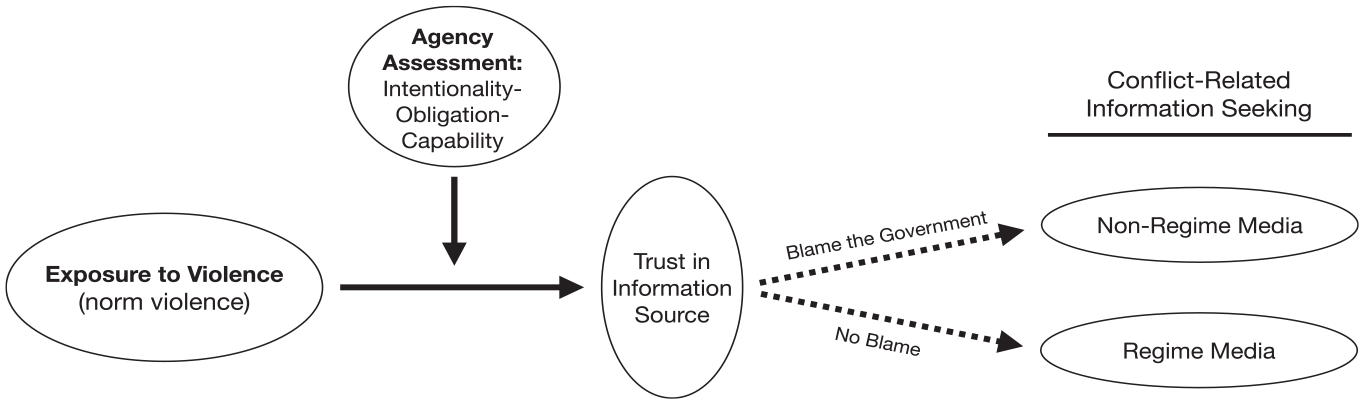
Application of the cognitive blame attribution model to CRIN.
To reiterate, according to the model of blame, exposure to violence – as a form of high involvement – leads to an assessment of the state as an intentional agent, which, in turn, reduces trust in media sources that offers a state-led representation of the conflict, particularly when those sources suppress alternative viewpoints and critical details. Moreover, because states typically hold a structural advantage through their direct involvement in conflict processes and due to legal frameworks that restrict what and how conflicts can be reported, the elbow room available to legacy news media (i.e. regime media) is significantly more constrained than that of social media. As a non-regime information space, social media hence hold greater potential for hosting alternative and critical perspectives. This leads us to the following hypothesis:
Hypothesis 1: As a catalyst for state blame attribution, exposure to violence will be significantly associated with less trust in regime media, where CRIN coverage is more likely to reflect the state’s priorities and perspective.
Next, in light of the blame attribution stages of obligation and capacity, we contend that, particularly in protracted conflicts, citizens’ assessments of the state’s performance in providing security across different phases of the conflict can either amplify or diminish the impact of exposure to violence on their relative trust in media types for covering a conflict. Put simply, depending on the circumstances that lead citizens to experience harm during a conflict, whether the state – both as the security guarantor and the regulator of regime media, is perceived as fulfilling its obligation to reestablish the social contract with its citizens may influence their trust in social (i.e. non-regime) media, being relatively freer from state oversight and less aligned with the state’s priorities and perspective.
Hypothesis 2: The relationship between an individual’s exposure to violence and which media type they trust more for CRIN will be moderated by the extent to which they think the state’s counterinsurgency efforts have been successful against the NSAAs.
Research design
Case selection
Türkiye has been engaged in a long-standing conflict with the Kurdistan Workers’ Party (PKK), a non-state armed group that claims to advocate for the rights of the Kurdish population since the 1980s. While the Turkish state achieved a significant breakthrough in countering the insurgency when it captured the PKK’s leader in 1999, the group has continued to operate. During the early stages of the conflict, the PKK’s tactics included abductions, extortion and indiscriminate killings. In response, the Turkish government pursued counterinsurgency strategies that relied heavily on military solutions. As a result, for an extended period, many citizens were exposed to the conflict. They were either targeted by the PKK through bombings, arbitrary killings, or retaliation for cooperating with the Turkish army, or they were evacuated and faced with security forces, which also resulted in various human rights violations (Pusane, 2015). Although the arrest of their leader weakened the PKK, predominantly militaristic strategies employed resulted in increased distrust in the government.
Recognizing that a military solution was no longer sufficient to address an organization that had developed complex political and economic networks and institutions, the Turkish government shifted its strategy in 2000. Under the leadership of the Justice and Development Party (AKP) government, Türkiye initiated the ‘Peace Process’ in the early 2010s. This peace initiative aimed to win the support of the Kurdish population by addressing political, social and economic aspects of the conflict. However, coercive measures have continued alongside the attractive actions. Although these actions fell short of the constituency’s expectations, both sides gradually shifted from coercive strategies toward more conciliatory approaches until the end of the peace initiative (Akcinaroglu and Tokdemir, 2020).
Over the years, Turkish governments have solidified their control over the media landscape through the acquisition of media brands by pro-government conglomerates and reported violations of and obstacles over independent journalism (Freedom House, 2024; Yeşil, 2016). This control has extended to the internet, resulting in content removals and lawsuits following online activities, particularly concerning conflict-related coverage, which has largely been avoided by mainstream media (Akdeniz and Güven, 2020). Türkiye’s press freedom ranking by Reporters Without Borders (2022) places it 153rd out of 180 countries, with 90 percent of national media under government control. Consequently, all these developments have coincided with the growing distrust among Turkish citizens toward legacy news media in recent years (Newman et al., 2023). However, despite the government’s extensive influence, the fragmented nature of the Turkish media landscape still allows access to alternative news and information on social media, which is perceived to be beyond the government’s complete control and offering space for citizens’ online political expression (Dal and Nisbet, 2022; O’Donohue et al., 2020). This unique situation, characterized by a protracted conflict background and the diversity of regime and non-regime media, has all the elements of an ideal case study for testing our hypothesis.
Data collection and sampling
We conducted a face-to-face, nationally representative public opinion survey with 1,816 adults in Türkiye administered by a national survey company Infakto. Our sample design was based on a stratified random probability sample across regions selected based on the NUTS classification covering both urban and rural settlements. In order to ensure sufficient representation of respondents with diverse ethnic and ideological backgrounds, we oversampled from cities in Eastern and Southeastern Türkiye. The final data includes 169 sampling units in our main sample of 1,350 respondents (nationally representative) and 57 sampling units in our booster sample of 466 respondents from Kurdish-majority cities (see Appendix A for sampling and implementation details). Fieldwork took place between 7 November and 29 December 2020 – a period during which pandemic-related interventions such as weekend curfews, school closures, etc. were effective. Therefore, the survey remained in the field longer than usual. The average completion time was 37 minutes, and the survey was designed to maximize the attention span of respondents.
Variable construction
We operationalized our dependent measure – Trust in Non-Regime Media – by adapting the media type distinction used in the Wojcieszak et al.’s (2019) study on religiosity and system-justifying attitudes as drivers of selective exposure in the Iranian media context. In line with our interest in citizens’ conflict-relevant experience vis-à-vis their perception of the state’s capacity, we focused on the respondent’s trust in non-regime media (i.e. social media) relative to their trust in regime media (i.e. TV and newspapers, including their online editions). We thus constructed an additive index that measures three dimensions of media trust. While there is no consensus on how to operationalize media trust (Strömbäck et al., 2020), we chose relevant dimensions for assessing media types (legacy vs social media) specifically for conflict news and information (Turcotte et al., 2015). Respondents were asked to report which media type they think is (1) the most comprehensive, (2) the most accurate, and (3) the most unbiased when it comes to CRIN. For each dimension, respondents chose one among three options: (a) social media platforms (such as Twitter, Facebook, Instagram, YouTube); (b) TV channels (including their online versions); and (c) newspapers (including their online versions). Each of these media types, then, were coded 1 if the respondent found it most comprehensive, most accurate, or most unbiased. We added the scores specifically for social media (i.e. non-regime media) grouping TV and newspaper responses as regime media being more reflective of the state’s priorities and perspective. Our ordinal-level Trust in Non-Regime Media measure ranged from 0 to 3, with higher scores indicating higher trust in the social media for CRIN. For example, if the variable takes a value of 3, it means the respondent reported non-regime media as the most accurate, comprehensive and unbiased compared to regime media alternatives. Likewise, if the value is 0, they reported placing greater trust in regime media (either TV or newspapers) across all dimensions.
Our main independent variable is Exposure to Violence, a binary measure generated based on respondents’ self-report on whether themselves, their families, friends, or relatives experienced any physical harm because of the conflict. If individuals thought they or their inner circle experienced any physical harm, we coded it as 1; otherwise, 0. This operationalization does not account for psychological harm. Given the sensitivity of the issue and potential ambiguity of violence exposure, we deliberately limited our measure to physical harm to minimize measurement errors and to strengthen conceptual validity.
Our moderator, Perceived Effectiveness of State Security Provision, 2 is also a binary measure based on respondents’ self-reported evaluation of conflict processes. We asked them whether they thought PKK’s effectiveness against the Turkish Armed Forces had decreased compared to the 1990s, when PKK activity peaked and the Turkish Armed Forces fought to prevent PKK occupation and insurrection. Since our aim is to understand whether a respondent thought the state had managed to provide security services effectively by ensuring safety entitlement of the social contract or not, we created a binary measure from the responses from a 5-point Likert scale. If the respondent said they strongly agreed or agreed to the statement that PKK effectiveness had decreased, we coded it 1, otherwise, 0. 3
Besides these variables, we first controlled for demographic indicators: gender, age, education, employment (i.e. whether unemployed and, if employed, whether the respondent is working in the public sector), urbanity and religiosity level. Second, we accounted for the frequency of TV, newspaper and social media use in receiving political news and information. Finally, we controlled for political indicators, such as respondents’ interest in politics, party choice (i.e. whether they supported the incumbent alliance or the opposition) and ethnic identity. Descriptive statistics for all variables are reported in Table 1 (see Appendix B for the correlation table, and Appendix C and D for the survey questions).
Descriptive statistics.
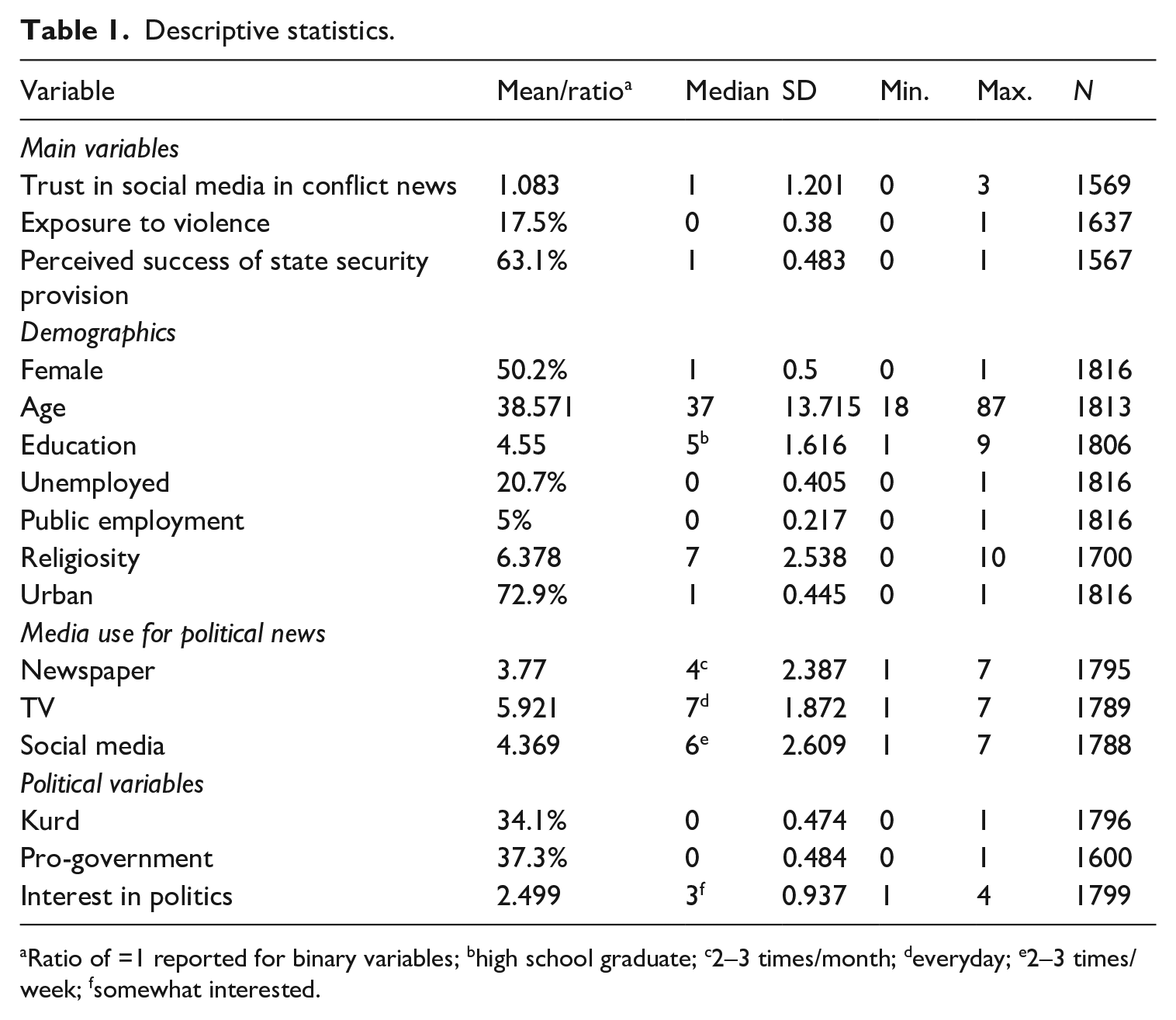
Ratio of =1 reported for binary variables; bhigh school graduate; c2–3 times/month; deveryday; e2–3 times/ week; fsomewhat interested.
Results
Although our dependent variable is an additive index, the data generation process makes it an ordinal one as a higher score indicates greater trust in non-regime media for CRIN measured across multiple dimensions of trust. Therefore, in our preliminary analysis, we estimated our models with OLS and ordered logistic regression using survey weights. We have oversampled Kurdish majority regions to ensure high power in our inferences about different ethnic groups. The findings hold across model specifications; we report the former in our main models for ease of interpretation (see online Appendix E for ordered logistic regression results).
In Models 1–4 we report the empirical tests for Hypothesis 1, which states that exposure to violence has a significant impact on individuals’ trust in non-regime media for CRIN (see Table 2). Model 1 is the naive model; Model 2 introduces demographic information about the respondents; Model 3 adds controls for the frequency of political news and information in various media outlets; and Model 4 demonstrates the full model, accounting for the effect of political variables. None of the models are statistically significant, which means that we do not find support for Hypothesis 1. In other words, exposure to violence alone does not have any significant impact on trust in non-regime media regarding conflict-related informational goals. We move on to examine and test the hypothesized interaction to see if the perceived performance of the state (i.e. regarding obligation and capacity) exhibits a moderating effect on exposure to violence.
OLS results of Hypotheses 1 and 2.
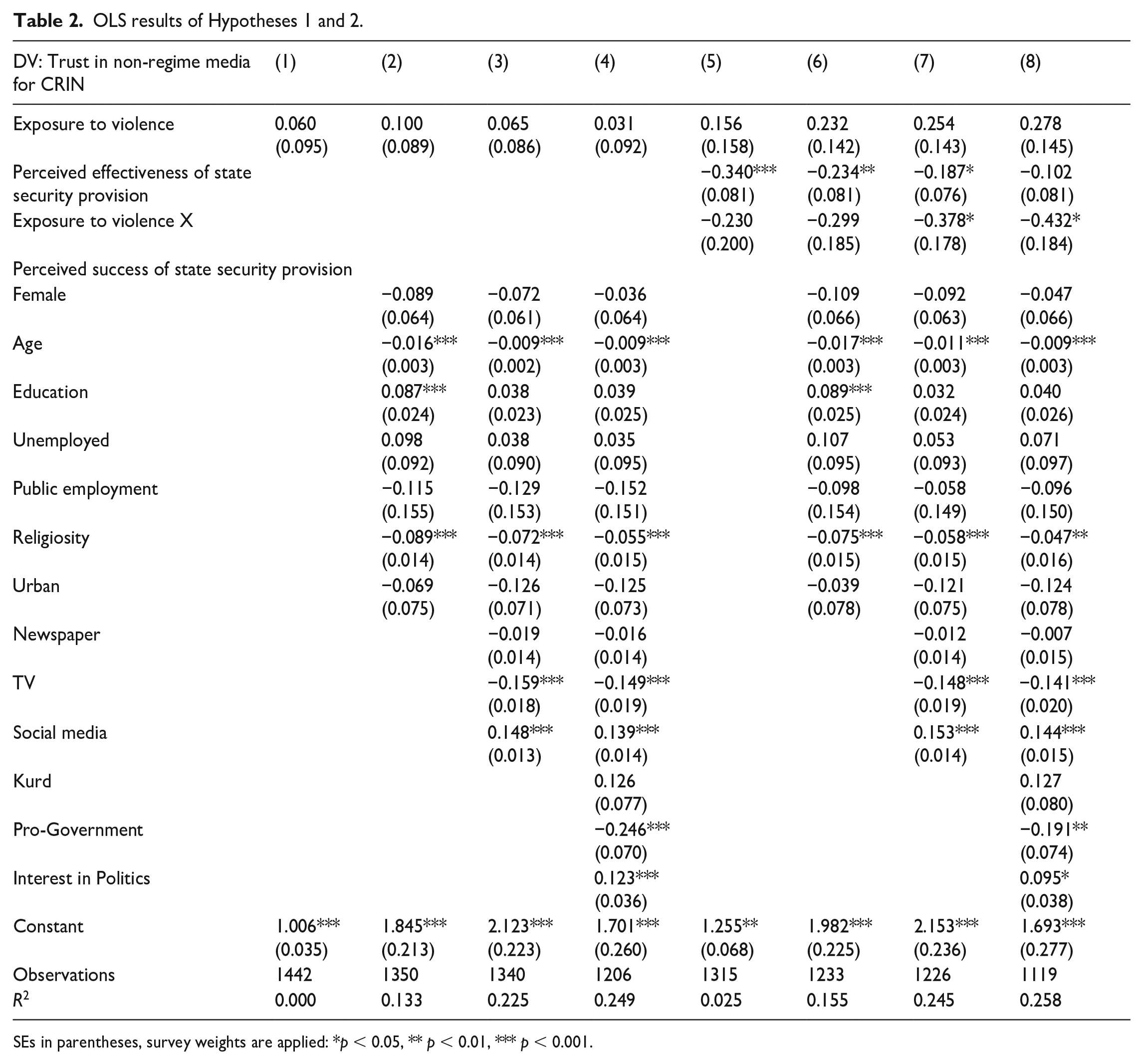
SEs in parentheses, survey weights are applied: *p < 0.05, ** p < 0.01, *** p < 0.001.
Next, we report the results for our interaction models (Models 5–8), demonstrating that the effect of exposure to violence on trust in non-regime media is conditional on individuals’ perceptions about the state’s success in security provision. In doing so, we distinguish those who believe the government has succeeded in restoring security provision via their counterinsurgency efforts from those who do not. While we report the statistical findings in Table 2, we also show the substantive results, as multiplicative interaction models are erroneous to interpretation without accounting for conditional marginal effects (Brambor et al., 2006). On the right panel of Figure 1, based on Model 8 of Table 2, and with all other covariates held at their means and medians, we report the substantive effect of exposure to violence conditional on perceived effectiveness of state security provision in predicting trust in non-regime media for CRIN.
Although some of the constitutive terms across models do not reveal significant results, the marginal effects in Figure 1 show that the perceived effectiveness of state security provision creates the difference in how exposure to violence is associated with trust in non-regime media for CRIN, which is in line with Hypothesis 2. Accordingly, while there is no difference between two hypothetical individuals with no exposure to violence regarding their trust in non-regime media, regardless of how they perceive the state’s success, exposure to violence influences trust in social media in a non-homogeneous way. While individuals who were exposed to violence during the conflict express more trust in non-regime media for CRIN if they perceive the state to be ineffective against PKK in its counterinsurgency efforts, they report lower trust in social media (i.e. placing relatively greater trust in legacy news media) if they think the state has been effective (Figure 2 – right panel).
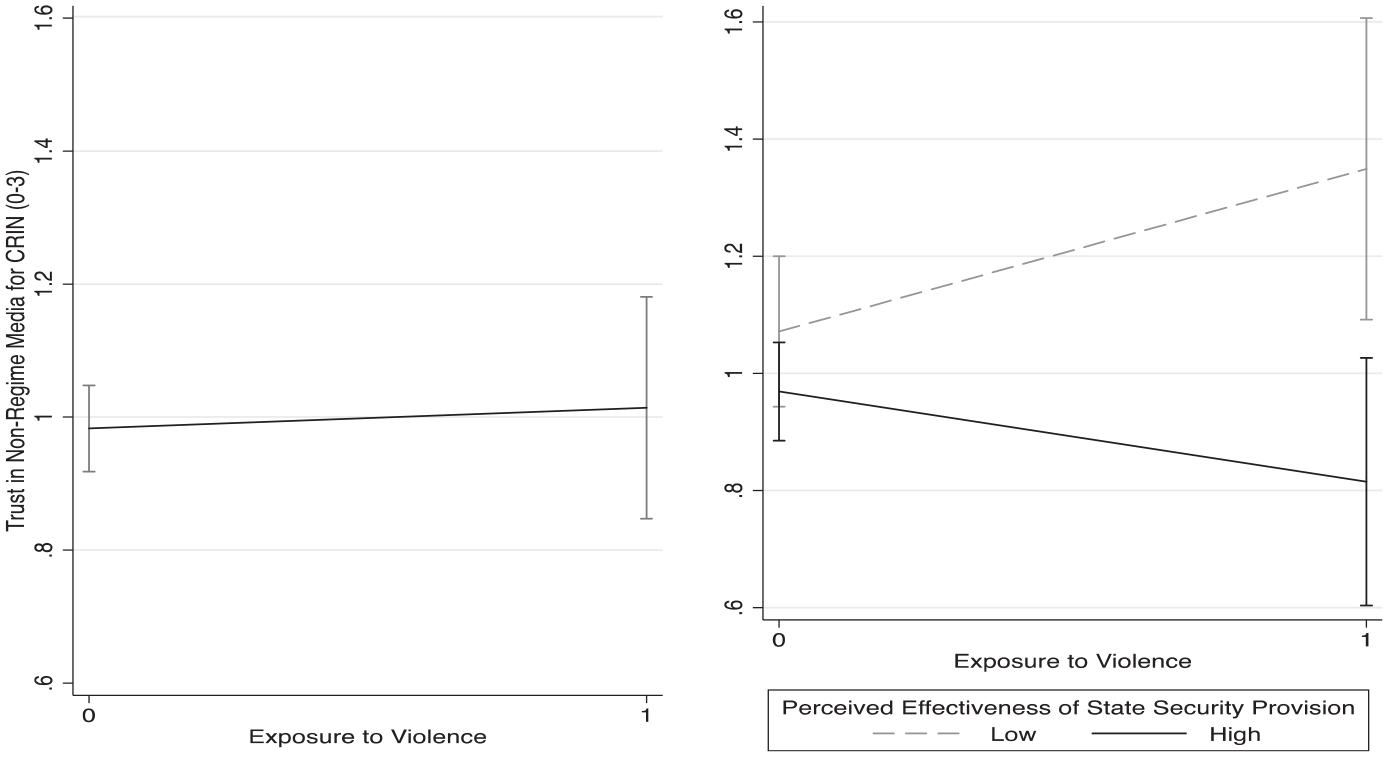
Impact of exposure to violence on trust in non-regime media for CRIN (left) conditional on perceived effectiveness of state security provision (right).
We also find that younger people, those with lower levels of religiosity, those who rely on social media for political information and those who do not support the government all report greater trust in non-regime media than in regime media for CRIN. Moreover, consistent with previous findings, those who rely on TV for their political news consumption and those who support the government exhibit lower levels of trust in non-regime media.
Discussion
Receiving reliable information on political and current affairs ensures the validity of a social contract that binds citizens to governments in exchange for security, welfare and trust. A key question is whether, at times of conflict, citizens trust the relatively more horizontal, user-driven content of non-regime media to the top-down, government-driven content of legacy news outlets? Our findings show that citizens who experience physical harm during conflict in Türkiye place greater trust in non-regime media, particularly if they believe the state fails to ensure security against PKK threats. Hence, while exposure to violence increases demands for credible information, media choice ultimately hinges on the extent to which citizens hold the state accountable for the breach of safety entitlement in the contract.
These findings have implications beyond Türkiye contributing to understanding how citizens respond to credibility in restricted information environments. While the regime vs non-regime media distinction is salient in competitive authoritarian systems, similar dynamics are evident in contexts with subtler government media control. Even in democracies, partisan polarization and ideologically segmented media ecosystem create parallel information flows that shape public trust and influence individuals’ behaviour and preferences. When access to diverse information is limited, do those relying on non-regime media become more critical of state narratives, or engage in selective scepticism, as seen in Russia, where media distrust both opposes and reinforces state propaganda (e.g. Alyukov, 2023; Szostek, 2018)? In polarized democracies, does distrust in mainstream media push citizens toward alternative, potentially conspiratorial sources, influencing their views on conflict and security policies? These questions underscore the relevance of our findings across socio-political contexts. Although our empirical analysis is grounded in Türkiye, the theoretical framework we develop, linking exposure to violence, blame attribution and relative media trust, can be applied to other conflict-affected or information-restricted settings. By identifying mechanisms that are not context-specific but rooted in broader perceptions of state legitimacy and media credibility, our study offers a foundation for cross-national research in conflict studies (Tokdemir et al., 2025).
Conflict environments amplify the need for reliable news as access to accurate news can be a matter of survival for exposed populations. At the same time, conflict enables governments to consolidate media control while minimizing the tools for citizen dissent and dissatisfaction, thus restricting individual freedom and political accountability. We show that citizens’ conflict experience may influence media preferences for CRIN, conditional on their assessments about the government. Therefore, when government narratives dominate the legacy media, trust in alternative media signals a decline in public confidence in state institutions. This underscores the need to better understand when citizens can and do choose alternative sources of receiving information in such settings. Nonetheless, while social media may offer a more diverse flow of information, this may come at the expense of information overload and possibly contamination via misinformation, polarization and provocation, all of which may increase uncertainty and anxiety in such settings (Walsh, 2020). Likewise, in politicized contexts like Türkiye, the consequences of such an implication may be exacerbated via government interference in the political communication processes.
The findings also reveal insights into citizens’ political learning in environments where legacy news media and social media coexist (Klinger and Svenson, 2015). Controversial topics – where legacy news media still benefit from institutional advantages, deserves further attention in light of citizens’ attitudes toward the definitional powers that differ across media logics (Chadwick, 2017). Perceived misinformation exposure among social media users decreases media trust, especially among those with low political knowledge (Stubenvoll et al., 2021). Likewise, the conditions under which citizens value alternative voices over mainstream ones, especially in conflict contexts, should also be studied. We suggest that network media logic may be more effective when the conflict management performance of the definitional powers behind legacy media undermines their legitimacy, prompting citizens to seek, if not fully replace them, alternative spaces for content creation and dissemination.
This study is not without limitations. We acknowledge that our dependent variable measures the relative trust placed in different media rather than informing us about assessments of specific dimensions of trust. It also does not allow for more fine-grained assessment of trust across distinct platforms and channels more so than others in a single media logic, which future studies may test in a more detailed investigation. Next, we acknowledge that our independent and moderating variables refer to exposure to violence in the 1990s, and we expect respondents to reach a judgment comparing the 1990s to our time, respectively. This may raise questions about the salience of these items for younger respondents, a variable we control in our models, and thus recommend interpretation of our results accordingly. However, we think that our inclusion of the inner circle’s experience in the exposure question addresses the issue of salience.
All in all, we believe our findings shed light on an understudied yet timely topic of pivotal importance. Our work implies that citizens’ sense of grievance over an armed conflict may shape their trust in social media, where government influence is relatively limited, conditional on how effective they perceive the state to be in countering NSAAs. Hence, citizens may choose to access government-sanctioned legacy news media for CRIN partly because they believe government has earned their trust by protecting them from violence and fulfilling the terms of the social contract.
Supplemental Material
sj-docx-1-mwc-10.1177_17506352251350330 – Supplemental material for The role of exposure to violence in citizens’ relative trust in media types for conflict-related information and news
Supplemental material, sj-docx-1-mwc-10.1177_17506352251350330 for The role of exposure to violence in citizens’ relative trust in media types for conflict-related information and news by Aysenur Dal, Seden Akcinaroglu and Efe Tokdemir in Media, War & Conflict
Footnotes
Acknowledgements
We thank the participants of the panels at the 2022 ICA Annual Meeting and 2023 ISA Annual Meeting as well as the editors and anonymous reviewers of Media, War & Conflict for their contributions and helpful comments. Aysenur Dal acknowledges the support of TÜBA-GEBIP Award and TÜBITAK International Postdoctoral Research Fellowship Program, and Efe Tokdemir acknowledges the support of TÜBITAK Incentive Award. All errors are our own.
Funding
The author(s) received no financial support for the research, authorship, and/or publication of this article.

Data availability statement
Supplemental material
Supplemental material for this article is available online.
Notes
Author biographices
References
Supplementary Material
Please find the following supplemental material available below.
For Open Access articles published under a Creative Commons License, all supplemental material carries the same license as the article it is associated with.
For non-Open Access articles published, all supplemental material carries a non-exclusive license, and permission requests for re-use of supplemental material or any part of supplemental material shall be sent directly to the copyright owner as specified in the copyright notice associated with the article.
