




Abstract
This article examines the impact of terrorism on voting behavior in the United States. We rely on an exhaustive list of terror attacks over the period 1970–2016 and exploit the inherent randomness of the success or failure of terror attacks to identify the political impacts of terrorism. We first confirm that the success of terror attacks is plausibly random by showing that it is orthogonal to potential confounders. We then show that on average successful attacks have no effect on presidential and non-presidential elections. As a benchmark, we also rely on a more naïve identification strategy using all the counties not targeted by terrorists as a comparison group. We show that using this naïve identification strategy leads to strikingly different results overestimating the effect of terror attacks on voting behavior. Overall, our results indicate that terrorism has less of an influence on voters than is usually thought.
Introduction
The political economy literature on electoral accountability provides a theoretical framework for investigating the effect of terrorism on electoral outcomes (Barro, 1973; Ferejohn, 1986). Voters often find it hard to determine the level of public goods provided by the government. For instance, voters have no complete information on the counterterrorism activities of their government. However, they do observe terror attacks. Therefore, voters use the amount of terrorism that they face as a signal to assess the competence of the incumbent. If the electorate believes that the level of terror under the current government is too high (relative to the expected level of terror under a different government), the incumbent government is more likely to lose votes, and eventually office.
While the theoretical framework linking terrorism to voting behavior is relatively straightforward, empirical results are contradictory. There are two broad sources of disagreement in the current literature. First, there is evidence that incumbents lose electoral support following attacks and casualties (Gassebner et al., 2008; Gelpi et al., 2006; Karol and Miguel, 2007). However, Berrebi and Klor (2008) and Koch and Tkach (2012) find that in Israel incumbents are not punished for suicide attacks. Second, while there is some evidence that right-wing parties increase their vote shares after terrorist events (Abramson et al., 2007; Berrebi and Klor, 2008; Kibris, 2011; Koch and Tkach, 2012), other studies show that terrorism may also shift the entire political spectrum to the left, as was the case of the 2004 train bombings in Madrid (Bali, 2007; Gould and Klor, 2010; Montalvo, 2011).
These conflicting findings are possibly a product of the difficulties in assessing the effect of terrorism on electoral outcomes due to selection bias. Indeed, terrorist attacks are not random, but rather terrorists are likely to choose the targets and the timing of their attacks strategically. In particular, they target populations that are more likely to respond in the desired manner, either by voting for right-wing parties (if the terrorists’ goal is to ‘spoil’ talks or facilitate recruitment) or for left-wing parties (if the goal is to extract concessions). In short, there is a concrete risk of overestimating the impact of terrorism on voting behavior.
We address these challenges by relying on an identification strategy that allows us to recreate a quasi-experiment. Brodeur (2018) examines the economic consequences of terrorist attacks by exploiting the inherent randomness of the success or failure of attacks, finding that successful attacks are followed by a marked reduction in earnings and job loss in targeted counties, compared to counties where attacks failed. Following the same empirical strategy, we use an exhaustive list of terror attacks in the U.S. from 1970 to 2016 and directly compare the political consequences of successful terror attacks with those of failed attacks. The definition of a successful/failed attack depends on the type of attack. For instance, an assassination is considered successful if the target is killed, while an explosion is considered successful if the explosive device detonates. The identification assumption is that, conditional on being a location targeted by a terror attack, the success or failure of the attack is plausibly exogenous. We confirm this assumption by showing that potential confounders are orthogonal to our treatment, i.e., successful vs failed attacks. This setting is attractive since successful terror attacks are more salient than failed attacks. On average, successful attacks receive more national media coverage and lead to more casualties, results that our empirical analyses validate.
We benchmark the results of our novel identification strategy with the results of a more naïve approach which compares counties in which terrorist attacks take place with those in which they do not. Using two-way fixed effects, these traditional difference-in-differences show that terrorism increases the vote for the Republican party in US presidential elections. On the contrary, when we rely on our identification strategy, which recreates a natural experiment comparing successful attacks with failed ones, we find no effect of terrorism on presidential elections. The null effect persists even when we explore the effect of terrorist attacks by motives and when we account for incumbency. The key contribution of this article is to show that there is very limited evidence of a causal effect of terrorism on voting behavior in the U.S.
Data
Our data on terrorist attacks come from the Global Terrorism Database (GTD), which records several descriptive variables for incidents, including measures of casualties and material damage caused, the identity and affiliations of perpetrators, and crucially, an indicator of whether an attempted attack was successful or unsuccessful (National Consortium for the Study of Terrorism and Responses to Terrorism (START), 2019). 1 We restrict our use of the GTD to attacks in the U.S. for the periods covered by our data on voting, which varies depending on the election type. Our full sample covers attacks which took place in the U.S. between and including 1970 and 2016. Additionally, we manually code a broad categorization of attack motives from the descriptions provided in the GTD. 2 It should be noted that the vast majority of the attacks in our sample are domestic. 3
We map the distribution of successful and failed attacks across the U.S. mainland in Figure 1. Counties which experience a large number of attacks are concentrated along the east and west coasts and tend to contain large cities. In Figure 2, we plot the distribution of successful and failed attacks over time. The number of both types of attacks has experienced a precipitous decline since the political violence of the early 1970s, although recent years have seen the annual numbers of attacks again rise to the levels of later in that decade. These figures provide suggestive evidence that the location and timing of terror attacks is not random. Table A1 in Online Appendix A includes descriptive statistics for the dataset, which comprises a total of 2639 attacks, disaggregated by attack type, target, weapon and logistics. In Table A2, we summarize our added motives and sub-motives. 4

The Geography of Terrorist Attacks – County Level.

Successful and Failed Attacks Over Time.
Our data on elections are sourced from David Leip’s Election Atlas (Leip, 2019). The vote totals which we use to merge with GTD terrorist incidents are at the county level. The vote counts are disaggregated into three categories: votes for the Republican candidate, votes for the Democratic candidate and votes for any other candidates in an election. County-level vote data are available for presidential elections from 1972 to 2016, while data on elections to the House of Representatives and the Senate begin in 1994 and end in 2016. We also collect data on potential confounding variables, which we describe in the Online Appendix.
Identification Strategy
As a benchmark, we begin by estimating a standard identification strategy at the county-election year level, which includes the full sample of observed units for presidential elections – i.e., over 30,000 observations – and two-way fixed effects. More formally, our model specification takes the following form:

where
Despite our attempt to control for confounding variables by isolating the causal effect of terrorist attacks at the election-year level, concerns about a potential omission of time varying confounders remain. We therefore rely on a sharper identification strategy, estimating the difference between voting in counties where successful attacks took place and counties where attacks were attempted but failed. More formally, we estimate the following model specification:

where
Table A3 in Online Appendix A assesses whether local area characteristics (e.g., violent crime, unemployment) together predict the success of a terror attack. Overall, we find that none of the 13 variables included in our analysis are statistically significant at the 5% level and that the variables do not jointly predict the success of terrorist attacks, reinforcing the validity of our quasi-experiment.
We further consider the possibility that comparing successful to failed attacks may over-correct for the selection bias inherent in the naïve approach. The concern in this case is that even failed attacks are likely to receive media coverage and may have caused casualties. 7 Table A4 in Online Appendix A assesses the effect of successful attacks on news coverage using a new dataset covering all of the attacks in our sample. 8 In Panel A, looking at pooled coverage we show that successful attacks in our dataset are associated with .27 more news stories (about 21% above the average number of stories for failed attacks, 1.26), and in Panel B that they receive 470 seconds longer coverage, an increase of more than double the average for unsuccessful attacks of 219 seconds. Both of these estimates are statistically significant at p < 0.05 using cluster-robust standard errors, and they are robust to the inclusion of attack-level controls and multi-dimensional fixed effects. 9
Results
Naïve analysis
Table 1 reports the findings from equation 1. The first column includes all county-election years and all attacks from 1972 to 2016, while the subsequent columns restrict the sample to counties where successful attacks took place within smaller windows before the election. 10 When considering all attacks, we find that each successful terrorist attack in a county is associated with an increase in the Republican two-party vote share of about half a percent.
Effect of Terrorist Attacks on the Republican Two-Party Vote Share in Presidential Elections, Naïve Analysis.
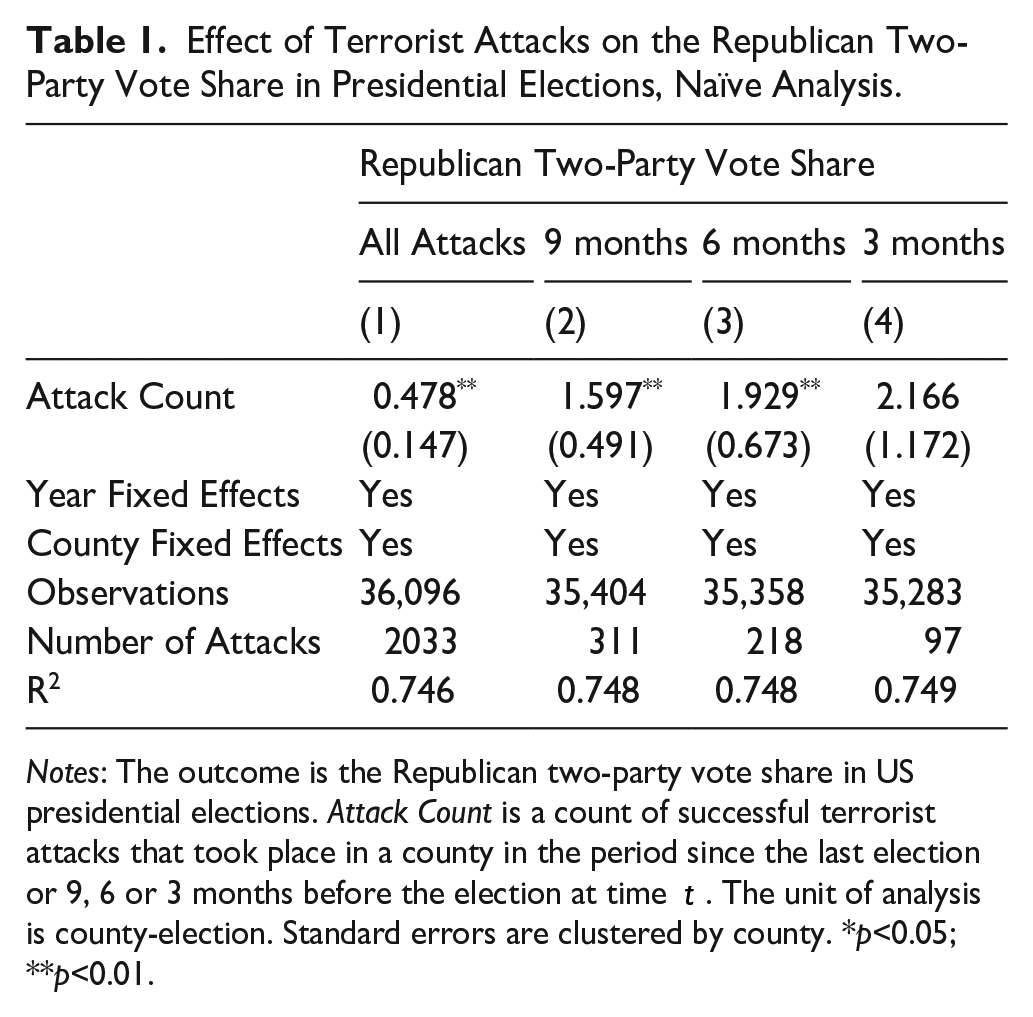
Notes: The outcome is the Republican two-party vote share in US presidential elections. Attack Count is a count of successful terrorist attacks that took place in a county in the period since the last election or 9, 6 or 3 months before the election at time t. The unit of analysis is county-election. Standard errors are clustered by county. *p<0.05; **p<0.01.
Notably, attacks that occur in smaller windows before the election consistently appear to have a more pronounced effect in our data. Individual attacks within nine months of voting are associated with a considerable increase in the Republican vote share of 1.6%. Restricting the sample to six months yields an increase of over 1.9%, while within a three-month window we estimate a 2.2% increase in the Republican vote share per attack. The latter estimate lacks precision, being statistically significant only at the 10% level, though it’s likely this is because the sample in that window falls to just 97 attacks, and the continued increase in the effect size as elections grow nearer to attacks is noteworthy.
To corroborate our findings, we perform a set of robustness checks. While we leave many of the details in Online Appendix B, here we summarize a few interesting results. First, we find some support for variation in the effect identified in Table 1 depending on incumbency. In particular, terrorism increases the vote for the Republican party almost exclusively when the president is Republican (Tables B5 and B6). Moreover, we find evidence that effect heterogeneity plays a role in this analysis. Most notably, when disaggregating by motive it turns out that only hate and political attacks are significantly related to increases in Republican votes for the presidency (Table B7). In addition, as the number of fatalities increases, terrorist attacks are less likely to electorally favor the Republicans than the Democrats (Table B8). Furthermore, our results indicate that the Republicans benefited from terrorism before 9/11 (Table B9) whereas they did not after 2001 (Table B10).
Success vs. failed attacks
Table 2 reports the results for the model specification in equation 2. Remember that in this analysis the counterfactual is no longer the absence of a successful attack but instead the failure of an attempted attack. We find that the positive association between terrorist attacks and the Republican vote share no longer holds in this specification. In no model do we estimate a significant effect of a successful attack on the Republican two-party vote share. In each model, the size of the coefficient is a small fraction of that estimated for the same window in Table 1. Even more, the sign of the coefficient switches between positive and negative depending on the window.
Effect of Successful vs. Failed Terrorist Attacks on the Republican Two-Party Vote Share in Presidential Elections.

Notes: The outcome is the Republican two-party vote share in US presidential elections. Success is a binary indicator of whether the attempted attack is successful or unsuccessful. The unit of analysis is the attempted attack. Standard errors are clustered by county. *p<0.05; **p<0.01.
Given the smaller sample sizes reported in Table 2, we calculate the statistical power of these specifications in order to benchmark their ability to capture an effect comparable in size to those identified in the naïve analysis. We find that the full model in Column 1 and the model with the smallest window in Column 4 are more than powerful enough from a statistical standpoint to identify extant effects in the overwhelming majority of cases, both with powers of 94%. 11
We further explore effect heterogeneity across motives to check whether a subset of terrorist attacks affect electoral behavior, though we remain cognizant of the caveat that smaller sample sizes are correlated with lower statistical power. In Table 3 we subset our sample for the nine sub-motives for which we have more than 100 observations. 12 We estimate the effect of successful attacks on the Republican vote share in presidential elections both with and without an interaction between success and the party of the incumbent president. The findings from this test strongly confirm our initial null result. Of 18 models and 25 unique estimates, we identify two significant relationships. In Model 4 there is a significant negative relationship between successful anti-abortion attacks and the Republican vote share, only when a Democrat is incumbent. The estimate when a Republican is incumbent is insignificant when examining a marginal effects plot (omitted for space). In Model 7, without including incumbency, there is a negative relationship between successful attacks by Puerto Rican independence militants and the Republican vote share.
Effect of Successful vs. Failed Terrorist Attacks on the Republican Two-Party Vote Share in Presidential Elections by Sub-motive.

Notes: This table reports the results for the model specification in Equation 2, alternatively also including an interaction with the party of the incumbent president, estimated separately for the nine most common attack sub-motives. The outcome is the Republican two-party vote share in US presidential elections. Success is a binary indicator of whether the attempted attack is successful or unsuccessful. Rep. Incumbent is a dummy variable for if the incumbent president is a Republican, and is only included in interaction with Success. The unit of analysis is the attempted attack. All models include county and year fixed effects. Standard errors are clustered by county. Model 16 is identical to Model 15, as no attacks in that sample took place during a Republican presidency. *p<0.05; **;p<0.01.
While these results could suggest that a small subset of terrorist attacks in the United States may result in political effects, in both cases the effects identified are in the opposite direction of our results from Table 1, and we cannot rule out the likelihood that they are the result of sampling error. In sum, there is no reliable evidence that effect heterogeneity affects our null results.
Similarly to the naïve analysis, we perform a series of tests which confirm the main findings, in Online Appendix C. First, our results are similar if we include state-election fixed effect (Table C1) and if we include third party votes (Table C2). Furthermore, the results do not change if we estimate models with Democrat presidents and Republican presidents separately, indicating that incumbency plays no role here (Table C3). Moreover, the results do not change if we leverage the intensity of terrorist attacks by looking at the number of fatalities (Table C4). Finally, our estimates are the same if we split the sample pre- and post-9/11 (Tables C5 and C6).
All in all, once we rely on the correct counterfactual we find that the naïve analysis largely overestimates the effect of terrorism on elections and that on average US voters do not respond to terrorist attacks.
Conclusion
This article has implemented a novel identification strategy to explore the electoral consequences of terrorism. Specifically, we have recreated a quasi-experiment by comparing the effects of successful terror attacks with those of failed attacks due to idiosyncratic reasons in US elections over more than four decades. By relying on this sharp research design, which allows us to build a credible counterfactual, we find no evidence that terrorism affects voting behavior in the U.S. Neither the Republicans nor the Democrats seem to gain electorally from terrorist attacks, regardless of the party of the incumbent president or the type of terrorist attacks.
Our findings have important implications. First, if terrorists do not act spontaneously in their targeting, but strategically, then empirical studies which fail to account for this non-randomness are fraught and estimates are likely to be flawed. Accordingly, we show that the occurrence of attacks is indeed correlated with confounding characteristics, when comparing a conventional identification strategy with our quasi-experiment. Second, our findings provide evidence that on average domestic terror attacks do not decide elections. Of course, it may be that the results would be different for other Western democracies with different electoral and party systems or large transnational attacks such as September 11, 2001. Third, assuming that terrorists aim to affect political outcomes in targeted countries, we show that terrorism is ineffective, a result in line with Abrahms (2006). To conclude, our results indicate that terrorism has less of an influence on voters than is usually thought.
Supplemental Material
sj-pdf-1-rap-10.1177_2053168020987333 – Supplemental material for Terrorism and Voting Behavior: Evidence from the United States
Supplemental material, sj-pdf-1-rap-10.1177_2053168020987333 for Terrorism and Voting Behavior: Evidence from the United States by Leonardo Baccini, Abel Brodeur, Sean Nossek and Eran Shor in Research & Politics
Footnotes
Declaration of conflicting interests
The author(s) declared no potential conflicts of interest with respect to the research, authorship, and/or publication of this article.
Funding
The author(s) received no financial support for the research, authorship, and/or publication of this article.

Supplemental materials
Notes
Carnegie Corporation of New York Grant
This publication was made possible (in part) by a grant from the Carnegie Corporation of New York. The statements made and views expressed are solely the responsibility of the author.
References
Supplementary Material
Please find the following supplemental material available below.
For Open Access articles published under a Creative Commons License, all supplemental material carries the same license as the article it is associated with.
For non-Open Access articles published, all supplemental material carries a non-exclusive license, and permission requests for re-use of supplemental material or any part of supplemental material shall be sent directly to the copyright owner as specified in the copyright notice associated with the article.
