




Abstract
Recent protests on university campuses have inspired conservative claims that liberals allow partisanship to color their judgement of disorderly activists. Prior research suggests, however, that both ideologies are prone to political bias. Furthermore, because conservatives are typically more concerned with orderliness and authority, there are theoretical reasons to expect conservatives to respond more forcefully to protests than liberals, especially when those protesters are political opponents. Using an experimental design with two samples, one with Mechanical Turk participants and the other with current college students, the study finds support for the hypotheses that (1) conservatives are more punitive towards protesters than liberals, (2) both ideologies are more likely to punish when protesters are their political opponents, and (3) conservatives’ responses to protesters are more sensitive to their ideology than liberals’. These results support recent studies of the psychology of political ideology and punitiveness.
The political divide in America has been characterized as growing in size (Hare and Poole, 2014), intensity (Webster and Abramowitz, 2017), and incivility (Sobieraj and Berry, 2011). Protests on college campuses, while nothing new, have been examined for evidence of these trends (Morgan and Davis, 2019). University administrators need to address protesters who are especially unruly, but how the public perceives such actions may be influenced by the very political divisions that inspire the protests. Using an experimental design, this study explores the role political ideology plays in individuals’ punitiveness towards unruly campus protesters.
Prior research
Over the past decade anthropologists Haidt and Graham have developed Moral Foundations Theory (MFT) to describe differences in political ideology as the result of psychological differences. Briefly put, MFT argues that conservatives have stronger foundations of loyalty/betrayal, authority/subversion, and sanctity/degradation than liberals, who primarily exhibit individual-focused harm/care and fairness/reciprocity foundations (Graham et al., 2009). By framing policy proposals in terms of moral foundations, researchers have increased subjects’ expressed support (Day et al., 2014). On matters of punitiveness, concern for the welfare of the punished might cause liberals to prefer a lesser punishment, while concern for keeping the members of a group loyal, organized, and pure might cause conservatives to prefer a harsher one (Silver and Silver, 2017).
But while evidence supporting MFT has accumulated, other research shows that an individual’s morals are not as stable as the theory suggests and may be influenced by context (Smith et al., 2017). In an earlier study of media framing and tolerance of the Ku Klux Klan, a free speech framing rather than a public order framing significantly increased subjects’ tolerance of the group (Nelson et al., 1997). Values also seem influenced by identification with a group, as support for policy changes when subjects are told the position taken by their political party (Cohen, 2003) or those sharing their ideology (Malka and Lelkes, 2010).
To further explore the role of ingroup and outgroup cues on moral foundations, Ciuk (2018) manipulated the wording of questions from the MFT questionnaire and found that among liberals, ingroup cues had no effect on moral positions, but outgroup cues did. Among conservatives, both ingroup and outgroup cues had effects. Such results (like Smith et al., 2017) not only cast greater doubt on moral foundations as the source of ideology, but also underscore the power of negative partisanship, which has been a factor in U.S. elections (Abramowitz and Webster, 2016).
If negative partisanship can influence moral foundations, it might also influence punitiveness. Studies in various contexts show that negative partisanship affects voting (Abramowitz and Webster, 2016; Medeiros and Noël, 2014) and other behaviors (Caruana et al., 2015). Partisans tend to dehumanize their opponents and perceive them as morally distant (Cassese, 2019) and avoid opponents’ messages when possible (Frimer et al., 2017). Given these findings in conjunction with the instability of moral foundations, we might expect punitiveness to intensify when the offender is from an opposing political party.
Research indeed shows that partisans are more tolerant of political messages with which they agree. While both liberals and conservatives generally oppose censorship in principle, when speech violates their sense of morality, they are more likely to endorse restrictions on liberties (Suedfeld et al., 1994). Crawford and Pilanski (2014) had similar findings in their study of political intolerance in which both liberals and conservatives were more likely to endorse censorship of messages from the opposing end of the political spectrum.
Does the willingness of individuals to adjust their moral foundation to accommodate their political preferences mean that MFT is wrong? Or might shifting values and behaviors reflect the essential differences that MFT argues exist? If liberals prioritize fairness and care over all else, conservatives might interpret situations in which liberals are agitating as threats to order, not simply because they disagree with the message but because they perceive liberals as willing to sacrifice order in pursuit of other values. Experiments by Alvarez and Kemmelmeier (2018), for example, used differences in context to show that while liberals think of self-expression as sufficient justification for free speech, conservatives support free speech for its importance as a cultural value. The roots of this difference are likely found in the psychological differences between liberals and conservatives, as described by researchers like Davis and Silver (2004), who found that the greater emphasis placed on security by conservatives might lead them to see the right to protest as something that unites a group in times of safety but could be curtailed when threats increase, such as after the attacks of 9/11. As Janoff-Bulman (2009) describes the root distinction, while liberals want government “to provide,” especially when doing so advances social justice, conservatives want government “to protect” against threats to the group, both from external dangers and from internal disorder. Conservatives’ resistance to social change leads them, in some contexts at least, to hesitate in defending the exercise of free speech, which by definition implies breaks with dominant norms and values (Stenner, 2009). In other words, the punitiveness of conservatives might be affected more by an ideological mismatch than the punitiveness of liberals because, as MFT suggests, they view liberal protests as representing foundations of betrayal, subversion, or degradation. Manifestations of negative partisanship, in some cases at least, could reinforce MFT rather than refute it.
The context of campus protests
The present study builds on the research described above by applying its theories to the context of protests on college campuses. While the intersection of ideology and punitiveness can be studied in many situations, university campus protests provide unique benefits. First, political ideology is integral to the act of protesting, so the offenders’ ideology is relevant to scenarios presented in surveys or experimental treatments. Second, protesting can violate rules but the behavior itself is unlikely to generate intense moral outrage or trigger feelings of victimhood that might exacerbate punitiveness the way other behaviors might (Bastian et al., 2013; Silver, 2017). Third, university campuses are often thought of as places where the free exchange of ideas is encouraged, making protest a welcome activity until it becomes dangerous or stifles others’ expression, at which point administrators have some responsibility to act. Fourth, a range of responses by university administrators are possible, from expelling the protestors to commending them for their political activism. Finally, recent news about protests on campuses likely heighten some conservatives’ anxiety over social order on college campuses. While speakers across the political spectrum have been targeted by student protests, presenters from the highly controversial Milo Yiannopoulos to the much less provocative Suzanne Goldberg of Columbia University and even the American Civil Liberties Union have suffered disruptions by campus demonstrators from the left. A popular narrative is that liberals have become so uncivil and influential that conservative thought is threatened in higher education (Nelson, 2017; Weiss, 2018). The non-partisan Foundation for Individual Rights in Education (FIRE) maintains a database of speakers disinvited from campus engagements; on it conservative speakers outnumber liberals roughly two to one. A scenario at an unspecified political protest on a college campus, therefore, can be useful for exploring questions about how political circumstances affect punitiveness in ways that they have not been explored so far in the existing literature.
Hypotheses
The following pages describe a study testing three hypotheses concerning the reactions of liberals and conservatives to protesters disrupting speeches on university campuses. The first states that in the context of a college campus, liberals will be more permissive towards protesters whose action shut down a speaking event (H1). This hypothesis predicts a “conservatism effect” (Alvarez and Kemmelmeier, 2018) in which conservatives seek to preserve order. As protests that disrupt a speech are inherently disorderly, conservatives should be more likely than liberals to punish the protesters, holding constant the message of the protesters.
The second hypothesis states that people will be more likely to punish protesters from the opposing end of the political spectrum (H2). This position reflects the “content effect,” described by Alvarez and Kemmelmeier (2018) and found in Crawford and Pilanski (2014) and Suedfeld et al. (1994). Regardless of their own ideology, individuals tend to show more willingness to censor messages they oppose.
Theoretical explanations of the psychology of ideologies suggest a third hypothesis. Applying Ciuk’s (2018) findings that conservatives are more likely than liberals to follow in-group cues on moral positions, we would expect that the ideology of campus protesters will have a greater effect on conservatives’ punitiveness than on liberals’ (H2), perhaps especially in the context of campus protests.
Method
I test these hypotheses with an experiment that randomly varies the ideologies of the student protests in a fictitious news brief about demonstrators interrupting a speaker on campus (see Figure 1). The prompt makes clear that the protesters’ behavior is a violation of university rules and that the protest leaders are known to administration, removing doubt over whether the administration has authority to act. Below the news item, participants were asked to say how much they agreed with the following possible disciplinary actions by university administration: (1) placing protesters on disciplinary probation; (2) expelling them, or (3) taking legal action against them. To distinguish respondents’ punitiveness from their support for preserving civil political dialogue, another item asked how much they agree with the administration making a statement in support of free speech on campus. For each item, participants indicated their level of agreement by choosing from among strongly oppose, somewhat oppose, neutral, somewhat agree, strongly agree, which were then coded 1 through 5. Responses to the three items identifying punishments were used to create a latent “willingness to punish” variable through structural equation modeling (see Online Appendix for variable descriptives).
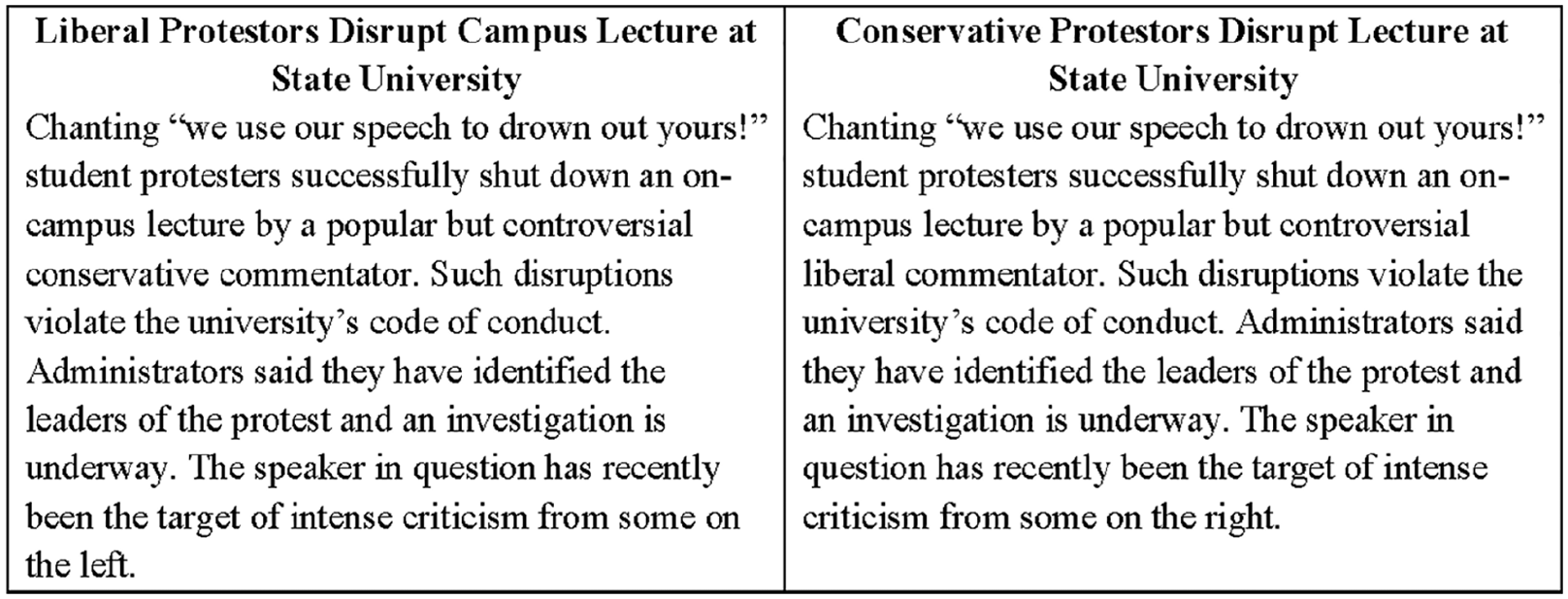
Two treatments appearing in the experiments.
By varying the ideology of the protesters, the study design tests whether ideology affects their willingness to punish offenders and promote political tolerance through statistical analysis using ordered logit models. A model with dummy variables for respondents’ ideologies and for the ideology of the protesters (as a control) will test the first hypothesis. The second and third hypotheses will be tested with models employing an interaction between participant ideology and protestor ideology.
The same experiment took place in two contexts, both with approval from an internal review board. The first was a Mechanical Turk (M-Turk) study that included 361 paid participants. The second was on the Qualtrics platform and included 164 college students recruited from introductory courses with opportunities to win gift cards or earn extra credit for participation. A background questionnaire administered separately from the experiment asked participants to describe their political ideology. Comprising roughly half of each sample, liberals outnumbered both conservatives and moderates. The surveys also included items testing concentration; participants who failed these measures were eliminated from the study.
Participants in the college sample were students at the University of North Carolina at Charlotte, a large public research institution. While most study participants were political science majors, the university culture is described as having very little political activity. Focus group sessions with both the College Republicans and College Democrats, held separately, yielded similar comments about very few students being politically involved or aware. While the Republican focus group said that they felt conservative viewpoints were not as welcome as liberal viewpoints in most classes or university events, they did not feel that their rights to speak or organize were unjustly restricted or that the school was any less tolerant than the typical college campus in the United States. FIRE gives this university its highest rating for protecting free speech.
Results and discussion
Linear regression models testing the relationship between the respondent ideology and support for sanctioning protesters while controlling for the ideology of the protesters produced significant results among conservatives in the M-Turk sample (see Table 1). Responses by liberals were not statistically different from those by moderates (the reference group) while conservatives’ willingness to punish was nearly a standard deviation higher. In the college student sample, liberals exhibited less willingness to punish than conservatives or moderates, who were statistically similar in their responses. For both samples, respondent ideology had no association with support for administration making a statement about free speech, as shown in the results of ordered logistic regression models also appearing in Table 1.
Respondent ideology and agreement with administrative actions.

OLS: ordinary least squares; M-Turk: Mechanical Turk.
p<.05, ***p<.001
Note: Models with the willingness to punish dependent variable use linear regression, while models with the free speech statement dependent variable use odds ratios obtained from ordered logit regression. 95% confidence intervals appear in parentheses under each estimate (lower bound, upper bound). Politically moderate respondents serve as the reference group.
The first hypothesis predicted that conservatives would be more willing to punish protesters than liberals, demonstrated in greater agreement with administrators implementing disciplinary consequences for protesters disrupting a political event. Participant responses support H1 in the M-Turk sample but not in the student sample, which may be a result of sample size or students perceiving their campus environment as non-volatile. As ideology had no association with support for administration speaking out on respecting free speech, the associations appearing for the punishment dependent variable seem to be about punitiveness and not concern for political tolerance.
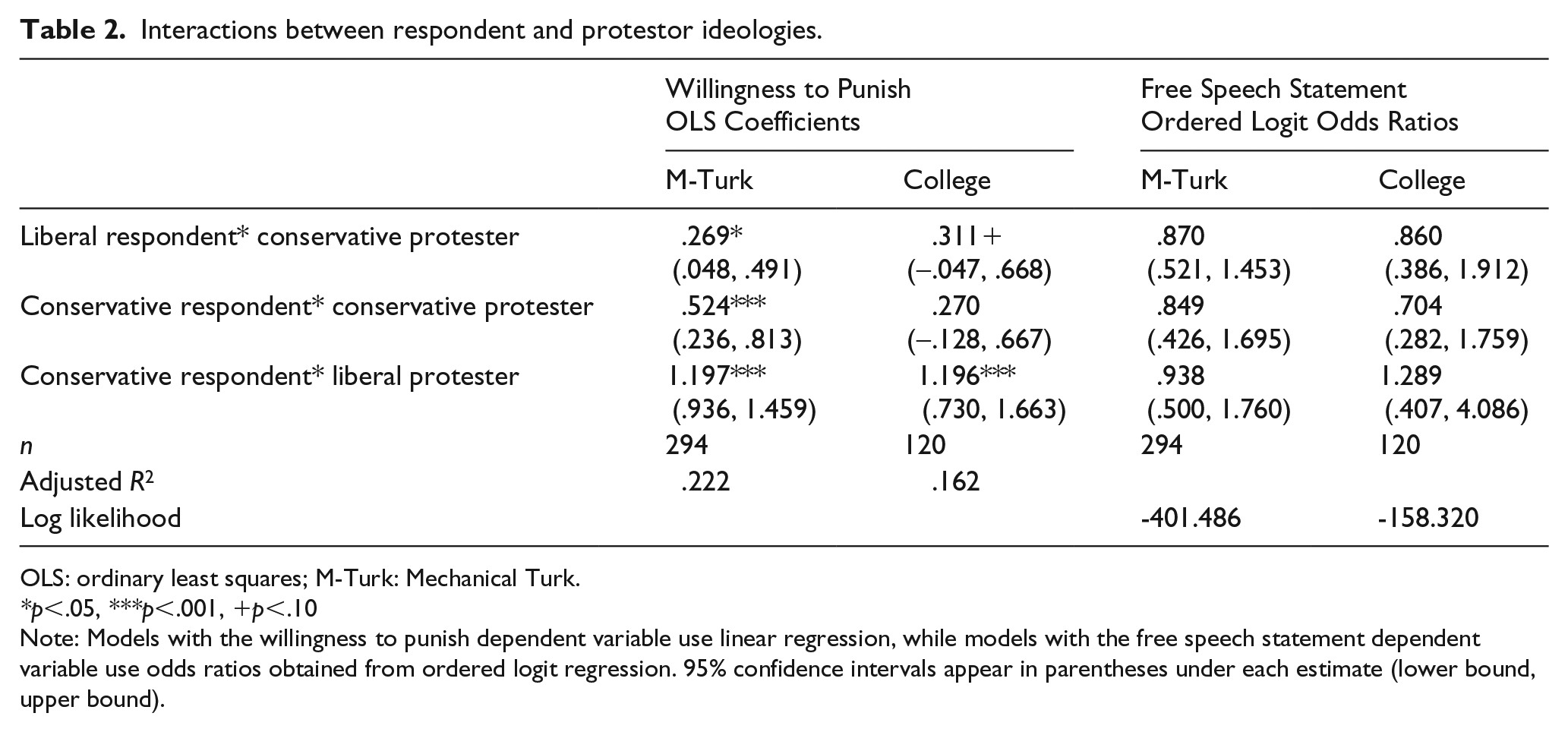
Regression models in Table 2 test the interactive relationships between participant and protester ideologies and their associations with punitiveness and concern for political tolerance. With a reference group of liberal respondents receiving the liberal protester treatment, results show that the liberals’ support for punishment increases when they receive the conservative protester treatment. Conservatives considering conservative protesters were more willing to punish than liberals considering liberal protesters in the M-Turk sample, but not in the college student sample. Conservatives considering liberal protesters exhibited greater willingness to punish than any of the other three combinations of ideology; in both samples estimates for this group were about a standard deviation higher than the others. Interactions between participant ideology and protester ideology showed no association with support for administration making a statement on free speech in ordered logistic regression models also appearing in Table 2.
Interactions between respondent and protestor ideologies.
OLS: ordinary least squares; M-Turk: Mechanical Turk.
p<.05, ***p<.001, +p<.10
Note: Models with the willingness to punish dependent variable use linear regression, while models with the free speech statement dependent variable use odds ratios obtained from ordered logit regression. 95% confidence intervals appear in parentheses under each estimate (lower bound, upper bound).
The experiment’s random assignment of ideology to the protesters described in the scenario provided a test of the second hypothesis, which stated that both liberals and conservatives would be more enthusiastic about punishing protesters when their views opposed their own. Indeed, both liberal and conservative participants were more likely to show stronger support for punishing protesters they disagreed with politically (despite not knowing what issues were at stake) than those with whom they identified. Again, concern over one’s opponents failing to respect differences of opinion did not seem to drive the results, as there were no statistically significant differences in whether participants recommended administrators endorse free speech associated with combinations of ideologies. How we choose to punish political incivility, it seems, is separate from our decisions to promote civility and political tolerance.
The third hypothesis, that conservatives’ responses will be more sensitive to the ideology of the protester than liberals’ responses, also finds support in the results. Conservatives, on average, exhibited a willingness to punish that was more sensitive to the protesters’ ideology than that of the liberal participants. While liberals’ endorsement of punishment increased by less than half a standard deviation when the protesters were conservative instead of liberal, estimates for conservatives’ support for punishment increased by about twice as much when considering liberal protesters rather than conservative. In contrast, their support for a statement on free speech did not vary with protester ideology. These results stand in contrast to rhetoric about free speech on campus coming from conservatives like David French, Lisa Nelson, and Bari Weiss, who insist that American universities are not respecting conservative voices or encouraging liberal students to practice civility. While they may have examples supporting their claim, the results of this study suggest something else is going on. If it were simply that conservatives perceive liberal college protesters as uncivil, disrespectful, and intolerant of opposing ideas, they would support administration making a statement about free speech more often when the protesters were liberal than when they were conservative. But their response on that item did not vary with protester ideology, while their response to punishment did, and to a greater degree than it did among liberals.
Conclusion
Overall, the results contribute to the growing body of work providing nuance to MFT. Participants’ support for punishing disorderliness varying with the ideology of the offender suggests that ideology is not as firmly grounded in a fixed set of morals as MFT might suggest, which aligns with work by Davis and Silver (2004) and Janoff-Bulman (2009). Further evidence that it was the partisanship driving punitiveness can be found in models I ran using only the political moderates in the sample, for whom none of the associations approached statistical significance (see Online Appendix). But the fact that conservatives’ responses vary by ideology more than liberals’ in campus protest scenarios could be evidence that liberals are more cautious about harm/care and fairness/reciprocity while conservatives are more concerned with ingroup/loyalty in such contexts, which would not be contradictory to principles of the theory. Further exploration of these phenomena might utilize a context in which the public perceives liberals to be more marginalized.
This study also has implications for those working in the university setting. The perception that conservatives are at a political disadvantage on college campuses seems to come through in their preference for punishing political opponents. Administrators may want to reflect on how well they provide forums for all political orientations. Working with conservative students to bring to campus conservative speakers with ideological yet substantive messages may help improve political climates, especially if all students are provided opportunities to respond in ways that defuse desires for protest.
Supplemental Material
ONLINE_APPENDIX – Supplemental material for Punishing campus protesters based on ideology
Supplemental material, ONLINE_APPENDIX for Punishing campus protesters based on ideology by Jason Giersch in Research & Politics
Footnotes
Acknowledgements
I am grateful to Cherie Maestas, Matthew Cawvey, and the POLS Lab at University of Northern Carolina at Charlotte for running the experiments that produced the data used in this study. An early version of this paper was presented at the 2019 annual meeting of the North Carolina Political Science Association at Johnson C. Smith University, resulting in helpful feedback and encouragement. Comments from anonymous reviewers and the editor of this journal also improved the manuscript considerably.
Declaration of conflicting interests
The author(s) declared no potential conflicts of interest with respect to the research, authorship, and/or publication of this article.
Funding
The author(s) received no financial support for the research, authorship, and/or publication of this article.

Supplemental materials
Carnegie Corporation of New York Grant
This publication was made possible (in part) by a grant from the Carnegie Corporation of New York. The statements made and views expressed are solely the responsibility of the author.
References
Supplementary Material
Please find the following supplemental material available below.
For Open Access articles published under a Creative Commons License, all supplemental material carries the same license as the article it is associated with.
For non-Open Access articles published, all supplemental material carries a non-exclusive license, and permission requests for re-use of supplemental material or any part of supplemental material shall be sent directly to the copyright owner as specified in the copyright notice associated with the article.
