



Abstract
In their online communications, political elites may choose to strategically eschew mainstream media sources and engage with alternative media outlets based on ideological and strategic considerations about the type of content they wish to legitimize or amplify to their followers. This is particularly true on social media which has become a fertile breeding ground for viral non-mainstream media content. Using an extensive dataset of social media posts sent from Members of the U.S. Congress between 2011 and 2022 (6.3 million tweets, 2.3 million Facebook posts), this article explores how media engagement in congressional online communications has evolved over time. The results suggest clear trends of asymmetric polarization, both in terms of media link sharing and media handle engagement, with Republican homophily and extremity of engagement growing steadily over time. This growing extremity is explained by changing Member behavior rather than changes in the composition of Congress and is primarily driven by more ideologically extreme Members of the Republican party increasingly engaging with rightwing and alt-right media. These trends have intensified in recent years, especially after the election of Donald Trump in 2016. Collectively, these results shed light on shifting ideological trends in media engagement and have important implications for our understanding of the relationship between political elites and the media in a highly polarized contemporary political environment.
Introduction
The media ecosystem in the United States has diversified rapidly in recent years (Prior 2007), especially on the ideological right (Berry and Sobieraj 2013; Heft et al. 2020), with Fox news becoming a dominant information source for the American right and alternative online news sources such as Breitbart, Townhall, and the Daily Caller springing up alongside new cable news offerings such as Newsmax and One America News Network (OANN). Online publications such as Vox, Salon, and Mother Jones also play a prominent role in driving media coverage and discourse on the ideological left. This increased media choice gives rise to an increasing ideological separation in both the types of stories that are covered and in the frames of coverage on any given story.
With this broad range of media sources comes strategic opportunity for political elites to guide political narratives by selectively steering the public toward politically aligned media sources (Heidenreich et al. 2022) while simultaneously discrediting and downplaying critical and non-ideologically aligned sources. Indeed, political elites are no strangers to the politically advantageous strategy of discrediting the media in general (Smith 2010) and, in particular, media outlets deemed to be aligned with the opposite end of the ideological spectrum (Ladd 2011).
Illustrating this, in the aftermath of the 2020 elections, after Fox News had shocked many observers by being the first network to call the crucial state of Arizona for Joe Biden (Karni and Haberman 2020), Trump branded Fox News “virtually unwatchable” and actively began promoting NewsMax on his Twitter feed (Colarossi 2020). Subsequently, viewership of Fox News declined and, briefly, NewsMax become the fourth-highest rated cable news channel, ahead of media stalwarts such as NBC and ABC. 1 This elite promotion of alternative media helped reinforce extreme and false election information among the Republican faithful, while diminishing the reach of more moderate and authoritative media.
From this, given the current media ecosystem and clear potential communicative power of power elites to amplify certain media sources while marginalizing others, the question remains as to the extent to which the general diversification of the media ecosystem has led elites to strategically amplify more ideologically extreme media in their political communications, effectively increasing levels of polarization in the highly interactive relationship between elites and the media.
Therefore, using comprehensive Twitter and Facebook data from Members of Congress between 2009 and 2022, this article seeks to explore the relationship between Congress and the media, with a focus on the ways in which elites in Congress choose to engage with the media online and the ways in which the sources of this engagement have changed over time. Specifically, the analysis here examines three interconnected questions: (1) How has ideological media engagement changed over time and between parties? (2) What are the key drivers of Members of Congress engaging with and sharing more ideologically extreme media sources? and (3) how does the public respond to online engagement with more extreme media by Members of Congress?
The findings show that there is a clear and increasing partisan ideological asymmetry in online media engagement, primarily driven by Republican Members of Congress turning to increasingly rightwing ideological news sources, with this trend accelerating after the election of Donald Trump in 2016. In modeling media engagement, legislator ideology is the main driving factor behind a Member’s relative level of engagement with more extreme sources, with the strength of this relationship growing over time, above and beyond the level explained by increasing extremity in Member roll call voting. Member replacement or cohort effects do not explain this shift, however, with freshman and senior Republican Members alike exhibiting similar engagement trends toward the extremes over time, suggesting a general shift in behaviors across the wider Republican party in Congress. In terms of public responsiveness, messages linking to more ideological extreme media do receive more public engagement, with this effect again disproportionately benefiting Republican Members of Congress.
Overall, the results provide an important and comprehensive overtime analysis of changing ideological dynamics in the relationship between Congress and the media online, while also providing insight into the factors which drive increasing extremity in the media ecosystems which Members of Congress choose to engage with and share with the mass public.
Congress and the Media Online
Members of Congress have historically made extensive use of a wide range of media and communications channels to strategically engage with local and national audiences. Congressional communications may have a variety of goals, including credit claiming, advertising, and position taking (Fenno 1978; Grimmer 2013; Mayhew 1974), with Members making use of televised floor speeches (Frantzich 1996; Maltzman and Sigelman 1996), press releases (Grimmer and King 2010), email newsletters and e-bulletins (Cormack 2017), and televised media interviews and punditry (Kedrowski 1996; Niven and Zilber 1998; Sellers 2000) to frequently and prominently communicate with both constituents and the general public on a regular basis.
In the contemporary media environment, Congress is also increasingly online, and its use of social media platforms, such as Twitter and Facebook, has risen steadily, with almost all Members of Congress now actively posting and tweeting from one or more Twitter and Facebook accounts (Peterson 2012; Gulati and Williams 2013; Straus et al. 2013). In tandem with this, the political news media is also increasingly making use of social media (Kamps 2015), with Members of Congress and media figures often engaging directly and in real time on these platforms (Engesser and Humprecht 2015; Schumacher et al. 2021; Wells et al. 2020).
Reflecting this, Members of Congress generally try to court media attention with their online communications content (Lipinski and Neddenreip 2004) and journalists see Twitter content as highly newsworthy (McGregor and Molyneux 2020). This increasingly interactive relationship has helped reinforce a mutually beneficial and dependent relationship between Congress and the media online (Van Aelst and Walgrave 2016). Through this dynamic social media relationship, Members are able to release relevant quotes and reactions to developing stories and ultimately set the political agenda with greater ease (Feezell 2018; Gilardi et al. 2022; Habel 2012; Parmelee 2014; Shapiro and Hemphill 2017).
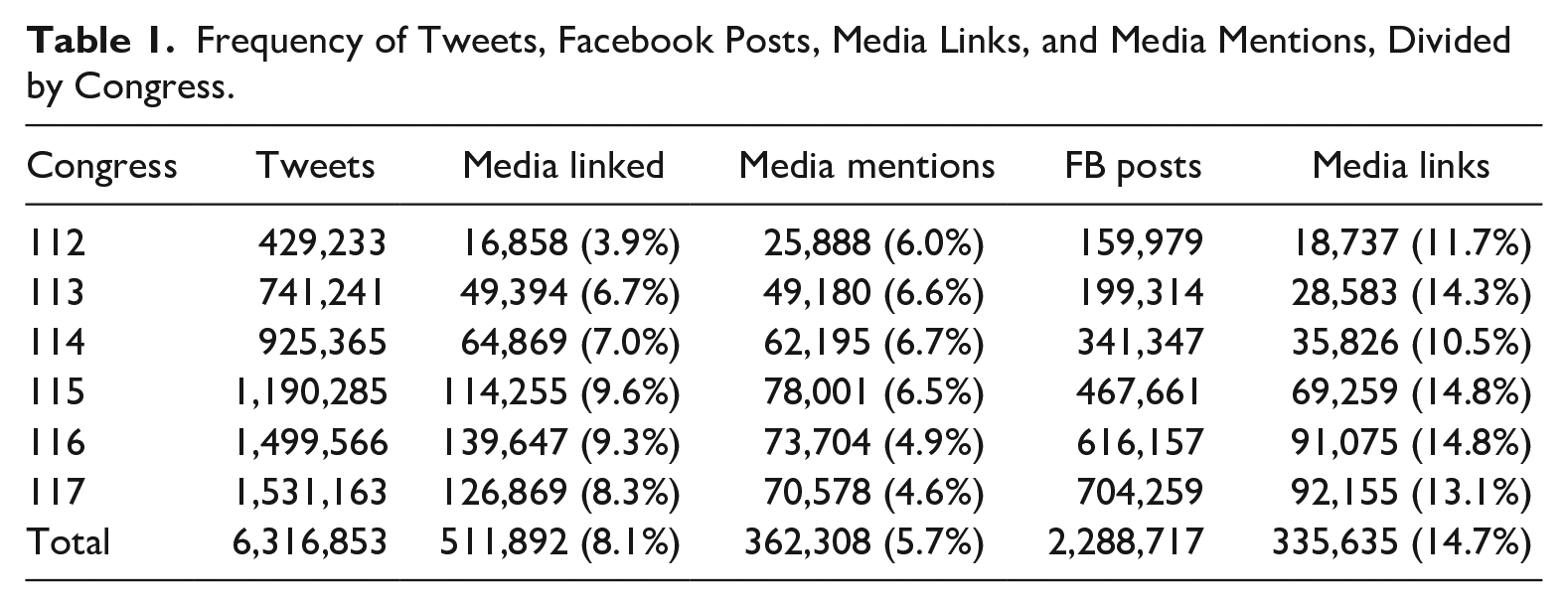
For political elites online then, media engagement combines both strategy and personal preferences in communications in a way that goes beyond regular congressional messaging. While much existing work has studied the media diets of individuals in the United States (e.g., Guess 2021; Levendusky 2013; Wojcieszak et al. 2021), the media diets of political elites themselves is often overlooked. To this end, the sharing of and interacting with news reports has also risen rapidly on congressional online messaging (see Table 1 below). Yet, Members have clear autonomy over the sources they choose to share with readers and the types of media figures and outlets that they choose to promote and the types that they choose to disregard. As such, media engagement from Members of Congress is likely not uniform, with personal, political, and electoral factors shaping when and with whom Members choose to engage.
Frequency of Tweets, Facebook Posts, Media Links, and Media Mentions, Divided by Congress.
Indeed, over time, personal and electoral factors have come to play an increasingly important role in shaping congressional communications on social media. Factors such as partisanship (Heseltine and Dorsey 2022), majority status in congress (Ballard et al. 2022a; Russell 2018), partisan control of the White House (Ballard et al. 2022a, 2022b; Russell 2020), and even gender (Evans and Clark 2016; Wagner et al. 2016) have all been shown to impact the tone and content of congressional messaging on social media.
An investigation of the direct relationship between congress and the media—who engages, how, and with what types of media—therefore takes on renewed importance in an era where both journalists and political elites are turning to social media platforms as their primary means of public communications.
Congressional Communications and the Mass Public
While the relationship between political elites and the media online is complex and evolving, interactions between these groups does not purely have implications for the direct relationship between legislators and the media, but also has important downstream implications for beliefs and information streams among the mass public. Indeed, a majority of the U.S. public uses social media as a source for news (Shearer and Mitchell 2021), with many users encountering political content from media figures and political elites (Marquart et al. 2020; Ohme 2019), leading to clear potential for political learning within the public through social media sources (Bode 2016).
Social media also has distinct utility for incidental news exposure, even among those not actively seeking out news on the platform (Fletcher and Nielsen 2018). From this, tweets from political leaders are likely to influence reader opinion both through selective (Messing and Westwood 2014) and incidental exposure (Karnowski et al. 2017). Additionally, when evaluating online content, users see media accounts and accounts of political elites as legitimate sources of information, with media content from trusted political figures being seen as especially trustworthy (Sterrett et al. 2019). These effects may be particularly apparent on social media, and the strength of these cues may in turn directly contribute to division and fragmentation in online discourse (Heiberger et al. 2021) and exacerbate political polarization (Parmelee and Bichard 2011).
Evidence also suggests that, within the public, news has increasingly become filtered through partisan lenses (Iyengar and Hahn 2009; Levendusky 2013; Stroud 2010), with partisan filtering affecting public exposure to news stories (Baum and Groeling 2008). Compounding this, social media is a particularly fertile breeding ground for homophily and polarization in political discourse (Barberá et al. 2015; Wojcieszak et al 2021; Yarchi et al. 2021). These political echo chambers also then condition individuals to be less critical about the news sources to which they are exposed (Levendusky 2013; Rhodes 2022), further entrenching polarized beliefs.
Subsequently, online messaging from political elites has the potential, through direct and indirect means, to both inform the public as well as to significantly alter public beliefs. These dynamics generally shift opinions in an ideologically aligned direction while ultimately moving public opinion further away from the truth (Munger et al. 2020). As such, the sharing of ideological media by elites may increase public news awareness while also increasing the ideological extremity of public beliefs on given issues. These dynamics, again, create natural incentives for political elites to use social media communications as a medium for the strategic sharing of particular favorable news outlets and news stories (Heidenreich et al. 2022).
Expectations for Extremity of Media Engagement
Based on the theoretical underpinnings of the interactive relationship between the media, elected officials, and the public in the social media era, three logical areas of analysis arise: (1) how have trends in media engagement by elected officials changed over time? and (2) at the Member level, what has driven potential changes in media engagement, and (3) how does the public respond to the sharing of extreme media? Theoretical expectations associated with these research questions are outlined in turn below.
Trends in Ideological Media Engagement
At a baseline level, politicians are incentivized to share news that readers are actually likely to click on. As Heidenreich et al (2022) find, politicians are more likely to share news articles from outlets which their own party supporters have a higher likelihood of reading. Additionally, the media itself is also more likely to report on media content which is favorable to parties that are ideologically aligned with the reporting news outlet (Haselmayer et al. 2017), meaning, from a supply side perspective, that Members of those parties will have more favorable news to share from those outlets. Members are therefore incentivized to primarily share news from ideologically aligned outlets, with this incentive likely growing as partisan fragmentation on social media platforms increases over time. As such, the general extremity of media engagement will likely have increased over time, as will the relative proportion of engagements with congenial, partisan-aligned media outlets (increasing homophily).
Drivers of Changing Ideological Media Engagement?
After considering how media engagement has changed over time, the next logical question to consider is then which factors, at the Member level, have driven this change. Across the social media era, personal, institutional, and environmental factors may have collectively or singularly shifted the dynamics between Congress and the media. At a basic level, as ideological polarization has increased in Congress and in the mass public (Abramowitz and Webster 2016; Theriault 2008), media engagement extremity may have simply moved in unison. Alternatively, given the rise of new media-focused and often controversial Members of Congress such as Marjorie Taylor Greene, Lauren Boebert, and Matt Gaetz, changes may be driven by new Members entering Congress who exhibit distinct (and likely more extreme) engagement behaviors compared to their predecessors. In addition, power dynamics within Congress in terms of government and chamber control regularly drive strategic shifts in congressional messaging (Ballard et al. 2022a, 2022b; Russell 2020), suggesting that the media contained within these messages may impacted by changes in institutional control which lead opposition politicians to seek out the more negative coverage found in more extreme partisan content (Berry and Sobieraj 2013; Sparks and Hmielowski 2023). The ultimate combination of which types of Members engage with more extreme media and when is therefore more of an open question which warrants more exploratory analysis.
It must also be noted that the general political environment has seen dramatic change across the social media era, with direct consequences for the relationship between Congress and the media. President Trump, in particular, took a decidedly hostile approach to the media, consistently railing against and launching attacks on “the mainstream media” (Stuckey 2021), while boosting preferred outlets of choice (Meeks 2020). In general, the Trump era has seen major shifts in tone and content of congressional communications (Ballard et al. 2022a; Heseltine and Dorsey 2022), with many Republican Members following the President’s lead and frequently using disparagement of mainstream or critical news outlets as a rhetorical tool. Subsequently, the election of Donald Trump may have been a singularly disruptive event, with his espoused hostility toward the media likely driving Members toward amplifying and engaging with sources outside of the mainstream, often on the ideological extremes, with the effects likely greatest among Republicans (Cowburn and Knüpfer 2023).
Public Responsiveness
Finally, in general, partisan news media is shared with far greater frequency than non-partisan news by social media users (Hasell 2021; Pedersen 2021). Members may therefore be more likely to want to share extreme media and, importantly, potential readers are more likely to engage with messages containing these sources, creating something of a mutually reinforcing relationship that pushes linked media toward the ideological extremes. Therefore, from the demand side, it is expected that congressional messaging which contains links to more extreme media will receive more public engagement.
Although such patterns exist on both the ideological left and right, these trends are most pronounced on the right of the ideological political spectrum (Barberá et al. 2015; Wojcieszak et al. 2021). This effect stems from, first, Republicans generally being more distrustful of conventional mainstream media sources (Jurkowitz et al. 2020) and, importantly, from social media algorithms actually being more likely to amplify right-leaning sources more than left-leaning sources (Huszár et al. 2022), meaning Republican elites may be the greatest beneficiaries from the sharing of more ideologically aligned media.
Data and Method
The data used in this analysis comprises a comprehensive dataset of every available tweet and Facebook post sent by a U.S. federal Member of Congress or Senator across the time period of January 2011 through to the end of 2022. 2 This dataset incorporates tweets and posts sent from official, personal, and campaign accounts and comprises roughly six and a half million tweets sent from 1,770 handles and 2.3 million Facebook posts from 1,386 pages. All Twitter handles and Facebook accounts were hand-collected by the author, with tweets collected using the Twitter API and Facebook posts collected using CrowdTangle on a monthly rolling basis. 3
These tweets and posts are then matched against two media datasets, one at the web domain level and one at the Twitter handle level. The first extracts the web domains for 187 national news outlets, including variations and shortened social media redirect links (e.g., “huffpost.com,” “huffp.st,” “huff.to,” and “huff.lv” all redirect to the Huffington Post). 4 This list of URLs is primarily drawn from the congressional tweets themselves, based on a hand-coding of over 9,000 of the most commonly cited domains featured in congressional tweets. 5 By taking the links from the actual congressional messages, this process ensures no major national news outlets are missed. The second dataset then comprises a list of 1,406 individual or institutional U.S. national media Twitter handles, hand-compiled by the author, grouped by relevant outlet or employer.
These datasets are then cross-referenced with comprehensive media outlet ideology scores. The media ideology scores come from Robertson et al. (2019), wherein domain-level ideology scores were constructed for media outlets based on the sharing trends of over 500,000 partisan Twitter users in the United States, matched to voter registration data. As this is both a Twitter and a sharing-based measure of ideology, these scores are an appropriate fit for the assessment of the sharing of ideological media by Members of Congress on social media. Scores sit on a continuous −1 to 1 scale, with results closer to 1 being more conservative, while results closer to −1 are more liberal. 6 As these scores were constructed at the domain level, meaning single outlets may have multiple domain scores, the most frequently used domain for each outlet was used to extract the relevant outlet score. In general, these scores are highly correlated with other conventional crowd-sourced and hand-coded measures of media ideology (r = 0.84 with AdFontesMedia outlet coding, r = 0.78 with Pew Research survey-sourced scores, r = 0.73 with AllSides hand-coded scores), meaning that they are both methodologically appropriate and not dissimilar from the ideological estimates provided by other sources. Furthermore, these scores have been used in many existing works (e.g., Chen et al. 2021; Hosseinmardi et al. 2021; Wojcieszak et al. 2022) and been shown to provide plausible and meaningful estimations of outlet ideology in the U.S. context. 7
Collectively, the congressional messages are filtered by references to media outlets using two criteria—whether a tweet or Facebook post links to a particular outlet, and whether a tweet mentions a particular media handle. This first measure represents the public-facing sharing of media by Members of Congress, whereas the second represents the interactive networks and connectivity between Congress and the media (as mentioning and reposting are not as common practices on Facebook and tagged pages are not recorded in the Facebook message data, interactivity through media mentions are only measured using the congressional tweets). This creates three unique datasets encompassing congressional media engagement, which are then separately merged with the corresponding media ideology score to produce tweet- and post-level media ideology scores.
From these datasets, the analysis below begins by exploring how engagement trends have changed through a series of aggregated plots of ideological engagement over time, divided by political party. This is then followed by predictive models exploring the factors which are associated with increased media engagement extremity from Members. This is first done at the aggregate Member-Congress level, then supplemented by a set of within-Member models, testing how changes in personal, institutional, and political factors have influenced Member engagement across an individual Member’s time in office.
As the central expectation is for temporally varying trends in ideological engagement, these predictive models use the absolute average link and mention ideology for a Member in a given Congress as the dependent variables, 8 with independent variables measuring (1) Member ideology (taken from the absolute distance from the chamber mean in a given congress based on Nokken-Poole Congress-by-Congress ideology scores) (Nokken and Poole 2004), (2) a binary variable indicating whether the Member is currently in the President’s party, (3) a binary variable indicating whether the Member is currently in the majority party in their chamber of congress, (4) the level of electoral competition in a Member’s district in a given congress (measured using the absolute value of the Cook Political Report’s Partisan Voter Index [PVI] for the district or state), (5) a binary indicator for whether the Member sits in the House or the Senate, (6) a binary variable for whether the Member is male or female, (7) an indicator for the Member’s party affiliation, (8) a binary indicator for whether a Member is a freshman in congress, and (9) a seniority count variable for the number of terms that a Member has served in congress. Fixed effects are then included for each congress, to account for temporal trends and ensure that results are taken relative to communications patterns in a given congress rather than across the entire time period.
Finally, to test the level of public engagement with differing types of media links, a two-way fixed effects model, controlling for Twitter handle/Facebook page and month effects, is utilized to assess how public engagement differs across posts linking to differing ideological sources. 9 As, at a baseline level, different Twitter handles and Facebook pages have more followers than others and generally receive more engagement on all posts, it is important to control within units rather than across units. Additionally, as the number of social media users and the level of public engagement generally increases over time, it is also important to control for temporal engagement effects. As the distribution of likes/retweets/shares is heavily left skewed and varies substantially across individual legislators, total public engagements with a given post are taken as a percentage change relative to a given handles average engagement in a given Congress. 10 Collectively, this model then tests, at the handle/page level, within units and within a given time period, the relative increases in public engagement that a message receives when linking a more (or less) ideologically extreme media source.
Results
Data Overview
First, Table 1 provides an overview of the level of congressional media engagement over time (2009–2022). Data are broken down by Congress, showing total tweets and Facebook posts, total tweets with news media links/mentions, and total Facebook posts with national news media links.
As can be seen, media links and mentions comprise a small but not insignificant percentage of congressional messages. In terms of national news media links, roughly eight percent of all tweets and 13 percent of all Facebook posts contain these links, with the frequency of these links generally increasing slightly over time on both platforms.
In terms of direct Twitter mentions, roughly five percent of all tweets mention a national news media organization or an individual national news journalist. Direct mentions are therefore less prevalent than the use of news links, but are still a common form of media engagement from Members of Congress.
Overtime Ideological Trends
Turning to the ideology of these messages, Figure 1 below shows the average link ideology for tweets and Facebook posts and the average Twitter handle mention ideology of each party, over time, with averages grouped by month. The left panels show the raw monthly averages while the right panels show the monthly average of absolute ideology scores. Vertical lines denote the 2016 and 2020 election dates. 11
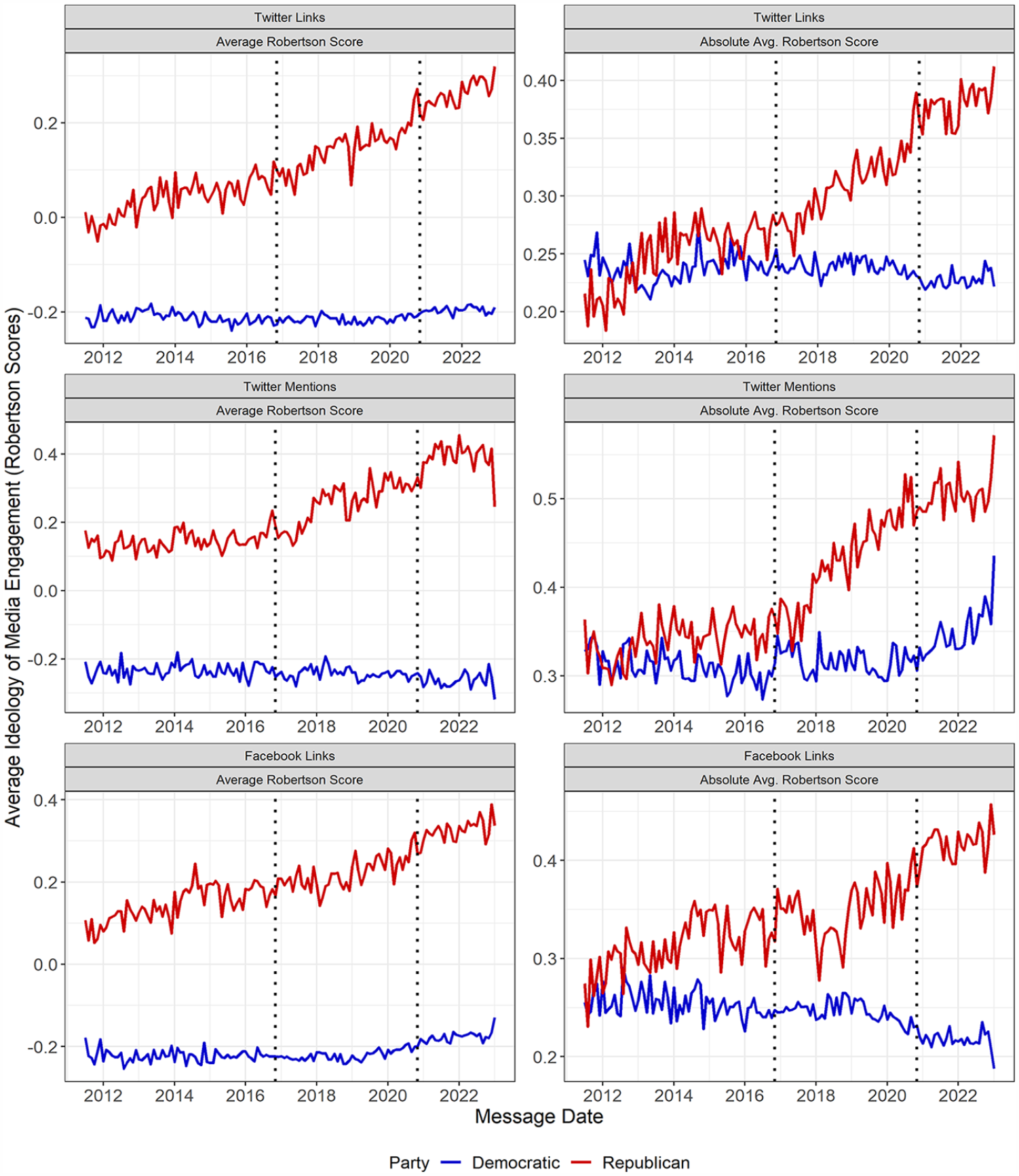
Average monthly link and handle mention ideology grouped by party, average monthly engagement scores shown in column 1 (Left), the average of the absolute outlet scores shown in column 2 (Right).
As can be seen, there is clear asymmetric polarization of media engagement from Members of Congress. Across the entire time period, the average ideology rating of links shared and handles mentioned by Democrats has remained relatively stable, hovering around 0.2 points left of the ideological center on both Twitter and Facebook. Republicans, however, have steadily increased their average ideology rating over time across all three measures. In 2011 and 2012, Republicans shared links and engaged with handles with an average score between 0 and 0.1. These scores steadily increased over time, averaging between 0.3 and 0.4 by 2022. 12
Of course, while average ideology is revealing, in and of itself, the larger question remains as to whether these changes in average ideology are the result of greater ideological extremity of sources, or alternatively as a result of greater ideological sorting. That is to say, equivalent results for Republican rightwing polarization can be achieved by either (1) holding leftwing engagement constant and engaging with more extreme rightwing sources, or (2) holding rightwing extremity constant while reducing the level of leftwing engagement, or (3) a combination of the two. In simple terms then, it is worthwhile exploring whether the results of Figure 1 are merely the result of Republicans engaging less with outlets like the New York Times, or are the result of increased engagement with sources such as Breitbart.
This question is addressed by looking to the absolute extremity of media source engagement in Figure 1. In this measure, a distinct Trump/2016 effect can be seen. Prior to 2016, Democrats and Republicans largely moved in tandem, with Republican absolute ideology being slightly greater than Democrat’s. After the 2016 election, Democratic absolute ideology stayed relatively flat with a minor and gradual reversion to the ideological center. The absolute ideology of Republican sources, however, rose sharply after the 2016 election, with a high point during the 2022 election period. This suggests then that the increases in average Republican source ideology have primarily been driven by an increase in source extremity, particularly in the post-2016 period. 13
Trends in Congenial Media Engagement
To further explore changes in the types of outlets seeing Member engagement over time, Figure 2 shows the overtime trends in links and handle mentions from Members of each party, based on whether an outlet contained in a message belongs to one of seven outlet group types. These groups were assigned by the author and capture the main historical medium and ideological perspective of an outlet. 14 The Alt-Right grouping contains outlets such as the Daily Caller, Breitbart, and Infowars, as well as new broadcast networks such as The Blaze and One America News Network. Mainstream Right includes Fox News and Fox Business, as well as the Washington Times and the New York Post. Mainstream Print includes outlets such as the Wall Street Journal, The New York Times, The Washington Post, and other national print organizations. Mainstream TV includes outlets such as CBS, NBC, and PBS. Political includes outlets whose primary focus is Washington-centric reporting such as Politico, The Hill, and CQ Roll Call. Mainstream Left includes MSNBC, The Huffington Post, and similar established left-of-center outlets. The ideological left includes a range of overtly left-leaning outlets such as Salon, Mother Jones, Occupy Democrats, and Think Progress.
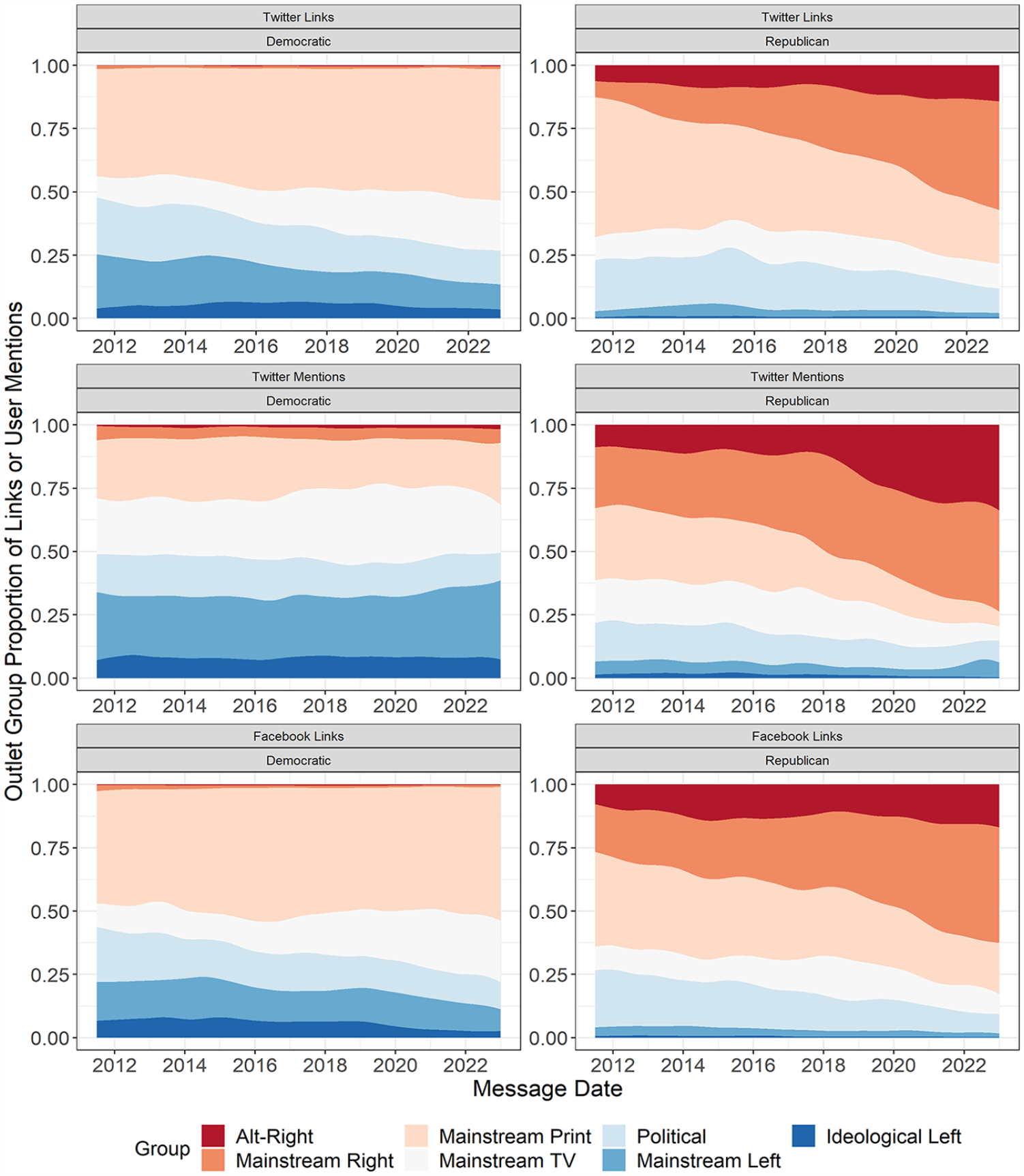
Trends in proportion of outlet engagement over time, by media outlet grouping, with panels divided by party and engagement type.
The results are clear and revealing. First, in line with Figure 1, Democratic engagement has changed little over time, regardless of platform or engagement type. Ideologically, Democratic engagement is almost perfectly sorted in the center and the left of the ideological spectrum, with mainstream right or alt-right engagement being essentially non-existent during all time periods (further plots comparing engagement with specifically right- and left-leaning outlets are also shown in the Supplemental Information file). In terms of news linking, on both Twitter and Facebook, mainstream print outlets make up the largest linked media group for Democrats. However, Twitter posts mention this group considerably less, with handles from mainstream TV and mainstream left outlets (primarily MSNBC) instead receiving the greatest proportion of direct engagement.
On the Republican side, there is a clear overtime shift toward right-leaning outlets. In the earlier period, similar to Democrats, the largest group receiving Republican engagement was mainstream print outlets, with mainstream right and alt-right groups receiving very little engagement in terms of message linking. Over time, Republicans have exhibited a clear replacement of mainstream print media with mainstream right media and, to a lesser extent, alt-right media. Notably, after the 2016 election, Republicans became more likely to engage with alt-right handles on the Twitter platform, even if actually linking externally to these outlets was less common.
The results reflect a clear trend of media replacement on the part of Republicans, with Democratic engagement beginning from a point of near-perfect ideological sorting and therefore seeing limited room for further change. At the outlet level, trends in changes in the most frequently cited outlets (shown in Supplemental Information file in Figures A2 and A3) highlight the extent to which these Republican trends are driven by Fox News replacing mainstream newspapers such as the Washington Post, with more than one in five links now going to Fox News and one in four mentions. This shift is further augmented by a small increase in engagement with extreme and alternative rightwing news sources such as Breitbart, Infowars, and the Daily Caller, explaining increases in both average and absolute ideological extremity over time.
Who Engages with More Extreme Media?
Having established the overtime trends in media engagement by party, with apparent asymmetric increases in source extremity emerging, it is worthwhile focusing in from the aggregate level to explore in more granular detail the types of Members who are most likely to share and engage with more ideological media sources.
Table 2 below shows predictive models for average source ideology per Congress at the individual level. To minimize noise and bias from Members who very infrequently engage with the media online, only Members who linked to or mentioned national media five times or more in a given congress are included. For each measure, the first model tests predictors on all Members, whereas the second and third models are divided by party. In order to make effect sizes more interpretable, for the following analyses, the Robertson scores have been multiplied by 100, and then converted to absolute scores, to produce a 0 to 100 absolute scale. 15
Average Message Link and Handle Ideology, Divided by Individual and Congress.
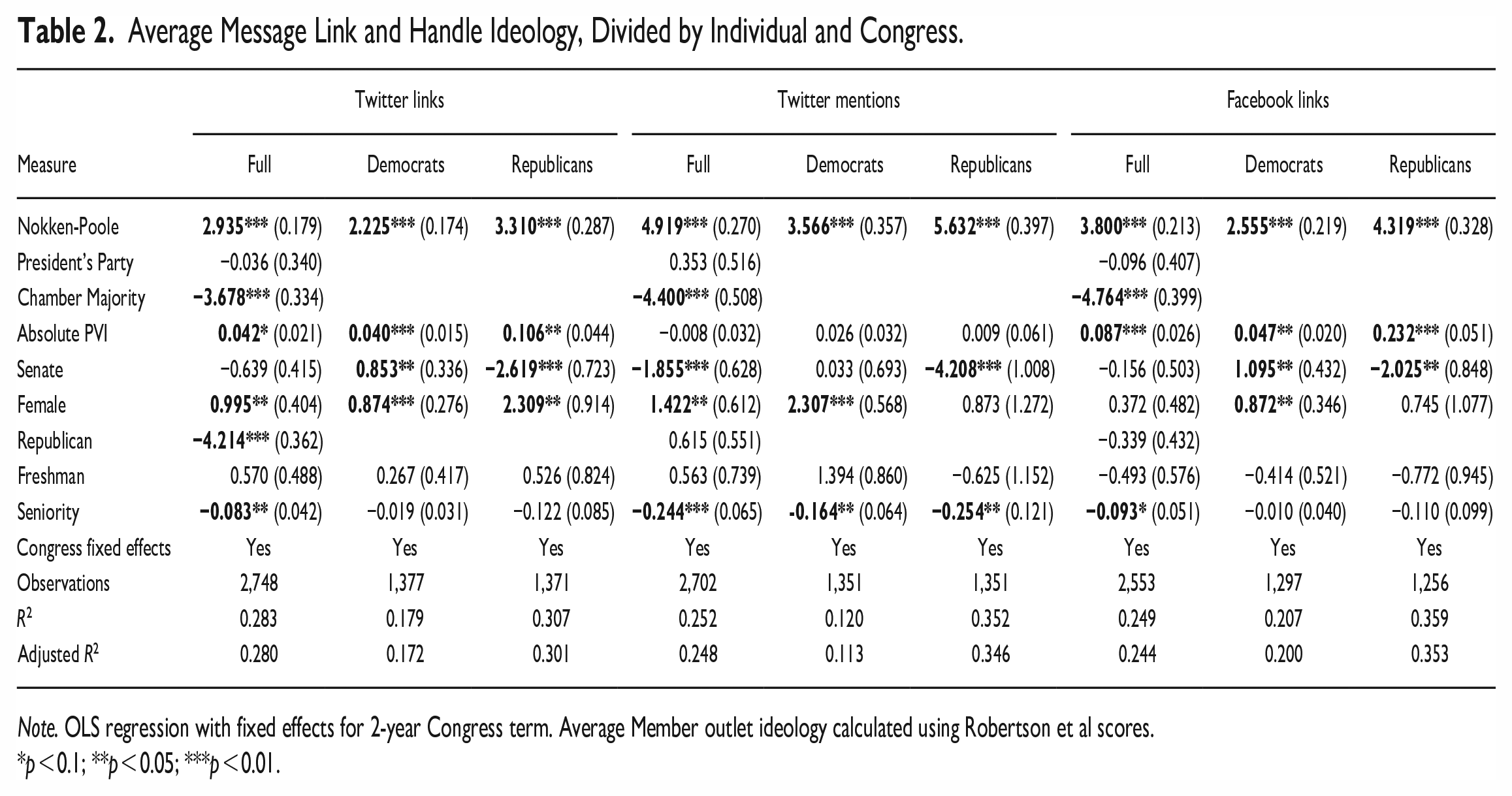
Note. OLS regression with fixed effects for 2-year Congress term. Average Member outlet ideology calculated using Robertson et al scores.
p < 0.1; **p < 0.05; ***p < 0.01.
In terms of both news links and media mentions, Member ideology is the clearest driver of engagement ideology, suggesting a logical core link between these factors—as Member extremity increases, so too does the absolute ideological extremity of media engagement, with the effects being more pronounced among Republicans.
At the institutional level, chamber majority status also emerges as a key predictive variable, with the effect of being in the chamber minority increasing media engagement extremity by roughly the same magnitude as a one standard deviation increase in Member absolute ideological extremity. There are also noteworthy differences between the parties across the two chambers of Congress. Democratic Senators link to marginally more extreme media, while Republican Senators engage across both measures with much less extreme media, suggesting that polarizing trends among Republicans may be primarily due to increasing extremity among Republicans in the House of Representatives.
Time in office has very little effect on engagement extremity. In no models do freshman Members link to or mention more extreme media, on average. Seniority does show some small and inconsistent negative effects, suggesting that the more junior pool of Members may be more inclined to engage with more extreme media. Collectively, though, there is limited evidence to suggest that new Members in each congressional cohort are driving increased engagement extremity.
Congress by Congress Predictive Effects
While Table 2 provides overall predictive effects, tracking these effects over time will provide additional insight into potential drivers at the Member level of the asymmetric engagement trends found in Figures 1 and 2. Specifically, if ideology is indeed a main driver of extremity, has this effect grown over time and across parties, in tandem with the overall aggregate engagement trends? Exploring this, Figure 3 below shows the coefficient estimate size for Member ideology over time, with models divided on a Congress-by-Congress basis.
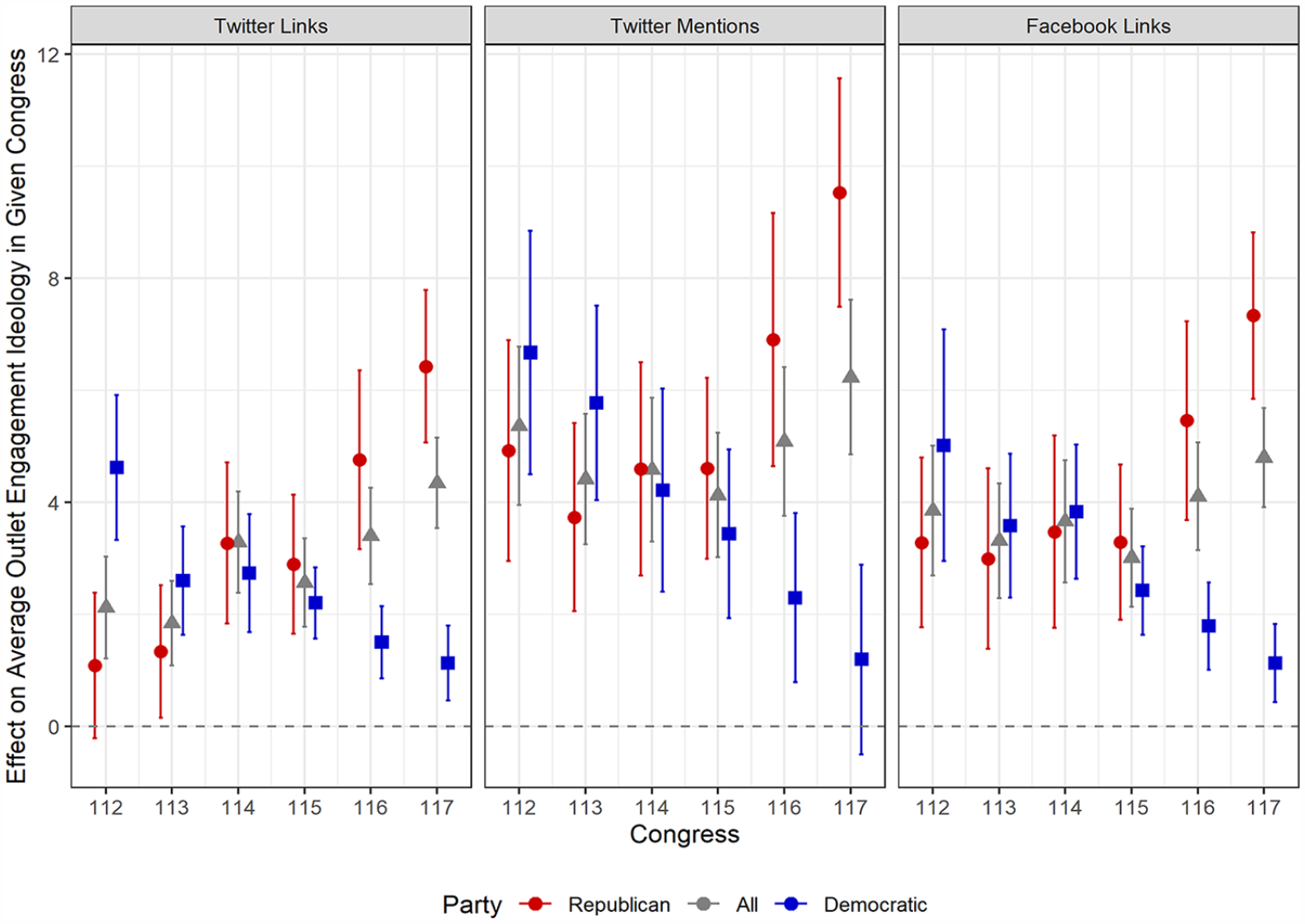
Congress-by-Congress coefficient estimates for effect of Member ideology on average extremity of media engagement by a given Member in a given congress.
The results show that there is a clear divergent partisan pattern over time, with the effect of ideology growing among Republicans, especially in the 116th and 117th Congresses. For Democrats, however, the inverse is true, with the effects showing a consistent decline over time. These results strongly support the notion of behavioral changes from more extreme Members driving engagement with more extreme media over time, with this relationship being entirely driven by Republican Members.
Within-Member Effects
Supplementing the Member level analyses, a within Member model allows for a further overtime test based on how individual Members adjust their engagement behavior across their time in office in response to changing conditions. Specifically, this also allows for a test of how individual Members adjusted their engagement behavior before and after Trump’s election in 2016. For these models, shown in Table 3, time invariant independent variables are removed (gender and party) and an additional binary variable is included for whether the engagement occurs in the period after the 2016 election (the 115th–117th Congresses). 16
Average Message Link and Handle Ideology, Divided by Individual and Congress, Within Member Models.
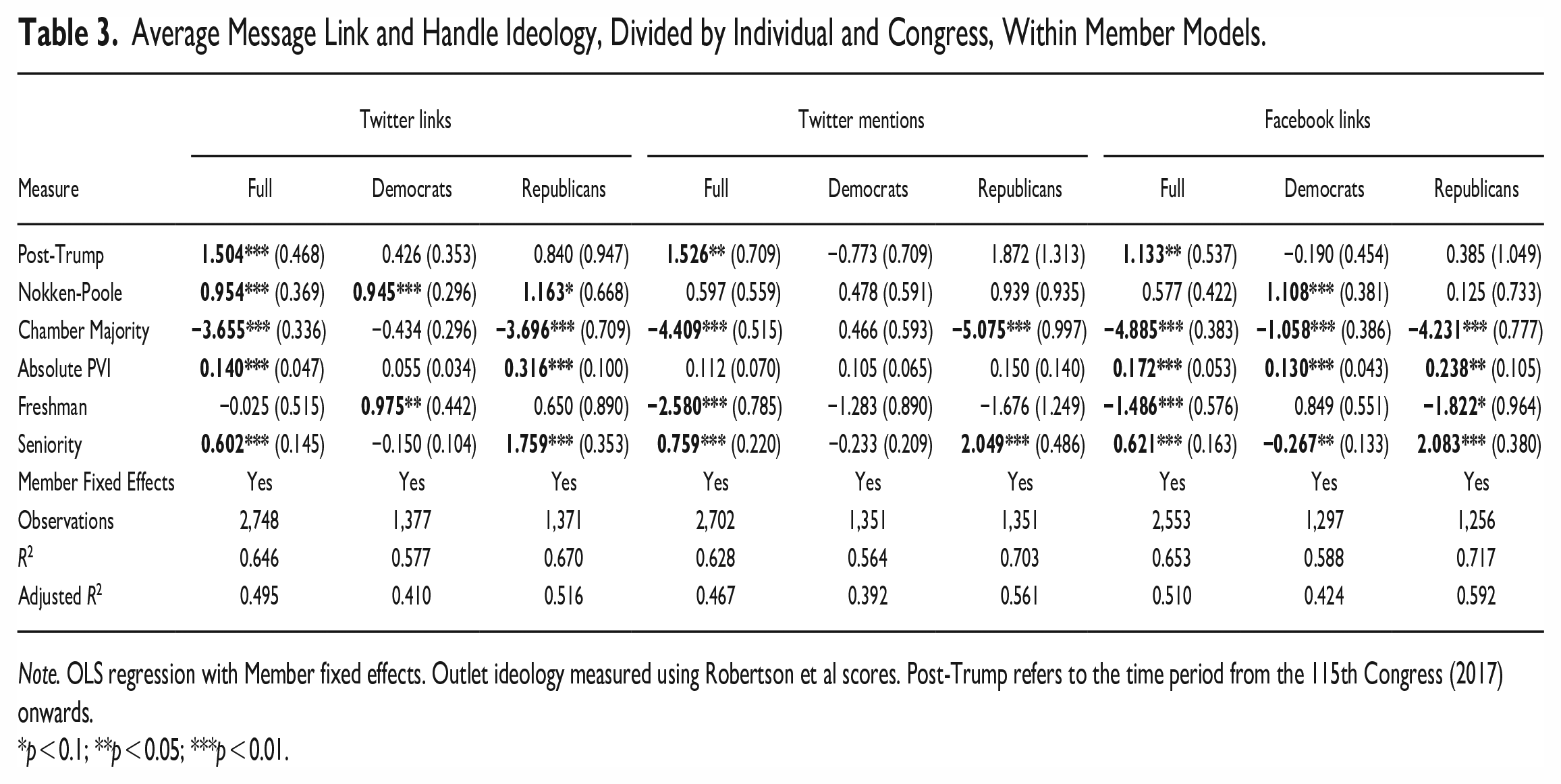
Note. OLS regression with Member fixed effects. Outlet ideology measured using Robertson et al scores. Post-Trump refers to the time period from the 115th Congress (2017) onwards.
p < 0.1; **p < 0.05; ***p < 0.01.
First, for each type of engagement, there is an overall increase in engagement extremity in the post-Trump era. This effect is moderate in magnitude, with a 1–1.5 point increase on the adjusted Robertson scale. However, despite clear asymmetric trends in the aggregate party plots, at the Member level this increase is not significantly associated with any one party. Trump’s election may have influenced engaged behavior then, but it is not singularly responsible for the divergent patterns of engagement in the post-2016 period.
In terms of Member extremity, there is generally inconsistent evidence to support the notion that as Members become more extreme, they link to more extreme media. Where these effects do occur, they are more consistent for Democrats, rather than Republicans. In conjunction with the previous analyses, this finding suggests that increased engaged extremity is not merely a function of increasing Member extremity, where both are moving in unison. Instead, building on Figure 3, Members on the ideological extreme are choosing to engage with more extreme media, without necessarily becoming more extreme themselves in terms of their voting records in Congress. This relationship (plotted in detail in Figure A4 in the Supplemental Information file) is almost exclusively a Republican phenomenon.
Again, the evidence for a replacement effect among new Members of Congress is minimal. In general, coefficients for the freshman variable are either not significant or are actually in a negative direction. Instead, in conjunction with the seniority variable, the results show that Republican Members, but not Democratic Members, actually engage with more extreme media as they become more senior in Congress. Far from a replacement effect then, a seniority effect actually appears for Republicans, who seemingly choose to embrace the extremes of the Republican media environment more as they progress in their congressional careers.
Finally, it is also noteworthy that clear partisan asymmetries do, however, occur with regards to chamber majority status. Once a Member switches to being in the minority in their chamber, engagement extremity increases by between four to five points on the adjusted scale. This effect is, once again, almost entirely confined to Republicans, who exhibit strong consistent effects across engagement types, while Democrats show only a small one point increase on just the Facebook link extremity measure.
In particular, asymmetries in extremity are most pronounced in the House (as found in Table 2 and plotted in detail in the Supplemental Information file in Figure A6), which remained in Republican hands throughout the 112th to 115th Congresses, but then switched to Democratic control earlier compared to the Senate, which began the time series under Democratic control and then switched to Republican control in the 114th Congress and remained in Republican hands through the Trump administration until Biden’s election and 117th Congress. Subsequently, while Republicans in both chambers have increased their extremity of engagement, the exact timing of these increases has been at least partially dictated by incentives brought about by the relative balance of power in Congress.
Demand for Media Extremity
Finally, the outstanding question remains as to whether the increased link extremity found here is part of an optimal communications approach in terms of public responsiveness to congressional messaging. To this end, Table 4 and Table 5 below model the demand for ideologically extreme news by testing the number of likes and retweets that each tweet receives, based on the ideologically extremity of the link included. Link ideology is standardized with a mean of 0 and standard deviation of 1, to give a standardized account of increased ideology, interpreted as a one standard deviation increase in ideology.
Public Engagement Effects Based on Increased Twitter Link Ideology.
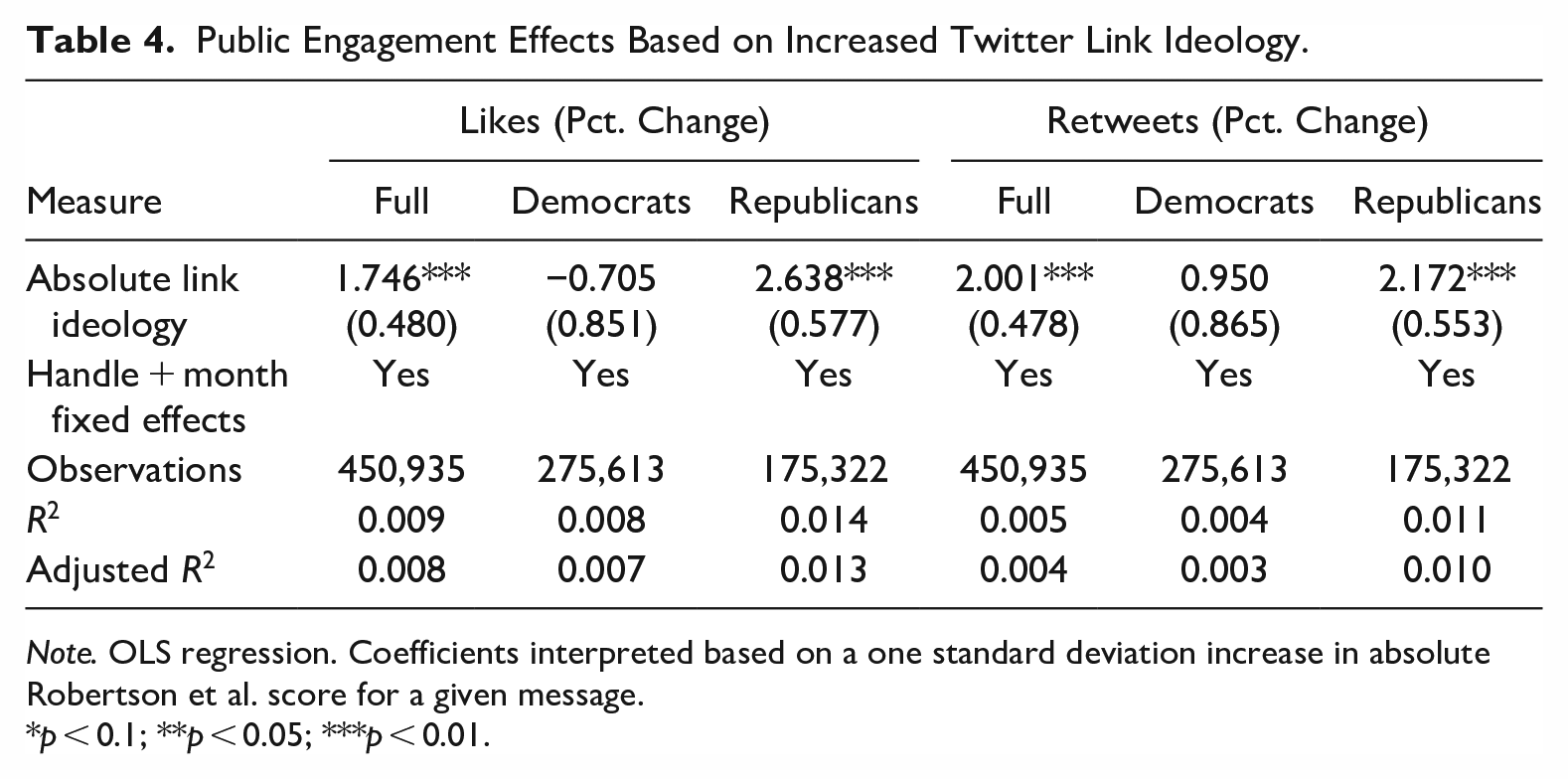
Note. OLS regression. Coefficients interpreted based on a one standard deviation increase in absolute Robertson et al. score for a given message.
p < 0.1; **p < 0.05; ***p < 0.01.
Public Engagement Effects Based on Increased Facebook Link Ideology.
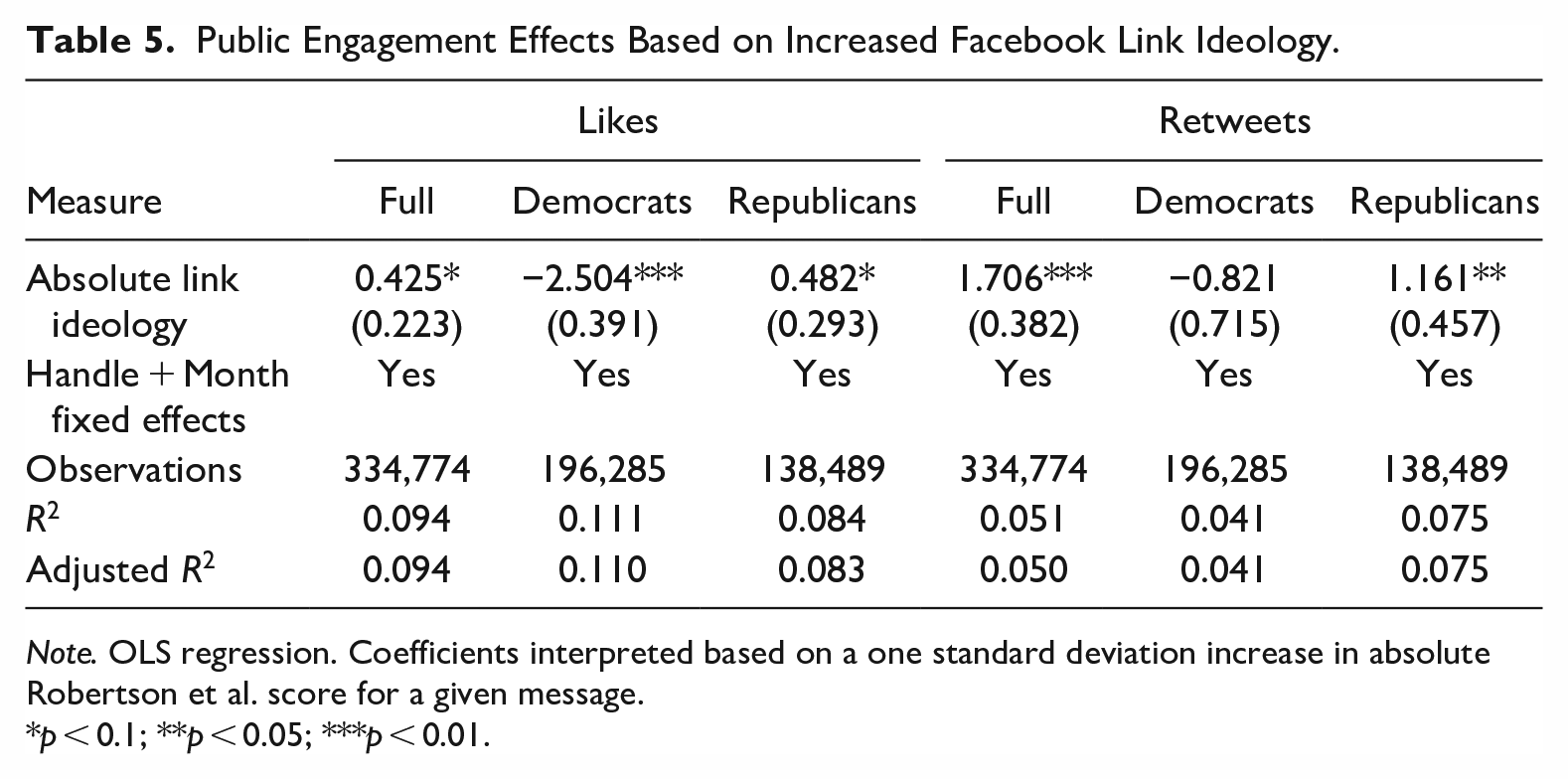
Note. OLS regression. Coefficients interpreted based on a one standard deviation increase in absolute Robertson et al. score for a given message.
p < 0.1; **p < 0.05; ***p < 0.01.
As can be seen, there are again partisan asymmetries in public engagement effects. Increased link ideology is generally associated with a positive increase in message engagement, however this positive effect is entirely on the part of Republican Members. On Twitter, Republicans see a between two to three percentage point increase in engagement when sharing links from more extreme outlets, whereas Democrats see no significant changes. On Facebook, positive effects for Republicans are slightly smaller, between 0.5 to 1 percentage point. However, for Democrats, both coefficients are in a negative direction and there is actually a significant decrease in likes received.
From a public demand standpoint then, there are small but significant engagement benefits for Republican Members sharing more extreme media, but not for Democrats. If a Member’s goal is to therefore maximize exposure to and engagement with the media that they share, then there is a rational incentive for Republicans to favor more extreme sources. For Democrats, there may be more of a demand-side tradeoff, meaning that linking to more moderate media may actually be an optimal strategy. Here then, the partisan differences may, at least in part, go some way toward further explaining the overall divergent trends in media engagement between the parties.
Conclusion
Overall, aligning with broader dynamics of asymmetric polarization in the United States (Grossman and Hopkins 2016), the results presented here show clear trends of asymmetric polarization in congressional media engagement over time, based almost exclusively on a growing engagement extremity by Republicans in Congress. This extremity growth is fueled, primarily, by a replacement of mainstream print outlets with ideologically aligned outlets, mostly in the form of Fox News, and is supplemented to a lesser degree by an increase in engagement with far right and “alternative” media sources.
Democrats, for their part, have stayed consistent in their media engagement, with center and center-left sources such as CNN, the Washington Post, and New York Times constituting the core of Democratic media interactions across all time periods. Collectively, as a result of these overtime changes, both parties are now almost perfectly sorted in terms of co-partisan media engagement, almost never linking to outlets on the opposing side of the ideological spectrum.
Importantly, these distinct partisan trends are not platform-specific, with clear asymmetric divergence occurring across both Twitter and Facebook posts, suggesting these shifts reflect Member preferences and changing behaviors generally, rather than any incentives specific to a particular platform. Additionally, these trends exist in parallel across measures of both media sharing and direct engagement, meaning that the content that Members choose to share and the types of media profiles that they directly engage with have shifted in unison.
At the Member level, much of this divide does indeed appear to be driven by ideology, with Member ideology being the clearest predictor of media engagement extremity. This relationship is not purely driven by increasing personal Member extremity in Congress, as the strength of this relationship has grown over time for Republican Members, independent of any concurrent increases in individual Member roll call extremity. Additionally, there was no evidence of a replacement effect, highlighting that these asymmetric trends are a result of (Republican) Members changing their individual engagement behavior over time and not merely being replaced by a new crop of freshman Members more willing to engage with the extremes.
Explaining these partisan asymmetries, these overall trends appear to have been exacerbated, in part, by the emergence of Donald Trump on the political scene and the results of the 2016 elections. These effects align with Donald Trump’s consistent attacks on the mainstream media and calls to reject these sources in favor of more ideologically favorable outlets. From the supply side, given that much mainstream coverage was critical of the Trump administration, Republicans were likely faced with greater incentive to go in search of more extreme media sources to support their preferred narratives on developing political stories. The effects of these changes are likely exacerbated by the media ecosystem on the right, which contains something of a void in the center-right space, but also contains an increasingly robust far right and alt-right segment (the jump from the Wall Street Journal to Fox News is from 0.01 to 6.01 on the Robertson scale, but the jump from Fox News to the Daily Caller or Infowars is from 6.01 to 6.12 and 7.82, respectively). From the demand side, Republicans enjoy a public engagement advantage when sharing more extreme media, providing further incentive for them to strategically shift their engagement rightward.
Looking forward, although the asymmetric trends in engagement and sharing may have accelerated in the Trump era, they do not necessarily show any signs of abating in the era following the Trump presidency. Given that the 2022 election actually saw the greatest levels of partisan divergence, it is likely that the central trends identified here may continue to increase in the future. With this in mind, further works exploring the public’s response to the embrace and amplification of extreme media sources are warranted. Additionally, with the strengthening of rightwing media ecosystems, globally, these trends may not merely be specific to the United States but may also extend to partisan dynamics in other national contexts (Heft et al. 2020, 2021).
Furthermore, while the central trends identified are revealing in and of themselves, future works may wish to investigate in greater detail the potentially self-reinforcing relationship between the media and Congress. If there is an increasing market for more ideologically aligned media, then outlets themselves may be incentivized to offer more ideological content. Congressional demand for and media supply of ideological content may therefore shift in parallel over time.
Additionally, while the analysis presented here offers a relatively macro assessment of engagement trends, at the more micro level there may be further variation in the exact types of articles being shared and the intent behind this engagement. If Members are indeed using more extreme media as means of sourcing more favorable coverage, then an open question remains as to whether the central shifts identified here have been consistent across type and topic of news reporting, leaving open the potential for further divergence in engagement with substantive or purely ideologically opinion content within outlets.
Collectively, the implications of the results shown here likely spill over into wider debates around asymmetric polarization and the contemporary polarized media and information environment. Members of Congress appear to be increasingly making strategic decisions about the types of media that they are amplifying and legitimizing based on personal and partisan considerations. This general polarization of media engagement results in an increasing lack of common information sources between partisan groups, producing greater potential for partisan echo chambers and misinformation. Additionally, elite legitimization of partisan media potentially leads to further subsequent public rejection or acceptance of particular media sources by partisan audiences. These factors, combined, likely contribute to a growing partisan divide in both the media ecosystem as well as the broader political system in the United States.
Supplemental Material
sj-docx-1-hij-10.1177_19401612231211800 – Supplemental material for Asymmetric Polarization in Online Media Engagement in the United States Congress
Supplemental material, sj-docx-1-hij-10.1177_19401612231211800 for Asymmetric Polarization in Online Media Engagement in the United States Congress by Michael Heseltine in The International Journal of Press/Politics
Footnotes
Declaration of Conflicting Interests
The author declared no potential conflicts of interest with respect to the research, authorship, and/or publication of this article.
Funding
The author received no financial support for the research, authorship, and/or publication of this article.

Supplemental Material
Supplemental material for this article is available online.
Notes
Author Biography
References
Supplementary Material
Please find the following supplemental material available below.
For Open Access articles published under a Creative Commons License, all supplemental material carries the same license as the article it is associated with.
For non-Open Access articles published, all supplemental material carries a non-exclusive license, and permission requests for re-use of supplemental material or any part of supplemental material shall be sent directly to the copyright owner as specified in the copyright notice associated with the article.
