




Abstract
The scholarly literature is observing a slow but steady growth in research exploring the effects of subnational economic inequality on political attitudes and behavior. Germane to this work is the assumption that citizens are aware of the level of inequality in their local residential context. At present, however, the evidence in support of this assumption is mixed. This article attempts to offer the literature improved tests of citizens’ awareness of local inequality by addressing a key limitation in past work—the discordance between the geographic unit underlying measures of the independent and dependent variables. Analyzing two national surveys employing a measure of perceived inequality scaled to the local level, the results suggest that citizens are indeed aware of the level of income inequality in their local environment and that the link between objective and perceived local inequality is most pronounced among lower income citizens.
Are citizens aware of the level of economic inequality in their local residential environment? This is a key question, especially in the US context, where income inequality has grown since the late 1970s. Theories of redistributive democracy contend that market inequality will be self-correcting in democratic political systems, as increases in inequality will trigger increased demand, especially among lower and middle-income citizens, for government redistribution (Meltzer and Richard, 1981). This expectation, however, has been met with mixed support, with some studies offering corroborating evidence (Dallinger, 2010; Finseraas, 2009; Schmidt-Catran, 2016) and others disconfirming evidence (Kenworthy and McCall, 2008; Lübker, 2007; Moene and Wallerstein, 2001). Focusing on the USA, scholarship finds that aggregate public support for redistribution did not increase between 1980 and 2010 when actual inequality was steadily rising (Ashok et al., 2015), that increases in aggregate inequality from one year to the next between 1952 and 2006 are accompanied by decreases in public support for redistribution (Kelly and Enns, 2010; cf. Johnston and Newman, 2016), and that institutional arrangements lead inequality to be self-reinforcing over time (Enns et al., 2014).
A key presumption underlying theories of redistributive democracy is that citizens will accurately perceive objective levels of national economic inequality (Kenworthy and McCall, 2008). While research on “macro politics” finds that Americans’ retrospections and expectations concerning national business conditions are linked to changes in macroeconomic conditions (Erikson et al., 2002; Wlezien, 2015), research on “innumeracy” (Lawrence and Sides, 2014) finds that Americans largely offer inaccurate estimates of macroeconomic statistics such as inflation, unemployment, and the median income (Conover et al., 1986; Holbrook and Garand, 1996; Lawrence and Sides, 2014; Sigelman and Yanarella, 1986). Combined with the substantial variation in subnational economic inequality that exists across locales (Bee, 2012), the research on innumeracy casts doubt upon theories or empirical models that consider national economic inequality as a singular, widely received treatment. Indeed, prior research finds that citizens are typically unaware of the level of income inequality in their nation of residence (Gimpelson and Treisman, 2018; Norton and Ariely, 2011) and that over-time perceptions of national income inequality track poorly with actual year-to-year trends (Bartels, 2008; Kenworthy and McCall, 2008). Overall, existing research uncovers substantial inaccuracy in citizens’ perceptions of levels of, and over-time changes in, national economic inequality. Borrowing the language of experimental methods, the literature points to the problem of treatment “noncompliance” (Gerber and Green, 2012), as citizens do not appear to be receiving the national inequality “treatment.”
In response, a growing thread of research demonstrates that citizens’ policy attitudes may respond to inequality in the manner suggested by theories of redistributive democracy, but that observation of the theorized relationship requires focusing on exposure to economic inequality in subnational contexts. For example, Franko (2016) finds that over-time increases in state-level income inequality are associated with subsequent liberal shifts in policy mood among state citizenries, and Johnston and Newman (2016) find that residing in a county or zip code with high levels of inequality is typically associated with modest increases in liberal policy mood. This work has been extended beyond policy attitudes, where local economic inequality has been found to influence belief in meritocratic ideology (Newman et al., 2015; cf. Solt et al., 2017), support for labor unions (Newman and Kane, 2017), voting in Senate elections (Newman and Hayes, 2017), and vigilante behavior (Phillips, 2017). This thread of research is based on the observation that “the public’s experience with income inequality can be quite distinct depending on the place where one lives” (Franko, 2017: 327) and the resulting assertion, most explicitly articulated by Johnston and Newman (2016), that scholarship should shift its focus to subnational contexts, particularly citizens’ local residential area, where objective levels of income inequality are more likely to be perceived. Indeed, a necessary link in the causal chain stipulated across this work is that citizens are aware of the amount of inequality in their subnational context.
How much evidence is there that citizens are aware of the level of economic inequality in their state or local area of residence? At present, few studies address this question, and evidence at the local level is inconclusive. There is evidence that the amount of income inequality within a state is positively associated with perceptions of growing national income inequality (Xu and Garand, 2010) and that over-time changes in inequality within a state are associated with increases in aggregate belief that the “rich are getting richer and the poor are getting poorer” (Franko, 2017). At the local level, Newman et al. (2015) demonstrate that the perception of American society as divided into “haves” and “have-nots” is positively associated with residing in a county with high levels of income inequality. This finding, however, is countered by Solt et al. (2017), who demonstrate that such results fail to hold when analyzed across a wider breadth of survey data, thus concluding that the available evidence fails to support the claim that perceived inequality corresponds to objective levels of local inequality. Most recently, Minkoff and Lyons (2017) report that perceptions of the level of inequality in New York City (NYC) are augmented by residing in a neighborhood with high income diversity. While these results align with those presented by Newman et al. (2015), they are limited in their generalizability due to analyzing data from a single city.
The purpose of this article is to address the question of citizens’ awareness of the level of economic inequality in their local residential context, and to do so in a manner that builds on the small body of existing research that speaks to this question. We build on prior research by addressing an important limitation in previous work—namely, the discordance between the geographic unit underlying the objective independent variable and the subjective dependent variable, where the former is measured at the local level (e.g. county of residence) and the latter is measured with respect to perceived inequality at the national level. For example, the analyses performed by Newman et al. (2015) and Solt et al. (2017) can be viewed as tests of citizens’ awareness of objective levels of local economic inequality. Both of these studies, however, rely on the following questionnaire item to measure awareness of inequality: “Some people think of American society as divided into two groups, the ‘haves’ and the ‘have-nots’, while others think it’s incorrect to think of America that way. Do you, yourself, think of America as divided into haves and have-nots, or don’t you think of America that way?” One concern in testing for citizens’ awareness of objective levels of local inequality with this type of question is that it prompts respondents to generate their response with respect to US society as a whole.
It is possible that citizens, while being aware of the level of economic inequality in their daily surroundings, do not bring such perceptions to bear—or do so inconsistently or in an under-theorized manner—when asked to consider economic conditions in the entire nation (Hopkins, 2013). Such a possibility was documented by Wong (2007) in relation to racial context, where the size of local racial groups failed to exert an effect on citizens’ perceptions of the size of such groups in the country as a whole. Concern over this possibility is further justified by Minkoff and Lyons (2017), who find that neighborhood-level income inequality strongly predicted perceptions of inequality in NYC but failed to predict perceptions of inequality in the nation as a whole. While there is evidence that citizens rely on local conditions to inform their evaluations of national conditions (Hansford and Gomez, 2015), countervailing work demonstrates that myriad characteristics of citizens’ local environment (e.g. power plants, military bases, air pollution) fail to exert a significant effect on attitudes over corresponding national policy issues (Hopkins, 2013). This work suggests that a superior test of whether or not citizens perceive local inequality is one where the subjective dependent variable is indexed to the local level. Indeed, efforts to index the geographic unit underlying the independent and dependent variable have increasingly become standard practice in the contextual effects literature, especially in the work addressing citizens’ perception of racial context (Velez and Wong, 2017; Wong, 2007).
Data and results
To address this limitation in existing research, we draw upon an N=1000-person pre-election module of the 2016 Cooperative Congressional Election Study (CCES). 1 The questionnaire for this module included an item asking respondents: “We’d like to ask you about your assessment of the local area where you live. To the best of your knowledge, how much economic inequality (that is, the size of the gap between the rich and the poor) would you say there is in your local area?” The response options for this item range from: (1) “None”; (2) “A Little”; (3) “Some”; (4) “A Good Amount”; and (5) “A Great Deal.” To assess the effect of objective levels of local income inequality on respondents’ perception of local inequality, we estimated a multilevel model with random intercepts that regresses perceived local inequality on the county-level Gini coefficient, as well as key contextual and individual-level controls included in the analysis by Newman et al. (2015). 2 To assess the robustness of the results to alternative definitions of “local context,” results are also presented from models using zip code as the measure of respondents’ local context.
The results from this analysis are presented in Figure 1, (a) and (b) (full results in Table C1 in Appendix C in supplemental materials). Beginning with Figure 1 (a), the results show that increasing levels of county inequality are associated with statistically significant increases in the probability of perceiving one’s local area as having higher levels of economic inequality. Moving from 5th to 95th percentile values of county Gini is associated with a 0.06 increase in the probability of perceiving a “great deal” of local inequality, and a 0.13 increase in the probability of perceiving more than “some” local inequality. Turning to Figure 1 (b), we see that the results hold and slightly increase in size, as a 5th to 95th percentile change in zip code Gini is associated with roughly a 0.07 (0.16) increase in the probability of perceiving a great deal of (more than “some”) local inequality. 3 The slight increase in the size of the effect of local inequality when focusing on zip code makes sense given that zips are smaller and less heterogeneous than counties. Indeed, Velez and Wong (2017) demonstrate that zip-level estimates of a variety of local population characteristics predict perceptions of these characteristics better than user-defined contextual units or county measures.
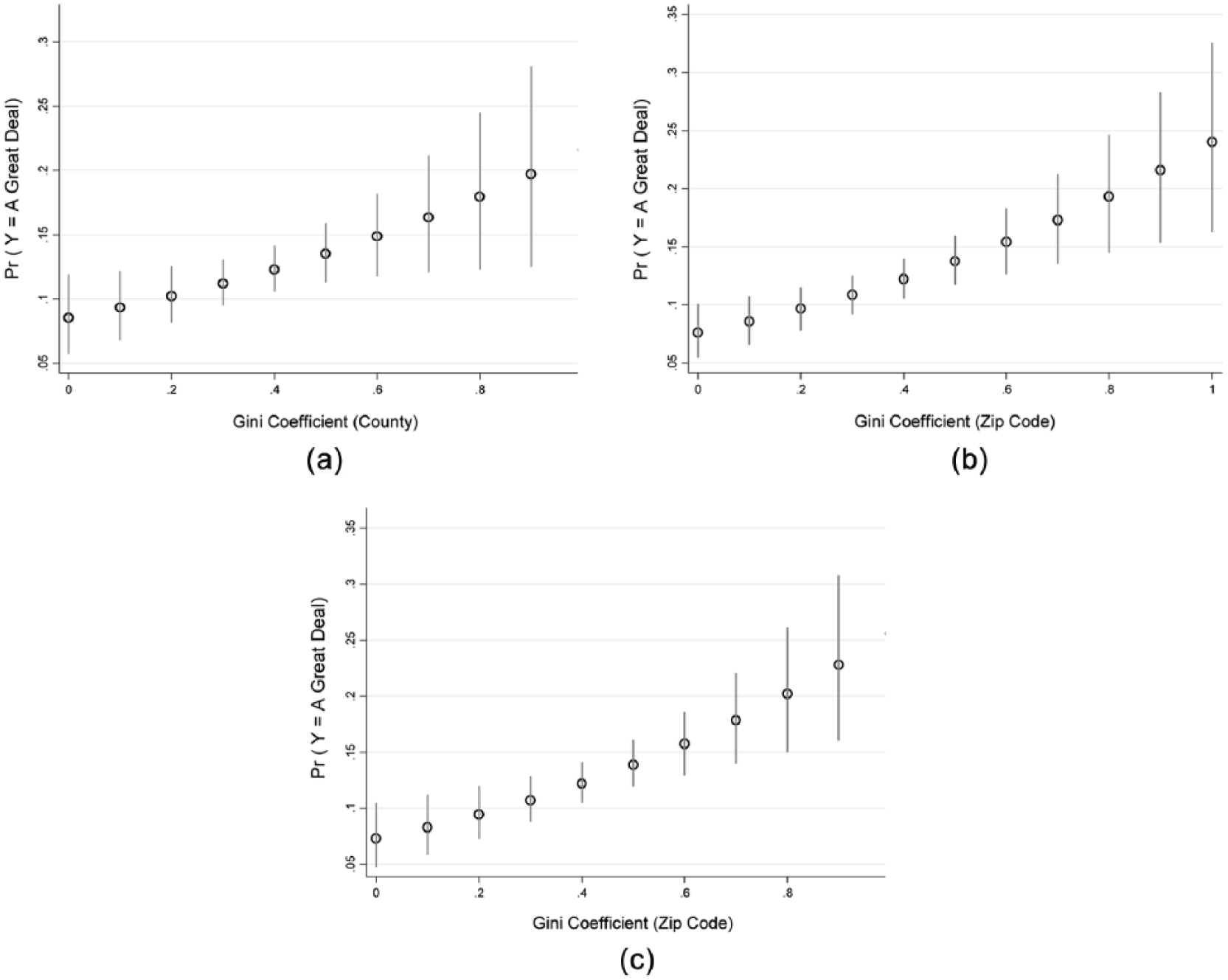
Perceived local income inequality across levels of objective local income inequality.
The results in Figure 1 corroborate a key argument offered by Newman et al. (2015), as they strongly suggest that citizens are cognizant of levels of local inequality. Our results hold when including controls for additional conditions present in respondents’ local economic context, such as family poverty, homelessness, and income diversity (Table D1 in Appendix D in supplemental materials). We report in Online Appendix D results from models employing alternative measures of income dispersion and concentration, such as income diversity (Minkoff and Lyons, 2017) and bimodal inequality (Johnston and Newman, 2016); we find that these measures perform poorly relative to the Gini coefficient, which is the most commonly used measure in the literature. Additionally, our results hold when using congressional district as the contextual unit (Table D4), however, this finding appears to derive from the strong positive correlations between zip, county, and district Gini, with district Gini rendered insignificant when including zip code Gini (Table D4). Finally, as many of the controls in our main model may be post-treatment to local inequality, we demonstrate that our results hold when using pre-treatment contextual controls (Table D6).
In addition to analyzing the main effect of Gini on perceived local inequality, the data can be broken down by respondent income to assess whether these effects vary by personal economic position. For example, Xu and Garand (2010: 1227) argue that “individuals with low income are likely to be the most vulnerable economically when income inequality is high, and hence we expect that lower-income Americans will be most sensitive to higher levels of income inequality.” Supporting their argument, Xu and Garand find that residing in a high inequality state is only associated with significant increases in perceived inequality growth for low income Americans. For this analysis, respondent income was broken into quintiles and the marginal effect of county and zip code Gini was estimated for each income quintile. The results from this analysis are presented in Figure 2 (Tables C2 and C3 in supplemental materials).

Changes in perceived local inequality associated with changes in objective local inequality by income group.
Figure 2 (a) displays changes in the predicted probability of perceiving “a great deal” of local inequality associated with a 5th to 95th percentile increase in Gini at the county (hollow circles) and zip code (solid circles) level. Focusing on the results using county as the contextual unit, we only observe a positive and significant effect of county Gini among the poorest respondents (i.e. those earning below US$30k per year). The effect among respondents in the first quintile is sizeable, as an increase in Gini is associated with a 0.18 increase in the probability of perceiving “a great deal” of inequality. The effect of Gini among those in the second lowest income category is still positive but fails to attain statistical significance. The results for zip code Gini depart from the results using county Gini: the substantively largest effect for zip code Gini is observed for respondents in the second income quintile (US$30 to US$50k). While we fail to observe a positive and significant effect among respondents earning below US$30k, we nonetheless observe a sizeable correspondence between objective and subjective income inequality among respondents whose reported income places them below the median in 2016 of US$57.6k per year. The effect of zip code Gini among respondents in the third income quintile is positive and marginally significant but insignificant at the p < .05 level. The effects of zip code Gini among those in the fourth and fifth quintiles, while similar in magnitude and not statistically different from its effects among those in the second and third quintiles, fail to attain even marginal significance. When jointly considering the results using county and zip code, the picture conveyed is that the perceptions of those earning below the median income tend to be the most responsive to local income inequality. Importantly, this finding is replicated in the following section.
Replication and extension
To assess the robustness of these results, we perform a replication using an N=1000-person national survey conducted online by Qualtrics (see Appendix A in supplemental materials). This survey included the perceived inequality item utilized in the CCES analysis, and for comparison purposes, included the national-level perceived inequality question (i.e. “Is American society divided?”) analyzed by Newman et al. (2015) and Solt et al. (2017). In contrast to the CCES, which includes county and zip code identifiers for respondents, our Qualtrics survey only includes zip codes. 4 We present the results from analysis of this data in Figure 1 (c) and Table 1, column 1. Consistent with the results from the 2016 CCES, we find a positive and significant effect of zip code Gini on perceived local inequality. Moreover, Figure 1 reveals that the size of the effect of Gini in the Qualtrics data is comparable to that observed in the CCES data.
Comparison analysis—effect of local income inequality on perceived local and national income inequality.

DV: dependent variable
Source: Qualtrics Omnibus Survey, May 2017.
Notes: Entries are unstandardized regression coefficients from random intercepts logistic regression models estimated using gllamm and xtlogit in Stata®, standard errors in parentheses. “∆Pr (Y) / ∆ Gini” is the first difference in the probability of perceiving “A great deal” of inequality (or America as divided into “haves” and “have-nots”) associated with a 5th to 95th percentile increase in Gini.
p < .10, *p < .05, **p < .01, ***p < .001, based upon two-tailed hypothesis tests.
Turning to the analyses by respondent income, presented in Figure 2 (b) (Table C7), we find that the pattern of effects of Gini align with the prediction of Xu and Garand (2010) and complement the findings from the CCES data: the most significant effects of Gini are among respondents earning below US$50k, with the most pronounced effect among those earning below US$25k. Finally, to connect our analyses to those conducted by Newman et al. (2015) and Solt et al. (2017), we analyze the effect of local inequality on both perceived local and national economic inequality. The results in Table 1 reveal that, while exerting a positive and significant effect on perceived local inequality (column 1), Gini failed to exert a significant effect on perceptions of inequality at the national level (column 2): the coefficient is negative but statistically indistinguishable from zero, which is consistent with the findings reported by Solt et al. (2017). In sum, when the measure of awareness of inequality refers not the nation as a whole but to one’s local area of residence, we observe strong and consistent evidence that citizens are “receiving the treatment.”
Conclusion
A critical assumption underlying the work exploring the effects of subnational economic inequality on political attitudes and behavior is that citizens are aware of the level of inequality in their residential context. Prior research, however, renders mixed evidence in support of this assumption. This article builds on prior work, particularly that by Newman et al. (2015) and Solt et al. (2017), by indexing the measure of perceived inequality to the geographic scale of the “treatment” variable. While these past works report inconsistent effects of objective local inequality on perceived inequality in the nation as a whole, we find consistent positive and significant effects of local inequality on perceived local inequality. Further, across two national samples, we find that the linkage between objective and perceived local inequality is most pronounced among those with lower incomes.
Our findings contribute to the existing literature by expanding the scope of the study performed by Minkoff and Lyons (2017), whose analysis similarly differentiates between perceived national and local inequality but is restricted to respondents in a single city. Importantly, while citizens evince awareness of local inequality, our findings—as well as those reported by Minkoff and Lyons (2017) and Solt et al. (2017)—indicate that they do not translate local conditions into perceptions of economic conditions in the nation as a whole. Taken together, our results support the argument articulated by Newman et al. (2015) and Johnston and Newman (2016) that, while innumerate with respect to national inequality, citizens will be aware of the inequality surrounding them on a daily basis. These findings suggest the possibility of a correction mechanism for inequality predicted by theories of redistributive democracy, however, one that unfolds in a more spatially nuanced and local manner than previously theorized.
On a final note, the insignificant effects of the alternative measures of income dispersion and concentration we report in Appendix D in supplemental materials conflict with results reported by Minkoff and Lyons (2017), who find that neighborhood income diversity and “bimodal” inequality (Johnston and Newman, 2016) significantly predict perceived inequality in NYC, while Gini does not. While our results are broader in scope than those presented by Minkoff and Lyons due to being based upon two national samples (compared to a sample of NYC residents), the study conducted by Minkoff and Lyons has undeniable strengths, such as possessing geolocation data enabling the analysis of finer-grained and customized measures of neighborhood context. In the end, we view these conflicting findings as suggesting the need for further research. What is particularly warranted is research offering a deeper exploration of the mathematical features of different measures of inequality, differences in the “day-to-day” manifestations of income disparity associated with such measures, and the psychological dynamics governing how individuals perceive their environment and the types of characteristics that capture attention.
Supplemental Material
Hourglass_Society_RandP_Supplemental_Appendix – Supplemental material for Who sees an hourglass? Assessing citizens’ perception of local economic inequality
Supplemental material, Hourglass_Society_RandP_Supplemental_Appendix for Who sees an hourglass? Assessing citizens’ perception of local economic inequality by Benjamin J. Newman, Sono Shah and Erinn Lauterbach in Research & Politics
Footnotes
Declaration of conflicting interest
The author(s) declared no potential conflicts of interest with respect to the research, authorship, and/or publication of this article.
Funding
This research received no specific grant from any funding agency in the public, commercial, or not-for-profit sectors.
Supplemental materials

Notes
Carnegie Corporation of New York Grant
This publication was made possible (in part) by a grant from the Carnegie Corporation of New York. The statements made and views expressed are solely the responsibility of the author.
References
Supplementary Material
Please find the following supplemental material available below.
For Open Access articles published under a Creative Commons License, all supplemental material carries the same license as the article it is associated with.
For non-Open Access articles published, all supplemental material carries a non-exclusive license, and permission requests for re-use of supplemental material or any part of supplemental material shall be sent directly to the copyright owner as specified in the copyright notice associated with the article.
