



Abstract
Despite growing attention to income inequality in debates about European integration, our understanding of its effect on European Union support remains limited. Using European Social Survey data from 2002 to 2020, we analyse how income inequality and pro-redistribution attitudes shape diffuse and specific forms of support for the European Union. We find no direct effect of country-level income inequality, while individual support for redistribution has a negative effect on both. In line with benchmarking theory, inequality emerges as a contextual moderator: in unequal national settings, egalitarian citizens are comparatively more supportive of further integration than in more equal countries. This effect persists when we control for income position, suggesting an ideological rather than utilitarian basis for benchmarking European Union attitudes. We discuss implications in light of debates about a social Europe.
Introduction
The decade after the Great Recession has seen exploding attention to inequalities of income and wealth in European societies, often regarded as a consequence of European integration (Beckfield, 2019; Busemeyer and Tober, 2015; Burgoon, 2013). Studies in sociology and political science attest to the effects of inequality on voting behaviour, trust and participation (Andersen et al., 2014; Lancee and Van De Werfhorst, 2012; Solt, 2008). Relating these back to the question of integration, a common argument is that high inequalities have harmed perceptions of the European Union (EU), as citizens would blame the unequal distribution of resources on its advocacy of market-building and liberalization. At the onset of the crisis, some speculated that ‘debates over eliminating inequalities could produce the next great cleavage in European Union politics’ (Kaltenthaler et al., 2008: 235). Later, Kuhn et al. (2016: 41) foresaw that if ‘increasing Euroscepticism as a result of the handling of the crisis is combined with increasing Euroscepticism as a result of within-country income inequalities, support for the European project may decline considerably’. Along similar lines, Hopkin (2017) and others have connected the Brexit vote to rising inequality in the United Kingdom (UK) (but see De Vries, 2018).
In how far has inequality eroded support for the EU in the 21st century? Recent research provides evidence for the claim that growing income inequality augmented Eurosceptic sentiments in the post-Maastricht era (Kuhn et al., 2016; Simpson and Loveless, 2017; Lipps and Schraff, 2021), but empirical support in the literature is limited and points in different directions (Ritzen et al., 2016; Schraff, 2020). Against the background of diverse trends in income inequality across member states, this article provides a comprehensive and systematic answer to the question whether and how income inequalities affected EU attitudes before and after the Great Recession, often seen as a breakthrough period for Eurosceptic parties and sentiments (Armingeon and Ceka, 2014; Hobolt and De Vries, 2016). Drawing from the literature on institutional trust and the benchmarking of EU public opinion (e.g. De Vries, 2018), we expect high levels of, and increases in, income inequality to be associated – perhaps counterintuitively – with higher support for integration. We furthermore argue that this macro-context moderates the effect of support for redistribution on EU attitudes: while egalitarian1 citizens will be more negative about the EU in more equal countries where integration may appear as a potential threat, those in unequal societies might see it as a remedy for domestic inequalities.
Using multilevel regression models to analyse pooled data from the European Social Survey (ESS) between 2002 and 2020, we find no aggregate effect of inequality on EU support, whereas egalitarian citizens tend to have less trust in the EU and are less enthusiastic about integration. We find robust evidence that egalitarian citizens tend to be more supportive of further integration in settings where inequality is comparatively high or has risen over the years. This contextual effect shapes support for unification, even when controlling for income position, suggesting that the benchmarking of the EU against national performance in reducing inequalities may be more ideological than utilitarian in nature. Trust in the European Parliament (EP), in contrast, remains lower among egalitarian citizens irrespective of context. We discuss the ramifications of these findings for the study of EU public opinion in light of debates on a ‘social Europe’.
Income inequality and public support for the EU: Reviewing the recent debate
A major strand of research into the drivers of EU public opinion has examined the importance of the socio-economic context in which citizens find themselves. This scholarship has been strongly anchored in a ‘utilitarian’ perspective on opinion formation, which holds that individuals’ attitudes towards the EU are primarily shaped by the material benefits that they derive from the integration process (Anderson, 1998; Gabel, 1998; Gabel and Whitten, 1997). While such work has unpacked the effects of macro-level economic variables such as unemployment, gross domestic product (GDP) growth and inflation, it has also been attentive to the risks and benefits that integration entails for different social groups and the implications for their attitudes (Anderson and Reichert, 1995; Herzog and Tucker, 2010).
Despite ample consideration of the ‘winners and losers’ of European integration, issues of socio-economic inequality – of income, wealth or other resources – initially attracted less attention. This changed in the wake of the Great Recession, as the socio-political salience of inequality grew. Building on parallel work into attitudes towards national politics, which demonstrated that high and growing income inequalities have translated into lower institutional trust and less satisfaction with democracy (Andersen et al., 2014; Anderson and Singer, 2008; Rothstein and Uslaner, 2005; Schäfer, 2010), a literature emerged that grapples with its ramifications for public support for the EU. The main contributions in this field, their design and findings are summarized in Table 1.
Recent studies of income inequality and EU support.
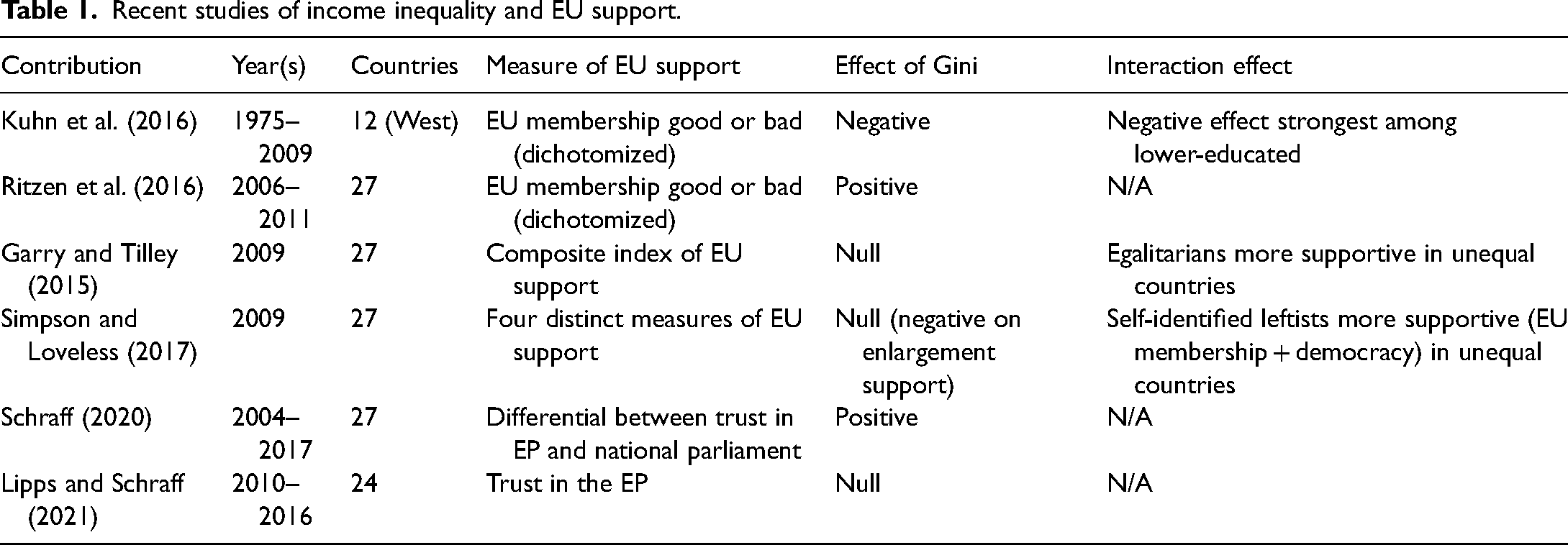
Most available studies have focused on the aggregate relation between income inequalities at the country level and support for the EU. These analyses point in different directions. Whereas Kuhn et al. (2016) notably find a negative impact of rising inequalities on views about EU membership, other studies find null results or even a positive effect. This applies regardless of whether these studies investigate the different levels of inequality between countries (Garry and Tilley, 2015; Lipps and Schraff, 2021; Simpson and Loveless, 2017) or the evolution of inequality in countries over time (Lipps and Schraff, 2021; Ritzen et al., 2016). For example, Schraff (2020: 1227) presents clear evidence that ‘worsening domestic conditions in the form of increased inequality lead to higher EU regime support’ between 2004 and 2017. While these studies vary considerably in their respective period of analysis, countries and measurement of EU support, we do not detect systematic differences that could explain the variety of outcomes.
Existing scholarship exhibits two main limitations that have confined our understanding of the implications of income inequalities for EU public opinion. First, although the literature on socio-economic inequalities has attested to the importance of individual perceptions and attitudes toward redistribution, the EU literature has paid little attention to their role. Simpson and Loveless (2017) have suggested that concern with inequality is associated with lower support for the present EU, but more enthusiasm about enlargement and deepening. However, we expect that these effects will be contingent on the socio-economic circumstances in which individuals find themselves. Indeed, the idea that inequality functions as a contextual moderator finds support in a study by Garry and Tilley (2015), who presented evidence that egalitarian citizens in countries with higher levels of income inequality are more positive about the EU. However, the fact that their analysis is based on a single year creates the risk of a snapshot and does not allow for the estimation of the effect of rising (or decreasing) inequalities. We instead exploit a longitudinal dataset on the period before and after the Eurozone crisis, using a research design that enables us to differentiate the effects of between-country variation and over-time changes in inequality. Second, most research has not accounted for the different facets of public opinion, despite the well-established argument that EU attitudes are multidimensional (Boomgaarden et al., 2011). In this article, we distinguish theoretically and empirically between the effects on diffuse and specific forms of support of the EU.
Trends in income inequality before, during and after the Eurozone crisis
Existing analyses often start from the assumption that income inequalities in the EU have been on the rise in the 21st century, but in doing so risk overlooking major differences between countries. Before theorizing its relationship to public attitudes, we therefore take stock of trends in inequality in the past two decades. The article uses the Gini index of disposable income, i.e. after taxes and social transfers, as its main indicator, relying on data from the Standardized World Income Inequality Database (SWIID) (Solt, 2020). Because Gini ‘calculates the overall inequality in society [and] captures the income distances of “everybody to everyone”, which is in line with general arguments for why inequality matters’ (Lancee and Van De Werfhorst, 2012: 1170), it has become the most frequently used measure of income inequality in sociology, economics and political science (OECD, 2008; Tóth, 2014). This includes the cited work on EU public opinion. For reasons of comparability and data availability, we follow the same approach. As a robustness check, we rerun our regression analyses with two alternative specifications of income inequality that are more sensitive to changes at the extremes of the income distribution – the Palma index and the rate of relative poverty – but this does not substantially alter our results.
Figure 1 plots the trends in the Gini index for each member state between 2002 and 2020. Levels of income inequality differ considerably between European societies. In 2020, Slovakia, Slovenia and the Czech Republic were among the most egalitarian countries of the EU, with an average post-tax Gini index below 25. Bulgaria stands out as the most unequal country in the EU in 2020, with a Gini of almost 39, while Lithuania and Latvia also rank among the top unequal societies with values around 35. In other words, the most unequal member state in the EU is about 70% more unequal than the most egalitarian one. There is no clear East-West divide, as we find countries from both geographic regions among the low- and high-inequality clusters.
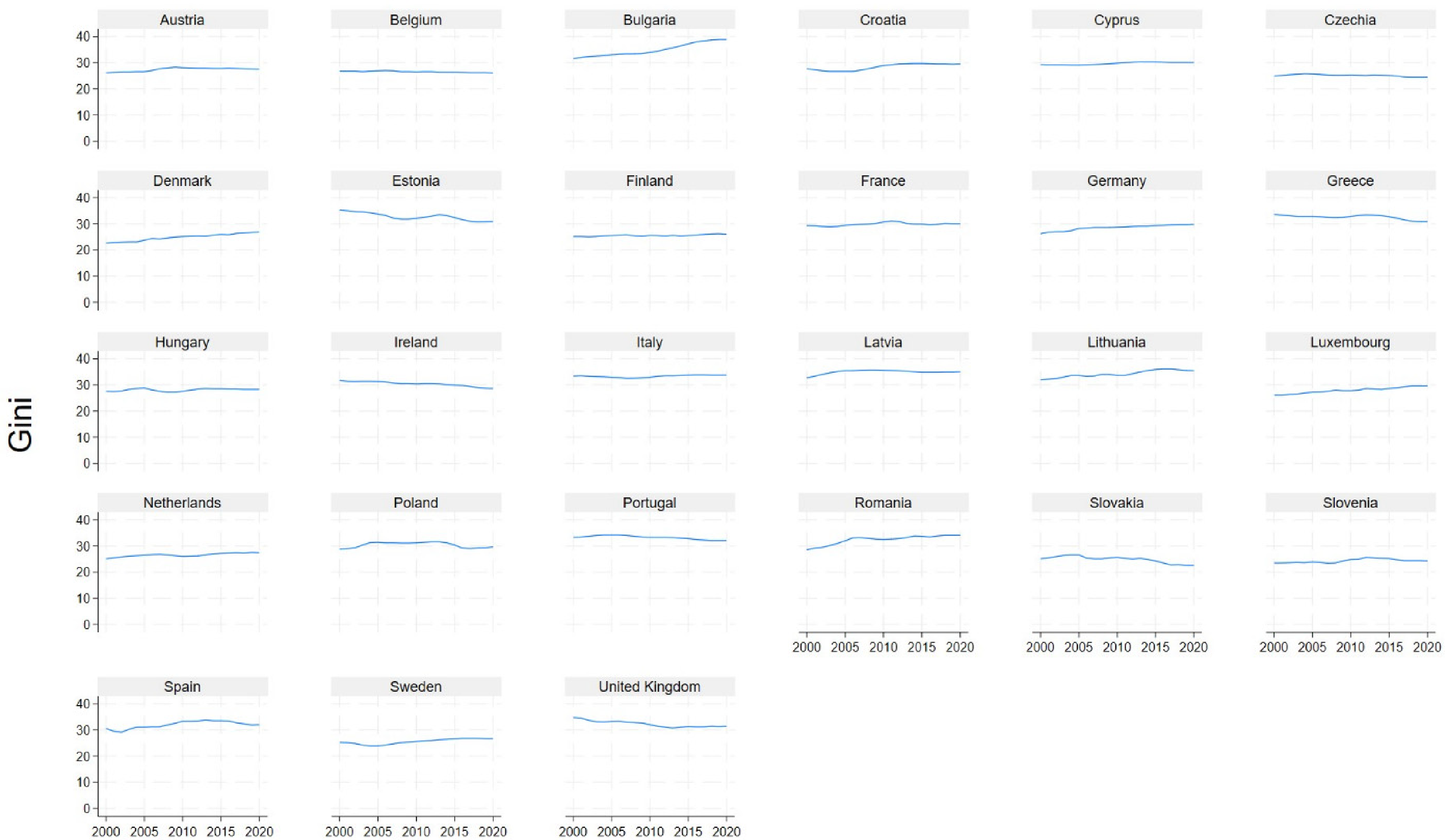
Disposable income inequality (Gini) across EU member states.
Overall, disposable income inequality in the EU member states has grown in the past two decades, but the increase is minor: between 2002 and 2020, the EU-average Gini index rose by 0.83 points from almost 29 to almost 30, i.e. by about 2.9%. The brunt of this increase occurred before the economic crisis. Despite the turmoil that the EU witnessed during the Global Financial Crisis and Eurozone crisis, the average level of income inequality flatlined in the post-2010 period. In either case, though, the aggregate pattern risks overlooking heterogenous developments. While 19 out of 27 countries saw a net increase in income inequality, there are strong differences in the magnitude of change. Bulgaria, one of the most unequal EU countries, experienced the sharpest rise in income inequality with an increase in the Gini index of around 7 points (23%). Denmark, Luxembourg and Romania also have considerably more unequal income distributions than at the start of the century. Countries including Belgium, Hungary, Italy and Poland have been more stable, witnessing a small decrease or increase on balance. Several countries became notably more equal in the last 20 years: Estonia and Slovakia, but also the liberal welfare regimes of the UK and Ireland were marked by a substantially lower Gini index in 2020 than in 2002.
Theorizing the effects of income inequality and egalitarianism on EU support
What does this variation in levels and trends in income inequality portend for support for the EU? Should we expect the increase in inequality to have aggravated Eurosceptic sentiments? It may matter what type of attitudes we are talking about. We follow the common distinction between diffuse and specific forms of EU support. On the one hand, we are interested in institutional trust, which ‘can function as a general proxy measurement for diffuse support [that] represents the fundamental element of the relation between citizens and the political system’ (Goubin and Hooghe, 2020: 221). Trust in institutions can build up – or break down – via an evaluation of their overall performance in producing concrete benefits but also hinges on the perceived quality of the process of governance (Harteveld et al., 2013; Van Der Meer and Hakhverdian, 2017). Specific support for the EU, on the other hand, relates to the actual or future direction of integration, ranging from developments in a single policy domain to enlargement or deepening (Boomgaarden et al., 2011). We consider both dimensions and theorize their relation to income inequality, which we test in the empirical section.
As noted, studies of national settings have found that high and rising income inequalities undermine trust in political institutions across societal strata (Andersen et al., 2014; Christmann, 2018; Goubin and Hooghe, 2020). While a negative assessment of institutional performance would damage the perceptions of egalitarian citizens (Anderson and Singer, 2008), inequalities may also produce a drop in generalized social trust and perceived political efficacy, which could even hurt the institutional trust of those individuals who do not favour redistribution (Bienstman et al., 2023; Rothstein and Uslaner, 2005). A plausible expectation is that these effects spill over into lower trust in EU institutions, as citizens with limited knowledge of EU affairs would use the national context as a proxy and extrapolate their judgements about the latter (Anderson, 1998; Kritzinger, 2003). Conversely, income inequalities may have a positive effect on EU trust as citizens come to regard supranational governance as an alternative for failing national institutions (Harteveld et al., 2013; Sánchez-Cuenca, 2000). These mechanisms of congruence and compensation may also operate simultaneously, as Muñoz et al. (2011) demonstrate, insofar as higher levels of individual trust are associated with more trust in the EU, whereas higher average national trust is associated with a lower degree of EU trust (see also Lipps and Schraff, 2021).
In contrast, some of the recent literature has assumed a more direct relationship: citizens would blame the EU for rising levels of income inequality in a way that detrimentally affects their opinion, in particular in regards to more policy-oriented attitudes (Kuhn et al., 2016). The notion that the market expansion and liberalization accompanying European integration have contributed to growing inequalities – e.g. by promoting welfare retrenchment – is widespread in academic discourse (Andersen et al., 2014; Beckfield, 2019). In the political arena, this idea has informed opposition to integration and economic governance, especially in the wake of the Great Recession (Burgoon, 2013; Kuhn and Stoeckel, 2014). A number of studies indeed suggest that citizens have blamed the EU for the performance of public services (Kumlin, 2009) or a worsening economic situation during the Eurozone crisis (Baute and Pellegata, 2023; Biten et al., 2023). However, there is no specific evidence that bears on the attribution of blame for (increases in) the level of income inequality, let alone on the connection between such perceptions and EU attitudes.
Given the well-established and recognized role of national welfare states and labour market arrangements in protecting citizens from social risks, we expect national rather than EU institutions to attract most of the blame for income inequalities. Thus, ‘if inequality rises, it should put pressure on the governance level that keeps the main responsibility for containing inequalities – namely the national level’ (Schraff, 2020: 1219). As the compensation mechanism holds, poor performance at the member state level can foster trust in EU institutions, which would appear more capable of addressing these challenges than the national regime. We find further support for this reasoning in benchmark theories of EU public opinion, which suggest that the inferior performance of national systems compared to other member states – especially when combined with low trust in domestic institutions – improves the perceived benefits of membership (De Vries, 2018; Hobolt and De Vries, 2016). Inequality may even prompt citizens to see a need for more supranational problem-solving irrespective of their actual trust in national institutions, as Schraff (2020) suggests. 2 In particular because support for income redistribution is rather stable and broad-based across European welfare states (Kudrnáč and Petrúšek, 2022), we expect that high and rising income inequalities are not only associated with a higher level of trust in EU institutions but also with higher support for further European integration, as the opportunity costs of a sovereignty transfer will (perceived to) be smaller when domestic problems such as inequality loom large (cf. Sánchez-Cuenca, 2000).
Higher levels of, and increases in, income inequality are positively associated with trust in the EU.
Higher levels of, and increases in, income inequality are positively associated with support for further European integration.
In addition, we expect these effects of inequality on EU public opinion to hold independently of the ‘generosity’ of national welfare states. To be certain, earlier work has found that individuals in high-spending welfare states tend to be less supportive of the EU (Beaudonnet, 2015; Kumlin, 2009). However, while welfare states play a crucial role in the reduction of (disposable) income inequality, the relation between their generosity – as measured by social expenditure – and income redistribution is highly indeterminate. This is the result of the weight of earnings-related insurance and public service provision in welfare spending, as well as the effect of the welfare state on the pre-transfer distribution of income, which is theoretically non-negligible but ‘virtually impossible to define’ empirically (Esping-Andersen and Myles, 2011: 652; Hacker and Rehm, 2022).
Of course, individual citizens have different redistributive preferences and may not regard inequality as an (equally) urgent issue. Meltzer and Richard (1981) famously theorized that such preferences are largely a matter of income position. Since the distribution of incomes is skewed to the right, the income of the median voter will be below the mean. Thus, it is in their interest – and of those with a lower income – to favour redistribution. Higher inequality moves the median voter to the right, increasing redistributive demands. The model has yielded mixed evidence (Finseraas, 2009; Kenworthy and McCall, 2008). Behavioural economists argue that citizens may hold altruistic attitudes and that different views of ‘fairness’ lead to behaviour that is not concerned with a maximization of economic self-interest (Falk et al., 2008). Citizens in different countries have diverging perceptions of, and tolerance for, inequalities (Alesina et al., 2004; Luebker, 2014). In this sense, redistributive preferences are (also) a matter of values and ideology, although not simply of left-right positioning. With ongoing political realignments, the strong association between left-wing self-identification and support for redistribution has become less pronounced (De Vries et al., 2013; Elchardus and Spruyt, 2012). In many countries, a sizable group of citizens who identify as right-wing and/or vote for (radical) right parties are somewhat or very supportive of income redistribution, even if only for the ‘native’ majority (Savage, 2023).
How do citizens with pro-redistribution attitudes perceive the EU compared to other individuals? One might expect that they will be more negatively disposed towards the EU, as they associate it with a project of liberalization and market-making. Conversely, one could anticipate that they would be supportive of a larger and deepened EU that could mitigate socio-economic inequalities (Reinl et al., 2023; Simpson and Loveless, 2017). In line with benchmarking theory, however, we argue that it makes little sense to consider the effects of this kind of individual-level disposition in isolation. What ultimately matters, rather, is how EU public opinion is shaped by the interaction between individual characteristics and a changing macro-context (cf. Anderson and Singer, 2008). This leads us to inquire how the effect of egalitarianism on support for the EU might be conditional on given trends and levels of income inequality.
Along these lines, Garry and Tilley (2015: 145) have suggested that egalitarian citizens in low-inequality countries are more negative about the EU than those in unequal contexts, because of ‘reasonable expectations as to how [a more integrated EU] would be different from (and thus move) their existing member state position’. This argument draws on prior research that examines how left-right positioning and welfare regimes together shape EU support. The assumption is that ‘Europeans expect that European integration will lead to a convergence of policy outcomes across the EU’ (Ray, 2004: 53; see also Brinegar and Jolly, 2005; Brinegar et al., 2004). Citizens are seen to anticipate that EU membership, and further integration in particular, would bring about higher levels of inequality in more equal countries and vice versa. This presumes rather extensive policy knowledge among citizens, which itself has not been empirically tested.
A similar but rather more plausible mechanism, we argue, can be derived from benchmark theories of EU public opinion. These hold, as discussed, that perceptions of the EU depend on an evaluation of (non-)membership which uses the national context as the primary heuristic: ‘the way people view the EU is intrinsically linked to the national conditions in which they find themselves as well as their comparison of these conditions to those at the EU level’ (De Vries, 2018: 5). Various studies have found that this benchmarking mechanism can account for the impact of political-economic factors such as institutional trust or unemployment on EU support (Foster and Frieden, 2021; Muñoz et al., 2011; Sánchez-Cuenca, 2000). As theorized above, we anticipate that support for the EU will increase if a country is seen to perform ‘badly’ – implying, in the present context, that the income distribution is more unequal than in other countries, or higher than in the past.
This contextual variable, in turn, should condition the effects of egalitarianism. In countries where income inequality is high or on the rise, citizens who favour more redistribution will be less distrusting of EU institutions than their counterparts in relatively equal countries. We expect this interaction effect to be stronger when it comes to support for unification, which to egalitarians in unequal countries may offer the positive prospect of a ‘life buoy’. Conversely, those with pro-redistribution attitudes in comparatively equal societies are expected to consider further integration unnecessary or even threatening, given that ‘there is potentially less to gain and more to lose’ (Harteveld et al., 2013: 549) through the transfer of (social) sovereignty.
Egalitarian individuals have less trust in the EU, but this effect is weaker in countries with relatively high or increasing inequality.
Egalitarian individuals are less supportive of European integration, but this relationship becomes positive in countries with relatively high or increasing inequality.
Data and methods
Dataset
Given our interest in both between-country and within-country variation, our sample requires cross-national data that cover a long time span. We opt for the ESS (European Social Survey, 2023), which is well-suited to test our hypotheses because it fields questions about preferences for redistribution, while containing items that capture the multidimensional character of EU attitudes (Boomgaarden et al., 2011). The ESS has been fielded biennially since 2002, resulting in 10 rounds, which we pooled into a comprehensive dataset with information about individual attitudes between 2002 and 2020. In total, 27 EU countries participated in the ESS, with only Malta missing. Not all countries have participated with the same frequency, but 19 participated in at least seven rounds. As such, the ESS offers the most exhaustive data set available to test our hypotheses. Detailed information about countries and respondents can be found in Online appendix.
Dependent variables
We include two dependent variables in the sample. First, we use a question that asks to what extent respondents trust the EP. In line with previous studies, we rely on this measure as a proxy of trust in the EU regime and satisfaction with its performance, since the EP directly represents EU citizens and has a clear comparator in the shape of national parliaments (Dotti Sani and Magistro, 2016; Muñoz et al., 2011; Schraff, 2020). To complement this present regime orientation with a future policy-oriented measure, we use a second item that maps how respondents view the level of integration with a question that asks whether unification should go further or has gone too far already. Both questions are scaled from 0 to 10, with higher values representing more positive attitudes. While the variables show some overlap, the correlation is moderate at most (0.34, p < 0.00), indicating that they tap into different dimensions of EU attitudes (cf. Boomgaarden et al., 2011). Summary statistics can be found in Online appendix.
Independent variables
To test our hypotheses, we rely on independent variables at the individual and country levels. Our main individual-level variables should measure egalitarian economic attitudes, given our expectation that individuals with a different valuation of inequalities assess European integration in a dissimilar fashion. Thus, we include a question that asks respondents whether they believe that the government should reduce differences in income levels. This item has found widespread use in research to capture support for redistribution (Finseraas, 2009; Schmidt-Catran and Fairbrother, 2016). Answers range from strongly disagree (1) to strongly agree (5).
At the country level, the primary variable of interest is income inequality. We use the Gini index as our main indicator, as discussed in the second section of the article. Ranging from 0 to 100, with higher values indicating higher inequality, Gini is available for all years of interest in the SWIID (Solt, 2020). 3 Since we are interested in the inequalities that shape people's daily quality of life, we use the Gini index for disposable income after taxation and transfers, capturing the redistributive effects of the welfare state. As indicated, we use two alternative measures of disposable income inequality as robustness checks.
To ensure that we capture the effect of income inequality, we include several country-level control variables that past literature has found to influence EU attitudes. These are of an economic nature and likely to be related to inequality, making their inclusion essential to avoid spurious relationships. To account for income differences between member states, we include GDP per capita. We also control for other macroeconomic conditions that influence EU support, namely unemployment and inflation (Foster and Frieden, 2021). To control for an additional effect of the welfare state, Eurostat data on general government expenditure on social protection are added to the model. 4 The analysis does not include a lag for country-level variables because ESS fieldwork is done in the second half of each respective year, often ending in the next year. As such, we expect the data from the same year to be the most accurate to analyse the effect of contextual variables. We also control whether the country was a member of the EU in the respective year.
At the individual level, we control for variables of a mainly socio-demographic nature: age, gender, education (in years), employment status and left-right placement. 5 Income is not included at this stage due to missing values but is used as a robustness check after the main analysis.
Missing values
Given that the unification question was not asked in 2002 and 2010, we essentially have two datasets. We start with 400,647 observations for the first dependent variable (EP trust) and 322,279 observations for the second dependent variable (unification). For both, there are low numbers of missing values for the socio-demographic variables gender, age and education, as well as the main independent variable that captures egalitarian attitudes (all below 2%). Listwise deletion of these observations leads to a loss of observations of 3.92% (EP trust) and 3.90% (EU unification) of the data, which is an acceptable amount (Schafer, 1999). This leaves us with a dataset of 384,949 observations (EP trust) and 309,710 observations (EU unification).
Unfortunately, we encounter more severe item non-response for our dependent variables and left-right self-placement. Respondents that did not answer either or both questions represent 18.31% and 16.84% of the data, which makes listwise deletion more problematic. For the main analysis in this paper, we exclude the respondents that have one or more missing values for the dependent variables and/or left-right placement. This leaves 314,477 observations for the EP trust models and 257,564 observations for the unification models. However, in the Online appendix, we perform multiple imputations for both dependent variables and left-right placement, such that the models reflect the number of observations after listwise deletion of gender, age, education and egalitarian attitudes. We impute m = 20 for every missing observation in any of these variables, i.e. generating 20 plausible values for each missing data point, which is more than conventional amounts of multiple imputations (Rubin, 1987). Since there are no meaningful differences in the model estimates, we are confident that our main estimators are unbiased.
Methods
Given the hierarchical structure of the data, we use multilevel regression models in our analysis in order to avoid a statistical bias as the result of correlated error terms (Steenbergen and Jones, 2002). We nest our respondents (level 1) into country-years (level 2), which we in turn nest in countries (level 3) to account for the fact that respondents from the same country and the same year are more similar to each other than respondents from the same country but a different year (Schmidt-Catran and Fairbrother, 2016). This allows us to differentiate between the between-country (BE) and within-country (WE) effects of income inequality. Following Fairbrother (2014), we include two terms in our equation to distinguish these effects. First, we take the average Gini for each country for the years that it participated in the ESS and include this as a time-invariant variable at level 3. 6 This cross-time mean tells us what the effect on EU support is of the average difference in income inequality between countries. Second, for each country-year, we include the difference between the Gini index of that year and the cross-time mean. This captures the evolution of income inequality in a country and tells us whether such changes are associated with changing EU attitudes. We include the same coefficients for the other macroeconomic variables to control for them in an optimal way. We include year fixed effects to account for a potential time trend and preclude that the within-country effects are driven by the dynamics of public opinion over time.
Results
We start the analysis with an empty base model (not shown), after which we model three multilevel linear regressions for each dependent variable. We first add the individual-level variables (M1 and M4), after which we include the country-level variables (M2 and M5). Finally, we add the cross-level interaction terms that allow us to scrutinize our hypotheses about the interaction between individual traits and macro-context (M3 and M6). Provided that likelihood ratio tests are significant, we are confident that with each extra layer of complexity, we provide a better fit of the data.
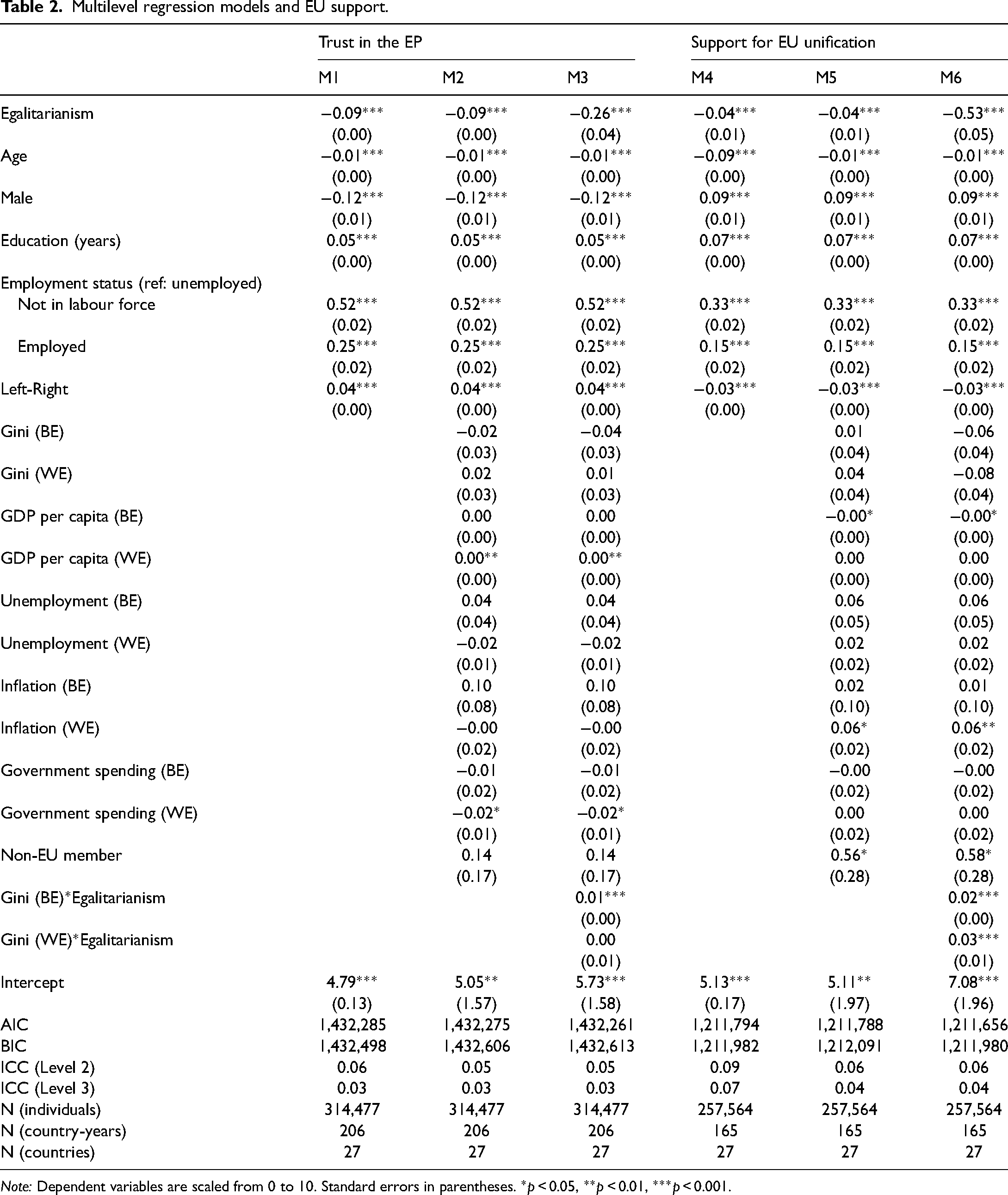
Table 2 reports the results. Since both dependent variables are measured on the same scale (0 to 10), we can compare them directly; the difference in observations does not bias the results (see the Online appendix where we exclude 2002 and 2010 for trust in the EP). Models 1 and 4 show a negative and significant effect of egalitarian attitudes on both dependent variables. This latter finding stands in contrast to Simpson and Loveless (2017), who found that egalitarians are more favourable towards deeper integration. The effect is clearly stronger for EP trust. Note that we control for left-right self-identification, which suggests that the effect of support for redistribution is not a proxy for ideological positioning (at −0.17, their correlation is modest at most).
Multilevel regression models and EU support.
Note: Dependent variables are scaled from 0 to 10. Standard errors in parentheses. *p < 0.05, **p < 0.01, ***p < 0.001.
When we include the country-level variables in models 2 and 5, we find no meaningful change in the effect of the individual-level variables. Disposable income inequality – as captured by the Gini coefficient – has no significant effect on either trust in the EP or support for further European integration. We obtain null results for both estimators, which means that neither the difference between countries in income inequality nor the development of income inequality within a country over time has a direct effect on diffuse or specific support for the EU. Accordingly, we do not find any evidence for H1 and H2. These findings stand in contrast to some earlier studies (Kuhn et al., 2016; Ritzen et al., 2016), which may be due to their focus on a different subset of countries and/or period of time. Our findings nonetheless question an obvious causal link between national income inequalities and public attitudes toward the EU.
Finally, we include cross-level interactions between the Gini estimators and egalitarianism (M3 and M6). To test H3 and H4, we examine whether the effects of support for redistribution are context dependent. We indeed find a significant interaction effect on support for unification: in national contexts of high or rising inequality, individuals who favour a more equal distribution of income tend to be less negative about deepened integration. The coefficient for the stand-alone variable of egalitarianism provides some help to interpret this result. Given that the model includes interaction terms, this coefficient provides the effect of moving one step on the egalitarianism scale when the Gini index is 0. This is a hypothetical scenario, as none of the countries faces complete equality. In this situation, the negative effect of egalitarianism is 0.53. With each unit increase in the average Gini across countries, the effect of egalitarian attitudes decreases by 0.02.
Figure 2 visualizes these results. It shows that the relationship between support for redistribution and support for unification reverses past a certain level of income inequality. Egalitarian individuals that live in the most unequal member states are thus more supportive of unification, while in countries with a relatively equal income distribution, those who favour redistribution are more sceptical about integration. We find a comparable moderating effect of within-country changes in inequality, suggesting that rising inequalities are associated with more positive views of integration among egalitarian citizens (see Figure 3). Although this coefficient is substantial, the Gini index only changes marginally every year, deflating the effect in practice. Thus, we find plausible evidence for H4. This also puts in perspective why Simpson and Loveless (2017) found the opposite (positive) effect of egalitarianism on support for unification: given that the direction of effects differs per context, the average direct effect might simply reflect the number of countries that are relatively (un-)equal in a given year, and thus the average income inequality in the EU as a whole.
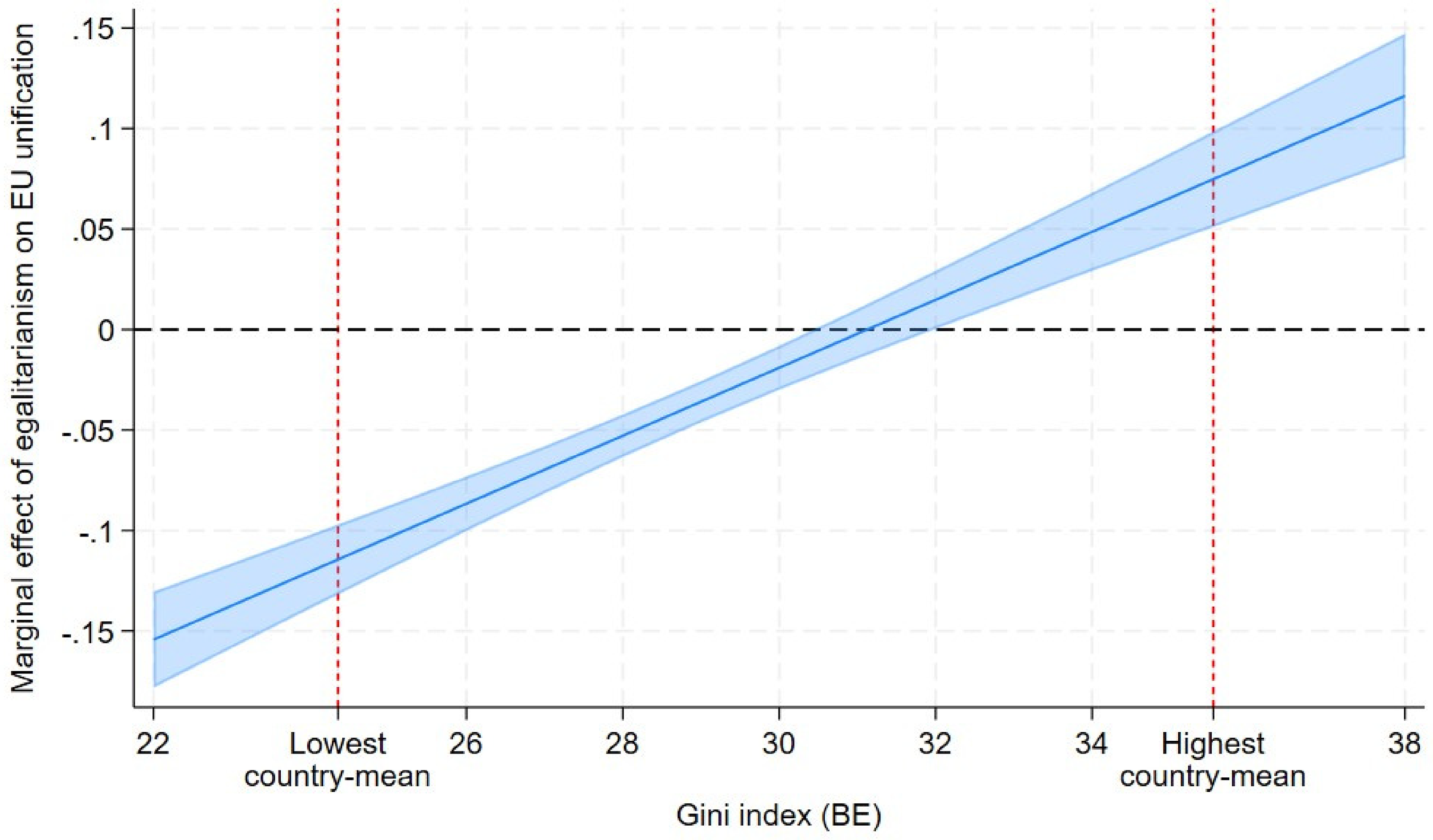
Interaction effect between Gini (BE) and egalitarianism on support for unification.
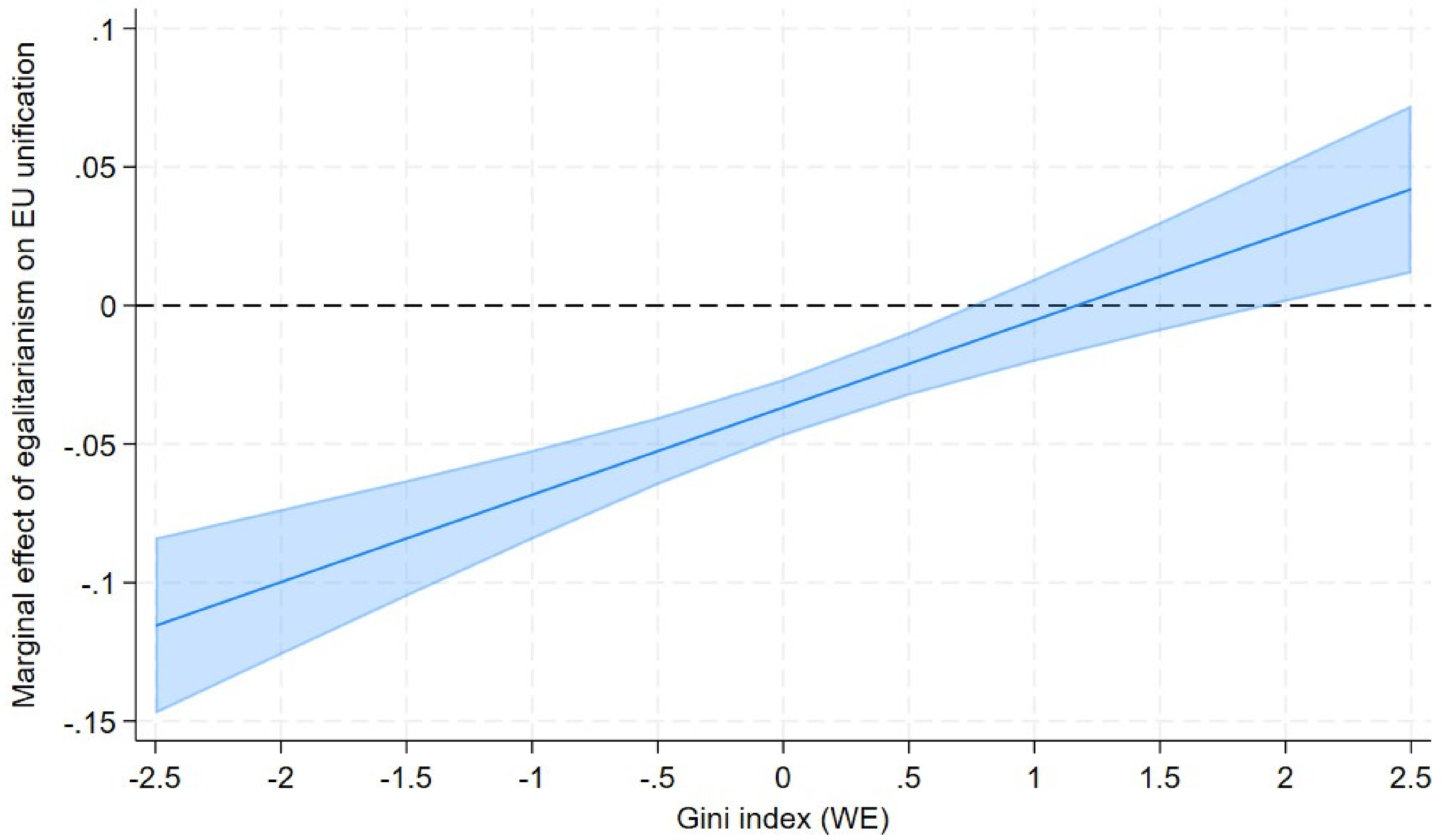
Interaction effect between Gini (WE) and egalitarianism on support for unification.
For trust in the EP, we initially find a similar significant interaction effect between countries, with the negative effect of egalitarianism being mitigated in countries with high inequalities. Yet, when we perform a jackknife test (with results reported in the Online appendix) in which we exclude one country at a time to estimate if the results are driven by an outlier, we find that the significance collapses when the UK is left out. This is likely due to the particularly Eurosceptic attitudes of the British public (Hobolt and Tilley, 2021). This suggests that the effect of egalitarianism on EP trust is not moderated by contextual differences in terms of income inequality (H3), given that the interaction term with the within-country estimator is also insignificant. Rather, individuals with pro-redistribution attitudes across the board are critical of the EU, as evidenced by their lower trust in the EP. However, even if egalitarian citizens in member states with high levels of inequality are dissatisfied with the European status quo, they may believe that the road towards a more just society lies in the path of closer cooperation – perhaps because they see the opportunity for more redistributive policies through the Europeanization of national social models (cf. Reinl et al., 2023). In relatively equal countries, on the other hand, egalitarians do not only tend to be more negative about the status quo but also seem to fear that unification might have few benefits. They appear to be sceptical about the idea that further integration could create a more ‘social’ Union.
Robustness checks
We perform several additional analyses to check the robustness of our findings; these results are reported in the Online appendix. While we included left-right ideological positioning as a control variable in the original analysis, it shows a certain overlap with the main individual independent variable of interest, i.e. support for redistribution. However, we find that no substantial differences emerge if we leave it out of the model or if we create an interaction term with support for redistribution.
As noted before, the Gini index has its limitations as measure of inequality. We, therefore, use two alternatives to the Gini index that give a higher weight to the extremes of the income distribution: the Palma ratio, i.e. the income of the top 10% divided by that of the bottom 40% (Palma, 2011), and the share in relative poverty, i.e. the percentage of the population with an income below 50% of national median income. While the former renders the interaction effect between over-time changes in inequality and egalitarianism insignificant, our other results remain robust. Neither measurement has a direct effect on support for the EU.
In the main analysis, we left out individual income position as a control variable due to a high level of item non-response (see also Yan et al., 2010). Income is nonetheless important to our argument because of its relation to both EU attitudes and support for redistribution. We use a variable that sorts respondents into income groups, from the lowest (1) to the highest (10). The ESS question was changed in round four from 12 absolute categories of household income to 10 country-adjusted categories. Since few respondents (2.3%) were located in the two highest categories for the old question, we merged categories 10, 11 and 12. When we control for income, we find no substantial changes in the coefficients of the main variables of interest.
One might furthermore hypothesize that the fiscal austerity associated with Economic and Monetary Union, in particular during the debt crisis, dented EU public support both directly and indirectly through its effect on inequalities (Armingeon and Ceka, 2014; Biten et al., 2023; Dotti Sani and Magistro, 2016). Although fiscal consolidation has not consistently increased income inequalities, even in the case of Eurozone bailouts, we control for the effect of austerity measures by including the cyclically adjusted primary balance calculated by the International Monetary Fund Fiscal Monitor, which captures a country's fiscal stance. We also include a dummy variable for respondents that live in Eurozone countries. This does not produce a notable difference in our findings.
Last, to take into account the possible divergent impact of inequality and the Eurozone crisis in different regions and their associated social models, we check whether the individual-level variables have the same effect across different parts of the EU. Here, we differentiate between five welfare state regimes. The negative effect on egalitarianism on EU support generally holds for trust in the EP but is more context-dependent for attitudes regarding unification – which can be explained by the contextual differences that we found in the analysis.
Discussion and conclusion
In the wake of the financial crisis and Great Recession, scholarship has devoted growing attention to the causes and consequences of unequal income and wealth distributions in democratic societies. Faced with the socio-economic and political shocks of the early 2010s, scholars have been quick to claim that income inequalities impact support for European integration. Given that the EU has been associated with market expansion, liberalization and welfare retrenchment, especially in the shadow of the crisis, it has been suggested that rising income inequalities would have depressed popular support for integration (Kuhn et al., 2016; Lipps and Schraff, 2021; Simpson and Loveless, 2017). At the same time, however, the academic debate has remained rife with disagreement and confusion about the size, direction and conditionalities of this effect.
Given the persistent unclarity about this salient question, this paper has sought to provide a more systematic analysis of the relation between income inequality and public support for the EU, zooming in on the turbulent period between 2002 and 2020. We find no evidence of any effects of country-level trends and differences in disposable income inequality on individual-level attitudes toward the EU. This suggests that the relation between rising income inequality and growing Euroscepticism that Kuhn et al. (2016) found may be a relic of the pre-crisis period or even the previous century. We do find, however, that individuals who favour redistribution generally are more distrusting of the EU and less supportive of further integration, even when we control for their income position.
From a theoretical perspective on EU public opinion formation, the results become more interesting when we turn to the contextual interaction between individual concern with inequality and levels of income inequality. With regards to support for unification, we find clear evidence that cross-national differences in income inequality moderate the negative relationship between egalitarianism and EU support. In unequal countries, egalitarians are more likely to regard the EU positively than in member states with low levels of inequality. It thus appears that a logic of compensation, according to which ‘Europe will be distrusted more by those living in countries that perform well, as there is potentially less to gain and more to lose’, drives popular responses to inequality (Harteveld et al., 2013: 549). Moreover, where inequality increased, citizens who favour redistribution are more supportive of further integration. With regards to EU institutional trust, in contrast, we find no such robust effect. Egalitarian citizens faced with growing inequalities seem to remain distrusting of the EU, even if they see it as a venue for more equitable policies.
More generally, these findings speak to the argument that the public forms its preferences regarding the EU through processes of benchmarking (De Vries, 2018). Citizens concerned about inequality differ in their views of European integration depending on the national socio-economic context in which they find themselves. While those who live in societies with large discrepancies in the income distribution are confronted with a majority of member states with smaller income gaps, the reverse holds in more equal societies. This could change how citizens perceive the EU regime and the prospect of integration: as a vehicle for positive change or as a threat to their ideals and interests. The fact that the effects of pro-redistribution attitudes remain robust when we control for income suggests that this benchmarking exercise may be more ideological than utilitarian in nature. Further research will be needed to probe the mechanisms behind this context-dependent relationship, including perceptions of, and blame attribution for, socio-economic inequalities.
Our findings also resonate with other avenues for study. While European integration has been seen as an economic project in which the space for social integration is limited and national welfare states would be undermined, our analysis implies that individuals in unequal societies may expect further integration to improve the redistributive performance of member states. Of course, this turns upon the kind of integration which people envisage. While we know little about preferences regarding the balance of authority and responsibilities in social policy between national and EU institutions, recent research has sought to unpack the patterns and drivers of public opinion in this area (Baute and Pellegata, 2023; Reinl et al., 2023). Given that egalitarian citizens may be more supportive of a social Europe (Baute et al., 2019), it would be important to uncover how socio-economic context factors and policy developments influence their attitudes. A pertinent question remains: if citizens use the national context as the main heuristic for opinion formation, does this mean that a social Europe that does more to address inequalities may undermine support for itself, as national institutions gain the credit for improved performance?
Supplemental Material
sj-docx-1-eup-10.1177_14651165231226054 - Supplemental material for Unequal perspectives? Income inequality as a benchmark for support for European integration
Supplemental material, sj-docx-1-eup-10.1177_14651165231226054 for Unequal perspectives? Income inequality as a benchmark for support for European integration by Bjarn Eck and Sven Schreurs in European Union Politics
Supplemental Material
sj-do-2-eup-10.1177_14651165231226054 - Supplemental material for Unequal perspectives? Income inequality as a benchmark for support for European integration
Supplemental material, sj-do-2-eup-10.1177_14651165231226054 for Unequal perspectives? Income inequality as a benchmark for support for European integration by Bjarn Eck and Sven Schreurs in European Union Politics
Supplemental Material
sj-do-3-eup-10.1177_14651165231226054 - Supplemental material for Unequal perspectives? Income inequality as a benchmark for support for European integration
Supplemental material, sj-do-3-eup-10.1177_14651165231226054 for Unequal perspectives? Income inequality as a benchmark for support for European integration by Bjarn Eck and Sven Schreurs in European Union Politics
Supplemental Material
sj-dta-4-eup-10.1177_14651165231226054 - Supplemental material for Unequal perspectives? Income inequality as a benchmark for support for European integration
Supplemental material, sj-dta-4-eup-10.1177_14651165231226054 for Unequal perspectives? Income inequality as a benchmark for support for European integration by Bjarn Eck and Sven Schreurs in European Union Politics
Supplemental Material
sj-dta-5-eup-10.1177_14651165231226054 - Supplemental material for Unequal perspectives? Income inequality as a benchmark for support for European integration
Supplemental material, sj-dta-5-eup-10.1177_14651165231226054 for Unequal perspectives? Income inequality as a benchmark for support for European integration by Bjarn Eck and Sven Schreurs in European Union Politics
Supplemental Material
sj-dta-6-eup-10.1177_14651165231226054 - Supplemental material for Unequal perspectives? Income inequality as a benchmark for support for European integration
Supplemental material, sj-dta-6-eup-10.1177_14651165231226054 for Unequal perspectives? Income inequality as a benchmark for support for European integration by Bjarn Eck and Sven Schreurs in European Union Politics
Supplemental Material
sj-png-7-eup-10.1177_14651165231226054 - Supplemental material for Unequal perspectives? Income inequality as a benchmark for support for European integration
Supplemental material, sj-png-7-eup-10.1177_14651165231226054 for Unequal perspectives? Income inequality as a benchmark for support for European integration by Bjarn Eck and Sven Schreurs in European Union Politics
Supplemental Material
sj-png-8-eup-10.1177_14651165231226054 - Supplemental material for Unequal perspectives? Income inequality as a benchmark for support for European integration
Supplemental material, sj-png-8-eup-10.1177_14651165231226054 for Unequal perspectives? Income inequality as a benchmark for support for European integration by Bjarn Eck and Sven Schreurs in European Union Politics
Supplemental Material
sj-png-9-eup-10.1177_14651165231226054 - Supplemental material for Unequal perspectives? Income inequality as a benchmark for support for European integration
Supplemental material, sj-png-9-eup-10.1177_14651165231226054 for Unequal perspectives? Income inequality as a benchmark for support for European integration by Bjarn Eck and Sven Schreurs in European Union Politics
Supplemental Material
sj-png-10-eup-10.1177_14651165231226054 - Supplemental material for Unequal perspectives? Income inequality as a benchmark for support for European integration
Supplemental material, sj-png-10-eup-10.1177_14651165231226054 for Unequal perspectives? Income inequality as a benchmark for support for European integration by Bjarn Eck and Sven Schreurs in European Union Politics
Supplemental Material
sj-png-11-eup-10.1177_14651165231226054 - Supplemental material for Unequal perspectives? Income inequality as a benchmark for support for European integration
Supplemental material, sj-png-11-eup-10.1177_14651165231226054 for Unequal perspectives? Income inequality as a benchmark for support for European integration by Bjarn Eck and Sven Schreurs in European Union Politics
Supplemental Material
sj-png-12-eup-10.1177_14651165231226054 - Supplemental material for Unequal perspectives? Income inequality as a benchmark for support for European integration
Supplemental material, sj-png-12-eup-10.1177_14651165231226054 for Unequal perspectives? Income inequality as a benchmark for support for European integration by Bjarn Eck and Sven Schreurs in European Union Politics
Supplemental Material
sj-png-13-eup-10.1177_14651165231226054 - Supplemental material for Unequal perspectives? Income inequality as a benchmark for support for European integration
Supplemental material, sj-png-13-eup-10.1177_14651165231226054 for Unequal perspectives? Income inequality as a benchmark for support for European integration by Bjarn Eck and Sven Schreurs in European Union Politics
Supplemental Material
sj-png-14-eup-10.1177_14651165231226054 - Supplemental material for Unequal perspectives? Income inequality as a benchmark for support for European integration
Supplemental material, sj-png-14-eup-10.1177_14651165231226054 for Unequal perspectives? Income inequality as a benchmark for support for European integration by Bjarn Eck and Sven Schreurs in European Union Politics
Supplemental Material
sj-png-18-eup-10.1177_14651165231226054 - Supplemental material for Unequal perspectives? Income inequality as a benchmark for support for European integration
Supplemental material, sj-png-18-eup-10.1177_14651165231226054 for Unequal perspectives? Income inequality as a benchmark for support for European integration by Bjarn Eck and Sven Schreurs in European Union Politics
Supplemental Material
sj-png-19-eup-10.1177_14651165231226054 - Supplemental material for Unequal perspectives? Income inequality as a benchmark for support for European integration
Supplemental material, sj-png-19-eup-10.1177_14651165231226054 for Unequal perspectives? Income inequality as a benchmark for support for European integration by Bjarn Eck and Sven Schreurs in European Union Politics
Supplemental Material
sj-png-20-eup-10.1177_14651165231226054 - Supplemental material for Unequal perspectives? Income inequality as a benchmark for support for European integration
Supplemental material, sj-png-20-eup-10.1177_14651165231226054 for Unequal perspectives? Income inequality as a benchmark for support for European integration by Bjarn Eck and Sven Schreurs in European Union Politics
Supplemental Material
sj-png-21-eup-10.1177_14651165231226054 - Supplemental material for Unequal perspectives? Income inequality as a benchmark for support for European integration
Supplemental material, sj-png-21-eup-10.1177_14651165231226054 for Unequal perspectives? Income inequality as a benchmark for support for European integration by Bjarn Eck and Sven Schreurs in European Union Politics
Supplemental Material
sj-png-22-eup-10.1177_14651165231226054 - Supplemental material for Unequal perspectives? Income inequality as a benchmark for support for European integration
Supplemental material, sj-png-22-eup-10.1177_14651165231226054 for Unequal perspectives? Income inequality as a benchmark for support for European integration by Bjarn Eck and Sven Schreurs in European Union Politics
Supplemental Material
sj-png-23-eup-10.1177_14651165231226054 - Supplemental material for Unequal perspectives? Income inequality as a benchmark for support for European integration
Supplemental material, sj-png-23-eup-10.1177_14651165231226054 for Unequal perspectives? Income inequality as a benchmark for support for European integration by Bjarn Eck and Sven Schreurs in European Union Politics
Supplemental Material
sj-png-24-eup-10.1177_14651165231226054 - Supplemental material for Unequal perspectives? Income inequality as a benchmark for support for European integration
Supplemental material, sj-png-24-eup-10.1177_14651165231226054 for Unequal perspectives? Income inequality as a benchmark for support for European integration by Bjarn Eck and Sven Schreurs in European Union Politics
Supplemental Material
sj-png-25-eup-10.1177_14651165231226054 - Supplemental material for Unequal perspectives? Income inequality as a benchmark for support for European integration
Supplemental material, sj-png-25-eup-10.1177_14651165231226054 for Unequal perspectives? Income inequality as a benchmark for support for European integration by Bjarn Eck and Sven Schreurs in European Union Politics
Supplemental Material
sj-png-26-eup-10.1177_14651165231226054 - Supplemental material for Unequal perspectives? Income inequality as a benchmark for support for European integration
Supplemental material, sj-png-26-eup-10.1177_14651165231226054 for Unequal perspectives? Income inequality as a benchmark for support for European integration by Bjarn Eck and Sven Schreurs in European Union Politics
Supplemental Material
sj-png-27-eup-10.1177_14651165231226054 - Supplemental material for Unequal perspectives? Income inequality as a benchmark for support for European integration
Supplemental material, sj-png-27-eup-10.1177_14651165231226054 for Unequal perspectives? Income inequality as a benchmark for support for European integration by Bjarn Eck and Sven Schreurs in European Union Politics
Supplemental Material
sj-png-28-eup-10.1177_14651165231226054 - Supplemental material for Unequal perspectives? Income inequality as a benchmark for support for European integration
Supplemental material, sj-png-28-eup-10.1177_14651165231226054 for Unequal perspectives? Income inequality as a benchmark for support for European integration by Bjarn Eck and Sven Schreurs in European Union Politics
Supplemental Material
sj-png-29-eup-10.1177_14651165231226054 - Supplemental material for Unequal perspectives? Income inequality as a benchmark for support for European integration
Supplemental material, sj-png-29-eup-10.1177_14651165231226054 for Unequal perspectives? Income inequality as a benchmark for support for European integration by Bjarn Eck and Sven Schreurs in European Union Politics
Footnotes
Acknowledgements
This work started as a graduate course paper; Bjarn Eck would like to thank Björn Bremer for his feedback and advice. An earlier version of this article was presented at the EU Politics workshop of the 2023 Politicologenetmaal conference in Leuven. The authors would like to thank the organizers and participants of this workshop, in particular Martijn Huysmans, as well as the two anonymous reviewers for their useful comments.
Author contributions
The authors contributed equally to the article.
Funding
The authors disclosed receipt of the following financial support for the research, authorship, and/or publication of this article: Bjarn Eck acknowledges funding received from the FNRS.

Supplemental material
Supplemental material for this article is available online.
Notes
References
Supplementary Material
Please find the following supplemental material available below.
For Open Access articles published under a Creative Commons License, all supplemental material carries the same license as the article it is associated with.
For non-Open Access articles published, all supplemental material carries a non-exclusive license, and permission requests for re-use of supplemental material or any part of supplemental material shall be sent directly to the copyright owner as specified in the copyright notice associated with the article.


