




Abstract
In the Anthropocene, humanity faces a pressing question: ‘what should we do?’ Here we are interested in the underlying sense and reference of the normative ‘should’ as it applies to ethics with respect to different actors. To excavate ‘should’, we unearth the foundations of three conventional groupings of normative ethical systems: Mill’s utilitarianism, Kantian deontological ethics and Aristotelian virtue ethics. Each provides a normative basis for saying what humans ‘should’ do. We draw on specific examples from the private sector to argue that debates on the role of ethics in business are dominated by consequentialist and deontological accounts which, while essential, entail certain limitations regarding the realities of this new geological epoch. Identifying the comparative benefits of Aristotelian virtue ethics enables us to develop new insights and suggestions for ethics in the Anthropocene. We identify three distinctive features of Aristotelian virtue ethics: (i) a focus on agents rather than acts, (ii) a distinction between laws and customs versus nature and (iii) the importance of tradition. We set out corresponding implications for ethics and sustainability as applied to the private sector.
Welcome to the Anthropocene: What should we do?
Human beings have converted about a third of the ice-free and desert-free land surface of the planet to cropland or pasture [and] dammed more than 60% of the world’s rivers . . . vertebrate species have, on average, had their population sizes cut in half in the past 45 years. The concentrations of major greenhouse gases-carbon dioxide, methane, and nitrous oxide-are at their highest levels for at least the past 800,000 years. . . humanity has become a primary determinant of Earth’s biophysical conditions (Whitmee et al., 2015 1976).
Contemporary planetary conditions are significantly different from preceding millennia and this poses an existential threat to humanity and other lifeforms (Williams et al., 2015). Across several disciplines, scholars refer to our latest geological epoch as the Anthropocene in recognition of these trends (Crutzen, 2002). The challenges the Anthropocene raises are compelling for scholars in both the natural and social sciences (Hoffman and Jennings, 2018; Seidl et al., 2013; Steffen et al., 2011). The key question facing our species is: what should we do given the state of this new Earth System? More specifically, this has multiple implications for a variety of different actors, but none more so than the private sector which has been operating within an economic system that many believe is the fundamental driver of the various geophysical and social manifestations of the Anthropocene (Dahlmann et al., 2019; Reichel and Perey, 2018).
While recent planetary effects are human in origin, considering how long humans have been on Earth, there is wideranging debate about using ‘Anthropocene’ to signal a new geological epoch caused by humans (Bonneuil and Fressoz, 2016; Emmett and Lekan, 2016; Hoelle and Kawa, 2021; Malm and Hornborg, 2014). As a banner term, the concept brings together different disciplinary perspectives and alerts people to the scale of the threat. Yet, if our goal is more precise understanding of causes and of solutions, a focus on anthropos could miss important historical and political forces such as the role of capitalism (Bonneuil, 2015; Burch and Di Bella, 2021; Feola et al., 2021; Reichel and Perey, 2018). Rather than humanity in general, the Anthropocene is ‘elite-driven’ (Lewis and Maslin, 2015: 177), fuelled by consumerism and a socio-economic system dominated by markets, large multinational corporations and state-owned enterprises (Wright et al., 2018). As such, the term ‘Anthropocene’ glosses over important inequalities, as well as spatial and temporal differences between human causes and socio-ecological effects (Banerjee and Arjaliès, 2021). For instance, a subset of wealthy humans has had a greater impact on planetary conditions than the world’s poor (Gössling and Humpe, 2020; Purdy, 2015).
The existential threat of climate change is not the consequence of the actions of all anatomically modern humans – who, as homo sapiens, have been on the planet for approximately 300k years (Hublin et al., 2017). Although the etymology of Anthropocene signals the central role of humans in shaping planetary conditions, human activity takes shape at multiple levels of analysis and involves a constellation of actors, institutions and networks (Latour, 2017; Reyers et al., 2018). Most notably, the great acceleration has occurred very recently in our species’ history (Steffen et al., 2015) and specifically through the vector of private sector corporations (Folke et al., 2019; Nyström et al., 2019). Consequently, questions arise about the nature of business ethics (Campbell et al., 2019), and our understanding of the common good in relation to these organizations (Albareda and Sison, 2020; Sison and Fontrodona, 2012) within the context of a socio-ecological system under pressure (Schmidt et al., 2016).
In this review paper, we first examine ethics-oriented literature on the Anthropocene with a particular focus on the private sector, before unearthing the foundations of the three major schools of ethics used in business and management literature (Sison et al., 2018). Each gives a normative basis for saying what humans (and business organizations by extension) ‘should’ do. Specifically, the first grouping is consequentialist theories where we focus on Mill’s Utilitarianism. In consequentialism, the consideration is the outcomes or ends of acts: ‘it is. . . by the whole formed by an action and its consequences, that what is done is judged right or wrong’ (Foot, 1985: 196). The second grouping is deontological theories where we focus on Kantian ethics: ‘the categorical command of reason to cultivate a way of life in which all of one’s acts (whatever they may be) are in complete harmony with the idea of lawfulness’ (Louden, 1986: 484). The third grouping is virtue theories, where we focus on Aristotelian virtue ethics, which holds that: ‘virtuous agents are those who respond at the right time, to the right objects, towards the right people, with the right motive and in the right way’ (Carr, 2003: 219). Respectively then, each grouping of normative theories of ethics considers the following: maximizing welfare or minimizing harm (consequentialist); following prescribed duties that should in turn be for everyone else to follow (deontological); or acting in a virtuous way that builds good character and is consistent with the goal of a good life (virtue).
The aim of our review paper is to demonstrate the comparative potential of Aristotelian virtue ethics when responding to the challenges of the Anthropocene. We highlight that debates on the role of ethics in business are dominated by consequentialist and deontological accounts which, while essential, entail certain limitations regarding the realities of this new geological epoch. Identifying the comparative benefits of Aristotelian virtue ethics enables us to develop new insights and suggestions for ethics as applied to the private sector. Our approach is like that of a circuit-breaker, connecting the foundations of each tradition to current understanding of the Anthropocene without the mediating distortions of market capitalism. In making this argument we build on contributions in The Anthropocene Review advocating the need for new research into ethics (Lowe, 2019; Schmidt et al., 2016), the need to understand relations between ethics and market forces (Benatar et al., 2018) and the ethics of repair (McLaren, 2018). We also draw connections to earlier work in The Anthropocene Review advocating a focus on corporate actors (Dahlmann et al., 2019) and critique of unchecked economic growth in the market system (Reichel and Perey, 2018).
The Anthropocene
Modern humans have evolved since the epoch of the Pleistocene (Hublin et al., 2017) but only comparatively recently have they had wide-ranging effects on the Earth System. The use of fire as well as farming and rice production, and the domestication of cattle (as well as goats, dogs, pigs, sheep) can be traced back to approximately 11,000 BCE (Steffen et al., 2011). Ruddiman (2003) therefore proposed it was early agricultural humans who first induced significant changes to the atmosphere (Ruddiman et al., 2020). More conventionally, while some suggest the planetary-scale effects of human influence should be tied to the beginning of industrial revolution, which they date as long ago as 1610 (Crutzen, 2002; Lewis and Maslin, 2015), others argue that only significant ‘human impacts on the Earth System, not on the environment’ are evidence of the emergence of the Anthropocene. Since 1950, dramatic rises across a number of global socio-economic and environmental indicators, for instance, energy use, surface temperature, NO2, methane, ocean acidification and economic growth, represent the ‘Great Acceleration’ (McNeill and Engelke, 2016). At least according to this more broadly defined conceptualization, the cumulative effect of 10,000 generations of humans has been dwarfed by those of the last three.
Regardless of the precise origins, the growing awareness of the Anthropocene is challenging our general understanding of sustainable development and raising questions about how lifestyles, organizations and economies should be governed in the future (Biermann et al., 2016; Patterson et al., 2017). In response to complex, multi-scale and multi-nodal challenges, scholars are seeking new insights into the nature, causes and effects of the Earth’s socio-ecological systems (Ribot, 2014). While these questions are being pursued in debates in established disciplines in the natural and social sciences, they also encourage new interdisciplinary inquiry in ‘Earth Sciences’ (Rockström et al., 2009) and ‘Earth Systems Science’ (Donges et al., 2017; Steffen et al., 2020). These banner terms indicate the emergence of increasingly interdisciplinary academic discussions (Hoffman and Jennings, 2015, 2018; Whiteman and Yumashev, 2018; Wright et al., 2018). They also help to organize a fragmentary but growing debate on role of private sector corporations and their impact on sustainability (Banerjee and Arjaliès, 2021; Dahlmann et al., 2019; Mayer et al., 2017).
The challenges of the Anthropocene and the complex configuration of agents, networks, rules and systems implicated in the negative impacts on the social-environmental system have inspired a new, interdisciplinary research agenda: Earth System Governance (Biermann et al., 2016). The home for these debates is the Earth System Governance Project (Burch et al., 2018), a global research alliance which is the largest social science network carrying out research into governance and environmental change. It organizes work into four cross-cutting research themes: the role of power; the role of knowledge; the role of scale; and the role of norms. These themes find more specific expression in a series of problems and questions relating to sustainability (Burch et al., 2019).
The research theme of norms – which connects most closely to our focus on what humanity ‘should’ do – recognizes that established ethical systems are inadequate in facing the complex challenges of the Anthropocene (Burch et al., 2018). Corporate sustainability is under scrutiny (Mayer et al., 2017) because we are not sure how corporations should be governed in the Anthropocene (Hoffman and Jennings, 2015, 2018; Wright et al., 2018). There is a need for new theorizing which reflects that corporations exercise a unique kind of collective agency as part of Earth System Governance (Bouteligier, 2011; Lim et al., 2018).
Without losing sight of the established, substantial literatures on corporate sustainability and corporate social responsibility (see reviews by: Bansal and Song, 2017; Lozano, 2012), we argue that the Anthropocene raises issues that are importantly different from much work in these literatures because it concerns planetary scale consequences: ‘grand challenges’ (Reid et al., 2010). Cumulative, global effects arising from a constellation of interconnected actors, networks and rules have translated into failings at the level of the Earth System (UN Environment, 2019). This has been expressed in terms of a failure to govern humanity as whole (Smythe, 2014), or to govern individuals (Jenkins, 2016), or to curb nation states (Dalby, 2007), or to mitigate against growing pollution (Reinmuth-Selzle et al., 2017). Most fundamentally it signals a failure to make corporations (and state-owned enterprises) responsible (Alcaraz et al., 2015).
To address this challenge, scholars have debated the wider ethical implications of humanity reaching a new geological epoch in terms of a hypernorm of sustainability (Scholz et al., 2019). Others argue for a radical reappraisal of ethics in the Anthropocene (e.g. Schmidt et al., 2016). This latter research trajectory highlights the need to look afresh at our most influential, anthropocentric (i.e. human centred) normative traditions (Sison et al., 2012). This is consistent with the imperative to respond to an existential threat with new thinking.
We therefore contribute on this front by unearthing the foundations of three conventional groupings of normative ethical systems: consequentialism, deontology, virtue. Each is a basis for saying what humans ‘should’ do and as such they undergird much thinking on corporate sustainability.
Three schools of ethics and their implications for corporate sustainability
Table 1 expands on our earlier brief definitions of consequentialism, deontology and virtue. These three schools are shown in each column beginning with a summary, ‘overview’ row. Subsequent rows identify focal and neighbouring texts. We then describe the conditions for the emergence of each school in terms of its respective historical context. This helps to explain how sustainability can be understood from within this school. The following row identifies important verbatim extracts from the focal text, which we have numbered, because we later refer to some of these explicitly. Then we set out foundational rules or principles which follow from these verbatim extracts. From these we explain what the typical approach to ethical problems is for each tradition. The final row identifies implications for corporate sustainability, also setting out some benefits and limitations for each perspective. We are conscious that we have condensed a great deal of information here, however we have structured the table in a way that is not simply summarizing these traditions but that also synthesizes key points that tie in with our broader argument.
Three schools of ethics and their implications for sustainability in the Anthropocene.
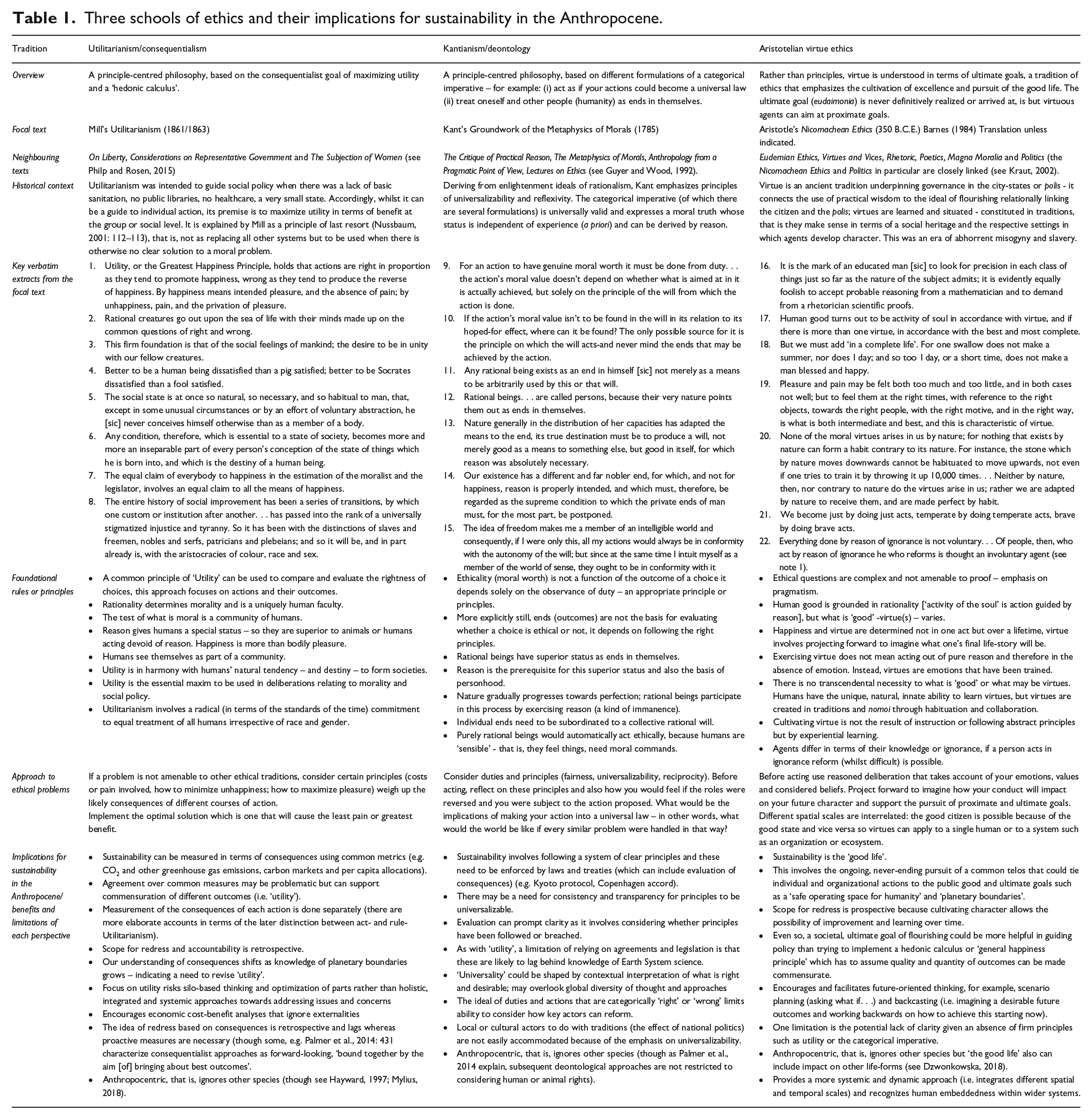
Demarcating the schools in this way is helpful because it allows us to highlight differentiating emphases in virtue on: (i) agents rather than acts, (ii) nomos versus physis (laws and customs versus nature) and (iii) the constitutive effects of tradition, where a tradition is ‘a set of understandings someone receives during socialization [a] social heritage’ (Bevir et al., 2003, 6–7). We argue that a virtue perspective has comparative benefits that afford greater scope to consider interrelations at different spatial scales, to focus on temporality, culture and norms. It therefore helps to rethink the role of ethics, particularly regarding the private sector, in the Anthropocene.
The challenges of the Anthropocene call for radical scrutiny (in the sense of radix or root) and it is partly because of this that unearthing each tradition in Table 1 is a useful exercise. This identifies fault lines between respectively different understandings of sustainability in each school. In the same way previous geological time scales are characterized by various markings and traces recovered from Earth’s natural systems (i.e. geosphere and biosphere) (Steffen et al., 2020), our intellectual traditions were built upon and have affected subsequent thought on ethics across different periods in time. To help us make sense of their respective relation to sustainability in the present, it is important to examine how each was shaped by the conditions of humanity at the time of their writing and how each provides insights for and guidance on action to the challenges of the Anthropocene.
To pursue clarity of argument, our description develops what might be called skeletal accounts of each school and does not elaborate points of commonality or crossovers and resonances across these. This is without wishing to caricature. As Louden (1986: 473) says, Kant was far from ‘deontology personified’ for instance. Kant repeatedly emphasizes virtue and takes the moral character of agents seriously (Korsgaard, 2009). In turn, for Mill, character remains central to utilitarianism (Solomon, 2003). He explains that virtue (Crisp, 1996) and benevolence (White, 1995) are key ingredients to utility. Another limitation, again to maintain clarity of argument, is that Table 1 does not present extensions or later generations’ accounts of these systems such as rule utilitarianism. It could introduce ideas such as species equality (Steinbock, 1978) and environmentalism (Sterba, 2000) as alternative norms forming the basis for expanded conceptions of utility or duty. It might take in an alternative deont (i.e. duty) such as justice (Rawls, 1971) or libertarianism (Nozick, 1974) or reflect alternative virtues like ecological virtue (Van Wensveen, 2005) or more contemporary accounts of virtue ethics (Mac Intyre, 1985). Our approach also does not consider non-western perspectives like Buddhist or Confucian ethics. This is a limitation because, whereas Aristotelian logic is pertinent in the Western world, much of the global population understands norms of conduct in these terms. Our review also does not draw on discussions of feminist ethics (Burton and Dunn, 1996), some of which emphasize the oneness of living things (Næss, 1989) and reject the idea that things in nature can be owned and commodified (see Castree, 2003 for a review). Thus, they can readily apply to Earth System Governance (Gaard, 2015). Nonetheless, our table seeks to separate these three accounts and trace the foundations underlying each to its respective founding text(s). In doing so it traces what are now great currents of thought influencing contemporary understanding of sustainability back to their original tributaries.
This approach helps to show how consequences and duty dominate current understanding of ethics in the business environment. A great deal of the debate about sustainability has been about consequences – the effects of negative externalities on our environment and the entire planet. Debate has also prioritized the welfare of humans and progress for society (while often ignoring other species and the intrinsic value of nature). Consequently, much of this literature can be characterized as instrumental:
Instrumental reasoning would suggest that sustainability is desirable, because it maximizes social welfare and, when applied to the corporate context (e.g., through CSR), also shareholder wealth (Schuler et al., 2017: 216).
This chimes with the first two schools set out in our table: instrumental reasoning is consistent with consequentialism and systems of sanctions and regulations with duties. By contrast, the third school – virtue – affords alternative insights into sustainability. The following section outlines three differentiating characteristics of Aristotelian virtue ethics that demonstrate comparative potential to inform understanding of sustainability. These are: a focus on agents rather than acts, a distinction between nomos versus physis (laws and customs vs nature) and an emphasis on the importance of tradition.
Differentiating characteristics of virtue and implications
Agents rather than acts
Rather than focussing on the act (whether a particular decision has favourable consequences or is made following given duties), Aristotelian virtue ethics focuses on the agent (Slote, 1997). To ask what we ‘should’ do in any situation, we need to account for the complex contingencies inherent in that situation as well as wider socio-historical conditions and traditions (verbatim extract 20: see Table 1). To ask if someone did the right thing, we need to consider not just that action, but the unfolding character of the agent taking that action and their overall life course (verbatim extracts 18 and 21). If we want to consider whether an agent is virtuous this is not something that can be answered based on a single outcome (consequence) or decision (whether they followed a universalizable duty). Instead, Aristotelian virtue ethics is interested in questions like: ‘what does it mean to live the good life’ (Bloomfield, 2014; Nunziato and Hill, 2019) and it is a perspective where moral agency is constituted over the whole of an agent’s life. From this simple difference – an agent-centred rather than an act-centred philosophy – flow important consequences relevant to corporate sustainability in the Anthropocene.
An agent-centred ethic offers more scope for nuanced evaluation of ethical (and unethical) behaviour over time. This is perhaps more useful in considering the role of business in the Anthropocene because influential agents can change their behaviours. To illustrate, consider an actively managed investment fund whose managers take what they propose to be an ethical stance by divesting assets held in fossil fuel companies. Such a stance might be seen as ethical because it avoids supporting polluters or, more colloquially, climate villains. Yet even where such companies have historically been polluters, any once-and-for-all characterization of villain is oversimplification. Whilst some fossil fuel companies historically have had a huge detrimental impact on the environment, their role as energy suppliers may now make them the best agents to influence and implement changes. Because there is a temporal dimension to the evolution of character, Aristotelian virtue ethics has greater flexibility when it comes to normative judgements.
Agents (and agent can apply to corporations as well as to individuals: French, 1979), can also be vicious and – if they are self-aware – they are responsible for this, ‘a wicked person is responsible for his or her character not because he or she could now alter it but because he or she could have and should have acted differently early on’ (Solomon, 2003: 45). Nonetheless, even though character reflects constancy across a number of traits, there is also the possibility that those we consider vicious can learn and reform. Allowing this possibility may be particularly important as our knowledge of Earth System Science increases and any doubts about the extent of humanity’s impacts are removed. We think Aristotle hints at the potential for such change in this extract in Table: ‘Of people, then, who act by reason of ignorance he who reforms 1 is thought an involuntary agent’ (Aristotle, 1110b21–23). Whilst fossil fuel companies have been far from ignorant about climate science and even concealed the truth about the impact of emissions (Hall, 2015), the potential for agents to reform is an important consideration that we argue is under-theorized in both consequentialism and deontology.
Further, from an Aristotelian virtue ethics perspective, even if we condemn certain choices, they are not seen as simply either right or wrong. Instead, they form part of an agent’s overall story and need to be understood in relation to various traditions and norms: ‘moral character is constant and on-going, it is a state of “constant becoming”, and an object of constant re-negotiation with and in relation to ourselves and others’ (Sadler-Smith, 2012: 366). This processual aspect to character allows for the possibility of redemptive behaviour and potentially encourages reform and improvement: ‘character is never fully formed and settled. It is always vulnerable to circumstances and trauma’ (Solomon, 2003: 45).
In contrast to this broad range of possibilities offered by a virtue perspective, in both consequentialism and deontology we have a situation where there is an emphasis on acts, and this can lead us to think in terms of a categorical judgement. Revisiting this from the vantage point of Aristotelian virtue ethics does not mean we jettison the language of consequences and duty, and it does not mean we cannot condemn certain actions. However, it does offer a complementary perspective which has comparative benefits because of an emphasis on agents rather than acts and on the longitudinal dimension in development of character.
In consequentialist ethics, as the verbatim extracts 3, 5, 6 and 7 in Table 1 show, benefit is understood in terms of net utility to society as a whole. In deontological ethics, actions are understood as ethical in relation to humanity as a whole (extract 14). Contemporary Kantian scholars differ in their interpretations of universalism (see Korsgaard, 1996), but often these principles are taken to imply we should treat complete strangers in the same way as community and family members. This seems unrealistic because as individuals a great many of our choices are not sensibly seen as isolable from all our other choices; nor do we act as though we are insulated from our networks of social interaction or communities. The Earth Systems Governance framework suggests there are many kinds of agent and that whilst these are embedded in networks of social interaction they operate at different spatial scales. They have their own ecosystems, identities and cultures. Relationships within and across these ecosystems are co-created over time with respect to the identities and behaviour of employees and other stakeholders. In other words, the ethical choices and responsibilities for an agent such as a business corporation, government or state-owned enterprise are also not atomic, isolable acts. Instead, they form one element within an unfolding and continuing narrative about character. When we are considering the prevailing characteristics of a group or even society, we do not focus only on their latest choices but on the agent, and usually over a longer period. To recognize this helps us to understand that a virtue perspective carries further implications. Instead of focussing on acts (and taking us to a second differentiating characteristic of virtue), there is a need to consider customs and norms and their relation to overriding, natural categories – such as the planetary consequences signalled by the Anthropocene.
Nomos versus physis
An important distinction that lies at the origins of virtue ethics is the contrast between nomos and physis. Nomos, as the verbatim extract 20 in Table 1 shows, is a socially determined rule, custom or human-made law, whereas physis is something determined by nature, ‘nomos encompasses all social and political norms of a given society [physis] embraces all those qualities which are physiologically and genetically ingrained in all mankind’ (Ostwald, 1990: 299). The observance of several human-made laws is a common theme in discussions of virtue as is the question as to whether some laws have precedence over others or can in turn be trumped by the higher laws of nature. These tensions are perennial themes, dating back to antiquity and often expressed through aesthetic forms such as drama (Nussbaum, 2001). For example, the play Antigone is about the tension between Antigone’s obeying the diktat of a tyrant (Creon) or her properly observing what she sees as a supreme, overriding duty to the family dead. Creon decrees that Antigone cannot bury her brother within the city walls and yet, tradition demands that she does exactly that in order to pay proper tribute to her brother.
Though the nomos-physis contrast is an ancient distinction (Ostwald, 1990) it is also very familiar in contemporary artforms. Routinely in action movies drama comes about when the protagonist experiences a conflict between what convention, custom and law dictate they should do and what they are compelled to do by nature because of a specific incident. A hypothetical example might be that the protagonist hijacks a car at gunpoint to pursue someone who has kidnapped their child. In that case, breaking some laws may seem justifiable because of an overriding natural imperative that is physis and that we would all recognize. However, important critical and complex questions are, first, whether this suspension of nomos in favour of physis is or should be temporary, or permanent? and second, whether this suspension would affect all or just certain nomoi? The protest group Extinction Rebellion (2020) makes a parallel argument – that normal conventions should no longer apply given the scale of the threat to humanity:
Conventional approaches of voting, lobbying, petitions and protest have failed because powerful political and economic interests prevent change. Our strategy is therefore one of non-violent, disruptive civil disobedience – a rebellion.
When it comes to thinking about ethics in the Anthropocene, the nomos-physis distinction forces us to reflect on the extent to which extant human-made laws are sufficiently aligned with our growing understanding of certain natural laws (physis) in the Earth System (Kotzé et al., 2022), for instance, as expressed by the concept of the planetary boundaries (Alcaraz et al., 2015; Rockström et al., 2009). The laws and conventions we are using to regulate human interactions and economic activity rarely account for what can be tolerated by nature at a planetary level, mostly because existing nomoi do not systemically recognize nature as a rightful claimant.
Building on this insight and applying a virtue perspective, humanity may now be grasping for a solution to an existential threat that is physis but doing so through the medium of nomoi. From a virtue perspective, if the Anthropocene calls for us to align human and natural laws then this suggests there may be moments of dramatic awakening which could overturn some traditional customs and habits. Emblematic, ‘lightning-rod’ events (catastrophic floods, hurricanes, fires) could become watershed moments and prove to be epiphanies from nature. There may come a time when certain existing laws must be abandoned – for instance if social movements, national governments, or transnational bodies deliberately break with the frameworks that underpin free markets. They could variously: close companies, isolate polluters, impose sanctions, block trade and pursue collective action or civil disobedience. Using Friedman’s (1970) terms there could come a time when the rules of the game are not so much modified as blown up. In the wake of existential crisis, it may be easier to maintain a virtue account of what we should do rather than to hold onto consequentialist and deontological norms that prove irrelevant and outdated given the scale of threat.
Examples of large-scale interventions which reshape our understanding of nomoi include ‘truth and reconciliation commissions’ or ‘restorative justice approaches’. These are designed to discover and discuss past wrongdoings and develop a shared understanding of how future problems can be collectively addressed and resolved. While representation of planetary ecology in legal and social settings remains challenging, an example from New Zealand, where the Whanganui river was granted the same legal rights as a human being, demonstrates increasing recognition of the validity of eco-centric approaches towards justice and norms. Another example is the translation of physical limits to greenhouse gas concentration in the atmosphere into global policy targets such as the 2°C of the Paris Agreement and subsequent national and corporate efforts to mitigate their emissions accordingly. 2
As the verbatim extracts 18 and 21 in Table 1 show, Aristotelian virtue ethics highlights the need for humans and, by extension, business organizations to scrutinize their habits. This can include organizational practices, policies and processes as well as business models; the aim being that these would better align with the demands of physis (nature) rather than established customs and regulations (nomoi). Taking cues from Earth System Science, there is a need for behaviours and decisions to be consistent not only with existing laws, but also for added scrutiny of taken-for-granted behaviours so as to be increasingly mindful of the wider context of planetary boundaries and complexities of global socio-ecological systems (Bennett et al., 2021; Folke et al., 2021; Rockström et al., 2021). This requires enormous shifts in awareness and education. An Aristotelian virtue ethics perspective offers a chance to reshape perspectives of individual and organizational behaviours within the Anthropocene. Recognizing the wide diversity of actors, and the plethora of rules and norms worldwide, there is a need for greater collective reflection on how traditions and cultures can be reformed. Such change needs to move in concert with other forms of hard laws and interventions. New habits need to be formed and shared that pay increasing attention to wider systemic effects rather than a focus on acts that are seen as atomic and isolable.
Aristotelian virtue ethics also helps us to remember that any choice is part of the story of an agent and to see how this involves rationality but also such things as emotion and culture (Sison et al., 2012). This collective aspect to behaviour is important in the Anthropocene epoch because there is a shared inertia that comes from reliance on fossil fuels and traditional business models. Whereas Utilitarian and Kantian norms can indicate ways to change these collective habits by sanctions (consequences) or laws (duty), a virtue perspective suggests we also need to think about character and social norms and whether these – and the traditions that underpin these – can be changed. Reforming behaviours in tune with the radical change required involves – more colloquially – that we change the narrative (McLaren, 2018). The Anthropocene may prove a useful banner term under which to orchestrate such change.
Aristotelian virtue ethics is, indeed, sometimes understood as a narrative ethic (Morrell, 2012). This is because it considers the life course of an agent or community. Developing this focus on narrative, one way in which to hold agents such as individuals or corporations to account is by evaluating agents’ unfolding narrative arcs, or – more simply – their life stories. If actions over time are understood as a story, we can evaluate this from a virtue perspective by seeing if the story reflects a coherent trajectory onto which roles, responsibilities and impacts can be mapped. These stories could also be contextualized in terms of the growing awareness of the Anthropocene. For instance, if we looked at the strategy of a car manufacturer in terms of an unfolding story, would their choice to transition from petrol and diesel cars to electric vehicles be seen as a reactive response to market and regulatory forces, or could it (also) be seen as the more proactive realization of an imperative to reduce global emissions? This fairly simple question is straightforward enough to grasp, yet this narrative perspective also folds together agency, tradition, temporality and the nomos/physis distinction in a way that utilitarian and Kantian frameworks cannot.
The constitutive effects of tradition
Utilitarian and Kantian normative frameworks involve consideration of general moral principles. One benefit of this – in relation to business – is that abstract principles may more easily translate into governance mechanisms that can apply across a sector or even a global population of companies. They can be the basis for the rules of the game. Yet, when it comes to how the marketplace operates in practice, as others have argued (Streeck, 2011), market distortions are widespread and can even be seen as inherent to capitalism. Consequently, when it comes to understanding the effects of market mechanisms on the environment, we see pale and partial shadows of these principles. For instance, we can discuss both stockholder and stakeholder constructions of corporate responsibility using a language of duties and a concept of universalizability (Hasnas, 1998). However, in the marketplace these respective duties – to stockholders alone or to stakeholders more broadly – are far more narrowly circumscribed than is implied by Kant’s categorical imperative (see Table 1). The goal of having general moral principles that apply to all may be a mistake because these can only ever be partially implemented in market settings where there are incentives to game these principles, or to do no more than the minimum. This could partly be responsible for the problems we associate with the Anthropocene. Rather than aim for something that is always going to be out of reach, a virtue perspective allows for more flexible, intermediate goals that are tradition-constituted. One implication is that, for example, developing nations might have different sets of obligations and duties (Doh et al., 2016). A virtue perspective also means we can look beyond the narrow consideration of how an act effects carbon and other emissions. Instead of simply seeing this as an unethical act (because of its consequences or because it violates a duty), a virtue perspective takes wider socio-historical traditions into account. This could mean we do not just consider a nation’s or an organization carbon footprint, but that we also account for its level of economic development and whether that is driven by manufacturing goods and commodities for consumers in another, wealthier nation.
One reason virtue ethicists are interested in tensions between nomos and physis is because virtues are tradition-constituted and it can be difficult to determine whether there is any transcendent basis to challenge local customs and conventions. In contrast to seeking universalizable principles, a virtue perspective incorporates contingent and socially constructed elements such as the roles of history and tradition. Indeed, taking account of these is one way in which virtue can be thought of as something applying both to individuals and larger groups. In its attention to tradition, Aristotelian virtue ethics also considers habits and character – both these features can also apply to groups, organizations, or whole societies as well as individuals.
Recognizing the extent to which virtues are to an extent path dependent, that is, shaped by tradition and history, is helpful when thinking about the notion of sustainability at multiple levels of analysis in relation to the Anthropocene. Both consequentialism and duty ethics rely on a single moral principle (utility or the categorical imperative). Though understandings of utility and even of a categorical imperative may shift, their universality implies an unrealistic ideal: that these systems are abstracted from a historical and social tradition. This may make it difficult to follow these in practice because in different circumstances there may be conflicting principles in relation to what humanity ‘should’ do (Louden, 1986). Such principles, especially by the time they have become embedded in law, lag behind the latest knowledge of climate science. For example, we have been living with the legacy of treating the environment as a ‘free lunch’ for decades (Commoner, 1973). As problematically, many agents are incentivized to exploit the weakest point in a system of governance. As a result, though agents are governed by duties and consequences, this can mean in practice that they make choices that satisfice when it comes to the requirements of nomos, but, in terms of Earth System Governance, still act in ways that compromise humanity’s safe operating space (Rockström et al., 2009).
One of the problems with a consequentialist account is that it leads us to think that there can be commensurate punishment or redress, for example, in form of the polluter pays principle. If we are accustomed to thinking about consequences, this disguises the uncomfortable truth that it may not always be possible to redeem past actions or to make good. Understanding could change sharply if effects of mass pollution and warming are accelerated by self-reinforcing feedback loops (Lenton and Williams, 2013). There may be no way to reverse past misdeeds or to put the genie back into the bottle. An example occasionally given is that of melting ice in the Arctic. The loss of vast white spaces would lead to less heat being reflected and could also release huge quantities of methane. Aristotelian virtue ethics is characterized by a built-in pragmatism that allows for shifts in traditions and for uncomfortable truths. It can more readily even the breaking of existing rules.
Another potential benefit of a virtue perspective is that it gives us a well-established way of speaking about the good in terms of the ideal of a community that flourishes (Albareda and Sison, 2020; Sison and Fontrodona, 2012, 2013). This is a longstanding and very broad ranging statement of collective benefit that we draw on if we are trying to evaluate if a course of action is something that benefits wider society (Morrell and Bradford, 2018; O’Brien, 2009). We can invoke the public good as a legal consideration for instance – or it can be used to evaluate the actions of an individual, or government, as well as in studying wider scale political or economic reforms (Morrell, 2009). An account of what it means for a community to flourish is not simply a cross-sectional, once and for all assessment but one that considers traditions and that projects forward in time as well (Ozcan and Santos, 2015). This makes it useful in discussing Earth System Science since our understanding – and therefore our evaluations of organizational and individual sustainability – is continually developing. As an ultimate goal or telos, the ideal of flourishing is flexible enough to change as our understanding grows, as people’s social attitudes change, as well as alongside technological changes or the consequences of particular ways of doing business. In this context, the notion of a safe and just Earth System offers further conceptual and potentially measurable guidance on how such a global goal can help shape organizational and individual behaviours (Bennett et al., 2021; Rockström et al., 2021).
As well as using the concept of an overarching telos as an evaluative framework, a virtue perspective could help to revisit ways in which agents make themselves accountable. When it comes to corporate reporting and disclosure, researchers show us how we can understand such documents (like annual reports) as stories (Aerts, 1994; Gray, 2010; Morrell & Tuck, 2014). Perhaps the idea of using stories to evaluate organizational behaviours can be expanded. One way to do this would be to require that companies’ annual reports include a narrative section detailing corporate activities and planned activities that specifically invoke responses to the Anthropocene. Unlike existing financial and ESG (environmental, social and governance) reports and disclosures – which are typically retrospective accounts of different measures of performance and practices, companies could use these sections to do two things differently.
First, they could outline different scenarios of the future that recognize potentially changing socio-ecological conditions and detail anticipated business responses. Guidance prepared by the Taskforce on Climate-related Financial Disclosures (TCFD, 2021) as well as emerging similar guidance by the Taskforce on Nature-related Financial Disclosures (TNFD, 2021) already encourages companies to provide so-called transition plans designed to prepare and future-proof organizations regarding different ecological challenges. Scenario planning, that is preparing organizational responses to differently evolving socio-political and environmental conditions, is explicitly recommended and reflects the importance of future-oriented thinking in this area.
Second, such narrative sections could also more strongly invite companies to consider their organizational telos, or strategic purpose as it is increasingly becoming known (George et al., 2021). Rather than focussing on the present, companies could use these sections to project an ideal organizational outcome or achievement at a certain point in the future that is shaped by, or at least consistent, with Earth System Science. Developing longer-term statements of purpose and a vision of how to operate and exist in the future within planetary boundaries (Mayer, 2021), bears comparison with virtue ethics’ telos of the good life. The need to construct such public stories, while aspirational, may create a more attractive and transformational pull for employees, investors and customers – rather than reporting retrospectively against a range of sustainability targets. While the latter remain important from a performance improvement perspective, they are likely to be less inspirational and accessible compared to narratives expressing purpose and guiding future actions. Using a method known as backcasting, companies could begin with an overarching telos and work back to provide details of how the organization was seeking to achieve this over time (Vergragt and Quist, 2011). While there is no guarantee or certainty that a company would succeed in living out such a statement of purpose, a well-crafted organizational telos could encourage transparency and accountability for stakeholders more generally (including investors). In turn, it could be a basis for ongoing, nuanced feedback and evaluation of an organization character and virtue in a way that does not depend on individual decisions and acts and instead refocuses evaluation at an organizational level and over a longer time frame.
A parallel for this is the requirement for some companies specifically to disclose corporate activity in relation to conflict minerals (i.e. those extracted from conflict zones) (EC, 2021) and modern slavery (HM Government, 2015). Though there are flaws in these models of voluntary disclosure (Reinecke and Ansari, 2016), if it were to become a more explicit requirement that corporations reported on their activities and planned activities in relation to the Anthropocene, it might help to unearth unspoken assumptions, inherent contradictions, fears and other challenges that companies encounter when reflecting on their role in relation to planetary conditions.
Conclusion
To answer how we ‘should’ respond to the Anthropocene commits us to accounting for the interrelations between humans, organizations, other forms of life and the planet. We are falling short of this because of a legacy of self-interest and because pale shadows of consequentialism and deontology are expressed in governance mechanisms and legal frameworks that are failing us. Narrow framings of consequences and duties do not account for planetary effects. By shifting attention towards wider framings of sustainability based on virtue, we can develop new ways in which to understand sustainability and the ethical human. Anthropos is an individual member of a species and much of human behaviour takes shape through relations of exchange, but at a global level this is in turn scaled up by corporations and markets.
The Anthropocene asks fundamental questions about the governance of societies and economies. It prompts scrutiny of our daily choices when we ask what we ‘should’ do as employees, consumers, investors and citizens. Because sustainability is globally dispersed and enacted at different spatial scales over time, and because there is an array of interconnected markers of planetary change, the schools of consequentialism and duty face challenges. In these dominant perspectives on business ethics, governance of corporations is understood as top-down and rules-based. In concert with a framework of duties, actions are evaluated in terms of consequences. But measures of consequences are often unsophisticated because they focus on single indices (such as carbon emissions). These are crude proxies for the complex, multifaceted indicators of planetary level change and trail behind our growing understanding of Earth System Science. This is not to argue that these schools are redundant of course. However, it does suggest that Aristotelian virtue ethics can be a source for complementary insights that flow from a contrasting perspective. This can help to identify behaviours and outcomes that are better aligned with the needs of an increasingly fragile planetary ecological system.
The way we frame social problems plays an important role in determining how well we can address them (Gibbons et al., 1994). We are enmeshed with the social world and cannot simply apply evaluative frameworks to it as if we were objective or detached observers. The schools and frameworks we apply to the world also constitute the world (Ghoshal, 2005). Whereas consequentialist and deontological traditions remain indispensable, these approaches are also limited because they construe decision makers as ‘atomistic individuals, deliberating in isolation, exercising unilateral control over their choices and actions’ (Phillips and Margolis, 1999: 627). As a result, they are not at heart set up for overcoming some challenges the Anthropocene throws up (Heikkurinen et al., 2016). This requires an understanding of moral agency at different spatial scales, over time – from the human to the whole Earth System. The shift in focus to consider agents rather than acts demands that both individuals (as citizens, consumers, investors and employees) and organizations are held to account for their behaviours over both the short and the long term.
Aristotelian virtue ethics offers a different, complementary basis from which to understand issues relating to sustainability. This perspective can take in, but also look beyond consequences and duties. Considerations of consequences and duties are de-contextualized. In contrast, a virtue perspective involves refocusing on the importance of the individual agent’s values and history. It allows for agents who are fallible and who can learn and reform. To consider the role these factors have in influencing decisions makes discussion of what is sustainable seem more immediate and linked to traditions. In contrast, to rely on principles can lead to abstraction and distance from a changing landscape. Such thinking can fail when it comes to deciding what to do in complex situations because – contrary to the logics of both consequentialism and deontology – there may be no one course of action that captures what we ‘should’ do. Equally there may be no clear way of comparing the potential consequences of rival courses of action.
Excavation of the three normative traditions complements our review of the relevant literature on the Anthropocene and Earth Systems governance and shows comparative benefits in taking an Aristotelian virtue perspective on the Anthropocene (Jenkins, 2016). The language of virtue creates space for conversations with a broad range of scholars working at the confluence of the natural and social sciences. This can also connect different groups of stakeholders, something that is of vital importance for policy makers and society. The agent-centred focus in virtue ethics enhances understanding of the role corporations could play as private actors in supporting effective and equitable Earth System Governance. The basic distinction between act-centred and agent-centred approaches allows for more nuanced and temporally sensitive analysis of what a diverse array of agents ‘should’ do. It also highlights the contrast between limitations placed on action as a result of laws and convention and the growing threat of a natural imperative to keep within planetary boundaries.
There is often a clash between approaches to ethical problems based on consequentialism and those based on duties. But Aristotelian virtue ethics is more flexible than either of these traditions and it can complement or even incorporate consequentialist and duty-based frameworks. At the same time, identifying comparative benefits of Aristotelian virtue ethics allows us to highlight important points of contrast. These can lead us to novel departure points from the two most influential approaches to understanding sustainability. This acts like a circuit-breaker taking debate back to some ancient principles. It offers a new way of talking about the failings of societal norms and regulations (nomoi) which inevitably lag behind the science on climate change (the expression of physis). This builds a richer picture of traditions and customs and a need to understand the unfolding life-course of agents, thereby allowing periodic reappraisal of character. It rejects an unsophisticated caricature of organizations as persistent eco villains, or a black-and-white system of rules and sanctions, and instead makes allowance for the potential of individuals and organizations to reform and develop a moral character that recognizes the urgency and imperative of contributing to a broader telos, a flourishing society within a safe and just Earth System.
Footnotes
Acknowledgements
We would like to thank the editor, Dr. Robert Costanza, and three anonymous reviewers for their comments.
Author Note
No data are associated with this article.
Declaration of conflicting interests
The author(s) declared no potential conflicts of interest with respect to the research, authorship, and/or publication of this article.
Funding
The author(s) received no financial support for the research, authorship, and/or publication of this article.
