




Abstract
The Anthropocene, as a shared existential concern, is catalysing current scholarly paradigms, and one example is the recent emergence of ‘post-sustainability’. This first ever literature review surveys the meanings of post-sustainability in 116 texts, from a wide range of scholarly fields. Alongside a thematic classification of post-sustainability, a general characterization is suggested; Post-sustainability describes the tension between the implausibility of the sustainability paradigm and the seeming impossibility to deal with the future eco-social predicaments such as the Anthropocene. Articulations of post-sustainability are committed to the well-being of humankind and living nature, within the limits of emerging conditions. Post-sustainability is stimulating self-reflection within a range of scholarly fields by raising timely questions: Is sustainability behind us? If so, in what sense, and what should be done about it? Future conceptualizations of post-sustainability are suggested to take into account (a) the plural meanings of the prefix ‘post-’, and (b) the demarcation between post- and anti-sustainability positions.
Keywords
Introduction
The Anthropocene is a contested yet influential concept: at the same time as its natural scientific definition is being eagerly discussed, it has also established a certain undeniable cultural and social factuality (Autin, 2016; Maslin and Lewis, 2015; Toivanen et al., 2017; Walker et al., 2024). Most importantly, the Anthropocene has been used to describe a scientifically founded understanding of the emerging eco-social realities, and as such it can serve as a shared point of reference for today’s sustainability discourse and debates (Benson and Craig, 2014; Schmidt et al., 2016). Notably, such future does not permit over-optimistic sustainability visioning, as ‘the Anthropocene posits absolute limits to human activity, curtailing the sphere of human freedom.’ (Dibley, 2012: 142). Thus even if articulations of the ‘good Anthropocene’ have emerged, they have been questioned on both empirical and ethical grounds (Dalby, 2016; Hamilton, 2016). This review suggests that the emerging meaning of the Anthropocene as a shared existential concern is indeed affecting current intellectual and scholarly paradigms (Autin, 2016; Maslin and Lewis, 2015), in this case sustainability itself, by catalysing the emergence of ‘post-sustainability’. Understanding post-sustainability can illuminate how the Anthropocene challenges and shapes the sustainability paradigm.
The meaning of ‘sustainability’ is largely determined by internationally defined goals and policies of ‘sustainable development’ (SD; UN General Assembly, 2015). Yet this historical identification is not conceptually necessary, and sustainability is sometimes described as an open signifier that can also carry other meanings (Brown, 2016). The origins of sustainable development dates back to the 1970s, when discussion emerged concerning the environmental degradation, pollution and resource depletion caused by post-war economic progress (Ruggerio, 2021). A notable milestone response was the Limits to Growth report (Meadows et al., 1972), which warned that the foreseeable scenarios of economic and technological expansion would lead to ecological and societal collapse. As a response, in 1987 the World Commission on Environment and Development defined sustainable development as development that secures the needs of the present without compromising the needs of future generations (Ruggerio, 2021). Since then, sustainable development has commonly been considered to consist of three dimensions: environmental, economic and social sustainability (Adloff, 2024).
However, even if we arguably live in the age of sustainability, which means an ‘inescapable normative frame of reference that no state, society, or organization can escape’ (Adloff, 2024: 2), there is notable discontent regarding the results and definitions of sustainable development. This is indicated by the emergence of new sustainability-concepts: strong sustainability critiques the economistic sustainability thinking (i.e.: weak sustainability) by arguing that ecological sustainability is the necessary prerequisite for other forms of sustainability (Ruggerio, 2021), design-oriented regenerative sustainability calls for more processual, transformative and holistic sustainability (Gibbons, 2020), and degrowth argues that real sustainability would need to give up pursuing economic growth altogether (Sconfienza, 2019) – just to name a few examples.
Further, extensive literature would suggest that SD has lost much of its transformative meaning (Fergus and Rowney, 2005; Redclift, 1992), that the concept is now empty as a signifier (Brown, 2016), and is ambiguous as a scientific paradigm (Ruggerio, 2021). More specifically, SD has been questioned due to its: biased global North -perspective (Redclift, 1992), non-inclusiveness of its scientific-economic hegemony (Fergus and Rowney, 2005) and institutionalization into capitalist-technocratic ‘post-politics’ (Brown, 2016). Such misplaced priorities might even warrant arguing that ‘[s]ustainability has not failed – it has never been attempted’ (Hannis, 2017: 4). This review refers to either ‘sustainability’ or ‘SD’ depending on the terminology used in cited literature.
As the Anthropocene unfolds and sustainability faces increasing criticism, articulations of ‘post-sustainability’ have emerged in various scholarly fields (Priddat and Schlaudt, 2025). However, ‘[w]hile the term post-sustainability does exist and is used, it does not yet have a widely recognized or established definition’ (Olsen, 2023: 15). The object of this first literature review is thus to establish some of the meanings of post-sustainability that have arisen in the interdisciplinary discourse. The study is motivated by the hypothesis that emerging meanings of post-sustainability might reflect the suggested emptiness or meaninglessness of sustainability in the face of Anthropocene challenges.
Brown’s (2016) Laclauan analysis of sustainability as an empty signifier suggests two initial meanings for post-sustainability. Firstly, sustainability can be seen as co-opted by dominant institutions and thus maintaining the unsustainable status quo. Such hegemonic sustainability swallows, limits and nullifies more transformative approaches (Brown, 2016: 127). By signalling the excess of meanings that refuse to be incorporated inside this hegemonic framework, post-sustainability is thus a gesture of exteriority. Secondly, sustainability gains its ultimate meaning from society’s ability to question its own unsustainable trajectories and thus create political and cultural imagination for a sustainable future (Brown, 2016: 129–130). Sustainability thus means potential difference – a window of opportunity – between the present and the future. Correspondingly, post-sustainability means the closing of this open horizon and its collapse into unavoidable ad hoc adaptations to the ecological crises. In this respect, the post- in post-sustainability signifies limitations that are both conceptual (critical post-) and temporal (post- as a missed opportunity in time).
In the rest of this article, Section 2 will describe the hermeneutic review method; Section 3 a chronological overview of ‘post-sustainability’ and thematic classification of its notable articulations; Section 4 the post-sustainable landscape as a general framework of meaning, with more details about the various meanings of ‘post-’; and Section 5 the final conclusions. This review of post-sustainability aims to encourage more interdisciplinary and in-depth discussions about sustainability and the Anthropocene.
Hermeneutic literature review
Some critical notions on sustainable development use the term ‘empty signifier’ (Brown, 2016; Jickling and Sterling, 2017a) to indicate elusiveness or even a complete lack of meaning. Such criticism is well justified when analysing hegemonic sustainability which may be policywise vague and thus result in ‘empty gestures’ (Brown, 2016). Whereas in analytical philosophy a concept might be considered meaningless due to unsuccessful reference or definition, a hermeneutic perspective considers this unlikely, as signifiers like ‘sustainability’ always carry some meaning, even if not anchored to any conceptual truth. Such meanings change as a result of political struggles (Brown, 2016), shifts in scholarly paradigms (Boell and Cecez-Kecmanovic, 2014), and emerging socio-ecological outlooks such as the Anthropocene (Benson and Craig, 2014).
In the hermeneutic tradition, a word’s meaning is seen to emerge from its actual use in language (Wittgenstein), where the meanings are not transparent but need to be interpreted through cyclic translation (Gadamer) which requires existential attunement and engagement with the text (Heidegger; Boell and Cecez-Kecmanovic, 2014; Smythe and Spence, 2012). Hermeneutic reading does not aim at reducing a text, but rather on engaging with it (Boell and Cecez-Kecmanovic, 2014) to provoke thinking (Smythe and Spence, 2012). Even if post-sustainability thus far lacks a single authoritative definition and carries many meanings (Karrow et al., 2022; Olsen, 2023), its articulations by many scholars are certainly not meaningless. Furthermore, due to the shared context (emerging concerns over sustainability), family-resemblant meanings can be expected (Paul and Van Veldhuizen, 2021: 241).
A hermeneutic review emphasizes the engaged interpretation of a body of literature, while the search phase and its reporting is usually less formal than in systematic reviews (Boell and Cecez-Kecmanovic, 2014). A hermeneutic approach allows interpretive movement between paradigms and research fields, whereas systematic literature review was developed to be used inside more limited paradigmatic contexts, such as in medicine. Since the meanings of post-sustainability are not limited to the paradigms of science, certain extrascientific – or existential – interpretation is essential.
Articulations of ‘post-sustainability’ were surveyed with search engines Google Scholar, Scopus and Web of Science (with the search string: [post-sustainab*; post sustainab*; postsustainab*]), manual search and citation snowballing. The criteria for inclusion were that post-sustainability is articulated either in the title, abstract, key words or main text. Even short mentions would express some context where ‘post-sustainability’ is meaningfully used. Scholarly text formats were widely accepted – including editorials, commentaries, workshop papers and theses – to locate also nascent discourses. Appearances in mere references were excluded. Texts which did not themselves mention the term post-sustainability, but were in a volume (Jickling and Sterling, 2017a), journal issue (Foster, 2017) or conference workshop (Preist et al., 2013) titled ‘post-sustainability’ were included, since they partake in discussion surrounding the concept. This resulted in a total of 116 texts between years 2000 and 2025 being included (see Appendix 1). Due to the plurality of represented scholarly fields – the largest proportion (26%) came from education – and possible differences in sustainability paradigms, no strict commensurability between the different articulations was expected. An iterative and interpretive approach was therefore taken to the literature (Smythe and Spence, 2012), which would allow the relevant meanings and questions to emerge as they were read. The search and analysis of the literature was considered complete when no novel meanings for ‘post-sustainability’ appeared (Boell and Cecez-Kecmanovic, 2014).
The review was guided by two interpretive approaches; the first is that post-sustainability clearly signals (critical) exteriority and/or (temporal) posteriority in relation to sustainability. The second approach is that the past or present alone do not explain this ‘post-’ relation. The ultimate reason lies in the futurity, as sustainability is made obsolete by the anticipation of ecological crises – often labelled ‘the Anthropocene’ (in 40% of the texts). As a field of meaning, post-sustainability thus describes a tension between the sustainability of the past and Anthropocene in the future. Moreover, during the review it became evident that the prefix ‘post-’ can be rich in meanings and performativity, and finally – in section 4 – five interpretive principles for understanding post-concepts (Paul, 2021) were utilized in order to gain even more comprehensive view.
Chronological overview and thematic classification of post-sustainability
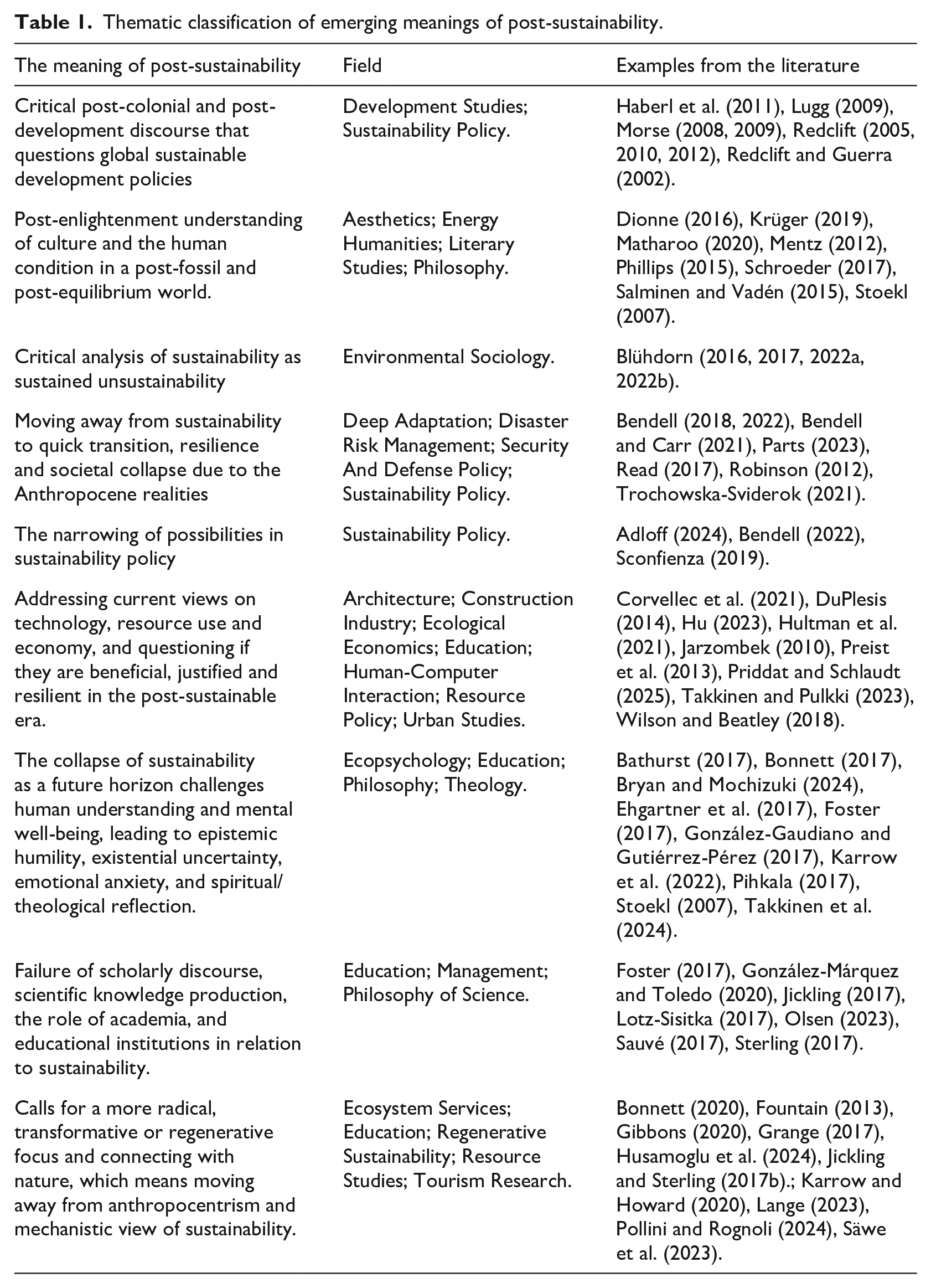
This chronological overview goes through notable formulations of post-sustainability that have occurred in very different scholarly contexts over the years (and often independently from one another) – the overview is summarized in Table 1.
Thematic classification of emerging meanings of post-sustainability.
The first mentions of post-sustainability would appear to be by Redclift (2000, also in 2005, 2010, 2012); and Redclift and Guerra (2002). This particular articulation describes the discursive registers and practices in society (Redclift and Guerra, 2002) and the sciences (Redclift, 2012) which allow sustainable development policies to be critically evaluated and contested. The stance questions the natural scientific and neo-liberal overtones of environmental management in developing countries by pointing out that ‘sustainability’ dismisses cultural and epistemological plurality while hiding inequalities in the past and present (Redclift, 2005). Post-sustainability thus questions the foundations for the original conceptualization of ‘sustainability’ and the legitimacy of current versions of it. In so doing, it keeps the question of sustainability open. In this case, ‘post-’ describes not the era of achieved sustainability but the temporal and theoretical distance from the origins of ‘sustainability’ (Redclift, 2010). Additionally, Redclift’s conceptualization of post-sustainability has Latourian undertones, reminding us of how ‘social realities and relationships are continually reconstructed as new technologies, communication systems and environmental issues arise’ (Lugg, 2009: 17). In sum, Redclift’s multilayered ‘post-’ means that the world and humans are no longer the same as when ‘sustainability’ was first coined. Such ontological reconsiderations are today familiar in Anthropocene- and post-humanist thinking.
Stoekl’s (2007) articulation of ‘postsustainability’ anticipates later energy humanities. Following Georges Bataille’s philosophy, Stoekl questions the validity of consuming less as a way to control the energy/material metabolism of a culture, as this goes against our natural desire to expend or use as much energy as possible. If we, however, satisfy this need for energy expenditure through our bodies, rather than fossil fuels, we will perhaps achieve sustainability, as an after-effect – hence postsustainability. Postsustainability is largely a post-enlightenment mode of experience which celebrates excess as ‘an ethics of generosity’ (Stoekl, 2007: 93). Later conceptualizations of postsustainability in energy humanities also characterize it as a source of meaningfulness and thus ‘a counterpower to the hierarchies of fossil capitalism’ (Salminen and Vadén, 2015: 107); an attunement to posthuman and Anthropocene thinking by reconceptualizing ‘energy’ and ‘future’ as ‘fundamentally resistant to planning’ (Schroeder, 2017: 358); and as an aesthetic understanding of environmental crises that can ‘energize truths that are inaccessible to ordinary sense’ (Matharoo, 2020: 224). While more policy- and science-oriented literature on post-sustainability hardly intersects with Stoekl’s view, it might concur that enlightenment rationality has little to do with how energy rushes through culture and individual subjectivities, thus questioning rationalistic approaches to sustainability.
Morse (2008, 2009) describes ‘post-sustainable development’ as a way to label critiques of sustainable development (SD) which align with ‘post-development’ theory. From this perspective, SD is a continuation of post-WW2 development programmes in the global South that have been criticized for being merely economic, scientific and industrial takeover of nature, with the old North-South injustices and hierarchies concealed as expert interventions. In contrast, post-sustainable development is identified as a process of discourse in which local and grassroots voices have real weight. While the ‘post-’ in post-development indicates an era following hegemonic development (Escobar, 1992), Morse (2008) emphasizes that the ‘post-’ in post-sustainable development means ‘withdrawal and rejection’ from the hegemony (p. 348). Notably, Morse himself does not align with the post-sustainable development view, in which he sees populistic overtones and thus defends the role of the West and experts. Morse concludes that – while post-sustainable development discourse has produced some valid criticism – much of this has already been incorporated as self-criticism within SD, making the ‘withdrawal and rejection’ position quite unwarranted (Morse, 2009).
Mentz (2012) outlines postsustainability eco-criticism in literature, that looks beyond ‘green dreams’ of sustainability and literary fantasies of pastoralism. Instead, ours is a postequilibrium world: ‘our global environment, in its changeableness, its alterity, and its violence, appears more oceanic than terrestrial’ (Mentz, 2012: 591) – with the ocean symbolizing the limits of human agency and knowledge. Mentz’s ‘post-’ means the ‘era of sustainability is over’ (2012: 586) – although it never existed in the first place. Mentz mentions postsustainability (see Stoekl, 2007) to expose and correct the underlying cultural narratives of stable sustainability existing in the past or future. Following Mentz, Phillips (2015) calls for ecoaesthetics to ‘unsolidify’ the techno-economic focus of sustainability and to convey ‘the post-sustainable world(s) [that] will sound, feel and look differently’ (p. 65).
Robinson (2012: 182) argues that the emerging realities of the Anthropocene demand that the public sector and environmental management play a central role in ‘post-sustainable decision making’. However, current capacities of public environmental legislation and management are lacking, and the real goals of sustainable development are to ‘promote economic growth’, ‘abet passivity’ and ‘legitimize existing “business as usual”’ (Robinson, 2012: 183). In contrast, a post-sustainable adaptation of society would engage all sectors and encourage public discourse, the key principles being cooperation and resilience. Robinson’s argument about how the Anthropocene renders the SD paradigm obsolete is one of the first appearances of the Anthropocene in the post-sustainability literature. In both the temporal and critical sense, the Anthropocene justifies the ‘post-’ in post-sustainability and is also characteristic of many later interpretations of the concept (see also Benson and Craig, 2014). Importantly, here post-sustainability is no longer limited to North–South relations nor philosophical or aesthetic theory; now it is about the adaptation and survival of even the most affluent and supposedly stable societies. The relevance of these questions have since then been underlined by Bendell in the context of Deep Adaptation framework (Bendell, 2018) and calls for ‘an upgraded form of Disaster Risk Management’ (Bendell, 2022: 1) as part of the wider ‘post-sustainability research agenda’ (p. 16).
In 2013, a workshop at the Conference on Human Factors in Computing Systems (CHI 2013) involved 13 abstracts (see Appendix 1) discussing information technology and post-sustainability (Preist et al., 2013). The workshop description gave three meanings for the ‘post-’. The first described moving beyond a persuasion-based approach to sustainable technology, that is, attempts to affect the individual behaviour of consumers. The second was about moving beyond an ‘overly simplistic focus on single resource reduction’ (Preist et al., 2013: 3252) in sustainable interaction design; and the third evoked the question of adaptation, resilience and even a possible societal collapse due to worsening environmental impacts, and what this means for information technology. Preist et al. (2013) thus frame post-sustainability both as a questioning of current sustainability approaches (i.e. a critical ‘-post’) and in anticipation of unsustainable times to come (temporal ‘-post’) – with the aim of moving sustainable human-computer interaction ‘to the next level’ (p. 3253). While there are many articulations of post-sustainability that are critical of technological optimism, here it is the scholars of information technology themselves who are questioning whether certain technological systems can promote sustainability or even endure the post-sustainable times. Similarly, in sustainable urban design, Jarzombek’s (2010) early articulation of post-sustainability as an internal critique of the field’s sustainability visions seems to echo in later literature (Hu, 2023; Wilson and Beatley, 2018). Further, it has been noted how through ‘resourcification’ things are turned into resources by the “constant and violent anthropogenic flux” (Hultman et al., 2021: 2), and thus the post-sustainable Anthropocene era requires critically revisioning current resource policies (Corvellec et al., 2021; Hultman et al., 2021).
Blühdorn’s (2016) studies in environmental sociology trace the metamorphosis of sustainability from failed eco-politics into a successful ‘politics of sustained unsustainability’ (p. 7). Accordingly, sustainable consciousness has been successfully integrated and pacified into modernity, into serving affluent subjectivities, without endangering the expansive possibilities of consumer lifestyles. Such post-sustainability – being essentially post-ecological and simulative (Blühdorn, 2004) – alleviates the need for transformation through ‘green’ consumerism and technology, thereby fostering the individual autonomy of consumer-subjects (p. 9). Blühdorn (2017) states that while the sustainability paradigm is becoming exhausted, sociologists should not focus on nurturing new narratives of hope, but instead study this ‘new social contract for sustaining the unsustainable’ (p. 58). In later studies, Blühdorn goes on to question the commonly assumed democracy/sustainability relationship, since emancipation and democratization seem to be ‘drivers for a politics of unsustainability’ (Blühdorn, 2022a: 490). He suggests how the exhaustion of sustainability may signal more widely the exhaustion of western modernity with its progressive and emancipatory normative horizon – this is being replaced by mere self-interested ‘resilience’ (Blühdorn, 2022b: 152). Crudely put, Blühdorn’s ‘post-’ means that the political communities in the global North committed to the ecological and social goals of SD are ceasing to exist – or rather, their non-existence from the outset is becoming increasingly evident.
In 2017, post-sustainability was addressed by scholars of education in Post-sustainability and environmental education: Remaking education for the future (Jickling and Sterling, 2017b), a volume that brought together 10 articles on the subject (see Appendix 1). The editorial states – citing Blühdorn – that due to the semantic plasticity of ‘sustainability’, it can sustain attitudes that further the ecological catastrophe, and regarding educational efforts, ‘whatever has been achieved in [last two decades in environmental- and sustainability education], it is not sufficient’. (Jickling and Sterling, 2017a: 2). The editors make a point of underlining that their ‘post-’ is not aiming so much at academic professionalism, but at education itself; they simply ask what many educators are asking: ‘What should we do next?’ (pp. 4–5). Due to the uncertainties of the Anthropocene, this anthology aims to provide heuristics for questioning, not a framework (p. 9). In his article, Grange (2017) comments on the terminology and prefers ‘after sustainability’, since it can mean both ‘in pursuit of sustainability’ and ‘following sustainability in time’ (p. 94). Scholars of education often discuss the questions of agency, hope and despair, and Sauvé (2017) shares her feelings when facing post-sustainability: ‘Here, I could stop writing this text: there is no point, it is too late! But I will not’ (p. 112). Since then, post-sustainability has been frequently discussed in education: Karrow and Howard (2020), Karrow et al. (2022) see post-sustainability as the field-signifier currently defining environmental and sustainability education, which implies wide-ranging revisionism regarding education, its purpose and future. Takkinen et al. (2024) note that ‘many students and teachers already hold post-sustainable views’ (p. 773) and since knowledge of the ecological crises poses an existential threat, a transformative approach is needed – education that focuses on skills and competencies alone is simply not enough. In other words, the ongoing discussion in education suggests that post-sustainability ‘is currently defining itself’ (Karrow et al., 2022: 116). Post-sustainability discourse in education makes visible the wider question of whose understanding of sustainability is legitimate in scientific and expert cultures; Many educators consider their honest educational relationship with the young people more binding than committing to the neoliberal and technologically optimistic sustainability statements of their curricula and institutions, since they fail to pass the ‘reality check’ of the Anthropocene (Sterling, 2017: 36). Also in other fields such uncertainties create ‘ecological cracks’ (Beck, 1994: 49) meaning debate and even division among scholars regarding acceptable sustainability paradigms (Takkinen and Heikkurinen, 2024).
In 2018, an interdisciplinary anthology was published called Post-Sustainability: Tragedy and Transformation (Foster, 2018), bringing together 19 texts on the subject, of which half were articles and the other half commentaries on them (see Appendix 1). It originally appeared in 2017 as a special issue in Global Discourse under the title ‘After Sustainability – What?’. For this editorial, the ‘post-’ is both critical and temporal: ‘It is no longer completely out of court for thinkers and scholars concerned with environmental issues to argue that the “sustainability” discourse and policy paradigm have failed, and that we are moving into a new and much bleaker era’ (Foster, 2017: 1). From a hermeneutic perspective, Foster seems to capture the general atmosphere among scholars of post-sustainability – tragedy and transformation are keywords that feature throughout the volume, for example in Gough’s (2017) piece: ‘the whole point about accepting the post-sustainability premise is that, anyway, stability just isn’t on offer any more’ (p. 142). One prevalent theme to emerge is that of human limitations and the inability of humans to understand our predicament. Ehgartner et al. (2017) follow the philosophy of Günther Anders and go so far as to say that post-sustainability means the obsolescence of human beings since it is no longer humans that are ‘the subject of history in our times, but the machines that they created’ (p. 68). Furthermore, the faith in technology colonizes the horizon of imagination, thus nullifying attempts to think about eco-social crises, making us – in Anders’ words – ‘apocalyptically blind’ (Ehgartner et al., 2017: 69). However, Pihkala (2017) notes that when the veil of apocalyptic blindness is lifted, it may become a question of mental health, namely eco- and climate anxiety, especially in education. Pihkala (2017) thus introduces ecopsychology into the post-sustainability discourse by reminding us that underlying anxieties should be taken seriously, while a ‘realistic sense of tragedy’ is needed (p. 2).
Sconfienza (2019) introduces us to the post-sustainability trilemma as a policy framework where the three pillars of SD – economic growth, political participation, and environmental protection – cannot all be achieved simultaneously. Only once we accept this impossibility, can political possibilities be clarified. In this case, ‘trilemma’ stems from the notion that because only two of the three goals can be achieved at any one time, there are three possible eventualities for a political framework: (a) techno business-as-usual – economic growth with political participation; (b) post-growth – political freedoms with environmental protection; and (c) environmental authoritarianism – environmental protection with economic growth (p. 777). These frameworks help in understanding the current articulations of technological optimism, degrowth and green authoritarianism. The performative weight of the post-sustainability trilemma lies in underlining that ecological modernization did not deliver what SD promised. The aim of this is to shake up the political imagination required to admit ‘there are no easy ways out’ (p. 779). More recently, Adloff (2024) refers to both Sconfienza (2019) and Blühdorn (2022a) when stating that in terms of sustainability, the trajectory of (eco)modernization has failed and any wider socio-ecological transformation there has been has come too little too late. What remains is ‘control under the conditions of ecological emergencies’ (Adloff, 2024: 6) which means that ‘sustainability, in the sense of an open future, is no longer achievable’ (Adloff, 2024: 13; see also Brown, 2016). In sum, the post-sustainable policy perspective would suggest that governments and the public sector are ill-prepared for an unsustainable future. The recent decades of SD can be seen as simply the postponement of necessary transformations – kicking the can down the road.
González-Márquez and Toledo (2020) suggest that the rapidly expanding field of sustainability science is in crisis in a Kuhnian sense and this might justify the emerging articulations of post-sustainability. Despite growing research efforts, ‘humanity has never before been moving faster nor further away from sustainability’ (González-Márquez and Toledo, 2020: 10). Here post-sustainability is described as a scenario, and ‘post-’ equals ‘the end of sustainability’ (referring to Benson and Craig, 2014). González-Márquez and Toledo (2020) argue that the unwarranted reliance on ‘technical fixes through market-based instruments’ (p. 12) signals far deeper problems in the current scientific paradigm and in wider epistemology: ‘the global socio-environmental crisis would seem to be an enormous “anomaly”, a huge unexpected result of our mental model of progress, so central to the modern worldview’ (p. 14). Similarly, Olsen (2023) argues that the irreversible realities of post-sustainability call into question the conventional three-part modus operandi of ‘teaching, researching and disseminating’ in academia, calling for an additional fourth part – ‘co-creation for sustainability’.
Finally, many conceptualizations of post-sustainability emphasize the need to overcome anthropocentrism and mechanistic worldview and instead foster nature connectedness and holistic sustainability approach. Many of these articulations stem from two different sources: first there is the education literature, where the skills and competences approach to sustainability is replaced by more transformative education (e.g. Jickling and Sterling, 2017b.; Bonnett, 2020; Karrow and Howard, 2020; Lange, 2023) and second, the literature of regenerative sustainability, where many authors in fields such as entrepreneurship, tourism and agriculture cite Gibbons (2020) when framing regenerative paradigm as an answer for post-sustainability. The ‘post-’ in these articulations can be seen as a call for a more comprehensive, transformative and radical sustainability paradigm beyond merely anthropocentric and mechanistic problem-solving (Lange, 2023; Säwe et al., 2023).
While not exhaustive, the above articulations do show the growing range of meanings for post-sustainability that have emerged over the last couple of decades (see Table 1). The table presents those family-resemblant meanings that appeared as frequent, distinctive, and relevant during the hermeneutic reading process. The aim is to map the conceptual territory for further thought and discussion (Smythe and Spence, 2012: 23). Furthermore, the identified meanings of post-sustainability are often intricately interlinked in the literature, making the overall picture more nuanced than the pigeon-hole appearance of the Table 1 can convey.
With so many articulations of ‘post-sustainability’, one might think that the only thing they have in common is their spelling; but their shared appearance is not accidental – each suggests or assumes some sense of ‘after sustainability’ that often coincides with the emergence of the Anthropocene discourse. Even if some are hesitant to add ‘post-’ to ‘sustainability’ (e.g. Grange, 2017; Hannis, 2017; Morse, 2008) there seems to be no disagreement over how post-sustainability should be understood or defined, and the above meanings seem to emerge in a mutual tolerance. This coeval emergence would confirm that post-sustainability expresses family-resemblant contemporaneous meanings and questions that no longer fit within ‘sustainability’ (Brown, 2016).
Plural meanings of ‘post-’ in the post-sustainable landscape
The previous section demonstrates that although first impressions of post-sustainability may intuitively suggest that SD has failed, the use of post- in the literature can imply more nuanced meanings as well. It seems most useful, therefore, to characterize post-sustainability as a landscape of meanings rather than an exclusive definition; (a) Post-sustainability describes the tension between the implausibility of the sustainability paradigm and the seeming impossibility to deal with the future eco-social predicaments such as the Anthropocene. This tension or ‘junction’ (Olsen, 2023: 52) is a source of uncertainty – indicative of the lack of scientific or existential understanding of what exactly ‘sustainability’ means in the Anthropocene era. Thus the above ‘impossibility’ means precisely the lack of problem-solving power of the sustainability paradigm, and such anomalies generally lead to a paradigm crisis and the emergence of new paradigms (González-Márquez and Toledo, 2020). For many disciplines this is causing comprehensive revision of the field, for others perplexity. The fact that the sustainability paradigm – maybe the most influential cultural idea and social movement in recent history – is so utterly unprepared to face the realities of an Anthropocene era (Benson and Craig, 2014) seems particularly ironic, if not contradictory. However, unlike in formal logic – where anything follows from a contradiction (ex contradictione quodlibet) – the post-sustainable contradiction does not lead to triviality. The plural meanings of post-sustainability are not random, but demarcated by the absence of certain meanings – none of these articulations signal nihilism, denialism, nor utopian optimism (e.g. the ‘good Anthropocene’ hypothesis) as a basis for declaring ‘the end of sustainability’. Thus in addition to the above characterization; (b) A central common nominator for articulations of post-sustainability is their acute commitment to the well-being of humankind and living nature, within the limits of emerging conditions.
Even if hermeneutic interpretation does not prioritize referential meanings, it is useful to ask what post-sustainability actually refers to in the literature. What is its semantic extension? There seem to be three: (a) anticipation of a bleak (often Anthropocene) future; (b) critical evaluation of the past sustainability paradigm; and (c) present challenges and possibilities in each respective scholarly field. In this post-sustainable landscape, (a) and (b) represent two opposing or at least distant poles – one located in the future and the other in the past; while (c) attempts to join the poles as best it can (with a certain amount of tension).
Strictly speaking these three ‘post-sustainabilities’ refer to different things, yet they are not mutually exclusive. On the contrary, they are only meaningful as part of the same landscape in which worsening socio-ecological crises simultaneously (a) define the emerging era (often termed the Anthropocene) and invalidate previously plausible ideas of future sustainability (e.g. Adloff, 2024; Foster, 2017; Mentz, 2012); (b) indicate failure of the prevailing hegemonic sustainability paradigm and call for its critique (e.g. Bendell, 2022; Blühdorn, 2017; Redclift, 2005); and as a consequence (c) require an alternative paradigm. Despite abandoning (some of) the goals and means of SD and its underlying worldview, these approaches are still committed to furthering the well-being of humans and living nature within the limits of emerging conditions (e.g. Bonnett, 2020; Sconfienza, 2019; Stoekl, 2007).
This post-sustainable landscape provides a heuristic overview that may help to locate present and future articulations of post-sustainability. As a hermeneutic attempt to gain a historical perspective over the topic, it nevertheless acknowledges the inevitability of being embedded within the historical conditions being studied (Smythe and Spence, 2012: 13).
Finally, many current concepts – such as sustainable development and the Anthropocene – already signal environmental urgency and the need for new approaches, so how is post-sustainability any different, and how does it avoid being trivial (see also Morse, 2008)? In this case, it is perhaps the reflective potential of the prefix ‘post-’, and here the five principles for interpreting ‘post-’ concepts proposed by Paul and Van Veldhuizen (2021) seem appropriate.
(1) Positioning in post-sustainability means both defining sustainability and distancing from it. As already seen above, this has ‘epistemic, aesthetic, moral and political dimensions’ (Paul, 2021: 7). It means that sustainability can be portrayed as counterproductive (Blühdorn, 2016) or hopelessly contested (Delanty, 2020), and it can also point to philosophical and practical shortcomings in terms of modernist (Lange, 2023), economic (González-Márquez and Toledo, 2020), technocratic (Takkinen and Pulkki, 2023), colonialist (Karrow and Howard, 2020) or anthropocentric (Stoekl, 2007) bias. Such a critical definition helps to orient the distancing. Since ‘post-’ articulates a clear relationship with sustainability, post-sustainability is not simply a synonym for environmental emergency – an unreflected call for ‘more sustainability faster’ – but also a question concerning the nature of sustainability (Blühdorn, 2017; Jickling and Sterling, 2017a). For example, faith in technological mastery (hubris) as opposed to resilient cultural adaptation (humility) are practically opposite reactions to the Anthropocene, and they rest on very different policies and cultural narratives (Bendell, 2022; Benson and Craig, 2017).
(2) Performativity means that post-sustainability not only describes the emerging era (what is), but also prescribes post-sustainable alternatives (what ought to be done). Notably, however, this is does not necessarily lead to the ought: societies of the Global North, for instance, persist in their unsustainability, yet still call it ‘sustainability’, while remaining yet relatively unaffected by the externalized consequences (Blühdorn, 2017). Such simulative sustainability, however, is no more than an empty gesture (Brown, 2016) that aims to accumulate symbolic capital and power (Olsen, 2023: 52). Post-sustainability marks a performative demarcation, which aims to expose and overcome unsustainable sustainability paradigm. Since sustainability has become so widely and loosely used, its meaning becomes both empty and saturated; indeed, because sustainability now carries an excess of meanings, it is no longer reducible to a single concept (see, e.g. Delanty, 2020), so it could be a waste of time and effort to try and redefine ‘sustainability’ yet again. Accordingly, Olsen (2023) describes the ‘post-’ as a reflective step away from sustainability, because it ‘allows us to shed some weight and leave those parts of the concept that are unhelpful behind’ (p. 52). In this way, ‘post-’ takes a sceptical step back from ‘sustainability’ and invites to ‘stop, and consider’ (Sterling and Jickling, 2017: 144).
(3) The transfer (or spread) of post-sustainability across different fields and contexts is illustrated in Section 3 above: the original focus on the global South and the legitimacy of sustainable development policies (Morse, 2008; Redclift, 2005) then began to be used to describe institutionalized unsustainability in the affluent North (Blühdorn, 2016; Redclift, 2012) and then with regard to the Anthropocene, resilience and possible societal collapse (Bendell, 2022; Robinson, 2012). However, a more accurate description would be the sequential emergence of different post-sustainabilities, since early articulations rarely build on each other. Perhaps the clearest line of transfer is Stoekl’s (2007) postsustainability, and its successors in philosophy, energy humanities and aesthetics. Many texts mention post-sustainability without any reference or elaboration, and it can be expected that different meanings bundle or blend in the future. This is not a critique, and the current aim is not to define post-sustainability in some exclusive way. However, early articulations by Redclift (2005), Stoekl (2007), Morse (2008), and Blühdorn (2016) are quite nuanced and add depth to intuitive articulations that might come across in more simple terms as the ‘failure of sustainability’ or ‘realities of the Anthropocene’.
(4) Post-concepts are often interconnected due to their magnetic appeal (Paul and Van Veldhuizen, 2021: 238). These may indicate proximity and overlap in meaning and possible strategic coherence. In post-sustainability, political views may be connected to ‘post-growth’ (e.g. Adloff, 2024; Sconfienza, 2019) and philosophical views to ‘post-human’ (e.g. Karrow et al., 2022; Lie and Wickson, 2018; Stoekl, 2007) or ‘post-colonial’ (González-Gaudiano and Gutiérrez-Pérez, 2017; Huhmarniemi and Jokela, 2020; Salminen and Vadén, 2015). Tracing interconnected post-concepts can also help to define some particular view of post-sustainability, for example Stoekl’s (2007) postsustainability is defined in terms of ‘posthistorical’, ‘postfossil’ and ‘posthuman’, while Mentz (2012) builds on ‘postequilibrium’ and ‘postpastoral’. Further, Blühdorn (2004, 2017, 2022a,b) conceptualizes post-sustainability along with ‘post-ecologism’, ‘post-capitalism’, ‘post-growth’, ‘post-consumerism’, ‘post-democracy’ and ‘post-politics’. Finally, it may be helpful to ask if the ‘post-’ in post-sustainability is the same ‘post-’ as in some of these other concepts – for example, post-colonial (Van Veldhuizen, 2021: 237). In contrast with post-colonial, for instance, it is evident that the ‘post-’ prefix does not describe a complete negation (as in anti-sustainability). Instead, the relation with the root word remains reflective and dialectical.
(5) The meaning of post-sustainability nevertheless emerges from a conceptual web, and one crucial factor is its ‘negative self-definition’ in relation to its root concept ‘sustainability’ (Paul and Van Veldhuizen, 2021: 238). Post-sustainability also often has a negatively self-defining relation to ‘neoliberalism’ (Delanty, 2020) and ‘technological optimism’ (Bonnett, 2017). It often concurs with ideas such as ‘resilience’ (González-Gaudiano and Gutiérrez-Pérez, 2017) and the sustainable transformation of ‘subjectivity’ (Pihkala, 2017; Stoekl, 2007; Takkinen et al., 2024). Overall, the emergence of concepts such as ‘resilience’, ‘adaptation’ and ‘transformation’ indicate that the era of sustainability as something stable and continuous is now considered to be over (Gough, 2017). Post-sustainability is also notably often interlinked with ‘the Anthropocene’ (e.g. Kao, 2019; Matharoo, 2020; Robinson, 2012; Säwe et al., 2023; see also Benson and Craig, 2014). Thus, as suggested above, in a very broad sense ‘post-sustainability’ describes the tension between ‘sustainability’ and ‘the Anthropocene’, which both are themselves vast and elusive fields of meaning.
The prefix ‘post-’ is thus potentially rich in meaning and performativity, but Beck (1990) claims that ‘post-’ is the blind person’s cane in the social sciences – something to helplessly poke around with in the search for what will emerge from postmodernity (51). After conducting this hermeneutic review, Beck’s critique seems fitting – post-sustainability is indeed haunted by the anticipation that something will and must come after this, but that something is shrouded behind economic, technological, political, educational, epistemological, and scientific impossibilities. In sum, modern human subjectivity, with its rational autonomy and mental health, faces existential impossibility (Foster, 2017; Pihkala, 2017; Salminen and Vadén, 2015; Takkinen et al., 2024).
Van Veldhuizen’s (2021) reply to Beck’s cynicism, about the post- prefix in so many concepts, is that they ‘are just as often markers for the use of (political) agency, and accompany successful attempts to reshape society’ (p. 241). Nevertheless, there is something in Beck’s claim;
Unlike many other post-concepts, post-sustainability might not be a marker for historical progress and emancipation, but rather the end of it, since it questions humanity’s ‘freedom to pursue long-term social and economic development’ (Rockström et al., 2009). When Beck (1990) goes further and anticipates modernity succumbing to risks of its own making – with the help of science and technology – and suggests that such a return of history gives ‘the word “post” some content’ (p. 52) – the resonance with post-sustainability is clear. If postmodern is linked with virtually all post-concepts (Van Veldhuizen, 2021: 238), its particular link with post-sustainability regards the question of human agency and progress in world history. The fall of sustainability as the last grand narrative marks the end of human agency and progress in the modern sense, but the history is not over, as nature imposes the inescapable narrative of the Anthropocene (Dibley, 2012: 141; Schmidt et al., 2016; Värri, 2018: 12). Ehgartner et al. (2017) see the concept of sustainability starting with environmental concerns after WWII and ending with the disillusionment of unfulfilled sustainable development goals (SDGs): ‘In 100 years, a geological blink of an eye, we will have passed from promethean power to powerlessness, from control to contingency’ (p. 77). If indeed the sustainable horizon – as a predictable and controllable future – is darkening, then the white cane suggested by Beck (1990) is perhaps a fitting analogy for post-sustainability: after all, the white cane signals not helplessness, but determined epistemic agency in a deeply transformed world-relation (Reynolds, 2017).
Conclusions
While sustainable development is still being introduced and adopted in many sectors of society and culture as a future paradigm (Benson and Craig, 2017), hermeneutic attunement to the literature on post-sustainability makes it seem like the era of sustainability is already over even before it properly began. As the Anthropocene or some other conceptual framework – such as the ‘polycrisis’ or ‘metadisaster’ (Bendell, 2022) – renders sustainability obsolete, post-sustainability aims to navigate between the Scylla of implausible sustainability and the Charybdis of impossible future prospects. This means acute self-reflection and theoretical re-orientation across disciplines, and it seems warranted to call it a paradigm crisis of sustainability science (González-Márquez and Toledo, 2020). Further, some suggest that ‘post-sustainability’ is a helpful concept for understanding and guiding this reorientation in-between paradigms (e.g. Bendell, 2022; Karrow et al., 2022; Olsen, 2023). Indeed, the emerging discourse surrounding post-sustainability can indicate – as a canary in the coalmine – challenges that lie yet ahead for much of sustainability scholarship. Thus the Anthropocene can be said to catalyse theoretical advances in the discourse surrounding sustainability (Bryan and Mochizuki, 2024).
Boell and Cecez-Kecmanovic (2014) suggest a hermeneutic approach for interpreting bodies of scientific literature, especially in contexts of paradigm change, where new concepts and theories may become incommensurable with the old ones (p. 259). Since post-sustainability is often described as a paradigm change in contrast to sustainability, it was essential to keep asking what work does this concept do in the literature – especially, since navigating the territory of post-concepts requires constant interpretation (Paul and Van Veldhuizen, 2021). For example, two volumes which address post-sustainability either as ‘after sustainability’ (Foster, 2015) or ‘the end of sustainability’ (Benson and Craig, 2017) both underline the need to revise our wider cultural narratives and foster a sense of tragedy and humility. What this means for the practice of science and policy, must be interpreted by us contemporaries who are existentially embedded in these conditions. Similarly, what the Anthropocene actually means, is arguably a wider question than its mere natural scientific definition (Maslin and Lewis, 2015; Toivanen et al., 2017).
This hermeneutic review introduced and interpreted the meanings of post-sustainability in current literature. The historical overview and thematic classification in Section 3, and closer analysis of the prefix ‘-post’ in post-sustainability (Section 4) aim to contribute to future discussions. Due to the plurality of scholarly fields involved, different articulations of post-sustainability proved often incommensurable yet were family-resemblant. A post-sustainable landscape was suggested – to describe the conceptual web between sustainability and the Anthropocene – as a broad background against which meanings of post-sustainability can be navigated. A common nominator is the acute commitment to the wellbeing of humans and living nature, within the limits of emerging conditions.
Finally, two remarks regarding the future discussions are in order. First, the combination of ‘post-’ with ‘sustainability’ has many potential meanings, and for post-sustainability to maintain its reflective potential, it might be beneficial to relate new conceptualizations of post-sustainability with earlier ones. Arguably there remains untapped potential for new understandings of post-sustainability. Secondly, as post-sustainability – in spite of its critical nature – is meant as a constructive concept, its positioning in contrast to sustainability should be carefully considered. In possibly more polarized future discussions post-sustainability might be (mis-)interpreted to encourage denialist or otherwise anti-sustainability views and policies. Thus while the legitimacy of the sustainability paradigm is being questioned in scholarly contexts, there are surely shared goals and values to be stated in contexts of policy and public communication. Even if sustainable development ‘needs to be jettisoned’ (Read, 2017: 149), sustainability might still remain a valuable guiding principle of ethical nature (Hannis, 2017), and the underlying spirit of post-sustainability afterall remains to be after sustainability (Grange, 2017).
In sum, post-sustainability can be seen as a catalyst for reflection across different fields by raising timely questions. Is sustainability behind us? If so, in what sense, and what should be done about it?
Footnotes
Appendix
Post-sustainability literature from the hermeneutic literature review.

| Authors | Year | Published in | Title (* = full text not found) | Field | Anthropocene thematized |
|---|---|---|---|---|---|
| Redclift | 2000 | International Sociological Association RC24 Miniconference | Post-sustainability* | - | - |
| Redclift, Guerra | 2002 | Raízes: Revista de Ciências Sociais e Econômicas | Pós-sustentabilidade e os novos discursos de sustentabilidade | Sustainability Policy | No |
| Redclift | 2005 | Sustainable Development | Sustainable Development (1987–2005): An Oxymoron Comes of Age | Sustainability Policy | No |
| Stoekl | 2007 | University of Minnesota Press | Bataille’s peak: energy, religion, and postsustainability | Philosophy | No |
| Morse | 2008 | Sustainable Development | Post-Sustainable Development | Development studies | No |
| Høgh-Jensen et al. | 2009 | Scientific Research and Essay | Research in sub-saharan African food systems must address post-sustainability challenges and increase developmental returns | Development studies | No |
| Lugg | 2009 | TCI (Transnational Curriculum Inquiry) | Journeys in/with ‘sustainability literacy’: Pedagogical possibilities in higher education contexts | Education | No |
| Morse | 2009 | International journal of global environmental issues | Post-(sustainable) development?: EKC and sustainable development | Development Studies | No |
| Jarzombek | 2010 | Smartcities and Eco-Warriors, Routledge | Post-Sustainability* | - | - |
| Redclift | 2010 | The International Handbook of Environmental Sociology, Second Edition | The transition out of carbon dependence: the crises of environment and markets | Sociology | No |
| Haberl et al. | 2011 | Sustainable development | A socio-metabolic transition towards sustainability? Challenges for another Great Transformation | Sustainability Policy | Yes |
| Loy | 2012 | E&PDE12: International Conference on Engineering & Product Design Education | Creating confidence in an alienating educational environment | Education | No |
| Mentz | 2012 | PMLA | After Sustainability | Literary Studies | No |
| Redclift | 2012 | Sustainability Science: The Emerging Paradigm and the Urban Environment | ‘Post-sustainability’: The Emergence of the Social Sciences as the Hand-Maidens of Policy | Sustainability Policy | No |
| Robinson | 2012 | Journal of Public Affairs | Beyond sustainability: Environmental management for the Anthropocene epoch | Environmental Management | Yes |
| Avram | 2013 | ECSCW 2013: The 13th European Conference on Computer Supported Cooperative Work | Starting a Garden, Caring for It, Growing with It - a Study on Collective Practices in Urban Gardening | Human–computer interaction (HCI) | No |
| Avram et al. | 2013 | CHI 2013 | Do-It-Yourself Sustainable Living: Opportunities and challenges of DIY communities | HCI | No |
| Borning | 2013 | CHI 2013 | UrbanSim, ConsiderIt, and OneBusAway: Reflections on three projects and post-sustainability* | HCI | - |
| Dillahunt | 2013 | CHI 2013 | Toward a Deeper Understanding of Sustainability within HCI | HCI | No |
| Hauser | 2013 | CHI 2013 | Rethinking and Envisioning Sustainable HCI and the Role of Interaction Design* | HCI | - |
| Knowles | 2013 | CHI 2013 | Deep interventions to change how we think and act | HCI | No |
| Kobayashi | 2013 | CHI 2013 | Human–Computer–Biosphere Interaction: Beyond Human - Centric Interaction | HCI | No |
| Massung | 2013 | CHI 2013 | The future of crowdsourcing: Supporting advocacy, creating awareness, and altering norms | HCI | No |
| Pargman et al. | 2013 | CHI 2013 | HCI in a world of limitations: Addressing the social resilience of computing* | HCI | - |
| Preist et al. | 2013 | CHI 2013 Extended Abstracts | POST – SUSTAINABILITY A CHI Sustainability Community Workshop | HCI | No |
| Shabajee | 2013 | CHI 2013 | HCI 4 Adaptation: A position paper* | HCI | - |
| Fountain | 2013 | Making Futures Journal | Resurgent homecraft, design for resilience, and the everyday practices of sustainable living | Sustainable Design | Yes |
| Stoekl | 2013 | Prismatic ecology: Ecotheory beyond green | Chartreuse | Philosophy | No |
| Du Plessis | 2014 | Proceedings of the 8th Construction Industry Development Board (CIDB) Postrgraduate Conference |
Adapting the built environment to climate change in a post-sustainable world | Construction | no |
| Silberman et al. | 2014 | CHI 14 Extended Abstracts | What have we learned? A SIGCHI HCI & Sustainability Community workshop | HCI | No |
| Fountain | 2015 | Doctoral thesis, University of Tasmania | Design for resilience at home: Integrating housing and regenerative food systems. | Design research | Yes |
| Phillips | 2015 | An introduction to sustainability and aesthetics: The arts and design for the environment | Artistic practices and ecoaesthetics in post-sustainable worlds | Art, aesthetics | Yes |
| Salminen and Vadén | 2015 | MCM Publishing | Energy and Experience: An Essay in Nafthology | Philosophy | No |
| Schorse | 2015 | Doctoral thesis, University of Delaware | Questioning the transformational potential of payment for ecosystem services in forest conservation: A case for greater connectivity in managing complex socio-ecological systems | Geography | No |
| Blühdorn | 2016 | The Oxford Handbook of Environmental Political Theory | Sustainability— Post-sustainability— Unsustainability | Sociology | Yes |
| Dionne | 2016 | punctum books | Posthuman Lear: Reading Shakespeare in the Anthropocene | Literary Studies | Yes |
| Blenkinsop and Morse | 2017 | Post-Sustainability and Environmental Education | Saying Yes to Life: The Search for the Rebel Teacher | Education | No |
| Bonnett | 2017 | Post-Sustainability and Environmental Education | Sustainability and Human Being: Towards the Hidden Centre of Authentic Education | Education | No |
| González-Gaudiano and Gutiérrez-Pérez | 2017 | Post-Sustainability and Environmental Education | Resilient Education: Confronting Perplexity and Uncertainty | Education | No |
| Grange | 2017 | Post-Sustainability and Environmental Education | Environmental Education After Sustainability | Education | No |
| Jickling | 2017 | Post-Sustainability and Environmental Education | Education Revisited: Creating Educational Experiences That Are Held, Felt, and Disruptive | Education | No |
| Jickling and Sterling | 2017 | Post-Sustainability and Environmental Education | Post-Sustainability and Environmental Education: Framing Issues | Education | Yes |
| Lotz-Sisitka | 2017 | Post-Sustainability and Environmental Education | Education and the Common Good | Education | Yes |
| Orr | 2017 | Post-Sustainability and Environmental Education | Foreword | Education | Yes |
| Sauvé | 2017 | Post-Sustainability and Environmental Education | Education as Life | Education | No |
| Sterling | 2017 | Post-Sustainability and Environmental Education | Assuming the Future: Repurposing Education in a Volatile Age | Education | Yes |
| Sterling and Jickling | 2017 | Post-Sustainability and Environmental Education | An Afterword | Education | Yes |
| Andrews | 2017 | Global Discourse | Transformation, adaptation and universalism (A reply to: Heatley, Brian. 2017. ‘Paris: optimism, pessimism and realism’.) | SustainabilityPolicy | No |
| Bathurst | 2017 | Global Discourse | Beyond sustainability: hope in a spiritual revolution? | Theology | No |
| Blühdorn | 2017 | Global Discourse | Post-capitalism, post-growth, post-consumerism? Eco-political hopes beyond sustainability | Sociology | Yes |
| Carr | 2017 | Global Discourse | Response to ‘Environmental education after sustainability: hope in the midst of tragedy’ | Education | No |
| Ehgartner et al. | 2017 | Global Discourse | On the obsolescence of human beings in sustainable development | Philosophy | Yes |
| Foster | 2017 | Global Discourse | Caring for the future? – a response to Rupert Read | Interdisciplinary | No |
| Foster | 2017 | Global Discourse | Editorial: Hope after sustainability – tragedy and transformation | Sociology / philosophy | yes |
| Foster | 2017 | Global Discourse | On Letting Go | Philosophy | No |
| Gough | 2017 | Global Discourse | Education after sustainability | Education | No |
| Hannis | 2017 | Global Discourse | After development? In defence of sustainability | Policy / philosophy | Yes |
| Hausknost | 2017 | Global Discourse | There never was a categorical ecological imperative: a response to Ingolfur Blühdorn | Policy / sociology | No |
| Heatley | 2017 | Global Discourse | Paris: optimism, pessimism and realism | Sustainability Policy | No |
| Moeller and Pedersen | 2017 | Global Discourse | Apocalyptically blinded | Interdisciplinary | Yes |
| Muers | 2017 | Global Discourse | Response to ‘Beyond sustainability: hope in a spiritual revolution?’ | Interdisciplinary | No |
| Pihkala | 2017 | Global Discourse | Environmental education after sustainability: hope in the midst of tragedy | Education / psychology | Yes |
| Read | 2017 | Global Discourse | On preparing for the great gift of community that climate disasters can give us | Disaster studies / philosophy | No |
| Read | 2017 | Global Discourse | The future: compassion, complacency or contempt? | Interdisciplinary | No |
| Scott | 2017 | Global Discourse | Learning and education after sustainability | Education | No |
| Wilde | 2017 | Global Discourse | Response to ‘After development? In defence of sustainability’ | Interdisciplinary | No |
| Schroeder | 2017 | Petrocultures: Oil, Politics, Culture | Getting into Accidents: Stoekl, Virilio, Postsustainability | Energy humanities / philosophy | No |
| Youssef | 2017 | Sustainability and the City: Urban Poetics and Politics, 47. (Lexington Books) | Unraveling the Poles of Suburb and City. | Urban Sustainability | No |
| Bendell | 2018 | IFLAS Occasional Paper 2, University of Cumbria | Deep adaptation: A map for navigating climate tragedy. | Deep Adaptation | Yes |
| Lie and Wickson | 2018 | Posthumanism: The Future of Homo Sapiens | Trans-ecology and Post-sustainability | Transhumanism, philosophy | No |
| Frank and Silver | 2018 | Urban Planning Education. Springer | Chapter 16 Envisioning the future of planning and planning education | Urban Planning, Education | No |
| Wilson and Beatley | 2018 | Urban Planning Education. Springer | Chapter 20 Educating Code-Switchers in a Post-sustainability World | Urban Planning, Education | No |
| Bathurst | 2019 | Doctoral thesis, The University of Manchester | The Flourishing of Life on Earth? A Theological Investigation of the Ecosystem Approach under the Convention on Biological Diversity. | Theology | Yes |
| Kaiser et al. | 2019 | Frontiers of Architectural Research | From file to factory: Innovative design solutions for multi-storey timber buildings applied to project Zembla in Kalmar, Sweden | Architecture | No |
| Kao | 2019 | Exemplaria | Precarious Figures, Rigorous Styles | Literary studies | Yes |
| Krüger | 2019 | Environmental Values | The Paradox of Sustainable Degrowth and a Convivial Alternative | Degrowth / philosophy | No |
| Sconfienza | 2019 | Journal of Environmental Policy & Planning | The post-sustainability trilemma | Policy | Yes |
| Bonnett | 2020 | Routledge | Environmental consciousness, nature and the philosophy of education: Ecologizing education | Education | Yes |
| Delanty | 2020 | Estudios Públicos | Critical Theory as a Critique of UnSustainability: ‘Damaged life’ in the Anthropocene | Sociology | Yes |
| Gibbons | 2020 | Sustainability | Regenerative—The New Sustainable? | Sustainability policy | No |
| González-Márquez and Toledo | 2020 | Sustainability | Sustainability Science: A Paradigm in Crisis? | Philosophy of science | Yes |
| Huhmarniemi and Jokela | 2020 | Sustainability | Arctic arts with pride: Discourses on Arctic arts, culture and sustainability | Art, cultural policy | No |
| Häggström and Schmidt | 2020 | Environmental Education Research | Enhancing children’s literacy and ecological literacy through critical place-based pedagogy | Education | Yes |
| Karrow et al. | 2020 | Canadian Journal of Environmental Education Research | Activities of the Canadian Standing Committee on Environmental and Sustainability Education in Teacher Education | Education | No |
| Matharoo | 2020 | Doctoral thesis, University of California | The Damned of the Anthropocene: Performatively Modeling Energy Aesthetics for a New Structuralism | Art / aesthetic | Yes |
| Bendell and Carr | 2021 | Sustainability | Group Facilitation on Societal Disruption and Collapse: Insights from Deep Adaptation | Deep Adaptation | No |
| Corvellec et al. | 2021 | Sustainable Development | Resourcification: A non-essentialist theory of resources for sustainable development | Resource studies | Yes |
| Hallin et al. | 2021 | Business Strategy and the Environment | Transition towards and of sustainability — Understanding sustainability as performative | Transition studies | No |
| Hultman et al. | 2021 | Research Policy | A resourcification manifesto: Understanding the social process of resources becoming resources | Resource studies | Yes |
| Trochowska-Sviderok | 2021 | European Research Studies Journal | Sustainable security: revolution or utopia? | Security and defense policy | Yes |
| Bendell | 2022 | Sustainability | Replacing Sustainable Development: Potential Frameworks for International Cooperation in an Era of Increasing Crises and Disasters | Disaster Risk Management | Yes |
| Blühdorn | 2022 | Handbook of Critical Environmental Politics | Sustainability: buying time for consumer capitalism | Sociology | Yes |
| Blühdorn | 2022 | The Routledge Handbook of Democracy and Sustainability | Post-democracy and post-sustainability | Sociology | Yes |
| Heasly and Iliško | 2022 | Discourse and Communication for Sustainable Education | Towards a More Regenerative and Resilient Post-Pandemic World | Education | No |
| Karrow et al. | 2022 | Brock Education: A Journal of Educational Research and Practice | What’s In a Name? The Signifiers and Empty Signifiers of Environmental Sustainability Education: Implications for Teacher Education | Education | No |
| Piteira et al. | 2022 | Handbook of Sustainability Science in the Future | Post-Sustainability, Regenerative Cultures, and Governance Scale-Up: Transformational Learning Cases of Sociocracy 3.0 in Portugal | Transition Studies | Yes |
| Zaretsky | 2022 | The Routledge Companion to Biology in Art and Architecture | Axioms on Art and Gene Action: Pathways to Expression | Art, Aesthetics | No |
| Hu | 2023 | Routledge Handbook of Asian Cities | The Asian city in a new urban age | Urban Studies | No |
| Lange | 2023 | Routledge | Transformative Sustainability Education: Reimagining Our Future | Education | Yes |
| Olsen | 2023 | Doctoral thesis, Technical University of Denmark | Fourth Mission and Post-Sustainability Oriented Innovation in the Arctic | Management | No |
| Panozzo et al. | 2023 | 17th Organization Studies Summer Workshop | Organising Utopia and Mending Dystopia in Anthropocene Venice | Organization Studies | Yes |
| Parts | 2023 | Ümber telje. Studia Vernacula | Regenerative entrepreneurship: practical radicalism | Deep adaptation | Yes |
| Phillips et al. | 2023 | Design for Adaptation Cumulus Conference Proceedings Detroit 2022 | Defining Ecological Citizenship; Case-studies, Projects & Perspectives; Analysed Through a Design-led Lens, Positioning ‘Preferable Future(s) | Sustainable design | No |
| Säwe et al. | 2023 | Academic Quarter | The making of a beach – Ecosystem services as mediator in the Anthropocene | Ecosystem services | Yes |
| Takkinen and Pulkki | 2023 | Educational Philosophy and Theory | Discovering earth and the missing masses — technologically informed education for a post-sustainable future | Education | Yes |
| Adloff | 2024 | International Journal of Politics, Culture, and Society | Trajectories of Post-Sustainability | Policy | Yes |
| Blom and Karrow | 2024 | International Journal of Sustainability in Higher Education | Environmental and sustainability education in teacher education research: an international scoping review of the literature | Education | No |
| Bryan and Mochizuki | 2024 | Handbook of Children and Youth Studies | Rethinking Agency, Affect, and Education: Towards new Childhood and Youth Studies in the Anthropocene | Children and Youth Studies | Yes |
| Domingues and Teixeira | 2024 | International Journal of Politics, Culture, and Society | The Social and Sociological Province of Climate Change: Introduction | Interdisciplinary | Yes |
| Husamoglu et al. | 2024 | Tourism Review | Regenerative stakeholder framework in tourism | Tourism research | Yes |
| Kantonen | 2024 | master’s thesis, University of Turku | Rethinking Transformative Education, Skills for a regenerative society | Education | Yes |
| Phillips et al. | 2024 | International Conference on Human-Computer Interaction | Design Futures, Ecological Citizenship & Public Interest Technologies = HCI Regenerative Interaction Opportunities. . .? | Human Computer Interaction | No |
| Pollini and Rognoli | 2024 | Research Directions: Biotechnology Design | Healing Materialities: framing Biodesign’s potential for conventional and regenerative sustainability | Sustainable Design | No |
| Radulova-Stahmer | 2024 | 29th International Conference on Urban Planning, Regional Development, Information Society. | Revitalising our Urban Landscapes: A Call for Territorial Regeneration | Urban Planning | No |
| Takkinen et al. | 2024 | Educational Philosophy and Theory | From the Archimedean point to circles in the sand — Post-sustainable curriculum and the critical subject | Education | Yes |
| Priddat and Schlaudt | 2025 | Ecological Economics | Beyond conservation of natural capital: Rethinking sustainability in the Anthropocene | Ecological economics | Yes |
Acknowledgements
The author would like to express his gratitude to Pasi Heikkurinen, Teea Kortetmäki and the anonymous reviewers for their encouraging and insightful comments during the writing process.
Declaration of conflicting interests
The author declared no potential conflicts of interest with respect to the research, authorship, and/or publication of this article.
Funding
The author disclosed receipt of the following financial support for the research, authorship, and/or publication of this article: This work was supported by the Maj and Tor Nessling Foundation under grant 202100031.
Ethical considerations
Ethical approval was not required.
