



Abstract
Objectives:
The coronavirus disease 2019 (COVID-19) pandemic disrupted classroom-based learning, necessitating the adoption of online learning in most universities. However, there has been a lack of information on university students’ perspectives regarding online learning during the COVID-19 pandemic. This study assessed the perspectives, satisfaction and experiences with online and classroom learning among human health students at the University of Zambia.
Methods:
This cross-sectional study was conducted among 737 students at the University of Zambia from October 2022 to April 2023. Data were analysed using Stata version 16.1.
Results:
Of the 737 participants, 51.6% were female and 56.5% agreed that blended learning should continue even after the COVID-19 pandemic. However, 78.4% of the students believed that group discussions were more suitable in the classroom than online learning. Most students (67.1%) disagreed that they preferred online learning to classroom learning. Furthermore, 77.6% of the students disagreed that online learning gave more satisfaction than classroom learning.
Conclusions:
This study found that most students recommended the continuation of blended learning after the pandemic. However, they believed that follow-up tutorials and assessments were better undertaken in physical classrooms than online learning. These findings are important in sensitising stakeholders in the education sector and governments to consider blended learning as a teaching strategy in the future. There is a need to develop and implement curricula that offer blended learning to students as well as ensure the students have the necessary facilities and equipment to support such learning.
Keywords
Introduction
The coronavirus disease 2019 (COVID-19) and its consequences appreciably impacted many facets of life globally, including the education sector.1 –4 Due to the high transmissibility and rapid spread of COVID-19, lockdown measures were rapidly instigated across countries as key mitigation measures to curb the pandemic in the absence of effective treatments and vaccines certainly initially.5 –9 The consequent closure of universities and other educational establishments appreciably impacted learning programmes.1,3,10 –13 Both students and academic staff were left to grapple with adjusting to online learning as well as grappling with concerns about the affordability of the necessary information and communication technology (ICT) equipment, internet bundles and approaches to effectively instigate online learning, especially among low- and middle-income countries (LMICs).1,14 –20 In the case of healthcare students, this included the added problems of conducting practical sessions as well as teaching patient care, which resulted in a rapid move towards simulations.1,21,22
Online learning, also referred to as e-learning, involves providing education services to students using electronic media including computers, smartphones and tablets.23 –29 Various platforms are currently being used to deliver e-learning lectures and other educational approaches, including Moodle, Zoom, Microsoft Teams, Blackboard and Google Meet.30 –32 However, this mode of learning has suffered setbacks, especially in resource-limited settings where universities were initially inadequately equipped to teach online effectively and lecturers were unfamiliar with these techniques.1,33,34 In addition, and, as mentioned, there were challenges for students in terms of the necessary ICT equipment in addition to mobile phones, the prohibitive cost of internet bundles without financial support, having a quiet room available to listen and take part in lectures, workshops and simulations as well as adapting to e-learning approaches.1,3,35,36 Students, and lecturers alike, have reported different experiences regarding online learning.37 –44
Most students from LMICs expressed challenges to online learning initially at the start of lockdown measures. Challenges included a lack of resources to purchase the necessary equipment required for online learning.1,3,45 –48 In addition, typically poor internet connectivity,49 –51 power cuts 52 as well as living in remote areas with often a lack of a learning environment35,50,53 and poor infrastructure for online learning.51,54,55 These circumstances have all been cited to impact negatively on this mode of learning. Moreover, many students certainly initially found difficulties in learning certain subjects associated with their inherent complexities, using online platforms and the lack of extended and more personalised faculty support.1,56 The lack of technical support was also cited as a main barrier to online learning as computer literacy was quite low among students in some countries.1,57 Alongside this, many students experienced mental health challenges as they could not handle the physical school closures and initiation of online learning.53,54 Anxiety, depression and stress have all been reported among learners during the establishment of online learning.4,54,58 –64
However, after lockdown measures were lifted, learning institutions typically continued providing online learning alongside physical classes.65 –69 The incorporation of online and classroom (face-to-face) learning, commonly referred to as blended learning,70,71 offers many benefits over physical learning alone. 72 Blended learning approaches ensure that learning continues even during the closure of educational establishments,73,74 as well as promoting distance learning, which has a wider reach beyond the limits of the physical infrastructure of an institution.71,73 Additionally, students can download lectures and material at a time convenient to them. 75
In Zambia, the first case of COVID-19 was reported on 18 March 20201,8,76,77 followed shortly afterwards by the instigation of comprehensive lockdown measures to contain the spread of the disease, which included the closure of educational establishments.1,8 Consequently, most universities in Zambia introduced online learning using Moodle, Google Meet and Zoom to ensure that students continued with their academic activities synchronously and asynchronously.35 –78 When the COVID-19 threat subsided, and strict social-distancing restrictions including lockdowns were lifted, most institutions of higher learning continued offering online learning in addition to the traditional physical classes, in line with approaches in higher-income countries. 74 Some of the activities that were being, and still offered, through online learning include lectures, tutorials, assignments, tests and theoretical examinations. Skills-based learning, such as clinical rotations, laboratory sessions, dispensing sessions and community-based education, are now typically undertaken in face-to-face sessions.
Despite these developments, and given today’s uncertainty, gaining a differentiated understanding of Zambian students concerning online and classroom learning during the COVID-19 pandemic is critical for current and future considerations. This builds on a re-assessment of the measures taken to address the challenges among LMICs with the introduction of lockdown measures. 3 Consequently, this study sought to answer the following questions: Do students prefer online learning to classroom learning? Alternatively, do students prefer blended learning compared to online learning alone or traditional classroom learning alone? Given this background, this study aimed to address this evidence gap by assessing students’ perspectives, satisfaction and experiences with online and classroom learning in Zambia. The results can be used to guide future learning approaches among students in Zambia including future hybrid learning approaches ready for future pandemics.
Materials and methods
Study design, settings and population
This cross-sectional study was conducted from October 2022 to April 2023 among human health students at the University of Zambia (UNZA) in line with the STROBE guidelines. This institution was chosen because it is the largest public university in Zambia that offers training in various health and non-health programmes. To be eligible, a student needed to be registered with UNZA, Ridgeway Campus, in human health programmes including medicine, pharmacy, biomedical sciences, nursing sciences, public health, physiotherapy and radiography and should have provided informed and written consent. Additionally, the study included students from first year up to the final year of study, which included those who had been through the pandemic. The students were informed about the purpose of this study before the request for their voluntary participation. We excluded all students who refused to participate in the study and those who were not from the Ridgeway Campus.
Sample size estimation and sampling criteria
The sample size was estimated using Taro Yamane’s formula as described by Charan and Biswas. 79 Using a margin of error of 5%, a conservative proportion estimate of 50%, and a finite population of 1895, the minimum sample size was estimated to be n = 331. A 10% non-response rate was anticipated and this gave a sample size of 364. Finally, using a design effect of 1.5, we obtained a sample size of 546. We used a convenient sampling technique, and a total of 750 questionnaires were distributed among University of Zambia human health students.
Ethical approval
This study was approved by the University of Zambia Health Sciences Research Ethics Committee (UNZAHSREC) with an approval number of 202211231184. Participation in the study was voluntary after students were informed of the purpose of the study. All participants provided verbal and written consent before filling in the questionnaire. Confidentiality was assured and no identifiable personal information was obtained from the participants.
Data collection
A structured questionnaire from a previous study was adopted for the present study. 16 The questionnaire was reviewed for content and face validation by experts from the University of Zambia. Additionally, a pilot study was conducted among 20 students at the University of Zambia to check for the simplicity and feasibility of the questionnaire. Subsequently, no changes were made to the adopted questionnaire. A Cronbach’s alpha of 0.880, indicating acceptable internal consistency, was used to determine the reliability of the questionnaire. 16
The questionnaire had four sections. These included Section A (socio-demographic characteristics of participants: gender, age, marital status, employment status and the year of study); Section B (three questions on the perceptions of participants on online and classroom learning during the COVID-19 pandemic); Section C (seven questions on the effectiveness of online learning); and Section D (seven questions on students’ satisfaction with online and classroom learning). All the questions from Sections B to D had five responses and were scored using a 5-point Likert scale as follows: strongly disagree (1), disagree (2), neutral (3), agree (4) and strongly agree (5).80 –82 The minimum and maximum score for satisfaction was 5 and 25, respectively. Participants who scored less than the mean score were considered dissatisfied towards online learning. Those who scored equal to, or above, the mean score was regarded as satisfied. To report the results, agreed and strongly agreed were reported as agreed or satisfied, whereas neutral, disagreed and strongly disagreed were reported as disagreed or dissatisfied. We also reported the mean score out of five (5) scores for each of the responses under students’ perspectives on online learning in order to ascertain the most preferred learning mode and effectiveness of online learning. Scores above the overall mean (2.8 ± 0.8) were considered as preference for online learning. Two focal data collectors were responsible for data collection at the institution. Data were collected from October 2022 to April 2023 using a self-administered structured paper-based questionnaire. Information about the demographics, and the experiences of students regarding accessibility, engagement and preference for online learning were obtained.
Statistical analysis
Data were first entered into Excel for cleaning and logic checks. Data analysis was done using Stata version 16.1 (Stata Corp, College Station, TX, USA). Descriptive statistics computed on sample characteristics include frequencies, percentage and the results were presented in tables and figures. To identify factors associated with satisfaction with online learning, unadjusted logistic regression was performed initially. Variables with a p-value <0.2 were considered in the adjusted regression analysis. The variables with a p < 0.05 in adjusted logistic regression were considered as the factors that affected university students’ satisfaction with online learning during the COVID-19 pandemic. The level of statistical significance was set at 0.05.
Results
Socio-demographic characteristics of study participants
Of the 737 students that participated in this study, 380 (51.6%) students were females and 51.3% of them were aged between 18 and 23 years. The majority of the participating students (87.8%) were unmarried with 73.5% currently unemployed (Table 1).
Socio-demographic characteristics of participants’ comparisons of satisfaction levels with online learning (n = 737).

Students’ preferred mode and effectiveness of learning
Most students (56.5%) agreed that blended learning should continue after the COVID-19 pandemic. The overall mean score for the preferred learning mode among students was 2.8 (SD ± 0.8) (Table 2). Furthermore, 78.4% of participating students agreed that group discussions were more suitable when delivered in a classroom learning environment (Table 2).
Students’ perspectives on online learning (n = 737).

SD: strongly disagree; DA: disagree; N: neutral; A: agree; SA: strongly agree.
Student’s satisfaction with online learning
Most students (54.1%) felt that online learning gives them opportunities to cheat during assessments. However, most students, (56.7%) and (67.1%) respectively, disagreed that they studied more efficiently with online learning and liked it more than classroom learning. The majority (77.6%) of participating students disagreed with the statement that ‘online learning gives more learning satisfaction than classroom learning’ (Figure 1).
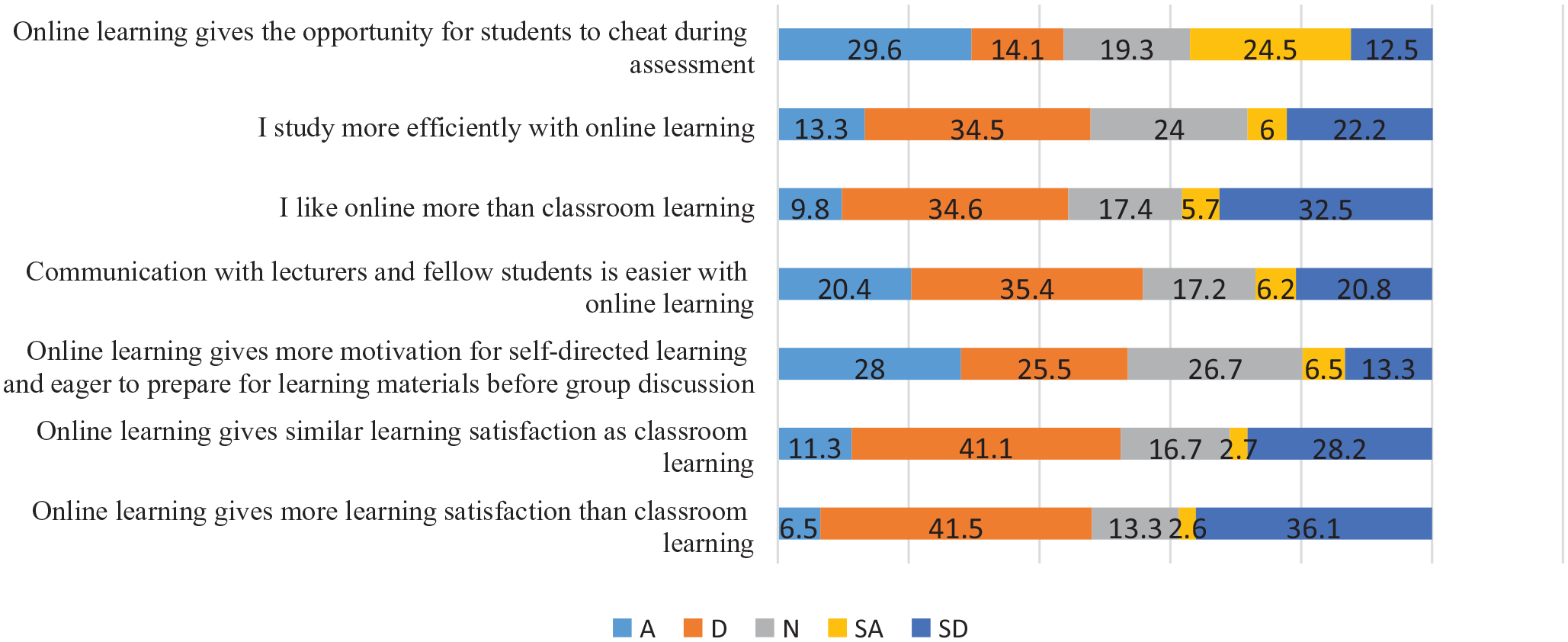
Student satisfaction with online learning (n = 737).
Factors associated with satisfaction with online learning
In the unadjusted model, students in the 30–35 years age range crude odds ratio (COR = 2.2, 95% CI: 1.26–3.67, p = 0.005) and those aged >36 years (COR = 8.1, 95% CI: 1.81–36.5, p = 0.006) were more likely to be satisfied with online learning. Employed (COR = 0.4, 95% CI: 0.29–0.58, p = 0.0001) and unmarried students (COR = 0.6, 95% CI: 0.37–0.91, p = 0.017) were less likely to be satisfied with online over classroom learning. Variables that were significant at a level of p < 0.2 were fitted in the adjusted logistic regression model to determine key factors associated with satisfaction with online learning. Students aged >36 years adjusted odds ratio (AOR = 5.1, 95% CI: 1.06–24.7, p = 0.042) were more likely to be satisfied with online learning while those who were employed (AOR = 0.5, 95% CI: 0.31–0.67, p = 0.002) were less likely to be satisfied with online learning (Table 3).
Bivariate and multivariate logistic regression analysis of factors associated with satisfaction with online learning.
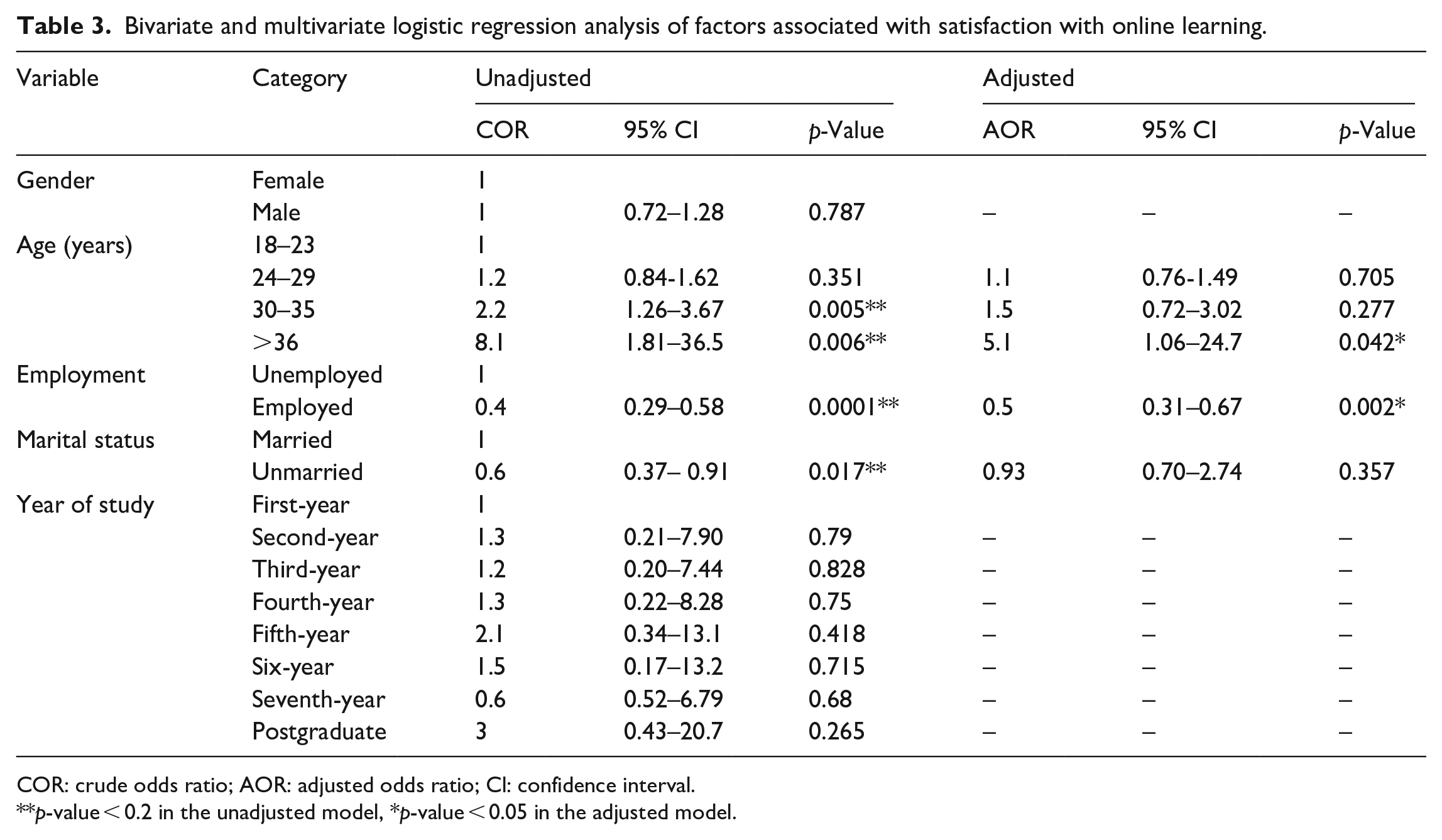
COR: crude odds ratio; AOR: adjusted odds ratio; Cl: confidence interval.
p-value < 0.2 in the unadjusted model, *p-value < 0.05 in the adjusted model.
Discussion
We believe this is the first study in Zambia to assess students’ perspectives of and satisfaction with online and classroom learning to provide future guidance to all key stakeholder groups. Our study found that most students felt that blended learning should continue during and after the pandemic. Additionally, most students felt that lecture clarifications and group discussions were more suitable when delivered in classroom learning. Students who were aged above 36 years of age were more likely to be satisfied with online learning.
Most students in our study were in favour of the continuation of blended learning post-COVID-19 pandemic, similar to the findings from the UK.65,74 In addition, similar findings were reported from studies that were conducted across developed and developing countries including Sweden, 83 Bahrain, 67 Kazakhstan, 84 Saudi Arabia, 85 Kenya, 86 India, 87 Malaysia 88 and Bangladesh. 3 This is because blended learning offers many benefits to teachers and students including continued learning even with the closure of physical classes. 89 Furthermore, it improves the efficient use of time by avoiding challenges with double-booked venues as well as the lateness of the lecturer or unavoidable delays among students.86,88,90 Furthermore, blended learning also promotes social interaction among students as opposed to purely online learning, which tends to motivate their learning.83,91 On top of this, blended learning also encourages students to learn at their own pace, subsequently motivating many students who may struggle in purely classroom learning situations. 74 However, the limitations posed by the available teaching technology infrastructure within lecture halls in LMICs can make it a challenge to demonstrate complex processes or concepts that require the use of a projector, screen, appropriate accessories including complex lighting and other technological issues.92,93 Consequently, being able to engage students through their ICT equipment during online learning can be an effective way to bridge this infrastructure gap, and we will be exploring this further in the future.
The majority of students in our current study disagreed with the view that lecture clarifications were better when undertaken online as opposed to physical classroom lessons. This is similar to findings from studies conducted in the Czech Republic 94 and Australia 95 where most students reported that lecture clarifications were better when undertaken in face-to-face learning than online. Another study in India also confirmed this by revealing that most students did not favour online learning alone because they were not satisfied with the clarifications as well as the relevance of the study materials that were given to them. 96 These findings are also similar to those reported in a study conducted in Bahrain where students and faculty members were more satisfied with face-to-face learning and preferred this mode of learning and teaching over e-learning in this situation. 97 Similar findings have been seen in Kenya, 98 Jordan, 17 Tukey 99 and India. 100 However, other studies have reported that students experienced more satisfaction with online learning during the COVID-19 pandemic.16,101 –103 The differences in these findings could partially be due to the different challenges faced by students when accessing online learning and some topics that require physical skills-based learning. In addition, difference in funding for pertinent ICT equipment and training between countries at the start of the pandemic.
There were also concerns with online learning in our study in terms of the potential level of interaction with lecturers and fellow students during the lecture or workshops. Alongside this, most students in our study felt that online learning did not give similar or more satisfaction compared to face-to-face learning. However, our findings are in contrast to those reported in Indonesia where students felt that clarifications were better when performed online. 16 These differences could be due to challenges that students from LMICs usually experience, including poor internet connectivity, electricity cuts, expensive internet bundles and a lack of internet gadgets. 35 However, further research is necessary before we can say anything with certainty. Poor internet connectivity demotivates students from attending online classes,96,104 –106 and negatively affected their satisfaction and perception of e-learning.104,105,107 This needs to be addressed especially among LMICs if both students and faculty members are to take full advantage of the potential for blended learning. Additionally, there have been concerns that teachers did not offer online learning properly, which can be demotivating for students. 94 This though has now been addressed in many LMICs by offering courses and training to lecturers on optimal ways to deliver online lectures and tutorials. 3
Similarly, in our study, students found that group discussions conducted within classroom settings were more favoured by them compared to online discussions, similar to studies conducted in Kenya, 86 Egypt, 108 Jordan 17 and India. 96 This is because it can be challenging to maintain discussions virtually due to several deterrents. Deterrents include distractions in the home environment, especially if there is no designated quiet room, challenges with internet connectivity, incompatible software, online platforms that are not user-friendly as well as power outages.51,109,110
Most students in our study also preferred writing assessments (theoretical tests and examinations) physically than online. This is because of concerns with the integrity of online assessments, similar to the findings from Australia 111 Norway 112 and Jordan. 113 However, some studies reported that students preferred online assessments to physical assessments because of their convenience.16,114 These differences could be due to variations in the effectiveness and implementation of online learning across countries coupled with measures put into place to ensure the integrity of any work submitted. 1 However, our current study revealed that most students did not prefer online-based examinations even if the credibility of the assessments was assured. Given these concerns, there is a conscious need to strengthen the infrastructure that can support an online learning environment for examinations. This is because our study findings align with those reported in Jordan, where students did not prefer online examinations as there was time to prepare for exams and potential dishonesty among candidates. 113 Additionally, most students in our study did not study efficiently using online platforms and thus preferred face-to-face learning to e-learning. These findings though contrast with reports from Norway where most of the students preferred online examinations online than the physical ones on campus. 103 Similarly, a study in Spain also found that veterinary students preferred online examinations written from home. 115 These differences could again be due to the many challenges that still exist within LMICs to take full advantage of the potential for blended learning. 110 However, this is beginning to change. 3
More efforts are needed among universities in LMICs regarding blended learning as the majority of the students in our study experienced stress and other problems due to online learning during the COVID-19 pandemic. These findings corroborate reports from other studies.116 –119 This could be due to most students being exposed to online learning for the first time, which is now changing. 3 Additionally, the challenges experienced by the students during online learning, which could have contributed to stress and other mental health problems.2,10,11,14
Encouragingly, the majority of the students in the current study agreed they had enough time to prepare learning materials before having group discussions online. However, they stated that they did not have enough time to review all their learning materials after having online classes. Our findings are in agreement with reports from an Egyptian study where most students did not have enough time to review their learning materials after online classes causing them to spend a lot more time on learning compared to the pre-pandemic period. 108 Time management limitations contributed to students failing to complete some requirements for certain courses. 53 These factors must be taken into consideration by lecturers in Zambia and other LMICs going forward. Having said this, in a study conducted in Indonesia, the authors found that most students had enough time to review their learning materials after attending online classes. 16
In our study, older students were significantly associated with satisfaction with online learning compared to young students. This finding is supported by a study conducted among students in Southern Italy in which older students were likely to be involved in and satisfied with online learning. 120 However, an earlier study reported that age did not have an influence on the satisfaction of students with online learning. 121 We are not sure of the reasons behind these differences; however, we will be exploring this further in future studies given the concerns that this could raise for younger students with hybrid approaches.
Overall, it is important to establish a variety of ways to help both lecturers and students adapt and grow with online learning, building on the situation within countries, because blended learning approaches are here to stay. In view of this, institutions must develop a variety of strategic plans to help improve the effectiveness and efficiency of online learning for healthcare students combined with face-to-face learning. The use of tools and techniques that will improve interaction and communication with students during the online learning process, combined with those to improve the robustness of formative assessments and evaluation activities, can be included in professional development training sessions for university lecturers going forward. We will continue to monitor and investigate this.
We were aware that there are some limitations to this study. Firstly, we only included one university; consequently, generalisation of the findings must be done with caution. Secondly, the questionnaire was adapted from another study. However, this was piloted to enhance its robustness. In addition, utilising self-reported measures for the study may be subjected to exaggeration and lead to bias. Additionally, the use of a cross-sectional research design could not effectively indicate causal inferences. Despite these limitations, we believe our findings are robust providing direction for the future. Additional research should clarify psychological responses including emotional stress and quality of life, and institutions should work to improve students’ learning during and post-COVID-19 era. We will be following this up in future studies.
Conclusion
This study found that most students felt that blended learning should continue even after the pandemic. However, the surveyed students preferred physical classroom clarifications and assessments compared to online learning. This underlines the importance of addressing the needs of students for face-to-face clarification and evaluation within a blended learning framework. There is also an identified need to develop and implement curricula that offer blended learning to the students. In addition, the implementation of blended learning curricula should be guided by continuous assessment and feedback from students. This will enable educational institutions to refine and improve their approaches over time, ensuring that the blend of online and face-to-face components remains responsive to the evolving needs of learners.
Supplemental Material
sj-docx-1-smo-10.1177_20503121231218904 – Supplemental material for Student’s perspectives, satisfaction and experiences with online and classroom learning during the COVID-19 pandemic: Findings and implications on blended learning
Supplemental material, sj-docx-1-smo-10.1177_20503121231218904 for Student’s perspectives, satisfaction and experiences with online and classroom learning during the COVID-19 pandemic: Findings and implications on blended learning by Steward Mudenda, Victor Daka, Webrod Mufwambi, Scott Kaba Matafwali, Billy Chabalenge, Phumzile Skosana, Ruth Lindizyani Mfune, Maisa Kasanga, Osaretin Christabel Okonji, Godfrey Mayoka, Martin Kampamba, Christabel Nang’andu Hikaambo, Moses Mukosha, Manal Hadi Ghaffoori Kanaan, Lindi Angeline Zikalala-Mabope, George Sinkamba, Roland Nnaemeka Okoro, Martha Chulu, Brian Godman and Joseph Fadare in SAGE Open Medicine
Supplemental Material
sj-docx-2-smo-10.1177_20503121231218904 – Supplemental material for Student’s perspectives, satisfaction and experiences with online and classroom learning during the COVID-19 pandemic: Findings and implications on blended learning
Supplemental material, sj-docx-2-smo-10.1177_20503121231218904 for Student’s perspectives, satisfaction and experiences with online and classroom learning during the COVID-19 pandemic: Findings and implications on blended learning by Steward Mudenda, Victor Daka, Webrod Mufwambi, Scott Kaba Matafwali, Billy Chabalenge, Phumzile Skosana, Ruth Lindizyani Mfune, Maisa Kasanga, Osaretin Christabel Okonji, Godfrey Mayoka, Martin Kampamba, Christabel Nang’andu Hikaambo, Moses Mukosha, Manal Hadi Ghaffoori Kanaan, Lindi Angeline Zikalala-Mabope, George Sinkamba, Roland Nnaemeka Okoro, Martha Chulu, Brian Godman and Joseph Fadare in SAGE Open Medicine
Footnotes
Acknowledgements
We are grateful to the students that participated in this study. We acknowledge the University of Zambia e-library for providing us with access to most of the articles that we cited. We are also grateful to the management staff of the institution for allowing us to collect data from the students.
Author contributions
Conceptualisation of the study: SM; Methodology: SM, VD, WM, MM and GS; Data collection: SM, VD, WM, RLM, MC and GS; Data validation: SM, SKM, BC, PS, MK (Maisa Kasanga), GM, MK (Martin Kampamba), CNH, MM, MHGK, LAZM, RNO, BG and JF; Data curation: SM; Data analysis: SM and MK (Martin Kampamba); Interpretation of the data: SM, VD, SKM, BC, PS, RLM, MK (Maisa Kasanga), OCO, GM, MK (Martin Kampamba), MM, LAZM, RO, BG and JF; Writing of first draft: SM, VD, SKM, MK (Maisa Kasanga), PS and RLM; Reviewing and editing of the manuscript: SM, VD, SKM, BC, PS, RLM, MK (Maisa Kasanga), OCO, GM, MK (Martin Kampamba), CNH, MM, MHGK, LAZM, GS, RO, MC, BG and JF; Writing the final version: SM, VD, SKM, BC, PS, RLM, MK (Maisa Kasanga), OCO, GM, MK (Martin Kampamba), CNH, MM, MHGK, LAZM, GS, RO, MC, BG and JF; Supervision: SM, WM, BG and JF; All authors read and approved the final version of the manuscript for submission and publication.
Declaration of conflicting interests
The authors declared no potential conflicts of interest with respect to the research, authorship, and/or publication of this article.
Funding
The authors received no financial support for the research, authorship, and/or publication of this article.
Informed consent
Written informed consent was obtained from all subjects before the study (Yes). Or verbal informed consent was obtained from all subjects before the study (Yes).
Trial registration
Not applicable.

Supplemental material
Supplemental material for this article is available online.
References
Supplementary Material
Please find the following supplemental material available below.
For Open Access articles published under a Creative Commons License, all supplemental material carries the same license as the article it is associated with.
For non-Open Access articles published, all supplemental material carries a non-exclusive license, and permission requests for re-use of supplemental material or any part of supplemental material shall be sent directly to the copyright owner as specified in the copyright notice associated with the article.
