



Abstract
Objectives:
To investigate the satisfaction of the undergraduate nursing classroom teaching quality based on the Kano model and provide a reference for improving the overall quality of educational services.
Methods:
A total of 621 sophomores and juniors of nursing at Hubei University of Medicine were selected to conduct questionnaires based on the Kano model using convenient sampling.
Results:
The 16 items are all a one-dimensional factor. The satisfaction and importance are 0.77 to 0.86 and −0.58 to −0.80, respectively. In the quadrant analysis chart, there are four items in the dominant area, three items for improvement, three in the observation area, and six in the retention area.
Conclusion:
Analyzing the satisfaction of nursing undergraduates’ classroom teaching quality can help us effectively understand the intrinsic needs of students and improve the overall quality of nursing undergraduates’ curriculum teaching services.
Introduction
Since the late 1990s, due to the rapid development of higher education, the teaching quality of higher education has become an essential concern of society. 1 Teaching quality is the cornerstone of higher education based on society, the lifeline of sustainable development, and the primary factor affecting the continuous improvement of the quality of education and teaching in colleges and universities.2,3 With the rapid development of society and the economy, people’s pursuit of quality higher education has become a higher level, and teaching quality has unconsciously become an inherent requirement for the development of colleges and universities.
The World Trade Organization has incorporated education into the service industry, and higher education service has received more and more attention.4–6 Many educational quality principles are founded on a comprehensive identification and comprehension of “customer” requirements. 7 Currently, the general opinion on “who are the customers of higher education institutions” is that the “customers” of higher education institutions are the individuals who acquire knowledge in the university. Therefore, students are the customers of educational services, and schools are the main bodies that directly provide educational services. 8 Quality factors trigger emotional responses (i.e., satisfaction and dissatisfaction), which in turn generate behavioral intentions and responses. 9 Education serves educators and students, and it ultimately serves the development of society. Teaching quality is the extent of the high level and effectiveness of teaching, which is ultimately reflected in the quality of the students trained. Students are the customers of educational services and are the subjects who perceive the quality of university teaching services. 10 Student satisfaction is an indirect measure of the quality of the educational process, and the level of student satisfaction directly determines the excellent quality of the teaching and learning services of the university. 11 Student satisfaction is a subjective assessment corresponding to a match/mismatch between a student’s academic expectations and the educational experience received. 12 Higher education is gradually becoming popular and internationalized, and the proportion of enrollment expansion in colleges and universities is increasing yearly. Only by focusing on students and paying attention to students’ satisfaction can universities promote the development of universities from passive to active. The United States was the first country to take the lead in studying student satisfaction. In 1994, Anderson et al. pioneered the introduction of the American Customer Satisfaction Index (ACSI) model into higher education satisfaction measurement, 13 which provided a breakthrough and basis for measuring student satisfaction from a customer satisfaction perspective. ACSI is the most widely designed national customer satisfaction index in the world. Subsequently, scholars from various countries use the ACSI model for reference to build their own higher education satisfaction index model. Compared with foreign countries, domestic scholars’ research on classroom teaching satisfaction is relatively scarce. In the 1990s, domestic scholars redefined the concept of higher education satisfaction based on customer satisfaction. According to Chinese higher education, scholars used the ACSI model for reference and explored establishing the Chinese higher education customer satisfaction model.14,15 Although there are many studies in China, most of them are limited to the scope of schools, and the scale of research is not large enough to form a unified model for measuring student satisfaction. At the same time, classroom satisfaction questionnaires are usually formed in Likert-type scales, which can only analyze the linear relationship between question indicators and satisfaction; in reality, the linear relationship between measurement indicators and student satisfaction is not presented.
Since 2011, the nursing discipline has been independent of the second discipline of clinical medicine and has become a first-level discipline. Nursing education in medical schools and hospitals is receiving increasing attention. 16 However, some medical colleges still use an evaluation form to evaluate all medical courses and cannot objectively assess the teaching of nursing courses. At the same time, much of the previous research on evaluating satisfaction or dissatisfaction with quality has relied on a bipolar view. Satisfaction and dissatisfaction lie at opposite ends of the same continuum, 17 requiring individuals to evaluate multidimensional attributes of the service on an asymmetrical one-dimensional scale. However, this bipolar conceptualization allows for contradictory or simultaneous satisfaction, and dissatisfaction is not suitable for assessing customer responses, suggesting that feeling satisfied does not preclude the presence of dissatisfaction and vice versa.
The primary function of the Kano model is to make the invisible attributes of service quality explicit, classify user needs, and use the satisfaction degree of functional requirements to influence user satisfaction. The Kano model identifies three categories (i.e., delighters, satisfied, and dissatisfied). 9 The features of the satisfaction category indicate that satisfaction and dissatisfaction lie on opposite ends of a single continuum, consistent with the bipolar view. In contrast, the characteristics of satisfaction or dissatisfaction indicate that satisfaction and dissatisfaction are distinct constructs consistent with the unipolar view. Since the Kano model captures the nonlinear relationship between product performance and user satisfaction, it has been used to assess the quality of classroom teaching and investigate the satisfaction of nursing students. This article aims to identify students’ expectations of various indicators and objectively reflect the quality of classroom teaching, thus exploring ways to improve the quality of classroom teaching in undergraduate nursing programs.
Aim
To investigate the satisfaction of the undergraduate nursing classroom teaching quality based on the Kano model and provide a reference for improving the overall quality of educational services.
Method
This study is a cross-sectional study.
Participants
Using convenient sampling, 621 sophomores and juniors of nursing at Hubei University of Medicine were selected to conduct questionnaires based on the Kano model. This study has been approved by the ethics committee (the name of the Independent Ethics Committee is Ethics Committee of Shiyan Taihe Hospital, the number of the ethical approval is 2022KS42), and all students voluntarily participate and sign a written informed consent, and the results also do not include any identifying information.
Sample size calculation
The main estimation process is 5–10 times the number of selected variables, the number of variables involved in this article is 32, and then the sample size is estimated to be in the interval of 160–320 cases, considering the 10% invalid proportion of the questionnaire, and then the sample size is determined to be 176–352 cases.
To fully understand undergraduate nursing students’ satisfaction with the quality of classroom teaching, a total of 625 students in the second and third grades of nursing were selected to conduct a questionnaire survey.
Inclusion criteria
(1) Undergraduate nursing students enrolled in their sophomore and junior years.
(2) Those who have attended nursing courses at this stage.
(3) Able to correctly understand and answer the questions related to the questionnaire.
(4) Voluntary participation in this study.
Exclusion criteria
(1) Participants were not undergraduate students.
(2) Not having taken a nursing course.
(3) Students who did not want to participate in the study.
Survey method
The Kano model
Fundamentals of the Kano model:
The traditional quality model examines perceptions from a one-dimensional perspective and assumes a linear relationship between quality element performance and customer satisfaction. However, not all quality elements have such a linear relationship. In 1984, Professor Noriaki Kano, a leading Japanese expert in quality management, was inspired by Herzberg’s two-factor theory and proposed the concept of the Kano model. 18 According to the attributes of the product and users’ satisfaction, the Kano model divides service quality characteristics into five types (see Figure 1). 19

The Kano model.
Basic tools of the Kano model: Since customers’ judgments of quality attributes are highly individualized, research using hypothesis testing is required. The three main tools of the Kano model are the Kano questionnaire, the Kano assessment form, and the Kano survey results form.
Survey tools
The designed questionnaire was divided into the following two parts: (1) a self-designed general information questionnaire: including gender, age, and grade; (2) a questionnaire on undergraduate nursing students’ satisfaction with classroom teaching quality based on the Kano model: Refer to the classroom teaching quality evaluation scale for undergraduate nursing majors compiled by Zhao et al. 20 (The Cronbach’s alpha coefficient for the total scale was 0.892, and the Cronbach’s alpha coefficient for each dimension was 0.886–0.974, so the scale had good reliability. The total scale’s content validity index (S-CVI) was 0.954, and the content validity index (I-CVI) of each item was 0.818–1, so the scale had good content validity.) It includes four aspects: teacher literacy (4 pairs of items), pre-class design (3 pairs of items), classroom vitality (6 pairs of items), and after-school reflection (3 pairs of items), with a total of 16 pairs of items. For each of the 16 pairs of entries, two types of questions were asked: forward and backward. According to the Kano model attribute classification method (see Table 1), each item has five answers to choose from. The frequency and percentage of different classifications of each dimension item are counted based on the respondents’ responses to the positive and negative items, combined with the Kano classification table, and the quality attribute is finally determined as the attribute classification with the highest statistical frequency (Kano classification). According to the attributes of 16 pairs of items, satisfaction and importance were determined, and a matrix of satisfaction with classroom teaching quality of undergraduate nursing students based on the Kano model was drawn.
Kano classification table.
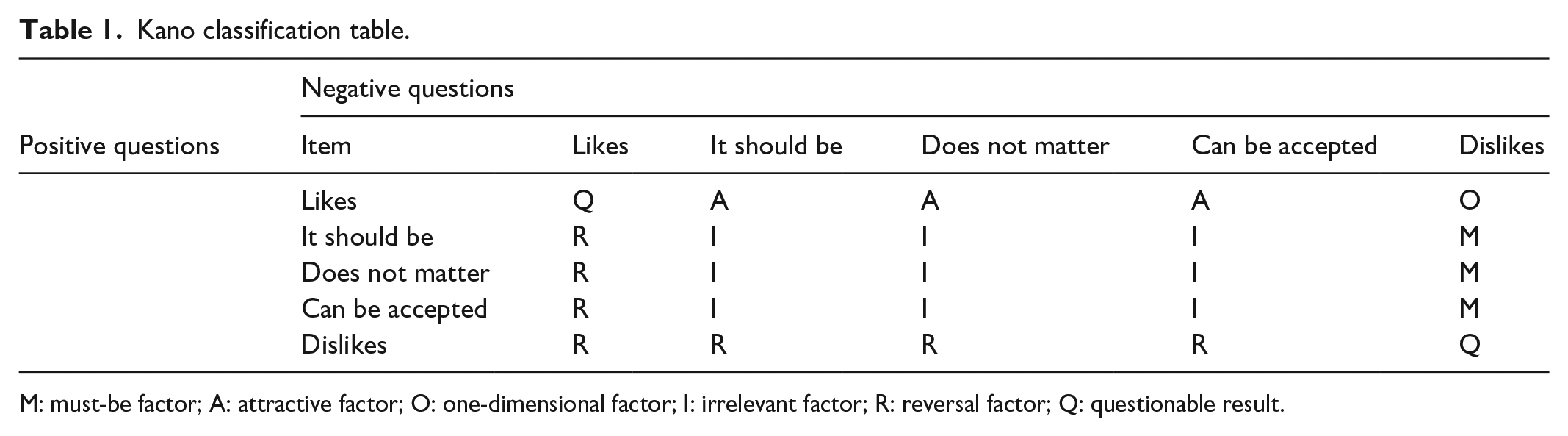
M: must-be factor; A: attractive factor; O: one-dimensional factor; I: irrelevant factor; R: reversal factor; Q: questionable result.
Questionnaire Survey methods
The survey was conducted in June 2022.The questionnaires of this study were mainly distributed and collected online through the questionnaire star platform.
To ensure the quality of Kano’s questionnaire:
(1) The questionnaire was mainly pushed through the counselors, which could effectively avoid some haphazard answers;
(2) Before distributing the questionnaire, survey training was conducted for counselors in each class, with detailed explanations of the broad purpose of the questionnaire study, survey notes, rules for completing the questionnaire, characteristics of the questions (such as positive and negative questions) and the meaning of the question items;
(3) The investigators used the students’ course breaks to distribute the questionnaires. They used uniform instructional language to guide students in filling out the questionnaires, emphasizing the completeness of the questionnaires. If students have questions about the questions and options of the questionnaire, explain them in time;
(4) Removed questionnaires with a completion time of 60 s or less;
(5) A part of the questionnaires that were incomplete or inconsistent were deleted.
Statistical analysis
(1) Descriptive statistic: The survey objects’ general information is described by the frequency, percentage, mean, and standard deviation.
(2) Two-dimensional attribute classification: classify and summarize the data according to the Kano model analysis method combined with Excel form, and get the quality characteristic classification of each element.
(3) Better–Worse coefficient analysis: The Better–Worse coefficient analysis method proposed by Berger evaluates the satisfaction of each function point by calculating the coefficient. In addition, it is necessary to draw the importance quadrant of satisfaction.
Results
Demographics
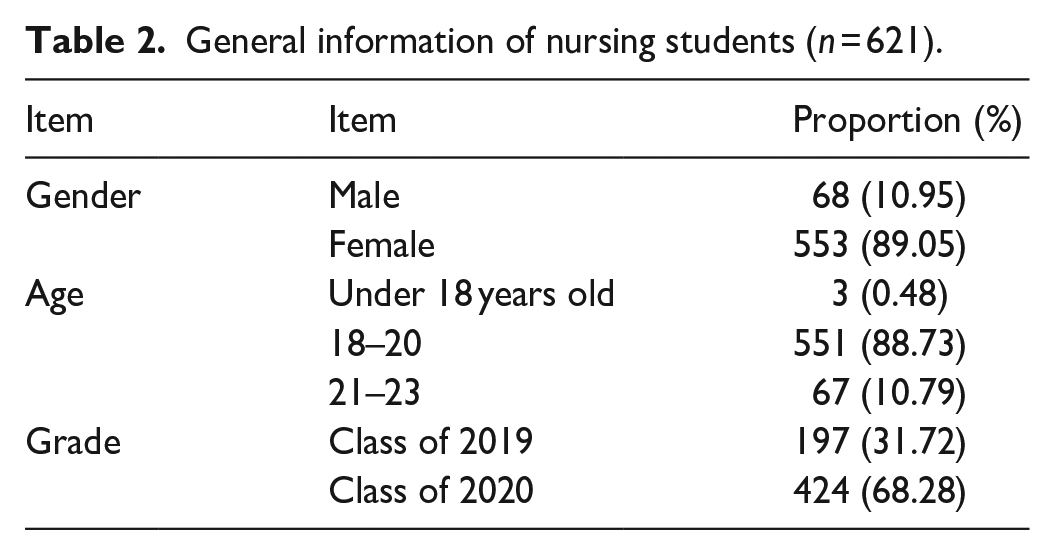
The survey recovered 625 questionnaires, of which 621 were valid, so the effective recovery rate was 99.36%. Among them, 424 (68.28%) were in the second grade, 197 (31.72%) were in the third grade, 68 were male (10.95%), and 553 (89.05%) were female. The general information of nursing students is shown in Table 2.
General information of nursing students (n = 621).
Attributes of satisfaction with the quality of classroom teaching for undergraduate nursing students
Calculate the proportion of M, O, A, I, and R in each indicator using the Kano classification table criteria. Taking the maximum value as the index attribute of the item, the classification table of the quality characteristics of teaching quality satisfaction is obtained, and the SI and DSI (SI refers to satisfaction and DSI refers to importance) are calculated according to the attribute of the item index (see Table 3).
Classification table of quality characteristics of undergraduate nursing classroom teaching.

SI = (A + O)/(A + O + M + I), the closer the value is to 1, the higher the satisfaction of students with this demand;
DSI = −1 × (O + M)/(A + O + M + I), the closer the value is to −1, the more important the student considers the need to be. M: must-be factor; A: attractive factor; O: one-dimensional factor; I: irrelevant factor; R: reversal factor; Q: questionable result. A matrix of satisfaction with the quality of classroom teaching for undergraduate nursing students based on the Kano model.
The results showed 16 attributes of satisfaction with classroom teaching quality of undergraduate nursing students, 16 of which are expected needs. That is, respondents’ satisfaction is proportional to the degree of fulfillment of this demand. 21 It can be seen from Table 3 that the item with the highest SI value is “create a good classroom atmosphere” (0.86), indicating that student satisfaction will be increased by 86% after creating a good classroom atmosphere, while the item with the highest DSI value is “good teacher ethics and style” (0.80), indicating that if this service is ignored, patient satisfaction will decrease by 80%.
The matrix diagram is plotted based on each entry’s satisfaction and importance results. The results of the Better–Worse indices in Table 3 were plotted against the satisfaction matrix using the Excel tool. The vertical coordinate is the SI value, the horizontal coordinate is the DSI, and the origin is the SI and DSI mean. In plotting the quadrant diagram, take the absolute value of the DSI value. The mean SI value is 0.819375, and the mean DSI value is −0.819375. The mean of SI and DSI values was used as the coordinate origin, and the origin was (0.819375, 0.66875). The advantage area, improvement area, observation area, and reserved area are located in the first, second, third, and fourth quadrants, respectively. Among them, 4, 5, 13, 16 in the advantage area; 1, 2, 3 in the improvement area; 5, 7, 14 in the observation area; 8, 9, 10, 11, 12, 15 in the reserved area (see Figure 2).

Satisfaction and importance matrix.
Discussion
Students are one of the subjects that determine the quality of education. Colleges and universities must “listen to the voice of the clients” and pay attention to students’ expectations and feelings. The Kano model is now widely used in higher education,22–24 which can effectively identify the needs of college students and provide a basis for improving students’ satisfaction with the classroom. The results of this study show that because the Kano model has the advantage of integrating many factors such as user expectations, sociocultural and psychological, and its revelation of the transformation of types of needs over time; it is natural to conclude that students’ requirements also change over time, reflecting their internal expectations. 8 As a result, the Kano model was used to investigate nursing undergraduates’ satisfaction with classroom teaching quality, precisely and effectively determine the quality attributes of students’ demand for nursing professional classroom teaching services, and identify the key factors influencing students’ satisfaction.
Analysis of functional attributes of the quality of classroom teaching
Must-be quality service indicators
Must-be quality service means that students think the classroom must have these functions and will evaluate a classroom that does not have these functions as substandard. At the same time, however, teachers’ continuous optimization of such functions does not significantly affect teaching satisfaction, that is, the “health factor” in teaching. According to the results of the survey, students do not have the must-be quality attributes for functional evaluation of classroom teaching quality, which may be due to the fact that, on the one hand, research on classroom teaching quality evaluation in nursing in China started late, and students do not have a deep enough understanding of the location and importance of nursing courses. Jiang et al. argued that the late start of teaching quality evaluation research in medical schools in China and the continuous research time of classroom teaching quality evaluation in medical colleges is short. 25 Lin et al. argued that students are the main learning body and need to clarify the position and importance of this professional course in the profession. 26 On the other hand, it lies in the many years of educational philosophy in China, which focuses on “teaching” but not “learning” and does not highlight the centrality of students. Sun et al. and Katawazai et al. agree that to truly improve the satisfaction of undergraduate nursing students with the quality of classroom teaching; it should highlight students’ leading position. Change the teaching concept from “teacher-centered” to “student-centered,” put students at the center of classroom teaching, and always grasp the “student-centered” educational idea in teaching activities.27,28 Treat the students as unique individuals, with their values, ideas, beliefs, and worldviews. 29 A student-centered learning approach encourages students to take more responsibility for their learning. In the process of education and teaching, teachers need to pay attention to the fundamental needs of students and meet the changing requirements of students to a greater extent. Effectively put the quality of talent training in the first place, continuously improve the quality of teaching, and improve student satisfaction. 30 At the same time, nursing educators must constantly adjust and evaluate their teaching methods to ensure that every teaching method used in the nursing curriculum promotes higher level learning, critical thinking skills, and practical application of knowledge, 31 in order to continuously improve the quality of undergraduate nursing talent training. Some studies have also shown that student-centered teaching strategies can enhance patient safety skill competence in the clinical setting. 32
One-dimensional quality service indicators
One-dimensional attribute refers to the service users expect to provide, which has a linear relationship with satisfaction. If this attribute performs well, students’ satisfaction will be high, while those with poor performance will be dissatisfied. Among the 16 indexes, 16 belong to one-dimensional quality. To improve students’ satisfaction, we must constantly optimize these functions. Studied students’ satisfaction from five dimensions—teaching ethics, teaching ability, teaching contents, teaching methods, and teaching outcomes. 33 Liu et al. improve the teaching quality and students’ satisfaction by stimulating the classroom teaching vitality, optimizing the curriculum, enhancing the practicality of teaching content, and strengthening the practice and practice links. 34
Better–Worse quadrant chart analysis of the quality of classroom teaching demand
Grasp the requirements of expected attributes, increase satisfaction, and eliminate dissatisfaction
The improvement of teaching quality depends on the construction of teaching staff. Good teaching ability can promote the cultivation of nursing students’ knowledge and, meanwhile, improve the overall quality of the teaching team. 35 The college needs to take a variety of methods to improve the development of teachers’ teaching ability, focus on enhancing the knowledge and teaching practice ability of the teaching staff, 36 and encourage teachers to carry out teaching academic research and exchanges in a targeted manner. With the development of information technology, teachers should be able to handle modern information technology, adapt to the changes of information technology, artificial intelligence, and other new technologies, and carry out education and teaching actively and effectively. 37 The aim is to promote the reform and development of teacher education in the new era and improve the quality of teacher education. 38 Nursing practice can maximize the cultivation of students’ analytical and problem-solving skills, practical operation ability, and innovation ability. Schools should combine the nature of the nursing profession, classify, and set the standards of practice teaching, appropriately increase the proportion of practice teaching, reform and innovate the content of practice teaching, and improve the conditions of practice teaching.
Enhancing the demand for charming attributes and focusing on improving student satisfaction
The second quadrant is the charisma factor. Indicators in this quadrant have a strong influence on satisfaction but a low ability to eliminate the effect of dissatisfaction. An exemplary implementation of the corresponding educational service indicators will surprise students and failure to implement these academic service indicators will not make students feel dissatisfied. The three significant indicators of “good teacher ethics and style,” “elegant manners and etiquette,” and “excellent professional knowledge” are the charm elements. Focusing on these three indicators is conducive to improving students’ satisfaction with the school’s educational services and creating the characteristics and highlights of the school’s educational services. A teacher’s role model has a significant impact on the students; uncivil behavior endangers the physical and mental health of faculty and students. 39 Teachers should consider the factors that influence education at all times. Students will be infected and educated with decent manners and good etiquette in the classroom, which will significantly improve the teaching effect, and then achieve the set teaching goals. The construction of teachers’ morality and style occupies an essential position in the structure of college teachers and is the first criterion for evaluating the quality of teachers. 40 Good teachers’ morality and style are college teachers’ essential qualities and necessary conditions. Strengthen the construction of teachers’ morality and style, and firmly guide most teachers to stand up with virtue, learn with integrity, and teach with virtue. 41 Teachers are the mirrors of students’ moral cultivation. Preparing nurses at all levels to be moral agents is a critical job of the profession, specifically nursing education. 42 Thus, college teachers should strengthen their moral obligations, abide by the basic norms of teacher morality, strengthen the construction of their ethics and style, and improve teacher morality and style construction. Teachers also should continuously replenish self-knowledge reserves, master excellent professional knowledge, improve their professional quality, and improve the quality of nursing education and teaching to meet teaching needs.
Guarantee the demand for undifferentiated attributes and weaken the fluctuation degree of dissatisfaction
The third quadrant is no difference factor. The educational service indicators in this quadrant have little influence on improving students’ satisfaction and eliminating dissatisfaction. Therefore, the school can appropriately reduce the investment in these educational services with the limited supply of various resources. “Correct use of teaching methods” is located in this quadrant. However, Liu et al. think that “teaching methods” is an item that has a high impact on teaching quality, but the actual satisfaction evaluation is not high. 34 The reason for the inconsistency with the results of this study is that, on the one hand, he studied “double first-class” universities, while in this study, it is a general university; on the other hand, it is because with the continuous development of computers and the 2019 coronavirus disease (COVID-19) pandemic, multimedia has gradually entered the campus classroom, and the nursing education model is also changing. 43 Various teaching methods, such as MOOCs, micro-course, blended teaching, flipped classrooms, and virtual simulation, are emerging. Compared with traditional education, multimedia teaching has the characteristics of diversity, intuition, and interaction, which enriches the teaching form, attracts students to a certain extent, and improves participation.44,45 “Course Ideological and Political” is also located in this quadrant. Zhang et al. found that students resented the over-injection of ideological and political elements and hard sensationalism after integrating course ideology and politics into professional courses. 46 Firstly, the integration of ideology and politics with nursing courses started late and was only explicitly proposed by the Ministry of Education in May 2020. 47 Secondly, most of the teachers of professional courses lack the element of “moral education” in the implementation of “ideological politics in curriculum,” and are only “thinking and politics for thinking and politics,” and they are unable to motivate students to think and assimilate it on their own.
Solidify must-be attribute requirements and strongly reduce dissatisfaction
The fourth quadrant is the must-be factor. The indicators of educational services in this quadrant have low pulling power but a high ability to eliminate dissatisfaction for students’ satisfaction. There are related educational services that will not satisfy students, but if such services are not provided, students’ dissatisfaction will be significantly increased. Schools should secure these educational service base items. Through an empirical study of undergraduate teaching quality satisfaction in general universities, Li found that students’ professional interest has the most significant impact on teaching effectiveness and is an important reflection of teaching effectiveness. 48 Jiang et al. concluded that interactive participation of teachers and students in the learning process, teaching feedback from nursing students, and troubleshooting from teachers could improve teaching quality. 49 Liu et al. found that creating a good classroom atmosphere and providing extracurricular learning materials for knowledge expansion can be an excellent way to improve student satisfaction. 50
At the same time, because the user’s demand attributes are periodic rather than constant, these characteristics may be transformed into attractive quality characteristics with the passage of time and the continuous improvement of functions. Therefore, in improving the education of nursing undergraduates, we should continuously tap the potential needs of students, adopt active strategies, and attach importance to tracking and improving these quality characteristics.
However, there are still shortcomings: First, there is no different analysis of students’ satisfaction by grade. Secondly, this survey only focuses on nursing students in this institution but does not extend the survey to the whole country, so it is not universal enough. Thirdly, the research results are of the times because the attributes of the Kano model will change and develop with time, and the categories and importance of educational service factors will also change with time. Therefore, school education administrators should establish a dynamic and phased demand survey mechanism from the students’ perspective and adjust the types and methods of educational services on time to effectively promote better employment and overall development of students.
Conclusion
Technological progress is accelerating with the continuous development of the economy and society, and significant changes have occurred in the international environment, which puts forward new talent requirements. Traditional teaching in colleges and universities also faces challenges. Colleges and universities, as talent training center, can only adapt to social needs and improve student satisfaction by making changes. This article applies the Kano model to the evaluation of classroom teaching quality in nursing from the perspective of students’ needs, derives the attributes of the elements affecting the quality of nursing teaching, effectively grasps the classification of students’ needs, analyzes the critical factors affecting their satisfaction, and provides a reference for exploring ways to improve the quality of classroom teaching in undergraduate nursing.
Supplemental Material
sj-docx-1-smo-10.1177_20503121231157207 – Supplemental material for The satisfaction of the undergraduate nursing classroom teaching quality based on the Kano model in China
Supplemental material, sj-docx-1-smo-10.1177_20503121231157207 for The satisfaction of the undergraduate nursing classroom teaching quality based on the Kano model in China by Jiu-Li Chen and Li-Na Zheng in SAGE Open Medicine
Footnotes
Acknowledgements
Thanks to Ye Hui for revising the grammar of the manuscript.
Author contributions
J-LC was involved in conception and design, acquisition of data, analysis and interpretation of data, statistical analysis, supervision, and writing—original draft. L-NZ was involved in conception and design, investigation, methodology, and writing—review and editing.
Declaration of conflicting interests
The author(s) declared no potential conflicts of interest with respect to the research, authorship, and/or publication of this article.
Funding
The author(s) received no financial support for the research, authorship, and/or publication of this article.
Ethics approval
This study has been approved by the ethics committee (the name of the Independent Ethics Committee is Ethics Committee of Shiyan Taihe Hospital, the number of the ethical approval is 2022KS42).
Informed consent
All students voluntarily participate and sign a written informed consent.

Supplemental material
Supplemental material for this article is available online.
References
Supplementary Material
Please find the following supplemental material available below.
For Open Access articles published under a Creative Commons License, all supplemental material carries the same license as the article it is associated with.
For non-Open Access articles published, all supplemental material carries a non-exclusive license, and permission requests for re-use of supplemental material or any part of supplemental material shall be sent directly to the copyright owner as specified in the copyright notice associated with the article.
