



Abstract
Objective:
Hospital-acquired infection is higher in low- and middle-income countries because of inadequate knowledge of hospital-acquired infection prevention and poor adherence to standard infection prevention practices.
Methods:
A facility-based cross-sectional study was conducted among 423 randomly selected nurses working at university referral hospitals in Southern, Nations, Nationalities and Peoples’ Region, Ethiopia from 01 to 30 April 2021. Data was collected by self-administer questionnaires. Multivariable binary logistic regressions were used to assess the association between the outcome variables and explanatory variables. The adjusted odds ratio was calculated and variables with a 95% confidence interval were declared as statistically significant.
Results:
The study found that 45.5% (95% confidence interval: 40.6%–50.4%) and 64.8% (95% confidence interval: 60.1%–69.5%) of nurses had good knowledge and practices toward hospital-acquired infection prevention, respectively. Being male (adjusted odd ratio: 2.2, 1.41–3.40), having a degree and above in nursing (adjusted odd ratio: 3.6, 1.73–7.38), having more than 5 years of work experience (adjusted odd ratio: 2.0, 1.24–3.26), having training on infection prevention (adjusted odd ratio: 2.6, 1.58–4.37) and adequate materials supplies (adjusted odd ratio: 2.2, 1.08–4.45) had associated with nurses’ knowledge about hospital-acquired infection prevention. On the other hand, having a degree and above in nursing (adjusted odd ratio: 1.98, 1.07–3.66), consistent water supply (adjusted odd ratio: 3.4, 1.58–7.30), and being aware of the existence of infection prevention guidelines in their institution (adjusted odd ratio: 1.80, 1.14–2.87) had associated with good practices of nurses toward hospital-acquired infections prevention.
Conclusion:
Less than half of the nurses had adequate knowledge and approximately two-thirds of nurses had good practice for hospital-acquired infection prevention.
Introduction
Hospital-acquired infections (HAIs) are infections acquired during hospital care that are not incubated at admission and manifest after 48 h of admission to the hospital. Healthcare-associated infection occurs within 3 days after discharge or 30 days after an operation due to another case. 1 The most common way of HAI transmission is through the infected hands of healthcare professionals. The transmission of pathogens from one patient to another causes the majority of HAIs, especially among healthcare workers (HCW) who do not wash their hands after examining a patient. 2
Healthcare-acquired infections are a typical global problem mainly in low socioeconomic countries. Based on World Health Organization (WHO) 2019 Healthcare Associated Infections (HCAI) fact sheet report globally 100 million patients are affected by healthcare-associated infection annually. 3 An estimated 10% of hospitalized patients in developed countries and 25% in developing countries develop HAI. 4 In Zabol, Iran, only 22% of nurses had good knowledge of nosocomial infection prevention, and 34% of nurses had good practices for HAI prevention. 5 Another study in Ghana shows only 25% of nurses had good knowledge about HAI prevention. Few studies conducted in Africa indicated that most nurses working in various health facilities have inadequate knowledge, and skills and lack proper training in standard protocols on infection prevention practices. 6
HAI is higher in low- and middle-income countries because of inadequate knowledge of healthcare providers regarding the prevention of HAI, poor adherence to universal precautions, and inaccessibility of personal protective equipment. 7 Hand hygiene, aseptic techniques, and the presence of a functioning infection prevention control committee are all effective strategies for preventing HAI. 8
Hand rubbing with alcohol for 15–30 s is important to decrease the microorganism count on the hand and reduce HAI. 9 The prevention of HAI is profoundly influenced by maintaining standard infection prevention practices while providing healthcare services in hospitals. The use of safe antiseptic procedures during patient care, environmental fumigation, instrument sterilization, staff training on infection prevention, and the use of isolation rooms are very important activities to reduce HAI.10–12 Infection prevention and control strategies in hospitals increase patient safety and quality of treatment while also reducing the harmful socioeconomic and psychological impacts of infectious diseases on patients and health systems.13,14
Failure of adhering to standard infection prevention and control procedures has resulted in many negative consequences include prolonged hospitalizations, high antibiotic resistance, lifelong disability, premature death, the financial burden on health systems, and reduced work output by nurses who develop HAI. 12
According to different literature, age, sex of participants, service experience, and taking training on infection prevention measures were established as factors influencing the nurse’s knowledge and practice concerning HAI. Furthermore, inadequate knowledge, infrastructure problems, and performance management processes have been recognized as factors affecting nurse prevention practice standards.15–18
Ethiopia’s federal ministry of health is focusing on developing infection prevention standards and guidelines to protect patients and healthcare professionals from healthcare-associated infections. Despite the existence of HAI prevention guidelines in Ethiopia, HAI continues to be a burden on the healthcare system through increased risks to patients as well as healthcare professionals. 19 There is little information available about the knowledge and practices of HAI prevention particularly those nurses working at hospitals in Ethiopia. Therefore, this study intended to assess knowledge and practices toward HAI prevention and associated factors among nurses working at university referral hospitals in Southern Nations, Nationalities, and Peoples’ Regions (SNNPR), Ethiopia.
Methods
Study design and setting
A facility-based cross-sectional study was conducted among nurses working at university referral hospitals which was found in SNNPR, Ethiopia from 01 to 30 April 2021.
Sample size determination and sampling technique
The sample size was determined by the single population proportion formula by considering a 50% proportion, 95% confidence interval (CI), and a 5% margin of error. The calculated sample size was 384. After adding a 10% non-response rate, the final sample size becomes 423. A simple random sampling technique was used to select study participants from each working unit at university referral hospitals.
Inclusion and exclusion criteria
Inclusion criteria: All staff nurses who were working at university referral hospitals available during the data collection period.
Exclusion criteria: All staff nurses who have less than 6-month work experience at university referral hospitals.
Operational definition
Adequate knowledge: Nurses who respond correctly to the mean score and above of knowledge-measuring questions toward HAI prevention. Inadequate knowledge: Nurses who respond correctly to the below mean score of knowledge-measuring questions toward HAI prevention. Good practice: Nurses who respond correctly to the mean score and above of practice measuring questions toward HAI prevention. Poor practice: Nurses who respond correctly to the below mean score of practice measuring questions toward HAI prevention.
Data quality assurance
Before the time of data collection 5% of the total sample size of the questionnaire was pilot-tested at Hawassa university referral teaching Hospital, Sidama Region, Ethiopia.
Data processing and analysis
The data was coded and then entered into Epi-data version 4.6 software and then finally exported to SPSS version 25 for analysis. Before analysis data were cleaned and checked for outliers and missing values. Logistic regression was performed and all variables with p values less than 0.25 in bivariable logistic regression were fitted into the backward stepwise multivariable logistic regression model. Adjusted odd ratio (AOR) along with a 95% CI and p-value <0.05 was used to interpret the finding of research from final models of multivariable regression tables.
Results
Sociodemographic characteristics of study participants
From the total 423 sample size, the response rate was 94.08% (398). The participant’s ages ranged from 20 to 41 years old with a mean age of 27.6 years. Among 398 participants 204 (51.3%) of the study participants were single. See Table 1.
Sociodemographic characteristics of nurses working at university referral hospitals in SNNPR, Ethiopia 2021.

Organizational factors influence nurse’s knowledge and practice of HAI prevention
Of the total study participants, only 14.3% of nurses respond that a consistent water supply is accessible daily in their institution. Concerning infection prevention training, only 23.9% of nurses obtained it. See Table 2.
Organization-related factors regarding knowledge and practices of nurses about HAI prevention at university referral hospitals in SNNPR, Ethiopia 2021.

Knowledge of nurses toward HAI prevention
There were 20 knowledge-measuring questions concerning HAI prevention which were computed to determine nurses’ knowledge of HAI prevention. Then nurses’ knowledge of HAI prevention was classified by using a mean score of study participants. As a result, 45.5% (40.6%–50.4%) of nurses had adequate knowledge of HAI prevention whereas 54.5% of nurses had inadequate knowledge of HAI prevention, see Figure 1.
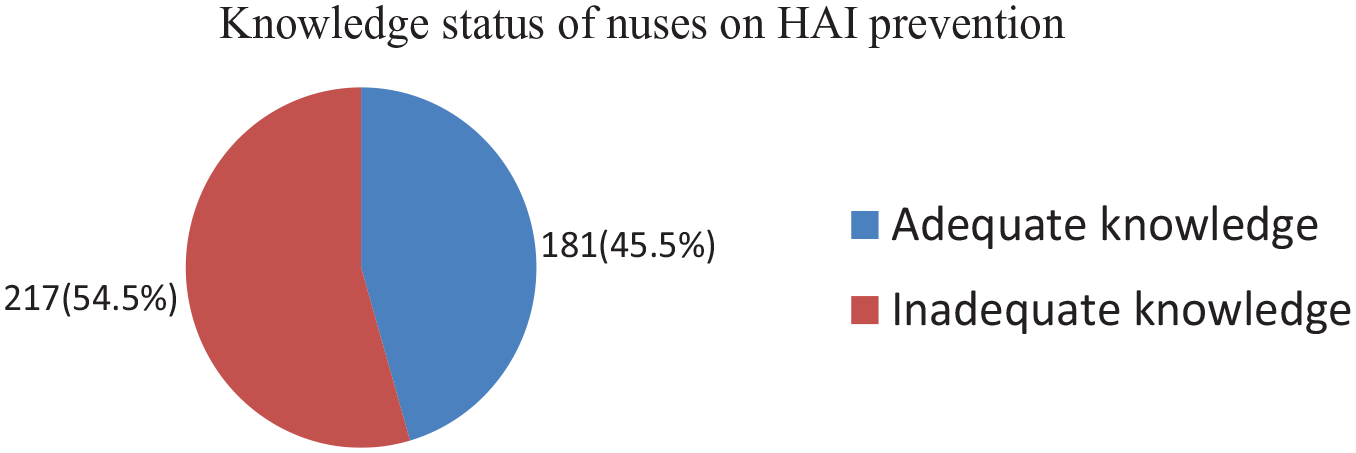
Knowledge of nurse’s toward prevention of HAI in the university referral hospitals in SNNPR, Ethiopia 2021.
Practices of nurses toward HAI prevention
There was 12 practice measuring questions concerning HAI prevention which were computed to determine nurses’ practices toward HAI prevention. Then the mean score of study participants was used to classify nurses’ nosocomial infection prevention practices. As a result, 64.8% of nurses (60.1%–69.5%) had good HAI prevention practices, while 140 (35.2%) had poor HAI prevention practices, see Figure 2.

Practice of nurse’s toward prevention of HAI at university referral hospitals in SNNPR, Ethiopia 2021.
Factors associated with knowledge of nurses toward HAI prevention
Different variables were evaluated with bivariable logistic regression analysis. Therefore, gender, educational status, work experience, average monthly income, training on infection prevention, adequate material supplies for infection prevention, availability of consistent water supply in the working units, and awareness of the existence of infection prevention standard guidelines in the institution were all variables with p values of less than 0.25 were fitted into the backward stepwise multivariable logistic regression model. However, on multivariable analysis, the participants’ gender, educational status, work experience, training on infection prevention, and adequate material supplies for infection prevention were found to be significantly associated with nurses’ knowledge of HAI prevention.
The odds of having adequate knowledge of HAI prevention among male nurses were about 2.2 times the odds for female nurses (AOR: 2.2, 1.41–3.40). The odds of having adequate knowledge of HAI prevention among nurses who had a BSc degree and above were about 3.6 times the odds of nurses who had a diploma in nursing (AOR: 3.6, 1.73–7.38). The odds of having adequate knowledge of HAI among nurses who have training on infection prevention methods were approximately 2.6 times greater than the odds of nurses who did not have training on infection prevention methods (AOR: 2.6, 1.58–4.37). The odds of having adequate knowledge of HAI among nurses who have more than 5 years of work experience were about two times the odds of nurses who have less or equal to 5 years of work experience (AOR: 2, 1.24–3.26). The odds of having adequate knowledge of HAI among nurses who had adequate material supplies for infection prevention were about 2.2 times the odds of nurses who did not (AOR: 2.2, 1.08–4.45) See Table 3.
Logistic regression analysis of factors associated with the knowledge of nurses toward HAI prevention at university referral hospitals, SNNPR, Ethiopia 2021.

Significant variable at p-value ⩽0.05.
Factors associated with practices of nurses toward HAI prevention
Bivariable logistic regression analysis was used to evaluate various variables. Thus, educational status, training on infection prevention methods, presence of a hand washing station with running water and soap, availability of water supply consistent daily, being aware of the existence of infection prevention guidelines in their institution, monitoring staff knowledge of infection prevention by management, presence of isolation rooms for patients with air born and droplet infections, adequate material supplies for infection prevention, vaccinated for hepatitis B virus and knowledge of nurses toward HAI prevention were all variables with p values less than 0.25 were fitted into the backward stepwise multivariable logistic regression model. However, on multivariable analysis, the educational status of the participants, the availability of water supply consistent daily, and awareness of the existence of infection prevention guidelines were significantly associated with the practices of nurses toward HAI prevention.
The odds of having good practices toward HAI prevention among nurses who had a BSc degree and above were approximately two times the odds of nurses who had a diploma in nursing (AOR: 1.98, 1.07–3.66). The odds of having good HAI prevention practice were 1.8 times higher among nurses who were aware of the existence of infection guidelines in the institution than among nurses who were not (AOR: 1.80, 1.14–2.87). The odds of having good practices toward HAI prevention among nurses who had regular water supply at the hand washing station were about 3.4 times the odds of a nurse who lacks consistent water supply at the hand washing sink in their institution (AOR: 3.40, 1.58–7.30). See Table 4.
Logistic regression analysis of factors associated with the practices of nurses regarding prevention of HAI at university referral hospitals, SNNPR, Ethiopia 2021.

Significant variable at p-value ⩽0.05.
Discussion
In this study, the proportion of nurses who had adequate knowledge of HAI prevention was 45.5% (40.6%–50.4%) which is consistent with the study conducted in Rwanda at 43.1% 20 and Ethiopia at 40.7%. 15 However, this study was found higher than many other studies conducted in Baghdad at 31%, 21 Iran at 22%, 5 Ghana at 25%, 6 and Yemen at 36.2%. 22 Explanations for this discrepancy could be sample size differences since all of the studies conducted smaller sample sizes than this study as well as study period differences. In the Iran study, nurse knowledge level was classified under three categories fair, moderate, and good knowledge toward HAI prevention, whereas in this study, the knowledge level of nurses was categorized under two categories. This study is also higher than a study conducted in Ethiopia at 35.5%. 7 This discrepancy is due to differences in study participants, work experience of study participants, and studying period.
On the other hand, the results of this study are lower than other studies conducted in Nepal 57.1%, 23 Kosovo 90%, 24 Ethiopia 57.2%, 25 70.8%. 19 This discrepancy could be due to sampling size, study area, and sociodemographic differences among study participants since Kosovo was an upper-middle-income country so nurses may get better access to facilities to update themselves with the recent evidence-based information and training about HAI prevention. Also, this study finding is lower than the study conducted in Ethiopia 68.5%, 26 55.4%, 12 53.7%, 27 and 52.5%. 28 This discrepancy could be due to differences in sample size and study subjects since those study conducted among HCW.
The odds of having adequate knowledge of HAI prevention among male nurses were about 2.2 times the odds for female nurses (AOR: 2.2, 1.41–3.40). The finding of this study is supported by a study conducted in Ethiopia. 4 Because the majority of the BSc or MSc graduates were males, this finding could be explained by the participants’ educational status, or it could be due to female nurses being subjected to a high workload at home while caring for their families, making it difficult to keep up themselves by updated.
The odds of having adequate knowledge of HAI prevention among nurses with a BSc degree and above were about 3.6 times the odds of nurses who have a diploma in nursing (AOR: 3.6, 1.73–7.38). This is because providing continuous professional development creates a great opportunity to increase knowledge about nosocomial infection prevention by taking an additional course that focus on infection prevention.
The odds of having adequate knowledge of HAI among nurses who have training in infection prevention methods were approximately 2.6 times greater than the odds of nurses who did not have training in infection prevention methods (AOR: 2.6, 1.58–4.37). This study’s findings were supported by previous similar and related studies.4,19,28–32 This is because providing evidence-based information and training to nurses has increased their knowledge of HAI prevention.
The odds of having adequate knowledge of HAI among nurses who have more than 5 years of work experience were about two times the odds of nurses who have less or equal to 5 years of work experience (AOR: 2, 1.24–3.26). This finding is supported by another study conducted in northern Ethiopia. 19 The odds of having adequate knowledge of HAI among nurses who had adequate material supplies for infection prevention were about 2.2 times the odds of nurses who did not (AOR: 2.2, 1.08–4.45). The findings of this study were supported by other similar and related studies.4,29,30,32 This could be because working experience increases, nurses acquire practical based knowledge as well as get the opportunity to work working with senior personnel. This could be because retains long-term theoretical information about HAI prevention by applying theoretical information to daily nursing care with accessible resources.
In this study, the proportion of nurses who had good practices toward HAI prevention was 64.8% (60.1%–69.5%) which is consistent with previous similar and related studies conducted in Rwanda 64.5%, 33 Ethiopia 66.1%, 12 60.5%, 34 and 65%. 35 However, this study finding was higher than in many similar and related studies conducted in Bangladesh at 36%, 36 Iran at 34%, 5 Elele, River State at 59%, 37 Nigeria at 50.8%, 38 Ghana 45.1%, 39 and Ethiopia 57.3%, 4 36%, 25 48.6%, 28 55.0%. 19 The discrepancy due to in differences sample size, study period, and study subject could be all possible explanations. In Iran’s study, nurse knowledge level was classified under three categories fair, moderate, and good knowledge toward HAI prevention whereas, in this study, the knowledge level of nurses was categorized under two categories.
On the other hand, the finding of this study was lower than studies conducted in Kosovo 76.2% 24 and Yemen 74.1%. 40 Compared to Kosovo, Ethiopia was a low-income country so the poor practice of nurses toward HAI prevention due to lack of training on infection prevention, lack of adequate supplies of materials and hand washing stations, and other infrastructure problems could be possible explanations. The reason for this discrepancy could be in the Yemen study participants were selected through purposive sampling methods and different study set up which were conducted in a private hospital.
The odds of having good practices toward HAI prevention among nurses with a BSc degree and above were approximately two times the odds of nurses who have a diploma in nursing (AOR: 1.98, 1.07–3.66). This study’s findings were supported by the study conducted in the Amhara regional state, Ethiopia. 15 The possible justification for this association could be the fact that nurses at a higher educational level may have learned crucial information that allows them to take infection prevention courses that are equivalent to infection prevention training. Besides that, up-to-date knowledge and skill in infection prevention may boost nurses’ confidence in complying with recommended guidelines.
The odds of having good HAI prevention practice were 1.8 times higher among nurses who were aware of the existence of infection guidelines in the institution than among nurses who were not (AOR: 1.80, 1.14–2.87). Being aware of the existence of infection prevention guidelines helps them to utilize those guidelines to update themselves. This finding is supported by another study conducted in northern Ethiopia. 28 The odds of having good practices toward HAI prevention among nurses who had regular water supply hand washing stations were about 3.4 times of nurses who lack consistent water supply at hand washing sink in their institution (AOR: 3.40, 1.58–7.30). This study finding was supported by other related studies conducted in Ethiopia.12,14,19 A possible explanation could be the fact that having access to water supply consistently to keep hand hygiene before and after healthcare provision and other essential infrastructures may all had very important for the prevention practices of HAI.
Limitations of the study
Social desirability bias might be introduced due to self-reporting practices and measuring tools.
This study doesn’t address attitude concerns due to it required a qualitative study design to assess the attitude of nurses toward HAI prevention.
Conclusions
According to the findings, less than half of the nurses had good knowledge about HAI prevention and approximately two-thirds of nurses had good practices in HAI prevention. Gender, educational status, work experience, training on infection prevention, and adequate supply of materials for infection prevention were all significant factors associated with nurses’ having good knowledge of HAI prevention. Educational status, the availability of a consistent water supply daily, and awareness of the existence of infection prevention guidelines were all significant factors associated with nurses practicing HAI prevention well.
Supplemental Material
sj-docx-1-smo-10.1177_20503121221149362 – Supplemental material for Knowledge and practice toward hospital-acquired infections prevention and associated factors among nurses working at university referral hospitals in Southern Nations, Nationalities, and Peoples’ Region, Ethiopia 2021
Supplemental material, sj-docx-1-smo-10.1177_20503121221149362 for Knowledge and practice toward hospital-acquired infections prevention and associated factors among nurses working at university referral hospitals in Southern Nations, Nationalities, and Peoples’ Region, Ethiopia 2021 by Sisay Foga Sebro, Mengistu Birhanu, Addis Bilal and Tadesse Sahle in SAGE Open Medicine
Footnotes
Acknowledgements
We would like to thank the stakeholders of all university referral hospitals, data collectors, supervisors, colleagues, and study participants (nurses) for their kind provision of all crucial support during the data collection period.
Author contributions
SF, MB, AB, and TS designed the study, was involved in data collection, did an analysis, interpretation of the result, draft the paper, and participated in preparing the manuscript.
Availability of data and material
The data sets analyzed during current the study are available to all authors for reasonable request.
Declaration of conflicting interests
The author(s) declared no potential conflicts of interest with respect to the research, authorship, and/or publication of this article.
Ethics statement
Ethical approval for this study was obtained from University of Gondar School of Nursing Institutional Ethical Review Board with protocol number S/N/164/7/2013 then formal letter was written for each university referral hospital found in SNNPR, Ethiopia.
Funding
The author(s) received no financial support for the research, authorship, and/or publication of this article.
Informed consent
Both verbal and written Informed consent was obtained from each study participant. The personal identification of study participants was not recorded to ensure their confidentiality.

Supplemental material
Supplemental material for this article is available online.
References
Supplementary Material
Please find the following supplemental material available below.
For Open Access articles published under a Creative Commons License, all supplemental material carries the same license as the article it is associated with.
For non-Open Access articles published, all supplemental material carries a non-exclusive license, and permission requests for re-use of supplemental material or any part of supplemental material shall be sent directly to the copyright owner as specified in the copyright notice associated with the article.
