



Abstract
Objectives:
Intestinal parasitic infections (IPIs) still cause a major public health problem in developing countries. The most affected populations are those with low socioeconomic status, lack of latrines, inadequate water supply, and poor hygiene like in pastoralist community areas in Ethiopia. Therefore, the study assessed the trends of intestinal parasites among the patients attended at Yabelo General Hospital, Southern Ethiopia, from 2019 to 2021.
Methods:
This retrospective study was conducted on 6108 patients and recorded data from Yabelo General Hospital, which were extracted using a checklist. The complete data of sex, age, and laboratory stool examination result in the record book were included in the study. The data were double-entered using EpiData version 3 and exported to the Statistical Package for Social Sciences version 16 for analysis. The associated factors were analyzed using chi-square and a p-value <0.05 was considered statistically significant. The results were presented in tables, pie charts, and graphs.
Results:
The overall prevalence of intestinal parasites among the patients who attended Yabelo General Hospital was 48%. Of these, 37.8% (2310) were intestinal protozoa, and 10.2% (624) were intestinal helminths. The study indicates that 59% of patients aged above 45 years were seen infected with intestinal parasites. Of the total suspected patients, 2% (123) were found to have mixed parasite infections. The most reported parasites were Entamoeba histolytica/Entamoeba Dispar 22.6%, Giardia lamblia 15.3%, and Ascaris lumbricoides 1.8%. The trend analysis of intestinal parasites revealed that the overall prevalence declined from 55% in 2019 to 42.3% in 2021.
Conclusion:
The prevalence of IPI was high among patients seen at Yabelo General Hospital. The analysis showed that the prevalence declined from 2019 to 2021. To sustain the decrease in prevalence, all intestinal parasite prevention measures should be continuously exercised in the area.
Introduction
Intestinal parasitic infections (IPIs) are caused by intestinal parasites throughout the world, although with higher prevalence in developing countries. The medical important parasites are broadly divided into intestinal helminths and protozoan parasites which are the cause of major public health problems, particularly in low-income countries. 1 The difference in prevalence and distribution of IPIs from place to place is because of social-economical factors, personal hygienic status, environmental conditions, and geographical locations.2,3
According to the World Health Organization 2017 report, half of the world’s population was infected with IPIs, and about 450 million clinical morbidities were from the most vulnerable populations in developing countries.4,5 It was predicted that nearly 2 billion individuals are infected with one or greater intestinal helminth infections globally, and about 300 million infections lead to intense morbidity, that’s related to the higher density of worm burdens. 6 In growing countries, the superiority and spread of intestinal helminths vary from region to region. Children are especially at risk of parasitosis, usually carrying heavier burdens of parasites as compared to adult populations.7,8
Intestinal parasites are vital causal agents that affect physical and mental development through gastrointestinal disorders such as diarrhea, dysentery, vomiting, loss of appetite, abdominal discomfort, and sometimes anemia-related disorders.1,9 Among IPIs, amoebiasis, schistosomiasis, ascariasis, trichuriasis, and hookworm infections are the top ten most common infections that cause global health problems and the second most common cause of outpatient morbidity in Ethiopia after malaria infection. These intestinal infections commonly causing parasites are protozoa or helminths. From helminthic parasites, the most prevalent and affecting nearly 1/6 of the world population are Ascaris lumbricoides, Trichuris trichuria, and hookworm.10–13
Protozoan parasites are causes of intestinal infections, besides helminths parasites. Entamoeba histolytica/dispar, Giardia lamblia, and cryptosporidium cause infections that are most dominant in poor countries, including Ethiopia, and they are a very common cause of intestinal morbidity in children as well as old age populations. 14 Protozoan infections are categorized under common prevalent human parasitic infections that result in clinical morbidity and mortality and constitute a global health burden. 15 Most giardiasis- and amoebiasis-infected cases were found to be asymptomatic, and the common risk factors are poor hygiene standards, low socioeconomic conditions, and malnutrition in developing countries.16,17
Furthermore, IPIs especially helminths are associated with an increased risk of protein-energy malnutrition, nutritional-related anemias, growth defects in children, and low weight gain during pregnancy and lead to low birth weight. Hookworm infections can cause chronic blood loss from the intestines which affects around 44 million pregnant women and predispose them to develop iron deficiency anemia. 18 Moreover, poor nutritional status in pastoral communities due to inadequate diet is exacerbated by unsanitary conditions and the absence of potable water, which contribute to raised IPI rates. 19
Several studies have been done on IPI prevalence in different parts of Ethiopia. Continuously observing the trend analysis and conducting surveillance on IPIs within the community is a prerequisite for evaluating the existing conditions, planning, and aids in formulating the intervention programs.20,21 There is an absence of IPI trend assessment and insufficient reliable information on the epidemiology of IPIs among patients in southern pastoralist areas that are needed for planning control measures. Therefore, this study aimed to determine the three-year trend of IPs among the patients who visited Yabelo General Hospital between 2019 and 2021.
Methods
Study setting and period
The study was conducted in Yabelo General Hospital, which is located in Yabelo town, South Oromia region, from 2019 to 2021. Yabelo town is located in the southern part of Ethiopia, 564 km from Addis Ababa, 292 km from Hawasa, and 202 km from Moyale. According to the 2007 national census, the total population of Yabelo woreda was 102,165, of whom 50,747 were women and 51,418 were men; where the majority 84,668 (82.9%) of the population were rural inhabitants. Yabelo General Hospital is found in Yabelo town and provides health services, including laboratory, delivery, outpatient treatment, and under-five and antenatal care, for 926,690 people in the Borena Zone. 22
Study design and populations
A retrospective study design was used. All patients were examined for stool samples, and their results were completely recorded over the aforementioned study period.
Data selection criteria
All patients had complete data of sex, age, and laboratory stool examination results in the registration book. The patients who had incomplete stool examination result data were excluded from the study.
Sample size determination
All 6108 complete patients’ data recorded in the laboratory registration book of Yabelo General Hospital from 2019 to 2021 were included and assessed in the present study.
Data collection methods
Laboratory technicians or technologists in Yabelo General Hospital regularly examined the stool samples by direct wet mount through saline preparation techniques. Laboratory findings were recorded in the registration book. Data collectors extracted all necessary information for this study from the record books using a data extraction sheet/form. All completed results of helminths’ larvae, eggs, and protozoan trophozoites stages were gathered for this study. In addition, sociodemographic characteristics such as laboratory-visited year, patients’ age, and sex of the study participants were collected from the registration book.
Data quality control
Before commencing data gathering, all 3-year stool examination registration books were prepared. Then, trained supervisors and data collectors checked the consistency and completeness of the data. The complete, accurate, and fulfilled all requirements documents were extracted for the study. The data were double entered, and all completeness and appropriateness were checked before analysis.
Statistical analysis
The data gathered from laboratory records were cleaned, edited, and double-entered using EpiData and then exported to the Statistical Package for Social Sciences version 16 software for analysis. The analysis involved descriptive statistics to determine the prevalence, proportion, frequencies, and summary statistics that describe the study population with relevant variables. Chi-square test was used to analyze association factors, and a p-value <0.05 was considered statistically significant. The findings are presented in tables, bar graphs, pie charts, and line graphs.
Ethical approval
An ethical clearance letter was received from Bule Hora University, Institutional Review Committee (IRC12/21) according to the Declaration of Helsinki. An official letter was written to the Yabelo General Hospital laboratory for permission. Informed consent was not applicable since the secondary data were collected from the laboratory registration book. No patient names were collected from the data, and only identification numbers were used for each data point.
Results
A total of 14,691 patients visited the parasitology department of Yabelo General Hospital for stool examination, and 6108 patients had complete data of sex, age, and laboratory stool examination result on the registration book between 2019 and 2021. Of 6108 patient records, 25.3% (1545) were in 2019, 32.8% (1942) in 2020, and 42.9% (2621) in 2021. The mean age of the patients was 30.66 (±13.21), with a range from 7 months to 84 years. The majority of patients (62.2%) were found between the 15 and 44 years age group. The ratio of females to males was 1.1:1 (Table 1).
Sociodemographic characteristics of IPIs examined patients at Yabelo General Hospital from 2019 to 2021, Southern Ethiopia.

IPI: intestinal parasitic infection.
Intestinal parasites prevalence
Out of the total patients, 2934 were diagnosed with at least one intestinal parasite, resulting in an overall prevalence of 48%. Of these, 37.8% (2310) were intestinal protozoa, and 10.2% (624) were intestinal helminths (Figure 1).

Prevalence of intestinal parasites among patients seen at Yabelo General Hospital, 2019–2020.
Proportion of intestinal parasites among the sexes and age groups of the patients
The overall proportion of intestinal parasites was higher among females (52%) than among males (48%). Similarly, a higher proportion of intestinal protozoa has been reported among female patients (54.5%). However, a higher proportion of intestinal helminths was seen among male patients (57.5%) than among female patients (42.5%) (Table 2).
Proportion of intestinal parasites among the sex of patients who attended at Yabelo General Hospital from 2019 to 2021, Southern Ethiopia.

Regarding age groups of the patients, the majority of 1672 (57%) of patients infected with intestinal parasites were aged between 15 and 44 year groups, followed by aged 45 years and above patients with 806 (27%) (Figure 2).

Proportion of intestinal parasites among age groups of patients attended at Yabelo General Hospital from 2019 to 2021, Southern Ethiopia.
Classification of parasite density among cases attended at Yabelo General Hospital
Among the total suspected patients, 123 (2%) were found to have two mixed infections. Up to three parasites were detected in nine (0.002%) of the patients, and 45.9% were infected with a single parasite (Figure 3).

Parasite density among patients seen at Yabelo General Hospital from 2019 to 2021
Parasite species reported at Yabelo General Hospital from 2019 to 2021
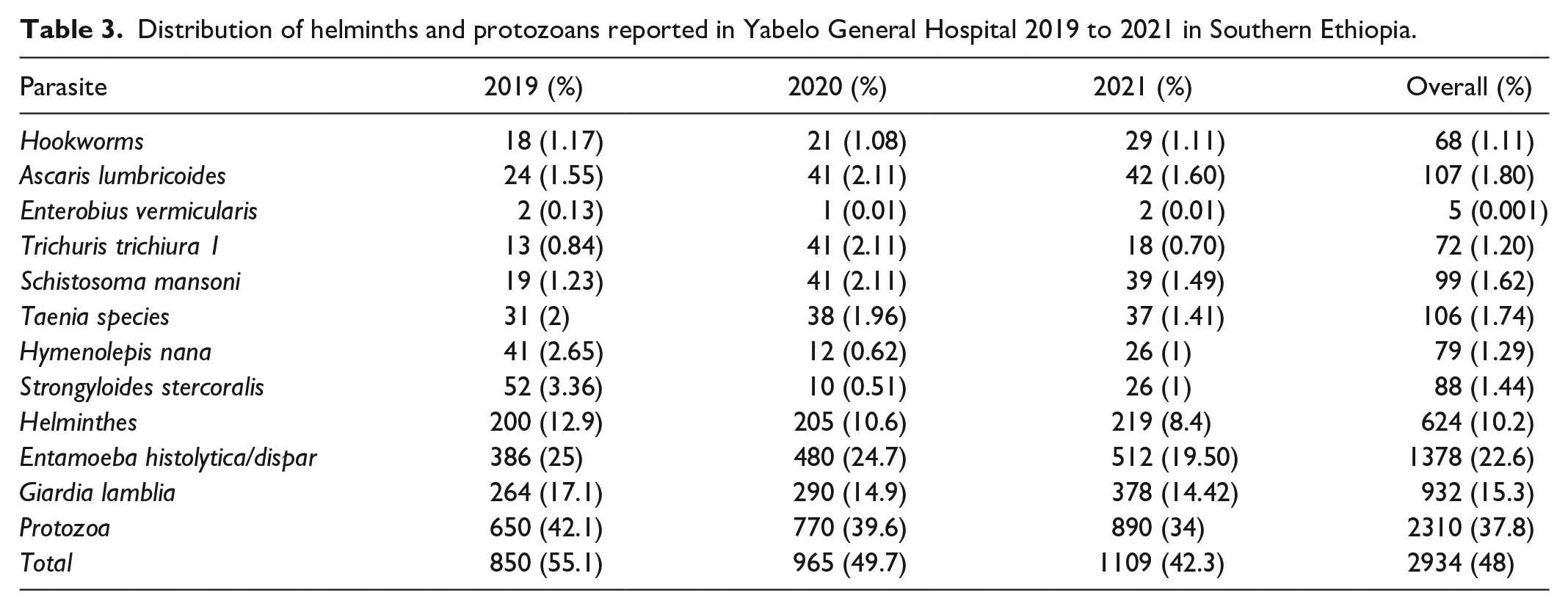
In the current study, the most common protozoan infection caused by Entamoeba species were E. histolytica/E. Dispar that occupied 1378 (22.6%) of intestinal parasites, while G. lamblia accounted for 932 (15.3%). In terms of helminthic infections, A. lumbricoides is the dominant causal agent of parasitic infections with a 1.8% prevalence. However, Enterobius vermicularis was the least common cause of helminth infections which was seen in only 5 (0.001%) cases (Table 3).
Distribution of helminths and protozoans reported in Yabelo General Hospital 2019 to 2021 in Southern Ethiopia.
Factors associated with intestinal parasites
In the present study, age group and sex of the patients do not associate with IPIs (p value > 0.05). However, more than half of 806 (59.2%) of patients aged 45 years and above were at least infected with one intestinal parasite (Table 4).
Factors associated with parasitic infections and the sociodemographic characteristics of Yabelo General Hospital, Southern Ethiopia from 2019 to 2021.

Trend analysis of intestinal parasites at Yabelo General Hospital from 2019 to 2021
Trend analysis of intestinal parasites showed a decreased overall prevalence from 55% in 2019 to 42.3% in 2021. Similarly, protozoan parasites slightly decreased from 42.1% in 2019 to 34% in 2021. In addition, the prevalence of helminths gradually decreased from 2019 (12.9%) to 2020 (10.6%) and 2021 (8.4%) (Figure 4).

Trend analysis of intestinal parasites among patients attended at Yabelo General Hospital from 2019 to 2021.
Discussion
Helminthic and protozoan infections are major health problems, especially in pastoralist communities of developing countries due to poor hygienic habits, poor standards of living, lack of health education, ignorance, poverty, and poor socioeconomic conditions, which are some of the many reasons behind the high prevalence of parasitic infections.23–25 The pastoralists are widely inhabited in semiarid to arid, therefore the types and amount of the diets are mostly affected by cultural and ecological factors as well as economic constraints and opportunities, the absence of pure drinking water, and poor sanitary conditions, which play a great role in parasitic infection.26,19
In the current retrospective study, the overall intestinal parasites prevalence among patients visiting Yabelo General Hospital between 2019 and 2021 was 48%. This finding agreed with prevalence findings of 45.6% from a study conducted at the University of Gondar student clinic 20 and 47.9% at the Hawassa University student clinic. 27 In contrast, the finding in this report is greater than that of the studies conducted in Tikur Anbessa Hospital (34.5%), 1 Jimma health center (20.6%), 28 Wonago Health Center (16.65%), 29 and Debre Tabor Comprehensive Specialized Hospital (27.3%). 21 However, the current finding was lower than that of a study conducted in the Dembia district (53.3%). 30 The possible differences among studies may be due to study years, sample size, skills of laboratory professionals, and geographical variations. The higher prevalence of IPIs in the study area may be due to water shortages in the arid and semiarid regions of the Borena zone, which are necessary for hygienic and sanitation purposes.
In the present study, intestinal protozoan infection was more dominant than intestinal helminthic infection. This finding is consistent with the studies done at the University of Gondar, 20 Hawassa University student clinic, 27 and Bale Robe health center. 31 Contrary to this study, a study from the Dambia district reported that helminthic infection was higher prevalent as compared with protozoan infection. 30 On the other hand, the current prevalence of protozoan infection (37.8%) was lower than that in studies conducted at the Gonder Poly Health Center (68.2%), 32 and Bale-Robe Health Center (47.1%) 31 and Wonago Health Center (78.3%). 29 However, this finding was higher than those of studies conducted at the University of Gondar student clinic (28.5%) 20 and the Debre Tabor Comprehensive Specialized Hospital (24.5%). 21 The variations in magnitude between the studies could be due to geographical variations, skills, quality of diagnostic equipment, time taken to examine stool samples in case of patient load, and life standards of the community.
The predominant protozoan parasite identified in the present study was E. histolytica/dispar, with a prevalence of 22.6%, which is similar to a study conducted in the University of Gondar student clinic (20.3%) 20 and the Debre Tabor Comprehensive Specialized Hospital (18.6%). 21 However, this finding was higher than the report of studies conducted in Tikur Anbessa University Hospital, Ethiopia (13.6%) 28 and Wonago Health Center (8.9%). 29 G. lamblia and A. lumbricoides followed Entamoeba species in the study area with prevalence rates of 15.3% and 1.8%, respectively. The reason could be higher contaminated drinking water and poor sanitation because of the clean drinking water shortage in the study area. 21
In this study, the overall proportion of intestinal parasites was higher among females (52%) than among males (48%). This finding agreed with studies conducted in Mwanza, Tanzania, 33 Bungado Tanzania, 34 Hawassa University students’ clinic, 27 Mojo Health Center, 35 and Wonago Health Center in Ethiopia, 29 which reported that females are more infected than males. Other studies that opposed the present finding were those from the University of Gondar students clinic, 20 Debre Tabor Comprehensive Specialized Hospital (18.6%), 21 Tikur Anbessa hospital, 28 and the Dembia district. 30 The females in pastoralist community are a more vulnerable group because they are more engaged in outdoor activities.
Regarding associated factors analysis, sociodemographics such as age groups and the sex of the patients were not significantly associated with IPIs (p value > 0.05). The prevalence of helminthes infection was observed higher among males (57.5%), while prevalence of protozoa infection higher among females (54.5%). In terms of age groups, 59.2% of above 45 year old patients were seen infected with intestinal parasites; however, patients aged between 15 and 44 years were occupied 57% all infected groups. This finding was supported by the study conducted in Gonder Poly Health Center (68.2%). 32 Higher detection of parasitic infection among patients of older age may be due to immunity defense compromised as chronic diseases are common as age increased.
The overall prevalence of intestinal parasite trends revealed a decreasing prevalence from 55% in 2019 to 42.3% in 2021. Similarly, protozoa and helminths prevalence slightly decreased from 2019 to 2021. The findings of this study are supported by a study performed in Morocco, which reported a decreasing trend of parasitic infection. 36 However, this finding differed from a study conducted in Ethiopia, which revealed an increase. 31 The possible explanation could be that during the COVID-19 pandemic period, the worldwide community practiced handwashing more than ever, and this activity may be attributed to the decline in fecal oral transmission of pathogens, including parasites.
The strength and limitations of the study
The study used a large sample size with completed data from the hospital laboratory database. The limitations of the study were that only 3 years of data were assessed, and the wet mount technique applied in the laboratory was poor in the detection and contrast of parasitic stages. Due to the secondary data used, it is impossible to assess different factors that may be associated with IPIs.
Conclusion
The overall prevalence of IPIs in this retrospective study was high. The trend analysis revealed that the overall prevalence slightly decreased from 2019 to 2021. This study shows that intestinal protozoans were more reported than intestinal helminthiases. The most reported parasite species was E. histolytica/E. Dispar, Giardia lamblia, and Ascaris lumbricoides. The study indicates that more than half of patients aged above 45 years were seen infected with intestinal parasites. It is necessary to sustain the decline in intestinal parasite prevalence by developing effective prevention and control strategies, including health education and improving environmental sanitation, and by increasing the sensitivity of parasite detection rate at the Yabelo General Hospital laboratory by using stool concentration method, in addition to direct wet mount technique.
Footnotes
Acknowledgements
I would like to express our deepest gratitude and heart full thanks to Bule Hora University, Institute of Health, for allowing and giving the chance to conduct this study. Next, thanks to Yabelo General Hospital laboratory staff for their support in data gathering activities. Last, I would like to express my heartfelt thanks to colleagues Samuel Dereje and Yadechu Hirpa for the sense of belonging and fraternity that was fostered for all the support and enthusiasm.
Author contributions
AA helped in conceptualization, developed proposal, resource, project administration, investigation, and supervision, performed data analysis and interpretation. AG helped in data curation, formal analysis, software, investigation, and supervision; performed data analysis and interpretation; and wrote. All authors read and approved the final manuscript.
Data and materials availability
All necessary data are available in this manuscript. With reasonable request, data can be provided from the corresponding author without restrictions.
Declaration of conflicting interests
The author(s) declared no potential conflicts of interest with respect to the research, authorship, and/or publication of this article.
Ethics approval
An ethical approval letter was obtained from Bule Hora University, Institutional Review Committee (IRC12/21)*.
Funding
The author(s) received no financial support for the research, authorship, and/or publication of this article.
