




Abstract
The likelihood of contraceptive implant discontinuation is very common and varies worldwide. This high prevalence of discontinuation may also indicate problems with implementation of family planning programmes. Consequently, a significant number of women are exposed to conception after discontinuation. Although studies have been conducted in Ethiopia, there are inconsistencies across studies. Therefore, this meta-analysis aimed to estimate the pooled prevalence of contraceptive implant discontinuation among women in Ethiopia.
Published articles from various electronic databases such as PubMed/MEDLINE, Google Scholar, Science Direct, AJOL and Cochrane library were systematically searched. All cross-sectional studies conducted on prevalence of contraceptive implant discontinuation and published up to 30 January 2022 were included in this review. To estimate the pooled prevalence, random effect model was used and a subgroup analysis was performed to identify the possible source of heterogeneity. Begg’s and Egger’s tests were used to identify possible publication bias.
A total of 13 cross-sectional studies with 5012 participants were included. Significant heterogeneity was observed across studies (I2 = 98.2%). However, there was no evidence of publication bias (p = 0.066). The estimated pooled prevalence of contraceptive implant discontinuation in Ethiopia was found to be 36.95% (95% confidence interval = 27.6–46.3). A subgroup analysis by time of discontinuation indicated that 21.5%, 42.2% and 33.5% of contraceptive implant user discontinue within 12 months, 2.5 years and 3 years, respectively.
This meta-analysis indicated that the prevalence of discontinuation of contraceptive implant was found to be high in Ethiopia. Therefore, strengthening the appropriate counselling prior to insertion and proper follow-up, independent choice will improve the proportion of implants retention.
Introduction
Contraceptive implants are second-generation single-rod etonogestrel and the two-rod levonorgestrel implantable long-acting reversible contraceptives (LARCs). Contraceptive implants are implanted subdermally and provide effective contraception for up to 5 years with a clinical failure rate of less than 1%. 1 It prevents the release of an egg from the ovary and thickens the mucus of the cervix, which may prevent sperm from accessing the egg and change the uterine lining, all of which prevent conception. 2
The first implant is norplant which was approved in 1983. However, global production was halted in 2008 after a lawsuit claimed that it caused scarring, pain upon removal, and other unwanted effects. Newer implant generations are smaller, easier to insert and remove and have fewer problems, including Implanon, Jadelle, Norplant and Sino Implants. 3
According to a United Nations report released in 2019, more than 23 million women of reproductive age (15–49) utilize implants globally and 6.4% are from sub-Saharan Africa. 4 According to the Ethiopian Demographic and Health Survey (EDHS) 2019, 9% were implant users. 5
Contraceptive discontinuation is considered the cause of 33 million unwanted pregnancies and has serious health and well-being implications for women and children. 6 It is a worldwide problem that may be linked to a lack of desire to avoid pregnancy and missed opportunities to continue using contraception. 7 Contraceptive implant discontinuation is defined as the removal of implants by healthcare providers before the recommended effective duration. 8
Method-related (contraceptive failure), right-based (lower need) and non-technique-related (desire to become pregnant, uncomfortable to use, hated method, lack of privacy for users and spouse disapproval) are the three categories of reasons for discontinuation. 9
The likelihood of Implanon discontinuance varies widely worldwide, ranging from 3% to 69%. 10 According to South African Family Practice, up to 43% of women discontinued their Implanon before the 3 years were completed. 11 According to studies conducted in Ethiopia, 12 Nigeria and Kenya, 11%, 19.0% and 30.0% of Implanon users discontinued use within the first year, respectively.13,14
Implant discontinuation before the recommended effective duration leads women at risk of unintended pregnancies and unsafe abortions, along with negative health consequences such as miscarriage and stillbirth.9,10 It also had negative impacts on financial capability of the healthcare system and social difficulties in the community as birth rates increase. 15
The higher prevalence of discontinuation of Implants contraceptive is a public health concern and it is also an indicator for the failures of a programme. To date, the prevalence of implant discontinuation rate in Ethiopia ranges from 16% to 66%.16–28 However, those studies offered district-level information and there is no updated national representative evidence regarding the overall discontinuation rate about all types of implant contraceptives. So it is practical to work on synthesizing the evidence. Therefore, this systematic review and meta-analysis aimed to determine the pooled prevalence of early Implanon discontinuation among women in Ethiopia. Moreover, cumulative estimates of contraceptive implants discontinuation rate will aid policymakers and other stakeholders in developing and implementing strategies for reducing contraceptive implants discontinuation.
Methods
Searching strategy and study identification
A systematic review and meta-analysis was designed to estimate the prevalence of contraceptive implant discontinuation among women who used implants in Ethiopia. All published research report on contraceptive implant discontinuation among women who used implants in Ethiopia up to 30 January 2022 were searched from all electronic databases, such as Medline, Google Scholar, Science Direct, AJOL and Cochrane library, and were retrieved. Our search for published articles was restricted by country (studies conducted only in Ethiopia). The search was carried out using the following key words: ‘prevalence’, ‘early discontinuation of implants’, ‘early discontinuation of implanon’ and ‘Ethiopia’. The search terms were used separately and in Combination using ‘OR’ or ‘AND’ (Supplemental S2 file). All articles published up to 30 January 2022 were included in the systematic review and meta-analysis. We followed Preferred Reporting Items for Systematic Reviews and Meta-Analyses (PRISMA) guideline during the systematic review 29 (Supplemental S1 file).
Inclusion criteria
Population
Study conducted on women who used contraceptive implants.
Study setting
Only studies in Ethiopia were included in the present review and meta-analysis.
Publication
All published articles both in peer-review journals and grey literature were included.
Study design and language
All original cross-sectional studies published in the English language in Ethiopia reporting the prevalence of contraceptive implant discontinuation among women who used contraceptive implant were included.
Exclusion criteria
Studies difficult to access full text and studies that did not report the primary outcomes of interest were excluded from this study.
Outcome measurement
The primary outcome of this study is early discontinuation of implant contraceptives. Implant contraceptive discontinuation is considered when a woman removes each type of implant before the recommended time for various reasons.
Data abstraction
All retrieved studies from all databases were imported into Endnote version X7 and duplicated articles were manually removed. Two independent reviewers (G.A.K and A.Y.G.) screened all the papers for eligibility criteria: first, abstract and title and second, full-text screening. If consensus could not be reached regarding study selection, disagreements were resolved by inviting a third investigator (Y.S.A.). Then, data were extracted from the included articles by using data extraction Excel spreadsheet software. The data extraction format included the authors, years of publication, study setting, region where the study was conducted, sample size, total number of cases, types of implant, time of assessing outcome prevalence of contraceptive implants discontinuation, and quality rating.
Quality assessments
To assess quality of each study, Joanna Briggs Institute (JBI) tool adapted for cross-sectional design was used. 30 The tool include the following items as criteria for appraisal: appropriateness of the list of the source population, appropriate recruitment of study participants, sample size sufficiency, appropriateness description of the study setting and subjects, data analysis with sufficient coverage of the sampled data analysis, use of appropriate method for identification of the outcome of interest, measurement of the condition using a standard reliable and consistent method for all participants, appropriateness of statistical analysis and adequacy of response rate or use appropriate handling mechanism for low response rate. Two independent reviewers (G.A.K and Y.S.A.) critically evaluated each study. Disagreements between the reviewers were resolved through discussion. If they didn’t agree, a third reviewer (A.Y.G.) was consulted to resolve discrepancies between independent reviewers. Then after, studies with a total score of ⩾50% of the quality assessment checklist criteria were taken as low risk and included in the final systematic review and meta-analysis. 31
Statistical analysis
The data were entered using Excel spreadsheet software in to computer after extraction and then exported to STATA 14.1 software for analysis. Inverse variance (I2) test was used to check homogeneity across studies that reporting prevalence. I2 with Cochran’s Q statistic values of 0%, 25%, 50% and 75% were assumed to represent no, low, medium, and high heterogeneity, respectively, at a p-value of <0.05. 32 Since significant heterogeneity was detected between studies (p < 0.01, I2 > 98.2%), a random effects meta-analysis model was used to estimate the pooled prevalence of contraceptive implants discontinuation. A forest plot was constructed to visualize the presence of heterogeneity. Subgroup analysis and meta-regression were conducted based on region, study setting and time of discontinuation of implant contraceptive to examine potential difference across the studies and to identify sources of variation. Evidence of publication bias was also assessed using both Egger’s and Begg’s tests with a p-value of less than 0.05 as a cut-off point. We also conducted a leave-one-out sensitivity analysis to appraise the main studies that exerted the most crucial impact on between-study heterogeneity. The analysis was done to evaluate the effect of each study on the pooled estimate of implant contraceptive discontinuation by excluding each study step by step. Finally, the findings of the study were presented using forest plots with the corresponding prevalence and 95% confidence intervals.
Results
Selection of studies
A total of 295 articles were retrieved from the electronic databases and other sources. The titles and abstracts were screened and 230 duplicate articles or unrelated articles were removed. Of the remaining 65 articles, 30 articles were excluded because their titles and abstracts were not in line with our inclusion criteria (not reporting the outcome of interest, studies conducted outside Ethiopia) and 22 articles were excluded for the following reasons: studies conducted outside Ethiopia, insufficient data, the study designs other than cross-sectional, study objective not related and outcome of interest isn’t reported. Ultimately, 13 articles were included in this systematic review and meta-analysis. The detailed selection procedures illustrated in Figure 1.
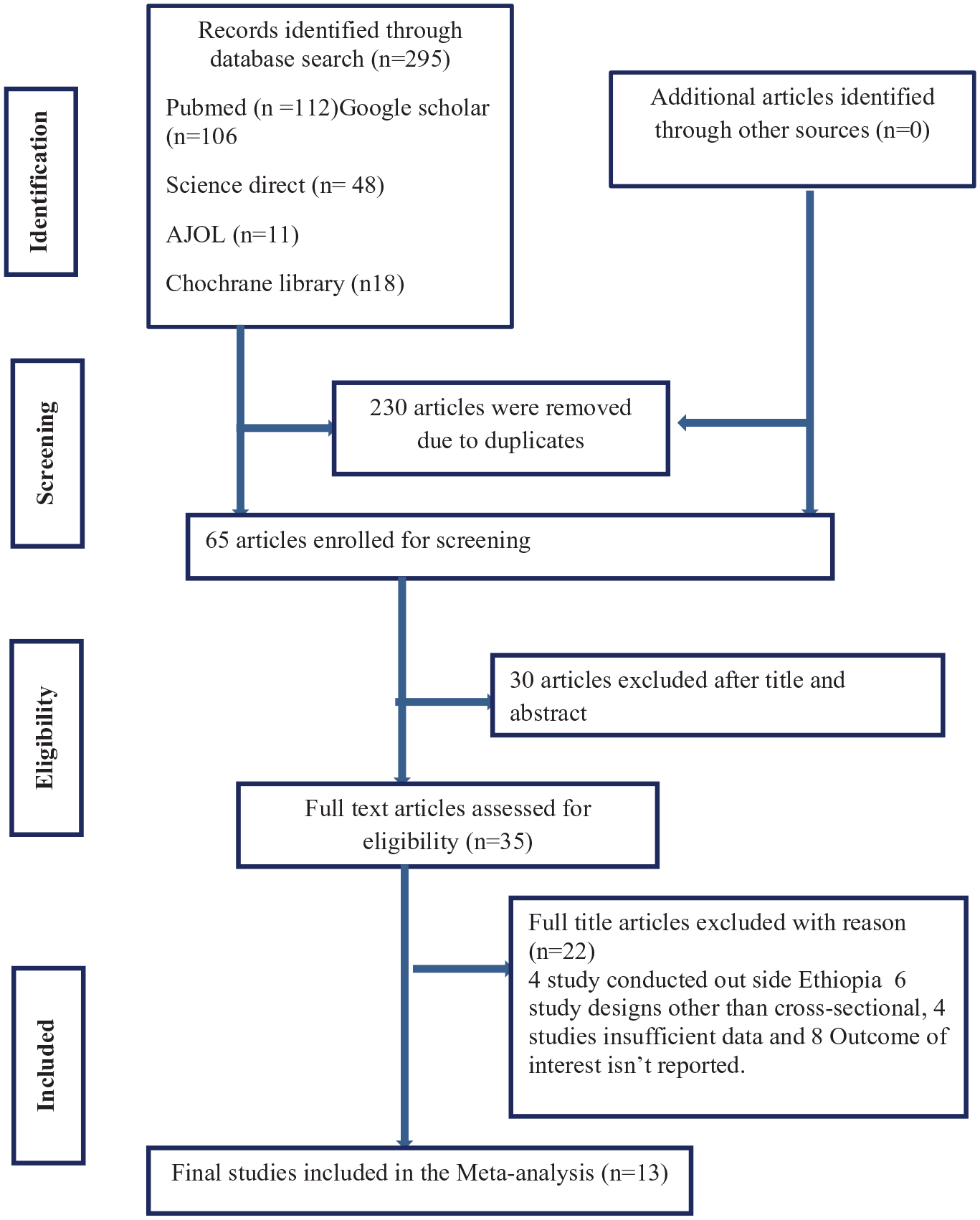
PRISMA flow diagram of articles screened and the selection process on prevalence of contraceptive implants discontinuation in Ethiopia.
Characteristics of included studies
Thirteen cross-sectional studies were included in the final systematic review and meta-analysis. All studies included in this meta-analysis were published between 2015 and 2022. A total of 5012 women who were using contraceptive implants were participated in the analysis, with a minimum sample size of 134 16 and maximum of 711. 17 From 13 articles included in this systematic review and meta-analysis, only four regions of Ethiopia were identified. Of the total studies included, four were conducted in Amhara;16,18–20 four in South Nations Nationalities and Peoples of Ethiopia national (SNNPR),17,21–23 three studies in Oromia24–26 and two in Tigray.27,28 Six studies were conducted in urban areas and the rest seven were conducted in rural areas. Regarding the time of implant discontinuation after insertion, eight studies assess the outcome of interest within two and a half years, three studies within 3 years and two studies within 1 year (Table 1).
Summary of characteristic of 13 studies included in the systemic review and meta-analysis on prevalence of contraceptive implant discontinuation in Ethiopia 2022.
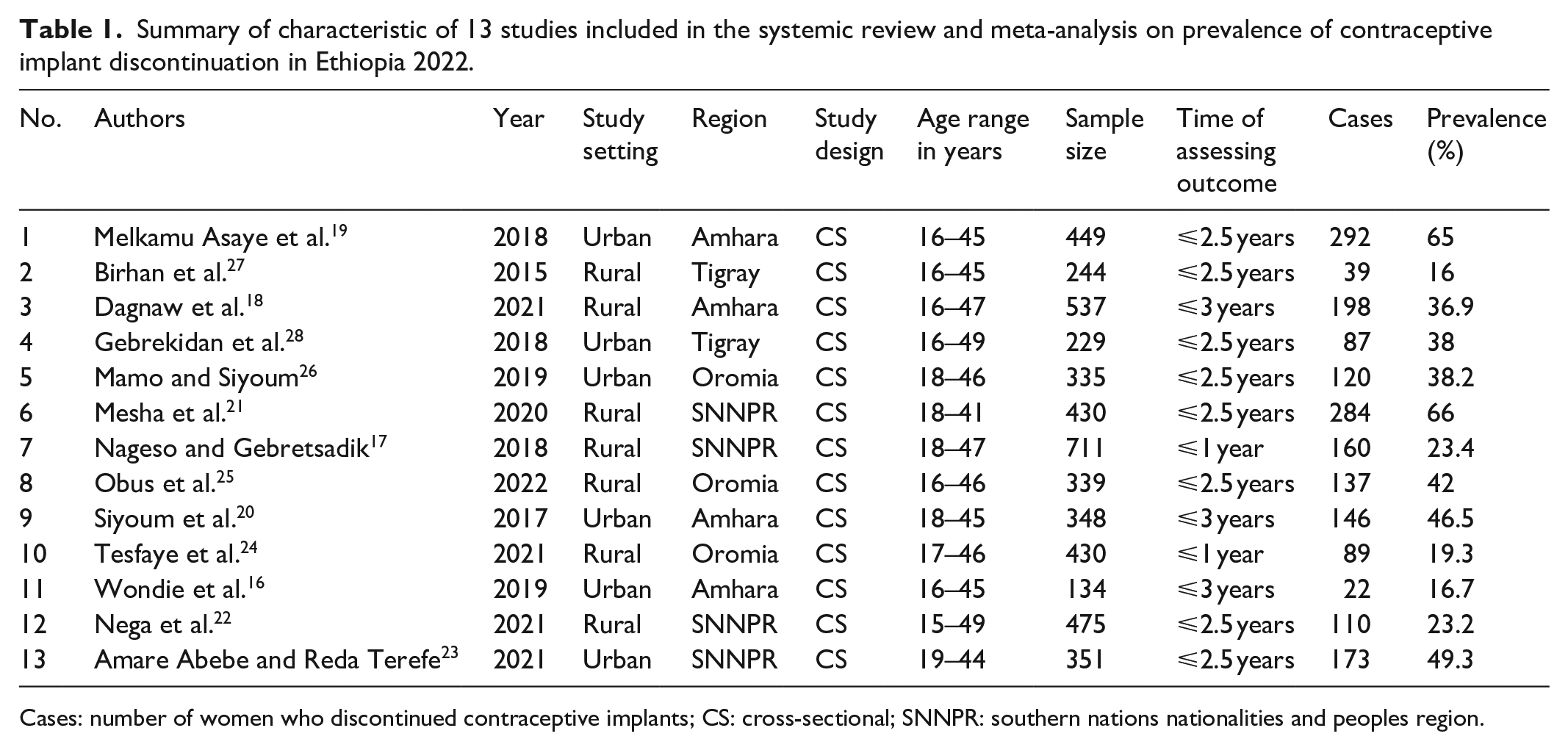
Cases: number of women who discontinued contraceptive implants; CS: cross-sectional; SNNPR: southern nations nationalities and peoples region.
Pooled prevalence of contraceptive implant discontinuation in Ethiopia (meta-analysis)
The pooled prevalence of contraceptive implant discontinuation in Ethiopia was 36.95% (95% confidence interval (CI) = 27.56–46.34). As shown in the forest plot below, a statistically significant heterogeneity was observed (I2 = 98.2%; p < 0.0001). Therefore, we estimated the pooled prevalence using random effects models to estimate the pooled discontinuation prevalence of the implants. In addition, the presence of heterogeneity also indicates the need to perform subgroup analysis to identify the sources of heterogeneity across studies (Figure 2).

Forest plot for pooled prevalence of contraceptive implant discontinuation among women who used implants in Ethiopia.
Subgroup analysis
In this meta-analysis, subgroup analysis was performed based on the study area (regions), time of discontinuation and study setting to assess the possible source of heterogeneity. Accordingly, statistical significant heterogeneity was found between groups (p < 0.05) (Table 2). Regarding the pooled prevalence of contraceptive implant discontinuation by region where the studies are conducted, the lowest prevalence of contraceptive implant discontinuation was reported in Tigray (26.89%) (95% CI = 5.33–48.45) and the highest was in Amhara (41.36%) (95% CI = 22.87–59.84), followed by SNNPR 40.42% (95% CI = 20.15–60.7) (Figure 3). Subgroup analysis by study setting also indicated that the pooled prevalence of contraceptive implant discontinuation was 42.38% (95% CI = 29.61–55.15) among the studies employed in urban areas and 32.36% (95% CI = 20.28–44.44) in rural areas (Figure 4). Moreover, a subgroup analysis by time of discontinuation after insertion indicated that 21.5% (95% CI = 17.25–25.49), 42.2% (95% CI = 28.74–55.68) and 33.5% (95% CI = 18.43–48.34) of contraceptive implant user discontinue within 1 year, within 2.5 years and within 3 years, respectively (Figure 5).
Subgroup analysis on the prevalence of contraceptive implants discontinuation in Ethiopia 2022.

SNNPR: southern nations nationalities and peoples region.
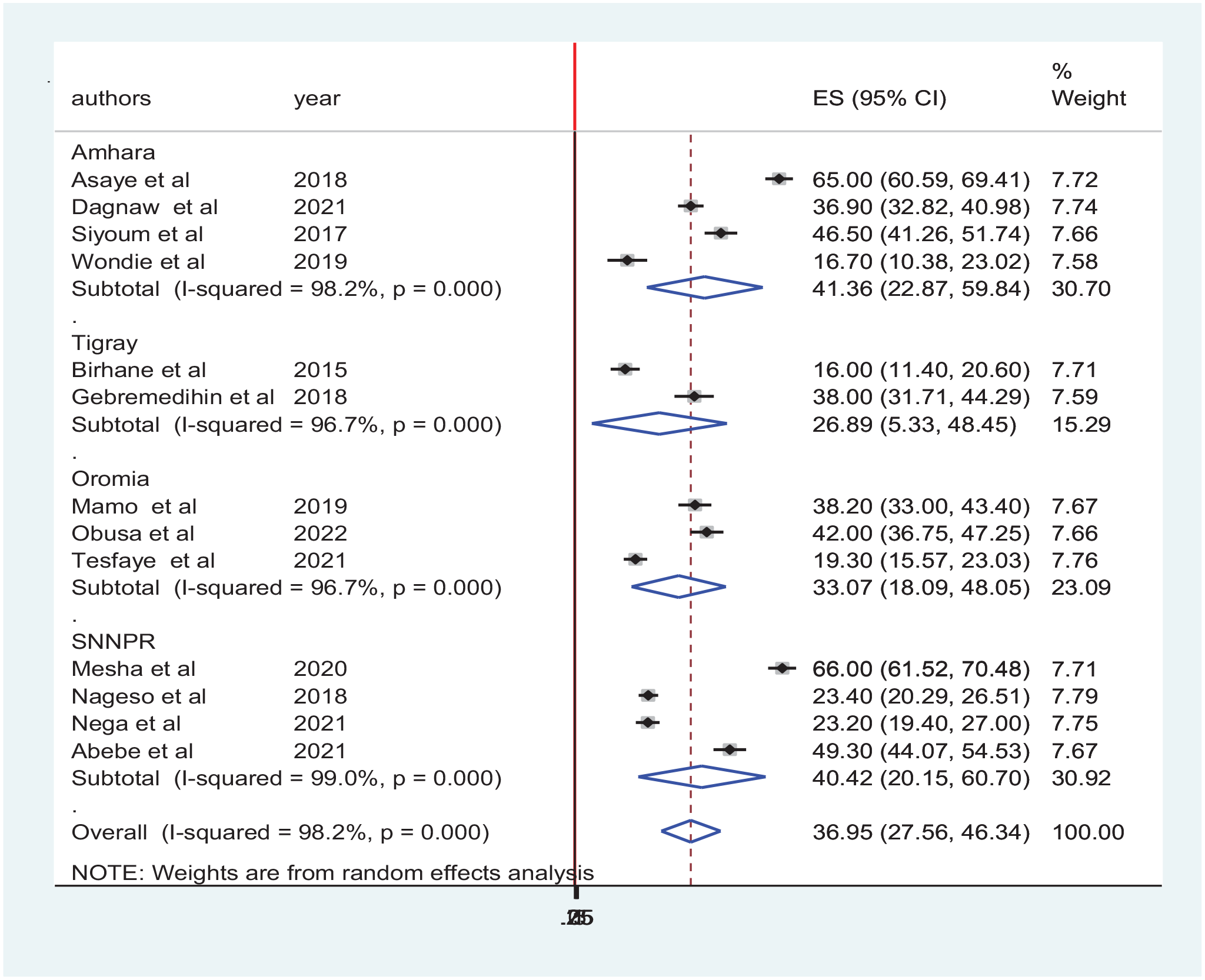
Forest plot for subgroup analysis by regions on discontinuation of contraceptive implants among women who used implants in Ethiopia.

Forest plot for subgroup analysis by study setting on contraceptive implants discontinuation among women who used implants in Ethiopia.

Forest plot for subgroup analysis by time of discontinuation of contraceptive implants among women who used implants in Ethiopia.
In addition to subgroup analysis, publication bias was assessed using both Begg’s and Egger’s tests. The results of the Begg’s and Egger’s tests indicated that there was no publication bias identified among studies included to estimate the pooled prevalence of discontinuation of implants at p-value of p = 0.055 and p = 0.066, respectively.
Leave-out-one sensitivity analysis
Sensitivity analysis was performed to evaluate the effect of a single study on the pooled prevalence of discontinuation of contraceptive implants among women in Ethiopia by step by step excluding each study. The results showed that no single study made a significant difference in the pooled prevalence of contraceptive implant discontinuation (Figure 6).

Sensitivity analysis on the prevalence of contraceptive implants discontinuation among women who used implants in Ethiopia.
Discussion
All types of contraceptive implants are intended to be used for a long time; however, the majority of users were discontinued them early. In this systemic review and meta-analysis, the overall pooled prevalence of contraceptive implant discontinuation was found to be 36.95% (95% CI = 27.56–46.34), in which more than one-third of the users were discontinued before the expected date of removal; these high prevalence of discontinuation may also signal problems in the implementation of family planning programmes. Moreover, discontinuation of contraceptive implant contributes for unwanted pregnancy and induced abortion which exposed the risk of women health. The results of this meta-analysis were consistent with the Ethiopian Demographic and Health Survey 2016 (35%) 33 and Uptake and Discontinuation of Long-Acting Reversible Contraceptives (LARCs) in low-income countries (33.3%). 10 However, it was lower than that reported in the South Africa demographic and health survey report of 2016 (74%). 34 This could be due to differences in socio-demographic characteristics, norms, beliefs and other cultural variations of the study settings.
In subgroup analysis of this meta-analysis, the pooled prevalence of implant discontinuation within 12 months was 21.5% (95% CI = 17.25–25.49). The finding was higher than the studies from Nigeria (8.5%) 14 and Nepal (11.74%), 35 and discontinuation of contraceptive implant within 2.5 years was 42.2% (95% CI = 28.74–55.68). This finding was consistent with the result from Kenya (25%). 36 However, it was higher than the study conducted in Nigeria (17.5%) and Nepal (17.3%).14,35 Moreover, discontinuation of contraceptive implants within 3 years was 33.5% (95% CI = 18.43–48.34), which was in line with the finding from Kenya (30%) 36 and Nepal (33.3%). 35 The possible explanation for the discrepancy in the prevalence of implants contraceptive across studies may be due to the differences in the level of counselling that was given during implant insertion and the subsequent continuous follow-up. In addition, it might be due to sociocultural variation across the study areas.
The subgroup analysis of this systemic review and meta-analysis revealed that the pooled prevalence of contraceptive implants discontinuation was significantly different across the regional state of Ethiopia. The highest prevalence of contraceptive implants discontinuation was observed in Amhara regional (41.36%) (95% CI = 22.87–59.84) as compared with Tigray regional state regions (21.76%) (95% CI = 5.33–48.45). A possible reason for these variations is the difference in cultural variations and the number of studies included in the analysis in which the Tigray regional state of Ethiopia was represented by only two studies. Moreover, it might be due to the study settings of the included studies because the study setting was one of the sources of heterogeneity in this meta-analysis. The disparity in the prevalence of discontinuation could also be due to differences in the socio-demographic characteristics of the study participants, pre-insertion and post-insertion counselling and proper follow-up.
Regarding the study setting, the highest prevalence of discontinuation of implants was observed among the studies conducted in urban setting 42.38% (95% CI = 29.61–55.15) when compared with urban settings 32.36% (95% CI = 20.28–44.44). This could be due to the difference in socio-economic status such as educational level and income and also it might be related to the access to information on the benefits of birth spacing for improving the child nutrition. Those who had a better income needed more children because they thought that they could provide the necessary care and grow children easily. In addition, they respond easily to minor side effects and discontinue it because they might have access to transportation and removal with payment at private facilities.
The high prevalence in discontinuation of contraceptive implants implies poor counselling during the provision of methods. Therefore, it can be reduced with appropriate counselling before and after implants insertion and it is presumed that women who have decided to use an implant intend to use it for a sustained period of time.
Limitation the study
The first limitation of the study was only English articles were considered for the analysis. Moreover, this meta-analysis represented only studies reported from five regions of the country; it might limit representativeness of the finding. And also due to the scarcity of national and global systematic reviews and meta-analyses, we have discussed some of our findings with single studies. Finally, included studies used different cut-off points to measurements time of discontinuation of contraceptive implants.
Conclusion
This systematic review and meta-analysis indicated that there was a high prevalence of contraceptive implant discontinuation in Ethiopia. Therefore, the government of Ethiopia should focus on giving greatest emphasis to improve the proportion of implants retention among implant users by creating enabling environments by providing client-centred care and encouraging healthcare providers to provide appropriate pre-insertion counselling on side effects, benefits and advantages to decrease discontinuation of implant contraceptive. A great effort should also be made to address implant user attitude and know-how through health information dissemination programmes in order to increase implant contraceptive retention.
Supplemental Material
sj-doc-1-smo-10.1177_20503121221135486 – Supplemental material for Prevalence of contraceptive implant discontinuation among women who used implant in Ethiopia: Systemic review and meta-analysis
Supplemental material, sj-doc-1-smo-10.1177_20503121221135486 for Prevalence of contraceptive implant discontinuation among women who used implant in Ethiopia: Systemic review and meta-analysis by Gizachew Ambaw Kassie, Amanuel Yosef Gebrekidan, Getachew Asmare Adella, Gedion Asnake Azeze and Yordanos Sisay Asegidom in SAGE Open Medicine
Supplemental Material
sj-docx-2-smo-10.1177_20503121221135486 – Supplemental material for Prevalence of contraceptive implant discontinuation among women who used implant in Ethiopia: Systemic review and meta-analysis
Supplemental material, sj-docx-2-smo-10.1177_20503121221135486 for Prevalence of contraceptive implant discontinuation among women who used implant in Ethiopia: Systemic review and meta-analysis by Gizachew Ambaw Kassie, Amanuel Yosef Gebrekidan, Getachew Asmare Adella, Gedion Asnake Azeze and Yordanos Sisay Asegidom in SAGE Open Medicine
Footnotes
Acknowledgements
The authors would like to thank all authors of the studies who participated in this systematic review and meta-analysis.
Author contributions
G.A.K. and Y.S.A. conceived and designed the study, methodology, data analysis and interpretation and wrote the original draft. G.A. Azeze and A.y.G. established the search strategy, extracted data and assessed the quality of the included studies. G.A.K., A.y.G., G.A. Adella, G.A. Azeze and Y.S.A. wrote review and edited. All the authors have read and approved the manuscript.
Declaration of conflicting interests
The author(s) declared no potential conflicts of interest with respect to the research, authorship and/or publication of this article.
Funding
The author(s) received no financial support for the research, authorship and/or publication of this article.

Supplemental material
Supplemental material for this article is available online.
References
Supplementary Material
Please find the following supplemental material available below.
For Open Access articles published under a Creative Commons License, all supplemental material carries the same license as the article it is associated with.
For non-Open Access articles published, all supplemental material carries a non-exclusive license, and permission requests for re-use of supplemental material or any part of supplemental material shall be sent directly to the copyright owner as specified in the copyright notice associated with the article.
