



Abstract
Objective:
The health belief model specifies that individuals’ perceptions about particular behavior can predict the performance of respective behavior. So far, the model has been used to explain why people did not follow COVID-19 preventive behavior. Although we are using it, to our best knowledge, its predictive ability in COVID-19 preventive behavior is unexplored. So, this review aimed to assess the model’s predictive ability and identify the most frequently related construct.
Method:
A systematic review was conducted to examine the predictive ability of health belief model in COVID-19 preventive behavior using research done all over the world. Preferred reporting items for systematic review and meta-analysis guidelines were used. Comprehensive literature was searched using databases such as PubMed, Google scholar, and African Online Journal to retrieve related articles. Descriptive analyses such as the proportion of studies that better explained COVID-19 prevention behavior and the significance ratio of each construct of the model were made.
Result:
Overall, 1552 articles were retrieved using a search strategy and finally 32 articles fulfilling the inclusion criteria undergo the review. We found that in the majority (87.5%) of the studies health belief model has a good predictive ability of COVID-19-related behavior. Overall the explained variance for health belief model ranged from 6.5% to 90.1%. The perceived benefit was the most frequently significant predictor; highest significance ratio (96.7%) followed by self-efficacy, cues to action perceived barrier, susceptibility, and severity in decreasing order.
Conclusion:
Health belief model has a good predictive ability of COVID-19-related behavior in the majority of reviewed studies. The perceived benefit was the most frequently significant predictor of COVID-19-related behavior. Professionals who are in need can effectively use health belief model in planning and designing interventions to prevent and control the pandemic.
Introduction
The 2019 novel coronavirus disease is caused by the severe acute respiratory syndrome coronavirus 2 (SARS-CoV-2) and spread to several countries. On 30 January 2020, the World Health Organization’s (WHO) 1 Emergency Committee considered it a global health emergency and declared it to be a pandemic in March 2020. 2 It was first identified as clusters of pneumonia cases that have been reported for unknown reasons in Wuhan, Hubei Province, China. 3 The COVID-19 pandemic has negatively affected economic growth, sense of security, healthcare system, trade relations, tourism, employment, education, and global interactions of many countries across the globe. 4
WHO has recommended several health-promotive behaviors for the prevention of the COVID-19 pandemic. Facemask wearing, social distancing, hand washing with soap and water, use of alcohol-based hand sanitizer, self-isolation, avoiding spending time in crowded places, and taking the vaccine was the most highly advocated behavior to prevent and control the pandemic. These preventive behavior are investigated and framed as interventions by different theoretical molds in different parts of the world.5 –7
Different scholars such as sociologists, psychologists, and behavioral and public health experts have proposed a variety of theories and models to explain the factors affecting people’s health behavior, among these the prominent was the health belief model (HBM). HBM was introduced by Rosenstock and is a general conceptual framework and theoretical guideline for health behaviors in public health research. It consists of constructs, namely the perceived susceptibility, perceived severity, perceived benefits, perceived barriers, self-efficacy, cues to action, and preventive health behaviors. Despite the subsequent development of alternate models, the HBM is still widely used in health campaigns and taught in academic settings.8,9
Systematic review and meta-analysis are combined and summarized sources of evidence for actual practice. They settle controversies arising from apparently conflicting individual studies and can answer questions not addressed by the individual studies. Systematic review and meta-analyses adopt “a replicable, scientific, transparent and detailed process that aims to minimize bias through exhaustive literature searches by providing an audit trail of the reviewers’ decisions, procedures, and conclusions.10,11 Those qualities of systematic review and meta-analyses put them at the top of the evidence hierarchy and increase their importance for policy formulation and decision-making. 12
Review of the model
The HBM specifies that individuals’ perceptions of six variables can predict their behavior. 8 First, the model argues people will be more motivated to act in healthy ways if they believe they are susceptible to a particular negative health outcome. Second, the model predicts that the stronger people’s perception of the severity of the negative health outcome, the more they will be motivated to act to avoid that outcome. Susceptibility and severity concern the individual’s perception of the threat to a negative health outcome. Third, the individual must perceive that the target behavior will provide strong positive benefits. Fourth, the model argues that if people perceive there are strong barriers that prevent them from adopting the preventive behavior, they will be unlikely to do so. Fifth, the model also assumes individuals should perceive as they are capable of performing that particular behavior. Finally, HBM includes a cue to action whereby the individual is spurred to adopt the preventive behavior by some additional elements13–15 (Figure 1). HBM has been used to explain a variety of health problems; from preventive behavior to complex sick role behaviors. 16 The model’s ability to explain and predict a variety of behaviors associated with positive health outcomes has been successfully investigated several times. 17 The model has also been used to develop many successful health communication interventions by framing messages to the HBM variables to change health behaviors. 18 The ability of each component of the HBM in predicting a variety of health behaviors is quite different. Additionally, the model’s ability in explaining people’s behavior to newly emerging health problems is unstudied. 19

Conceptual framework of the health belief model.
As COVID-19 pandemic emerged and propagated across the world scholars from different departments investigated the reason why people did not follow COVID-19 preventive behavior using the important framework, the HBM. Several interventions are also being implemented to prevent this pandemic, which is framed using the HBM. Despite we use the HBM for explaining COVID-19 behavior and designing of COVID prevention program; to our best knowledge, issue related to its predictive ability and most frequently associated construct to COVID-19 behavior is unexplored. So this systematic review aims to assess predictive ability and identify the most frequently related construct of the model to COVID-19 preventive behavior.
Significance of the study
The result of the review would be beneficial in planning and implementing an intervention to improve COVID-19 preventive behavior. Since it evaluates the effectiveness of the HBM in explaining COVID-19 preventive behavior, it can help program designers confidently use the model in COVID-19 prevention programs. Since the review identifies the most frequently associated construct of the model to COVID-19 preventive behavior, therefore it contributes evidence inputs for preparing messages and materials for outreach and media campaigns by considering the identified important construct to prevent and control COVID-19. In addition, it may ignite a new insight for further studies that might be conducted on a related topic.
Method
Study design and setting
A systematic review was conducted to examine the predictive ability of HBM in COVID-19 preventive behavior and identify the most frequently associated construct of the model to COVID-19 preventive behavior using research done all over the world on COVID-19 preventive behavior incorporating HBM as a framework. Preferred Reporting Items for Systematic Review and Meta-Analysis (PRISMA) guidelines were used for this review (supplementary table 1). PRISMA is a protocol consisting of checklists that guide the conduct and reporting of systematic reviews and meta-analyses, which increase the transparency and accuracy of reviews in medicine and other fields. 20
Search strategies and sources of information
We have checked the PROSPERO database (http://www.library.ucsf.edu/) and the resources on COVID-END (COVID-END) whether published or ongoing projects exist related to the topic to avoid any further duplication. Thus, the findings revealed that there were no ongoing or published articles in the area of this topic. Then this systematic review was registered in the PROSPERO database with Id no of CRD42022311171. Comprehensive literature was searched in databases such as PubMed, Google scholar, and African Online Journal to retrieve related articles from 28 December 2021 to 7 January 2022. Gray literature was searched using Google. Search terms were formulated using PICO guidelines through the online databases. Medical Subject Headings (MeSH) and key terms had been developed using different Boolean operators “AND” and “OR.” The following search term was used: “COVID-19” OR “SARS-CoV-2” OR “coronavirus” OR “coronavirus disease” AND “health belief model.”
Eligibility criteria
In this systematic review, we included studies that meet the following criteria. First, a study must be done on COVID-19 preventive behavior using HBM. Second, no restriction was made regarding country, population group, race, gender, and publication date. Study which employ a qualitative method and not report explaining ability such as variance explained, study with data extracted, duplicate, abstract-only papers, articles without available full text, conference, editorial, author response theses, case reports, case series, and systematic review studies are excluded at each respective stage of screening.
Outcome measurements
This review has two main outcomes. The primary outcome was the proportion of variance of COVID-19 prevention behavior explained by the HBM. It is defined as the variance of COVID-19 prevention behavior which is explained by the HBM framework that they are employed in their research article starting from the drafting of the conceptual framework up to the fitting of the analysis model. Therefore, all included studies were reporting the proportion of variance explained by the model they are fitted as analysis output. Thus, a higher percentage of explained variance indicates a great explaining ability of the model in COVID-19 preventive behavior. It also means that you make better predictions. 21 The secondary outcome was factors associated with coronavirus disease 2019 (COVID-19) preventive behavior (constructs of HBM). Construct that are frequently associated with the behavior are considered as an important factor that needs focus while we design interventions to improve COVID-19 prevention behavior.
Data extraction
All studies obtained from all databases were exported to Endnote version X8 software to remove duplicate studies. Then after, all studies were exported to a Microsoft Excel spreadsheet. Four authors (A.Z., A.M., T.S., and M.G.) independently extracted all the important data using a standardized data extraction form which was adapted from the Joanna Briggs Institute (JBI) data extraction format for the first outcome. 22 For the first outcome (proportion of variance) the data extraction format included (primary author, year of publication, country, sample size, analysis model fitted, and proportion of variance explained. Another three authors (J.B., N.K., and A.Y.) extracted data for the second outcome (associated factors of COVID-19 preventive behavior (constructs of HBM)) using table format which shows the effect size of each construct on COVID-19 prevention behavior with the level of significance. In case of disagreement, all the authors were met and discussed the issue and resolve it.
Quality assessment
To assess the quality of each study included in this systematic review, the modified Newcastle Ottawa Quality Assessment Scale for cross-sectional studies was used (Supplementary Table 2). 23 Three authors (A.Z., A.M., and T.S.) have assessed the quality of each study (i.e. methodological quality, sample selection, sample size, comparability and the outcome, and statistical analysis of the study). In the case of disagreement between authors; another four authors (M.G., J.B., N.K., and A.Y.) were involved and discussed and resolved the disagreement.
Statistical analysis
Selected articles were entered into Microsoft Excel spreadsheet format for analysis. For the primary objective (outcome) descriptive analyses such as the proportion of studies that better explained COVID-19 prevention behavior were made. For the second objective (outcome) frequency of each construct of the HBM for which it significantly predicts (significance ratio) COVID-19 prevention behavior were made considering all included studies. Then, verification of the most frequently associated (predictor) was given for possible use in the practical setting.
Patient and public involvement
In this review, neither patient nor the public was involved in the study design, conduct, reporting, or dissemination plans of our research.
Result
Overall, 1552 articles were retrieved using a search strategy about COVID-19 prevention behavior and HBM worldwide. Duplicates (257) were removed and 1295 articles remained. After reviewing (n = 683) articles were excluded by title, and (n = 394) articles were excluded by reading abstracts. Therefore, 218 full-text articles were accessed and assessed for inclusion criteria, resulting in the further exclusion of 186 articles primarily due to listed reasons (Figure 2). As a result, 32 studies fulfilled the inclusion criteria to undergo the final systematic review. Concerning the country in which the studies were done, the included studies relatively cover all segments of the globe despite Iran, the United States, and China having 7, 4, and 4 articles included countries, respectively. Of the total included studies 11(34%) of them utilized HBM for explaining COVID-19 vaccine acceptance and intention. The remaining 21 studies use HBM for explaining adherence and intention to practice COVID-19 prevention measures separately as well as in groups as prevention precaution (Table 1).

Flow chart of study selection for systematic review on predicting ability of the health belief model in COVID-19 preventive behavior.
Study characteristics, proportion variance, and type of COVID-19 related behavior explained in included studies in the systematic review 2022.
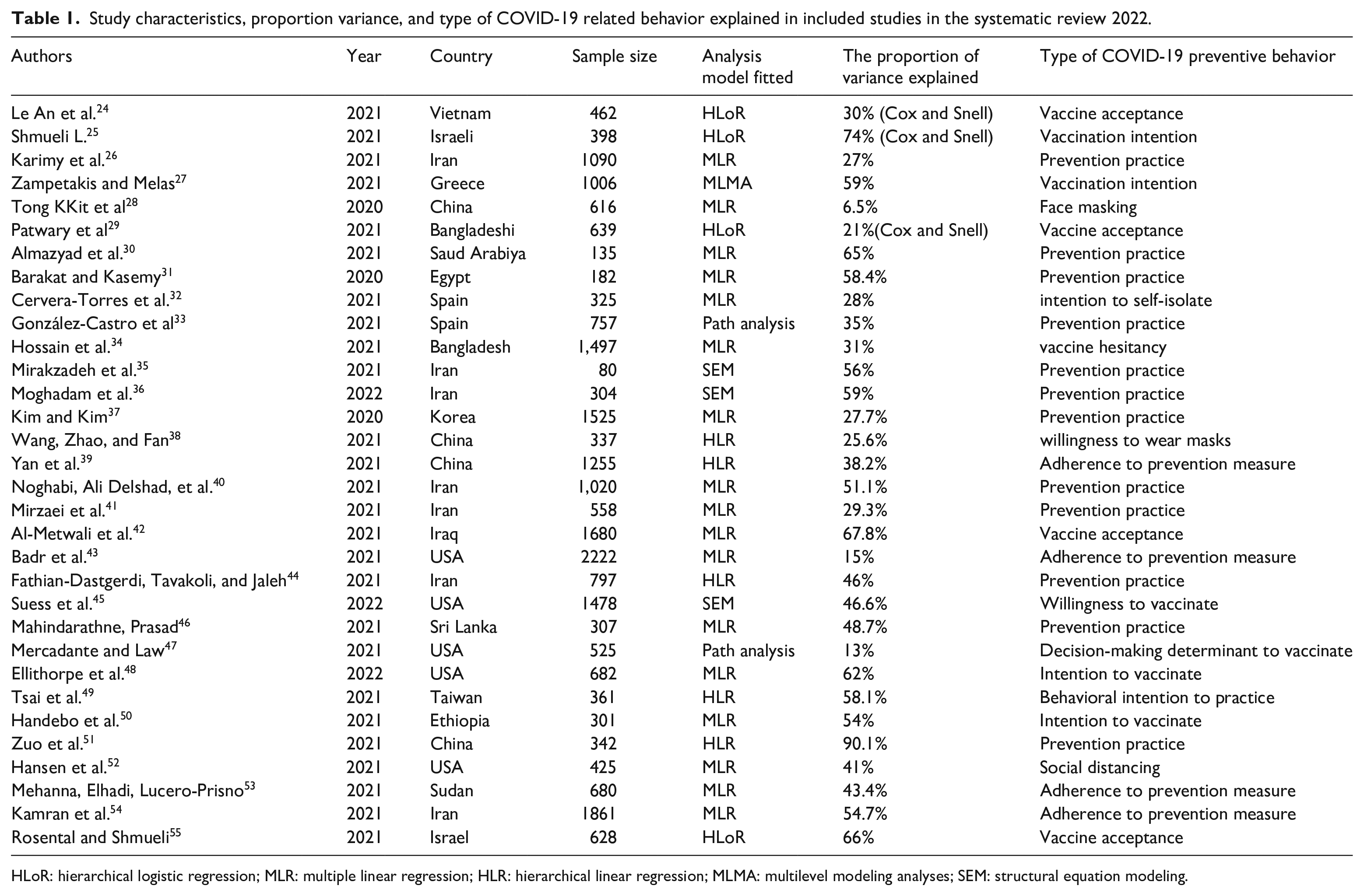
HLoR: hierarchical logistic regression; MLR: multiple linear regression; HLR: hierarchical linear regression; MLMA: multilevel modeling analyses; SEM: structural equation modeling.
Predicting ability of HBM in COVID-related behavior
Regarding the predictive ability of the HBM, in the majority 28 (87.5%) of the studies, HBM has a good predictive ability (R 2 > 25%) of COVID-19-related behavior.24 –27,30 –42,44 –46,48 –55 From this nearly half (43.7%) of the studies, HBM had explained 50% and above variance of COVID-19-related behavior and intention. Overall, the explained variance for HBM ranged from 6.5% to 90.1% (Table 1).
Frequency of statistically significant association of HBM constructs with COVID-19 preventive behavior
Knowing how frequently a certain factor predicts certain behavior is important to consider that factor when we plan to change the respective behavior. Included studies in this review incorporate those six key constructs of HBM in their analysis model as a predictor of respective behavior. Considering this, perceived susceptibility was significantly associated with COVID-19-related behavior in 19(59.4%) studies and it was the only construct that is not missed in all studies. From these, in three studies it was considered in combination with perceived severity as a perceived threat. Similarly, perceived severity significantly predicted COVID-19-related behavior in 12 (40%) of studies. In two studies it was not considered as a predictor.
Regarding perceived benefit, it was significantly associated with COVID-19-related behavior in 29(96.7%) of studies even if it was not included in two studies as a model construct. It is the most frequently significant predictor of COVID-19-related behavior and intention in this review since it was not significant only in a single study (higher significance ratio). Likewise perceived barrier significantly predicted COVID-19-related behavior in 16 (64%) of the studies and it was not considered as a model construct in 7 studies.
Concerning self-efficacy, it was a significant predictor of COVID-19-related behavior in 14(87.5%) studies. Although it was missed in half of 16 included studies as a model construct, it is the second most frequently associated construct of HBM with COVID-19-related behavior. Similarly, cues to action were significantly associated with COVID-19-related behavior in 13 (72.2%) studies and it was not considered as a model construct in nearly half 14 studies (Table 2).
Significance ratio of HBM constructs with COVID-19-related behavior of each included studies in the systematic review 2022.

b: unstandardized coefficient; β: standardized coefficient; NI: not included; Ps; Perceived susceptibility; –means nonsignificant.
Discussion
Psychological theories significantly contribute to the planning and design of effective public health and health promotion interventions. 16 This is particularly true in the current environment where public health officials need insights into effective COVID-19 responses, which has severely impacted many aspects of individuals’ lives across the globe. 56 There is also increasing evidence that protective behaviors are culturally molded, requiring a focused examination of perceptions and behaviors using verified and practically supported frameworks. 57 One of the important frameworks was HBM which we have been using for many health-related behaviors including COVID-19-related behavior and intention. In this review, we have focused on this important framework (HBM) to assess its predictive ability and how frequently its construct predicts the current COVID pandemic-related behavior in studies done all over the world.
We found that in the majority (87.5%) of the studies HBM has a good predictive ability of COVID-19-related behavior. From this, in half of the studies, HBM had explained 50% and above variance of COVID-19-related behavior and intention. The finding is consistent with a systematic review done on evaluating the effectiveness of the HBM in improving adherence by reviewing interventional studies. In that review, the majority (83%) of the HBM-based intervention studies achieved statistically significant improvements in adherence. 58 Overall, the explained variance for HBM ranged from 6.5% to 90.1%, which was comparable to a systematic review and meta-analysis on the effectiveness of HBM for mammography screening; the explained variance for HBM ranged from 25% to 89%. 59 This finding implies HBM had a significant predictive ability of COVID-19 preventive behavior and indicates the use of the model in designing an intervention to prevent and control the pandemic.
In this review, we have also examined the significant ratio of each six constructs of HBM with COVID-19 preventive behavior. The reason why we focus on the significance ratio of each construct is that knowing how frequently a certain variable or construct predicts certain behavior is important to consider the variable while we plan to change the respective behavior. Communication messages, as well as educational appeals, should target the factor that is frequently linked to the behavior. Concerning this perceived benefit was significantly associated with COVID-19 related behavior in almost all (96.7%) of studies. It was the most frequently significant predictor (highest significance ratio) of COVID-19-related behavior and intention. This finding was compliment with a systematic review and meta-analysis done on the effectiveness of HBM and the theory of planned behavior for mammography screening, in which the components of cues to action and perceived benefits were the variables most strongly associated with participation in mammography screening. 59 However, the significance ratio in the current review is slightly lower than a critical review on HBM-related investigations published during the period 1974–1984; in which the significance ratio of perceived benefit was 78%. 17 The possible discrepancy may be due to; the critical review was done for many different health behaviors which may lower the significance level of perceived benefit. In another way in the current review, perceived benefits (perceived importance of those COVID-19 prevention precautions) have great ability of predicting COVID-19 preventive behavior. This finding implies COVID-19 prevention behavior change intervention should address benefits of the prevention measures.
Self-efficacy, cues to action, perceived barrier, perceived susceptibility, and severity have 87.5%, 72.2%, 64%, 59.4%, and 40% significance ratios in this systematic review, respectively. This indicates self-efficacy was the second most frequent significant predictor of COVID-19-related behavior whereas perceived severity was the last significant predictor. This finding is compliment with a critical review of HBM-related investigations published during the period 1974–1984. 17 The finding implies COVID-19 behavior change intervention should target self-efficacy, important cues to action, individual perception of barriers, disease vulnerability, and severity in order of significance.
Restriction of our search strategy to the English language may limit our sample studies included in our review. Furthermore, variations in effect size that are reported by included primary studies restrict us from doing a meta-analysis to estimate pooled effect size rather we have focused on evaluating predicting ability of the HBM and identifying the most frequently associated construct of the model to COVID-19 preventive behavior.
Conclusion
HBM has a good predictive ability of COVID-19-related behavior in the majority of reviewed studies. This implies that HBM can explain COVID-19 preventive behavior by using its important components or constructs which increase its use in planning and designing an intervention to prevent and control the COVID-19 pandemic. To target our focus to the most frequently significant construct, we have evaluated the significance ratio of all constructs of HBM in the reviewed articles. Concerning this, perceived benefit was the most frequently significant predictor (highest significance ratio) of COVID-19-related behavior and intention. Self-efficacy, cues to action, perceived barrier, perceived susceptibility, and severity were the remaining significant predictor of COVID-19-related behavior in decreasing order of significance ratio. Public health professionals and health promotion experts should consider those constructs of HBM in order of significance while they plan and design behavior change interventions.
Supplemental Material
sj-docx-1-smo-10.1177_20503121221113668 – Supplemental material for The health belief model’s ability to predict COVID-19 preventive behavior: A systematic review
Supplemental material, sj-docx-1-smo-10.1177_20503121221113668 for The health belief model’s ability to predict COVID-19 preventive behavior: A systematic review by Amare Zewdie, Ayenew Mose, Tadesse Sahle, Jemal Bedewi, Molla Gashu, Natnael Kebede and Ali Yimer in SAGE Open Medicine
Supplemental Material
sj-docx-2-smo-10.1177_20503121221113668 – Supplemental material for The health belief model’s ability to predict COVID-19 preventive behavior: A systematic review
Supplemental material, sj-docx-2-smo-10.1177_20503121221113668 for The health belief model’s ability to predict COVID-19 preventive behavior: A systematic review by Amare Zewdie, Ayenew Mose, Tadesse Sahle, Jemal Bedewi, Molla Gashu, Natnael Kebede and Ali Yimer in SAGE Open Medicine
Footnotes
Acknowledgements
We would like to thank all authors of the primary studies which are included in this systematic review.
Authors’ contributions
A.Z. conceived the idea and participated in data extraction, analysis, and draft writing. A.M., T.S. M.G., J.B., N.K., and A.Y. participated in the analysis, preparation of the manuscript, and revision. All authors read and approved the final version of the manuscript to be considered for publication.
Availability of data and materials
The data set analyzed during the current study is available from the cross-pondering author on reasonable request.
Declaration of conflicting interests
The author(s) declared no potential conflicts of interest with respect to the research, authorship, and/or publication of this article.
Funding
The author(s) received no financial support for the research, authorship, and/or publication of this article.
Institutional review board statement
This systematic review used and analyzed information obtained from pre-existing studies

Supplemental material
Supplemental material for this article is available online.
References
Supplementary Material
Please find the following supplemental material available below.
For Open Access articles published under a Creative Commons License, all supplemental material carries the same license as the article it is associated with.
For non-Open Access articles published, all supplemental material carries a non-exclusive license, and permission requests for re-use of supplemental material or any part of supplemental material shall be sent directly to the copyright owner as specified in the copyright notice associated with the article.
