



Abstract
Objective:
Antimicrobial resistance is one of the serious threats in the world, including Ethiopia. Even though several studies were conducted to estimate common bacteria and their antibiotic-resistance profile in Ethiopia, it is difficult to estimate the overall resistant patterns due to the lack of a nationwide study. This systematic review aimed to determine the prevalence of gram-negative bacteria isolates and their antibiotic-resistance profile among pediatrics patients in Ethiopia.
Methods:
A web-based search using PubMed, EMBASE, Science Direct, the Cochrane Database for Systematic Reviews, Scopus, Hinari, Sci-Hub, African Journals Online Library, and free-text web searches using Google Scholar was conducted from August to September 16, 2021. Each of the original articles was searched by Boolean search technique using various keywords and was assessed using the Joanna Briggs Institute Critical Appraisal Checklist. The data were extracted using Microsoft Excel format and exported to STATA 14.0 for statistical analyses.
Results:
The database search delivered a total of 2,684 studies. After articles were removed by duplications, title, reading the abstract, and assessed for eligibility criteria, 19 articles were included in the systematic review. Of a total of 1372 (16.77%) culture-positive samples, 735 (53.57%) were gram-negative. Escherichia coli was the most frequently isolated bacteria followed by Klebsiella species, 139/1372 (10.13%), and 125/1372(9.11%), respectively. More than 66.67% of isolates were resistant to ampicillin except for Neisseria meningitidis which was 32.35% (11/34). Pseudomonas aeruginosa, Klebsiela species, and Citrobacter species were 100% resistance for cefepime. Haemophilus influenzae was 100% resistant to meropenem. Salmonella species were 93.30%, 78.26%, and 63.64% resistant to tetracycline, chloramphenicol, and cotrimoxazole, respectively.
Conclusion:
Gram-negative bacteria were identified as the common pathogen causing infection in pediatrics and the level of resistance to commonly prescribed antibiotics was significantly higher in Ethiopia. Culture and susceptibility tests and well-designed infection control programs are important measures.
Introduction
Infectious diseases including bacterial infections are the leading causes of childhood mortality, particularly in developing countries.1,2 Even though the introduction of broad-spectrum antibiotics has been made over the last 70 years, the mortality and morbidity rate due to these life-threatening pathogens remains high. This is because of the increment of antibiotic resistance to gram-negative bacteria. 3
Antimicrobial resistance (AMR) is one of the serious threats to global public health; it affects the ability to treat the infection effectively and puts patients at risk of prolonged illness, complications, and death. It is estimated that 700,000 people die annually as a result of AMR, and this figure will rise to 10 million by 2050 if no action is taken. 4 AMR has drastically amplified due to the irrational prescribing and/or inappropriate use of antibiotics, and limited availability of reliable laboratories, particularly blood culture, in areas far from hospitals. These factors lead to compromised care, outdated antibiotic guidelines, and the emergence of resistance.3,5
Effective empirical therapy of bacterial diseases in the pediatrics population requires knowledge of local AMR patterns, acquired through up-to-date surveillance.6,7 Understanding the prevalence of common pathogens is essential for definitive antibiotic therapy and reduces exposure of non-involved bacterial pathogens to unnecessary antibiotics. 8 The World Health Organization (WHO) released a list of antibiotic-resistant priority pathogens to combat the AMR crisis, to promote the development of new antibiotics, and advocate rational use of the available ones. The majority of these microorganisms are gram-negative bacteria. 9 Gram-negative bacteria are common cause of different human infectious diseases, such as urinary tract infections, wound infections, gastroenteritis, ear infection, meningitis, septicemia, and pneumonia.10–14
Different studies conducted in the various areas of the world showed that there is a high burden of gram-negative resistance strains of bacteria to available antibiotics which compromise the success of various surgical procedures, cancer chemotherapy, and the treatment of many infections.15–18 In addition, due to the presence of the outer layer envelope, gram-negative bacteria are more resistant to antibiotics than gram-positive bacteria. 19 Currently, there is one published review on the patterns of antibiotic resistance to gram-negative bacteria in Ethiopia. 8 However, the study was conducted regardless of age classification and samples only from wound infection. Therefore, this systematic review aimed to synergize the previous work by determining the resistance patterns of gram-negative bacteria among pediatrics patients isolated from different clinical specimens in the country.
Objective
This systematic review aimed to determine gram-negative bacteria isolates and their antibiotic-resistance patterns among pediatrics patients in Ethiopia.
Method
Search strategy
This systematic review was conducted in compliance with Reporting Items for Systematic Reviews and Meta-Analyses (PRISMA, 2009) 2 (Supplemental file 3). The comprehensive search for studies was done by two (BK and WY) of the authors from August to September 16, 2021. PubMed, EMBASE, Science Direct, the Cochrane Database for Systematic Reviews, Scopus, Hinari, Sci-Hub, African Journals Online Library, and free-text web searches using Google Scholar were searched for articles. First, articles were searched by examining the full title (“gram-negative bacteria isolates and their antibiotic-resistance patterns among pediatrics patients in Ethiopia”) and then keywords (bacterial infection, bacteria prevalence, drug resistance, antibiotic resistance, antimicrobial susceptibility, pediatric patients, Ethiopia). The specific name of each common gram-negative bacteria including Klebsiella pneumoniae, P. aeruginosa, Haemophilus influenzae (H. influenzae), Shigella species, Salmonella species, Acinetobacter species, Citrobacter species, Neisseria meningitidis(N. meningitidis), and Enterobacter species were also used as searching terms. These keywords were used separately and in combination using Boolean operators “OR” or “AND” as well as medical subject heading [MeSH] terms). In addition, we searched from the reference lists of all the included studies (snowball technique) to identify any other studies that may have been missed by our search strategy. All searches were limited to articles written in the English language. AMR was defined as the resistance of an isolated pathogen to the antibiotic tested using a standardized antimicrobial susceptibility-testing model such as the agar diffusion test or other standardized methods for determining the minimum inhibitory concentration (MIC) of the isolate.
Study selection criteria
To minimize selection bias, all possible relevant articles were evaluated critically and that meet the inclusion criteria were selected. All available studies and data were incorporated based on the following predefined eligibility criteria.
Inclusion criteria
Exclusion criteria
We excluded studies limited to tuberculosis infections. Furthermore, reviews and systematic review articles, case reports, case series, and articles which were only available in abstract form were excluded. If multiple publications were reported with the same authors and findings; only the most recent or most complete publication for each data set for a specific outcome was selected. In addition, Intermediate susceptible strains were excluded from this study.
Data extraction
Essential data were extracted from eligible studies using Microsoft Excel spreadsheet format. Data were extracted by two of the authors (BK and WY) independently to enhance the quality and methodological validity. A standard extraction format adapted from the Joanna Briggs Institute (JBI) data extraction form was used to extract data. 20 The following information was identified for data extraction: The last name of the first author, year of publication, the region of the study conducted, study design and period, age of patients (years), site of clinical specimen obtained, total sample size, number of cultures positive sample, the number of gram-negative bacteria species isolated and antibiotic-resistance pattern. Any inconsistencies in the data extraction process were decided through discussion involving all authors.
Outcome measure
The main outcome of this systematic review was the patterns of antibiotic resistance for isolated gram-negative bacteria. The second outcome was the prevalence of isolates gram-negative bacteria.
Article quality assessment
The quality assessment was accompanied by two reviewers independently according to the critical appraisal checklist recommended by the JBI (20). Moreover, the disagreements were resolved by consensus and decided by taking the average score of the two reviewers. The JBI checklist was composed of 10 questions, the scores ranged from 0 to 10. The studies which obtained more than 60% were considered as good-quality studies. All of them had good quality and were included in the present systematic review.
Statistical analysis
The data were extracted using Microsoft Excel 2010 format and exported to STATA version 14.0 for further analysis. Frequency and percentages were computed using descriptive statics. Percent (%) of culture-positive = number of culture-positive divide by sample size from each specimen (N/n) ×100; percent (%) bacterial isolate = number of isolates bacteria divide by number of culture-positive (n) ×100. The extracted data were standardized to a prevalence of resistance, defined as the percentage of isolates being resistant out of the total number of isolates tested for the specific drug. Meta-analysis was not conducted because of the large variability in AMR methodology, geographical region, and a specimen was collected from a different site. A meta-analysis within each of the geographical regions was considered but rejected based on having too few studies for most of the pathogen–antimicrobial drug combinations per region. Since the number of studies from regions was small, they were combined and a percentage of resistance was generated.
Result
Characteristics of studies included in the analysis
In total, 2,684 articles were identified. After articles were removed by duplications, title, and reading the abstract, 114 studies were assessed for eligibility criteria. Consequently, 95 articles were excluded due to different reasons because they were irrelevant. Finally, a total of 19 studies met the inclusion criteria and were included in the final analysis (Figure 1). The articles were published between 2013 and 2021. Among the selected studies, two articles were unpublished (accepted article) which were obtained from the Addis Ababa University repository. Most of the studies (15/19, 78.95%) were cross-sectional studies, others were longitudinal or retrospective observational studies. Around one-third of the studies were conducted in Addis Ababa city (i = 7) followed by Amhara region (n = 6), Southern Nation, Nationalities, and People (n = 3), Oromia region (n = 1), Tigray region (n = 1), and 1 study was multicenter conducted at Addis Ababa, Amhara, and Oromia regional state (Supplemental file 1).

Flow diagram of literature search and study selection.
Bacterial isolated
Overall, 1372 (16.77%) culture-positive samples were analyzed in the selected studies. Of these, 210/362 (58.01%), 153/300 (51.00%), and 643/2268 (28.41%) clinical specimens were taken from ear discharge, throat swab, and blood, respectively. The smallest culture-positive samples were obtained from the cerebrospinal fluid (CSF) analysis (177/4050, 4.37%). Of the total culture-positive sample, 735 were gram-negative (735/1372, 53.57%). Among gram-negative bacterial species, E. coli was the most frequently isolated bacteria followed by Klebsiella species, 139/1372 (10.13%), and 125/1372(9.11%), respectively. E. coli was mostly isolated from urine culture (70/152(46.03%), whereas Klebsiella species were from blood culture 96/643(14.93%). Moraxella catarrhalis account for 3.35% (40/1372) isolation, and it was most common in throat swab culture 37/300(24.18%). The most common isolates in ear discharge culture were E. coli 18/210(8.57%) followed by P. aeruginosa 15/210 (7.14%), and H.influenzae 14/210(6.67%). Importantly, N. meningitidis, 36/4050(20.34%) was isolated only from CSF culture (Table 1).
Prevalence of isolated gram-negative bacterial.

CSF = Cerebrospinal fluid; K.P =Klebsiela pneumoniae; P.A = P. aeruginosa; K.S = Klebsiela species; H.I = Haemophilus influenzae; Sh.S = Shigella species; Sal.S = Salmonella species; Actin.S = Actinetobacter species; Citr.S = Citrobacter species; N. M = Neisseria meningitidis; Entr. S = Entrobacters species; M. Ca = Moraxella catarrhalis.
Antibiotic resistance for gram-negative bacteria
More than 66.67% of isolates were resistant to ampicillin except for N.meningitidis which was 32.35% (11/34). Similarly, more than 50% of isolated gram-negative bacteria were resistant to amoxicillin/clavulanate and cefoxitin. P. aeruginosa, Klebsiela species, and Citrobacter species were 100% resistance for cefepime. More than 60% isolated Klebsiella pneumoniae; P. aeruginosa, other Klebsiella species, Acinetobacter species, and Citrobacter species were resistant to ceftriaxone. Similarly, isolated Klebsiella species were resistant to ceftazidime (104/120, 86.67%), tetracycline (80/105, 76.19%), chloramphenicol (115/125, 92.00%), co-trimoxazole (118/125, 94.90%), gentamicin (105/121, 86.78%), and cefuroxime (17/24, 70.83%). H. influenzae was 100% resistant to meropenem.
Salmonella species were resistant to tetracycline (21/23, 93.30%), chloramphenicol (18/23, 78.26%), and cotrimoxazole (14/22, 63.64%). Acinetobacter species are also resistant to most of the tested antibiotics including ceftazidime (27/36, 75.00%), cefepime (13/16, 81.25%), chloramphenicol (27/37, 72.97%), and co-trimoxazole (32/36, 88.89%). Moraxella catarrhalis was 80.43% (37/46) resistant to erythromycin. Ciprofloxacin had the lowest resistance (<50%) for all tested gram-negative bacteria even though still increase resistance to Klebsiella species (61/125, 48.8%) and N.meningitidis (9/28, 32.14%) (Table 2, Supplemental file).
Resistance patterns of isolated organisms to all tested antibiotics.
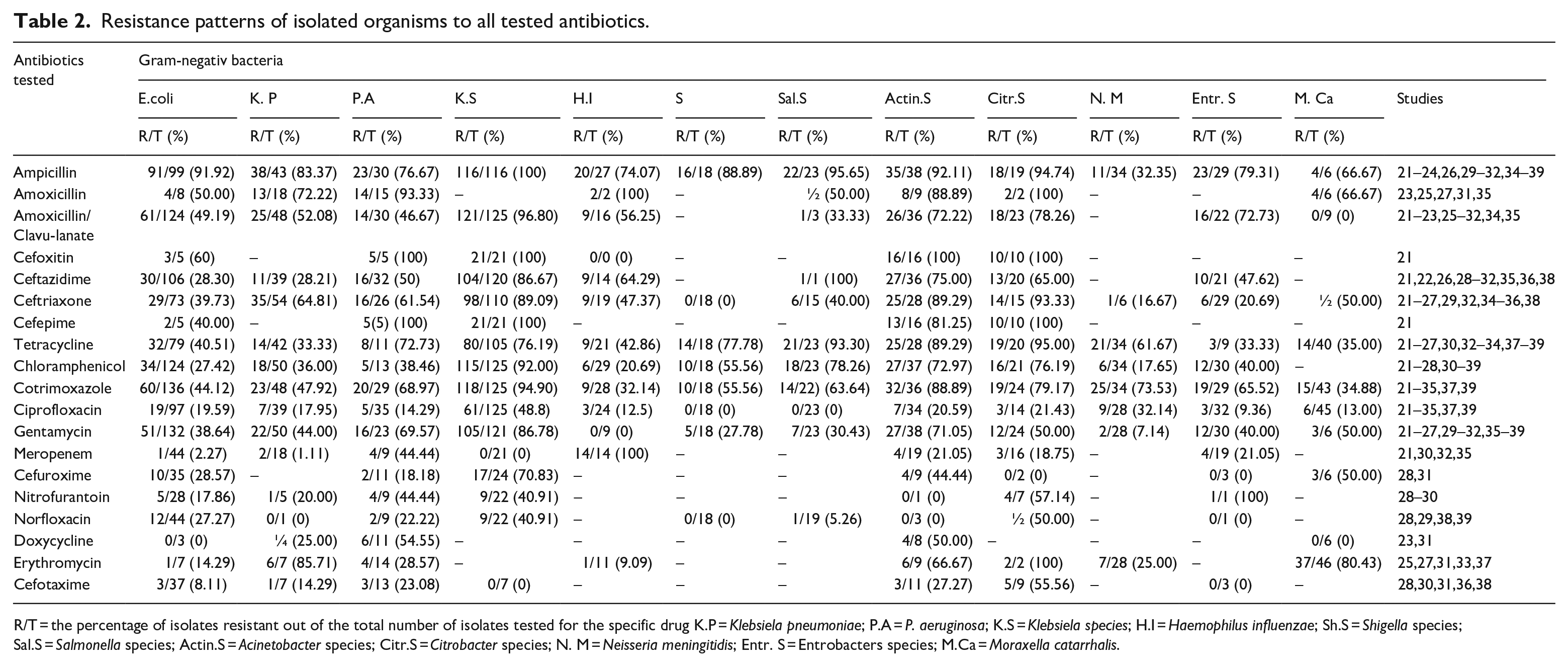
R/T = the percentage of isolates resistant out of the total number of isolates tested for the specific drug K.P = Klebsiela pneumoniae; P.A = P. aeruginosa; K.S = Klebsiela species; H.I = Haemophilus influenzae; Sh.S = Shigella species; Sal.S = Salmonella species; Actin.S = Acinetobacter species; Citr.S = Citrobacter species; N. M = Neisseria meningitidis; Entr. S = Entrobacters species; M.Ca = Moraxella catarrhalis.
Discussion
The overall prevalence of gram-negative bacteria isolated from various clinical samples (blood, urine, ear discharge, throat swab, CSF, and stool) from pediatrics patients was 53.75%. This is similar in studies from China, where 59.8% of the isolates were gram-negative bacteria, 40 and Pakistan, 55.7%. 41 However, it was lower than studies from low- and middle-income countries (63.9%), in Egypt (65.3%), and at Kigali, Rwanda (68.3%).42–44 The sources and numbers of the clinical samples collected, type of infections, types of patients, and geographical differences might be the cause of variation in the overall prevalence of gram-negative bacteria. The most frequent isolated gram-negative bacteria were E. coli, 139/1372 (10.13%), and Klebsiella species, 125/1372(9.11%), which were mostly isolated from urine and blood culture, respectively. The results were closed similarly with studies done in University Hospital of Leipzig, Germany, and Nepal.45,46 This might be due to the proximity of the anal opening to the urethra as E.coli resides as commensals in the gastrointestinal tract. In contrast, a study conducted in Iran explained that the most common isolated bacteria were Acinetobacter species and E.coli, each account for 5.9%, isolated gram-negative bacteria. 1 Moraxella catarrhalis account for 3.35% of gram-negative bacteria isolated which was most predominantly isolated from the throat swab culture. Other similar systematic reviews conducted in Australia showed that H. influenzae (23.1%) and Moraxella catarrhalis (7.0%) are the most common bacteria associated with acute otitis media globally. 47 This is because Moraxella catarrhalis is the most prevalent organism responsible for sinusitis, and acute otitis media among the pediatrics age group. 48 P. aeruginosa was common in-ear discharge, 15/210 (7.14%), secondary to E.coli. A study conducted in Sudan explained that P. aeruginosa was the second commonest isolated organism, accounting for 19% of cases from 38% of gram-negative bacteria. 49 It is the fourth leading cause of hospital-acquired infections, the second most common cause of pneumonia, and the third most common gram-negative cause of bloodstream infection. 50 N.meningitidis was isolated only from CSF culture 36/4050(20.34%). This agrees with the results of previous studies in the United States of America, Palestinian, and Iran, which was the third most common cause of acute bacterial meningitis in pediatrics following Streptococcus pneumoniae and H. influenzae type b.2,9,18
Our finding showed that the proportion of antibiotic resistance to gram-negative was ranging from 0% to 100%. In general, a high resistance rate was observed to the commonly prescribed antimicrobials. Except, N. meningitidis which was 32.35%, more than 66.67% of isolates were resistant to ampicillin. This result was similar to reports from Iran, where the resistance patterns of gram-negative bacteria to ampicillin were 80%. 51 Similarly, a Pakistan report showed that the isolated gram-negative bacteria exhibited a high resistance rate to cephalosporin, 70% of E.coli, and 80% of Klebsiella pneumoniae. 41 P. aeruginosa, Klebsiella species, and Citrobacter species were 100% resistant to both cefoxitin and cefepime. They were also 50.00–93.33% resistant to ceftazidime and ceftriaxone in our finding. Higher resistance rates of these bacteria could be considered as great threats and alarm the stakeholders to have more surveillance and control of the use of antimicrobials to combat infection.10–12
Klebsiella species was the most predominant resistance bacteria which were resistant for the majority of tested antibiotics except meropenem and cefotaxime which were 100% susceptible. The result was in line with other similar studies conducted in the world.15,45 In contrast, the study conducted at Cairo University Children Hospital, Egypt showed that Klebsiella had the highest susceptibility to levofloxacin (53%) but 94% resistance to meropenem. 43
Tetracyclines, chloramphenicol, and cotrimoxazole are commonly used medications to treat Salmonella infection in Ethiopia.39,52 However, finding from this review indicated that Salmonella species were 93.30%, 78.26%, 63.64% resistant to tetracycline, chloramphenicol, and cotrimoxazole, respectively. These might be due to the overuse of these antibiotics in developing countries because of easy availability and low cost. Moreover, irrationally prescriptions as empirical treatment options and over-the-counter use of these antibiotics are also common.13,52 H influenzae was 100% resistant to meropenem. This will be challenged for future antibiotics therapy, since this drug is the last alternative for use when gram-negative bacteria are resistant to other commonly used antibiotics. Ciprofloxacin had the lowest resistance (<50%) for all tested gram-negative bacteria. This finding was supported by the study done in Sudan, where 100% sensitive for P. aeruginosa, Klebsiella pneumoniae, E. coli, and Citerobacte species. 49 The possible justification might be because of the decrement of self-medication and discriminate use of ciprofloxacin as per WHO recommendation fluoro-quinolones reserved for treatment of multidrug-resistant tuberculosis developing countries. 53
The limitations of this review; this systematic review provides useful information about the current status of antibiotic resistance among isolated bacteria among pediatrics patients. Besides, the review provides insight into the magnitude of the problem at the national level to help policymakers to design effective infection control programs and antibiotics use strategies to combat the antibiotics resistance burden in Ethiopia. The limitations of this review include there may be data not accessible by our search and therefore larger antibiotics resistance trends might have been missed. In addition, in Ethiopia antibiogram documentation habit is so poor, we may miss data related to drug resistance. Resistance data were obtained from different specimens, laboratory methodologies, disk diffusion methods, and different clinical and laboratory standard guidelines; these may have an impact on the variation in bacterial isolates and antibiotic resistance. Therefore, resistance rates shown in this review should be interpreted with caution due to the variable nature of the methodologies used for susceptibility testing in the publications that were combined to calculate the rates shown.
Conclusion
The current systematic review indicated that gram-negative bacteria were identified as the common pathogen causing infection in pediatrics patients. E. coli and Klebsiella species were the two leading gram-negative bacterial species. Moraxella catarrhalis was considerably common in throat swab culture, while N.meningitidis were still prevalent in a central nervous system infection.
The rate of AMR to gram-negative bacteria was significantly higher in Ethiopia. P. aeruginosa, Klebsiella species, and Citrobacter species were 100% resistant to both cefoxitin and cefepime and also more than 50% resistant for ceftazidime and ceftriaxone. H. influenzae was 100% resistant to meropenem. Salmonella species were also highly resistant to commonly used antibiotics including tetracycline, chloramphenicol, and co-trimoxazole. Culture and susceptibility tests, regular AMR surveillance, and well-design infection control program are important measures. In addition, strong policy, a national guideline for appropriate use of antibiotics in the health institutions and drug vendors should also be important to reduce the antibiotics resistance crisis. Furthermore, creating community awareness to control infection and rational use of drugs is another targeted area. In addition, in this finding, meropenem is 100% resistant to H. influenzae. This result should be confirmed by retesting the susceptibility of isolates using a large sample size, in different health care institutions.
Supplemental Material
sj-doc-3-smo-10.1177_20503121221094191 – Supplemental material for Gram-negative bacteria isolates and their antibiotic-resistance patterns among pediatrics patients in Ethiopia: A systematic review
Supplemental material, sj-doc-3-smo-10.1177_20503121221094191 for Gram-negative bacteria isolates and their antibiotic-resistance patterns among pediatrics patients in Ethiopia: A systematic review by Bekalu Kebede, Wubetu Yihunie, Dehnnet Abebe, Bantayehu Addis Tegegne and Anteneh Belayneh in SAGE Open Medicine
Supplemental Material
sj-xlsx-1-smo-10.1177_20503121221094191 – Supplemental material for Gram-negative bacteria isolates and their antibiotic-resistance patterns among pediatrics patients in Ethiopia: A systematic review
Supplemental material, sj-xlsx-1-smo-10.1177_20503121221094191 for Gram-negative bacteria isolates and their antibiotic-resistance patterns among pediatrics patients in Ethiopia: A systematic review by Bekalu Kebede, Wubetu Yihunie, Dehnnet Abebe, Bantayehu Addis Tegegne and Anteneh Belayneh in SAGE Open Medicine
Supplemental Material
sj-xlsx-2-smo-10.1177_20503121221094191 – Supplemental material for Gram-negative bacteria isolates and their antibiotic-resistance patterns among pediatrics patients in Ethiopia: A systematic review
Supplemental material, sj-xlsx-2-smo-10.1177_20503121221094191 for Gram-negative bacteria isolates and their antibiotic-resistance patterns among pediatrics patients in Ethiopia: A systematic review by Bekalu Kebede, Wubetu Yihunie, Dehnnet Abebe, Bantayehu Addis Tegegne and Anteneh Belayneh in SAGE Open Medicine
Footnotes
Acknowledgements
The authors thank the Debre Markos University Information Technology Directorate.
Author contributions
B.K. and W.Y. participated in data extraction, the database search, screening, and quality assessment: B.K., W.Y., D.A., B.A., and A.B. contributed to data analysis, drafting, or revising the article. All authors read and approved the final article.
Availability of data and materials
All relevant data are within the article and its supporting information files.
Declaration of conflicting interests
The author(s) declared no potential conflicts of interest with respect to the research, authorship, and/or publication of this article.
Funding
The author(s) received no financial support for the research, authorship, and/or publication of this article.

Supplemental material
Supplemental material for this article is available online.
References
Supplementary Material
Please find the following supplemental material available below.
For Open Access articles published under a Creative Commons License, all supplemental material carries the same license as the article it is associated with.
For non-Open Access articles published, all supplemental material carries a non-exclusive license, and permission requests for re-use of supplemental material or any part of supplemental material shall be sent directly to the copyright owner as specified in the copyright notice associated with the article.
