




Abstract
Older age cohorts have been found to exhibit both less interest and less use of digital technologies than younger cohorts, which suggests that they may be less flexible in comparison to younger technology users. However, frequency is not the only differentiating factor between age groups in the context of mobile technology use, as the specific ways in which technologies are used also play a significant role in the daily lives of older adults (65+). Drawing on the selective optimization with compensation (SOC) model, we ask what strategies older adults use to enhance their subjective well-being when using mobile technologies. The thematic analysis is based on 20 elicitation interviews conducted in Central Finland in 2018. Our findings suggest that mobile technologies can act as both a tool to enhance well-being and a source of problems for older adults, and that older adults show considerable creativity in navigating various mobile, digital and non-digital strategies. Furthermore, we argue that these evolving, and thus also in this sense mobile, strategies contribute to the subjective well-being and successful ageing of older adults by providing them with “workarounds” to manage mobile technologies to their benefit.
Keywords
Introduction
The utilization of digital technologies has been demonstrated to augment psychosocial well-being, mitigate stress, alleviate feelings of social isolation, and enhance social support, collectively resulting in an elevated level of life satisfaction, enjoyment, and convenience (Chiribuca & Teodorescu, 2020; Joshi et al., 2020). In the context of successful ageing, however, digital technologies can act as both a driving force and a source of social exclusion regarding the subjective well-being of older adults and digital society at large. In fact, considering the relatively low frequency of digital, and especially mobile, technology use in later life (Friemel, 2016; Nimrod, 2017), alongside the demographic shift towards an ageing population and the rapid advancement of mobile technologies, such as smartphones and tablets, there is a notable decline in technology use in later life compared to younger age cohorts (Jacobetty & Fernández-Ardèvol, 2017; Schulz et al., 2015).
A substantial proportion of previous studies (Charness & Boot, 2009; Chee, 2024; Vaportzis et al., 2017) on both mobile and digital technology use by older adults have concentrated on the constraints that this age group encounters when using and adopting various technologies. However, less attention has been paid to the ways in which older adults actively manage mobile technologies in their everyday lives (Sun et al., 2016). Moreover, as Li et al. (2022) observe, numerous studies on the utilization of mobile technologies by older adults tend to focus on the affordances of technologies in terms of how individuals employ a given device, such as a smartphone, to achieve specific objectives or to address design issues. A limitation of this approach is that many mobile and digital devices, applications, and services are used in conjunction with one another rather than independently and are accompanied by non-digital strategies for negotiating both mobile and other digital technologies in later life.
Despite the growing body of research on the impact of mobile technologies on the subjective well-being and successful ageing of older adults, the findings remain inconclusive (Forsman et al., 2018; Li et al., 2022; Nimrod, 2020; Ren & Klausen, 2024). According to the selective optimization with compensation (SOC) model initially proposed by Paul and Margret Baltes (Baltes & Baltes, 1990; Freund, 2008), successful ageing is a lifelong process of maximizing gains and minimizing losses through overlapping processes or strategies of selection, optimization, and compensation. This study aims to gain a more nuanced understanding of the complexity of the creative strategies through which older adults engage or do not engage with various mobile technologies to their advantage within the context of both digital and non-digital workarounds and how mobile technologies contribute to their well-being in later life. Thus, in this study, we ask what strategies older adults use to enhance their subjective well-being when using mobile technologies.
In addition to the heterogeneity of older adults as mobile technology users, it is also necessary to recognize the heterogeneity of mobile technology use in later life. Hänninen et al. (2023a) refer to this distinction through the concept of digital repertoire, which is unique to each technology user, including older adults, and is constructed in and through practices that rely on personal interests, needs, skills, social networks, and access to technology. According to Schwarzenegger (2020), the significance of the idea of repertoire should be understood in terms of how older adults attach meaning to digital technologies. Thus, rather than being based on pragmatic decision making, digital repertoires are “a set of meaningful practices” (Hasebrink & Domeyer, 2012), closely linked to the social connections and the life transitions in older adults’ daily lives. In this perspective, not using a given technology, whether a mobile device, an app, or a service, can be a medium for older adults to articulate their expertise about their daily lives and attribute new meaning to those technologies they decide to use or not use (Fernández-Ardèvol et al., 2019). Furthermore, although previous studies (e.g., Hernández-Encuentra et al., 2009) suggest that mobile technologies can play a compensatory role in SOC processes in later life, less focus has been bestowed upon how the use of various mobile technologies reflects the SOC strategies and consequently subjective well-being and successful ageing in later life (Nimrod, 2020; Szabo et al., 2019).
Theoretical framework
The SOC model in digital environments
The SOC model (Baltes & Baltes, 1990; Wilson-Nash et al., 2023) describes how individuals maximize gains and minimize losses in response to everyday challenges and the changes associated with ageing. It portrays the late stage of life as a satisfying period during which older adults make decisions and manage their daily lives through selection, optimization, and compensation (Sun et al., 2016). Although SOC is not limited to older adults and rather underscores the idea of ageing as a lifelong phenomenon, it is amplified in old age due to the loss of biological, cognitive, and social resources (Baltes & Baltes, 1990). Furthermore, SOC emphasizes the importance of prioritizing goals (selection) according to their importance in increasing gains (optimization) and avoiding losses (compensation) with regard to available resources (Freund, 2008).
The concept of selection is not solely associated with a reduction in the number of high-efficacy domains or areas of life (Baltes & Baltes, 1990), but rather encompasses the emergence of novel and transformed domains and life goals. For instance, an older adult who was once an avid smartphone user may switch to using a feature phone or a tablet due to declining eyesight. The category of “selection” is used to describe the goal-oriented prioritization of activities and is classified into two categories: elective selection, which entails the deliberate choice of the more important activities and avoidance of the less important activities; and loss-based selection, which refers to seeking substitutes to compensate for some lack of functionality (Li et al., 2022). The second category of optimization reflects the view that people engage in behaviors to enrich and augment their general resources and to maximize their chosen life courses with regard to quantity and quality (Baltes & Baltes, 1990). In short, optimization involves acquiring and applying resources, including the application of resources in specific domains (Baltes & Carstensen, 1996; Li et al., 2022). As with selection, the third category of SOC, compensation, results from restrictions in the range of individuals’ adaptive potential and becomes operative when specific behavioral capacities are lost or reduced in terms of adaptive potential (Baltes & Baltes, 1990). Consequently, in practice, compensation involves the identification of alternative approaches, the utilization of assistive technologies, and social support to maintain effective and satisfying involvement when specific goal-relevant means are no longer available (Baltes & Carstensen, 1996; Nimrod, 2020).
From a digital point of view, older adults who are avid users of mobile technologies tend to select new devices, applications, and services when they find these technologies to be in line with their life goals (Hänninen et al., 2018; Joshi et al., 2020). In contrast, technologies that are perceived as lacking benefits and as costly are less likely to be adopted (Hänninen et al., 2023b). However, as Li et al. (2022; Lifshitz et al., 2018) point out, smartphones and other mobile devices can be employed for elective selection and optimization, with the aim of enhancing well-being, as well as loss-based selection of smart assistive devices that provide functional compensation for everyday well-being. Gallistl et al. (2021; Rasi-Heikkinen & Doh, 2023) discuss this issue in the context of the use and non-use of digital technologies in later life, pointing out that they should not be seen as binary opposites, but rather as an active process of “doing,” which refers to an ensemble of avoidance, use, and appropriation practices that older adults engage with in their everyday lives.
Subjective well-being and successful ageing in the digital age
Rowe and Kahn (1987) define successful ageing as low risk of disease and disease-related disability with high-level physical, psychological, and social functioning and active engagement with life. Based on the SOC framework, previous studies on digital technologies and ageing have focused on the integration of digital technologies into SOC strategies, including the reduced selection of mobile applications to meet the diverse needs of older adults (Li et al., 2022). The reasons why older adults use mobile technologies range from emotional communication and access to information to pleasure and self-actualization, all of which contribute to subjective well-being in later life (Ren & Klausen, 2024). However, as noted above, the relationship between mobile technology use and subjective well-being remains inconsistent, particularly in terms of the type of use. Elhai et al. (2017; Rosenberg & Taipale, 2022) suggest that social uses of mobile technologies are associated with greater subjective well-being in later life, and that specific types of social uses of these technologies, such as networking, messaging, phone calls, and maintaining social relationships, are more relevant than others for enhancing the well-being of older adults.
Unlike objective measures, which refer to observable conditions such as gender, income, and health, definitions of subjective well-being typically exclude objective conditions, although these may influence self-reported assessments of well-being (Betlej, 2023; Nimrod, 2020). As a parallel concept, life satisfaction is an indicator of subjective well-being, which refers to an individual's cognitive self-assessment of their daily life, as well as successful ageing and interaction with technologies (Özsungur, 2019). Smart technologies may also support ageing in place, which may further enhance well-being in later life.
Although the SOC model was developed before the emergence of contemporary mobile technologies, it remains a valuable framework for understanding the correlations between various mobile, other digital, and non-digital strategies and their association with the subjective well-being of older adults. Mobile technologies can be seen as an integral part of older adults’ resources, promoting successful ageing through selective optimization with compensation (Baltes & Baltes, 1990).The main idea of successful ageing, which also touches on concepts such as “vital ageing,” “active ageing,” or “productive ageing,” is that later life can be a time of sustained health and vitality in which older adults contribute to society rather than just a time of compromised health and dependency (Martin et al., 2015).
More critically, it can be argued that the concept of successful ageing places too much emphasis on individual choices to engage with mobile technologies. According to Katz and Calasanti (2015; Lamb, 2014), the idea that successful ageing can be reduced to minimizing decline in physical and cognitive health or social connections shows too little of both the social forces that influence success and older adults’ definitions of it regarding social inequality. As Fernández-Ardèvol et al. (2019) point out, it is critical to understand both how digital technologies are contextualized and made meaningful in later life and the interplay between users, technologies, and social change. In line with Baltes and Baltes (1990), Nimrod (2020) proposes that successful ageing can be defined as the process of making the most of one's resources and capabilities, rather than striving to achieve a specific objective level of functioning.
Mobile technology use among Finnish older adults
Finland ranks as a global leader in digitalization and digital skills, as highlighted by the International Digital Economy and Society Index (iDESI) (European Commission, 2022). For instance, in 2023, 73% of Finns aged between 64 and 74 searched for information on public authorities’ websites, compared to just 36% in the same age group across Europe (Eurostat, 2024). Finns are prolific users of digital technologies, with 84% of individuals aged 16–89 utilizing the internet on their mobile phones, 69% on laptops, 39% on tablets, and 31% on computers in 2021 (Official Statistics of Finland [OSF], 2021). It is notable that internet use among older adults is significantly lower across all devices (OSF, 2021). Just over two-thirds of those aged between 65 and 74 and less than one-third of those aged between 75 and 89 use the internet on their mobile phones (OSF, 2021). In 2021, among individuals aged 75 and above, the use of laptops for internet access was more prevalent than mobile phones (OSF, 2021). However, there has been a notable increase in the use of smartphones among older adults over recent years. In 2023, 82% of those aged between 65 and 74 and 49% of those aged between 75 and 89 had a smartphone (OSF, 2023). Nevertheless, older adults tend to utilize their mobile devices less actively than younger adults to access the internet (OSF, 2023).
Research data and methods
Data collection and participant-induced elicitation
The research material comprises 20 participant-induced elicitation (PIE) interviews, including one pair interview, conducted before the COVID-19 pandemic in November and December 2018 in Central Finland. The participants were recruited from a housing association that provides communal living services to adults aged 55 and older. The 21 participants we focus on in this study were aged between 65 and 89 years. The retirement age in Finland is between 63 and 68 years (Finnish Centre for Pensions, 2021), while 65 is the general retirement age in European Union countries. Thus, 21 out of the 23 interviewees were included in the analysis. Of the interviewees, 12 were female and 9 were male. Although not a prerequisite for participation in the study, all participants were in possession of either a smartphone or a feature phone (limited or no internet access), with the majority also utilizing tablets or laptops. The interviews investigated the types of digital technologies, including mobile technologies, that participants utilized in their daily routines, along with the challenges and benefits they encountered with various digital technologies and services. The participants were asked about their use of digital and mobile technologies, the rationale behind it, whether there were any technologies they could not or chose not to use, and their overall views on digital technologies in their daily lives. The research data comprises 336 pages, with each interview lasting approximately 1 hr on average (Kuoppamäki et al., 2022). The fieldwork was conducted in accordance with the provisions of the General Data Protection Regulation (GDPR). Written consent was obtained from all research participants. Pseudonyms were used in the study to ensure the anonymity of research participants.
PIE is an interview technique that employs the use of prompts, such as photographs or, as in this study, mobile devices, applications, and services, to elicit responses, meanings, or answers from the interviewee (Hänninen et al., 2020). In the present study, PIE was employed as a conversational instrument to facilitate discussions on mobile technologies and to elucidate the interviewees’ perspectives on the concepts of mobile and digital technologies (Hänninen et al., 2023b; Kaufmann, 2018; Korpela et al., 2024; Kuoppamäki et al., 2022). Moreover, it functioned as a point of reference when interviewees occasionally described their utilization of mobile technologies in a manner that diverged from their actual usage patterns (Hänninen et al., 2020). As digitalization is often an integral part of the daily lives of the individuals participating in the research, it can be challenging for the user to remain consciously aware of it (Hänninen et al., 2023b; Hine, 2015). It was therefore advantageous to have the digital devices and applications that older adults utilize on a daily basis in the interviews with them.
Data analysis
The analysis is based on systematic close reading or thematic analysis (Clarke et al., 2015) conducted without the use of analytical software. While the research data includes accounts of digital technology use in general, this particular analysis focused specifically on mobile technologies. In the first stage of analysis, sections relating to the use of mobile technologies were extracted, paying particular attention to instances where respondents either used or did not use these technologies. In the second, inductive stage of analysis, we identified several strategies employed by older adults to manage mobile technologies in their favor. In the third, theory-driven stage of the thematic analysis, key themes were drawn from the interview data that were relevant in the context of the SOC model. Similar accounts from the initial stage of the analysis were then grouped together for closer examination. This process was iterated for each category (selection, optimization, and compensation) and theme throughout the interview data.
Results
The results section builds upon the three main strategic categories of the SOC model, starting from selection and followed by optimization and compensation. In each section we first explore the type of strategies employed by older adults and, based on this analysis, reflect on the ways these various strategies contribute to the subjective well-being of the older adults.
Selective strategies in the use and non-use of mobile technologies
The interview data reveals that the interviewees employed a range of goal-oriented selection strategies, involving the prioritization of mobile technology use and non-use (see also Baltes & Baltes, 1990). These strategies can be grouped according to three main categories: (S1) limiting mobile technology use, (S2) expanding mobile technology use, and (S3) context-dependent use of mobile technologies.
Limiting technology use (S1) refers to strategies where participants restricted the number of mobile devices, applications, services, or media in their regular use (see also Nimrod, 2020). For instance, interviewees frequently abstained from adopting new devices, such as smartphones or tablets, because they did not consider these devices necessary, or they found them too difficult or laborious to use. Oscar, 72, for instance, bought a tablet on sale but has hardly used it: “If I don’t have the skills to use all these things, at least I know how to pay my bills on the computer.” The most minimalist mobile technology users, such as Anton, 82, used their phone “only as a phone,” because “everything else is just too much.” In these cases, mobile technologies were employed solely for communication and the most essential tasks (i.e., making healthcare appointments). This strategy can be attributed to a loss-based selection process (see Baltes & Baltes, 1990), whereby older adults perceive the adoption of mobile devices challenging. Instead of investing their time and resources in learning how to utilize new devices, applications, and services, they chose to direct their attention towards other daily pursuits.
The interview data also indicated that more proficient mobile technology users were also selective about the technologies they employed. These maximalist users retained the ability to use a computer or a GPS device, but chose not to do so because their mobile device was more convenient for the task at hand. In these instances, limiting the number of mobile devices reflected a personal choice, or elective selection (see Baltes & Baltes, 1990). For example, Hugo, 75, no longer needed to print paper maps or use a GPS device to navigate, “because that [smartphone] is enough.” Similarly, according to Lisa, 84, a tablet had replaced her computer: “I used to do my email and stuff on my computer, but gradually I started to question why I was doing that when this [tablet] was so convenient.”
Additionally, numerous interviewees chose to restrict their use of social media applications, such as Facebook, X, and other platforms. This decision was often influenced by a dislike of the evolving interfaces or a lack of interest in the content available on these platforms. This group of older adults preferred to maintain their social relationships through alternative means, including in-person interactions, telephone calls, and text messaging. Similarly, there were participants who were not interested in utilizing their mobile devices for leisure purposes, limiting their use to essential tasks only. In contrast, other interviewees described themselves as avid leisure users, albeit in a selective manner. They would, for instance, prefer reading newspapers and watching shows or listening to music or audiobooks over gaming and other leisure activities.
As a second category (S2), the interview data included several examples of expanding mobile technology use, indicating a selective increase in the range of technologies used by a given older adult (see also Baltes & Baltes, 1990). In most cases, this entailed the initial acquisition of a novel device, frequently provided by a family member or a close acquaintance. Thereafter, the recipient would determine whether to pursue further knowledge of the device's capabilities either independently or by requesting assistance. Laura, 65, for example, adopted a smartphone with some trepidation but became proficient in its use after recognizing its versatility in her daily life: Before I could only send text messages and call, but now it is possible to follow all kinds of things, search for information, look up addresses and locations and all that. I read magazines and even watch television programs with it.
The third main category (S3), context-dependent use of mobile technologies, includes strategies for management of time on mobile devices (see also Freund, 2008; Joshi et al., 2020; Li et al., 2022; Wilson-Nash et al., 2023). For example, interviewees postponed using their mobile device if they felt it would be more of a distraction in a particular situation. Most interviewees indicated that they refrained from using their mobile devices in the presence of others or because they wanted to be “present” in the moment. Furthermore, Laura, for instance, had disabled the notifications for her WhatsApp account, seeking to avoid the constant stream of messages that might otherwise distract her during the day. The interviewees also managed their screentime by designating specific time for using their mobile devices (see also Nimrod, 2020). Some interviewees enjoyed playing games on their tablets particularly in the evening while waiting for a certain television show to start or when they wanted to relax before going to bed.
Selection strategies enhanced interviewees’ subjective well-being by directing their available resources towards personally meaningful goals and actions. As illustrated above, the interviewees demonstrated a tendency to adopt technologies that they found useful in terms of their daily lives and well-being and redirect their time and resources towards things that were more meaningful for them (see also Pihlainen et al., 2021). Most of the selection strategies reflected elective selection, where the interviewees intentionally limited or expanded their use of mobile technologies. There were also some examples that corresponded more closely to loss-based selection. In these cases, the interviewees minimized their use of mobile technologies due to a lack of skills and resources.
Optimized use of mobile technologies
The concept of optimization reflects the active process of goal pursuit, whereby individuals invest their time and resources to achieve a desired result (Freund, 2008). Depending on personal preferences, the goal may be to maintain a particular skill or state at a certain level (e.g., staying up to date with the latest mobile technologies) or to achieve new outcomes or gain better results (e.g., learning to use a new application). These optimization strategies related to mobile technologies can be grouped according to four main categories: (O1) independent and assisted learning, (O2) maintaining active social life, (O3) efficient management of everyday tasks, and (O4) enriching leisure activities.
The interview material revealed numerous instances where older adults had invested a significant amount of time and resources to maintain or expand their skills to utilize mobile devices and applications to their advantage. In categorizing these strategies, it can be posited that the seamless utilization of mobile devices may be regarded as an intrinsic objective, for which the interviewees had employed a range of learning strategies.
In the category of (O1) independent and assisted learning, independent learning refers to the act of taking control of one's own learning process and expanding one's skill set by learning to use new devices and applications. Among those participants who were interested in learning new skills, learning was largely self-directed, but they also sought guidance and support from various sources, including family members, friends, volunteers, peer tutors, and customer service representatives. For example, Mikael, 77, learned to use his smartphone with the guidance of a non-governmental organization employee. Thomas, 66, on the other hand, adopted a variety of technologies independently, including mobile banking, shopping, fitness, leisure applications, and other digital services. He described himself as always being interested in digital technologies, which is why he tried to “get familiar with all the new digital stuff that comes along and start using the services.” Based on the interview data, taking an interest in learning new skills and utilizing various learning strategies had many benefits in later life, as it strengthened the active agency of older adults and facilitated the adoption of new skills.
As a second category, the analysis indicates that the interviewees frequently used mobile devices for maintaining an active social life (O2). The analysis also suggests that the interviewees employed selective use of their devices and applications to optimize communication with others. Primarily, the interviewees selected the most appropriate mode of communication based on the specific purpose or type of contact (see also Nimrod, 2020). For instance, the interviewees frequently reported that they made telephone calls when the matter was of an urgent nature or when they sought to engender a more personalized communication. Anna, 73, stated that although she was able to communicate with her daughter via the computer, she preferred to telephone her, citing the desire to “hear each other's voices.” In instances where the other party was unable to take the call or the message was of a concise nature, text messages were prioritized.
In addition to text messages, a significant number of interviewees identified WhatsApp as a fast and convenient medium for communication. Furthermore, WhatsApp facilitated the sharing of images and videos, which numerous interviewees regarded as a valuable feature. Many respondents preferred to manage their email on a computer, citing the larger screen and keyboard as beneficial for reading and writing. However, some had started to use their email on their tablet or smartphone, reporting a faster and more convenient experience.
The interviewees employed a variety of communication methods in accordance with the skills and preferences of their correspondents. For example, some interviewees engaged in WhatsApp chats and video calls with their children and grandchildren and opted for more traditional forms of mobile communication, such as phone calls and text messages, when contacting older relatives and friends. Emma, 69, had learned how to use Facebook because it was the only medium through which she could access updates from her grandchild regarding an international sports tournament. This example demonstrates the way the media and social media platforms utilized by family members and friends impacted the range of mobile technologies employed by a given interviewee.
As a third category (O3), the participants employed a range of digital technologies and services to manage their daily activities more efficiently. The most frequently cited services were online banking, health services, online stores, and services related to taxation, ID card renewals, and insurance. However, these services were predominantly accessed via a computer, as many individuals found this method more straightforward and reliable. Some interviewees had nevertheless acquired the ability to utilize essential services, particularly online banking, on a tablet or smartphone. The advantage of a mobile application in this context was its ability to manage financial matters from any location: interviewees could oversee their finances at home, monitor their account balance while shopping, or transfer pocket money to their grandchild. Furthermore, mobile devices were commonly used for the purposes of making appointments, facilitating caregiving, travelling, and shopping by enabling remote communication and assistance. For example, Teresa, 65, had instructed her father to take his phone with him whenever he left the house, which both reinforced his sense of autonomy and alleviated the interviewee's concerns for her father's safety.
The fourth category depicting optimization encloses how mobile devices were used to enrich leisure activities (O4) (see also Nimrod, 2020). Many interviewees employed their smartphones for a range of activities, including listening to music, radio, and audiobooks, watching online TV shows, as well as language learning, travel, reading news, looking up world events, and connecting with family and friends. Additionally, applications were identified as a means of enhancing existing hobbies (Hänninen et al., 2023a). Hugo, 75, for instance, utilized the smartphone's GPS to track his dogs while hunting. The use of mobile technologies for leisure increased the interviewees’ subjective well-being by reducing moments of boredom and increasing moments of relaxation and joy. For example, Lisa, 84, described her tablet as “a very important gadget” for her, as listening to music brought her comfort in the evening and helped her fall asleep.
In this section we have described the key strategies employed by the interviewees to maintain and expand their skills in using mobile devices. The benefits of these optimization strategies to subjective well-being are numerous. Firstly, the interviewees’ capacity to adopt new technologies and applications can, in itself, provide them with experiences of success and reinforce their sense of self-efficacy. Secondly, the seamless utilization of mobile devices in everyday life can enhance well-being by increasing the sense of social connectedness, saving time and money, and improving the enjoyment of leisure time. Optimization strategies work in conjunction with selection strategies, as they require deliberate selection of goals and prioritization of activities (see Freund, 2008). Although these are distinctive categories, we observed overlap between (S2) “expanding mobile technology use” and (O1) “independent and assisted learning,” as they both reflect the interviewees’ voluntary attempt to broaden their use of mobile technology.
Compensation strategies and mobile technology use
The category of “compensation strategies” denotes the individual's endeavors to circumvent losses and preserve functionality through meticulous goal selection (i.e., loss-based selection) and the pursuit of substitutes to offset some degree of functional deficit (Freund, 2008). This analysis identifies a range of strategies employed by older adults to utilize mobile devices as a means of compensating for various social, personal, and environmental deficiencies in their lives. The main categories in this section are: (C1) compensating for the lack of close support and social interaction, (C2) compensating for physical limitations and cognitive challenges, and (C3) compensating for lack of services. However, older adults also faced challenges when using mobile technologies and overcame these difficulties by applying “workarounds,” such as (C4) switching to another device and (C5) asking for help.
Following the first category of (C1) using mobile technologies to compensate for the lack of support and interaction, a mobile phone or a smartphone was the most significant digital tool for many of the interviewees due to its capacity for maintaining social relations and personal safety. From the perspective of compensation strategies, mobile phones served two important functions in the daily lives of older adults. Firstly, they compensated for the absence of proximate assistance or support. As Mikael, 77, observed, a mobile phone is “like having 911 with you at all times. The thought of not having a mobile phone with you makes you feel very unsafe.” Furthermore, mobile devices facilitated communication with non-local friends and family, as well as the maintenance of contact with former colleagues following retirement. Mobile devices were also employed to expand one's social network in the aftermath of the loss of a spouse and thus compensated for the lack of face-to-face social interaction (see also Nimrod, 2020).
In the second category of compensating for physical limitations and cognitive challenges (C2), interviewees employed mobile devices to offset physical constraints, including those pertaining to mobility and memory. Oscar, 72, whose mobility was restricted due to a physical impairment, utilized his mobile phone and computer extensively at home to manage daily tasks as well as for leisure. Similarly, Eva, 66, posited that she might start ordering a greater quantity of groceries online to “save legwork” if her mobility becomes more limited in the future, while Emma, 69, found it useful to utilize her smartphone's calendar to remind herself of upcoming health appointments.
In the light of the third category (C3) focusing on lack of services, it was common for the interviewees to use their smartphones and tablets for making appointments and utilizing digital services. From one perspective, the transition to digital services can be viewed as a means of optimizing the service experience, as in (O3) “efficient management of everyday tasks.” Conversely, for a significant proportion of the participants, the transition to digital services was primarily driven by the decline and unavailability of non-digital services rather than as a result of their own volition. In fact, many participants had started using online banking because banks had reduced their opening hours and increased service fees. In this sense, the utilization of mobile devices for the management of tasks can be perceived as a means of compensating for the decline of available services. Nina, 78, for instance, indicated that her primary motivation for becoming a proficient smartphone user was her concern that in the future she would have to do everything online: “It is really sad for us older people, overall. You can’t really do anything with the [landline] phone anymore.”
The fourth category (C4) emerging from the research data entails compensating for limitations related to mobile device usage by switching to a more convenient device. For instance, some interviewees struggled with a smartphone because they found it difficult to swipe a small touchscreen. In these cases, some interviewees opted for a tablet because it had a larger screen and it was easier to use, even with “butter fingers,” as Eva, 66, put it. Some participants had decided to go back to using traditional mobile phones after trying smartphones because they found them easier to handle. Mikael, 77, for instance, anticipated the future challenges with a smartphone by buying an age-friendly Doro phone as a backup plan. In addition, in common with several other interviewees, Teresa, 65, primarily used a laptop or computer for certain tasks, such as reading emails and paying bills, because she found it more stable and manageable: I do most of my tasks on the computer, especially when I need to do something that requires concentration. I haven’t learned how to do banking on these devices [smartphone and tablet], like paying bills on the phone or anything like that.
As a fifth category of compensatory strategies (C5), interviewees asked for help from family, friends, or experts to compensate technical issues, such as purchasing a new device, downloading applications, or solving an update issue. In these cases, asking for help reflected a form of shared co-use or proxy use, where a person deals with certain digital tasks on behalf of an older adult (see also Hänninen et al., 2020, 2023b). In some cases, the interviewees helped their family members with mobile technologies, for instance, in the context of online banking. In other instances, the interviewees themselves were the recipients of such assistance. Bea, 74, for instance, had a designated relative to turn to in problematic situations: And then we have someone, we [Bea and her husband] call her our “technical support,” a relative's daughter. So, when we have some problems, she comes over if we have managed to get things so tangled up that we can’t solve them ourselves.
Based on the previously described compensatory strategies, it is evident that the utilization of mobile devices can reflect positively on subjective well-being by enhancing feelings of self-efficacy and security, mitigating feelings of loneliness, and fortifying the sense of social belonging among older adults (see also Freund, 2008). Mobile devices can also facilitate tasks for those with limited mobility or lacking services. In instances where mobile devices did not offer an optimal means of achieving one's goals due to either personal or technical constraints, the interviewees employed alternative strategies to circumvent these challenges, utilizing other devices or seeking assistance from their social network.
Conclusions and discussion
The objective of this study was to identify the key strategies used by older adults to enhance their subjective well-being when using mobile technologies (Table 1). In our interview data, mobile technologies were used to selectively optimize with compensation (Baltes & Baltes, 1990) to address issues related to other digital technologies and well-being in general. Conversely, other digital technologies were employed to overcome the limitations of mobile technologies. Furthermore, the workarounds identified in our analysis indicate that issues pertaining to mobile technologies can be addressed through negotiating with both mobile and other digital strategies. Despite their association with diverse technologies and classification as either mobile or digital, we also found that these strategies do not solely entail a technical solution to a technical problem. Rather, they extend beyond the prefix “digital” to encompass social and societal aspects of mobile technology use, marking the constantly evolving boundary between mobile and non-mobile, digital and non-digital in (digital) society. This includes the utilization of conventional strategies, such as seeking support from social networks and non-use of mobile technologies.
List of strategies used by older adults based on the SOC model.
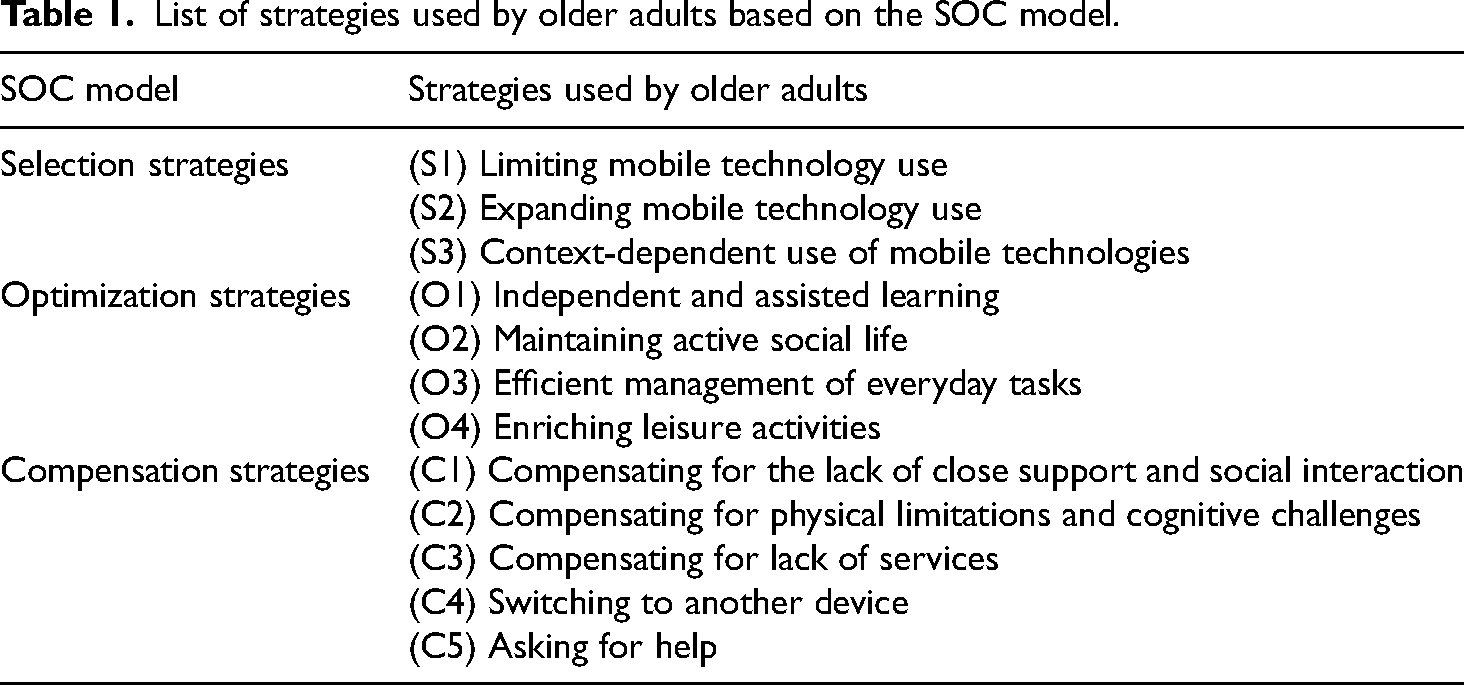
In the context of selective strategies, the participants demonstrated a proactive approach to expanding and limiting the range of mobile technologies they employed. Most of the selection strategies discussed here are consistent with elective selection, whereby users deliberately opt to augment or regulate their mobile device usage. Nevertheless, some strategies also fall under the category of loss-based selection, such as instances where interviewees chose not to adopt new technologies or applications due to their perceived complexity or time constraints. The optimization strategies, in turn, entail a systematic endeavor to achieve the selected goals within the context of the selection strategies and to refine them in a manner that contributes to the well-being of the older adults (see also Baltes & Baltes, 1990; Freund, 2008). Although this category provides numerous examples of elective strategies, it also encompasses loss-based strategies, suggesting that not all optimization strategies are based on voluntary choice. Furthermore, initial reluctance to use mobile technologies and services, such as online banking, may eventually lead to a positive user experience. The category of compensation indicates that mobile devices can positively impact subjective well-being, enhancing self-efficacy, strengthening social connections, and providing alternatives to declining face-to-face services. In the event of difficulties, interviewees engaged with alternative strategies, including the use of solutions beyond mobile or digital technologies or the seeking of assistance from their social network.
The strategies adopted by older adults reflect the different ways in which mobile technologies are perceived in later life, including the benefits and limitations associated with these technologies from an everyday perspective (Li et al., 2022). Thus, mobile technologies can act both as a tool to enhance well-being and as a source of complications for older adults (see also Forsman et al., 2018). Furthermore, all strategies related to the use of mobile technologies, including mobile, digital, and non-digital strategies, are processually mobile by reflecting transitions characteristic of ageing, and contribute in various ways to the well-being and successful ageing of older adults (Lifshitz et al., 2018; Nimrod, 2020; Sun et al., 2016). In this light, providing the necessary digital support and designing mobile technologies that can accommodate successful ageing not only supports individual older people, but also enables the digitalization of ageing societies (Robbins et al., 2018).
Limitations of the study and directions for future research
The SOC model provides a comprehensive framework for examining the mobile, other digital, and non-digital strategies associated with the subjective well-being of older adults in their everyday lives. However, further research based on larger datasets is necessary to gain a more nuanced understanding of the relationships and correlations between these strategies and their connection to subjective well-being, particularly among the oldest old (85+). Due to the categorical emphasis of the SOC model, there is also a need for further study of the overlapping and processual nature of these three types of strategies. Furthermore, advantaged societal groups with high levels of education and income derive greater benefits from both digital and mobile technologies than their more disadvantaged counterparts. Problems associated with ageing, health, and economic well-being often manifest in clusters, which provide a crucial context for understanding the overall digital strategies older adults implement in their everyday lives. In considering older adults’ active role as advocates of their subjective well-being, it is thus important to take into account the impact this has on both informal and formal digital support, and the design of mobile devices, applications, and services (see also Pajula et al., 2024; Vaportzis et al., 2017). In both cases, it is crucial to recognize the specific needs, personal preferences, and age-related limitations of older adults to gain insight into how both mobile and digital technologies are used in later life to effectively support these strategies.
Footnotes
Acknowledgments
Not applicable.
Author contributions
Riitta Hänninen contributed to the research design and implementation, analysis of the results, and writing of the manuscript. Sini Tiihonen contributed to the analysis of the results and the writing of the manuscript.
Consent for publication
Not applicable.
Data availability
The data that support the findings of this study are not publicly available. Anonymous data are however available from the authors upon reasonable request and with permission of University of Jyväskylä.
Declaration of conflicting interests
The authors declared no potential conflicts of interest with respect to the research, authorship, and/or publication of this article.
Ethical approval and informed consent statements
The data gathering, including ethical approval and informed consent statements, was conducted following the European General Data Protection Regulation (GDPR) and University of Jyvaskyla, Finland data protection guidelines. All participants provided written informed consent prior to participating.
Funding
The authors disclosed receipt of the following financial support for the research, authorship, and/or publication of this article: The study was funded by the Strategic Research Council at the Academy of Finland (grants 327145, 352501, 352505 and 327149 for the DigiIN Project), the Academy of Finland (grants 312367 and 336671 for the Centre of Excellence for Research on Ageing and Care), and it was conducted in partnership with the Aging in Data project (SSHRC Partnership Grant).

Writing assistance and third-party submissions:
The language in the manuscript has been refined using Microsoft Copilot, Grammarly, and DeepL translation and editing tools.