




Abstract
This research examines the interconnections between residential mobility, internet usage, and successful aging among older adults in China, drawing on nationally representative data from the China Health and Retirement Longitudinal Study (CHARLS). Utilizing binary logistic and stepwise regression analyses, the investigation assesses the impacts of frequent relocations on aging outcomes and identifies the mediating role of digital engagement. The findings indicate that residential mobility disrupts social networks and increases stress, negatively impacting successful aging. However, internet usage partially mitigates these effects by enhancing social integration, leisure and travel opportunities, emotional support, and access to health information. Younger seniors (60–74 years) are more adept at using internet technologies than older seniors (75+), highlighting a digital divide. Transitions from rural to urban environments also appear to support more favorable aging trajectories, reinforcing the significance of spatial context. This study expands successful aging theory by embedding digital inclusion within broader frameworks of social support and health equity. The results emphasize the urgency of implementing age-sensitive digital literacy initiatives and designing community-based interventions that account for regional disparities in access and capacity.
Plain Language Summary
As societies age, understanding how older adults can maintain their well-being becomes increasingly important. This study examines how internet use supports older adults in staying socially connected, engaging in leisure and travel activities, and adapting to life changes such as moving to new places. Older adults often face challenges like disrupted social networks and feelings of isolation when they relocate, especially as younger generations move away. The internet can help bridge these gaps by enabling communication with family and friends, providing access to travel planning tools, and offering opportunities for social and recreational activities online. Our findings highlight the positive role of digital technology in promoting active aging. Older adults who use the internet are more likely to participate in travel and leisure activities, which are essential for physical and mental health. They also benefit from improved access to health information and virtual social communities, which help reduce loneliness and enhance overall well-being. By empowering older adults with digital skills and tools, we can support their independence, social inclusion, and ability to enjoy meaningful leisure and travel experiences, ultimately contributing to successful aging.
Keywords
Introduction
China’s rapid demographic transition, marked by an unprecedented surge in the aging population and intensified urbanization, is reshaping the lived experiences of older adults (J. Chen & Wang, 2022; Huang et al., 2025). By 2040, individuals over 60 are projected to constitute more than 28% of the population, placing mounting pressure on China’s social, health, and spatial systems (WHO, 2021). Traditionally, older adulthood was characterized by residential stability, localized social ties, and intergenerational proximity. However, improved infrastructure, changing family structures, and rising aspirations are giving rise to complex patterns of late-life mobility that challenge static notions of “aging in place” (Huang et al., 2025; Jiang & Yang, 2022; C. Liu et al., 2021).
Successful aging, as a multidimensional construct, encompasses physical vitality, cognitive function, emotional resilience, and meaningful social participation (C. Chen et al., 2023; Kahana et al., 2014; Lyu et al., 2021; Rowe & Kahn, 1997; Teater & Chonody, 2020). Yet, this ideal is increasingly being redefined by mobility and digital connectivity. Scholars have long emphasized the role of leisure and tourism in promoting well-being among older adults (Lyu et al., 2024; J. Wu et al., 2020; X. Wu & Yang, 2023; Zhang & Zhang, 2018). However, few have adequately accounted for how frequent residential mobility—a reality for many Chinese seniors who migrate seasonally or relocate to support family—affects the structural and psychosocial foundations of aging well (Castilla-Polo et al., 2023; Tang et al., 2022; X. Zhao et al., 2023). Existing literature often treats mobility as either a disruption or an economic necessity, without probing its role as a voluntary, lifestyle-oriented strategy embedded in cultural and familial expectations (C. Liu et al., 2021; F. Wu, 2022).
Compounding these transformations is the digital turn in aging (Den Hoed, 2020). China’s digital ecosystem is expanding rapidly, with over 940 million internet users and increasing uptake among older adults (Yang et al., 2021). Digital tools—from health platforms and WeChat communities to online learning—have emerged as vital instruments for maintaining social inclusion, accessing services, and facilitating leisure activities (M.Lin, 2024; Pantelaki et al., 2023; Teater & Chonody, 2020). However, digital engagement is unevenly distributed across age cohorts, income groups, and mobility statuses (Lyu et al., 2025). Older adults who relocate frequently may face heightened digital marginalization due to infrastructural gaps or lack of tailored literacy support (Macdonald & Hülür, 2021; Wan et al., 2022). Moreover, studies exploring digital inclusion often overlook the moderating effects of age and the mediating role of internet use in the context of residential mobility, thereby missing the full complexity of aging in motion.
Against this backdrop, this study critically examines how residential mobility intersects with internet usage to shape successful aging among Chinese older adults. It builds on life course theory, which emphasizes how spatial transitions, technological engagement, and institutional shifts are embedded within broader sociohistorical and developmental trajectories (Hutchison & Levesque, 2017; Settersten, 2018). While previous research has established the importance of either mobility (Choi & Oishi, 2020) or digital participation (R. Chen et al., 2019; Jiang & Yang, 2022) in aging, few have interrogated how these domains interact or how their effects vary across younger and older senior cohorts.
This inquiry contributes to a growing body of scholarship that views older adults not merely as passive recipients of care but as adaptive actors navigating dynamic physical and digital environments (Fulmer et al., 2020; Fulmer & Huang, 2024; Peek et al., 2014; Vines et al., 2015). It also offers timely policy guidance on how to design mobility-sensitive, digitally inclusive ecosystems that promote autonomy, equity, and well-being in late life. Beyond its empirical contributions, this study advances the theoretical understanding of aging as a socially embedded and spatially contingent process. It challenges static conceptions of aging as a linear trajectory bound to a single place and instead theorizes mobility and digital connectedness as constitutive dimensions of later-life agency. Philosophically, the research prompts a rethinking of autonomy in aging—not solely as independence from assistance, but as the capacity to navigate changing spatial and technological environments in meaningful ways. Practically, the study offers timely guidance for designing age-friendly policies that move beyond generic inclusion efforts to address the lived realities of mobile and digitally marginal populations. In a rapidly transforming society like China, where structural modernity coexists with uneven digital and spatial development, such an approach is essential for building equitable aging infrastructures (Li et al., 2025).
Literature Review
Aging is a global phenomenon shaped by rising life expectancy and structural demographic shifts, leading to profound socioeconomic implications (Nari et al., 2021). The concept of “successful aging” remains complex and multidimensional, encompassing not only freedom from chronic illness and disability but also sustained cognitive functioning, physical autonomy, and meaningful social participation (Kahana et al., 2014; Rowe & Kahn, 1997). While classical models emphasized physiological resilience, contemporary frameworks—such as the World Health Organization’s active aging agenda—now incorporate broader determinants, including mental well-being, community integration, and access to recreational and cultural activities (Kok et al., 2017). In the Chinese context, successful aging increasingly intersects with leisure innovation and digital engagement, with older adults participating in cultural performances, online social forums, wellness tourism, and community learning initiatives (M. Lin, 2024; Otoo & Kim, 2020). This convergence of social, technological, and behavioral domains prompts renewed inquiry into how mobility and digital inclusion jointly shape later-life outcomes.
Residential Mobility Frequency and Successful Aging
Residential mobility, defined as the frequency and pattern of changing living environments, is a significant yet underexplored determinant of aging well. While traditionally viewed as disruptive in later life, mobility in the Chinese context is increasingly framed as a lifestyle adaptation facilitated by improved infrastructure, intergenerational dynamics, and urban expansion (R. Chen et al., 2019; Hao & Xiao, 2021). For some older adults, relocating offers access to superior healthcare, green spaces, or proximity to children, factors associated with enhanced psychological well-being and active living (Castilla-Polo et al., 2023; Lou, 2010). However, residential relocation also entails risks: disruptions to social capital, increased emotional stress, and challenges in place attachment, all of which may undermine critical domains of successful aging such as autonomy and life satisfaction (Choi & Oishi, 2020; Oishi, 2010). In China’s rapidly urbanizing landscape, these tensions are particularly pronounced in rural-urban transitions, where older migrants may experience both improved service access and heightened vulnerability to social dislocation (Han et al., 2020; Tang et al., 2022).
While residential stability is traditionally associated with older adulthood—grounded in homeownership, emotional place attachment, and withdrawal from the labor market—emerging evidence suggests that this assumption does not universally hold, particularly in the context of rapidly transforming societies like China. Patterns of late-life mobility are increasingly prevalent among Chinese older adults, driven not by economic displacement but by evolving intergenerational roles and shifting welfare ecologies. A substantial proportion of seniors relocate to urban areas to co-reside with or support adult children, often assuming caregiving responsibilities for grandchildren or seeking proximity to family networks (J. Liu, 2016; C. Liu et al., 2021). Others move strategically to access superior healthcare services, enhanced urban infrastructure, or age-friendly living environments that rural areas often lack (J. Lin et al., 2023). These relocations reflect deliberate family-level negotiations shaped by enduring cultural norms such as filial piety and collective responsibility, rather than individual preferences alone (F. Wu, 2022). Consequently, the conventional notion of “aging in place” is increasingly challenged in China, where demographic transitions, urbanization, and decentralization of care provision have redefined mobility as a key dimension of later-life adaptation (Huang et al., 2025). Recognizing these dynamics is essential to contextualize residential mobility not as an anomaly, but as a culturally embedded and policy-relevant component of successful aging.
The Life Course Theory (LCT) provides a powerful lens through which to examine how accumulated mobility experiences influence aging trajectories. It posits that residential transitions are not merely episodic disruptions but are structured by sociohistorical conditions, life-stage timing, and personal agency (Hutchison & Levesque, 2017; Settersten, 2018). Mobility in earlier adulthood may foster adaptability and resource acquisition, while in older age, similar transitions may yield stress or social fragmentation unless mitigated by institutional support. Moreover, mobility reflects not just physical relocation but a form of spatial negotiation shaped by cultural expectations, consumer behaviors, and retirement aspirations (de Jong, 2022). In this sense, older adults’ relocation decisions—whether to age in place or migrate for well-being—signal shifting values around autonomy, connectivity, and lifestyle (P.-C. Chen & Wilmoth, 2004). These decisions carry tangible effects on the structure and function of everyday life, from social network reconstitution to digital information access.
Engaging in leisure activities often drives travel among older adults, who may seek to participate in cultural festivals, explore nature, or visit historical sites. Rodriguez (2001) identified distinct mobility patterns among older residential tourists, who exhibit individual or economic motivations and influence territorial dynamics. Life course theory (LCT) offers insights into how historical, social, and cultural contexts shape individuals’ lives from birth to old age, including their travel experiences and leisure consumption (Hutchison & Levesque, 2017). LCT helps understand how residential mobility affects older adults’ health, well-being, and behaviors, with frequent moves during earlier life stages compounding effects on later life (Simsek et al., 2021). For middle-aged and older adults, frequent residential mobility is linked to challenges in daily activities and well-being (Tang et al., 2022). Residential mobility among older adults reflects a lifestyle centered on consumption, influencing their decision to age in place or relocate(P.-C. Chen & Wilmoth, 2004; de Jong, 2022). While relocating can enhance physical and social environments, it also introduces stress and psychological challenges (P.-C. Chen & Wilmoth, 2004). Research shows that residential mobility is associated with increased depression symptoms in China, although social leisure activities can mitigate these effects (Lyu et al., 2023). Residential instability heightens social isolation and loneliness risks, impacting physical and mental health (National Institute on Aging, 2019). Addressing these issues through interventions promoting sports, exercise, travel, and digital engagement can enhance older adults’ well-being and social connectedness.
Residential mobility is a crucial factor influencing successful aging, impacting older adults’ physical, social, and environmental well-being (Choi & Oishi, 2020; Lyu et al., 2023). In China, the hukou system—a form of internal passport dividing residents into rural and urban categories—significantly shapes access to resources and welfare programs (Vendryes, 2011). This system creates urban-rural disparities, limiting rural migrants’ access to quality education, healthcare, and leisure activities enjoyed by urban residents (Hou et al., 2019). Migration patterns are more common among elderly individuals in northern regions than in southern areas, affecting their engagement in social protection and leisure (Chai et al., 2006). Additionally, residential mobility is linked to increased health risks and reduced life satisfaction among older adults in China (Y. Liu, 2016).
Taken together, the literature highlights that residential mobility is a double-edged phenomenon for older adults. While relocation may sometimes offer improved access to healthcare, infrastructure, or family networks, it also imposes profound psychological and social costs that can undermine critical domains of successful aging. Empirical studies have consistently shown that frequent or involuntary moves are associated with increased stress, weakened place attachment, disrupted social networks, and heightened vulnerability to loneliness and depression, especially among older populations (Choi & Oishi, 2020; Lyu et al., 2021, 2023). These adverse effects are amplified in the Chinese context, where the hukou system and urban-rural disparities restrict access to welfare benefits for older migrants, often making relocation a source of exclusion rather than empowerment (Hou et al., 2019; Vendryes, 2011). Moreover, older adults with high mobility histories may accumulate disadvantage over the life course, including diminished continuity of care and loss of community familiarity, which can erode both physical well-being and emotional resilience in later life (Simsek et al., 2021; Tang et al., 2022). Consequently, despite its effects, residential mobility is, on balance, more likely to hinder than to enhance the components of successful aging, particularly when support systems are weak or moves are not self-initiated. Based on this synthesis, we hypothesize that residential mobility is negatively associated with successful aging.
Internet Usage and Successful Aging
Given the dual effects of residential mobility—opportunity and risk—attention turns to potential moderators or mediators that could buffer its negative outcomes. One such mechanism is internet usage, which may facilitate continuity of social interaction, emotional support, and access to information despite geographic dislocation. As digital infrastructures become more embedded in daily routines, especially in China’s aging society, the role of internet-enabled platforms in supporting mobility-related adaptation gains both theoretical and practical relevance (Rasi-Heikkinen & Doh, 2023; Van Dijk, 2020). Furthermore, patterns of digital adoption vary substantially by age cohort within the older population, suggesting that age may moderate the effectiveness of internet use in sustaining well-being post-mobility (Lyu et al., 2025). These insights lay the conceptual groundwork for our proposed hypotheses, developed next.
The global challenge of aging is particularly acute in rapidly evolving societies such as China, where internet technology has significantly reshaped sociocultural norms since the 1990s. With 940 million internet users, China has seen a notable increase in older adults’ internet adoption, increasing from 6.7% to 10.3% between March and June 2020 (Yang et al., 2021). As the internet becomes integral to daily life, its impact on older adults’ happiness, travel, leisure, social connectivity, and health is increasingly scrutinized. Research indicates positive links between internet use and psychological well-being (Werner et al., 2011), yet complexities remain, particularly in understanding its role in enhancing leisure activities vital for successful aging (Aggarwal et al., 2020). Digital technologies are crucial for improving older adults’ social engagement and autonomy, contributing to active and healthy aging (Pantelaki et al., 2023). However, the digital divide persists, with older adults often lagging in technological proficiency compared with younger generations (K. Chen, 2020; Macdonald & Hülür, 2021). Despite these challenges, internet use among older adults has been associated with better social connectedness, cognitive functioning, and engagement in educational and leisure activities (Heo et al., 2011). Digital tools are increasingly used for planning travel, researching destinations, booking accommodations, and connecting with travel communities, enhancing the accessibility and enjoyment of leisure travel (M. Lin, 2024). The internet also supports communication with family and friends, maintaining social networks, and engaging in diverse online activities, thereby improving overall quality of life (Aggarwal et al., 2020).
The increasing residential mobility among Chinese youth poses challenges for older adults, potentially disrupting their social networks and intensifying isolation. In this context, the internet has become a vital tool for older adults, fostering connections with peers and family and enhancing their overall quality of life (Aggarwal et al., 2020). Strong social ties and community engagement are crucial for motivating older adults to participate in leisure and travel activities, promoting psychological well-being, and personal growth (Pantelaki et al., 2023; Yang et al., 2021). Despite these benefits, there are concerns about potential negative effects, such as cognitive decline and social detachment (Wan et al., 2022).
While residential mobility may disrupt place-based ties and community integration, digital engagement can offer an important compensatory mechanism that mitigates its negative consequences. Older adults who use the internet are better able to maintain social connections across distances, access health and welfare information, and engage in leisure activities that support psychological well-being and cognitive vitality (Van Dijk, 2020; W. Wang et al., 2023). In the context of mobility, internet use fosters a sense of spatial continuity and socio-emotional belonging, reducing the stress and isolation typically associated with relocation (C.-H. Wang & Wu, 2022; Yang et al., 2021). Studies show that digital technologies help mobile seniors navigate new environments, rebuild social networks, and even participate in virtual forms of community life—effects that are particularly relevant in China, where the older population is rapidly adopting digital platforms (M. Lin, 2024). Moreover, from a life course perspective, internet use can buffer cumulative disadvantage by enabling adaptive behaviors, reducing information asymmetry, and enhancing autonomy in decision-making (Hutchison & Levesque, 2017; Settersten, 2018). Therefore, we posit that internet usage mediates the relationship between residential mobility and successful aging, with digitally engaged older adults experiencing fewer adverse effects from residential relocation.
Age Role as Moderator
Age serves as a crucial factor in understanding people’s motivations, attitudes, perceptions, and behaviors across different life stages and is often used to analyze how these factors vary across age groups (Natarajan et al., 2018). Younger individuals typically utilize internet technologies for activities such as messaging and online commerce, whereas older adults tend to use them to access healthcare information and maintain social connections (Pourrazavi et al., 2021). Research highlights significant age-related differences in the frequency and purpose of internet and mobile phone use (Forgays et al., 2014). Furthermore, age moderates the relationship between mental health and social networking behaviors (Hardy & Castonguay, 2018).
Age plays a crucial moderating role in how older adults adapt to residential transitions. Younger seniors are generally healthier, more cognitively agile, and more likely to engage in digital and leisure activities that facilitate adjustment to new environments (Rasi-Heikkinen & Doh, 2023; Simsek et al., 2021). In contrast, older seniors often experience declining physical mobility, greater dependency, and reduced technological familiarity, making it harder for them to rebuild social networks or access community resources after moving (Chai et al., 2006; Tang et al., 2022). Relocation in advanced age also entails higher risks of disorientation, stress, and diminished autonomy, especially when moves are involuntary or occur without institutional support (P.-C. Chen & Wilmoth, 2004; Rodriguez, 2001). Life course theory underscores that transitions in later stages of life, particularly those without continuity of place and routine, may compromise emotional security and social identity (Hutchison & Levesque, 2017). These factors collectively suggest that the detrimental effects of mobility are not uniform across age cohorts but disproportionately burden the oldest-old. Therefore, we propose the following hypothesis. The proposed conceptual model is given in Figure 1.

The proposed conceptual model.
Furthermore, the study retained three hypotheses to maintain conceptual coherence with the mediation framework and to avoid analytical redundancy. Within this model, residential mobility serves as the independent variable, internet use as the mediator, and successful aging as the dependent variable. These relationships are adequately represented through three directional paths: (1) the direct effect of residential mobility on successful aging, (2) the effect of residential mobility on internet use, and (3) the effect of internet use on successful aging. A separate hypothesis for the indirect (mediated) effect was omitted because mediation was statistically confirmed through the combined significance of these three pathways and verified via bootstrapping. Future research can extend this framework by incorporating newly released CHARLS data or cross-national panel surveys to validate temporal and cultural robustness.
Research Methodologies
Data
This study draws on data from the China Health and Retirement Longitudinal Study (CHARLS), a nationally representative panel survey of Chinese adults aged 45 and above. CHARLS employs a multistage, stratified probability sampling method to ensure national representativeness, covering 450 rural and urban communities across 28 provinces (Y. Zhao et al., 2020). Data from four consecutive waves—2011, 2013, 2015, and 2018—were utilized, providing a reliable framework to construct temporally valid mobility indicators. A total of 13,916 follow-up respondents were included after ensuring complete data across all four waves (please see Table 1).
Overview of the Four Waves of the China Health and Retirement Longitudinal Study (CHARLS).

To ensure analytical precision and theoretical consistency, this study strategically focuses on the 2018 wave as the core analytical dataset. This decision is grounded in both methodological and substantive considerations. The 2018 wave constitutes the most recent fully validated and publicly released CHARLS dataset that contains complete measures of digital engagement, physical and mental health, and social participation—variables essential to the mediation framework linking residential mobility, internet use, and successful aging.
According to the official CHARLS data portal (https://charls.charlsdata.com/pages/data/111/en.html), microdata are currently available only up to the 2020 release, which corresponds to the 2018 fieldwork period. Subsequent follow-up surveys have not yet been harmonized or made publicly accessible, and pandemic-related disruptions after 2019 introduced irregularities in sampling and measurement continuity. Consequently, relying on the 2018 wave ensures data completeness, internal validity, and comparability with earlier rounds while avoiding confounding influences associated with COVID-19 policy interventions and behavioral anomalies. This approach provides a stable empirical foundation for testing the hypothesized relationships between residential mobility, internet use, and successful aging.
Measures
Successful Aging
Consistent with Rowe and Kahn’s (1997) multidimensional model, successful aging was measured through five indicators: (1) absence of major chronic diseases, (2) no disability in activities of daily living (ADL), (3) high cognitive function, (4) absence of depressive symptoms, and (5) regular social engagement. A binary variable was constructed, coded as 1 if all five conditions were satisfied. This strict operationalization ensures a high threshold of aging quality, consistent with recent empirical work (Ding et al., 2023; Kim et al., 2024; S. Y. Pan et al., 2018).
No major disease: The measurement of major disease was assessed by participants reporting that they had been diagnosed with cancer, chronic lung disease, diabetes, heart disease, or stroke. Research has indicated that these chronic diseases impose a major health burden on the elderly (C.-W. Pan et al., 2018). This variable was coded as 1 if the respondent reported having none of the five diseases.
Absence of disability: The ADL scale is used to assess activities of daily living (Katz et al., 1964), including dressing, bathing or showering, eating, getting into or out of bed, using a toilet, and controlling urination and defecation. This variable was coded as 1 if the respondent had no trouble in any of the six activities. High cognitive function: Cognitive function was measured by the Telephone Interview for Cognitive Status (TICS), which includes recognition of the year, season, date, week, and month; immediate and delayed recall of 10 words in a list; and serial subtraction of seven from 100 five times (H. Liu et al., 2016). The participants were considered to have high cognitive functioning if they achieved a median or higher score. Absence of depressive symptoms: Depressive symptoms were assessed by the CES-D 10 (10-item Center for Epidemiological Studies Depression Scale; Andresen et al., 1994). The variable was coded as 1 if the respondent received a score below the cutoff score (10).
Social engagement in daily life: The respondents were considered socially engaged in daily life if they had participated in at least one of the listed social activities in the previous month (Kesavayuth et al., 2018). Sample items include helping family, friends, or neighbors who do not live with you; joining sports, social, or other clubs; and doing voluntary or charity work.
Residential Mobility Frequency
This key independent variable was calculated based on the number of inter-wave address changes (range: 0–3). It captures the structural dimension of mobility across the aging trajectory, using full panel data to improve reliability over single-time self-reports.
Internet Usage
A cumulative index (range: 0–9) was constructed to reflect the breadth of digital engagement, including activities such as online chatting, video watching, health information browsing, travel planning, participation in virtual fitness, mobile payments, and social media interactions (e.g., WeChat, Alipay). These variables capture both access and behavioral integration of digital technology into daily life.
Covariates
Demographic and health-related controls included gender, hukou status (urban/rural), education level, marital status, smoking and drinking behaviors, and disability status. These factors are included to minimize confounding effects and ensure robust estimates of aging outcomes.
Analytical Strategy
To investigate the relationship between residential mobility and successful aging, a combination of binary logistic regression and linear regression models was employed. Given the binary nature of the dependent variable, logistic regression was used to estimate direct effects. Internet usage, treated as a continuous mediator, was modeled using OLS regression. A three-step mediation procedure based on Baron and Kenny (1986) was applied, followed by bootstrapping with 5,000 resamples to test the significance of indirect effects (Hicks & Tingley, 2011; Ro, 2012; Shrout & Bolger, 2002). Moderation analysis was conducted by introducing an interaction term between residential mobility and age group (60–74 vs. 75+), followed by stratified regressions to explore heterogeneous effects across life stages. These steps ensure that age-related variations in digital literacy and adaptability are empirically evaluated.
Although CHARLS is a longitudinal panel, this study adopts a pooled cross-sectional design using data from the 2018 wave. Residential mobility frequency was derived from longitudinal information across waves, while key predictors and outcomes were taken from the final wave to maintain temporal sequencing and minimize reverse causality. This hybrid strategy enables robust modeling of accumulated experience while preserving conceptual clarity in variable alignment. To address concerns about possible selection bias in internet adoption, comprehensive covariate adjustments were made, including health, education, and urban residency, factors strongly associated with digital engagement in later life. While fixed-effects models for repeated measures are ideal for future analysis, they were not employed here to retain the interpretability of mediated and moderated pathways. Figure 2 provides a detailed analytical framework used in this research. All analyses were conducted using STATA version 16.0, with listwise deletion for missing data.

Analytical framework showcasing mediation and moderation.
Results
Descriptive Statistics
Table 2 presents the demographic characteristics of the study sample from the 2018 wave of CHARLS. Participants represented a wide age range: 35.67% were between 45 and 59 years, 48.13% were aged 60 to 74, and 16.20% were aged 75 and above. The overall mean age was 63.76 years, indicating a cohort primarily in the later stages of adulthood. Educational attainment varied considerably; 25.88% of respondents were illiterate, 43.17% had completed elementary education or below, and 30.95% had reached at least middle school education, reflecting a substantial diversity in educational background within the aging population.
Descriptive Statistics (N = 13,618).

The majority of participants (81.47%) held rural hukou status, and a high proportion (83.51%) were married, pointing to traditional family and residential patterns that may influence health and aging outcomes. Regarding physical functioning, 87.11% of individuals reported no physical disabilities, suggesting that most retained a relatively high level of mobility and independence. However, lifestyle risk factors were present: 14.10% were current smokers and 31.83% reported alcohol consumption, which could potentially compromise long-term health and well-being.
The rate of successful aging—defined as meeting all five criteria related to disease absence, cognitive function, mental health, disability status, and social engagement—stood at 17.39%. While the overall prevalence was modest, individual components were more encouraging. Specifically, 79.65% of respondents reported no major chronic diseases, 78.77% had no disabilities, and 68.56% were free of depressive symptoms. Nonetheless, only 51.59% had high cognitive function, and just 50.46% engaged in regular social or physical activities, indicating critical gaps that warrant attention in aging policy and intervention efforts.
Residential mobility, defined as changing addresses across the four survey waves, was reported by 19.12% of the sample, reflecting a notable portion of older adults experiencing relocation during the study period. Internet engagement was relatively low; only 9.59% reported any usage, and the average score on the Internet use index was 0.44, highlighting the persistent digital divide among this population. Table 3 details the correlations among the study variables. Spearman’s ρ was used due to the presence of ordinal and non-normally distributed variables. All correlations are based on the full sample (N = 13,618). p < .05, p < .01, p < .001. To ensure the validity of regression estimates, multicollinearity was assessed using the variance inflation factor (VIF). Results confirmed that collinearity was not a concern: in the linear regression models, VIF values ranged from 1.01 to 2.23 (mean = 1.42), and in the logistic regression models, from 1.01 to 1.27 (mean = 1.13). These values fall well within acceptable limits, affirming the stability and independence of the included predictors (Hair, 2009; Hair et al., 2017).
Spearman’s Rank-Order Correlations Among Key Study Variables.
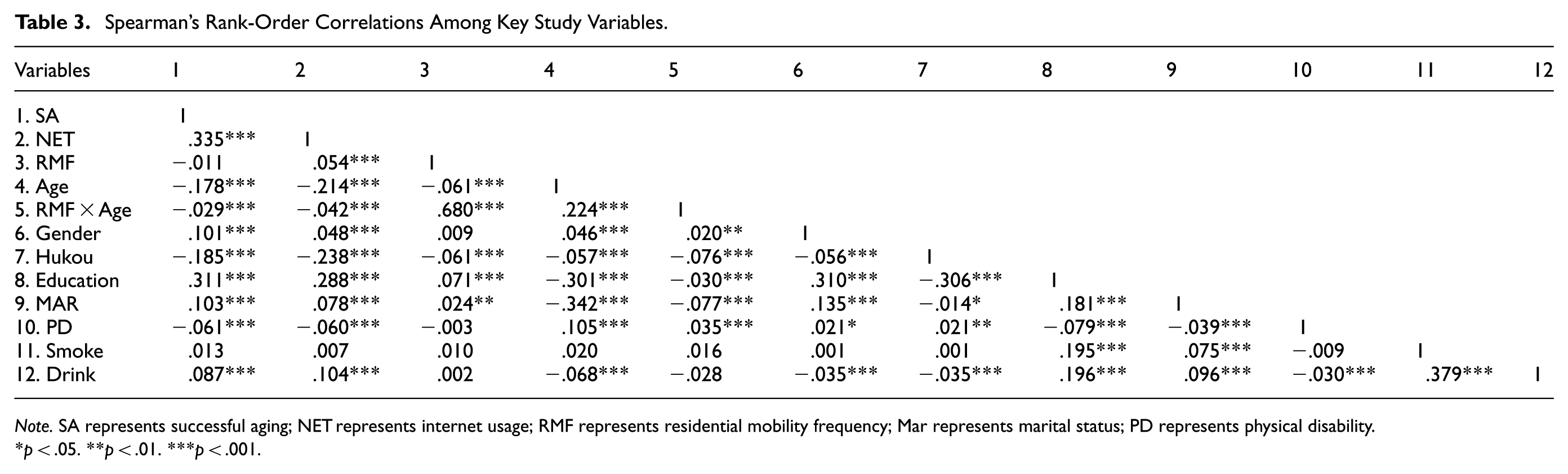
Note. SA represents successful aging; NET represents internet usage; RMF represents residential mobility frequency; Mar represents marital status; PD represents physical disability.
p < .05. **p < .01. ***p < .001.
Main Findings
The main findings, presented in Table 4, provide robust evidence for the relationship between residential mobility and successful aging. The logistic regression analysis indicates that a higher frequency of residential mobility is significantly associated with lower odds of achieving successful aging (β = –0.187, p < .05). This negative association underscores the potential disruptive impact of residential instability on the multidimensional process of aging well.
Logistic Regression Results Examining the Association Between Residential Mobility Frequency and Successful Aging and Its Individual Components.

Note. 95% confidence intervals are reported in square brackets. RMF refers to residential mobility frequency; MAR refers to marital status; PD refers to physical disability; and ADLs refers to difficulties in activities of daily living.
p < .05. **p < .01. ***p < .001.
Further examination of the five individual components that constitute the successful aging index reveals more specific patterns. Interestingly, residential mobility was found to be positively associated with the absence of chronic disease (β = .020, p < .05), suggesting that individuals who moved more frequently may be somewhat healthier in terms of physical illness burden. However, this potential benefit appears to be offset by a significant reduction in social engagement among those with higher mobility (β = –.048, p < .05), a finding that points to the possible erosion of social networks and community ties due to repeated relocation.
Notably, residential mobility did not exhibit significant associations with functional independence (ADLs), cognitive function, or depressive symptoms. These non-significant results suggest that while residential changes may influence certain aspects of aging, particularly social participation and physical health, they do not uniformly affect all domains of aging outcomes. Collectively, these findings highlight the complex and domain-specific consequences of residential mobility among older adults and underscore the need for supportive policies that mitigate its potential social costs.
Hypothesis Testing and Model Interpretation
The empirical tests of the three main hypotheses are summarized in Table 5 and Figures 3 and 4. Binary logistic regression results in Model 3 confirm
Results of Binary Logistic Regression and Linear Regression Analyses.

Note. N = 13,618. MAR refers to marital status; PD refers to physical disability; RMF refers to residential mobility frequency; NET refers to internet usage; SA refers to successful aging.
p < .05. **p < .01. ***p < .001.

Path model illustrating the mediation of Internet use in the association between residential mobility and successful aging.

Age moderation plots for RMF and NET.
To test
The moderating role of age, tested in
Direction of Residential Mobility Analysis
To further investigate the impact of residential mobility direction, an additional analysis was conducted using a subsample of respondents (N = 1,143) who relocated between Wave 3 and Wave 4. The direction of movement was categorized into four distinct groups: rural-to-rural (29.31%), rural-to-urban (38.06%), urban-to-rural (8.84%), and urban-to-urban (23.80%). This classification enables a deeper understanding of whether the type of relocation contributes differentially to successful aging.
Logistic regression results (Table 6) revealed that mobility direction significantly predicted successful aging. Compared with those who moved within rural areas (reference group), seniors who moved from rural to urban areas were 1.77 times more likely to experience successful aging (p < .05). Even more strikingly, those who moved from urban to rural areas were 2.87 times more likely to report successful aging (p < .01), and those who moved within urban areas were 2.37 times more likely (p < .01). These findings suggest that moves involving urban environments—whether toward or within them—are generally associated with better aging outcomes. For rural-origin older adults, relocation to urban areas may provide improved access to healthcare, services, and social infrastructure. Conversely, urban-to-rural moves may reflect lifestyle preferences or access to family-based care that enhances well-being. Interestingly, for urban dwellers, moving to rural areas increases the odds of successful aging by 1.21 times (2.87/2.37) relative to staying in urban settings, implying that reduced environmental stress or stronger community ties in rural areas may be beneficial later in life. Taken together, these results highlight the multi-dimensional and context-sensitive nature of residential mobility and its implications for successful aging. Both the frequency and direction of relocation matter, and digital engagement, moderated by age, plays a critical mediating role in shaping these outcomes.
Association Between the Residential Mobility Direction and Successful Aging.
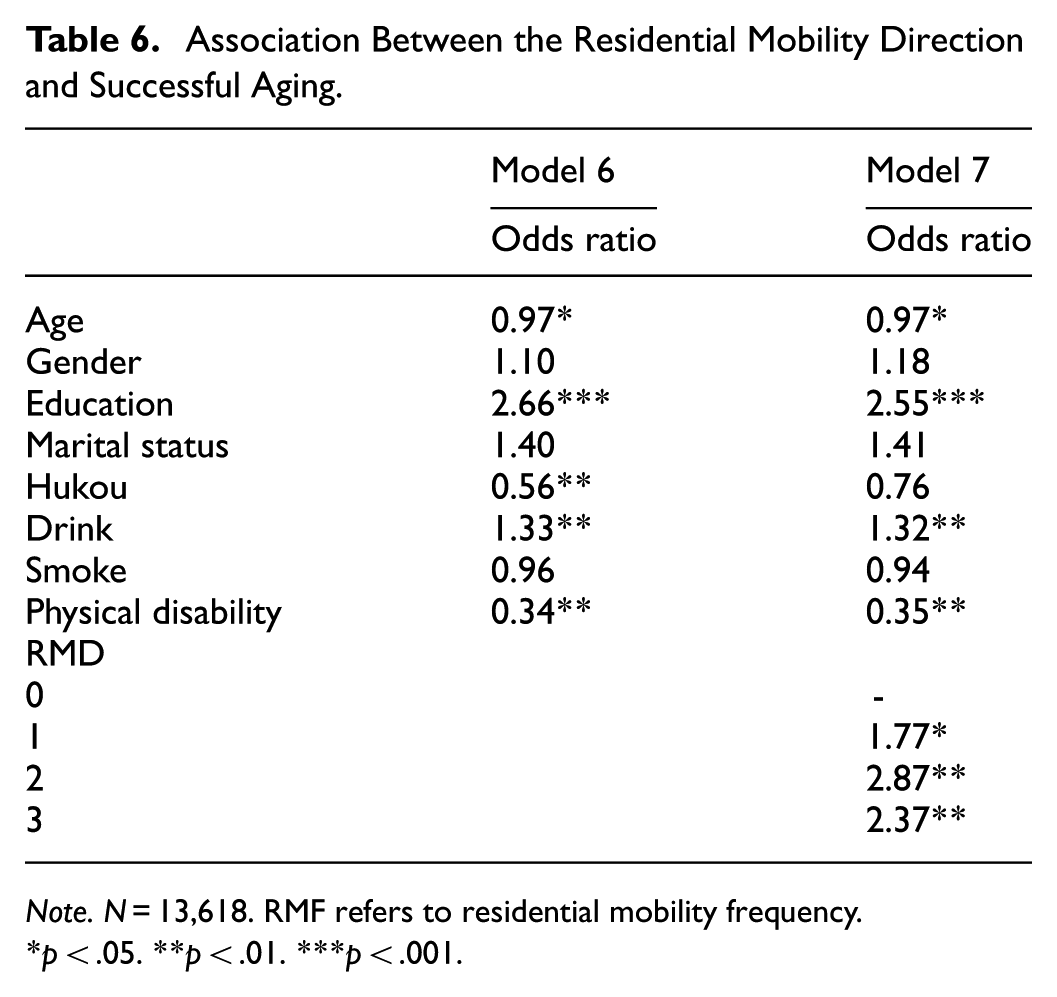
Note.N = 13,618. RMF refers to residential mobility frequency.
p < .05. **p < .01. ***p < .001.
Discussion
The current study contributes significantly to the evolving discourse on aging, digital inclusion, and residential mobility by offering empirical clarity on the moderating role of age in shaping internet use as a coping mechanism among older Chinese adults. While prior studies have identified internet adoption as a potential enhancer of well-being and successful aging (Aggarwal et al., 2020; Macdonald & Hülür, 2021), our findings refine this relationship by demonstrating its variation across age cohorts. Specifically, we show that “younger seniors” (aged 60–74) are more capable of leveraging internet technologies to mitigate the challenges of residential mobility, particularly in maintaining psychosocial well-being and life satisfaction. This insight aligns with the broader literature on the life course perspective (Hutchison & Levesque, 2017; Settersten, 2018), which suggests that age-related resources and adaptation capacities are not uniformly distributed among older adults.
Our findings are consistent with Jiang and Yang (2022), who emphasize the empowering potential of internet use for older Chinese women in enhancing their autonomy and life satisfaction. However, we extend these arguments by contextualizing internet use within the framework of residential mobility—an increasingly salient phenomenon given China’s rapid urbanization and aging trends (R. Chen et al., 2019; C. Liu et al., 2021; Lyu et al., 2021). Residential mobility, particularly from rural to urban areas, is often associated with disrupted social networks and increased vulnerability (P. Chen et al., 2022; de Jong, 2022; Xu et al., 2019). Our research highlights that digital connectivity can buffer these negative effects, but the benefits are disproportionately accessed by the more digitally literate younger seniors. This important contribution advances the digital divide literature (Fan et al., 2025; Van Dijk, 2020; W. Wang et al., 2023; C.-H. Wang & Wu, 2022) by empirically demonstrating how age mediates digital resilience following residential transitions.
Global evidence reinforces the significance of our findings. For instance, in the Netherlands, de Jong (2022) documents the heightened propensity to move among older adults and underscores the need for digital solutions to support post-mobility adaptation. Similarly, in the U.S., Hardy and Castonguay (2018) find that the psychological benefits of digital engagement are particularly salient among younger cohorts of older adults. Our study parallels these observations within the Chinese context, where regional disparities in infrastructure, digital access, and education exacerbate existing inequalities (C.-H. Wang & Wu, 2022; X. Wu & Yang, 2023). This geographic and technological heterogeneity requires targeted policy responses, particularly in underdeveloped regions where older seniors remain digitally excluded.
Importantly, our study responds to the critique that much of the digital literacy discourse lacks contextual feasibility (Rasi-Heikkinen & Doh, 2023). We argue that promoting digital literacy among older adults must move beyond generalized training to tailored, age-sensitive strategies that consider mobility histories, health status, and social capital. For example, smart TVs and user-friendly platforms have been proposed as inclusive entry points for older adults with limited digital skills (C.-H. Wang & Wu, 2022). However, their adoption requires infrastructural support, public-private collaboration, and a redesign of gerontechnological interfaces—factors often overlooked in policy design.
Moreover, our study complicates prevailing assumptions that older adults form a homogeneous group. While much of the literature on aging, mobility, and technology adopts a binary age distinction (e.g., old vs. young), our results advocate for a more comprehensive categorization based on developmental trajectories and digital adaptation potential. This perspective resonates with the call by Pantelaki et al. (2023) and Kok et al. (2017) to recognize heterogeneity in aging experiences when designing inclusive digital and social policies. This research challenges the overly generalized assumptions in prior work by offering a stratified analysis of digital coping and mobility among older adults in China. It underscores the importance of age-specific digital interventions, contextualized infrastructural investments, and adaptive mobility policies. By combining longitudinal Chinese data with analytical models, our study not only aligns with global findings but also offers culturally and institutionally grounded recommendations for mitigating digital exclusion and enhancing successful aging across diverse senior cohorts.
Theoretical Implications
This study contributes to theory by advancing an integrative understanding of successful aging, residential mobility, and digital engagement through a life course and ecological systems lens. While earlier models of successful aging often emphasized static attributes such as health status, cognitive function, or social participation (Decancq & Michiels, 2019; Rowe & Kahn, 1997), our findings demonstrate that these outcomes are significantly shaped by adaptive capacities that evolve across digital and spatial dimensions. Specifically, our research supports Bronfenbrenner’s (2013) ecological systems theory by illustrating that older adults’ well-being is contingent upon interactions between individual resources (e.g., digital literacy), mesosystemic transitions (e.g., relocation), and broader exosystemic structures (e.g., urban-rural infrastructure disparities; Bronfenbrenner, 2013).
Moreover, this study enhances life course theory (Hutchison & Levesque, 2017; Settersten, 2018) by empirically showing that aging trajectories are not linear but shaped by historical timing and cohort-specific digital competencies. By identifying distinct patterns of digital coping among “younger seniors” (aged 60–74) as compared to their older counterparts, we emphasize that successful aging must be re-theorized as stratified and non-uniform. This contradicts homogenizing assumptions often embedded in aging research and supports recent calls to differentiate aging experiences based on mobility histories, technological exposure, and socio-demographic positioning (Khan et al., 2025; Kok et al., 2017; Pantelaki et al., 2023).
Importantly, the study also contributes to digital divide literature (Van Dijk, 2020) by introducing a comprehensive framework of digital resilience—the capacity to mobilize technology in response to life disruptions such as residential mobility. This reframing not only affirms the centrality of digital capital in later-life adaptation but also invites a new layer of theorization that links digital participation to spatial mobility and psychological adjustment. In doing so, our study provides a conceptual bridge between gerontological theory, mobility studies, and digital sociology.
Practical Implications
The practical relevance of this study is multifaceted and policy-relevant, especially for rapidly aging societies such as China. First, the differentiated impact of internet usage across age groups calls for more age-specific digital literacy initiatives. While broad-based training programs have gained popularity, our findings argue for targeted interventions that recognize both generational divides and prior residential contexts. For instance, mobile senior centers, smart TV platforms, or simplified digital interfaces could be deployed in underdeveloped rural areas where older seniors reside and where digital readiness is typically low (Rasi-Heikkinen & Doh, 2023; C.-H. Wang & Wu, 2022).
Second, this study urges stakeholders to view residential mobility not merely as a physical shift but as a social and psychological rupture. Policies that address relocation among older adults—whether driven by health needs, family obligations, or urban migration—must include provisions for digital integration as part of post-mobility adjustment programs. These could involve community-led digital inclusion hubs, partnerships between telecom companies and aging services, or subsidies for elderly digital devices.
Third, healthcare planners and urban policymakers should recognize the protective role of digital engagement in reducing loneliness, preserving cognitive function, and supporting emotional well-being. Integrating digital access into China’s ongoing welfare and urbanization policies—particularly in the context of its Hukou system and regional disparities—can serve as a cost-effective strategy to support successful aging across diverse social strata.
Lastly, this study advocates for a shift in gerontechnology design and policy discourse: from a focus on usability to adaptability and inclusivity. Interventions must be culturally resonant and infrastructure-sensitive, accounting for both the capabilities and constraints of different age cohorts. In doing so, our study provides a roadmap for designing digital aging policies that are not only technically sound but socially just and contextually grounded.
Conclusion
This study reconceptualizes successful aging as a multidimensional outcome shaped by intersecting forces of mobility, technology, and age-specific adaptation capacities. Rather than viewing internet use as a universal panacea, our findings demonstrate that its benefits are contingent on age-related digital capital, residential histories, and structural conditions. By uncovering differentiated patterns of internet engagement among older Chinese adults, this research reframes digital inclusion as a stratified and evolving process embedded in socio-spatial inequalities (Hunsaker & Hargittai, 2018; Pantelaki et al., 2023). Our findings affirm that while residential mobility poses risks to social well-being, particularly through disrupted networks and psychological strain, digital engagement offers a partial remedy. However, this remedy is not equally accessible: younger seniors benefit more significantly than their older counterparts. This insight supports life course theory and invites a more comprehensive view of successful aging as both a developmental trajectory and a policy target.
One of the study’s core contributions lies in establishing digital engagement as a mediator that not only enhances psychosocial well-being but also buffers the destabilizing effects of residential transitions. These findings extend the emerging theoretical perspective that successful aging in contemporary societies is increasingly influenced by digital infrastructures, connectivity norms, and individuals’ ability to leverage these tools for maintaining autonomy and relational continuity (Jiang & Yang, 2022; Van Dijk, 2020). This insight aligns with broader global shifts where aging is no longer a static phase but a technologically mediated life stage characterized by negotiated forms of inclusion and agency (K. Chen, 2020; C.-H. Wang & Wu, 2022).
As China and other aging societies continue to undergo rapid urbanization, migration, and technological change, the intersection of digital and spatial transitions will become more salient. This study emphasizes that successful aging should be evaluated through the lens of dynamic adaptation strategies, where mobility, digital engagement, and age are not isolated variables but part of an interdependent system of resilience. Such a shift calls for reimagining aging policies and scholarship as inherently interdisciplinary, cross-scalar, and responsive to the uneven digital geographies shaping later-life trajectories.
Limitations and Future Research Directions
While this study makes meaningful contributions to the discourse on aging, digital engagement, and residential mobility, several limitations must be acknowledged, each of which provides a foundation for future research. First, the use of observational panel data from the CHARLS allows for temporal tracking but does not support definitive causal inferences. Although our mediation and moderation analyses were theoretically grounded and statistically robust, the possibility of reverse causality remains a concern. It is conceivable that older adults who are already healthier and more socially active are more likely to engage with digital technologies and relocate, rather than digital engagement leading to successful aging. To address this, future studies could apply quasi-experimental techniques, such as fixed-effects models, instrumental variable approaches, or propensity score matching, to strengthen causal claims.
Second, although we account for multiple individual-level covariates, unobserved confounding variables—such as baseline digital literacy, personality traits, or social capital—may influence both internet use and mobility patterns. Future research could integrate richer behavioral data or employ mixed-methods approaches to capture these latent factors and explore their interactions with environmental and technological contexts. Third, this study focuses on the Chinese context, where state-driven urbanization, intergenerational family structures, and regional digital disparities shape older adults’ experiences in distinctive ways. While this cultural and institutional specificity enhances internal validity, it also limits generalizability. Future studies should examine how these dynamics unfold in other national contexts—such as in Scandinavian countries with strong welfare support systems or in Global South regions with infrastructural constraints—to test the cross-cultural applicability of our findings.
The fourth limitation arises from the study’s reliance on data from the 2018 wave of the China Health and Retirement Longitudinal Study (CHARLS). Although this wave provides comprehensive measures of digital engagement and health outcomes, it predates the profound social and technological changes triggered by the COVID-19 pandemic. As a result, the findings largely represent pre-pandemic behavioral patterns and may not fully capture the recent acceleration of digital adoption or shifts in mobility dynamics among older adults. The unavailability of harmonized post-2018 CHARLS data further limits the capacity to track longitudinal changes. Future research should employ newer or cross-national longitudinal datasets to evaluate the stability of these relationships in evolving digital environments. Moreover, while three hypotheses were retained to maintain theoretical clarity, subsequent studies could extend this model by incorporating contextual moderators such as gender, socioeconomic status, or regional differences.
Fifth, while our analysis revealed significant age-based variation in digital engagement, the binary age grouping (young-old vs. old-old) may obscure more comprehensive developmental, cognitive, or social transitions. Future work should explore dynamic life-course models that incorporate time-varying individual traits and community-level digital environments to better reflect the heterogeneous pathways of aging.
Moreover, longitudinal follow-up studies could examine the sustained effects of digital engagement on psychosocial outcomes post-mobility, particularly in light of rapidly evolving technologies such as smart homes, AI companions, and gerontechnology platforms. Additionally, future research should assess the feasibility and efficacy of age-sensitive digital literacy programs tailored to older adults with varying cognitive and physical capacities, especially those residing in under-resourced rural areas. Besides, future scholarship would benefit from adopting intersectional, cross-cultural, and methodologically rigorous designs that not only examine the enabling role of digital engagement in aging but also interrogate its limitations and unintended consequences. By addressing these gaps, subsequent studies can better inform inclusive policies and technologies that enhance aging with dignity in increasingly mobile and digital societies.
Footnotes

Ethical Considerations
This article does not contain any studies with human participants performed by any of the authors.
Consent to Participate
Not applicable.
Funding
The authors received no financial support for the research, authorship, and/or publication of this article.
Declaration of Conflicting Interests
The authors declared no potential conflicts of interest with respect to the research, authorship, and/or publication of this article.
Data Availability Statement
Data sharing does not apply to this research as all the data are available in the provided tables, and web links are provided for the data sources.
Human Ethics
Not applicable.
Clinical Trial
We confirm that this study is not a clinical trial and, therefore, does not require registration details.